
A house overlay can change because signs and houses come from different chart layers. Your Moon, Venus, and Mars signs describe how those planets operate by zodiac longitude. A synastry house overlay describes where one person’s planets fall in the other person’s chart, using that person’s Ascendant, house cusps, birth time, birthplace, and chosen house system. Change the time, place, or system, and the overlay can move while the planetary signs stay exactly the same. Read the signs and planet-to-planet aspects first. Then name the house system and treat a planet near a cusp as a boundary case. If the house result changes between versions, keep the shared sign and aspect story, mark the house meaning as conditional, and don’t force one dramatic conclusion from an unstable overlay.
The short answer: the planets stayed put, but the local chart turned
The simplest answer is also the one readers miss most often. A zodiac sign placement and a house placement are not the same kind of information. The sign belongs to the planet’s position along the zodiac. The house belongs to the chart’s local frame, the twelve-part map built from a birth moment, a birthplace, and a house system. Those layers can move independently.
So if someone’s Moon remains in Taurus, Venus remains in Gemini, and Mars remains in Leo, those sign statements can stay intact while the same planets land in different houses in a partner’s chart. Nothing has gone wrong. You’re looking at a different layer of the comparison. The Moon still carries its Taurus manner. Venus still speaks through Gemini. Mars still acts through Leo. The overlay tells you where that style of feeling, relating, or pursuing gets activated in the other person’s life.
This is why two reports can agree on the signs and disagree on the house overlay. One may use a recorded birth time and Placidus houses. Another may use an estimated time, Equal houses, or Whole Sign houses. One may place Venus in the fifth house. Another may place it in the sixth. The sign did not change. The local frame did.
The practical answer is to label each layer before interpreting it. Mark a sign as stable only after checking the Moon’s possible sign change; mark an aspect as usable only when supplied degrees support it within the chosen six-degree orb; mark a house as stable only when the time range and named system keep the planet in the same place. Confirm whose chart receives the planet, too. The same overlay can feel different to the planet person and the house person. This small audit keeps an attractive fifth-house label from carrying more weight than the data allows.
That ranking matters in a real conversation. A fifth-house overlay may describe romance, pleasure, creative play, and the feeling of being invited into joy. A sixth-house overlay may describe routines, practical help, schedules, and the daily work of being close. Both can be meaningful. But they lead you to different questions. Before you interpret either one, find out whether the house placement is stable enough to carry that much meaning.
This article uses synastry language in a precise way. A sign placement refers to the supplied zodiac sign of Moon, Venus, or Mars. An aspect refers to a relationship between two planetary positions, read here with a stated six-degree orb when degrees are available. A house overlay refers to one person’s planet falling into a house in the other person’s chart. The Synastry Comparison Report can compare supplied Moon, Venus, and Mars signs, optional degrees, and selected major aspects. It does not calculate a natal chart from birth details or create house cusps. That boundary keeps the reading honest and useful.
Sources: What Do ‘Houses’ Mean in Your Birth Chart?; Astrology house systems and why exact birth time matters; The 12 Astrology Houses: Meanings, Birth Time, and House Systems
Signs, planets, and houses answer different questions
A clean synastry reading starts by separating three questions. What is the planet doing? How does it do it? Where does it show up? Astrology gives those questions to the planet, the sign, and the house. They work together, but they do not replace one another.
The planet gives you the function. The Moon speaks to feeling, instinct, comfort, memory, and the ways a person seeks safety. Venus describes attraction, pleasure, affection, values, and the way someone gives and receives sweetness. Mars describes desire, initiative, heat, anger, pursuit, boundaries, and the energy used to get something moving. These are not interchangeable jobs. A Venus placement cannot carry the whole meaning of Mars, even when both planets occupy the same sign.
The sign gives the manner. Moon in Taurus may seek steadiness, touch, food, patience, and a reliable rhythm before it relaxes. Venus in Gemini may need lively talk, curiosity, humor, and mental movement in affection. Mars in Leo may act with pride, warmth, theatrical courage, or a strong wish to be recognized. Those descriptions belong to the signs and planets together. They can be read without knowing a house overlay.
The house gives the field. The second house brings questions about resources, values, and what helps a person feel supported. The third house brings conversation, messages, errands, siblings, and the close world around you. The fifth house brings romance, pleasure, creativity, play, and risk. The sixth house brings routine, work, service, maintenance, and the small acts that keep life running. The seventh house brings partnership, agreement, and the person standing across from you. The eighth house brings shared resources, trust, vulnerability, and deep change. The eleventh house brings friendship, networks, hopes, and the future you imagine with others. The twelfth house can make a contact private, hidden, sacrificial, spiritual, or difficult to name.
In synastry, a planet’s house overlay says something like this: this person’s Moon activates my fifth-house matters. It does not say the Moon has become a fifth-house Moon in its natal chart. It does not erase the Moon’s sign. It adds a setting. If that Moon is in Taurus, the reader can combine a need for steadiness with fifth-house themes of pleasure and romance. If the same Moon falls in the sixth house, the reader can combine that steadiness with care, routine, and practical support.
The mistake is to let the house label become a verdict. A fifth-house overlay does not prove romance will last. A twelfth-house overlay does not prove secrecy or loss. The house shows where the contact may gather attention. The signs, aspects, rulers, condition, and lived behavior tell you how that attention behaves. The house is a room. It is not the whole relationship.
Sources: Astrology house systems and why exact birth time matters; The 12 Astrology Houses: Meanings, Birth Time, and House Systems; The 12 Houses in Astrology: Meanings & House Systems
Birth time is the hinge that lets an overlay move
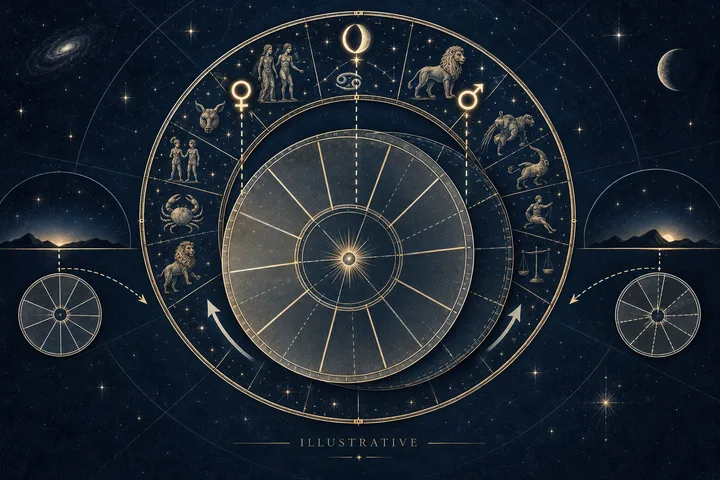
The zodiac keeps its planetary positions according to the birth moment, but the local sky keeps turning. That turning is the hinge. The Ascendant, Midheaven, and house cusps are tied to the relationship between the sky, the horizon, the place, and the clock. As time changes, the chart’s local frame changes. The planets can keep the same signs while the frame shifts underneath them.
This is why a small birth-time correction can matter much more for houses than for a slow-moving planet’s sign. The Ascendant travels through the zodiac over the course of a day. House cusps follow that local motion. A few minutes may not change an adult person’s Venus sign, but it can move a cusp closer to a planet or carry a planet across a house boundary. The effect is not identical in every chart. It depends on latitude, the house system, and how close the planet already sits to a cusp.
Imagine a chart with the other person’s Venus close to the line between the fifth and sixth houses. At 8:12, a particular house calculation may place it in the fifth. At 8:20, the same planet may sit in the sixth. The Venus sign remains the same. Any Venus aspect based on stable degrees remains the same. What changes is the life area you use to describe the contact. That is a boundary question, not a cosmic contradiction.
An unknown or rounded birth time creates a second problem. You may know the date and birthplace, yet not know the minute that sets the angles. A noon chart can display planetary positions for exploration, but it does not turn an unverified noon into a true house map. If the time is approximate, say so in the working notes. If the time is unknown, keep house-based claims out of the center of the reading. Use signs and planet-to-planet aspects that remain dependable under the available information, and mark the house layer as unavailable or conditional.
This does not make the chart useless. It makes the reading more disciplined. You can still compare a Moon sign, a Venus sign, a Mars sign, and selected aspects when those placements are supplied or reliably calculated. You can still ask whether affection lands as warmth, whether desire meets a different pace, or whether emotional needs support one another. You simply don’t claim a seventh-house overlay when the Ascendant and house cusps have not been established.
A useful rule is simple: the closer a planet is to a cusp, the less wise it is to make the house label carry the interpretation alone. Put the planet in a cusp range if needed. Read both neighboring houses. Then ask which description matches the observable bond. That approach keeps the symbolism alive without pretending a narrow boundary is wider than it is.
The Moon deserves a special check because it moves faster than Venus or Mars and can change zodiac degree more noticeably across a day. If the question is only about the Moon’s sign, verify that the Moon did not change signs during the relevant birth window. If the question is about the Moon’s house, verify both the Moon’s degree and the chart angles. A reader can otherwise mistake two different uncertainties for one. The sign may be uncertain because the Moon is near a sign boundary. The house may be uncertain because the birth time is rounded. Name each uncertainty separately.
Venus and Mars usually give a steadier sign layer over a short birth-time correction, but their house placement can still be sensitive. That contrast helps you troubleshoot a report. Compare the two versions line by line: did the planet’s zodiac degree move, did the aspect list change, did only the receiving house change, or did the receiving person change because the chart direction was reversed? A house-only change calls for a narrower rewrite of the interpretation. A degree or sign change calls for a fresh check of the planet’s meaning. Once you name the changed input, you know which sentence needs revision and which one can stay.
Sources: What Do ‘Houses’ Mean in Your Birth Chart?; Astrology house systems and why exact birth time matters; The 12 Astrology Houses: Meanings, Birth Time, and House Systems
Birthplace and house system can change the map too
Birth time is not the only input. Birthplace matters because houses describe a local horizon. The same clock time means a different sky orientation at a different latitude and longitude. A chart cast for Bucharest and one cast for Montreal cannot share identical house cusps simply because the dates and clock readings match. The local horizon has changed, so the house map changes with it.
Then there is the house system. A house system is the method used to divide the chart into twelve houses. Placidus, Equal, Whole Sign, Regiomontanus, Koch, Porphyry, and other systems draw that division differently. The Ascendant may remain the same for a given time and place, while intermediate cusps shift. A planet near a boundary can therefore change houses without any change in its sign or degree.
Whole Sign houses make the comparison especially easy to see. The entire sign containing the Ascendant becomes the first house, and the following signs become the next houses. In an Equal house approach, each house is thirty degrees beginning from the Ascendant degree. In a quadrant system such as Placidus, the houses can be unequal because the method follows time and space around the local angles. These are different maps of the same sky. The map you choose affects the house story.
No single house system should be smuggled into a report as if every astrologer uses it by default. Name the system. Keep it consistent. If two sources or charts disagree, check the system before searching for a dramatic astrological reason. You may be comparing Whole Sign houses in one version with Placidus houses in another. That alone can explain why Venus appears to move from the fifth house to the sixth, or why Mars shifts from the eleventh to the twelfth.
The choice also depends on the technique. A reader working in a Hellenistic whole-sign tradition may give the sign-based house framework the lead and use angles as sensitive points within houses. A modern Western reader may use a quadrant system to emphasize the exact angular relationship and the experience of planets near cusps. Neither approach gives permission to mix systems mid-reading just to rescue a preferred interpretation.
For couples comparing reports, hold the date, time, place, zodiac, and chart direction constant, then change one house system at a time. Record the Ascendant, the four angles, the planet’s degree, the receiving house, and the nearest cusp distance. This turns a vague disagreement into a traceable difference. If only the intermediate cusp changes, you’re looking at a system effect. If the angles change, check the place or time. If the planet itself changes sign or degree, stop comparing house labels and verify the underlying chart inputs first.
A relocation chart shows the same principle from another angle. When the place changes, the local angles and houses can change while the natal planets keep their zodiac signs. In synastry, that means a person’s house relationship to a partner may be discussed differently after a move if the reader is casting a relocated chart or comparing a new local frame. The natal sign story remains the foundation. The place-based overlay describes where that story is being emphasized in a particular setting. Do not mix a natal overlay and a relocated overlay without labeling them. Otherwise a reader may think the relationship changed its planetary nature when the chart frame changed instead.
This also explains why a house overlay can feel highly personal even when the planet’s sign is familiar. Signs belong to the shared zodiac field. Houses bring the contact into a person’s horizon, home, partnership axis, work life, or private world. When the horizon changes, the lived emphasis can change. The planet has not abandoned its sign. It has entered a different room of the chart.
Sources: What Do ‘Houses’ Mean in Your Birth Chart?; Astrology house systems and why exact birth time matters; The 12 Astrology Houses: Meanings, Birth Time, and House Systems; What Do ‘Houses’ Mean in Your Birth Chart?
In synastry, the overlay depends on whose chart receives the planet
A synastry overlay is directional. Person A’s planet falls into Person B’s house. Then Person B’s planet falls into Person A’s house. Those are two different statements, even when the same two planets are involved. The overlay can change on one side, the other side, or both sides when the birth-time data or house system changes.
If your Moon falls in your partner’s seventh house, your emotional presence may draw attention to partnership, agreement, and the experience of being met by another person. Your partner may experience your Moon through the relationship field. If their Moon falls in your third house, their feelings may enter your life through messages, daily conversation, local movement, and the need to keep talking. You are not reading one shared house. You are reading two points of contact.
This is why planet-person and house-person language helps. The planet person brings the function. The house person receives that function in a particular life area. If your Venus falls in someone’s fourth house, your affection may touch their home, family memory, privacy, or sense of belonging. They may feel that your presence makes a private place more beautiful or more emotionally charged. Your Venus still acts through its natal sign. Their fourth-house experience supplies the setting.
Now add the planet roles. A Moon overlay may show where safety, habit, and tenderness gather. Venus may show where attraction and value become visible. Mars may show where pursuit, conflict, courage, sexuality, and action enter the other person’s life. The same house can hold all three, but they won’t do the same job there. Moon in the fifth can seek shared ease and playful reassurance. Venus in the fifth can enjoy romance and beauty. Mars in the fifth can bring heat, competition, pursuit, or creative force.
The overlay also does not replace synastry aspects. A planet falling in the other person’s seventh house can matter, but a close Moon-Venus trine, Venus-Mars conjunction, or Moon-Mars square tells you how the two planetary functions meet by degree. If you have degrees, compare major aspects with a stated six-degree orb. If you do not have degrees, don’t invent an aspect from sign labels alone. Sign affinity can describe a broad tone. It cannot stand in for exact aspect evidence.
Read in this order: identify the planet and its natal sign, identify the receiving house and whose chart it belongs to, check whether the house placement survives the chosen system and time range, then add close aspects and relevant rulers if the data supports them. This sequence stops the common error of treating a partner’s house as a fixed property of your planet. It is a meeting point. The house belongs to the person whose chart receives the planet.
Sources: Astrology house systems and why exact birth time matters; The 12 Astrology Houses: Meanings, Birth Time, and House Systems; The 12 Houses in Astrology: Meanings & House Systems
Moon, Venus, and Mars can keep their signs while changing the relationship story
The house overlay changes the setting, not the planet’s voice. That distinction becomes clearest with the Moon, Venus, and Mars because couples often use these placements to understand emotional fit, affection, and desire. Keep the sign meaning in place. Then let the overlay tell you where that meaning is likely to become personal between the two charts.
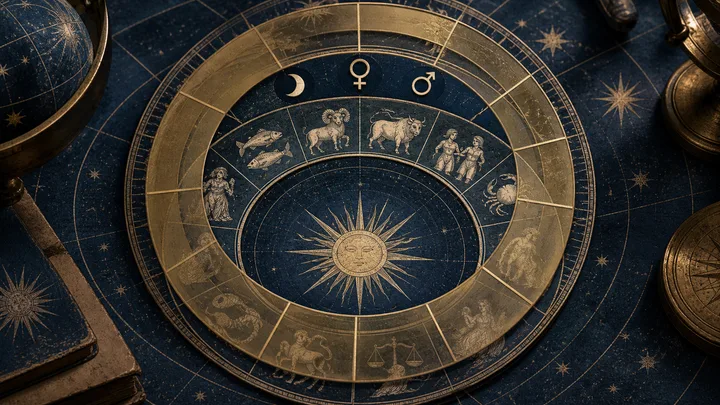
Start with the Moon. A Taurus Moon still seeks calm, continuity, and a body-level sense of safety whether it falls in a partner’s second house, fifth house, or sixth house. In the second, the bond may touch resources, food, money, possessions, and the question of what makes life feel secure. In the fifth, the same Moon may soften through pleasure, touch, play, romance, and shared enjoyment. In the sixth, it may show care through schedules, meals, errands, work, health habits, and the ordinary maintenance of life. The Moon sign remains Taurus. The house tells you where its need for steadiness may be felt.
Now take Venus. Venus in Gemini may want words, wit, variety, and the freedom to learn the beloved. In a partner’s third house, conversation itself can become a love language. In the ninth, the attraction may gather around beliefs, travel, education, distance, or the pleasure of seeing a larger world together. In the eleventh, affection can grow through friendship, communities, shared causes, and future plans. None of those house stories turns Venus into a different sign. They give Gemini Venus different rooms in which to speak.
Mars needs even more care because people often reduce it to chemistry. Mars in Leo may pursue with warmth, pride, creativity, and a desire to make an impact. In a partner’s fifth house, that can animate romance, play, performance, sexuality, or creative collaboration. In the tenth, the same Mars may energize ambition, public goals, reputation, and the way the partner experiences your drive. In the twelfth, the action may become private, indirect, protective, or difficult to name until both people bring it into the open. The sign gives Mars its style. The house shows where the charge gathers.
A changing overlay can therefore change the question without changing the core placement. With Moon in the fifth, ask what helps the couple play and feel safe enough to be seen. With Moon in the sixth, ask whether care becomes a shared routine or an unequal burden. With Venus in the third, ask whether the couple keeps curiosity alive. With Venus in the eighth, ask how affection meets trust, privacy, and shared resources. With Mars in the seventh, ask how directness becomes cooperation instead of a contest. With Mars in the twelfth, ask what the couple avoids saying.
A useful comparison asks three separate questions. What does the planet want to do in its sign? What life area receives that activity? Which aspect, ruler, or angle gives it support or friction? For Maria, Gemini Venus may seek words and variety; a fifth-house placement gives those qualities a courtship and pleasure setting, while a sixth-house placement gives them a routine and service setting. The comparison becomes meaningful when she can name the different behavior each version would make easier to notice, rather than repeating ‘this means romance’ in both versions.
Imagine Maria knows her own placements as Moon in Taurus, Venus in Gemini, and Mars in Leo. She is comparing them with a partner’s chart. She has no interest in a compatibility grade. She wants to know why one report describes her Venus as a fifth-house contact while another calls it sixth-house synastry.
First, Maria separates what is stable from what is conditional. Her Venus sign is Gemini in both versions. If the supplied degree supports a close aspect to her partner’s Moon or Mars within the chosen six-degree orb, that aspect can be examined in both versions. The house placement is conditional because the two reports use different house systems or different assumptions about the partner’s birth time. Maria should not throw away the Venus story. She should stop treating the house label as settled.
In the fifth-house version, Maria’s Gemini Venus may bring conversation into romance. The partner may experience her as someone who makes pleasure more playful, asks interesting questions, and keeps attraction mentally alive. They can look for dates that feel creative rather than dutiful. They can notice whether laughter, shared hobbies, and flirtation help affection grow. That is a useful fifth-house question.
In the sixth-house version, the same Gemini Venus may enter the relationship through the daily pattern. Maria may show love by sending the useful message, improving the plan, making a task lighter, or keeping the couple connected through small exchanges. The partner may feel loved when the relationship stays responsive in ordinary life. The risk is that affection becomes a stream of adjustments and problem-solving with too little pleasure. That is a useful sixth-house question.
Those readings are not enemies. They are neighboring expressions, and a planet near the fifth-sixth cusp can speak to both. Maria can test the distinction against life. Does the contact show up mainly when the couple plays, dates, creates, and celebrates? Does it show up mainly through errands, schedules, work, health, and practical support? Does it move between both? The answer does not prove a house system, but it tells her which symbolism has better descriptive force in this relationship.
Now add Mars in Leo. If Mars falls in the partner’s tenth house in one version and eleventh in another, the question changes again. The tenth-house reading points toward shared ambition, public visibility, professional drive, and the way one person energizes the other’s goals. The eleventh-house reading points toward friendship, networks, group projects, social causes, and a future built among other people. Maria should observe whether the partner becomes more alive around career aims or around community and shared plans. She can hold both possibilities without turning either into destiny.
Finally, Maria checks the direction. Her Venus in the partner’s fifth or sixth is not the same as the partner’s Venus in Maria’s fifth or sixth. She records whose planet lands where. Then she asks one grounded question: what does this contact make easier to notice, discuss, or practice? That question turns the overlay from a label into a tool.
Sources: Astrology house systems and why exact birth time matters; The 12 Astrology Houses: Meanings, Birth Time, and House Systems; The 12 Houses in Astrology: Meanings & House Systems
The strongest exception: a house change can be technical, not interpretively important
A house overlay can change on paper without changing the main reading in a meaningful way. This is the strongest exception to the rule that every house shift deserves a new interpretation. Sometimes the planet moves between neighboring houses because the cusp is close, yet the sign, aspects, angle contacts, house ruler, and lived pattern all point in the same direction. The technical label changes. The central story does not.
Consider a Venus contact that sits close to the fifth-sixth boundary. The fifth house adds romance, pleasure, play, and creative expression. The sixth adds routine, service, work, and maintenance. Those themes can overlap in an established relationship. A couple may express love through cooking together, caring for one another, sharing a craft, or turning a daily chore into a ritual. In that case, the two neighboring houses are not competing verdicts. They describe two sides of one practice.
The same principle applies when Whole Sign and quadrant houses disagree but the planet remains close to an angle. Angular houses, especially the first, fourth, seventh, and tenth, carry a strong presence in many astrological traditions. A planet may be inside a whole-sign house while sitting near an angle that gives the contact more force. If a report ignores the angle because it only names the house, it may miss the most important part of the picture. The reverse can happen too. A house label can sound dramatic while the planet is far from the angle and unsupported by close aspects.
Another exception appears when the birth time is reliable and the house system changes, but the relationship question does not require a fine-grained cusp distinction. If you are asking whether the couple communicates easily, a stable Mercury contact may answer more directly than a small third-fourth house variation. If you are asking where shared resources need care, an exact Venus-Saturn aspect may matter more than a disputed eighth-house overlay. Relevance ranks the evidence.
This is not a reason to ignore houses. It is a reason to ask what would make one house reading matter more. A planet close to an angle may have a stronger presence than a quiet intermediate-house label. The ruler of the receiving house may connect the overlay to a second life area. A close aspect may describe the exchange between the two people more directly than either house. And a theme repeated by the planet, its ruler, and an observable pattern deserves more attention than a single dramatic house name. The house remains part of the reading, but its force comes from the whole chart picture.
When reports disagree, write two sentences. First: ‘The stable layer is ...’ Name the sign, planet function, and supported aspect. Second: ‘The conditional layer is ...’ Name the two possible houses and the shared question between them. That wording keeps the strongest interpretation while preserving the real exception. You don’t need to choose the loudest symbol. You need to choose the symbol that survives the data.
Sources: What Do ‘Houses’ Mean in Your Birth Chart?; Astrology house systems and why exact birth time matters; What Do ‘Houses’ Mean in Your Birth Chart?
Use this order when your overlay reports disagree
Start with the inputs. Write down both birth dates, both birthplaces, the recorded or estimated birth times, and the house system used in each report. If the report only supplies Moon, Venus, and Mars signs, don’t pretend it has supplied house data. If one time is unknown, mark that person’s angles and houses as unconfirmed. Precision begins before interpretation.
Next, separate the three layers. Make one column for signs, one for degrees and aspects, and one for house overlays. The sign column may say Moon in Taurus, Venus in Gemini, and Mars in Leo. The aspect column may contain only contacts supported by supplied degrees and the chosen six-degree orb. The house column should show the receiving person, the planet, the house system, and whether the planet is near a cusp. This small table prevents one uncertain result from contaminating the whole reading.
Then rank the interpretations. Put stable planet signs first. Add exact major aspects second. Add house overlays that remain consistent across the accepted time range and house system third. Add cusp possibilities and technique-dependent alternatives fourth. This is not a ranking of spiritual value. It is a ranking of how much information the current inputs can carry. The lower layer can still be rich. It just needs clearer language.
After that, translate each house into a decision or conversation. If Venus may be in the fifth or sixth, ask whether the bond grows through play or through practical attention, and how it can make room for both. If Mars may be in the seventh or eighth, ask whether conflict is handled through direct agreement or through trust, vulnerability, and shared resources. If the Moon may be in the third or fourth, ask whether emotional safety depends more on talking things through or building a private home base. The chart gives the question. The couple observes the answer.
Use the sign to refine the behavior. Gemini Venus may need words in either house. Leo Mars may need warmth and respect in either house. Taurus Moon may need steadiness before it opens in either house. This step keeps the house overlay from becoming generic. It also stops the common habit of reading a fifth-house placement as romance without asking what romance means to that planet and sign.
Finally, record the unresolved point. Say, ‘This overlay is stable,’ ‘This overlay depends on the house system,’ or ‘This overlay cannot be responsibly assigned without a dependable birth time.’ That sentence is not a retreat from astrology. It is good chart craft. A precise boundary lets the interpretation speak with more force where the chart actually supports it.
If you are comparing known placements rather than calculating charts, a Synastry Comparison Report can help organize the stable layer. Supply the Moon, Venus, and Mars signs, add degrees when you have them, and use the report to compare selected aspects with the stated six-degree orb. For house overlays, bring the exact calculated placements and the named house system. The report does not create natal houses from birth details, so it should not be used to fill an unknown overlay with invented certainty.
Your next step is simple. Ask both people for the source of the house placement, confirm the time and system, then compare the neighboring-house meanings against the relationship you can actually observe. Keep what repeats. Mark what moves. Let the stable story lead.
Sources: What Do ‘Houses’ Mean in Your Birth Chart?; Astrology house systems and why exact birth time matters; The 12 Astrology Houses: Meanings, Birth Time, and House Systems; The 12 Houses in Astrology: Meanings & House Systems
A little more clarity
Can a house overlay change if the Moon, Venus, and Mars signs stay the same?
Yes. Signs describe the planets’ zodiac positions, while houses depend on the chart’s birth time, birthplace, and chosen house system. A different time estimate, location, or house system can move a planet into a neighboring house without changing its sign. Check the house system, the time accuracy, and the planet’s distance from a cusp before giving the overlay a strong interpretation.
Sources & further reading
- What Do ‘Houses’ Mean in Your Birth Chart?
Supports the distinction between signs as planetary expression and houses as life areas, plus the dependence of houses on birth time and place.
- Astrology house systems and why exact birth time matters
Supports how house systems change cusps and house assignments while leaving a planet’s zodiac longitude unchanged.
- The 12 Astrology Houses: Meanings, Birth Time, and House Systems
Supports the sign-versus-house distinction, birth-time sensitivity, neighboring-house changes, and the need to name the chosen system.
- The 12 Houses in Astrology: Meanings & House Systems
Supports the local-horizon model in which date, time, place, and house system create the house map and planets retain their signs.
- What Do ‘Houses’ Mean in Your Birth Chart?
Supports practical meanings for relationship, romance, routine, shared-resource, and friendship houses and the role of the Ascendant.
Synastry Comparison Report
Enter known placements for two people. Get an input-by-input comparison, selected aspect calculations and a clear record of what remains uncertain.
Compare our placements