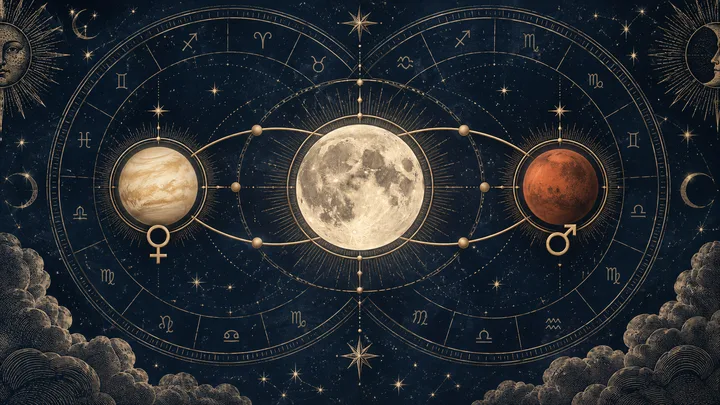
Imagine the same feeling turning sweet, then hot
Imagine Maria and Daniel at the end of a long week. Maria is quiet when she is tired. She wants food, a familiar room, and a little time before she explains what is wrong. Daniel notices before she speaks. He orders the meal she likes, puts his phone away, and sits beside her. Maria relaxes. Then Daniel reaches for her hand and suggests they leave the house for a late walk. The mood changes. The care becomes movement. The room that felt safe now feels charged.
This is an illustrative scene, not a reported couple or a calculated chart. It gives us the question underneath the astrology: why can one person make another feel both at home and intensely awake? In synastry, one answer appears when Maria’s Moon contacts Daniel’s Venus and Mars. Her Moon meets the part of him that knows what it likes and the part that wants to act. He may respond to her moods with tenderness, but he may also feel pulled to pursue, protect, provoke, or physically approach her.
The contact doesn’t mean Daniel always understands Maria. It doesn’t certify a future. It describes a live exchange between chart functions. Her Moon supplies the feeling and the need. His Venus gives that feeling a language of affection. His Mars gives it momentum. That is why this pattern can show up in a quiet kitchen, a difficult conversation, a kiss, or a disagreement about plans. The same Moon can invite care and trigger action.
Start there. Don’t ask whether the pattern is good or bad. Ask what it joins. Moon with Venus joins feeling with appreciation. Moon with Mars joins feeling with instinct and force. Together, they can make the relationship feel personal very quickly. They can also make small moments matter more than either person expects.
The most useful reading keeps all three planets visible. If you speak only about Venus, you may mistake attraction for ease. If you speak only about Mars, you may miss the affection underneath the heat. If you speak only about the Moon, you may miss why the connection keeps moving toward touch, pursuit, or conflict. The pattern has a rhythm. Feeling, response, desire. Then feeling again.
Name the three roles before you interpret the contact
The Moon is the first layer because it reacts before it explains. In relationship astrology, it speaks to comfort, habit, emotional memory, and the needs that surface when a person is tired or unguarded. The Moon person is often the one who feels the contact in the body first. They may feel seen, stirred, exposed, or quickly attached. The other person’s planet describes what meets that Moon and how it answers the Moon’s signal.
Venus is the language of liking. It shows what a person values, how they offer warmth, what they find pleasing, and how they seek harmony. When another person’s Moon contacts Venus, the Venus person may find the Moon person emotionally appealing. The Moon person may feel that Venus knows how to make ordinary life gentler. A meal, a compliment, an invitation, or a shared taste can carry more weight than it would with a looser contact.
Mars is the language of directed energy. It pursues, protects, competes, cuts through delay, and expresses desire. It also shows how anger and assertion move. When another person’s Moon contacts Mars, the Mars person can draw out instinctive reactions from the Moon person. The attraction may be physical and emotional, but the contact can also bring touchiness. Mars acts. The Moon responds. Neither planet has to wait for a polished explanation.
Now combine the roles. The Moon person may become the emotional subject of the Venus-Mars person’s attention. The other person doesn’t just enjoy the Moon person’s style or body. They may feel that the Moon person’s moods, habits, and vulnerability are part of the attraction. That can feel deeply caring. It can also make the Venus-Mars person more reactive when the Moon person withdraws, changes plans, or needs reassurance.
The direction matters, even though both people participate. If Maria’s Moon contacts Daniel’s Venus and Mars, Maria may feel Daniel’s responses in a particularly personal way, while Daniel may experience Maria as someone who activates both his affection and his drive. Reverse the planets and the emphasis changes. Daniel’s Moon contacting Maria’s Venus and Mars would make Daniel’s emotional life the trigger for Maria’s liking and desire. Don’t flatten these roles into gender. Venus and Mars belong to every chart.
This is also why the pattern should be read as an exchange, not a label. The Moon person isn’t simply needy. The Mars person isn’t automatically aggressive. Venus isn’t always soft, and the Moon isn’t always passive. Sign, aspect, condition, house placement when known, and the rest of the synastry change how the roles speak. The planets give the verbs. The signs give the accent. The aspect gives the manner.
There’s a useful difference between being activated and being understood. The Moon person may feel that the Venus-Mars person reaches them at once, but speed is not the same as accuracy. Daniel may notice Maria’s silence and respond beautifully, then misread the reason for it. Maria may feel the force of his attention and assume he knows what she needs. The chart can show why the assumption is tempting. It can’t replace the sentence that checks it.
Watch for the planet that receives the contact in the other person’s chart. If Venus is well supported, affection may be easy for that person to express even when Mars is impatient. If Mars is under pressure elsewhere, the person may want closeness but show it through pursuit or argument. If the Moon person has a strong Saturn signature, they may appear composed while feeling the contact intensely inside. The same interaspect meets two whole people, not two isolated symbols.
Read this as one combined pattern, not as three separate promises. The Moon describes the emotional body: what feels safe, familiar, private, and instinctive. Venus describes affection, attraction, taste, and the way a person gives value. Mars describes desire, pursuit, heat, anger, and action. When one person’s Moon contacts the other person’s Venus and Mars at once, the Moon person often touches both the other person’s tender preferences and their active desire. The result can feel unusually immediate. One person feels received. The other feels both soothed and stirred. That blend is the main story, but the exact aspects decide its tone. A Moon trine or sextile to Venus can soften a Mars square. A Moon square to Mars can make an otherwise lovely Venus contact feel reactive. A conjunction can fuse the planets so closely that affection, appetite, comfort, and irritation arrive in the same moment. Read the Moon-Venus contact first for the bond’s sweetness, the Moon-Mars contact second for its instinctive charge, then ask how the two contacts work together in daily life. This guide uses supplied sign placements and optional degrees. It does not calculate a birth chart, houses, or personal planetary positions from birth data. For the worked examples, the degrees are illustrative only. If you want a degree-based comparison, enter your known Moon, Venus, and Mars placements in the Synastry Comparison Report and use a six-degree orb for selected major aspects. The short version is a three-part test. Does the Moon feel emotionally received? Does Venus know how to express appreciation in a form the Moon can feel? Does Mars act with enough respect that desire remains inviting? If the answer is yes, the contact can describe a warm bond with real spark. If one answer is no, the pattern still explains the pull, but it also points to the work. Chemistry may bring two people close. Translation and restraint help them stay close. Keep the order intact when you read it. Start with the feeling, name the affection, then study the impulse. This keeps a vivid Mars contact from swallowing the softer Moon-Venus story, and it keeps a sweet Venus contact from hiding the places where timing, pressure, or anger need attention.
Sources: Synastry: Moon-Venus Aspects Between Charts; Synastry: Moon-Mars Aspects; What’s Your Sign? An Intro to Synastry Charts and Astrological Compatibility; Synastry Glossary
Read Moon-Venus first: what feels lovable
Begin with the Moon-Venus contact because it shows whether the emotional exchange has a natural sweetness. Cafe Astrology describes easier Moon-Venus aspects as affectionate, conciliatory, and supportive during conflict. It also links the conjunction with tenderness, enjoyment of simple time together, and a cooperative concern for fairness. These are useful clues for the first question: does the Moon person feel welcomed by the Venus person’s style of love?
With a conjunction, the answer often arrives quickly. The Venus person may like the Moon person’s manner without needing to defend the preference. The Moon person may feel that Venus’s compliments, habits, and gestures fit their emotional skin. They can enjoy routine together. A boring errand may become a date because the contact makes companionship itself feel pleasing.
With a trine or sextile, the affection tends to move more easily. The Venus person may know how to lower the temperature after a tense moment. The Moon person may respond with warmth rather than suspicion. This is the part of the larger pattern that can make Mars manageable. Desire still has force, but affection gives it a hospitable room to enter.
With a square or opposition, don’t erase the liking. The attraction can remain real while the emotional habits and Venusian values miss each other. The Moon person may want reassurance when the Venus person offers charm, or may read a social preference as emotional neglect. The Venus person may feel unappreciated when the Moon person reacts from habit instead of acknowledging the gesture. The work here is specific: name what counts as care for each person.
In the combined pattern, Moon-Venus tells you what the Mars contact is trying to protect or reach. If the Moon person feels cherished, Mars can become playful, erotic, brave, and constructive. If the Moon person feels undervalued, the same Mars contact can become a test. The Mars person may push for proof. The Moon person may pull away, then return for the reassurance that the push made harder to receive.
Ask three questions. What does the Venus person do that calms the Moon person? Which Venus habits make the Moon person feel overlooked? When desire rises, does affection stay visible? Your answers will tell you more than the word compatible. They show whether attraction has a language both people can understand.
The Venus person’s response may also depend on what the Moon is doing to Venus by sign. A Moon in an earth sign can be experienced as steady, sensual, and dependable by Venus, while a Moon in an air sign may make Venus feel mentally refreshed or socially alive. A water Moon can touch Venus’s softer side, though it may also ask for more emotional presence than Venus usually gives. A fire Moon can make affection vivid and immediate. These are broad sign colors. The exact aspect still leads.
The Moon person should ask whether they feel loved in the form the Venus person naturally offers, not only whether they feel attracted. Venus can enjoy a person’s emotional texture without knowing how to tend it every day. That difference often appears after the first rush. If the answer is no, the contact is still meaningful, but its lesson becomes translation. What feels like devotion to Venus may feel like politeness to the Moon. What feels like pressure to Venus may feel like a request for proof to the Moon.
Sources: Synastry: Moon-Venus Aspects Between Charts; What’s Your Sign? An Intro to Synastry Charts and Astrological Compatibility
Read Moon-Mars next: what gets activated
Moon-Mars supplies the heat and the reflex. Cafe Astrology reads the conjunction as strongly physical and emotional, with fascination, involvement, and a risk that Mars feels too forceful for the Moon’s needs. It treats the square and opposition as more difficult versions of the same instinctive charge, while describing trines and sextiles as animated, attractive, and often mutually encouraging. The central question is simple: when the Moon feels something, what does Mars do with it?
A supportive Moon-Mars aspect can turn emotion into courage. The Mars person may help the Moon person say what they need, leave a stale situation, or take a risk that feels alive. The Moon person can soothe Mars without extinguishing its fire. In the larger contact pattern, Venus adds appreciation to that encouragement. Daniel doesn’t only urge Maria forward. He may genuinely enjoy who she becomes when she moves.
A conjunction binds the response tightly to the feeling. A look can invite touch. A silence can feel like rejection. A practical suggestion can sound like criticism. This doesn’t make the contact doomed. It makes the channel fast. Fast channels need clear handling. The couple benefits from slowing down long enough to ask whether the reaction is desire, fear, anger, or a mix of all three.
A square or opposition needs more care. Mars may act before the Moon feels ready. The Moon may express hurt in a way Mars experiences as accusation. The Mars person can feel that nothing they do is enough, while the Moon person feels pushed, managed, or emotionally cornered. When Venus is also involved, the contradiction can sting. The same person who is tender in one moment may feel startlingly hard in the next.
A helpful reading doesn’t call every argument passion. It separates charge from skill. Mars can show desire and anger. The chart contact can explain why those energies wake up around one another, but it doesn’t excuse contempt, coercion, intimidation, or disregard for a boundary. The astrological meaning is clearest when you watch what each person does with the energy. Attraction asks for consent. Anger asks for responsibility.
Try this practical test. After a charged moment, can the Mars person repair without demanding instant closeness? Can the Moon person state the need without punishing the other person for having a different reaction? If both can return to the bond with honesty, Moon-Mars becomes a source of movement. If neither can pause, the contact will keep turning feeling into a fight before either person knows what happened.
A trine doesn’t remove anger. It can make anger easier to move through. The Mars person may say what is wrong and then act on the solution, while the Moon person gives that action emotional meaning. A sextile may need more conscious use. The pair might have a good instinct for one another, but they still need to choose it. A conjunction can feel so natural that neither person notices how quickly they have begun reacting for the other.
When the Moon-Mars contact is hard, track timing rather than blaming character. Does the Mars person initiate when the Moon person is depleted? Does the Moon person seek reassurance only after Mars has already made a decision? Does desire appear after conflict because conflict is the only moment when both people stop holding back? Those details show how the aspect is operating. They also show where a new habit can interrupt it.
Sources: Synastry: Moon-Mars Aspects; Synastry Glossary
Put the contacts together instead of adding keywords
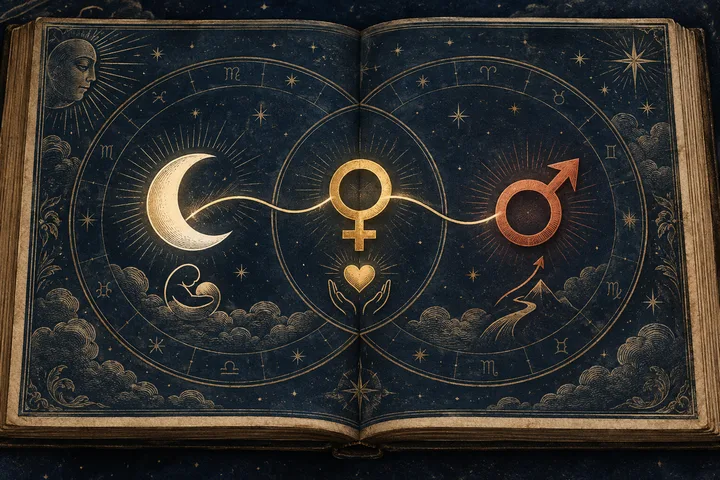
The distinctive feature of Moon contacting Venus and Mars at once is not that the relationship has three attractive ingredients. It is that one emotional channel reaches two different responses in the same person. The other person may want to comfort the Moon, please the Moon, touch the Moon, challenge the Moon, or win the Moon’s attention. Sometimes those motives arrive together. That is the signature to watch.
Consider an example. Suppose Maria’s Moon is at 14 degrees Taurus, Daniel’s Venus is at 12 degrees Taurus, and Daniel’s Mars is at 17 degrees Scorpio. These figures are illustrative, not a personal chart calculation. Maria’s Moon is within a tight conjunction to Daniel’s Venus by degree, while it opposes Daniel’s Mars by sign and degree. The reading is not simply soft or difficult. Maria may feel deeply valued by Daniel’s affection and strongly activated by his desire, yet the same desire can threaten her need for steadiness when it arrives too forcefully.
Notice the sequence. Maria relaxes when Daniel offers tangible care. She becomes more open. Then Daniel wants intensity, an answer, or a decisive move. Maria hesitates. Daniel reads the hesitation as distance. Maria reads the pressure as a loss of safety. The Venus contact opened the door. The Mars contact determines whether they walk through it together or push against each other in the doorway.
Now change the Mars aspect. If Daniel’s Mars were at 16 degrees Virgo instead, Maria’s Taurus Moon would trine it by sign and sit within a close degree relationship. The same Moon-Venus sweetness could feed a practical, responsive desire. Daniel might act in ways Maria finds useful and calming. Attraction would still be present, but it could feel less like a test and more like shared competence. The sign and aspect have changed the delivery, not erased the bond.
Then change the Venus contact. If Daniel’s Venus were at 14 degrees Leo while his Mars remained in Scorpio, Maria’s Moon would square Venus by sign and degree while still opposing Mars. The pattern would carry affection, but appreciation might land unevenly. Maria could feel wanted yet not fully understood. Daniel could admire her and still miss the habits that help her feel loved. The combination would need clearer translation and slower escalation.
This is why you rank rather than average. First rank exactness. A two-degree contact usually deserves more attention than a six-degree one within this guide’s selected six-degree method. Then rank the aspect. A conjunction, square, opposition, trine, or sextile tells you how the planets meet. Then rank the signs. Finally, read the wider chart for repetition. If several contacts repeat the same story, the pattern gains weight. If another contact contradicts it, keep the contradiction.
The strongest supported view is this: Moon-Venus-Mars contacts describe emotional attraction with a live erotic and reactive edge. They often explain why a couple can feel tender and combustible without either quality being fake. The strongest exception is a chart where Saturn, the Sun, Mercury, or difficult repeated contacts change the context. No single cluster outranks the whole comparison.
A useful way to write the synthesis is as a sentence with three verbs. “Your Moon receives my Venus, so my affection reaches your need for comfort. Your Moon also touches my Mars, so your feelings wake my desire and my reflex to act. When the two meet, I may want to care for you and move you at the same time.” That sentence is stronger than a pile of keywords because it shows direction and consequence. It also leaves room for the signs and aspects to change the tone.
Look for the handoff between planets. Does Venus lead and Mars follow? Then affection may open the way for desire. Does Mars lead and Venus follow? Then a bold approach may need a softer translation afterward. Does the Moon lead? Then the relationship may revolve around changing needs, moods, and the search for safety. The best interpretation describes the handoff you can actually observe.
Sources: Synastry: Moon-Venus Aspects Between Charts; Synastry: Moon-Mars Aspects; Synastry: Venus-Mars Aspects Between Two Charts; The Classical Origin and Traditional Use of Aspects
Use degrees, orbs, and signs to decide how much weight it gets
A sign contact gives you a broad relationship between placements. A degree-based aspect tells you how closely the planets meet. You need both when you have the data. Skyscript’s discussion of aspects distinguishes sign-based relationships from degree-based, partile contacts, and it explains that an orb marks the distance from exactness at which an aspect is treated as active. The closer the contact, the more confidently you can make it central.
For this publication’s comparison scope, use a six-degree orb for selected major aspects. A contact at one or two degrees deserves close attention. Three or four degrees can still carry the pattern clearly. Five or six degrees belongs in the supporting layer, especially if other contacts repeat the same theme. Beyond the chosen orb, keep the sign relationship as background rather than calling it a tight degree aspect.
Don’t confuse a same-sign contact with a conjunction by degree. Two planets can share a sign while sitting far apart. They may speak a common sign language, but their exchange isn’t as concentrated as an exact conjunction. The reverse can also matter in an out-of-sign contact. Skyscript notes that planets can form a relationship by degree even when the sign relationship looks different. Such a contact deserves a careful description, not a quick yes or no.
Aspect type changes the conversation. A conjunction blends the planets and can make the pattern hard to separate. A trine allows the energy to move with less resistance. A sextile offers opportunity that grows through participation. A square creates friction that demands skill. An opposition pulls the two poles into awareness, often through projection or a strong sense of difference. None is automatically a verdict. Each gives the attraction a different job.
Sign element and mode refine the job. Fire can make the Moon-Mars response direct and fast. Earth may turn desire into touch, work, food, or dependable action. Air can move the charge through words, ideas, and social play. Water may intensify the bond’s psychic and emotional sensitivity. Cardinal signs initiate. Fixed signs hold and resist change. Mutable signs adapt, but they can also scatter the moment. These are interpretive lenses, not substitutes for the actual contact.
If you only know the signs, say so in your own reading. You can compare sign relationships and describe likely themes, but you shouldn’t present a sign-based impression as a measured aspect. If you know degrees, record the exact placements and the orb you used. Precision builds trust. It also stops a loose contact from taking over the whole story.
Here is a clean worksheet. Write the Moon sign and degree in one column. Put the other person’s Venus and Mars signs and degrees beside it. For each planet, record the shortest zodiac distance from the Moon to the exact conjunction, sextile, square, trine, or opposition point. Keep only selected major aspects within six degrees. Mark the closest one as primary, the next as secondary, and any same-sign relationship without a close degree as background. Then write one sentence for care and one for activation.
The Moon moves quickly, so missing birth information matters more for a Moon placement than for many slower placements. If a supplied Moon sign is uncertain, don’t build a firm reading on it. If the sign is known but the degree isn’t, keep the analysis at the sign level. The report can compare what you supply, but it won’t turn incomplete inputs into a calculated natal chart. That boundary keeps the interpretation honest and useful.
Orbs are not a contest. A wide traditional orb and a modern six-degree orb answer slightly different editorial questions. This guide uses six degrees so the comparison stays focused. A looser contact may still be felt, especially when the same planet is emphasized elsewhere, but it shouldn’t outrank a closer aspect simply because its symbolism sounds more dramatic. Exactness first. Drama second.
When two contacts sit close together, don’t assume they have equal force just because they involve the same Moon. Compare their distances and then compare their behavior. A one-degree Moon-Venus contact may describe the bond’s most natural affection, while a five-degree Moon-Mars contact describes a secondary but noticeable trigger. In another chart, the Mars contact may be exact and the Venus contact broad. Your wording should follow that order. Say what leads, what supports it, and what qualifies it.
The same rule helps when a sign description feels more convincing than the degree data. A Taurus Moon and Scorpio Mars may sound naturally intense because the signs oppose, yet if they sit far outside the chosen orb, describe that polarity as a background possibility. A close contact between signs that seem less dramatic may show up more clearly in behavior. The chart reader’s job is to resist the loudest keyword and follow the strongest connection.
Begin with the moment that still has a charge in it. That is usually where the Moon, Venus, and Mars are speaking most clearly. Write down what happened before you interpret it. Who reached out? Who hesitated? What did each person want next? The order often reveals the aspect’s real rhythm. Then choose the smallest kinder action that could change the next exchange and make the astrological insight practical for both people.
Sources: The Classical Origin and Traditional Use of Aspects; What’s Your Sign? An Intro to Synastry Charts and Astrological Compatibility
Turn the pattern into a conversation you can actually have
Astrology becomes useful when it helps you name a repeating exchange. Don’t use this pattern to announce that someone is your soulmate or to decide whether a relationship must continue. Use it to ask better questions about care, desire, timing, and repair. Moon-Venus-Mars contacts are especially valuable for this because they bring private feeling into contact with visible behavior.
Start with care. Ask, “What helps you feel wanted when you’re tired or withdrawn?” The Moon person may need quiet, food, touch, reassurance, or practical help. The Venus person may assume that a compliment or invitation should be enough. Neither person is wrong. They are speaking different forms of affection. Naming the form prevents the Moon-Venus bond from being buried under guesswork.
Then ask about pursuit. “When you want closeness, how do you show it, and how can I tell whether you want me to come closer or give you room?” This question gives Mars a cleaner path. The Mars person can act without treating hesitation as rejection. The Moon person can ask for space without making desire feel shameful. The exchange slows down, but it doesn’t lose its heat.
Ask one more question about conflict. “What happens between us right before a tender moment turns sharp?” You may find a reliable sequence. One person gets quiet. The other presses. One asks for proof. The other becomes defensive. One reaches for affection. The other hears control. Once you can name the sequence, you can interrupt it. That is the decision aid this pattern offers.
The practical recommendation is ranked. First, identify the exact Moon-Venus and Moon-Mars contacts and separate tight degree aspects from broad sign contacts. Second, compare the aspect types and signs, then look for repetition or a strong exception elsewhere in the supplied placements. Third, test the interpretation against one real pattern of care, desire, or conflict and discuss it without using astrology as a weapon. Start with what happens. Let the chart help you describe why.
If Maria and Daniel had this conversation, Maria might say, “I like how quickly you notice what I need, but when you push for an answer I stop feeling safe.” Daniel might answer, “I’m not trying to corner you. I feel close through action, and I need to know what kind of action helps.” That exchange honors Venus, Moon, and Mars at once. It keeps tenderness visible, desire honest, and choice in both hands.
Compare your supplied Moon, Venus, and Mars placements when you’re ready. Bring the degrees if you have them. The best reading won’t hand you a score. It will show you the pattern you keep living, the place where the pattern changes, and the next sentence worth saying to each other.
You can make the conversation small enough to begin tonight. Choose one recent moment when affection felt easy and one when desire or frustration moved too fast. Describe each moment without assigning motives. Then ask which planet’s language was loudest. Was someone seeking the Moon’s comfort? Was Venus offering a gesture that went unnoticed? Was Mars trying to create movement? This turns an abstract cluster into a shared observation.
The answer may surprise you. Perhaps the Moon person doesn’t need more reassurance. They need a clearer invitation. Perhaps the Mars person isn’t asking for intensity. They’re trying to escape uncertainty. Perhaps Venus has been present all along in small acts that neither person counted as romantic. The chart gives you a map of the exchange. Your attention supplies the detail.
That is the mature use of this contact. Let it name the attraction without making the attraction your judge. Let it reveal the argument without making conflict your proof of passion. Let it point toward a form of care that both people can recognize. Then decide what to do with what you’ve learned. A final question brings the whole pattern into focus: “What would make this connection feel both alive and safe?” The answer should contain an action, not a theory. It might be asking before touching, naming the need for reassurance, setting a time to revisit a hard subject, or making room for affection that isn’t followed by pressure. That action is where the chart reading becomes yours. If you’re the Moon person, notice what you do when the other person’s attention becomes intense. If you’re the Venus or Mars person, notice whether you offer warmth and direction as invitations or as demands. Both observations matter. The contact belongs to both charts, and its healthiest expression gives both people room to respond freely. You don’t need to solve the whole synastry at once. One clear contact, one repeated moment, and one honest question can show you how this pattern wants to be lived.
Sources: Synastry: Moon-Venus Aspects Between Charts; Synastry: Moon-Mars Aspects; Synastry: Venus-Mars Aspects Between Two Charts
A little more clarity
Is Moon contacting Venus and Mars in synastry a soulmate aspect?
It can describe a strong emotional, romantic, and physical pull, but one aspect cluster can’t certify a soulmate bond or decide a relationship’s future. Read the exact aspects, signs, degrees, and wider synastry. Then compare the pattern with how you handle care, desire, boundaries, and repair in daily life.
What if the Moon-Venus contact is easy but the Moon-Mars contact is a square?
The easy Moon-Venus contact can create genuine affection and a sense of being valued, while the Moon-Mars square adds fast reactions, sexual tension, or arguments about timing and pressure. Treat the sweetness as a resource, not a cure. Ask how each person wants closeness expressed, and agree on a way to pause before desire turns into defensiveness.
Sources & further reading
- Synastry: Moon-Venus Aspects Between Charts
Supports interpretations of Moon-Venus conjunctions, easier aspects, affection, harmony, and value differences.
- Synastry: Moon-Mars Aspects
Supports interpretations of emotional and physical attraction, instinctive reactions, and challenging Moon-Mars contacts.
- Synastry: Venus-Mars Aspects Between Two Charts
Supports the distinction between romantic attraction, physical desire, ease, and friction in Venus-Mars synastry.
- The Classical Origin and Traditional Use of Aspects
Supports distinctions between sign-based and degree-based aspects and the interpretive use of orbs.
- What’s Your Sign? An Intro to Synastry Charts and Astrological Compatibility
Supports the roles of the Moon, Venus, and Mars and the importance of close degree contacts in synastry.
- Synastry Glossary
Supports synastry as chart comparison through interlocking planetary positions and aspects.
Synastry Comparison Report
Enter known placements for two people. Get an input-by-input comparison, selected aspect calculations and a clear record of what remains uncertain.
Compare our placements