Start with the pattern, not the stereotype
The tempting way to compare two charts is to scan the sign names and reach for a verdict. Fire looks passionate. Earth looks steady. Air looks detached. Water looks sensitive. The words can be useful, but they become blunt when they stand in for a person. A sign is a style. A planet is the part of life asking for that style. Your Moon, Venus, and Mars don’t all speak about the same thing, so a simple pile of sign adjectives misses the relationship question.
A better question is, what kind of relationship work does each element do through each planet? Start there, and keep the reading concrete. Water on the Moon may describe a need to feel the room before speaking. Water on Venus may describe affection through emotional merging, care, or quiet loyalty. Water on Mars may move through instinct, protection, and indirect pressure. The element repeats, but the planet changes the verb. That is the first safeguard against stereotype. Don’t say, ‘She’s watery.’ Say, ‘Her Moon seeks emotional attunement, while her Mars may act from instinct.’
Western astrology groups the signs into four elements: Aries, Leo, and Sagittarius are Fire; Taurus, Virgo, and Capricorn are Earth; Gemini, Libra, and Aquarius are Air; Cancer, Scorpio, and Pisces are Water. The elements describe broad tendencies, while the signs add modality and individual form. Astrodienst presents the four elements as basic principles applied through the signs, and Cafe Astrology describes them as a way to count emphasis across a chart. That gives you a sound first layer, not a finished reading.
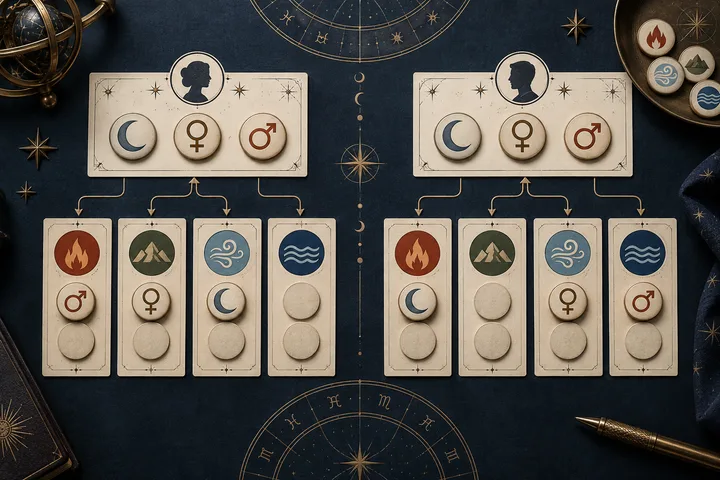
When you compare partners, keep the two charts separate at first. Write one line for Person A’s Moon, Venus, and Mars. Write another for Person B’s. Then mark each placement by element. You are looking for concentration, absence, and contrast. A chart with Moon in Water, Venus in Earth, and Mars in Fire is not inconsistent. It may need tenderness, show love through practical acts, and pursue desire directly. That mixture is more interesting than a single label, and it gives you more to test in real life.
The main judgment is simple: element balance is most useful as a map of relationship needs and responses. It isn’t a personality score. Don’t add points because a pair shares an element, and don’t subtract them because one element is missing. A missing element can show a skill the person develops through partners, habits, or experience. A repeated element can feel natural, but it can also become excessive. The pattern tells you where to look next. It doesn’t remove the need to look.
There is a practical reason to keep the layers separate. People often behave differently when they are calm, attracted, disappointed, or angry. The Moon may describe the care that restores someone. Venus may describe what they enjoy receiving. Mars may describe what they do when they want movement now. If you blend all three into ‘how they love,’ you lose the sequence. A partner can be generous in Venus matters, guarded in Moon matters, and forceful in Mars matters. That is not a contradiction to solve away. It is the pattern you need to understand before you ask whether the two charts fit.
Sources: A Brief Introduction to Astrology: The Four Elements; The Elements in Astrology
Gather only the chart information you can stand behind
For this comparison, you need six placements: both people’s Moon sign, Venus sign, and Mars sign. If you have degrees, record those too. Keep the zodiac system consistent. If one list uses tropical signs and the other uses sidereal signs, the labels may not describe the same positions, and your element count will shift before interpretation begins. Put the system at the top of the page. Small discipline here saves a large repair later.
The Moon deserves special care. It moves faster than Venus or Mars, so an uncertain birth time can matter when the Moon changes signs on that date. If you know only a sign supplied by a trusted chart, record the sign and mark the degree as unknown. If the Moon could occupy two signs, don’t force a single element balance. Read both possibilities, then notice which one better fits the person’s described emotional pattern. The method stays honest because the uncertainty stays visible.
Birth details and supplied placements are different inputs. A full natal chart calculates positions from birth date, time, and place. A placement comparison uses the signs and optional degrees that you provide. This page’s report bridge works with supplied Moon, Venus, and Mars placements and can examine selected major aspects with a stated six-degree orb. It doesn’t quietly invent a birth time, houses, or an exact Moon degree. That limit is part of the reading’s precision.
If the degrees are present, copy them exactly, including minutes when available. They let you separate a sign-level resemblance from an actual aspect. A Moon at 4 degrees Taurus and a Venus at 5 degrees Virgo are not conjunct, but they do share an Earth element and form a close trine by sign and degree. A Moon at 28 degrees Taurus and Venus at 2 degrees Libra form a close trine too, about four degrees from exact, even though Earth and Air tell a different element story. Numbers refine the story. They don’t replace it.
Make a small input table before you interpret. Use columns for person, planet, sign, element, degree, and confidence. Add a final note for the zodiac system and orb policy. This is not busywork. It stops the eye from jumping between attractive details and makes the comparison repeatable. If a placement is missing, say ‘unknown.’ A blank is more useful than a confident sentence built on a guess.
Give each input a confidence mark before you count anything. Confirmed means the placement came from a chart record you trust. Supplied means someone gave you the sign but not the underlying birth data. Uncertain means the Moon may change signs or the degree is incomplete. Use confirmed and supplied signs for the broad element ledger, but keep uncertain placements in a separate line. For aspects, require the degree pair and the same zodiac system. This two-column habit prevents a vivid but weak contact from outranking a plain, reliable pattern.
A useful ledger has two levels. The first is a three-box summary for each person: Moon element, Venus element, Mars element. The second is a cross-chart list that asks what each person’s planet meets in the other chart. For example, Person A’s Moon is compared with Person B’s Venus and Mars, while Person A’s Venus is compared with Person B’s Moon and Mars. You don’t need to fill every possible pair to find the theme. Mark only the contacts allowed by your chosen aspect list, then return to the planet question that brought you here.
Sources: Love, Relationship Astrology: Venus in Elements; What’s Your Sign? An Intro to Synastry Charts and Astrological Compatibility
Read the Moon as the emotional climate
Begin with the Moons because a relationship can carry attraction and still leave one person emotionally unfed. The Moon describes feeling, comfort, private reactions, and the ways we seek and offer care. In a comparison, ask what helps each person settle after stress. Does comfort arrive through physical presence, words, space, shared silence, a plan, or immediate reassurance? The element gives the climate. The sign and the person’s history give the weather.
A Fire Moon often wants warmth, movement, candor, and a sense that life is still alive. An Earth Moon may relax when promises become routines and affection becomes tangible. An Air Moon may need conversation, perspective, and room to think before emotion can move. A Water Moon may seek sensitivity, privacy, and proof that feelings can be held without being rushed. None of those needs is superior. The trouble begins when one partner offers care in a language the other cannot feel.
Compare the Moons in three passes. First, note whether they share an element. Shared Fire can make emotional response quick and expressive. Shared Earth can make calm and reliability easier to build. Shared Air can support talk and mental space. Shared Water can create intuitive closeness. Second, note the modality within each element. Cardinal and fixed Earth do not create the same pace. Third, check degrees for a conjunction, trine, sextile, square, or opposition if your data permits it. The aspect tells you how the two emotional climates meet.
Imagine Maria has a Moon in Cancer and Leo has a Moon in Capricorn. At the element level, Water and Earth can support one another: Maria brings emotional awareness, while Leo can offer structure and practical containment. At the sign level, the opposition can pull them into a familiar tension. Maria may read Leo’s composure as distance. Leo may read Maria’s changing feelings as instability. The stronger interpretation is not ‘bad Moon compatibility.’ It is a care problem with a clear experiment: can Leo name reassurance and can Maria ask directly for it before resentment grows?
The strongest exception is a close contact that changes the element story. Suppose the same Cancer Moon and Capricorn Moon sit near an exact opposition by degree. The contrast becomes louder, but it may also create recognition. Each person carries what the other lacks. Conversely, two Moons in the same element can still miss each other if they form a tense aspect or express different modalities. Element harmony is ease at the broad level. It is not a promise of emotional fluency.
Sources: Love Styles: About Her Report; What’s Your Sign? An Intro to Synastry Charts and Astrological Compatibility
Read Venus as the exchange of affection and value
Venus answers a different question from the Moon. The Moon asks, what helps me feel safe enough to be open? Venus asks, what do I enjoy, value, and recognize as love? It describes attraction, taste, reciprocity, pleasure, and the manner in which affection moves between people. A couple may understand each other’s moods yet disagree about how love should look. That is why Venus deserves its own layer instead of being treated as a decorative repeat of the Moon.
Venus in Fire may appreciate direct pursuit, play, novelty, and visible enthusiasm. Venus in Earth often trusts consistency, touch, time, and practical proof. Venus in Air may feel cherished through talk, curiosity, humor, and freedom to remain a distinct person. Venus in Water may value emotional presence, loyalty, tenderness, and an unspoken sense of attunement. These are broad approaches. The sign modifies them, and the rest of the chart can make the same element more restrained, social, private, bold, or cautious.
Now compare each person’s Venus with the other person’s Venus. A shared element can make tastes and expressions easier to recognize, but don’t stop at similarity. Ask whether the two Venuses want the same pace. Two Earth Venuses may both want commitment, yet one may show love through schedules while the other wants sensual closeness. Two Air Venuses may enjoy constant conversation, yet one may need independence while the other wants frequent verbal reassurance. Similar elements can conceal different requests.
Consider an example. Maria has Venus in Gemini, while Leo has Venus in Taurus. Maria may experience a lively exchange as intimacy. Leo may experience steady presence and repeated acts as intimacy. If Maria sends a dozen messages and Leo answers by making dinner, each may believe they are giving clearly. Each may also wonder why the other seems unmoved. The useful reading names the translation: Maria can notice the meal as an act of love, and Leo can answer the message with words instead of assuming presence speaks for itself.
Then check cross-contacts within the three supplied planets. One person’s Venus contacting the other person’s Moon can connect affection with emotional comfort. Venus contacting Mars can energize attraction and pursuit. Moon, Venus, and Mars contacts can also bring a difference into focus, making one exchange vivid, easy, tense, or demanding. The element balance tells you the style. The aspect tells you where that style becomes a lived relationship issue.
Compare the three personal planets as a pattern, not as six isolated sign labels. First, assign Fire, Earth, Air, or Water to each person’s Moon, Venus, and Mars. Then give the Moon priority for emotional safety, Venus priority for affection and values, and Mars priority for desire, pursuit, and conflict. Count the elements, but don’t stop there. A person with two Fire placements may still need Water-style reassurance if the Moon is in Water. Next, compare the two charts planet by planet and check close aspects, using the degrees you actually have. The strongest reading usually comes from a repeated theme: for example, one person’s Water Moon needs steadiness while the other person’s Earth Venus offers it, even if their Mars signs argue about pace. Use the result to name a conversation or habit to test. Astrology can show the pattern. Your daily choices show how well you work with it.
Sources: Love, Relationship Astrology: Venus in Elements; Love Styles: About Her Report; What’s Your Sign? An Intro to Synastry Charts and Astrological Compatibility
Read Mars as desire, action, and friction
Mars shows how each person moves toward what they want. It speaks to desire, initiative, physical energy, pursuit, anger, and the way conflict gets started. This layer often exposes the difference between attraction and cooperation. Two people may feel strong chemistry while using opposite methods to ask, press, retreat, or repair. Mars is not a moral grade. It is the engine and the way the engine meets resistance.
Mars in Fire may act quickly, openly, and with appetite for challenge. Mars in Earth may build slowly, persist, and prefer results that can be felt. Mars in Air may act through ideas, words, strategy, or movement between options. Mars in Water may act from instinct, emotional force, protection, or carefully chosen timing. Again, the planet is the key. Mars in Water is not simply ‘sensitive,’ and Mars in Air is not simply ‘detached.’ Ask how desire takes action.
Compare Mars with Mars to see how the two people pursue and fight. Shared Fire may produce quick mutual momentum, but it can also create two people who want to lead. Shared Earth can support endurance, but neither person may want to make the first move. Shared Air can keep conflict verbal and mobile, though decisions may drift. Shared Water can create powerful instinctive bonding, yet indirect anger can cloud the actual issue. The element describes the fuel. Modality describes the gear.
Then compare Venus with the other person’s Mars in both directions. This is often where attraction becomes visible. If one person’s Venus is in Air and the other person’s Mars is in Fire, shared Fire-Air symbolism can make flirtation quick and playful. If one person’s Venus is in Earth and the other person’s Mars is in Water, the combination may join physical care with emotional depth. A hard aspect can still be compelling. It may show the very difference that keeps desire awake, as well as the friction that needs skill.
The strongest exception is a Mars pattern that overwhelms an otherwise smooth element count. Imagine both people have compatible Moon and Venus elements, but one person’s Mars tightly squares the other person’s Moon. The relationship may feel affectionate until frustration arrives, then one person’s action presses directly on the other’s emotional safety. Don’t erase the good pattern. Rank it correctly. Moon and Venus may support tenderness; Mars supplies the issue the couple must learn to handle.
Sources: Love Styles: About Her Report; What’s Your Sign? An Intro to Synastry Charts and Astrological Compatibility
Combine the six placements without flattening them
Once you have read the planets separately, compare the two six-placement patterns. A useful summary has three lines: emotional climate, affection exchange, and desire or conflict. Under each line, name the dominant element, the strongest contrast, and one observable behavior. This keeps the reading attached to life. ‘Water Moon’ becomes ‘needs time to feel safe before solving the problem.’ ‘Earth Venus’ becomes ‘trust grows when care is repeated and tangible.’ ‘Fire Mars’ becomes ‘acts directly and wants a response.’
You can count each element across Moon, Venus, and Mars. The count is three points per person, not a full natal-chart weighting. If Person A has Water, Earth, Fire and Person B has Air, Earth, Fire, they share a practical and active channel while differing in emotional processing. If Person A has three Water placements and Person B has three Air placements, the contrast is larger, but it still doesn’t say the pair cannot understand each other. It says the translation work will be central.
Weight the planets by the question in front of you. If the question is emotional safety, start with the Moons and Moon contacts. If it is how affection lands, start with Venus and Venus-Moon links. If it is sexual charge, pursuit, or conflict, start with Mars and Venus-Mars or Mars-Moon contacts. Don’t let the most dramatic placement win automatically. A striking Mars contact may describe chemistry, while a quieter Moon pattern describes whether the couple can recover after a hard day.
Imagine Maria’s pattern is Moon Water, Venus Air, Mars Earth. Leo’s is Moon Earth, Venus Fire, Mars Air. The element count shows no shared Moon element, but it does show a possible bridge between Maria’s Earth Mars and Leo’s Earth Moon. Maria may act through practical help, which can settle Leo emotionally. Leo’s Fire Venus may enjoy Maria’s lively Air Venus, while Maria may need more direct affection than Leo naturally offers. Their reading is not ‘compatible’ or ‘incompatible.’ It is a ranked set of translations.
A cross-chart grid makes those translations easier to rank. Put Person A’s Moon, Venus, and Mars down the left side, and Person B’s three planets across the top. In each cell, record the element relationship first, then any supplied aspect and orb. A Moon-to-Venus cell answers how feeling meets affection. A Venus-to-Mars cell answers how attraction meets action. A Mars-to-Moon cell answers where pursuit may touch emotional safety. Leave cells empty when the data or aspect policy doesn’t support a claim. The empty space protects the reading from forced symmetry.
Don’t confuse an elemental relationship with an aspect. Two placements can belong to elements that astrologers often find cooperative without forming a close major aspect. They may still describe a shared style, but the contact is not automatically vivid between the people. The reverse matters too: a close square or opposition can make unlike elements impossible to ignore. Record both facts separately. One describes the broad language; the other shows where the charts press that language into an exchange.
Write the synthesis as a chain. First, state what comes easily. Next, state what is likely to be misunderstood. Then name the contact or repeated element that matters most. Finally, give the couple one behavior to observe. This is how you avoid sign stereotypes. You don’t deny the symbolic meaning. You place it in a system: planet role, element, modality, degree, aspect, then lived expression.
Sources: A Brief Introduction to Astrology: The Four Elements; The Elements in Astrology; What’s Your Sign? An Intro to Synastry Charts and Astrological Compatibility
Use degrees and aspects to rank what matters
Element comparison works by sign, but synastry becomes sharper when degrees are available. An aspect is an angular relationship between two chart positions. A conjunction joins them. A trine and sextile often ease the flow. A square and opposition can create pressure, polarity, and a demand for response. The same planet pair can feel different at two degrees apart and eight degrees apart. Set your orb before you read, then keep the rule steady for both charts.
For this report’s selected major aspects, use a six-degree orb when degrees are supplied. A close aspect should outrank a loose resemblance. A Moon at 12 degrees Pisces and another person’s Venus at 14 degrees Cancer share Water and form a close trine. That repeated Water symbolism gives emotional and affectionate exchange a strong place in the reading. A Venus at 1 degree Gemini and Mars at 8 degrees Scorpio may create a more complicated sign relationship, and the distance may not support the same strength under a six-degree rule.
Rank contacts by three questions. Is the aspect close? Does it involve a personal planet tied to the reader’s question? Does it repeat a theme already visible in the element balance? A close Moon-Venus trine that repeats Water is more persuasive than a loose Moon-Mars square that appears alone. A close Mars-Venus square that repeats an Air-Fire difference may be the key to attraction and argument. Ranking prevents a long list of aspects from becoming a cloud of equal-sounding claims.
The aspect’s quality is not a simple good or bad label. An easy aspect can show instinctive flow, but people may not notice what they receive without effort. A hard aspect can create irritation, yet it can also keep the relationship engaged and alive. The question is what the contact asks the people to do. A Moon-Mars square may ask for slower conflict and clearer reassurance. A Venus-Mars opposition may ask attraction to make room for difference. Keep the interpretation inside the planets and aspects the report actually compares.
If minutes are missing, preserve the degree as approximate and avoid pretending to know a tighter contact than the data supports. If the Moon degree is unknown, leave Moon aspects unranked or describe only the sign-level element pattern. A careful reading can still be useful. It simply gives priority to what the supplied placements can actually show. Precision is not the same as having more numbers. It is using the numbers you have without making the rest up.
Sources: Love, Relationship Astrology: Venus in Elements; What’s Your Sign? An Intro to Synastry Charts and Astrological Compatibility
Read the strongest exception instead of hiding it
Every element pattern has an exception that matters. Same-element pairs can still struggle. Different-element pairs can work beautifully. The exception usually appears when a planet role, modality, or close aspect changes the broad picture. Your job is not to collect every possible caveat. It is to find the one that could change the reader’s conclusion and put it in the right place.
A common mistake is to treat Fire and Air as automatically easy, or Earth and Water as automatically safe. Those combinations can cooperate because their basic styles often support one another. But two Fire Moons may turn every hurt into an immediate contest. Two Water Venuses may feel deeply but avoid saying what they need. An Earth Moon and Air Venus may love one another while disagreeing about whether quiet presence or conversation is the clearest proof. Element families are tendencies, not contracts.
Another exception comes from repetition across different planet pairs. Suppose Person A’s Water Moon forms a close aspect to Person B’s Earth Venus, and Person B’s Earth Moon forms a close aspect to Person A’s Water Venus. The charts repeat a Water-Earth exchange. That may matter more than whether their Mars signs belong to traditionally harmonious elements. The repeated theme says emotional needs and affection can meet through care, steadiness, and embodied reassurance. The Mars layer still tells you how they handle heat.
Consider an example with a sharper contrast. Maria has Moon in Air, Venus in Water, and Mars in Fire. Leo has Moon in Water, Venus in Earth, and Mars in Air. Their Moon elements can understand feeling through different routes, and their Venus elements may join tenderness with practical loyalty. Their Mars elements, however, may argue about timing. Maria’s direct movement may feel too fast to Leo’s emotional body, while Leo’s response may feel too indirect to Maria. The strongest exception is not a hidden bad sign. It is the Mars pace.
When two interpretations compete, test them against the same kind of moment. Choose a recent disagreement or an attempt at closeness, and write what happened in order: who moved first, what response followed, when the tone changed, and what restored contact. Then ask which planet layer explains the sequence most clearly. If the event begins with a need for reassurance, Moon leads. If it begins with a missed gesture or different love language, Venus leads. If it begins with pressure, pursuit, or anger, Mars leads. This keeps the strongest exception tied to a real pattern instead of whichever symbol sounds most dramatic.
State the exception in one sentence: ‘The element balance supports emotional recognition, but the tight Mars contact changes how conflict is likely to feel.’ Or: ‘The shared Venus element helps affection land, but the Moon signs need different kinds of reassurance.’ This sentence gives the reader a governing judgment. It ranks the evidence. It also keeps the reading from becoming a pile of equally weighted possibilities.
Sources: The Elements in Astrology; Love Styles: About Her Report; What’s Your Sign? An Intro to Synastry Charts and Astrological Compatibility
Turn the reading into a decision guide
A useful comparison should end with a choice about what to observe, not a label about what the relationship is. Keep the ranking clear: Moon first for emotional safety, Venus second for the way affection and value are exchanged, Mars third for desire, initiative, and friction. This order keeps chemistry from outranking care. It also gives you a clean way to handle a mixed result, because a smooth Venus-Mars pattern can still sit beside a Moon need that no one has learned to answer.
Make the final judgment traceable. Write one sentence for each person’s Moon: ‘I settle when...’ Write one for Venus: ‘Affection registers when...’ Write one for Mars: ‘When I want movement, I tend to...’ Now compare the six sentences. Don’t compare the labels alone. If both Venus sentences point to conversation but one Moon sentence asks for privacy, the pair may enjoy talking and still need quiet after conflict. If one Mars sentence says ‘act now’ and the other says ‘give me time,’ the live issue is pace.
Consider an example with supplied placements only. Maria has Moon in Cancer, Venus in Gemini, and Mars in Virgo. Leo has Moon in Capricorn, Venus in Taurus, and Mars in Sagittarius. Maria may seek emotional acknowledgment, lively words, and practical problem-solving. Leo may offer structure, steady presence, and direct movement. The first bridge is clear: Leo can name reassurance before fixing the problem, while Maria can recognize steady acts as affection and say when she needs more words. The second bridge is harder. Leo’s Mars may push for an answer while Maria’s Mars wants to improve the details first. That is the behavior to watch.
Then ask whether the pattern appears in ordinary moments. Does the person with the Earth emphasis actually repeat care, or does the promise stay theoretical? Does the Air expression invite curiosity, or does it become avoidance? Does the Water expression create tenderness, or does silence leave the other person guessing? A placement describes a symbolic tendency. The relationship shows how that tendency has been shaped, matured, or resisted.
If degrees are supplied, attach the strongest contact to the sentence it changes. A close Moon-Venus contact may help affection feel soothing even when the signs use different elements. A close Mars-Moon square may make a small disagreement feel urgent when one person presses for movement and the other needs safety first. Name the skill that contact asks for, such as pausing before advice or agreeing when the conversation will resume. One precise practice is more useful than ten equal-sounding aspect notes.
If the data is incomplete, narrow the conclusion rather than abandoning the reading. With signs only, compare the elements and planet roles. With degrees, rank selected major aspects under the same six-degree orb for both people. If the Moon degree is uncertain, don’t use an unverified Moon aspect to settle the reading. Confirm the zodiac system and the supplied placements before revising the interpretation. The report can organize known Moon, Venus, and Mars signs and optional degrees; it doesn’t calculate a natal chart from birth details, determine houses, or issue a dating verdict.
This is the point where the Synastry Comparison Report can help. Bring the six placements and any degrees you already have. Use the organized result to answer one live question, such as ‘What kind of reassurance reaches both of us?’ or ‘Where does our pace change?’ Then choose one small practice for a week. Ask for the reassurance plainly. Slow the first minutes of conflict. Notice the act of care you usually miss. The report supports the comparison; the conversation gives it a life.
At the end of that week, review three things. What felt easy without prompting? What kept getting mistranslated? Which person adjusted, and did the adjustment last beyond one good evening? This review protects the reading from wishful symmetry. A different element can become a bridge when both people translate it. A harmonious count can still fail if neither person repairs the same recurring hurt.
Your decision point is modest and real. Keep exploring the pattern when both people can name the difference, respond to it, and practice a workable adjustment. Pause the compatibility story when the chart is being used to excuse pressure, silence, or repeated disregard. Astrology can show the relationship language. Your next observed exchange tells you whether the two of you are learning to speak it.
Sources: Love, Relationship Astrology: Venus in Elements; What’s Your Sign? An Intro to Synastry Charts and Astrological Compatibility
A little more clarity
Should I count Moon, Venus, and Mars equally when comparing elements?
Count them equally for a simple three-placement overview, then interpret them by role. Give the Moon priority for emotional safety, Venus for affection and values, and Mars for desire, action, and conflict. If your question is about chemistry, Mars and Venus contacts may lead. If it is about feeling secure together, start with the Moons. A count is a map of emphasis, not a compatibility score.
Can different elements work well together in synastry?
Yes. Different elements can supply what the other person lacks, especially when the two people can translate their needs clearly. Earth can give Water feeling a container. Air can help Fire find words and perspective. The same contrast can create friction when one person expects the other to offer care in an unfamiliar form. Check the planet roles, modalities, and close aspects before deciding what the difference means.
What if I know the signs but not the degrees?
You can still compare element balance and sign-level themes. Mark the degrees as unknown and avoid claiming exact conjunctions, trines, squares, or oppositions. If the Moon degree is uncertain, be especially careful with Moon aspects. A supplied sign comparison can show the broad emotional, affectionate, and desire patterns. Degree-based ranking needs reliable degree data and a consistent orb, such as the six-degree scope used by the report described here.
Sources & further reading
- A Brief Introduction to Astrology: The Four Elements
Supports the four-element framework and the broad meanings of Fire, Earth, Air, and Water in astrology.
- The Elements in Astrology
Supports element groupings, element counts, and giving personal planets more interpretive weight.
- Love, Relationship Astrology: Venus in Elements
Supports reading Venus by element as a style of giving and receiving affection and relationship value.
- Love Styles: About Her Report
Supports distinguishing Moon feeling nature, Venus romantic nature, and Mars desire nature when they occupy different elements.
- What’s Your Sign? An Intro to Synastry Charts and Astrological Compatibility
Supports the role of Moon, Venus, and Mars in synastry and the importance of close degree-based aspects.
Synastry Comparison Report
Enter known placements for two people. Get an input-by-input comparison, selected aspect calculations and a clear record of what remains uncertain.
Compare our placements