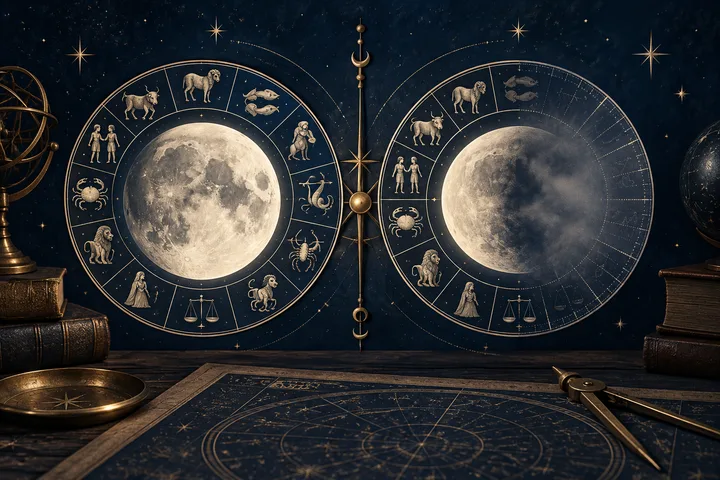
Imagine the report that sounds certain
Imagine Maria and Daniel comparing placements after a promising first month. Maria knows her Moon is at 14° Taurus. Daniel knows only that his Moon is in Scorpio. The sign is written on an old chart, but the degree is gone. They ask the natural question: does Daniel’s Moon oppose Maria’s Moon?
A careless report answers yes, then builds a large story around emotional intensity. It may call the pair magnetic, difficult, or bound to keep returning to one another. The words sound decisive. The data isn’t. Scorpio and Taurus are opposite signs, but sign polarity does not tell us the exact distance between two Moons. Daniel’s Moon could sit at 1° Scorpio, 14° Scorpio, or 29° Scorpio. Those positions create different orbs to Maria’s 14° Taurus Moon.
A careful report starts with less drama and gives Maria more value. It says that the Taurus-Scorpio axis creates a meaningful sign-level contrast between steadiness, sensory calm, and preservation on one side, and depth, privacy, and emotional merging on the other. That is a real interpretive layer. It then says the exact Moon-Moon opposition remains unconfirmed until Daniel’s degree is known or the possible degree range has been tested.
That distinction matters because synastry has layers. A planet describes a function. A sign describes the style of that function. An aspect describes how two functions meet. A house describes where the meeting becomes visible. If one Moon degree is missing, the sign layer may survive while the aspect and house layers remain open. The report should name those layers instead of blending them into one confident paragraph.
This isn’t timid astrology. It’s disciplined astrology. You want the strongest claim the supplied chart data can carry, not the most exciting claim the story invites. A report earns trust when it knows the difference. Precision can feel intimate because it respects the person reading. It says, ‘Here is what I can see with you, and here is the part we should explore together.’
There is a second reason to begin with the data. Readers often arrive at synastry because one interaction has left them wondering whether the connection has a name. A report can honor that feeling without rushing to seal it inside one aspect. The Moon degree question is a chance to ask a better question: what pattern is visible in the way these two people actually seek safety, and which part of that pattern is chart-supported?
For Maria and Daniel, the first answer is therefore simple: yes, their known Moon signs can be read. No, their exact Moon-Moon aspect cannot be declared from the signs alone. The rest of the reading should be built around that boundary.
A report can even make the boundary feel reassuring. It tells the reader that the chart is not a machine that demands a missing number before it can speak. It is a set of symbols read at different resolutions. The sign offers a wide lens. The degree sharpens the lens. The aspect describes the angle between two lenses. Losing one setting reduces detail, but it doesn’t erase the view. You can still ask what feels familiar, what feels exposing, and what kind of reassurance lets both people remain present. Those questions belong to the Moon reading even before the final degree is recovered.
Sources: Timing with the Moon in Astrology; A Brief Introduction to Astrology: Aspects; Astrological Orbs Explained: Natal Charts, Transits and Synastry; Synastry Aspect Grid Calculator
What the Moon sign still gives you
The Moon describes instinctive response, comfort, mood, memory, and the habits that appear before a polished explanation. In a relationship comparison, it helps you ask what each person needs in ordinary emotional life. How do they settle after a hard day? What kind of care feels natural? What makes the body relax enough to speak honestly?
Those questions don’t require a degree to begin. If Maria’s Moon is in Taurus, her emotional rhythm may favor steadiness, physical comfort, familiar routines, and proof that affection will still be there tomorrow. If Daniel’s Moon is in Scorpio, he may seek privacy, emotional honesty, loyalty, and a willingness to stay with what is uncomfortable instead of smoothing it over too quickly. These are sign-based themes, not fixed verdicts about either person.
The contrast can be fertile. Maria may calm a crisis by slowing it down and making the surroundings safe. Daniel may calm it by getting to the hidden feeling underneath the polite version. Each can offer what the other lacks. Maria might find Daniel’s intensity clarifying. Daniel might find Maria’s consistency deeply reassuring.
The same contrast can create a pressure point. Maria may experience probing questions as a demand for more feeling than she can produce on command. Daniel may experience a request for calm routine as avoidance if he believes the real issue has not been named. The sign comparison lets the report describe that translation problem. It does not prove that either person will mishandle it.
This is where a report should resist stereotypes. Taurus Moon does not mean someone is always placid, stubborn, or materialistic. Scorpio Moon does not mean someone is always suspicious or dramatic. The whole natal chart would add context, and the report in this brief does not calculate that chart from birth details. Use the supplied placement as a symbolic lens, then return to behavior.
You can make the sign layer concrete with a small comparison in prose. Taurus may ask, ‘Can we make this steady?’ Scorpio may ask, ‘Can we make this honest?’ Taurus often trusts repetition and tangible care. Scorpio often trusts candor and emotional presence. When both questions receive an answer, the pair can build a strong rhythm. When one question is ignored, each person may believe the other is asking for the wrong thing, when they’re really asking for safety in a different dialect.
A useful sign-level reading ends with a practical question: what does each person do when comfort is offered in a different form than expected? Maria and Daniel can answer that from their relationship. They don’t need to pretend they know a degree they don’t have. That’s a strong place to begin for this reading.
This also gives the reader a way to compare the Moon with Venus. Moon comfort is often about what helps someone feel safe enough to soften. Venus describes what they enjoy, value, and offer as affection. They can agree, but they don’t have to. Someone may want quiet, familiar care when distressed and still enjoy lively, flirtatious conversation when feeling well. Keep those functions distinct.
A synastry report can still read the supplied Moon sign, compare it with the other person’s Moon, Venus, and Mars signs, and describe broad emotional habits. It can’t safely present a precise Moon aspect, orb, applying or separating status, house overlay, or degree-based conclusion when that Moon degree is unknown. The right method is to separate confirmed symbolism from conditional geometry, test the possible degree range if it’s available, and let the clearest surviving pattern lead the reading. A missing degree narrows the report. It doesn’t make the whole comparison meaningless.
Sources: Timing with the Moon in Astrology; Synastry: Two charts, not one verdict
Why the missing degree changes the aspect reading
An aspect is an angular relationship between two chart points. A conjunction is 0°, a sextile is 60°, a square is 90°, a trine is 120°, and an opposition is 180°. The orb measures how far the actual separation sits from the exact angle. If two planets are 92° apart, an astrologer may call that a square with a 2° orb.
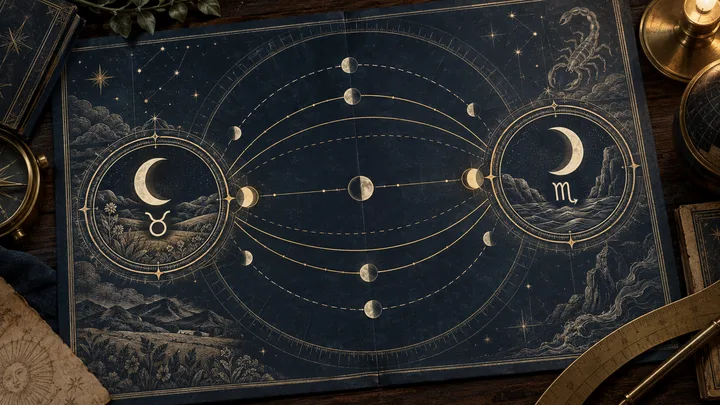
That arithmetic needs two positions. A sign gives you a thirty-degree field, not a single point inside it. When Daniel’s Scorpio Moon has no degree, the distance to Maria’s 14° Taurus Moon can’t be calculated exactly. At 14° Scorpio, the opposition is exact. At 10° Scorpio, it’s a 4° opposition. At 1° Scorpio, the separation is 167°, which sits outside a six-degree opposition orb. The same sign pair produces three different aspect judgments.
The situation gets more interesting near sign boundaries. Suppose Maria’s Moon is at 28° Taurus and Daniel’s Moon is at 26° Scorpio. Those positions are 178° apart, so they form a 2° opposition even though the degrees sit near opposite ends of the two signs. If a report looks only at the sign labels, it may miss the geometry. If it announces an opposition without the degrees, it may be right by symbolism and wrong by calculation. Both layers deserve their own names.
The same issue applies to contacts with the other person’s Venus or Mars. A Scorpio Moon can describe an emotional style in sign language. It cannot prove a Moon-Venus trine, Moon-Mars square, or Moon-Mars opposition without its degree and the other planet’s degree. If the other placement is known only by sign too, the uncertainty expands again.
Use the report’s six-degree orb as a stated editorial rule. Within that rule, a contact is confirmed only when every needed degree is supplied and the angular distance falls inside six degrees of the exact aspect. A contact that could fall inside or outside the orb is conditional. A sign relationship that suggests a theme but does not establish an aspect belongs in a separate sign-level paragraph.
This separation makes the reading more useful. The reader can see what the chart says, what the chart might say, and what the chart cannot decide yet. That is a much better map than a single list of aspects with hidden assumptions.
It also prevents a common reading error: letting the meaning of an aspect decide whether the aspect exists. A writer may see a compelling story in Moon opposition and then quietly stretch the orb until the story fits. Reverse the order. Establish the positions, calculate the distance, apply the declared orb, and only then interpret the contact. Interpretation should deepen geometry, not replace it.
The six-degree rule is a choice the report makes visible. Other astrologers may use different orbs, especially for the luminaries, and a reader may work within another tradition. That doesn’t weaken the method. It makes the method legible. Once the rule is stated, the reader can understand why one contact leads the report while another stays in the margin. Hidden flexibility is what creates false precision.
Sources: A Brief Introduction to Astrology: Aspects; Astrological Orbs Explained: Natal Charts, Transits and Synastry; Synastry Aspect Grid Calculator; Synastry: Two charts, not one verdict
A worked range test for Maria and Daniel
Let’s work the example carefully. Maria’s Moon is supplied as 14° Taurus. Daniel’s Moon is supplied as Scorpio, with no degree. We’ll use a six-degree orb for major synastry aspects. We won’t calculate a birth chart, houses, angles, or any placement that the report doesn’t receive.
If Daniel’s Moon is 8° to 20° Scorpio, it falls within six degrees of a 14° Taurus opposition. In that range, the report can call the Moon-Moon opposition possible or confirmed only if Daniel’s actual degree is known to sit there. If the degree is unknown, the correct wording is conditional: the sign axis supports a polarity, and an opposition may be present across part of the possible range.
If Daniel’s Moon is 1° to 7° Scorpio, the opposition to Maria’s Moon sits more than six degrees away. The sign contrast remains. The degree-based opposition does not. If Daniel’s Moon is 21° to 29° Scorpio, the same thing happens. A late Scorpio Moon is farther from 14° Taurus than the six-degree threshold allows. This is why a report should never convert opposite signs into an automatic opposition.
Now change Maria’s supplied degree to 28° Taurus. Daniel’s Moon at 26° Scorpio creates a 2° opposition, so this is a strong degree-based contact. Daniel’s Moon at 14° Scorpio creates a 14° separation from exact opposition, which falls outside the chosen orb. The sign pair hasn’t changed. The aspect judgment has.
When you test a range, measure the shortest angular distance around the zodiac, then compare that distance with the exact aspect angle. Don’t add the sign names as if each sign were a single point. Taurus begins at 30° of the zodiacal circle, while Scorpio begins at 210°, so the labels tell you the broad polarity but not the final angle. A report can show the calculation in plain language: these supplied positions are 178° apart, the opposition is 180°, and the remaining 2° falls inside the six-degree orb. That small line gives the reader a method they can repeat for Moon-Venus or Moon-Mars contacts. It also makes clear why a sign-based interpretation and a degree-based calculation can reach different levels of certainty.
What should the report say if Daniel can narrow his birth time to morning or evening but still can’t find the exact minute? Show the tested range. If the Moon stays between 11° and 16° Scorpio and every point remains within six degrees of Maria’s 14° Taurus Moon, the opposition is stable enough to report as a range-supported contact. If the range crosses the six-degree edge, label it conditional and explain what would confirm it.
This method also handles a Moon sign near a cusp. If Daniel’s Moon could be late Libra or early Scorpio, the report should carry both possibilities until the supplied data resolves them. It can compare the two sign stories, but it should not pick the more attractive one because it fits the relationship better. Lived experience can help a reader reflect. It doesn’t turn an unknown input into a known degree.
The range test gives Maria and Daniel a clean result. Their Taurus-Scorpio emotional axis is the broad theme. A Moon-Moon opposition is a question of degree. The report can show exactly how much of that question is open.
A range can be written as a small set of outcomes. If every plausible degree gives an opposition, interpret the opposition with confidence and mention the range. If some degrees give an opposition and some do not, interpret the axis first and place the opposition in a conditional note. If the sign itself changes, write two short sign readings and identify the missing time as the deciding input. This format lets the reader see the fork in the road instead of receiving a foggy statement that the chart is ‘a little uncertain.’
The same discipline applies if the reported degree is rounded. A displayed 14° may mean a position somewhere around 13°30′ to 14°29′, depending on how the source rounds. That usually won’t change a wide, comfortably inside-orb contact, but it can matter at the edge. Don’t pretend a rounded number has minute-level precision. Say whether the supplied degree is exact, rounded, or simply copied from a chart whose calculation method is unknown.
In practice, you can write the result in three lines: confirmed range, open range, and reader action. For example, ‘At every tested degree from 12° to 16° Scorpio, Daniel’s Moon opposes Maria’s 14° Taurus Moon within six degrees. The exact orb remains unknown. Recover the recorded time if you want to distinguish a 2° contact from a 6° contact.’ That is precise, readable, and immediately useful.
Sources: Astrological Orbs Explained: Natal Charts, Transits and Synastry; Synastry Aspect Grid Calculator; Synastry: Two charts, not one verdict
Rank the claims from firm to conditional
Not every sentence in a synastry report deserves the same weight. When one Moon degree is unknown, rank the interpretation before you write it. The ranking keeps a vivid possibility from drowning out a quieter fact.
This ranking is also a writing tool. Put the confirmed material in the main path of the report. Put conditional material beside the fact that would confirm or reject it. Put unsupported material outside the report entirely. Readers can handle uncertainty when you give it shape. They struggle when every sentence sounds equally certain and the most colorful one quietly becomes the conclusion.
First comes supplied sign symbolism. If Daniel’s Moon is known to be in Scorpio, the report can discuss Scorpio Moon themes and compare them with Maria’s Taurus Moon. This is the broadest layer, but it is not empty. It gives language for comfort, privacy, trust, pace, and emotional repair.
Second comes degree-confirmed contact. If Daniel’s degree is later supplied and the distance to Maria’s Moon is within six degrees of a major aspect, the report can interpret that aspect. The aspect tells you how the two lunar functions meet. It still doesn’t erase the natal context of either person, and it doesn’t make a relationship outcome inevitable.
Third comes range-supported contact. If the unknown degree has a narrow, documented range and every plausible point produces the same major aspect inside the stated orb, you can treat the aspect as stable across the range. Say how the range was defined. A range that includes both a 3° square and no square at all is not stable. It remains conditional.
Fourth comes a near-boundary possibility. This is the language of may, could, and if. It belongs in a short note, not in the headline interpretation. A possible Moon-Mars square may help the reader investigate how desire and emotional reflex meet, but it shouldn’t become the explanation for every disagreement.
Last comes an unsupported exact claim. Don’t make it. No exact degree means no exact orb. No reliable birth time means no house overlay or Ascendant contact. A report that leaves those out is more accurate and more respectful of the reader’s actual question.
The ranking can guide the report’s verbs. Use ‘shows’ for supplied sign symbolism, ‘confirms’ for a calculated contact, ‘supports’ for a repeated theme, and ‘may’ for a range that has not settled. Small word choices do real work here. They tell the reader whether a sentence describes a placement, a relationship between placements, or an avenue for reflection.
It also keeps the report from becoming a courtroom. Astrology doesn’t need a prosecutor and a defense attorney for every aspect. A square can describe friction that teaches timing. A trine can describe ease that still needs attention. The Moon degree question asks for accuracy in the input, not a verdict about the people involved.
The strongest synthesis often combines the first two layers without pretending they are equal. In Maria and Daniel’s case, the sign axis can lead the reading now. A degree-based opposition can deepen it later if the missing input confirms the contact. That order protects both the astrology and the reader. It gives the couple something true to work with, and a clear reason to revisit the details.
Sources: A Brief Introduction to Astrology: Aspects; Astrological Orbs Explained: Natal Charts, Transits and Synastry; Synastry Aspect Grid Calculator; Synastry: Two charts, not one verdict
What changes when the Moon degree is near a boundary
A missing Moon degree creates two different kinds of uncertainty. The first is aspect uncertainty inside a known sign. The second is sign uncertainty when the Moon changes signs during the possible birth-time window. They need different language.
The Moon moves quickly compared with the other natal planets. Cafe Astrology describes it as changing signs about every two and a half days and completing its cycle in about twenty-eight days. A birth date often narrows the Moon considerably, but an unknown time can still matter when the Moon changes signs that day or when a close contact sits near an orb boundary.
Suppose Daniel’s birth date is one on which the Moon enters Scorpio late in the evening. His Moon could be late Libra or early Scorpio, depending on the time. Maria’s Taurus Moon then meets two different sign stories. Libra brings a social, balancing, and relational mode of emotional regulation. Scorpio brings privacy, depth, and emotional concentration. The report should present both, then identify what additional information would settle the matter.
Don’t use a noon default as if it were a birth fact. Some chart services place an unknown-time chart at noon for display, but that is a working placeholder, not knowledge of the person’s actual sky. If a degree comes from such a placeholder, label it accordingly or leave it out of precise synastry claims. A neat number can hide a wide uncertainty.
The practical test is straightforward. Ask whether the unknown time can change the Moon’s sign. If yes, keep both sign readings open. If no, ask whether it can move the Moon into or out of a six-degree aspect. If yes, keep the aspect conditional. If no, the sign and the major contact may be stable enough for the report’s stated scope.
This is also the strongest exception to a simple ‘missing degree means sign-only’ rule. Sometimes a birth-time range is narrow enough to support a degree-based contact, even without a recorded minute. Sometimes the Moon is safely placed in one sign and far enough from every aspect boundary that the exact degree adds detail but not a change in the main conclusion. The data decides how cautious the wording needs to be.
The report should tell the reader which kind of uncertainty they have. ‘Your Moon sign is uncertain’ is not the same as ‘your Moon sign is known, but the orb is uncertain.’ Those sentences lead to different next steps.
When the sign is uncertain, avoid writing as though both possible signs are secretly one blended placement. Name the fork. Libra and Scorpio may both care about connection, but they can seek emotional balance through very different gestures. The reader deserves to know which interpretation rests on which possible Moon position.
When only the degree is uncertain, keep the sign reading stable and vary the aspect language. This is often the easier case. The report can say, ‘Your Moon is in Scorpio, so the sign comparison remains Scorpio to Taurus. The exact opposition is open because Daniel’s degree is missing.’ That sentence preserves the useful center while putting the uncertainty where it belongs.
Sources: Timing with the Moon in Astrology; Synastry Aspect Grid Calculator; Synastry: Two charts, not one verdict
Read the rest of the supplied synastry first
A missing Moon degree shouldn’t force the whole report to stop. It should change the order of attention. Begin with the placements the reader actually supplied and can stand behind. Compare Moon, Venus, and Mars signs. Then use any confirmed degrees to identify the closest major contacts among those placements.
Venus shows attraction, appreciation, pleasure, and the ways affection becomes visible. Mars shows initiative, desire, assertion, and the move from wanting to doing. Moon shows comfort and instinctive response. Together, these three describe different parts of relational life. A Moon degree question doesn’t cancel a known Venus-Mars contact or a confirmed Moon-Venus contact with the other person’s degree.
Consider Maria and Daniel again. Their Moon-Moon aspect is uncertain. But Maria’s Venus at 3° Gemini and Daniel’s Mars at 5° Libra create a 120° trine within a two-degree orb if those supplied degrees are accurate. That confirmed contact may say more about how attraction and pursuit move between them than the unresolved Moon-Moon question does. The report should lead with the clearest contact, then return to the lunar uncertainty.
Or suppose Maria’s Moon sign is Taurus and Daniel’s Venus sign is Cancer, with neither degree known. The earth-water sign relationship can support a broad story about care expressed through steadiness, protection, food, home, touch, or practical tenderness. It cannot establish a 60° sextile. Write the sign comparison as a sign comparison. Don’t sneak an aspect into it through a flattering phrase.
Look for repetition. If the Moon sign contrast, Venus sign comparison, and confirmed Mars contact all point to a difference in pace, the theme deserves more weight. If one uncertain Moon contact is the only evidence for emotional volatility, keep that claim small. A repeated pattern across separate supplied placements is stronger than a single dramatic possibility.
This tight-first method follows a useful synastry habit: sort the chart by the most direct contacts, then read the pattern as a whole. The closest contact isn’t automatically the most important humanly, but it gives the report a better starting point than a wide or uncertain contact. The reader can then test the symbolism against ordinary life.
A report can sort the surviving material into three columns. The first holds sign comparisons, such as Taurus Moon with Scorpio Moon. The second holds degree-confirmed contacts, such as a Venus at 3° Gemini trine Mars at 5° Libra. The third holds questions, such as a possible Moon opposition waiting on Daniel’s degree. This simple layout stops the unresolved question from taking over the page.
It also helps when one person arrives with more data than the other. Maria shouldn’t have to discard her known degree because Daniel’s is missing. Her 14° Taurus Moon can still be used in every calculation that has a complete pair of inputs. The report can say, ‘Maria’s position is known. Daniel’s position is sign-only.’ That is more exact than calling both charts equally vague.
A good report doesn’t punish incomplete data. It uses the reliable pieces well, names the missing piece, and shows what would change if that piece arrived. That is enough for a grounded comparison today and a sharper revision tomorrow.
Sources: Astrological Orbs Explained: Natal Charts, Transits and Synastry; Synastry Aspect Grid Calculator; Synastry: Two charts, not one verdict
Turn the uncertainty into a useful conversation
The report’s purpose isn’t to win an argument about whether an opposition exists. It’s to help two people notice how their emotional habits meet. When a Moon degree is unknown, move from a claim about destiny to a question about practice.
Maria might ask Daniel, ‘When you’re upset, do you want me to stay close and ask questions, or give you quiet until you know what you feel?’ Daniel might ask Maria, ‘When you need reassurance, what kind actually lands? More words, a plan, physical closeness, or time together?’ These questions test the Moon sign themes without treating either person as a stereotype.
If the Taurus-Scorpio contrast is active, the couple may discover that one person reaches for stability while the other reaches for emotional proof. Neither need be cast as the easy one. Maria can say when calm becomes withdrawal. Daniel can say when depth becomes pressure. The astrology gives them a shared language for the difference, and the conversation gives the language a living shape.
If a later degree confirms a close Moon-Moon opposition, the report can add a more focused interpretation. Oppositions often describe a pull across two poles. They can create awareness, complementarity, and tension. The contact may feel compelling because each person encounters a quality the other carries strongly. It still needs conscious handling. An aspect describes the meeting. It doesn’t perform the relationship for you.
If the later degree rules the opposition out, the earlier conversation doesn’t become false. The sign-level contrast may still describe how comfort differs. Perhaps the issue is not an exact lunar polarity but a Venus-Mars mismatch, a communication habit, or the simple fact that two people learned care in different homes. Astrology helps you rank possibilities. It doesn’t require one symbol to explain everything.
Try this three-part check after reading the report. What soothes me? What do I assume when you don’t soothe me that way? What could I ask for directly instead of testing you? Write down separate answers. Then compare them when neither person is already in the middle of a fight.
You can make the conversation even more specific by asking for one recent example. ‘When we disagreed about the weekend, what did you need first?’ One person may have wanted a plan. The other may have wanted proof that the feeling mattered. Listen for the need beneath the timing. That information can confirm, complicate, or soften the sign-based picture, and all three outcomes are useful.
If recovering the degree is easy, do it before paying special attention to a close Moon aspect. Check the original record, ask the person who knows the birth time, and preserve the time zone and location used by the source. If recovery isn’t possible, keep the conditional language. A report can be complete in method even when the chart data is incomplete.
The conversation can also reveal where interpretation needs a second look. If Daniel says he needs quiet but returns reliably to finish the conversation, the report should not label his privacy as avoidance. If Maria asks for routine but can adapt when the reason is explained, the Taurus need for steadiness isn’t rigidity. The chart offers a starting pattern. The people show its range.
That is why a useful synastry report ends with a decision the reader can actually make. Decide whether to recover the missing degree. Decide which recent interaction deserves a calmer conversation. Decide which confirmed placement deserves more attention than an attractive but uncertain possibility. The result is modest, but it changes what you do next.
If you choose to revisit the report after finding the degree, don’t rewrite every section from scratch. Update the Moon aspect line, its orb, and the interpretation that depends on it. Then check whether the new contact repeats a theme already shown by Venus or Mars. A new degree should sharpen the pattern, not force the whole relationship into a new story.
And if no degree ever appears, the reading still has a proper ending. You know the emotional styles you’re comparing. You know which aspect claims are confirmed and which are not. You have a question to ask each other. That is enough to use the astrology well, because the point is not to fill every blank. It’s to see the relationship more clearly. You can revisit the reading as new information arrives, but you don’t need to postpone every insight until the record is perfect. Start with what is known. Keep the unknown visible. Let the relationship supply the living detail that no degree can provide.
That is the best next step for Maria and Daniel, and for anyone reading an uncertain Moon contact. Use the sign comparison to start the conversation. Hold the exact aspect open until the degree earns its place. If the conversation feels easy, notice what made it easy. If it feels tender or awkward, notice that too. The response is part of the information you’re seeking.
Sources: A Brief Introduction to Astrology: Aspects; Synastry Aspect Grid Calculator; Synastry: Two charts, not one verdict
A little more clarity
Can I still read Moon-Moon synastry if one Moon degree is unknown?
Yes, but separate the sign reading from the aspect reading. You can compare the Moon signs and describe broad emotional needs, comfort styles, and differences in pace. You can’t safely state the exact Moon-Moon aspect or orb unless the missing degree is supplied or a tested degree range keeps the same aspect inside the stated six-degree orb.
Does having opposite Moon signs automatically mean a Moon opposition?
No. Opposite signs suggest a polarity, but an opposition is a 180-degree relationship measured from the actual positions. Two Moons in Taurus and Scorpio may be close to an opposition, or too far apart for the chosen orb. Exact degrees decide the aspect.
What should a synastry report leave out when the Moon degree is missing?
Leave out an exact Moon orb, a confident applying or separating label, a house overlay that depends on an unknown birth time, and any conclusion that treats a possible contact as proven. The report can still read supplied Moon, Venus, and Mars signs, confirmed degree-based contacts, and clearly labeled conditional possibilities.
Sources & further reading
- Timing with the Moon in Astrology
Supports the Moon’s rapid sign movement, its approximate two-and-a-half-day sign cycle, and the importance of recording the time zone for lunar events.
- A Brief Introduction to Astrology: Aspects
Supports the definition of aspects as angular relationships and orbs as the allowed distance from an exact aspect, which underpins the report’s distinction between confirmed, conditional, and unsupported synastry contacts.
- Astrological Orbs Explained: Natal Charts, Transits and Synastry
Supports the angular-distance formula for an orb, static synastry geometry, tighter synastry orbs, and the distinction between geometric closeness and lived intensity.
- Synastry Aspect Grid Calculator
Supports reading inter-aspects by exact orb, prioritising close contacts, and treating an unknown birth time as especially relevant to Moon aspects and angles.
- Synastry: Two charts, not one verdict
Supports the layered reading of planet, sign, house, and aspect, plus the rule that same-sign placements are not automatically conjunctions.
Synastry Comparison Report
Enter known placements for two people. Get an input-by-input comparison, selected aspect calculations and a clear record of what remains uncertain.
Compare our placements