The common assumption gets Saturn wrong
A Saturn contact often gets reduced to one of two stories. It is called the glue that keeps two people together, or the cold hand that takes the joy out of love. Both stories catch something real. Neither is enough.
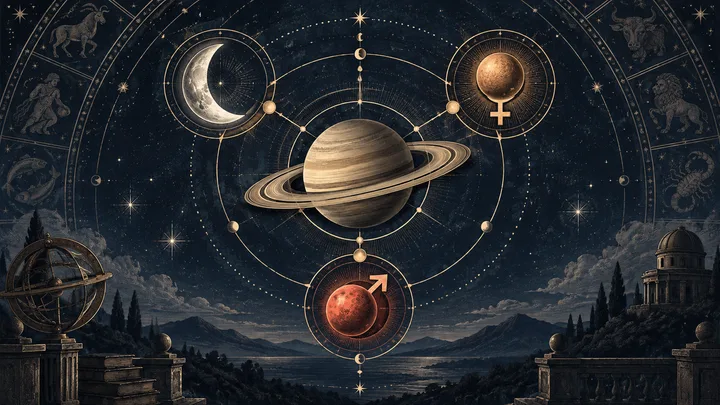
Saturn changes the terms of a contact. It adds time, duty, limits, memory, and consequence. The planet does not simply bless or block the Moon, Venus, or Mars. It asks that planet to become more deliberate. The question is whether the pair can meet that demand without turning care into supervision, affection into proof, or desire into a contest of endurance.
That is why the same Saturn aspect can feel protective in one relationship and heavy in another. A Saturn person may bring patience to a partner's Moon, steadiness to a partner's Venus, or focus to a partner's Mars. The same person may also criticize feelings, withhold approval, or slow every attempt to move forward. The symbol stays the same. The lived expression depends on the natal condition of the planets, the exact aspect, the direction of the contact, and the rest of the comparison.
The strongest position for this guide is simple: Saturn matters most as a management principle. It tells you where a relationship must develop a reliable practice. That practice may be checking in after conflict, naming what affection means, setting a pace for intimacy, or agreeing on how shared work gets done. If the pair builds that practice, Saturn can make a bond durable. If the pair avoids it, Saturn can make the unresolved issue feel older and larger every month.
This also explains why Saturn isn't a shortcut to a promise. A binding feeling can be meaningful, but it isn't the same as mutual care. A difficult contact can be workable, but it isn't a reason to ignore contempt, fear, or coercion. Read the astrology as a map of the relationship's pressure points. Then watch what the two people actually do with them.
The article's method follows a narrow path. Use the supplied Moon, Venus, and Mars placements. Add degrees when you have them. Count a selected major aspect within a six-degree orb. Read the planet first, the aspect second, and the wider pattern third. That order prevents one dramatic Saturn contact from swallowing the whole chart.
Saturn contacting the Moon, Venus or Mars changes the relationship area that carries weight. With the Moon, Saturn makes emotional safety feel earned, tested, and tied to reliability. With Venus, it gives affection a serious shape, but can also make love feel judged or rationed. With Mars, it slows desire and action, asking the pair to manage timing, anger, sex, and shared effort. The contact does not mean the relationship is doomed, and it does not certify a lasting bond. It shows where the connection needs structure. Read the contacted planet first, then Saturn's aspect to it. A close conjunction, square, opposition, trine, or sextile deserves more attention than a loose sign-only contact. In this guide, the report scope uses supplied placements and optional degrees, with a six-degree orb for selected major aspects. It does not calculate natal charts, houses, or a relationship outcome. The most useful question is not, "Is Saturn good or bad here?" Ask instead, "What does Saturn make us take seriously, and does the way we handle that pressure create steadiness or silence?" That question keeps the reading specific. A Saturn-Moon contact is about belonging, moods, care, and emotional timing. Saturn-Venus is about value, affection, pleasure, and the terms of closeness. Saturn-Mars is about pursuit, boundaries, anger, sex, work, and the right to act. Start with the tightest contact. Name the Saturn person and the personal-planet person. Compare the aspect. Then check whether another Moon, Venus, or Mars contact provides warmth, attraction, ease, or a way to repair tension. Saturn can hold a bond together, but it cannot supply every other ingredient.
Sources: Synastry | Cafe Astrology; Saturn in Synastry | Cafe Astrology; Introduction to Relationship Astrology 2: Synastry
What you need before reading the contact
Begin with the actual data. You need to know which person's Saturn is contacting which person's Moon, Venus, or Mars. Write it in that order: Maria's Saturn square Daniel's Moon, or Daniel's Saturn trine Maria's Venus. The names keep the roles visible. They also stop you from treating the aspect as an abstract label.
The Saturn person tends to embody the rule, limit, standard, or long view. The personal-planet person tends to feel the contact through the needs of that planet. This is not a rigid division. Both people participate, and a natal chart can make either person more familiar with Saturn's language. Still, the role distinction gives you a useful first pass. Ask what Saturn is asking for and where the other planet wants room to breathe.
Degrees matter. A contact at one degree is usually more immediate than a contact at six degrees. A conjunction, square, opposition, trine, or sextile has its own geometry, and a sign-based relationship is not the same thing as a degree-based aspect. If you only know that Saturn and the Moon share a sign, describe a sign connection. Don't promote it to a precise conjunction without degrees.
This report's comparison scope uses a six-degree orb for selected major aspects. The choice is deliberately clear. It gives the reader a repeatable boundary while leaving room for the Moon's sensitivity and the personal nature of the planets. A wider contact can still color the story, but it should not outrank a close contact simply because its symbolism sounds dramatic.
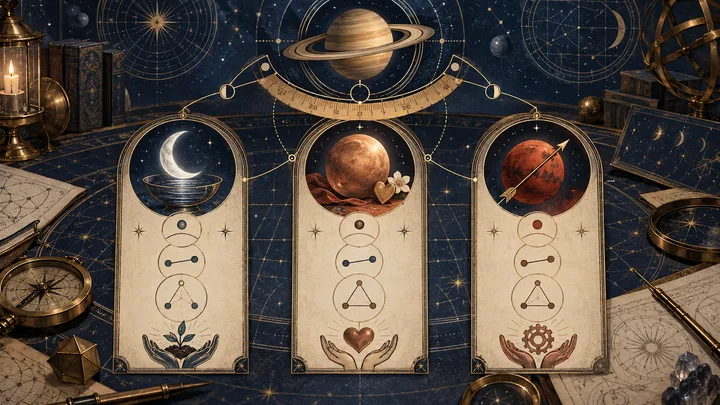
A useful worksheet has five lines. First, list the two placements and their degrees if known. Second, name the aspect and its orb. Third, write the contacted planet's job in the relationship. Fourth, write Saturn's demand. Fifth, record one supporting or conflicting contact. This small structure does more than a long list of aspects. It forces you to rank what you know.
You do not need to invent houses, birth times, or a full natal chart to answer the narrow question. If birth information is missing, say what remains outside the reading. You can still compare supplied Moon, Venus, and Mars signs and optional degrees. You just cannot claim a house overlay, a calculated Ascendant, or a complete chart judgment from absent inputs. Precision gives the interpretation more strength, not less.
Keep the roles separate from the moral story. The Saturn person is not automatically wiser, older, stricter, or in charge. The personal-planet person is not automatically needy, charming, or reckless. Those are possible expressions, not fixed identities. The chart contact describes an exchange of functions. It does not hand either person a permanent title.
Also note whether the contact is applying or separating only when that information is genuinely supplied and part of the chosen method. Don't use a technical label to create false precision. The strongest reading is often the plainest one: Saturn is close to the Moon, Venus, or Mars, and the pair keeps meeting the same question about safety, value, or action.
Sources: Synastry: Moon - Saturn Aspects | Cafe Astrology; Introduction to Relationship Astrology 2: Synastry
Saturn contacting the Moon: emotional safety becomes a practice
The Moon describes emotional needs, comfort, instinct, habit, and the private rhythm that appears when a person is tired or unguarded. Saturn contacting it makes those needs serious. The bond may feel familiar quickly, yet opening up can take time. The Moon person may sense that every feeling has to pass an inspection before it receives a response.
At its best, Saturn gives the Moon a container. The Saturn person remembers appointments, keeps a promise, stays present during an awkward mood, or helps turn care into something dependable. The Moon person may feel that their inner life has a place to land. Emotional safety stops being a beautiful idea and becomes a repeated act.
At its hardest, the Saturn person treats the Moon's needs as inconvenient, childish, excessive, or badly timed. The Moon person then edits feelings before sharing them. A pause becomes rejection. A practical suggestion sounds like a rebuke. The relationship may remain intact while the emotional life inside it grows quiet. This is the clearest exception to the easy Saturn-as-glue story: endurance without tenderness can preserve a structure that no longer feels inhabited.
The aspect changes the tone. A conjunction fuses Saturn's seriousness with the Moon's emotional field, so the pair may feel bound and exposed at once. A square or opposition creates a sharper conflict between need and control, timing and responsibility, or vulnerability and distance. A trine or sextile can make emotional steadiness easier to offer, though an easy aspect still needs warmth. Comfort can become routine, and routine can become emotional neglect if nobody names the feeling underneath it.
Consider an example. Imagine Maria's Moon at 14 degrees of Cancer and Leon's Saturn at 17 degrees of Libra. A three-degree square brings the aspect into focus. Maria may want immediate reassurance when the relationship feels uncertain. Leon may respond by discussing the plan, the schedule, or what can be proved. Neither response is meaningless. Maria is asking for safety. Leon is trying to create it through order. The work is translating those two forms of care before each person labels the other uncaring.
When Saturn touches the Moon, judge the contact by the quality of repair. Can the Saturn person return after a withdrawal and offer warmth, not only an explanation? Can the Moon person state a need without testing, hinting, or demanding mind-reading? The astrology points to the emotional lesson. The couple's practice shows whether they learn it.
The Moon person's sign still matters. A Moon that seeks privacy may experience Saturn's steadiness differently from a Moon that needs frequent verbal reassurance or visible movement. Saturn's sign matters too, because it shows the style of the structure: practical, verbal, social, guarded, ambitious, or physical. Keep the planet's core meaning in charge, then let the signs describe the accent.
There is a quiet strength in a well-held Saturn-Moon contact. The relationship may not look dramatic from outside. It may look like a person who remembers the difficult anniversary, makes soup without being asked, or returns to a conversation after sleeping on it. Those acts are not proof by themselves, but they show the form Saturn can give to lunar care.
Sources: Synastry | Cafe Astrology; Saturn in Synastry | Cafe Astrology; Synastry: Moon - Saturn Aspects | Cafe Astrology; Introduction to Relationship Astrology 2: Synastry
Saturn contacting Venus: affection gets terms, weight, and memory
Venus describes attraction, affection, taste, pleasure, values, and the way a person gives and receives appreciation. Saturn contacting Venus makes love concrete. It raises questions about loyalty, resources, time, exclusivity, and what each person is willing to sustain after the first rush fades.
A close Saturn-Venus contact can feel quietly compelling. The Venus person may see the Saturn person as mature, dependable, or difficult to dismiss. The Saturn person may feel responsible for protecting the bond. Shared routines become meaningful. A promise carries more weight. The relationship may grow through small, repeated acts rather than theatrical declarations.
But Venus needs to feel wanted, not merely retained. Saturn can turn affection into a performance review. The Saturn person may judge the Venus person's spending, appearance, pleasure, friends, or way of showing love. The Venus person may keep offering sweetness while wondering why approval always arrives late. In that version, the bond has commitment language but not enough delight.
The aspect helps describe the style of the lesson. A trine or sextile may support loyalty and steady affection with less friction. A conjunction can make love feel central, binding, and serious, while also blurring the line between devotion and obligation. A square or opposition can create a push and pull between desire and restraint. One person reaches for warmth. The other asks whether the warmth is safe, affordable, appropriate, or lasting.
The best question is not whether Saturn likes Venus. Ask what Venus is allowed to enjoy. Can the Venus person have taste, pleasure, and social ease without needing Saturn's permission? Can Saturn state a real value or limit without disguising control as wisdom? A healthy Saturn-Venus contact gives love a backbone. An unhealthy one makes love prove its worth every day.
Think of the difference between a promise and a contract. A promise can be heartfelt and still vague. A contract can be clear and still lifeless. Saturn wants clarity, but Venus needs beauty and generosity too. If the pair only talks about duties, the contact becomes dry. If the pair only chases pleasure, Saturn keeps returning as the unpaid bill. The interpretation ranks both needs, then asks how the couple can honor them at the same time.
When you read Saturn to Venus, look for evidence in ordinary choices. Who makes time? Who decides what counts as enough? Who apologizes without keeping score? Who can receive affection without making the other person earn access? Those questions reveal the contact better than a promise that the aspect guarantees permanence.
Venus also brings choice into the picture. A Saturn-Venus contact can make two people ask whether their values fit when attraction is no longer doing all the talking. How do they define loyalty? What does a shared life cost in time and attention? Which pleasures belong to both people, and which remain personal? Saturn can make these questions feel sober, but sober does not mean joyless.
Pay attention to criticism disguised as refinement. Saturn may notice what needs improvement, and Venus may hear that attention as a verdict on worth. The healthier expression names a shared standard without shrinking the person. A couple can decide to spend carefully, dress differently for an event, or protect private time without making one partner feel like a project.
Sources: Synastry | Cafe Astrology; Saturn in Synastry | Cafe Astrology; Synastry: Moon - Saturn Aspects | Cafe Astrology; Introduction to Relationship Astrology 2: Synastry
Saturn contacting Mars: desire meets the wall, the clock, and the rule
Mars describes desire, initiative, assertion, anger, physical drive, and the way a person moves toward what they want. Saturn contacting Mars changes speed. The Mars person may feel delayed, corrected, managed, or challenged by the Saturn person. The Saturn person may feel that Mars acts too quickly, pushes too hard, or ignores consequences.
This contact can be useful when the pair has a shared task. Saturn gives Mars a plan, a boundary, and a reason to keep going after excitement fades. Mars gives Saturn motion. Together they can build something, train for something, protect something, or handle an ordinary burden that neither person could carry well alone. The bond grows through disciplined effort.
It can also produce frustration that never finds a clean name. Mars reaches. Saturn brakes. Mars protests. Saturn tightens the brake. Sexual desire may become entangled with permission, timing, fear of failure, or resentment. Anger can come out sideways as criticism, delay, sarcasm, or a refusal to cooperate. A Mars-Saturn contact does not make conflict inevitable, but it does make the handling of force part of the relationship's central story.
Conjunctions, squares, and oppositions usually make the pressure more visible. The Saturn person may block the Mars person's initiative, or the Mars person may force Saturn to confront a wish that has been postponed too long. Trines and sextiles can support patience, technique, and shared stamina. They still need conscious desire. Ease can make the pair productive, but it cannot make either person feel wanted if attraction has been replaced by duty.
Consider this example. Imagine Noor's Mars at 22 degrees of Aries and Tomas's Saturn at 19 degrees of Cancer. The three-degree square may show up when Noor wants a direct answer and Tomas wants more preparation. Noor reads delay as avoidance. Tomas reads urgency as pressure. The useful interpretation does not choose a villain. It names the loop: urgency triggers caution, caution triggers more urgency. A workable agreement might give Noor a decision time and Tomas a defined period to think.
Mars needs a way to act that Saturn can respect. Saturn needs a boundary Mars can understand. That might mean setting a pace for physical intimacy, agreeing how to argue, or separating a practical delay from a personal rejection. Watch what happens after a no. Can Mars accept a limit without punishment? Can Saturn set a limit without humiliation? The answer tells you more than the aspect's reputation.
If Saturn contacts Mars while Venus or the Moon has a close supportive contact, the relationship may have more ways to soften the pressure. If Saturn repeats through several hard contacts to personal planets, rank the pattern rather than treating each aspect as an isolated omen. One challenge can become training. A whole system of restraint can become a climate.
Mars also tells you where the pair puts effort. A Saturn-Mars contact may show up less in romantic scenes than in moving house, managing money, planning travel, dealing with family demands, or deciding who carries an unpleasant task. The aspect becomes visible wherever initiative meets a limit. That is why the same contact can feel erotic in one season and logistical in another.
Don't confuse controlled action with dead action. Saturn can teach Mars aim, timing, and endurance. Mars can teach Saturn that a plan must eventually become a deed. If both people can name the shared goal, the contact often has somewhere constructive to go. Without a goal, the same energy circles around blame: one person is always too slow, and the other is always too forceful.
Sources: Synastry | Cafe Astrology; Saturn in Synastry | Cafe Astrology; Introduction to Relationship Astrology 2: Synastry
The aspect changes the lesson, but the planet sets the subject
Readers often ask whether a square is always worse than a trine, or whether a conjunction is automatically the strongest. Those shortcuts miss the point. The aspect describes how the two planetary principles meet. The contacted planet tells you what the meeting is about. Saturn square Moon is not just a difficult aspect. It is a difficult meeting between emotional need and structure. Saturn trine Venus is not simply a good aspect. It is an easier route toward durable affection, shared values, and pleasure with boundaries.
A conjunction intensifies and blends. Ask what becomes hard to separate. With Saturn and the Moon, care and duty may feel fused. With Saturn and Venus, love and obligation may be hard to distinguish. With Saturn and Mars, desire and restraint may operate as one engine. The conjunction can create recognition and commitment, but it can also make the issue constant.
A square creates friction that demands a method. It often shows where one person's instinct interrupts the other's preferred way of functioning. Moon wants comfort now. Saturn wants a responsible response. Venus wants appreciation. Saturn wants proof. Mars wants movement. Saturn wants control of timing. The square becomes more useful when the pair can identify the exact behavior that repeats instead of calling the whole relationship difficult.
An opposition creates a visible polarity. The two people may alternate roles, with one carrying Saturn's restraint while the other carries the personal planet's need. Or the same person may feel both sides inside the bond. Opposition contacts can create attraction because each side recognizes what it lacks. They can also create a ping-pong pattern in which every attempt to express one side provokes the other.
A trine or sextile makes cooperation easier, not automatic. The Saturn person may know how to support the personal planet without taking it over. The personal-planet person may accept structure without experiencing it as rejection. Yet easy aspects can go unused. A couple may have the capacity for patience and still fail to practice it. The chart shows an available path. Daily behavior decides whether anyone takes it.
Use the orb to rank intensity. A two-degree square should usually lead a six-degree sextile in the reading because it speaks more directly, even though the sextile sounds easier. Then check repetition. If Saturn also contacts another personal planet, the shared theme gains weight. If a close Moon-Venus or Venus-Mars contact provides tenderness or desire, it may change how the Saturn pressure is experienced. Don't erase the hard contact. Place it in the whole pattern.
The best interpretation can hold two truths at once. Saturn can stabilize and constrain. The exception is not a footnote. It is the test of the reading. If the article says Saturn is binding, ask whether the binding feels like loyalty or captivity. If it says Saturn is difficult, ask whether the difficulty gives the couple a skill they actually want.
A planet can also receive Saturn differently depending on whether it is already familiar with discipline in the natal chart. A person with a strong Saturn signature may recognize the contact quickly and use it well. Another person may experience the same pressure as a foreign demand. This is one reason a synastry aspect cannot be read as a free-floating verdict. The natal context belongs in the next layer when it is available.
If that context is not available, keep the claim modest and useful. Say what the contact emphasizes. Give two likely expressions. Name the behavior that would distinguish them. Then stop. A precise partial reading serves the couple better than a complete-sounding story built from missing chart information.
Sources: Synastry | Cafe Astrology; Synastry: Moon - Saturn Aspects | Cafe Astrology; Introduction to Relationship Astrology 2: Synastry
How to rank a Saturn pattern across Moon, Venus, and Mars
When several contacts appear, don't count them like points in a game. Rank them by closeness, planet, aspect, and repetition. A tight Saturn-Moon square may describe the emotional atmosphere even when a wider Saturn-Venus trine offers a useful resource. A close Saturn-Mars conjunction may dominate the couple's pace and conflict style while a soft Venus contact keeps attraction alive. Synastry becomes clearer when you decide what leads.
First, rank the tightest major contact. Record the degree difference if you have it. At zero to two degrees, the contact is likely to feel immediate. From three to four degrees, it remains a strong working theme. From five to six degrees, treat it as relevant but less commanding, especially if a closer contact says something else. These are editorial working bands, not a promise that every chart will behave identically.
Second, rank the contacted planet by the question being asked. If the couple is struggling with reassurance, begin with Saturn-Moon. If the issue is feeling valued, begin with Saturn-Venus. If the issue is sexual pace, initiative, or arguments, begin with Saturn-Mars. The same chart can produce three different readings because each planet answers a different relationship question.
Third, compare the aspect's action. Does Saturn join, challenge, oppose, or cooperate with the personal planet? Then name the behavior. "Restriction" is too vague. Is the restriction a delayed decision, a financial limit, a slower sexual pace, a demand for consistency, or a habit of withholding praise? Concrete language makes the astrology testable in the couple's own life.
Fourth, check for support. Moon-Venus can give the pair an emotional language. Venus-Mars can keep desire active while Saturn asks for patience. Moon-Mars can connect feeling and action, though hard contacts may make the connection volatile. A supportive contact doesn't cancel Saturn. It gives the pair another tool. A repeated hard pattern doesn't condemn the bond. It tells you where the tool kit is thin.
Imagine a comparison with Saturn trine one person's Venus within two degrees, Saturn square the other person's Moon within four degrees, and Saturn conjunct Mars at six degrees. The Moon contact may describe the most sensitive emotional issue. The Venus contact may show why the bond still feels worth tending. The Mars contact may matter when frustration accumulates, but its wider orb keeps it from outranking the closer patterns. That is a more useful reading than calling the chart simply good or bad.
Finally, ask who carries the standard and who carries the need. Then reverse the question. Saturn is not a one-way force. The personal-planet person may shape what the Saturn person learns about care, pleasure, or action. The Saturn person may not be the only one with authority. A mature interpretation describes mutual development without pretending the roles feel identical.
Sources: Saturn in Synastry | Cafe Astrology; Synastry: Moon - Saturn Aspects | Cafe Astrology; Introduction to Relationship Astrology 2: Synastry
Turn the interpretation into a decision you can use
A synastry reading becomes useful when it changes what you notice next. Saturn contacts are especially suited to practical questions because they describe repetition, timing, and responsibility. Don't ask the chart to make the decision for you. Ask it to show you which decision keeps returning.
For Saturn-Moon, observe emotional follow-through. When one person says they feel hurt, does the other stay curious? Does comfort arrive in the form the Moon person can receive? Does a period of distance end with a real return, or does the couple quietly move on and leave the wound in place? The decision point is whether the relationship can make emotional safety repeatable.
For Saturn-Venus, observe the economy of affection. Who gives praise, time, money, touch, and social consideration? Are the terms spoken openly? Can the Venus person enjoy the relationship without feeling monitored? Can the Saturn person ask for loyalty without making love a debt? The decision point is whether commitment makes pleasure safer or smaller.
For Saturn-Mars, observe how the pair handles a no, a delay, and a disagreement. Does a boundary end the conversation or start a better one? Can each person act without forcing the other? Does sexual tension become mutual play, or does it become pressure? The decision point is whether structure supports desire or replaces it.
Then run the three-part repair test. Name the pattern without accusation. Ask for one observable change. Set a time to review what happened. For example: "When plans stay vague, I become anxious and you feel pressured. I need us to choose a time by tonight. Let's check tomorrow whether that helped." Saturn respects a clear container. The Moon, Venus, and Mars all need the human feeling inside it.
The strongest exception remains important. A difficult Saturn contact can become one of the most valuable features of a synastry comparison when both people want the skill it demands. Someone may genuinely want a slower pace, stronger boundaries, or a more deliberate form of love. But no astrological promise turns repeated contempt into commitment, or fear into proof of depth. Saturn's seriousness should make the relationship more accountable, not less.
Use the chart as a prompt, then return to the evidence of the bond. Does care arrive? Does affection have room? Can desire move without punishment? If the answer is yes, Saturn may be giving the relationship a frame. If the answer is no, the frame is the thing you need to examine.
Write the next step in the language of the planet. For the Moon, choose a reassurance ritual or a repair time. For Venus, name one form of appreciation and one boundary around resources or pleasure. For Mars, agree on a pace, a task, or a conflict rule. The point is not to turn the relationship into a project plan. It is to give the Saturn principle a form that protects the human need underneath it.
Then let the result update the reading. If a small change creates more trust, Saturn may be functioning as a teacher and container. If every agreement becomes another test, the issue is not a lack of astrological symbolism. The relationship is showing you how it handles power. That is the decision point: continue building the structure, revise it together, or stop calling strain a promise.
This is also the point where you can compare the chart with the relationship's timing. A contact may become louder when the couple makes a promise, shares a home, changes work, or faces a family duty. Saturn's symbolism often appears when a private feeling meets a public consequence. Notice the transition, but don't invent a transit or date that the available chart data cannot support.
The final reading should leave you with one honest sentence. Perhaps it is, "We need a kinder way to set limits," or, "We have affection, but we keep making it prove itself." That sentence is more valuable than a grand prediction because it gives both people something they can answer through action.
If you are comparing two possible interpretations, choose the one that explains more behavior with fewer invented assumptions. Saturn-Moon should help you see how reassurance is offered and received. Saturn-Venus should clarify how affection and value become commitments. Saturn-Mars should show where action, pace, and anger need rules. When a reading names the pattern and the next test, you can return to it later and see whether the relationship has changed. That return matters. Saturn is measured in patterns over time, so a single intense evening should not outrank a clear history of how the pair responds to one another.
Let the symbolism sharpen your attention, not replace it. The chart can name the lesson, but the relationship reveals the answer through repeated choices. That is the point of a Saturn reading: not to predict a verdict, but to see whether responsibility leaves more room for trust, affection, and desire. Small choices count. They are where Saturn becomes real. Over time, they form the bond and reveal whether its structure can hold warmth and shared trust.
Sources: Synastry | Cafe Astrology; Saturn in Synastry | Cafe Astrology; Introduction to Relationship Astrology 2: Synastry
A little more clarity
Does Saturn in synastry mean the relationship will last?
No. Saturn can describe commitment, responsibility, and the work required to sustain a bond, but it doesn't certify an outcome. Read the contacted planet, aspect, orb, and supporting contacts. Then watch whether the two people turn Saturn's pressure into consistent care, clear limits, and repair. A binding feeling matters. So does the quality of what it binds.
Which feels harder, Saturn-Moon, Saturn-Venus, or Saturn-Mars?
They feel hard in different places. Saturn-Moon can make emotional vulnerability feel judged or delayed. Saturn-Venus can make affection feel conditional or overly dutiful. Saturn-Mars can create frustration around desire, timing, anger, or action. The closest contact usually leads, but the question you're asking decides which planet deserves first attention.
Can I read Saturn synastry without exact birth times?
You can compare supplied Moon, Venus, and Mars signs and degrees, then read selected major aspects within a stated six-degree orb. You can't responsibly claim house overlays, Ascendants, or a complete natal-chart comparison without the required birth information. Keep the scope narrow and name what the available placements can actually show.
Sources & further reading
- Synastry | Cafe Astrology
Supports the relationship meanings of Mars contacts, Saturn as binding structure, and major synastry aspect patterns.
- Saturn in Synastry | Cafe Astrology
Supports Saturn's themes of familiarity, responsibility, restriction, control, and growth under commitment.
- Synastry: Moon - Saturn Aspects | Cafe Astrology
Supports the dedicated Moon-Saturn aspect reference within a broader synastry framework.
- Introduction to Relationship Astrology 2: Synastry
Supports degree-based synastry comparison, limited major-aspect orbs, planetary roles, and Saturn's stabilizing or dampening effects.
- An Intro to Synastry Charts and Astrological Compatibility | Astrology.com
Supports the introductory meanings of Moon, Venus, Mars, and Saturn in romantic synastry.
Synastry Comparison Report
Enter known placements for two people. Get an input-by-input comparison, selected aspect calculations and a clear record of what remains uncertain.
Compare our placements