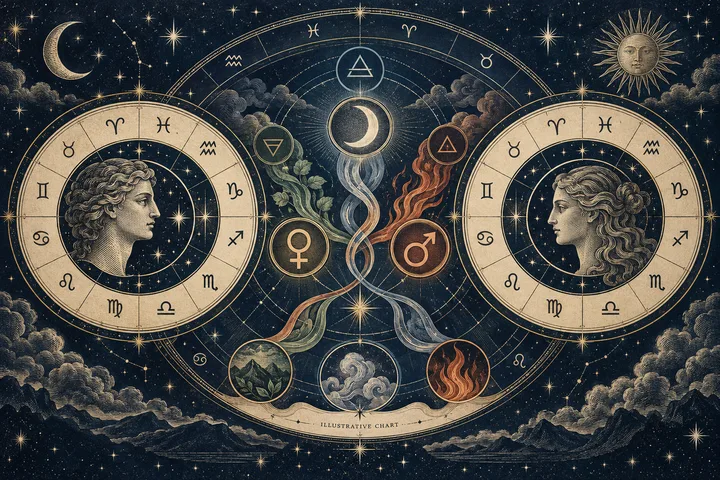
Triplicity rulers add a second layer by showing how much support a Moon, Venus, or Mars placement has behind it. The sign tells you the planet's immediate style. Its triplicity rulers show the wider elemental team connected to that sign, with the day or night ruler taking priority and the participating ruler adding a common thread. In synastry, compare those rulers with the other person's Moon, Venus, and Mars, then check whether the rulers are well placed in the chart information you actually have. This can explain why a smooth sign pairing feels steady, or why an exciting contact needs more care. It does not replace the planet, sign, or aspect. It ranks the background conditions around them. Start with sect, identify the three rulers, and ask which one is carrying the relationship theme most clearly.
Triplicity rulers do not replace the planet pair. They explain its support.
When people compare Moon, Venus, and Mars in synastry, they usually begin with the visible layer. One person's Moon touches the other's Venus. A Venus sign matches a Mars sign by element. Mars makes a close aspect to the other person's Moon. These are the parts you can see first, and they matter. But they do not tell the whole story.
Triplicity rulers add the room behind the doorway. They show which planets have a traditional relationship with the sign holding the Moon, Venus, or Mars. That relationship comes through the sign's element and the chart's sect, meaning whether the birth chart is diurnal or nocturnal. The day or night ruler leads. The other ruler follows. A third planet participates in both conditions. The result is not a new sign placement. It is a layer of planetary backing.
That distinction keeps the technique useful. A Moon in an earth sign still describes the emotional style in the sign itself. Its triplicity rulers do not turn the Moon into Venus or Mars. They show which planets may help, complicate, or qualify the Moon's way of seeking safety. Venus still describes affection, pleasure, taste, and values. Mars still describes desire, pursuit, heat, and conflict. Their rulers add context to those functions.
In synastry, the most valuable question is not, ‘Do our triplicity rulers match?’ That question is too blunt. Ask instead: what does each ruler add to the planet's job, and does the other person's chart meet that added need? A Moon may need reliable earth and a practical response. Venus may need warmth that feels generous rather than merely intense. Mars may need an outlet that turns pressure into action instead of argument. The rulers help you name those differences.
The traditional sources treat triplicity rulership as a dignity. In other words, it is one measure of how a planet can operate in a sign, alongside other measures such as domicile, exaltation, terms, and placement. Vettius Valens describes the three rulers as co-workers or guardians of the triangle, with priority changing between day and night. He then directs the reader to inspect their places, aspects, and condition. That sequence matters. A ruler is not a magic label. It is a planet whose condition deserves inspection.
So the supported view is clear. Use triplicity rulers after you have identified the Moon, Venus, or Mars contact, not before. They are a ranking tool. They can tell you which relationship need has more support, which one needs conscious care, and which apparent promise is too weak to carry the whole reading.
A useful way to test the layer is to separate capacity from expression. Capacity asks what the planet can draw on. Expression asks what the couple actually experiences. A dignified ruler can describe available support without promising that either person will use it well. A strained ruler can describe a task without making the task impossible. This distinction keeps the reading human. You are not assigning a permanent grade to either chart. You are identifying the kind of attention that lets a planetary promise become a lived habit.
The strongest exception is a very tight, exact aspect. A close Moon-Venus or Venus-Mars contact can speak loudly even when the triplicity layer is mixed. Do not erase a strong contact because a ruler is awkward. Read the contact first, then let the ruler explain why it flows, stalls, or asks for work.
Sources: The Classical Use of Triplicities; Vettius Valens, Anthologies, Book II
Begin with sect, then name the three rulers without changing systems halfway through.
Triplicity work becomes confusing when an astrologer starts with a table but never states which table or sect is in use. Keep the method visible. For this guide, use the classical three-ruler scheme associated with Dorotheus and Valens. The four triplicities are fire, earth, air, and water. Each has a day ruler, a night ruler, and a participating ruler.
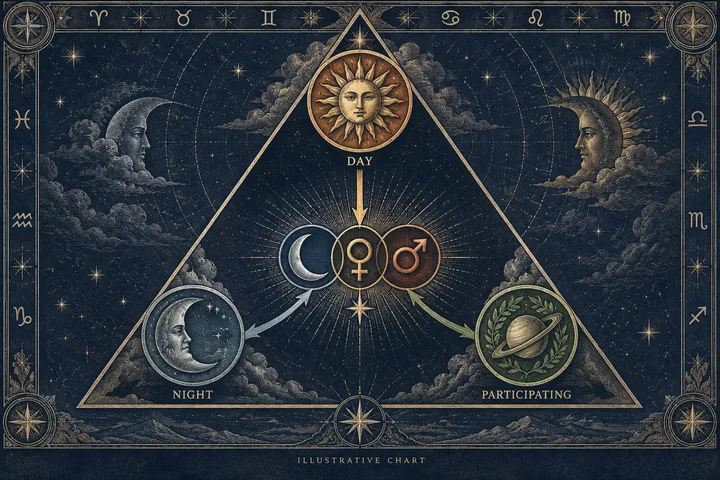
The working table is simple. Fire, covering Aries, Leo, and Sagittarius, has the Sun by day, Jupiter by night, and Saturn as participating ruler. Earth, covering Taurus, Virgo, and Capricorn, has Venus by day, the Moon by night, and Mars as participating ruler. Air, covering Gemini, Libra, and Aquarius, has Saturn by day, Mercury by night, and Jupiter as participating ruler. Water, covering Cancer, Scorpio, and Pisces, has Venus by day, Mars by night, and the Moon as participating ruler.
The order changes with the chart's sect. In a day chart, the diurnal ruler leads. In a night chart, the nocturnal ruler leads. The participating planet remains part of the picture. Valens gives this order directly in his discussion of the triangles, and he then asks the astrologer to look at the ruler's location, angularity, aspects, and relationship to its own signs. Houlding's historical account also describes the three rulers as a sequence that can speak to beginning, middle, and end. That does not mean every modern synastry reading should become a life-timing prediction. It means the order gives you a way to rank the layer rather than flatten it.
There is one practical limit. If you only know both people's Moon, Venus, and Mars signs, but you do not know birth time or chart sect, you cannot honestly choose the day or night ruler. You can still identify the triplicity and list its three traditional rulers. You can say that the priority remains conditional on sect. You should not quietly assume a day chart because the birth occurred in the daytime according to a vague memory, and you should not treat a missing birth time as a minor detail when the method depends on it.
You also need to keep zodiac systems consistent. A tropical sign comparison and a sidereal sign comparison can place a planet in different triplicities. Neither becomes useful if the reader moves from one to the other halfway through the report. State the supplied sign labels and the chosen system. If the signs were supplied without calculation from birth data, read those placements as inputs, not as a newly calculated chart.
Now add the synastry bridge. For every relevant planet, write down four things: the planet's sign, its triplicity, the chart's sect if known, and the prioritized ruler order. Then compare those rulers with the other person's relationship planets. You are looking for repetition. A Moon in Taurus with Venus as the day ruler may gain a strong Venus thread. If the other person has a prominent Venus contact to that Moon, the same theme appears at the sign level and in the supporting dignity. That is more meaningful than a single loose resemblance.
But do not overstate repetition. A ruler in the same element is not automatically a conjunction, trine, or promise. It is a shared symbolic field. Degree-based aspects still require degrees. The Synastry Comparison Report can use supplied Moon, Venus, and Mars signs, plus optional degrees, and can select major aspects with a stated six-degree orb. It does not calculate missing natal positions, houses, or birth charts from dates. That boundary makes the interpretation cleaner, not smaller.
Make the method visible in a small worksheet. List each person's planet, sign, triplicity, three rulers, and any repeating planet in the other chart. Leave sect blank when it is unknown. That single blank prevents a false ranking, while the separate columns stop sign resonance, aspects, and rulership from being counted as the same evidence.
The next inspection is the ruler's condition. If you only have supplied signs, compare the ruler's sign and element with the planet it supports, then describe the result as a symbolic tendency. If you also have degrees, inspect close contacts involving the ruler and the other person's Moon, Venus, or Mars. If a full birth chart is available, houses and angularity can add another layer, but they are outside a sign-and-optional-degree report. Do not borrow that extra precision when the input does not contain it.
This gives the participating ruler a clear job. It is not a spare answer to use whenever the leading ruler feels inconvenient. It becomes useful when the day and night possibilities are both live, or when the same planet repeats across the comparison. For example, a Taurus Moon with unknown sect still has Venus, Moon, and Mars in its ruler set. If the partner's Venus and Mars both touch that set by sign or aspect, the reading can name a tension between comfort, pleasure, and action without pretending to know which planet leads. The missing sect changes the ranking, not the existence of the theme.
Sources: The Classical Use of Triplicities; Vettius Valens, Anthologies, Book II
The Moon layer asks whether emotional contact has a dependable way to settle.
The Moon is where triplicity rulers become especially revealing. The Moon receives impressions, describes familiar comfort, and shows how a person moves toward belonging. In a synastry comparison, Moon contacts often tell you what feels private and immediate between two people. The sign shows the style of that response. The triplicity rulers show the planets standing behind the style.
Consider an example. Imagine Maria has the Moon in Taurus and a night chart. Taurus belongs to the earth triplicity. The Moon leads that triplicity by night, Venus follows, and Mars participates. Her emotional pattern therefore carries a lunar need for steadiness, a Venusian concern with pleasure and attachment, and a Martian question about how practical pressure gets handled. The last point does not mean Maria is secretly combative. It means the participating ruler gives Mars a seat at the table when you ask what helps this Moon remain secure under strain.
Now imagine Daniel has Venus in Taurus and Mars in Cancer. Without inventing degrees, you can see two possible bridges. Daniel's Venus speaks the same earth language as Maria's Moon, so affection may arrive through presence, touch, food, time, or dependable habits. His Mars in Cancer belongs to the water triplicity, which introduces a more protective and mood-sensitive way of acting. If their actual aspects are close, the triplicity layer helps you ask whether Daniel's care settles Maria or whether his protective reactions make the atmosphere harder to read.
The decision aid is concrete. When a Moon contact feels good, ask what happens after the first warm moment. Does the other person's planet support the Moon's need in a repeatable form? A shared earth thread may need consistency. A fire thread may need encouragement and room to act. Air may need words, perspective, and movement. Water may need emotional presence and protection. These are not rigid personality labels. They are ways to observe what kind of response lets the Moon soften.
Triplicity rulers can also explain a mismatch that sign shorthand misses. Suppose one person's Moon and the other person's Venus share an element, but the Moon's prioritized ruler is placed in a difficult condition or receives little support from the other chart. The contact may still feel affectionate. Yet the person may struggle to sustain the behavior that creates safety. The attraction is real. The maintenance problem is real too. Read both.
When sect is unknown, stay with the full set of rulers. A Taurus Moon still belongs to earth, and Venus, Moon, and Mars remain the relevant traditional rulers. You can compare the other person's planets to each one without pretending to know which one leads. If degrees are known, inspect actual aspects. If degrees are missing, describe the elemental and rulership themes as interpretive context rather than as calculated aspects.
The Moon layer should therefore end in a practical question: what does reassurance look like here, and can both people recognize it? Triplicity rulers help you answer the second half. They show whether the emotional language has one obvious carrier or several competing ones. A relationship does not need one perfect language. It does need a way to translate when the first language fails.
Pay attention to the difference between soothing and solving. An earth-supported Moon may settle when someone handles a task. A water-supported Moon may settle when someone stays emotionally present. An air-supported Moon may settle after the feeling has been named and discussed. A fire-supported Moon may settle when the bond restores confidence and forward motion. These descriptions are starting points, not scripts. Watch the person's actual response. The best synastry interpretation is the one that helps you notice the response sooner and answer it with less guesswork.
Sources: The Classical Use of Triplicities; Vettius Valens, Anthologies, Book II
The Venus layer asks whether affection and value have real support behind them.
Venus synastry is often reduced to attraction. That leaves out the part people meet every day. Venus also describes taste, pleasure, social ease, the way someone gives and receives appreciation, and the values that shape a choice. A Venus contact can feel lovely and still leave two people with different ideas about time, money, loyalty, beauty, or peace. Triplicity rulers add a way to see what kind of support Venus has when the first sweetness becomes a pattern.
Imagine Maria's Venus is in Leo in a day chart. Leo belongs to the fire triplicity. The Sun leads by day, Jupiter leads by night, and Saturn participates. Her Venus may want visible warmth, generous praise, and a relationship that feels alive rather than hidden. The Saturn thread does not cancel that desire. It asks whether the affection has form, boundaries, and staying power. The Sun and Jupiter threads ask whether warmth is expressed openly and whether joy has room to grow.
Now imagine her partner has the Moon in Sagittarius and Mars in Aquarius. Again, this is a worked sign-level scenario, not a calculated personal chart. The Sagittarius Moon shares the fire triplicity with Maria's Venus. That can create a natural feeling of enthusiasm and mutual lift. The Aquarius Mars belongs to air, whose classical rulers are Saturn by day, Mercury by night, and Jupiter as participant. Mars may approach desire through ideas, independence, conversation, or experimentation. Maria's Venus may enjoy the freshness, but it may also ask for a more personal display of warmth than Aquarius Mars offers automatically.
The triplicity layer changes the question from ‘Are we attracted?’ to ‘What keeps attraction generous?’ If the relevant rulers repeat across both charts, affection may have several ways to express itself. If the rulers clash, the connection may still be strong, but each person may need to translate. A Saturn-backed Venus may want proof through reliability. A Jupiter-backed Venus may want good faith and room. A Mercury-backed Venus may want the conversation to stay alive. The planet's placement and condition decide how these themes actually behave.
This is where ranking matters. First, read the Venus sign and any close Venus contacts. Second, inspect the prioritized triplicity ruler and its relation to the other person's Moon, Venus, and Mars. Third, check whether the participating ruler repeats a useful or difficult theme. Do not let three ruler names become three equal paragraphs of symbolism. The leading ruler gets first consideration. The second adds a qualifying note. The participating ruler tells you what remains in the room even when sect changes.
A common exception appears when Venus is in a sign traditionally associated with a ruler that feels uncomfortable to modern readers. A Venus-Mars thread can bring heat, initiative, and direct desire, but it can also make affection feel contingent on action. That is not automatically bad. It becomes important when one person reads action as love and the other reads it as pressure. The chart does not decide the answer for you. It tells you what to ask and what behavior to watch.
For a couple comparing known placements, the useful next step is to name one value in plain language. ‘We both like closeness’ is too broad. Try ‘We both need regular time together,’ or ‘We both want affection to stay private,’ or ‘We show care by solving problems.’ Then compare that value with the Venus sign and its rulers. If the symbolism and the daily choice agree, the layer reinforces the bond. If they disagree, the reading gives you a conversation before resentment has to do it.
You can also use Venus's rulers to distinguish a preference from a condition. A preference is a style someone enjoys, such as grand gestures, quiet touch, clever conversation, or practical help. A condition is what must be present for affection to remain open, such as respect for privacy or a steady promise kept. The triplicity layer may suggest which planet carries that condition. Ask for it directly rather than making the other person guess. That is where a symbolic reading becomes a useful relationship practice.
Sources: The Classical Use of Triplicities; Vettius Valens, Anthologies, Book II
The Mars layer asks how desire, initiative, and conflict move through the bond.
Mars shows how a person acts when something matters. In synastry, Mars can describe pursuit, sexual energy, courage, irritation, competition, and the way conflict gets started or stopped. Because Mars moves quickly into action, people often feel its contact before they understand it. Triplicity rulers slow the reading down just enough to reveal what kind of action is being supported.
Consider an example. Imagine Daniel has Mars in Virgo in a night chart. Virgo belongs to the earth triplicity. The Moon leads earth by night, Venus follows, and Mars participates. His Mars may pursue through practical effort, correction, preparation, and useful work. The Venus thread asks whether that effort can remain considerate. The lunar thread asks whether action responds to actual needs or only to the actor's idea of what should be fixed. Mars participating in its own triplicity does not guarantee ease. It makes the planet part of the elemental structure, and its condition still matters.
Imagine Maria has Venus in Pisces and Moon in Gemini. Pisces belongs to water, whose rulers are Mars by night, Venus by day, and the Moon as participant. Her Venus carries a Venusian connection to its own water triplicity, while her Gemini Moon belongs to air, ruled by Saturn and Mercury according to sect, with Jupiter participating. This can create an interesting contrast. Her affection may seek softness and emotional merging, while her Moon processes experience through words, questions, and changing angles. Daniel's practical Mars may feel grounding one day and overly corrective the next.
The triplicity reading does not label either person as right. It identifies the pressure point. If Mars repeatedly meets the other person's Venus or Moon, ask how initiative lands. Does the action create safety, pleasure, or heat? Does it arrive at the right time? Does it leave room for the other person's response? A strong Mars contact can be deeply magnetic, but it can also turn every difference into a contest if no Venus or Moon layer receives it.
Use the rulers to sort three different experiences that people often call chemistry. The first is activation: Mars gets the other person moving, alert, and interested. The second is cooperation: the triplicity rulers give that energy a compatible channel, often through shared elemental needs or repeated planetary themes. The third is repair: after desire or conflict rises, the Moon and Venus layers can help the bond return to warmth. A chart may show the first and lack the third. That is why Mars should never be allowed to speak for the whole relationship.
If the Mars ruler is strong by the information available, describe the action as supported, not guaranteed. If it is under strain, describe the work plainly. A difficult Mars layer may need slower timing, clearer requests, or a rule against solving an emotional problem with more pressure. A harmonious Mars layer may still need consent and space. Astrology gives the shape of the impulse. People choose how they carry it.
When degrees are available, rank exact major aspects before sign-based resonance. A six-degree orb can be stated and applied consistently in a report, but a sign match alone is not an aspect. When degrees are not available, keep the reading at the sign and ruler level. That protects the reader from a false sense of precision while preserving the useful question: what kind of action does this connection invite, and what helps it remain welcome?
Mars also benefits from a timing pause inside the reading. Notice what happens before action, during action, and after action. Before action, one person may need emotional permission while the other needs a clear plan. During action, one may become direct while the other becomes protective or analytical. After action, the Moon and Venus reveal whether the energy returns to closeness or leaves a residue. The triplicity rulers help you name which planetary function should take the lead at each stage. That is more precise than calling the pair simply passionate or difficult.
Sources: The Classical Use of Triplicities; Vettius Valens, Anthologies, Book II
Read the three layers together, then choose the relationship question they can actually answer.
Triplicity rulers become most useful when they stop being a glossary entry and start changing the order of your reading. Begin with the strongest visible contact. Is it Moon-Venus, Venus-Mars, Moon-Mars, or a repeated theme across all three? Name what that contact does. Then identify the triplicity of each planet, determine sect if the chart data allows it, and rank the rulers. Finally, ask which ruler repeats in the other person's Moon, Venus, or Mars. That repeated ruler is a candidate for the hidden support or hidden friction in the pattern.
Here is a complete worked comparison. Imagine Maria has Moon in Taurus, Venus in Leo, and Mars in Pisces. Imagine Daniel has Moon in Sagittarius, Venus in Taurus, and Mars in Aquarius. No degrees are supplied, so this example does not claim an aspect. It shows how to layer sign meanings and triplicity rulers without inventing a calculated chart.
Maria's Taurus Moon and Daniel's Taurus Venus repeat the earth sign. The first reading is familiar: Maria may feel that Daniel's affection speaks to her need for steadiness and tangible care. Because Taurus is earth, the ruler set is Venus, Moon, and Mars, with priority changing by sect. That adds a richer picture. The connection may be tender and practical, but it may also carry a question about how comfort responds to pressure. If Maria's chart is nocturnal, her Moon leads the earth triplicity. If it is diurnal, Venus leads. The same signs remain, but the emphasis changes.
Maria's Leo Venus and Daniel's Sagittarius Moon repeat the fire triplicity. Affection may feel encouraged by Daniel's emotional style. He may respond to warmth with warmth, enthusiasm, and a desire to keep life moving. Fire is ruled by the Sun, Jupiter, and Saturn, with the first position changing according to sect. The Sun and Jupiter can describe generosity and lift; Saturn asks whether the relationship can give that warmth a durable shape. This is not a verdict. It is a reason to ask whether praise, adventure, and commitment are all present, or whether one is carrying the others.
Maria's Pisces Mars and Daniel's Aquarius Mars do not share a triplicity. Water Mars can act through feeling, protection, and indirect pressure. Air Mars can act through ideas, distance, and quick shifts in attention. The contrast may be stimulating. It may also create a translation problem during conflict. Maria may want emotional acknowledgment before action. Daniel may want to discuss the principle before addressing the feeling. Their Mars layer needs a bridge, not a score.
Now rank the interpretation. First comes the repeated Taurus sign between Moon and Venus because it directly links emotional comfort and affection. Second comes the repeated fire triplicity between Venus and Moon because it can support delight, praise, and mutual encouragement. Third comes the Mars contrast because it names the likely work point. This order is more useful than saying the charts are ‘highly compatible’ or ‘mixed.’ It tells the couple where the ease may live and where a conversation should begin.
Notice what this ranking does not claim. Maria's Taurus Moon and Daniel's Taurus Venus share a sign, but they are not conjunct without degrees. The sign gives a common field. A degree-based aspect shows direct contact. The ruler adds a third question: which planet carries that field, and does it echo elsewhere? A useful report can say, ‘The sign pattern supports practical affection; the degrees would decide whether the planets aspect; the ruler pattern makes Venus the first planet to inspect.’ Each layer then has one job.
The strongest exception is a close major aspect that cuts across the sign picture. A tight square or opposition can make an easy elemental match urgent, while a close trine can soften a difference. Triplicity rulers qualify aspects. They do not overrule them. Give first place to the tight contact, then use the ruler condition to explain why it flows, stalls, or needs care.
Use this sequence with your supplied placements. List both people's Moon, Venus, and Mars signs. Mark their triplicities. Add day, night, and participating rulers, but only prioritize sect when it is known. Compare those rulers with the other person's three planets. If degrees are supplied, assess the agreed major aspects with a six-degree orb. If they are missing, leave the aspect judgment open.
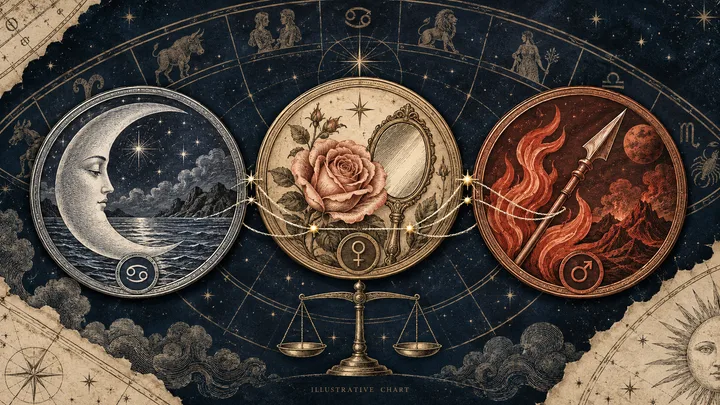
When the layers disagree, rank them by the question. Moon leads a question about emotional safety. Venus leads affection and shared values. Mars leads pursuit, erotic charge, and conflict. The other two planets qualify the answer. This lets you say, for example, that Venus support comes easily while Mars needs a repair rule, instead of hiding both facts inside ‘mixed compatibility.’
Now translate the leading pattern into a test you can observe within a week. Earth support might become a plan both people make and keep. A Saturn thread in Venus might become one promise stated plainly and repeated through action. An air contrast in Mars might call for discussing the issue without turning the feeling into a debate. If the symbolism cannot reach a behavior, it has not earned its place in the reading.
Consider an example where the Moon layer points to steadiness, Venus points to shared warmth, and Mars shows different conflict rhythms. The useful decision isn't a score. Keep the affection, then agree on repair: pause, name whether you want comfort, a solution, or space, and return at a stated time. The chart names the pressure. Daily conduct shows whether the couple can meet it.
Use the missing inputs to choose the size of the conclusion. With a close Venus-Mars aspect, begin with desire and response, then ask whether the Moon layer can make that heat feel safe. With signs but no degrees, describe the shared elemental field and leave the aspect judgment open. With unknown sect, list both ruler priorities and choose the relationship question before choosing a leading ruler. Precision here doesn't weaken the reading. It tells you which part is observation and which part is interpretation.
Your final action is small. Choose one act of care that strengthens the leading supportive ruler and one boundary that keeps the Mars tension from taking over. If the behavior improves, the interpretation has become useful. If it does not, the pattern still gave you a clearer question and stopped chemistry from standing in for cooperation. Write the test down in ordinary language. ‘We need more earth’ is vague. ‘We will make the plan before Friday and keep it’ can be observed. ‘Mars needs space’ is vague. ‘We pause for twenty minutes and return at eight’ gives the tension a container.
Triplicity rulers are a second layer because they add order to what you already see. Start with the strongest Moon, Venus, or Mars contact. Rank its elemental support. Then ask the people involved to test that reading in ordinary life. That sequence keeps the chart precise: the planet names the need, the aspect shows contact, the ruler shows support, and the conversation tests the interpretation. Keep the conclusion practical, specific, and open to what the couple actually observes.
Sources: The Classical Use of Triplicities; Vettius Valens, Anthologies, Book II
A little more clarity
Do triplicity rulers create a synastry aspect?
No. Triplicity rulers describe a dignity and elemental relationship. They do not create a conjunction, trine, square, or opposition. Use supplied degrees to assess actual major aspects with a stated orb, such as six degrees. Without degrees, keep the reading at the sign and ruler level.
What if I do not know whether a chart is day or night?
List all three rulers and mark the priority as conditional. The triplicity still belongs to the planet's sign, but you should not choose a leading ruler without reliable sect information. A missing birth time also limits houses and other timed techniques, so say exactly what the comparison can and cannot rank.
Should I read the Moon, Venus, or Mars triplicity ruler first?
Start with the planet involved in the strongest close contact or the question you are trying to answer. Use the Moon for emotional settling, Venus for affection and values, and Mars for desire and conflict. Then inspect the ruler that repeats most clearly in the other person's relationship planets.
Can triplicity rulers show whether a relationship will last?
They can show support, tension, and the kind of care a pattern asks for. They do not certify a future outcome. Rank the Moon, Venus, and Mars layers, check the actual aspects when degrees are available, and bring the strongest question into a real conversation.
Sources & further reading
- The Classical Use of Triplicities
Explains the classical three-ruler scheme, sect priority, elemental triangles, and practical use of triplicity rulers.
- Vettius Valens, Anthologies, Book II
Provides Valens's day, night, and participating ruler order and directs readers to inspect each ruler's condition.
- Triplicity Rulers in Astrology: The Elemental Layer of Essential Dignity
Summarizes the Dorothean day, night, and participating rulers and distinguishes that table from later variants.
Synastry Comparison Report
Enter known placements for two people. Get an input-by-input comparison, selected aspect calculations and a clear record of what remains uncertain.
Compare our placements