The short answer: precision and reach do different jobs
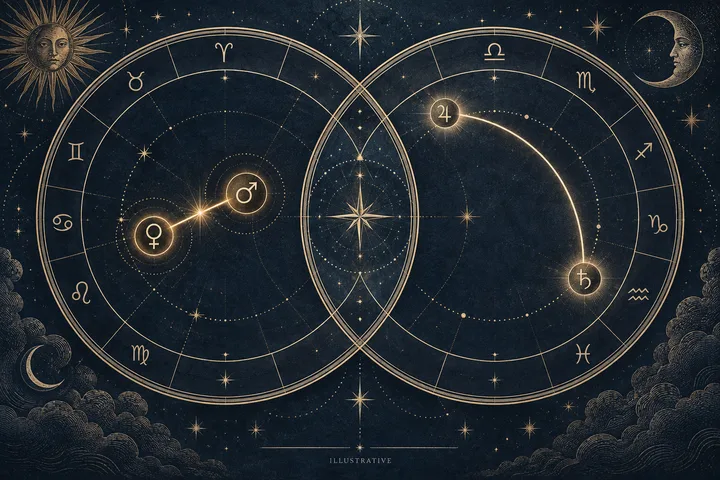
When two synastry contacts compete, don't ask which one is stronger in every sense. Ask what each one can explain. A close minor aspect has precision. A major aspect has a recognized structural role. Orb and aspect family both matter, but they answer different parts of the reading.
The working judgment is this: lead with the tight, relevant contact when you need to describe a distinctive pattern. Keep the loose major aspect as context when it remains within the orb you chose. The minor aspect gives the sentence texture. The major aspect gives it a larger room to live in.
That rule defeats two lazy shortcuts. Major doesn't mean automatically first, and exact minor doesn't mean automatic control of the chart. A contact earns space by combining closeness, planetary relevance, aspect meaning, and support from the rest of the comparison.
Sources: Aspects - Astrodienst Astrowiki; Orbs (or rays) - Skyscript Glossary; An Introduction to Aspects and Chart Shaping in Natal Astrology
What information must be settled before the ranking
An aspect is an angular relationship between two chart points. The five classical major aspects are the conjunction at 0°, sextile at 60°, square at 90°, trine at 120°, and opposition at 180°. Minor aspects include the semi-sextile, semi-square, quincunx, quintile, biquintile, and others. The label tells you which family the contact belongs to. It doesn't tell you how close the contact is.
The orb is the distance from the exact angle. If two positions are 72°30′ apart, their quintile has a 0°30′ orb. If two others are 125°30′ apart, they sit 5°30′ from an exact trine. Record the positions, the separation, the exact angle, and the remaining orb. A line on a wheel is not enough.
Astrologers don't use one universal orb policy. Some give major aspects more room and minor aspects less. Traditional approaches may assign orbs to the planets, with the Sun and Moon receiving more influence than Venus or Mars. That is why the rule must appear before the interpretation. A ranking built on hidden admissions will keep changing under your feet.
For the confirmed report scope, the six-degree ceiling belongs to selected major-aspect calculations using supplied placements and optional degrees. It should not be described as a product rule that calculates minor contacts. This article can still teach the comparison, but its quintile and other minor-aspect examples are editorial illustrations, not a promise of a report feature.
If a degree is rounded, say so. A contact near the boundary may move in or out of the chosen orb when minutes are restored. With signs alone, stay at the sign layer. You can discuss resonance between signs, but you can't claim a precise degree-based aspect that the inputs don't establish.
Sources: Aspects - Astrodienst Astrowiki; Orbs (or rays) - Skyscript Glossary; A Brief Introduction to Astrology: Aspects
Why a tight minor aspect can deserve the first close look
A minor aspect earns attention when it is close, relevant, and readable. Close means its orb is narrow under the chosen method. Relevant means the planets answer the question. Readable means you can state what it adds without repeating a major aspect in fancier language.
A 0°20′ Venus-Mars quintile offers an illustrative example. Venus describes affection, taste, pleasure, and values. Mars describes pursuit, desire, initiative, and action. The quintile can be read as a distinctive pattern in the way affection draws out desire. The pair may have a private rhythm of flirtation, timing, or creative play. That is a symbolic line of inquiry, not a forecast.
A 0°20′ Moon-Mars semi-square asks a different question. The Moon seeks comfort and familiar emotional rhythm. Mars moves, presses, pursues, or reacts. Their close contact may describe a small but recurring mismatch between needing comfort and taking action. It needn't become a dramatic fight. Sometimes the value is simply naming the moment when one person wants tenderness and the other starts fixing.
Exactness opens the door. Planet relevance decides whether you walk through it. If the contact explains a detail the reader already recognizes, give it a clear paragraph. If it only supplies an attractive phrase, keep it brief. A minor aspect should sharpen the reading, not decorate it.
Sources: Aspects - Astrodienst Astrowiki; An Introduction to Aspects and Chart Shaping in Natal Astrology; Minor Aspects in Astrology, with Rick Levine
Why the loose major aspect still belongs in the frame
A major aspect isn't automatically powerful because of its name. A trine at 0°40′ is more exact than a trine at 5°55′. The wider contact needs measured language. Still, the major family gives the reader a broad relationship between the two planetary functions, and that framework can matter even when the contact is loose.
A 5°30′ Moon-Venus trine, for example, may describe an available channel between feeling and affection. One person's emotional style may find room in the other's way of showing care. At that orb, write “can support” or “may make room for.” Don't make the trine carry a complete story by itself.
The aspect's nature remains important. A square puts the functions into active friction. An opposition creates polarity and awareness. A trine allows flow, while a sextile offers a possibility that still needs engagement. Orb changes the volume of the contact. It doesn't turn a square into a trine or a trine into a conjunction.
So let the major aspect supply the broad condition, then let the tight minor contact explain a particular expression inside it. If the major contact is the one that answers the reader's central question, reverse the order. The method is conditional, but the final reading should still choose a lead.
A tight minor aspect usually deserves the sharper description, while a loose major aspect usually deserves the wider structural place. That isn't a tie on one scale. A 0°30′ Venus-Mars quintile can describe a precise style of attraction; a 5°30′ Moon-Venus trine can describe a broader ease between feeling and affection. First verify the degrees and orb. Then ask which planets answer the reader's question. Finally, look for a repeated theme that confirms one contact without double-counting it. The important product boundary is simple: the Synastry Comparison Report uses supplied Moon, Venus, and Mars placements, optional degrees, and selected major-aspect calculations under its stated six-degree method. It doesn't promise to calculate or rank minor aspects. Use the guide below to read the distinction clearly, and keep any minor-aspect example illustrative unless its data have been supplied separately.
Sources: Aspects - Astrodienst Astrowiki; Orbs (or rays) - Skyscript Glossary; A Brief Introduction to Astrology: Aspects
A worked example: a close quintile beside a wide trine
Imagine Maria has Venus at 18°10′ Leo and Daniel has Mars at 0°40′ Scorpio. Their positions are 72°30′ apart, so this illustrative Venus-Mars quintile has a 0°30′ orb. In the same imagined comparison, Maria's Moon is at 12°00′ Libra and Daniel's Venus is at 17°30′ Aquarius. Those positions are 125°30′ apart, or 5°30′ from an exact trine. These are two different planet pairs.
Read the quintile first if the question is about the distinctive style of attraction. Leo Venus can seek warmth and visible appreciation. Scorpio Mars can pursue with focus and intensity. Together, the symbols suggest a private pattern in how interest is offered and received. They don't certify permanence, and they don't tell either person what to feel.
Read the Moon-Venus trine next if the question is about emotional welcome. Libra Moon may seek peace, conversation, and graceful exchange. Aquarius Venus may value friendship, space, and an unusual route into affection. At 5°30′, call this a possible background ease. Let lived recognition and other supplied contacts decide how much room it gets.
The point of the example is the order, not the invented people. The exact minor contact gives a specific texture. The wide major contact gives a broader setting. If another close Moon-Venus contact repeats the emotional theme, that theme can move to the center. If not, the quintile remains a detail rather than a verdict.
Rank the planets before you rank the aspect label
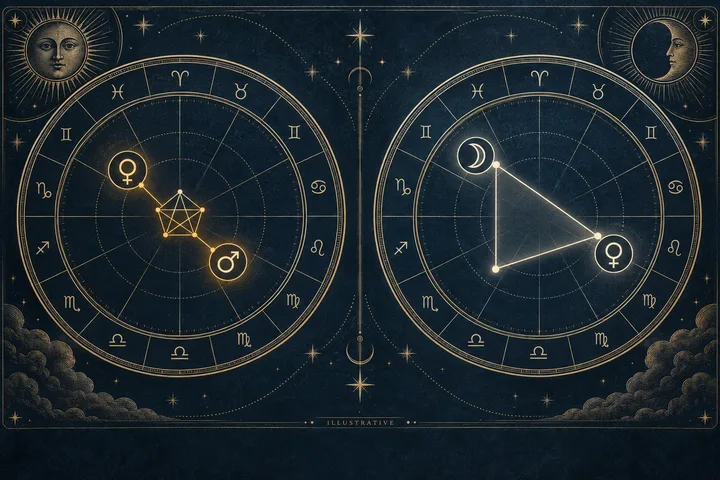
The reader's question should break a close call. Venus leads questions about affection, pleasure, attraction, and values. The Moon leads questions about comfort, habit, emotional safety, and being met. Mars leads questions about pursuit, heat, initiative, boundaries, and conflict.
A tight Moon-Venus minor aspect may be more useful for a question about tenderness than a looser Venus-Mars major aspect. A close Venus-Mars square may lead when the reader is asking why attraction and conflict arrive together. The angle matters. The planets decide what the angle is talking about.
Keep the planet person visible. “Maria's Venus to Daniel's Mars” preserves the direction of the exchange. A generic “your Venus-Mars aspect” can hide who is offering affection, who is pursuing, and whose response needs translation. That small piece of grammar keeps the reading grounded.
Stay inside the supplied chart layer. A placement comparison can discuss Moon, Venus, and Mars signs and supplied degrees. It cannot quietly add houses, rulers, natal conditions, or a relationship outcome. Those techniques may belong to another reading, but they don't belong in this one unless the required inputs and scope are present.
Sources: Aspects - Astrodienst Astrowiki; A Brief Introduction to Astrology: Aspects; Minor Aspects in Astrology, with Rick Levine
Use repetition to confirm a theme, not to count votes
One aspect gives you a question. Repetition tells you whether that question belongs near the center. Don't count contacts as though a chart were holding an election. Ask whether another contact performs the same symbolic job.
A planet echo gathers contacts around one subject. Several Moon contacts may keep returning to comfort. Several Venus-Mars contacts may keep returning to attraction and pursuit. An aspect echo repeats the mode: trines can describe ease, while squares and semi-squares can keep a pair working through friction. Sign echoes add style through elements or modes. These are forms of support, not interchangeable proof.
The strongest exception is a close major contact that repeats the reader's central theme. An isolated 0°20′ Venus-Mars quintile may be the most exact contact, yet repeated close Moon-Venus contacts may make emotional reception the chart's main conversation. The quintile hasn't lost its precision. It has lost the right to carry the whole reading.
Combine duplicates. If three contacts all describe affection arriving easily, give the reader one ranked synthesis and explain what each contact adds. One may describe receiving care. Another may describe expressing it. A third may show what happens when desire asks for action. Repetition deserves structure, not a parade of labels.
Then test the symbolism against an observable scene. Ask how interest gets shown, what kind of comfort lands, or when a smooth exchange still needs a change in pace. Astrology gives the pattern language. The couple supplies the recognition.
Sources: Aspects - Astrodienst Astrowiki; Orbs (or rays) - Skyscript Glossary; An Introduction to Aspects and Chart Shaping in Natal Astrology; A Brief Introduction to Astrology: Aspects
Turn the ranking into a clear reading order
Once the contacts are admitted, give each one a job. Start with the question. Record the planet person, sign and degree, exact angle, orb, aspect family, and interpretive role. Then rank by usefulness, not by drama.
A practical order has five levels. First comes a close contact that directly answers the question. Second comes a close major contact broad enough to organize a theme. Third comes a wider but relevant major contact. Fourth comes an exact minor contact that is peripheral. Fifth comes a wide, isolated, or uncertain contact that cannot carry a clear claim.
These ranks choose paragraph space. They aren't a compatibility score. A 0°35′ Moon-Venus quintile may lead a tenderness reading, but describe a particular pattern rather than a whole emotional climate. A 0°50′ Venus-Mars square may lead an attraction-and-conflict reading because it combines precision with a major aspect's structural reach.
For the worked example, lead with the Venus-Mars quintile if the question is about unusual chemistry. Follow with the Moon-Venus trine as a possible emotional setting. Let the signs shape the language, then use repeated supplied contacts to decide whether either theme deserves promotion.
If the question changes, the order can change. “What keeps us emotionally available?” may put Moon-Venus first. “Why does our attraction have this oddly specific rhythm?” may put Venus-Mars first. That isn't inconsistency. It's interpretation answering the actual question.
Sources: Aspects - Astrodienst Astrowiki; Orbs (or rays) - Skyscript Glossary; An Introduction to Aspects and Chart Shaping in Natal Astrology; A Brief Introduction to Astrology: Aspects
Finish with a scope check and one useful decision
Before you finalize the reading, check the inputs. With degrees and minutes, calculate the angular separation and name the orb. With rounded degrees, flag the boundary. With signs alone, stay with sign meaning. Never call an aspect exact when the supplied data can't establish it.
Use one zodiac reference frame, one aspect list, and one declared orb policy. The Synastry Comparison Report's confirmed scope is supplied Moon, Venus, and Mars placements, optional degrees, and selected major-aspect calculations using its stated six-degree method. It does not calculate natal positions from birth details, houses, or minor-aspect rankings. That boundary belongs in the product description and in the reader's expectations.
The editorial decision is short. Give the tight, relevant minor aspect the clearest description. Give the loose major aspect the wider frame if its orb and planetary role support it. Promote the major contact when repetition makes it central. Keep the minor contact as detail when it stands alone.
Then ask for an observable next step. How does interest get shown? What kind of comfort actually lands? When does ease need a conversation? Those questions turn an aspect from a label into a useful reflection. Choose the lead contact, state why, and let the people living the chart test the meaning.
Sources: Aspects - Astrodienst Astrowiki; Orbs (or rays) - Skyscript Glossary; An Introduction to Aspects and Chart Shaping in Natal Astrology; A Brief Introduction to Astrology: Aspects
Sources & further reading
- Aspects - Astrodienst Astrowiki
Defines major and minor aspect families, their angles, and the role of orb in deciding whether an aspect is admitted.
- Orbs (or rays) - Skyscript Glossary
Explains differing modern and traditional orb approaches, including narrower allowances for minor aspects.
- An Introduction to Aspects and Chart Shaping in Natal Astrology
Supports the interpretive distinction between closer exact aspects and wider looser contacts.
- A Brief Introduction to Astrology: Aspects
Describes major aspect meanings and presents minor aspects as additional interpretive depth.
- Minor Aspects in Astrology, with Rick Levine
Documents the modern distinction between the five classical major aspects and the wider minor-aspect family.
Synastry Comparison Report
Enter known placements for two people. Get an input-by-input comparison, selected aspect calculations and a clear record of what remains uncertain.
Compare our placements