Imagine the same moment means two different things
Imagine Maria and Daniel planning a weekend away. Maria checks the train times, books the room, and asks what they can afford. Daniel says he wants the trip to feel spontaneous. He sends a list of restaurants, changes the plan twice, and still expects Maria to make the final call.
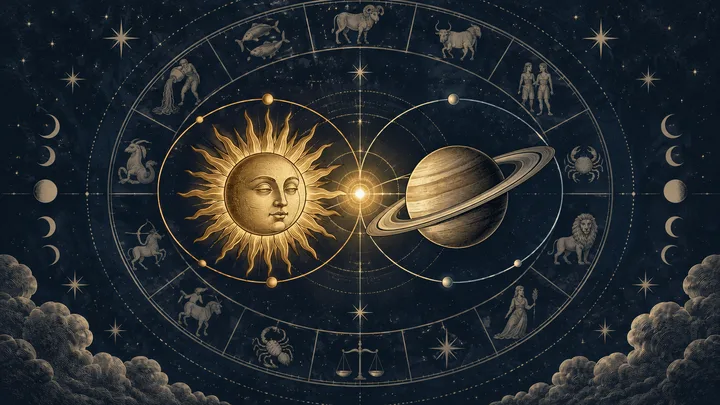
Their charts show Maria's Saturn conjunct Daniel's Sun. The planets sit in the same sign, within four degrees. Maria experiences the contact as responsibility. Daniel experiences it as pressure, or as a steadying force he secretly trusts. Both descriptions can be true at once.
That is the central problem with a synastry conjunction between planets with different jobs. The contact is close, active, and hard to ignore. Yet the planets don't arrive carrying the same assignment. The Sun wants to express identity, vitality, and purpose. Saturn wants to define limits, manage time, and make something hold. Their conjunction can create respect and structure. It can also make one person's self-expression feel measured by the other's standards.
So don't ask only, Is this conjunction good? Ask a better question. What happens when these two functions occupy the same room? Who brings the initiating energy? Who sets the pace? What does the sign allow them to share, and where does it keep them different?
This article uses a fictional scene to make the method concrete. Maria and Daniel aren't a real couple, and no personal chart has been calculated for them. Their supplied example is simply a clean way to follow the interpretive sequence. In an actual comparison, work from the placements and degrees you know. If you only have signs, keep the reading sign-based and leave exact aspect strength open.
Notice what the scene does not ask. It doesn't ask whether Maria is too serious or whether Daniel is secretly irresponsible. Those labels close the reading before it begins. The chart gives you a pattern of exchange, and the pattern becomes visible through ordinary moments: a late reply, a changed plan, a request for reassurance, a decision about money, or the point at which one person says, I need you to trust me.
This approach keeps the relationship human. A planetary contact can describe a powerful pull without explaining every choice. Use the conjunction to notice where attention gathers. Then watch the actual behavior inside that field. The interpretation earns its place when it helps you name what keeps happening and choose a more conscious response.
For readers comparing known placements, this is also a guard against reading by reputation. Saturn isn't automatically the difficult one. The Sun isn't automatically the favored one. The receiving person may feel more exposed, while the planet person may feel more responsible. In another situation, the roles reverse. Ask who is carrying the function in this moment, not who has been assigned the good or bad planet.
First, define what a conjunction actually joins
In synastry, you compare one person's chart with another person's chart. A conjunction occurs when two planets occupy the same zodiac area, usually close to 0 degrees apart. The aspect brings their meanings into direct contact. They don't take turns from a safe distance. They press on the same point in the relationship.
Astrodienst describes aspects as angular relationships between planets and says that a conjunction's quality depends greatly on the planets involved and how close the contact is. Its astrological reference also describes the conjunction as a close bond in which both energies interpenetrate. That gives you the first rule: conjunction means concentration, not automatic harmony.
Astrology.com uses a wider working range for conjunctions but gives special weight to contacts within six degrees. This article follows a six-degree orb for selected major aspects. A contact at one degree deserves more attention than one at six degrees. A sign-only contact can still offer a useful first impression, but it shouldn't be presented as an exact degree aspect when the degrees are unknown.
The word interpenetrate matters. A conjunction isn't just a shared label. The planets alter one another's expression because they keep meeting in the same relational space. A person's Venus may soften the other person's Saturn. The Saturn person may bring form to the Venus person's affection. A Mars person may energize another person's Mercury, while Mercury gives Mars a language for action.
The contact also has two sides. Read it from the planet person and from the person whose planet receives it. In Cafe Astrology's synastry guidance, each person can take on the role of the planet they contribute during the interaction. If A's Saturn meets B's Sun, A may act as the Saturn figure while B expresses the solar side of the exchange. Then reverse the lens. B's Sun can illuminate A's Saturn patterns too.
This is why a conjunction can feel intimate and irritating in the same week. It removes distance, but it removes insulation as well. The partners notice one another's themes quickly. They can cooperate with unusual ease, or they can keep activating the same unresolved knot.
You can think of the conjunction as a shared switch. When one person turns on the function, the other person feels it. A Sun person may feel watched when Saturn enters the room. A Saturn person may feel called to take charge when the Sun becomes uncertain. A Venus person may invite closeness, and Mars may answer immediately. The switch creates contact; it doesn't dictate the response.
That distinction helps when the planets have different speeds or social meanings. A personal planet often makes the exchange immediate and recognizable. A slower planet may describe a deeper pressure, a generational tone, or a lesson that becomes obvious only over time. Keep the symbolism specific to the pair you are actually reading.
The same switch can be welcomed by one person and resisted by the other. The Sun may enjoy Saturn's focus because it feels like serious recognition. Saturn may feel burdened by having to keep the Sun's confidence grounded. In a Venus-Mars contact, Venus may enjoy being pursued while Mars wants a clearer answer. The aspect is mutual, but the experience is not always symmetrical.
A synastry conjunction joins two planetary functions in one concentrated field, but it doesn't make those functions identical. Read the planets separately first, then ask what they do together in their sign, how close they are by degree, and which person tends to express each role. A Moon-Saturn conjunction may bind care to duty; a Venus-Mars conjunction may join affection with pursuit; a Mercury-Neptune conjunction may blend thought with intuition and blur the line between them. The strongest interpretation comes from the exact contact and the lived pattern it describes, not from the word conjunction alone.
Sources: A Brief Introduction to Astrology: Aspects; Conjunction - Astrodienst Astrowiki; Synastry - Astrodienst Astrowiki; What’s Your Sign? An Intro to Synastry Charts and Astrological Compatibility
Name each planet's job before you blend them
Before you interpret the pair, write one plain sentence for each planet. Don't begin with the relationship story. Begin with the tools in the story.
The Sun describes the center of a person's vitality, identity, will, and way of shining. The Moon describes emotional needs, instinctive responses, comfort, and the habits that restore a person. Mercury speaks to thought, speech, perception, and the way someone handles information. Venus describes attraction, values, pleasure, affection, and the style of exchange that says, I like this and I want to come closer.
Mars acts. It shows drive, desire, anger, courage, pursuit, and the way a person goes after what they want. Jupiter expands, teaches, blesses, and sometimes overdoes. Saturn concentrates, tests, commits, delays, and builds through repetition. Uranus disrupts and wakes up. Neptune dissolves boundaries, heightens imagination, and can obscure what the eyes would otherwise separate. Pluto intensifies, exposes, and transforms.
These are working descriptions, not personality verdicts. A Saturn person isn't simply cold. A Mars person isn't simply aggressive. A Neptune person isn't simply confused. The planet's job can serve the other planet, challenge it, or take over the shared field when the rest of the chart reinforces that pattern.
Now blend the pair as a verb. Sun-Saturn can structure identity. Moon-Saturn can contain feeling. Mercury-Saturn can discipline thought or inhibit speech. Venus-Saturn can give affection endurance or make love feel earned. Mars-Saturn can pace desire, frustrate action, or train effort. Mercury-Neptune can imagine meaning, translate subtle cues, or mistake a wish for a fact.
That verb is more useful than a pile of adjectives. It tells you what the conjunction does. A conjunction between different planets is not a contest in which one planet wins. It is a repeated action the relationship performs.
Try the same exercise with the personal planets you are most likely to compare. Moon and Venus can comfort and please. Moon and Mars can stir feeling into action, but anger may enter the room before either person understands why. Mercury and Venus can make affection easier to name. Mercury and Mars can sharpen debate and help a couple solve problems quickly, or turn every difference into a contest.
When you write the two jobs down, you also see what the conjunction cannot promise. Venus does not guarantee kindness. Saturn does not guarantee loyalty. Mars does not guarantee sexual ease. Mercury does not guarantee honest communication. The planets describe capacities and pressures. The sign, chart condition, and choices decide how those capacities are used.
Use a two-column note if the pair feels confusing. In the first column, write what planet A wants to do. In the second, write what planet B wants to do. Underneath, write the shared verb. If your notes say, Moon wants to feel safe and Mars wants to move now, the shared verb might be activate feeling. That immediately gives you a richer reading than chemistry or conflict.
Sources: Conjunction - Astrodienst Astrowiki; Synastry - Astrodienst Astrowiki; Aspects Between Charts; What’s Your Sign? An Intro to Synastry Charts and Astrological Compatibility
Use the planet pair to find the relationship's repeated scene
Return to Maria and Daniel. Saturn conjunct Sun doesn't mean Maria is the villain and Daniel is the wounded hero. It means Saturn's rules, timing, and standards meet the Sun's need to act from a clear center. The conjunction may show up whenever Daniel wants to take the lead and Maria starts checking whether the plan can last.
In one version of the contact, Maria helps Daniel turn confidence into a real commitment. She asks for a budget, a date, and a promise he can keep. Daniel gives Maria warmth, pride, and a reason to take her own ambitions seriously. He reminds her that a structure exists to serve life, not replace it.
In another version, Daniel hears every practical question as criticism. Maria hears every burst of enthusiasm as another responsibility she will have to carry. The same conjunction is still operating. The expression changes because the partners have different levels of self-awareness, different natal conditions, and different choices in the moment.
Cafe Astrology makes a similar point in its interchart guidance. The sign and house placements change how a planet-to-planet exchange is expressed. The site also advises reading each individual horoscope as a whole before interpreting synastry. That instruction protects you from turning one vivid aspect into the entire relationship.
Look for the scene that repeats. Who starts the conversation? Who slows it down? Who asks for proof? Who brings play? Who notices risk? Who decides when a feeling has become a plan? When you can describe the repeated scene, you have moved from a generic conjunction meaning to a synastry interpretation.
A different pair creates a different scene. With Venus conjunct Mars, one person may offer tenderness while the other pursues direct physical closeness. Attraction can move quickly. So can irritation when one person wants sweetness and the other wants action. With Mercury conjunct Neptune, one partner may speak in facts while the other speaks in images, hints, and impressions. The conversation can become poetic, healing, or slippery.
The best reading names both the gift and the friction in the same sentence. This contact joins affection and pursuit. It may also confuse their timing. This contact joins thought and intuition. It may also blur what was actually said. This contact joins identity and duty. It may also make approval feel like a test.
A repeated scene gives you a way to check the interpretation without flattening the chart. Suppose a Venus-Mars pair keeps circling the question of initiation. One person waits for romance before moving closer. The other shows desire through direct action. The issue isn't that one loves and the other doesn't. Their planets speak different dialects of approach. Once they know that, they can ask for the form of affection each one actually recognizes.
The same check works for Mercury-Neptune. If one partner says, I thought you understood, and the other says, You never said that, the conjunction may be blending intuition with language. The answer isn't to distrust every feeling. It is to separate the feeling, the image, the words, and the agreed plan. Good synastry interpretation creates those useful separations.
The repeated scene can be quiet. A Moon-Saturn contact may appear in who notices fatigue, who takes care of practical needs, and who decides when a private feeling is safe to share. A Jupiter-Saturn contact may appear in every conversation about growth, risk, study, travel, or money. The aspect becomes legible when you follow its subject across several moments instead of waiting for one dramatic event.
Sources: Synastry - Astrodienst Astrowiki; Aspects Between Charts
Let the sign decide how the two jobs cooperate
The planets tell you what is meeting. The sign tells you the style of the meeting. Don't skip it.
A Sun-Saturn conjunction in Aries may put identity and duty into a direct, urgent, self-starting mode. The pair may need room to lead, but it also needs a clear rule about whose turn it is. In Taurus, the same planets may focus on loyalty, resources, reliability, and the slow work of building security. In Gemini, the conjunction may turn into a running conversation about plans, facts, and decisions. In Cancer, care and protection can become the central language, with a risk of over-management.
Those examples don't predict a fixed outcome. They show how the sign gives the planets a shared medium. Fire signs can make a conjunction act quickly. Earth signs can make it practical and tangible. Air signs can move it through ideas, words, and social exchange. Water signs can make it emotional, protective, intuitive, and private.
Then add the sign's mode. Cardinal signs initiate. Fixed signs sustain and resist change. Mutable signs adapt, translate, and distribute energy. A conjunction in a cardinal sign may ask, Who leads? In a fixed sign, Can we change without breaking trust? In a mutable sign, What are we actually agreeing to while the plan keeps moving?
Return to the fictional example. Maria's Saturn and Daniel's Sun in Capricorn would make their shared field concerned with timing, work, responsibility, and measurable progress. In Leo, the same conjunction would put pride, recognition, creativity, and authority in the spotlight. In Pisces, the pair might meet through compassion, sacrifice, spiritual meaning, and unclear limits.
The sign can make different planets feel more at home together, but it never cancels their jobs. Saturn in Leo still asks for discipline around expression. The Sun in Capricorn still needs life, confidence, and personal purpose. Keep the difference visible. That is where the interpretation becomes accurate and useful.
You can also read the sign through its values. A conjunction in Taurus may ask whether desire can become dependable. In Gemini, it may ask whether two people can keep talking without scattering the point. In Scorpio, trust, privacy, and emotional power may shape the shared field. In Sagittarius, honesty, freedom, and a larger horizon may matter most. These are interpretive directions, not scripts.
The sign may show where the planets find common ground, while the planet pair shows what keeps pulling them together. If the sign is earthy but one planet is Mars, don't make Mars passive. If the sign is airy but one planet is Saturn, don't make Saturn weightless. The sign supplies the room. The planets still bring their own furniture. If the signs differ by element or style, don't treat that as a failure of the conjunction. Fire can ask earth to take a risk. Earth can ask fire to finish what it starts. Air can give water language. Water can give air emotional depth. The planets still need a shared method, but the tension may be part of the contact's purpose.
Sources: Synastry - Astrodienst Astrowiki; Aspects Between Charts
Rank orb, roles, and the rest of the charts
When a conjunction feels overwhelming, readers often ask which planet is stronger. There isn't one answer that works for every chart. Rank the evidence instead.
Start with the orb. Using a six-degree working orb, a one-degree conjunction is the loudest version of the contact. At three degrees, it remains clear and active. At six degrees, read it with care and look for confirmation elsewhere. If you only know the signs, call it a sign-based conjunction or same-sign contact. Don't invent degrees to make the interpretation sound precise.
Next, identify the roles. The person who contributes Saturn may feel responsible, cautious, or evaluative. The person who contributes the Sun may feel seen, shaped, challenged, or judged. But the roles can reverse in different scenes. The Sun person may take charge of the relationship's direction while the Saturn person becomes the one asking for safety. Planet person and house person are useful labels, not permanent identities.
Then read the sign. After that, inspect the natal chart of each person, if a full chart is available. Is the planet already prominent? Does it receive supportive or difficult aspects? Is it comfortable in its sign? Does the person already know how to use that planet? Astrodienst's synastry guidance stresses that the individual horoscope comes before the comparison, and that maturity matters in how a contact becomes lived experience.
Finally, check the wider synastry. A single conjunction doesn't carry the whole relationship. Other personal-planet contacts may make the pair easier to express. Saturn contacts may give endurance. Challenging aspects can bring friction that forces growth. House overlays can show where the contact lands for each person, but you need reliable birth time for houses and angles. If you don't have it, stop at the planetary and sign layers.
This ranking keeps a vivid contact in proportion. A close Moon-Saturn conjunction deserves attention. It doesn't erase a warm Moon-Venus exchange, a clear Mercury connection, or the actual choices the couple makes. Astrology shows the pattern. The people still enact it.
A useful rule follows from this ranking: let repetition confirm emphasis. If the conjunction says responsibility and several other contacts also bring Saturn into the personal planets, give the theme more weight. If the conjunction says pressure but the rest of the comparison supplies ease, attraction, and mutual understanding, read pressure as one important channel rather than the whole story.
Avoid the temptation to total the chart in your head. Five easy contacts don't cancel one difficult contact, and one difficult contact doesn't cancel five easy ones. Their meanings don't behave like points on a scoreboard. They describe different rooms in the same house. Your task is to find which room the couple keeps entering and what happens there. When you have only Moon, Venus, and Mars signs, begin there and be honest about the scope. Moon contacts often show the emotional rhythm. Venus contacts show attraction, values, and ease in giving and receiving. Mars contacts show pursuit, heat, initiative, and conflict. A conjunction involving one of these planets can be vivid, but it remains one layer of the comparison.
Sources: A Brief Introduction to Astrology: Aspects; Conjunction - Astrodienst Astrowiki; Synastry - Astrodienst Astrowiki; Aspects Between Charts
The strongest exception: change the interpretation when facts change
The cleanest conjunction joins planets with related jobs. Moon conjunct Venus can connect emotional comfort with affection. Sun conjunct Mars can join identity with action. Similarity helps, but it doesn't guarantee ease.
Two planets can want the same thing and still want too much of it. Moon-Moon may deepen familiarity while both people reinforce the same mood. Mars-Mars may make desire direct while neither person wants to yield. Venus-Venus may share taste while both avoid the harder talk about money, loyalty, or disappointment.
That is the strongest exception to the idea that different planets create the most friction. Similar jobs can become an echo chamber. Name the function, the excess, and the missing function. If Moon-Moon keeps the couple in feeling, bring in Mercury and ask for words. If Mars-Mars keeps producing arguments, bring in Venus and ask what care would look like.
A close, supportive contact can also turn difficult when a planet's shadow takes over. Venus may please instead of speaking plainly. Saturn may protect through control. Neptune may offer spiritual closeness while leaving a practical gap. The aspect describes the meeting point, not a guaranteed behavior.
Let the reading change when the inputs change. At two degrees, Maria and Daniel's Saturn-Sun contact belongs near the center of the interpretation. At six degrees, give it less weight unless other contacts repeat the theme. With signs but no degrees, describe a shared sign field and leave exact strength open.
If the planets are close by degree but cross a sign boundary, call it a dissociate or out-of-sign conjunction. Astrodienst's dedicated reference says the degree aspect can still operate while taking on some character from the signs involved. Read the geometry and the sign relationship together, rather than treating either layer as a correction to the other.
Houses, angles, retrogrades, and additional contacts can change the emphasis, but only use them when the supplied chart data supports them. A house overlay needs a reliable birth time. Without it, stay with planets, signs, degrees, and the wider contacts you actually know. If the lived relationship doesn't match the first interpretation, test the layer before discarding the chart. A Mercury-Saturn contact may describe a work decision rather than romance; Venus-Mars may describe creative collaboration or a charged friendship.
The practical rule is simple. Read the pair, then the orb, then the sign, then the natal and wider-chart context. Similar planets ask what they amplify and leave out. Different planets ask whether they cooperate or compete. In both cases, the missing function tells you what the relationship needs next.
Take Venus-Saturn as a useful test. Venus brings attraction, pleasure, taste, and the wish to exchange warmth. Saturn brings time, limits, duty, and the demand that something prove its strength. Together, they can make affection dependable. The Venus person may feel that Saturn takes love seriously. The Saturn person may give the bond shape through consistency. But if Saturn becomes the gatekeeper, Venus may start performing for approval. The interpretive question is not whether Saturn is good or bad. It is whether commitment is creating safety or rationing affection.
Now compare Mercury-Neptune. Mercury sorts, names, and connects information. Neptune receives symbols, impressions, ideals, and moods. A close contact can help one person find words for a subtle feeling, or help the other imagine a meaning that facts alone don't reveal. The difficulty comes when an impression becomes a promise. In this pair, the missing function is often verification. Ask what was said, what was inferred, and what still needs a plain answer. That is a sharper reading than calling the contact either magical or confusing.
Mars-Saturn shows why unlike jobs can cooperate without becoming comfortable. Mars wants movement, heat, and a direct response. Saturn measures timing and consequence. The Saturn person can help Mars aim its force. The Mars person can keep Saturn from postponing action forever. Under strain, Mars experiences every delay as refusal while Saturn experiences every push as recklessness. A chart reader should look for the arena where this happens, then name a shared rule: when to act, when to wait, and how each person signals the difference.
The same method works when one planet is outer or slower. Jupiter-Neptune can enlarge faith, compassion, and a shared vision, but it may also enlarge a hope before the couple has checked its cost. Uranus-Saturn can join disruption with structure, producing a relationship that must keep rebuilding its rules. Pluto-Venus can intensify attraction and expose value conflicts at the same time. These are not verdicts. They are invitations to identify the function being joined, the excess it can create, and the practical behavior that gives it a constructive outlet.
Sources: A Brief Introduction to Astrology: Aspects; Conjunction - Astrodienst Astrowiki; Synastry - Astrodienst Astrowiki; Aspects Between Charts; Dissociate Aspect - Astrodienst Astrowiki
Turn the conjunction into one useful conversation
The point isn't to award a score. It's to notice the shared pattern early enough to use it well. For a different-job pair, ask three questions: What does my planet bring naturally? What does your planet need from it? Where does our sign help, and where do we overdo its style?
Keep the questions concrete. A Saturn-Sun couple can ask, How can I offer structure without becoming your judge? How can you receive a limit without hearing rejection? A Moon-Mars pair can ask, What helps you feel safe before we act? A Mercury-Neptune pair can ask, What did you hear me say, and what part is only an impression?
For your comparison, use the placements you actually know. Start with the two planets and their signs. Add degrees when you have them, applying the stated six-degree orb to selected major aspects. Read each planet separately, blend them into a relationship verb, and add houses only when reliable birth information supports that layer.
The Synastry Comparison Report follows that scope. You can compare supplied Moon, Venus, and Mars signs, add optional degrees, and review selected major aspects without turning the reading into a compatibility percentage. It doesn't calculate natal positions from birth details or decide whether a relationship should continue. It helps you see what the placements are asking you to discuss.
So give each planet its own voice. Let the orb set the volume and the sign set the style. Then choose one conversation that matches the contact. For Saturn and the Sun, name one practical limit and one clear act of encouragement. For Venus and Mars, say who wants closeness, who wants space, and how each person can initiate without guessing. For Mercury and Neptune, repeat the plan in plain words after the emotional conversation ends.
Use language that keeps both people visible: When you ask for a plan, I hear care, but I also feel judged. Or, When I move quickly, I'm showing desire, not dismissing your feelings. The chart gives you a bridge. It turns a planetary label into a question two people can answer.
Before you begin that conversation, separate observation from interpretation. Observation sounds like, You ask for more detail whenever I announce a new plan. Interpretation sounds like, You don't trust me. The first belongs to the shared scene. The second may be one possible story about it. A conjunction reading is strongest when it gives you the first sentence and leaves room to discover the second together.
You can also track who is expressing the planet and who is receiving it in a given moment. In a Saturn-Sun exchange, the Sun person may be asking for recognition while the Saturn person is asking for proof. Later, the roles can flip. The Saturn person may need warmth, and the Sun person may become the one offering steadiness. Write down the change. It keeps the interpretation mutual and prevents a planet label from becoming a character judgment.
If you're comparing only Moon, Venus, and Mars, choose the pair that repeats most clearly instead of trying to explain every possible combination. A Moon-Venus conjunction may show a need for tenderness. A Venus-Mars conjunction may show different timing around pursuit and receptivity. A Moon-Mars conjunction may show feeling becoming action before either person has named the feeling. Start with the scene that is easiest to recognize. The report can then help you place the other contacts around it.
A small written check can make the next step even clearer. Write the planet pair at the top of a page. Under the first planet, note what you do automatically. Under the second, note what your partner does automatically. Then finish three sentences: We connect when... We get stuck when... We could cooperate by... Keep each ending tied to an observable moment, such as planning a trip, answering a message, choosing how to spend money, or deciding when to pause an argument. This turns the chart into a shared language instead of a private label. It also gives you something to revisit after the conversation, when you can see whether the proposed cooperation changed the scene.
If the first answer feels too broad, make it smaller. Replace We need more trust with We need to say whether a plan is still tentative before one of us starts arranging it. Replace You are too controlling with I need a limit explained before it becomes a decision. Specific language lets both planetary jobs remain present. It also shows you whether the contact is describing a genuine pattern or only a single tense moment. That distinction protects the reading from drama and keeps the final question answerable in practice.
That is the direct answer. Interpret the conjunction as a concentrated exchange between different jobs, rank it by orb and sign, test it against the wider chart, and then ask how the two functions can cooperate in one real scene. Start with tonight's next conversation, not a verdict about the whole relationship.
Sources: Synastry - Astrodienst Astrowiki; Aspects Between Charts
A little more clarity
Is a synastry conjunction between different planets always difficult?
No. Different planets can complement one another beautifully. Venus can soften Saturn, Saturn can steady Venus, and Mercury can give Mars a plan. The same contact can create friction when one planet's job overwhelms the other. Read the pair, orb, sign, roles, and wider chart before ranking it.
What if I know the signs but not the exact degrees?
Treat the contact as sign-based and keep its exact strength open. You can interpret the shared sign and the planetary combination, but you shouldn't call it a precise six-degree conjunction without degrees. Add houses or angles only when reliable birth times support those calculations.
Sources & further reading
- A Brief Introduction to Astrology: Aspects
Supports the definition of angular aspects, the conjunction, the role of orb, and the need to judge an aspect through the planets involved.
- Conjunction - Astrodienst Astrowiki
Supports the conjunction as a close blending of planetary energies and explains why unlike planets require separate meanings before their shared expression is judged.
- Synastry - Astrodienst Astrowiki
Supports comparing two horoscopes in synastry, reading personal and outer-planet contacts, and considering each individual's natal chart as a whole first.
- Aspects Between Charts
Supports role-based synastry reading and the need to include each planet's sign, house placement, and wider interchart context when interpreting a contact.
- What’s Your Sign? An Intro to Synastry Charts and Astrological Compatibility
Supports the practical six-degree emphasis, basic planetary meanings, and examples of personal-planet conjunctions used in romantic synastry interpretation for readers comparing known placements.
- Dissociate Aspect - Astrodienst Astrowiki
Supports reading an aspect that falls within degree orb but across unexpected signs as a dissociate aspect with an added sign-based character.
Synastry Comparison Report
Enter known placements for two people. Get an input-by-input comparison, selected aspect calculations and a clear record of what remains uncertain.
Compare our placements