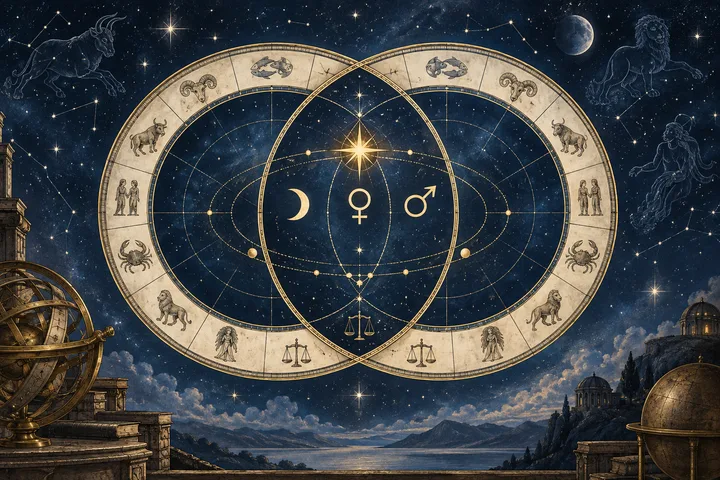
Yes. A fixed-star conjunction can add a distinct tone to a Moon, Venus, or Mars synastry reading, but it works as a fine brush, not a new painting. Start with the actual interaspect between the two charts, the sign and condition of the planet, and the wider pattern. Then check whether a named star falls in a genuinely close conjunction with one of those planets. Moon contacts tend to describe the emotional atmosphere and instinctive comfort between you. Venus contacts color affection, taste, pleasure, and the way love is offered. Mars contacts sharpen pursuit, desire, heat, and conflict. The star can intensify, dignify, protect, or complicate that planet's role. It can't certify a soulmate bond, override a difficult chart pattern, or speak for a person whose birth data you don't have. If you're comparing supplied placements, rank the ordinary synastry first, the star second, and the conversation it prompts third.
The fixed star adds a note, not a verdict
A fixed-star conjunction can add something to synastry. The useful question is how much, and where. In most readings, the answer is modest but meaningful. A star can give a personal planet a particular flavor. It can make a Moon contact feel more protective or exposed, make Venus more graceful or exacting, or give Mars a more public, intense, honorable, or uncompromising way to act. That detail matters when it explains a pattern you can already see.
It matters much less when it appears alone. If someone announces that a star on Venus proves an extraordinary love story, the interpretation has outrun the chart. A conjunction between your Venus and your partner's Mars still describes the exchange between Venus and Mars. The star touching either planet can refine that exchange. It doesn't turn attraction into a promise, and it doesn't tell you what either person will choose.
This order protects the reading from two opposite mistakes. One mistake is ignoring the star because it isn't a planet. The other is letting a famous star swallow the chart. Both miss the point. Fixed stars are special reference points used with close contact. They're strongest when they repeat or sharpen a theme already carried by the planet, its sign, its house, and its major aspects.
So the short answer is yes, but with a strict rank. Read the interaspect first. Read the planet's own condition next. Check the fixed star after that. Then ask what the combined picture helps you understand about affection, emotional safety, desire, boundaries, or repair. The star earns attention by clarifying a live question between two people. It doesn't earn authority by having a dramatic name.
Sources: Major Fixed Stars Astrology - Astrology King; Fixed stars - Skyscript Glossary; The Classical Origin and Traditional Use of Aspects - Skyscript; What's Your Sign? An Intro to Synastry Charts and Astrological Compatibility - Astrology.com
What a fixed-star conjunction actually is
In this tradition, a fixed star is a named star used as a precise point in the zodiac. It appears to stay in place compared with the planets, although precession slowly changes its zodiacal degree over long periods. The word fixed describes the pace, not absolute stillness. A current star table and the birth year matter because an old degree can drift from the position used for a present-day chart.
A conjunction means close zodiacal contact. For planets, astrologers often allow a wider orb because planets are large, active symbols in the chart. Fixed-star practice is narrower. A one-degree orb is a common working limit, and some astrologers tighten it further for a secondary star or an uncertain table. Other reference tables publish star-specific orbs that extend beyond one degree. For this comparison, use a six-degree orb for selected major planet-to-planet synastry aspects, but treat a fixed-star conjunction as a separate, much tighter check.
That difference is easy to miss. If your Venus is six degrees from your partner's Mars, that may be a valid ordinary aspect under the chosen synastry method. It doesn't follow that Venus is six degrees from a fixed star and therefore carries the star's full meaning. The two calculations answer different questions. One compares two moving chart points. The other asks whether one chart point sits almost exactly on a named celestial reference point.
Most fixed-star work gives priority to conjunctions. Parallels, contraparallels, antiscia, and other techniques belong to their own methods. They may be valuable in a broader practice, but mixing them into a simple sign-and-degree report makes the result hard to reproduce. If you want a clean comparison, write down the star table, the epoch or birth year used, the orb, and the point being tested. Precision makes the interpretation calmer.
The word conjunction can also hide a second choice: which zodiac frame and table are you using? A tropical chart places the star by its projected tropical longitude, while a sidereal practice uses a different reference frame. Use the system that produced the supplied placements and keep the star table consistent with it. A star contact is only precise inside a consistent calculation.
Distance should be recorded, not guessed from a visual chart wheel. A planet that looks close to a star in a drawing may not be close by zodiacal longitude, and a planet near the end of one sign may be close to a star in the next sign. Check the degrees across the sign boundary. Then record whether the contact is applying or separating only if the method you use gives that motion a role. Do not borrow ordinary planet-aspect rules without saying so.
Brightness can help explain why some stars appear often in reference lists, but brightness alone doesn't settle interpretive importance. Tradition, position near the ecliptic, and the quality of the planet touched all matter. A star that rarely meets personal planets may still be meaningful when the contact is exact. A bright star with a loose contact may contribute little. The practice is selective by design.
Read the old symbolism as a set of images and conditions rather than a list of events. Traditional language about honor, danger, fortune, or loss becomes more useful when translated into a personal planet's behavior. What does honor look like in Venus? What does excess look like in Mars? What does protection look like through the Moon? This translation keeps the tradition alive without turning it into a literal prediction.
Sources: Major Fixed Stars Astrology - Astrology King; Fixed stars - Skyscript Glossary; The Classical Origin and Traditional Use of Aspects - Skyscript; Fixed Star Phact - Astrology King
Use the chart inputs you really have
A good fixed-star synastry reading begins with an honest inventory. Do you know each person's Moon, Venus, and Mars sign? Do you know their degrees? Are the degrees supplied from a chart already calculated elsewhere, or are you asking a comparison tool to calculate them from birth details? Those are different services. A report based on supplied placements should say exactly what it uses.
For this publication's Synastry Comparison Report, the working inputs are the two people's supplied Moon, Venus, and Mars signs, with optional degrees. The report compares those placements and selects major aspects using a stated six-degree orb. It does not calculate fixed-star positions or provide a star-table overlay. If you want to study that layer, use the report's planet-first comparison as your starting point, then check the supplied degree against a consistent current star table yourself. The report doesn't calculate a natal chart from birth dates, determine houses, or manufacture missing degrees.
This limit is especially important for angles. The Ascendant and Midheaven depend on an accurate birth time. If the birth minute is unknown, a one-degree claim about an angle can become unreliable. A supplied Moon, Venus, or Mars degree may still be usable if it comes from a trusted chart calculation, but the source of that placement should remain clear. Don't smuggle an angle reading into a planet-only comparison.
Precession adds one more practical step. Regulus, Aldebaran, Antares, Spica, and other stars don't occupy the same tropical degree in every historical table. Don't print a star degree as if it were timeless. Use a current table or identify the epoch, keep the orb tight, and mark the contact as unavailable when the input doesn't support it.
If a degree is missing, the right result is not a vague star story. It's a narrower reading. You can still compare the Moon, Venus, and Mars by sign and by any supplied planet-to-planet relationships. You can explain what a fixed-star check would add if the degrees become available. That keeps the reader inside the actual chart rather than inside a chart someone wished they had.
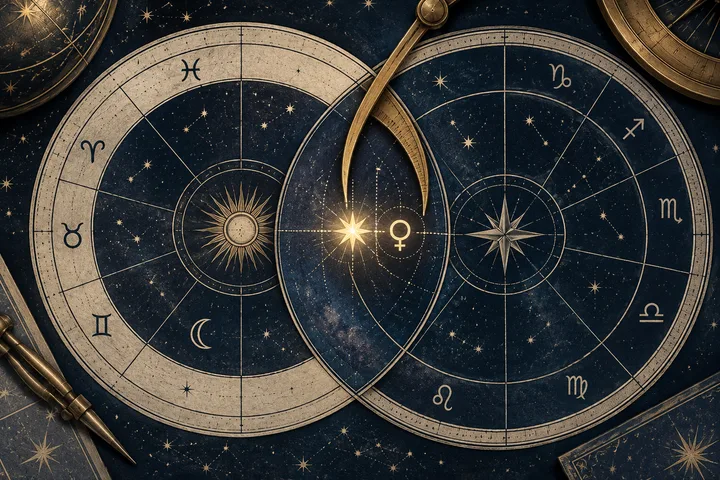
A placement comparison can do more than list signs. It can show whether the emotional, affectionate, and desire layers support one another or pull in different directions. With supplied degrees, you can identify selected major aspects under a stated six-degree orb, then test a fixed-star conjunction separately with a narrower rule. That sequence gives the reader a map. It doesn't pretend that every symbol has equal weight.
Keep the three kinds of language distinct. Use direct language for the supplied placement and the calculated aspect. Use traditional language for the star's symbolism, which sits outside this report's calculation scope. Use conditional language for the relationship expression, because two people still choose how a pattern lives. That is the cleanest way to say what belongs to the chart and what belongs to the couple.
When the layers disagree, rank the closest meaningful personal-planet exchange first. Next consider the planet's sign, house, and other aspects if those inputs are available. Then use the fixed star as a modifier. A close star on an isolated planet may describe an individual signature more than the bond. A slightly less dramatic star that touches the planet carrying the relationship's main exchange may be more useful. Relevance beats fame.
That ranking also protects the reader from a false average. A tender Moon-Venus contact and a heated Mars contact don't become a percentage. They become two different questions. Where does comfort come easily? Where does desire need pacing? Which one deserves the next conversation? A clear report can answer all three without pretending that one word, such as compatible, settles the matter.
Sources: Major Fixed Stars Astrology - Astrology King; Fixed stars - Skyscript Glossary; What's Your Sign? An Intro to Synastry Charts and Astrological Compatibility - Astrology.com; Fixed Star Phact - Astrology King
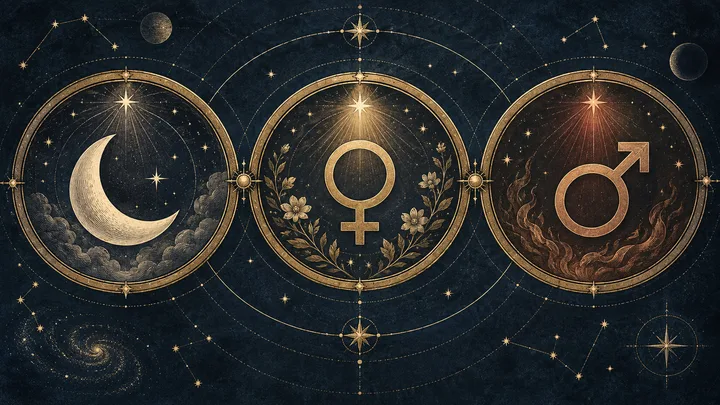
Moon, Venus, and Mars receive the star differently
The planet touched by the star decides where the added symbolism lands. A fixed star on the Moon does not mean the same thing as the same star on Venus or Mars. The planet gives the star a job, and the partner's contact shows whether that job becomes part of the relationship or remains a private signature.
The Moon describes feeling, habit, memory, nourishment, and the private response that arrives before a polished explanation. A star conjunct one person's Moon may color the way that person receives the partner. A bright, protective star can make emotional generosity more visible. A severe or intense star may show that closeness awakens vigilance, pride, or a strong need for emotional control. The partner's planet tells you what activates that Moon. A Venus contact may soothe it. A Mars contact may stir it. The fixed star helps describe the emotional register, not an unavoidable outcome.
Venus speaks to attraction, pleasure, affection, taste, and the way someone makes room for sweetness. A star on Venus can make the Venus person's style more refined, magnetic, principled, or selective, depending on the star and the rest of the chart. In synastry, notice whether the other person's Moon, Venus, or Mars actually engages that Venus. A star on Venus with no meaningful cross-chart contact may be an individual signature that the relationship doesn't activate strongly.
Mars describes pursuit, initiative, erotic heat, anger, courage, competition, and the act of wanting something enough to move. A fixed star on Mars can sharpen the way desire is expressed. The person may pursue with more pride, focus, urgency, strategy, or intensity. In a Mars-Venus contact, this can make the chemistry more specific. It can also make the friction more specific. Heat needs a channel. Without one, the star is a note about the Mars person, not proof of mutual desire.
A useful test is to write three short lines. First, name the cross-chart contact. Second, name the planet's job. Third, name the star's function. If the third line doesn't change the first two in a clear way, the star may be interesting but it isn't doing much interpretive work.
Moon synastry often gets described as comfort, but comfort has several forms. One person may feel emotionally recognized. Another may feel that the partner reaches a private place too quickly. A star overlay can distinguish those experiences. A supportive star may describe an easier path to care, while a more demanding star may show that safety depends on loyalty, honesty, or emotional self-command. The contact does not decide which response wins. The sign and the lived history still matter.
Venus synastry also has more than one register. Attraction can be visual, verbal, social, sensual, or rooted in shared values. A fixed star on Venus may highlight the style that carries affection. Spica may point the reader toward grace and talent. Regulus may raise the question of dignity and recognition. Aldebaran may make values and honest conduct central. If the partner's Moon or Mars activates that Venus, the relationship gives the symbolism a stage. If not, keep it personal.
Mars is not only sex. It is how someone starts, pushes, competes, protects, refuses, and repairs after anger. A star on Mars can make the planet's method easier to name. Is the person bold because they trust their aim, or forceful because they fear losing control? Does their courage create movement for both people, or only demand a response? The star can suggest the theme. The aspect and behavior show its expression.
Sometimes the same cross-chart contact reaches two layers at once. One person's Moon may contact the other's Venus and Mars, for example. Then the partner may feel both cherished and activated. Add a fixed star to the Venus or Mars point and ask which layer it modifies. It may soften affection while sharpening pursuit, or make desire feel more serious than the tenderness can yet support. Don't collapse the difference. Name it.
Sources: The Classical Origin and Traditional Use of Aspects - Skyscript; What's Your Sign? An Intro to Synastry Charts and Astrological Compatibility - Astrology.com; Fixed Star Phact - Astrology King
Compare the star's function, not its reputation
A star's name shouldn't do the interpreting for you. Translate its tradition into a function, then place that function on the Moon, Venus, or Mars it touches. Regulus asks how dignity is handled. Spica points toward grace, talent, or help. Aldebaran tests whether success and affection stay honest. Antares concentrates force and passion. Algol describes feeling or action that can't be managed casually. Those are working images, not relationship verdicts.
The planet supplies the room where the image speaks. Regulus on the Moon can make private respect central. Regulus on Venus may raise the standard for appreciation. Regulus on Mars can sharpen pride in action. Spica on Venus may show tact or a gift for creating pleasure; on Mars, skill and timing; on the Moon, a constructive way to receive care. Aldebaran on Venus makes integrity a condition of affection, while Antares on Mars asks whether desire stays disciplined. Algol on any of the three calls for an honest outlet rather than fear-driven storytelling.
This is also where tradition meets synastry. If the star-touched planet has no meaningful contact with the other chart, keep the symbolism with that person. If a partner's Moon, Venus, or Mars activates it, the star becomes part of an exchange. A partner's Venus may meet a Regulus Moon's need for respect. A partner's Mars may stir an Antares Venus's intensity. The second chart doesn't erase the natal signature. It shows where the signature gets lived between two people.
Before you keep a star in the reading, finish this sentence: 'When my partner activates this planet, we need to handle ___ with more care.' If the blank stays empty, the star hasn't added enough. That test keeps a famous name from becoming a shopping list and gives the symbolism a useful scale.
Sources: Major Fixed Stars Astrology - Astrology King; Fixed stars - Skyscript Glossary; What's Your Sign? An Intro to Synastry Charts and Astrological Compatibility - Astrology.com; Fixed Star Phact - Astrology King
A worked comparison: let the planet lead
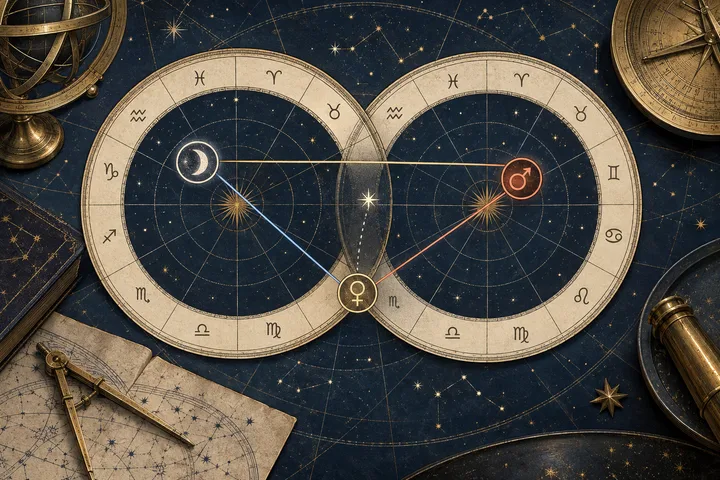
Imagine Maria and Daniel comparing supplied Moon, Venus, and Mars placements. Their report shows a close Moon-Venus contact, so the bond already has a clear bridge between feeling and affection. They may welcome one another easily. The real question is whether that warmth becomes dependable in ordinary life.
Now suppose Daniel's supplied Venus degree is tightly conjunct Spica in the chosen current star table. Spica didn't create the Moon-Venus contact. It refines Daniel's Venus role with a possible tone of grace, tact, or generosity. Maria can test the reading in simple places: does appreciation survive inconvenience, and does kindness remain present when nobody is performing romance?
Change the overlay. If Daniel's Mars, rather than Venus, is tightly conjunct Antares, the Moon-Venus warmth remains the main evidence of tenderness, while Antares describes more heat in pursuit or disagreement. The useful question changes from 'Is this lucky?' to 'Does directness create honesty, or pressure?' If Maria's Moon is the star-touched point and Daniel's Venus contacts it, the question becomes whether affection feels trustworthy when promises meet inconvenience.
The method has five moves: name the cross-chart contact, name the planet's job, identify the star's function, describe one observable expression, and name what would disconfirm it. If the supposed Spica-Venus person is consistently ungenerous, don't force the star to win. Re-read the sign, house, aspects, and planetary condition if those inputs are available. The symbol is a lens. Conduct gives it focus.
Notice what this prevents. You don't count the Moon-Venus contact, the Venus sign, and the star as three separate votes for one conclusion. The interaspect shows the exchange. The planet shows the function. The sign gives style. The star adds one narrow image or condition. If it adds no new information, leave it out.
The strongest exception: a close star contact can still be secondary
Here is the exception that keeps the method honest. A very close fixed-star conjunction can be symbolically striking and still remain secondary in the relationship reading. Exactness gives the star a voice. It doesn't automatically give it the loudest voice. A close star contact on a planet that has little connection to the partner's chart may say more about the individual than about the bond between them.
The reverse can also happen. A star contact may be close, but the planet it touches is under strong pressure from other chart factors. A Venus conjunct Spica doesn't erase a difficult Saturn contact, a complicated Mars pattern, or a mismatch in how the couple handles commitment. A Moon on a royal star doesn't replace the emotional work shown by the Moon's sign and aspects. A Mars on Antares doesn't justify intimidation. The star adds texture. It doesn't remove responsibility.
A second exception concerns fame. The best-known stars aren't always the most relevant. If a less celebrated star is closer to the planet, precision matters more than reputation. A close Antares-Mars contact may feel vivid to the Mars person, while the couple's ease comes from a separate Moon-Venus contact. Let the star explain the edge of pursuit. Let the stronger synastry explain why the pair can listen, enjoy one another, or recover.
Keep the exception visible in the final wording: 'This close star contact may add pride and intensity to Mars. The main synastry still rests on the Moon-Venus exchange and the way you handle disagreement.' If the degree is missing, the table is old, or the planet has no meaningful link to the partner's chart, stop at the claim the data can carry.
Sources: Major Fixed Stars Astrology - Astrology King; Fixed stars - Skyscript Glossary; What's Your Sign? An Intro to Synastry Charts and Astrological Compatibility - Astrology.com; Fixed Star Phact - Astrology King
Turn the symbolism into a relationship question
A symbol earns its place when it gives you a question you can actually ask. A Moon contact points toward emotional safety and recovery after tension. Venus points toward appreciation, pleasure, loyalty, and the difference between charm and care. Mars points toward pursuit, sex, anger, competition, and how conflict gets handled.
If the star adds dignity to Venus or the Moon, ask where respect shows up in daily life. Do you feel admired only when you're easy to please, or do you feel valued when you disagree? If the star adds an integrity test, ask whether the relationship's promises survive inconvenience. If the star adds intensity to Mars, ask how each of you says stop, asks for space, and returns to repair. The chart gives the topic. Your behavior supplies the evidence.
Suppose your partner's Mars activates your star-touched Moon. You may feel energized and exposed at the same time. Don't reduce that to chemistry. Ask whether their initiative helps you act or makes you brace. Suppose your Venus touches your partner's star-touched Mars. You may enjoy the person's boldness, but you still need to know whether they respond to your pace. Desire is not consent, and attraction is not a substitute for listening.
Difficult symbolism can still become constructive. Antares can become courage with discipline. Algol can become honesty about overwhelming feeling. Regulus can become generous leadership instead of pride. Aldebaran can become a refusal to trade integrity for approval. Spica can become a talent shared rather than a gift expected. The point isn't to force a positive gloss. It's to name the skill that lets the symbol live well.
Sources: Fixed stars - Skyscript Glossary; What's Your Sign? An Intro to Synastry Charts and Astrological Compatibility - Astrology.com; Fixed Star Phact - Astrology King
The conversation to have after you check the star
After the star check, keep the conclusion proportional. Write down each person's supplied Moon, Venus, and Mars signs, add degrees when available, and mark the contacts selected under the report's six-degree orb. The Synastry Comparison Report can organize those supplied placements and optional degrees. It doesn't calculate the fixed-star overlay, houses, angles, or missing natal positions.
If you check a star separately, use a current table and a narrow conjunction rule. Write four lines: the cross-chart contact, the planet's job, the star's traditional function, and the behavior that would express or distort that symbolism. If no planet falls close to a star, continue with the ordinary synastry. Nothing is missing.
Then ask one specific question: 'Where do we need more respect, steadiness, or better pacing when this connection gets intense?' Listen without using the chart as a closing argument. A useful interpretation makes the next conversation clearer. If it only makes the story grander, return to the planets.
Leave unknowns visible. If degrees are missing, leave the star unconfirmed. If birth time is missing, leave angles and houses outside the claim. If behavior contradicts the first impression, let behavior revise the interpretation. Astrology should sharpen attention, not make you defend a story after the evidence changes. That is the final discipline: let the narrow symbol serve the living relationship.
Sources: Fixed stars - Skyscript Glossary; What's Your Sign? An Intro to Synastry Charts and Astrological Compatibility - Astrology.com; Fixed Star Phact - Astrology King
A little more clarity
How close does a fixed-star conjunction need to be in synastry?
Use a much tighter orb than you would for a normal planet-to-planet aspect. About one degree is a common conservative working limit, with some traditions using star-specific allowances or tighter contacts. The star table and birth-year epoch matter because precession changes the star's zodiacal degree over time. If the degree is missing, don't claim the conjunction. Read the supplied Moon, Venus, or Mars placement at the level the data supports.
Does a fixed star on Venus or Mars prove strong romantic compatibility?
No. It can describe a distinctive tone in the Venus or Mars person, and it can sharpen a meaningful cross-chart contact involving that planet. But the ordinary synastry pattern comes first. Read the planet, sign, degree-based contact, and wider chart condition before adding the star. Then connect the symbolism to observable choices such as affection, pacing, desire, conflict, respect, and repair. A fixed star adds texture. It doesn't certify an outcome.
Sources & further reading
- Major Fixed Stars Astrology - Astrology King
Supports the close-orb, conjunction-first method and the need to account for precession.
- Fixed stars - Skyscript Glossary
Supports reading a fixed star as a precise overlay that sharpens, rather than replaces, a chart factor.
- The Classical Origin and Traditional Use of Aspects - Skyscript
Supports the conjunction as a close bond whose meaning depends on the planets and chart context.
- What's Your Sign? An Intro to Synastry Charts and Astrological Compatibility - Astrology.com
Supports reading Moon, Venus, and Mars contacts through their distinct emotional, affectionate, and desire-related functions.
- Fixed Star Phact - Astrology King
Supports conjunction-only practice, precession, and published current star positions and orbs.
Synastry Comparison Report
Enter known placements for two people. Get an input-by-input comparison, selected aspect calculations and a clear record of what remains uncertain.
Compare our placements