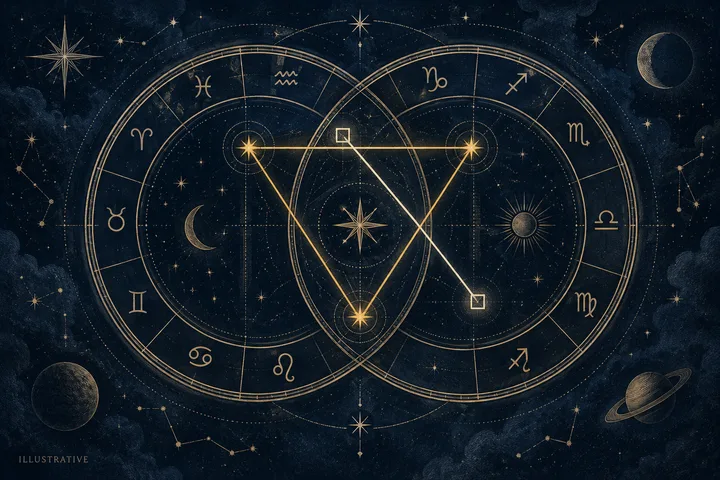
Read the grand trine as the relationship’s easiest shared language, then let the hard contact tell you where ease stops being enough. A synastry grand trine links three points across the two charts through three trines, so it can describe natural understanding, support, and a way of moving together that feels familiar. The square or opposition does not cancel that pattern. It concentrates the reading. First check that all four contacts are real by degree and within your chosen six-degree orb. Then identify the planets involved, rank the tightest contact, and ask what the hard aspect demands that the trine does not provide. The best interpretation is usually not “good versus bad.” It is flow plus a task: what comes easily, what catches, and what the two people must choose to handle well.
1. The grand trine shows the bond’s natural rhythm
A grand trine is not one aspect. It is a pattern made from three trines linking three points. In synastry, those points belong to the two charts, so the pattern describes a channel the pair can enter together. The people may understand one another quickly. They may share a mood, value, instinct, or style of response without needing a long explanation. That is the first thing to read.
The pattern can also describe a shared response rather than a permanent mood. Two people may become more generous together, more playful, or more willing to trust their instincts. Look for the verb in the relationship. “We encourage each other” is more useful than “we have a harmonious aspect.” It tells you what to watch when the relationship is tested.
The type of ease depends on the planets and the element. A water pattern may flow through emotional attunement, memory, and private reassurance. An earth pattern may make practical cooperation feel obvious. Air can bring easy conversation, shared ideas, and social movement. Fire can create enthusiasm, confidence, and a sense that the other person makes action more possible. The element gives the atmosphere. The planets give the subject.
Still, ease is not the same as completion. A trine joins energies that already know how to move together. It can support warmth and trust, but it may not force a difficult conversation or create a plan when no one wants to interrupt the mood. Cafe Astrology describes trines in synastry as supportive and naturally blending, while its discussion of grand trines also warns that effortless patterns can become static when they are never developed. That distinction matters here.
So begin with a plain sentence: “This is what we do well without much effort.” Keep it concrete. Do you soothe one another? Make decisions? Share desire? Solve practical problems? Laugh through pressure? The grand trine is useful when you name the behavior it supports. It is too vague when you stop at “natural compatibility.”
There is another reason to stay concrete. A grand trine can make a relationship feel self-contained. The two people may create a private atmosphere that is rich, loyal, and hard for outsiders to understand. That can be beautiful. It can also make feedback harder to hear. If both people keep saying, “We know what we mean,” ask whether the bond is actually communicating or simply enjoying its own fluency. The best version of the pattern turns shared instinct into shared skill. It can explain the other person quickly, then slow down enough to check the explanation.
The hard contact has a proper role. It is the threshold where the pair's natural rhythm meets a different need. Notice when it appears: during a decision, a boundary, a change in pace, or the move from private feeling to public commitment. That threshold tells you what to investigate.
Sources: Aspect - Astrodienst Astrowiki; Aspect Patterns in an Astrology Chart; Synastry: Love and Relationship Astrology
2. Verify the pattern before interpreting it
Many confusing synastry readings begin with a pattern that was never checked. A chart picture may draw attractive lines, but the interpretation needs actual supplied placements. For this kind of comparison, record each planet’s sign and degree for both people. Then compare the shortest zodiac distance between the relevant points. A trine is 120 degrees. A square is 90 degrees. An opposition is 180 degrees.
Use one rule throughout the reading. This guide uses a six-degree orb for selected major contacts. An aspect at 1 degree is tighter than one at 5 degrees. A contact outside the chosen orb may still look suggestive by sign, but it should not carry the same weight as a degree-based aspect. Cafe Astrology’s glossary defines an orb as the range in which an aspect operates and distinguishes close orbs from loose ones. The number is not decoration. It decides which claims belong in the reading.
Check the grand trine one pair at a time. Point A must trine point B. Point B must trine point C. Point C must trine point A. Then check the hard contact separately. If a fourth point squares one member of the triangle, do not call the entire figure a single named pattern unless the geometry supports that name. A lone square touching a grand trine is still meaningful, but it is not automatically a kite, T-square, or another formal configuration. This distinction matters because a named pattern adds interpretive weight. Use the name only when the geometry earns it.
This is where sign-based and degree-based reading need to stay separate. Signs can show an elemental or modal relationship. Degrees show whether the planets actually reach the aspect within the method you chose. If one person’s Venus is in an earth sign and the other person’s Mars is in a sign that can form an earth trine, that tells you the sign story. It does not, by itself, prove a six-degree Venus-Mars trine.
Do not let a chart’s visual symmetry overrule the data. Write the contacts in a small table if needed: planet one, planet two, aspect, exactness, orb, and source of the placement. Once the pattern survives that check, you can read it with confidence. If it does not, narrow the claim. A precise partial reading serves the couple better than an impressive shape built from loose lines.
Also record what is missing. If you have only Moon, Venus, and Mars signs, you can compare sign relationships and discuss possible major contacts only when degrees are supplied. You cannot responsibly claim a complete grand trine, a house story, or a full chart pattern from three sign labels. If one degree is unknown, mark the affected aspect as unconfirmed. This does not weaken the reading. It tells you exactly what the reading can and cannot carry.
If the supplied placements produce three sign-based trines but the degrees are not available, describe them as a possible sign pattern, not a confirmed degree pattern. If the report’s method uses only selected major aspects, do not add minor aspects to make the picture more dramatic. Precision keeps the reader from confusing a broad astrological impression with the particular comparison they actually requested.
A useful check is to draw a line between a mixed pattern and a named pattern. A grand trine plus an unrelated square is a grand trine with a hard contact. A kite requires more: an opposition to one point of the grand trine and sextiles from the opposing point to the other two. If those extra links are missing, keep the interpretation focused on the actual contacts. Names should sharpen the reading, not decorate it.
When the numbers are close but not decisive, keep both layers visible. You might write, ‘The signs suggest an earth-based flow, while the degree contacts confirm only two of the three trines.’ That sentence gives the reader a useful possibility without presenting an unverified shape as settled. It also makes later revisions easy if a birth time or degree becomes available.
For a clean comparison, keep an aspect ledger beside the chart notes. Record the two planets, the exact angle, the calculated orb, and whether the contact is sign-based or degree-based. Add one short phrase for the question it answers, such as ‘emotional repair’ for Moon contacts or ‘pace and proof’ for Venus-Saturn. This prevents the reading from drifting when several attractive lines compete for attention. It also shows the reader why one contact leads and another remains background.
Sources: Aspect - Astrodienst Astrowiki; Glossary of Astrology Terms
3. Read the planets before you judge the pattern
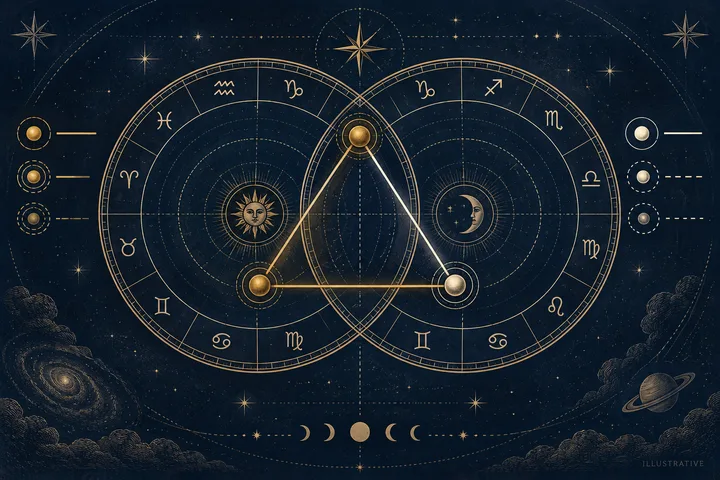
The same geometry changes meaning when the planets change. A grand trine linking Moon, Venus, and Mars has a different center of gravity from one linking Mercury, Jupiter, and Saturn. The first speaks more directly to feeling, affection, desire, and response. The second may describe shared thinking, belief, planning, and responsibility. The pattern tells you how the energy circulates. The planets tell you what is circulating.
Start with the Moon if it is involved. Ask what feels safe, familiar, and emotionally understood. A Moon contact can be felt in ordinary life: how two people comfort each other, share food, respond to silence, or recover after a hard day. A flowing Moon trine may make emotional repair easier. But it can also encourage both people to assume the other already knows what is needed. The hard contact may expose that assumption.
Venus brings affection, pleasure, attraction, taste, and the way love is shown. Mars brings pursuit, heat, initiative, sexuality, and conflict. A trine among these themes can make affection and desire move in the same direction. One person may find the other easy to enjoy and easy to approach. Yet if the hard contact involves Venus and Mars, the couple may discover that pleasure and timing do not always agree. Chemistry can be real and still require negotiation.
Mercury changes the question to language. Does the grand trine help you find the right words, or does it let you rely on tone and assumption? Saturn raises duty, boundaries, time, and consequence. Jupiter expands faith, generosity, and meaning. Uranus, Neptune, or Pluto can deepen the pattern, but they can also make it less personal and more generational unless they touch a personal planet closely. Keep the most direct relationship planets at the center when the question concerns daily partnership.
Then notice whose planet is doing what. In synastry, the planet person often experiences the function as a personal part of life, while the house or receiving person may feel the other person activating it. You do not need houses for this article’s scope. You can still ask which person initiates the contact and which person tends to receive, amplify, or resist it. That distinction keeps the reading relational instead of turning the chart into a list of traits.
A useful test is to translate each planet into a verb. The Moon receives and protects. Venus values and attracts. Mars pursues and asserts. Mercury names and connects. Saturn contains and commits. Jupiter enlarges and trusts. Uranus disrupts and frees. Neptune imagines and dissolves. Pluto intensifies and transforms. Then read the aspect as a meeting between verbs. A Venus trine Mars can say that valuing and pursuing cooperate. A Venus square Saturn can say that valuing meets a demand for proof. The sentence becomes readable because the planets are doing something.
This order prevents a familiar mistake: importing a memorized meaning before looking at the pair. “Saturn is bad” tells you very little. Saturn touching Venus may describe caution, loyalty, fear, duty, age difference, or a need for dependable proof. Which one fits depends on the sign, orb, other contacts, and the behavior the couple recognizes. The aspect is a relationship between functions, not a moral label attached to one planet. The same discipline applies to the grand trine. Moon, Venus, and Mars do not promise one fixed outcome; they show three functions that may cooperate, overprotect, seduce, irritate, or repair depending on the contact that joins them.
Sources: Synastry: Love and Relationship Astrology; Glossary of Astrology Terms
4. Let the element describe what comes easily
Once you know the planets, return to the grand trine’s element. The element tells you the medium through which the connection flows. This is not a score. It is a working description of the bond’s easiest route. You are asking, “When we are at our best, what kind of exchange happens without force?”
A water grand trine can give the pair a strong private current. They may sense changes in one another’s mood, protect vulnerability, and remember emotional details. The risk is indirectness. Both people may feel the issue clearly and say it poorly, or wait for the other to notice. The hard contact can become the point where feeling must become a sentence, a boundary, or a direct request.
An earth grand trine often supports reliability. The couple may divide tasks, make a home, manage resources, or show love through useful acts. The risk is inertia. If the arrangement works, no one may ask whether it still fits. A hard contact can interrupt the routine around money, time, work, or physical needs. It asks the pair to update the agreement instead of quietly performing an old one.
An air grand trine can make conversation, humor, and shared curiosity the relationship’s oxygen. The two people may give each other room to think. The risk is staying in the discussion. A difficult contact can show where a topic cannot be solved by another clever explanation. Someone has to choose, feel, commit, or apologize. A fire grand trine can supply courage and momentum. Its risk is speed, especially when enthusiasm outruns consent, patience, or follow-through.
The hard contact does not have to belong to the same element. In fact, the contrast may explain the experience. A water flow with a fire square can feel tender one minute and urgent the next. An earth trine with an air opposition may make life work smoothly while leaving the couple divided about ideas or social priorities. Name the mismatch without moralizing it. Different elements often describe different kinds of truth.
Use the element as a question rather than a label. For water, ask what remains unspoken because both people sense it. For earth, ask which routine has become too fixed to revise. For air, ask which decision keeps becoming another conversation. For fire, ask where eagerness is being mistaken for agreement. These questions connect the symbolic pattern to the moment when the relationship leaves its easiest setting.
The element can also show what restores the couple after friction. Water may need privacy and emotional naming. Earth may need a practical repair and reliable follow-through. Air may need a clean explanation without pressure to feel on command. Fire may need movement, play, or a shared act of courage. These are starting points, not prescriptions. Match the repair to the medium of the trine, then make sure it answers the actual demand of the hard contact.
This gives the reading a humane pace. Do not demand that an air pattern become water, or that a fire pattern behave like earth. Let the relationship use its own element as the first bridge, then ask it to learn the missing quality where the hard contact points. A flowing pattern is strongest when it expands its range without losing its native way of connecting. The goal is not to correct the element. It is to let the relationship keep its natural gift while building the skill the hard contact asks for.
Sources: Aspect Patterns in an Astrology Chart; Synastry: Love and Relationship Astrology; Glossary of Astrology Terms
5. Give the hard contact the job it actually has
A square and an opposition do not mean the same thing. Both are hard aspects, but they create different relationship tasks. A square tends to show energies that want to act in different directions. The people may keep colliding over style, timing, priorities, or method. An opposition sets up a polarity. One person expresses one end of the axis while the other person seems to carry the other end, and the couple may alternate between attraction and resistance.
In synastry, a square often asks, “How do we do this together when our instincts disagree?” A Moon-Mercury square, for example, may bring a gap between feeling and explanation. One person wants emotional recognition while the other reaches for analysis. Neither role is automatically wrong. The work is to stop treating a different language as proof of a different heart.
An opposition often asks, “What are we seeing in the other that we have not integrated in ourselves?” The attraction can be strong because the other person carries a missing or contrasting quality. But the same polarity can become a ping-pong match. Cafe Astrology’s synastry guide describes oppositions as capable of complementing each other while also creating competition or insecurity. That is a useful middle reading. Attraction and friction can belong to the same contact.
The hard aspect becomes more important when it touches a personal planet, is tight by orb, or repeats a theme already visible in the pair’s behavior. It becomes less decisive when it is wide, involves only slow planets, or stands alone while the personal planets describe another story. Do not count contacts like votes. Rank them by relevance.
Ask what the hard contact prevents the grand trine from doing automatically. Maybe the trine helps the two people forgive, while the square asks them to stop avoiding the original issue. Maybe the trine creates sexual warmth, while the opposition asks for a clearer agreement about exclusivity or space. Maybe the trine supports conversation, while the hard aspect demands that someone make a decision. The contact’s job is the missing action.
A strong interpretation can be direct: “You understand each other easily here, but you do not solve this part by understanding alone.” That sentence honors the ease and names the work.
The distinction protects the reader from two common errors. The first is fatalism: one hard aspect is treated as a permanent wound. The second is sentimentalism: a beautiful trine is treated as proof that every problem can be smoothed over. Both errors flatten the chart. A square may become a practiced way of making differences useful. An opposition may become a conscious exchange between two strong positions. But neither outcome arrives because the aspect has been renamed. It arrives because the people learn the task the aspect keeps presenting.
Read the pair with two sentences: “This part of you reaches me easily.” And, “This part of us needs a method.” The first keeps the interpretation warm. The second gives it a usable edge. A hard contact can be valuable in an established bond because it keeps comfort from becoming inattention. It asks the couple to keep learning one another after the first understanding has become familiar.
Sources: Aspect - Astrodienst Astrowiki; Synastry: Love and Relationship Astrology; Glossary of Astrology Terms
6. Rank the contacts by orb, planet, and repetition
When a grand trine and one hard contact appear together, readers often ask which one wins. The answer is not the aspect with the nicer name. Rank the pattern in three passes: exactness, planetary importance, and repetition of the theme.
First, rank exactness. A 1-degree square to the Moon deserves more attention than a 6-degree trine between two less personal points, even if the grand trine remains structurally important. Exact does not mean automatically difficult or fatal. It means concentrated. A 5-degree contact may still speak clearly under the stated six-degree method, but it should not be described with the same force as a near-exact contact. Precision changes emphasis, not destiny. It tells you where to listen first. It also keeps the reading fair to both people. A loose contact should not be used to make a sharp accusation, and a close contact should not be softened into a vague compliment. The orb sets the volume. The planets set the subject.
Second, rank planetary importance for the question. If you are reading emotional fit, Moon contacts rise. If the question is affection and attraction, Venus and Mars rise. Mercury matters when the couple is stuck in conversation. Saturn matters when commitment, time, fear, or responsibility keeps returning. A wide contact to a relevant personal planet may deserve a closer look than a tighter contact between points that do not address the reader’s question.
Third, look for repetition. Does the hard contact repeat the same tension shown by the signs? Does it echo a personal-planet mismatch elsewhere? Does the grand trine offer a direct resource for handling it? One square between unrelated slow planets may be background weather. A tight Venus-Saturn square alongside a soft Venus-Moon-Mars pattern is a different story. The affection is available, but trust, pacing, or fear may require deliberate care.
This ranking creates a usable reading order. Begin with the tightest relevant contact. Then read the grand trine as the resource around it. Finally, check whether the signs and elements support or complicate the interpretation. That order prevents the grand trine from becoming a blanket promise and prevents the hard aspect from swallowing the whole chart.
You can record the result in a simple three-line summary: the easiest exchange, the sharpest friction, and the resource that can help. A synastry reading becomes much clearer when every technical detail earns one of those lines.
If the pattern contains several contacts close to the same degree, note the cluster, but do not inflate it into a universal rule. Repetition matters because it makes a theme harder to dismiss as a one-off. It does not replace judgment about the planets. Three loose contacts to unrelated points do not necessarily outweigh one exact Moon-Saturn square when the reader is asking about emotional safety. Weight is contextual. The technical method becomes humane when it respects the actual question.
You can also compare applying and separating contacts when the supplied data supports that calculation. Some astrologers give an applying aspect more forward pressure because it is moving toward exactness, while a separating aspect may describe a pattern already familiar or established. Treat this as a refinement, not a replacement for orb and planet. The core question remains the same: which contact is most relevant to the issue the reader is trying to understand?
When two contacts appear equally relevant, choose the one that changes the reader’s next question. If the trine explains why closeness feels easy but the square explains why plans fail, the square usually deserves the practical focus. If the hard contact is already handled well and the trine explains the bond’s deepest support, let the trine lead. Ranking is not a fixed hierarchy. It is a decision about what the reader needs to see now.
A tie-breaker helps when the technical picture still feels crowded. Prefer the contact that is both close and personal, then ask whether the rest of the comparison confirms it. If a tight Moon square describes guarded feelings but the Moon also receives a close Venus trine, the reading should include both the sensitivity and the available comfort. Do not average them into ‘mixed emotions.’ Name the sequence: the friction appears first, and the trine shows how the pair may soften it.
Sources: Aspect - Astrodienst Astrowiki; Glossary of Astrology Terms
7. Worked example: ease around a recurring difference
Consider an example where the supplied personal-planet contacts form a grand trine through Moon, Venus, and Mars, while one tight square links Venus to Saturn. This is an illustrative reading method, not a calculated personal chart. The first layer says that feeling, affection, and desire can circulate with unusual ease. The pair may enjoy one another’s company, recover quickly after small disappointments, and find physical closeness natural.
Now give the square a precise job. Venus wants warmth, pleasure, and a visible sign that love is welcome. Saturn asks for time, definition, limits, and proof through consistency. The square does not erase the attraction. It says that affection may meet caution, delay, uneven availability, or a fear of making the wrong promise. The relationship can feel good and still move slowly around commitment.
The grand trine is the resource. The couple already has a way to reconnect. They may be able to soften a tense conversation, remember what they value, or return to tenderness after distance. But that ease can become avoidance if they use it only to restore the mood. The pattern works best when the pair brings the Saturn question into the Venus language: What does care look like over time? What pace feels honest? Which promise can each person keep this week? Add a date to the promise, or a behavior that another person can actually see. Saturn becomes useful when its need for proof has somewhere to land.
Notice how the interpretation changes if the square is loose and the trine contacts are exact. Then the Saturn theme may be present without governing every interaction. Reverse the orbs, and the square moves forward in the ranking. If Saturn also touches the Moon or Mars, the theme repeats and deserves more weight. If the hard contact involves only two outer planets, keep the conclusion broader and less personal.
The same method works with other planets. A grand trine through Mercury, Venus, and Jupiter with a tight Mars square may make conversation and affection easy, while conflict arrives through speed or tone. A grand trine through Moon, Mercury, and Neptune with a tight Uranus opposition may support psychic sensitivity and imagination, while unpredictability interrupts the bond. In each case, identify the easy channel, name the interruption, and use the easy channel to meet the interruption directly.
The point is not to decide whether the pattern is good. It is to find the relationship’s built-in strength and aim it at the place that needs conscious work.
Notice the difference between an interpretive example and a promise. The example shows how the symbols might organize a reading. It does not tell you that every Venus-Saturn square produces delay, or that every Moon-Venus-Mars trine guarantees tenderness. Signs, degrees, the people involved, and the rest of the supplied contacts all matter. A worked example teaches sequence: establish the pattern, identify the resource, identify the pressure, then choose a behavior that lets the resource meet the pressure. That sequence is the article’s main practical contribution. It keeps a striking shape from becoming a conclusion before the planets have been read.
A reader can repeat this sequence with any personal planets supplied in a report. Write the grand-trine contacts first. Beside each one, name the behavior it supports. Then write the hard contact and name the behavior it interrupts. Finally, write one sentence beginning “The resource can help when...” and finish it with an action. This turns a shape on the wheel into an interpretation that can be checked in ordinary life. It also gives the couple a way to return to the chart later without asking it to speak more loudly than the lived relationship.
8. Turn the reading into a decision you can observe
A useful synastry reading ends in observation, not a verdict about whether two people should date. The chart can show a pattern of ease and a point of friction. The relationship shows how those symbols are being lived. Put the interpretation to work in a small, honest test.
Start with the grand trine. Name one behavior that already comes easily. “We calm each other.” “We make plans well.” “We talk for hours.” Then ask whether that strength is available under pressure, or only when the relationship is pleasant. A grand trine that survives a difficult conversation is more useful than one that appears only in ideal conditions.
Next, name the hard contact without turning it into character judgment. Do not say, “You are cold,” when the pattern may show different pacing around affection. Do not say, “You are controlling,” when the chart only gives a Saturn theme that needs to be compared with real behavior. Say what happens: one person asks for reassurance, the other asks for more time; one wants a decision, the other keeps the conversation open; one moves toward intensity, the other pulls back.
Then choose one experiment that fits the planets. Moon contacts may need a clear check-in. Venus contacts may need an explicit statement of affection or value. Mars contacts may need a rule for arguing and a way to pause without disappearing. Mercury contacts may need one question answered at a time. Saturn contacts may need a promise small enough to keep and clear enough to test. Astrology becomes practical when the symbolic language points to a behavior.
Watch what happens next. Does the pair use the grand trine as a bridge, or as a reason to avoid the hard subject? Does the hard contact create a skill, or only repeat the same injury? That is the decision point. If the pattern helps both people name the task and respond with consistency, the tension can become a source of maturity. If it keeps excusing disrespect, silence, coercion, or broken agreements, the lived behavior deserves more weight than the chart’s promise.
The final reading is simple. Keep the ease. Work the friction. Compare your supplied placements again only after you have named what actually happens between you.
You can make the next step small enough to be honest. Choose one recurring situation tied to the hard contact. Write down what each person wants, what each person fears, and what each person actually does. Then name the grand trine resource you will use: listening, patience, humor, practical help, affection, or direct conversation. Try the new behavior once. Review the result by asking three questions: Did the old pattern appear? Did the chosen resource reach it? Did both people take part in the repair? Those answers tell you more than a dramatic label.
If you are comparing placements with a partner, do this together only if the conversation feels welcome. Astrology can open a door, but it should not be used to force a confession or win an argument. Share the interpretation as a question: “Does this fit the way we handle this?” Leave room for a different answer. The chart gives a language for reflection. The two people still decide how to use it. That freedom is part of a responsible reading. Symbols can reveal a pattern without removing either person’s agency.
Sources: Synastry: Love and Relationship Astrology; Glossary of Astrology Terms
A little more clarity
Does one hard synastry contact cancel a grand trine?
No. A grand trine and a hard contact describe different parts of the bond. The grand trine shows where the two people blend easily, while the square or opposition shows where their needs, timing, or styles require conscious work. Rank the contacts by orb, planet, and repetition rather than treating either pattern as an automatic verdict. The hard contact may become the place where the relationship learns a skill that the trine cannot supply on its own, such as direct speech, patience, boundaries, or dependable follow-through. That practice reveals how the pattern works in real life, with care, context, and an honest look at repeated behavior.
Sources & further reading
- Aspect - Astrodienst Astrowiki
Defines major aspects, aspect patterns, orbs, and the distinction between applying and separating contacts.
- Aspect Patterns in an Astrology Chart
Explains the grand trine as three mutual trines and discusses ease, stability, inertia, and the activating role of hard contacts.
- Synastry: Love and Relationship Astrology
Supports the relationship meanings of trines, squares, oppositions, attraction, polarity, friction, and supportive flow in synastry.
- Glossary of Astrology Terms
Defines aspects, grand trines, hard and soft aspects, synastry, and orb ranges used in the technical reading.
Synastry Comparison Report
Enter known placements for two people. Get an input-by-input comparison, selected aspect calculations and a clear record of what remains uncertain.
Compare our placements