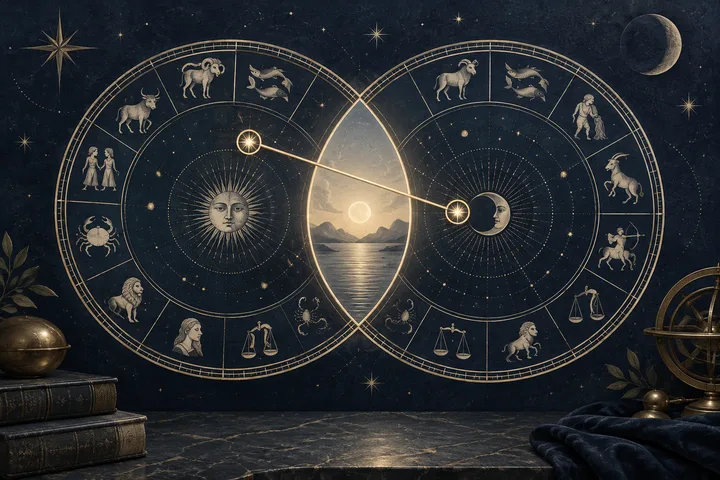
The aspect may be true without being the whole story
A synastry report says, ‘Your Saturn restricts his Sun.’ You read it twice. He doesn’t seem restricted. He’s warm with you, proud of your work, and quick to make room for your plans. The sentence feels false.
Or the report calls your Venus-Mars square irresistible, while the relationship feels quiet, affectionate, and almost shy. You don’t fight about desire. You don’t feel caught in a cycle of pursuit and refusal. You wonder whether the aspect means anything at all.
Start with the most useful distinction: an aspect describes contact, not a verdict. In synastry, two chart factors meet across two nativities. The planets show what is meeting. The aspect shows the manner of contact. The signs give the style. The houses, when known, show where the meeting lands. None of those layers, alone, can narrate every conversation, choice, and season of a relationship.
Astrodienst defines an aspect as an angular relationship between planets or between a planet and an axis. It also distinguishes the exact angle from the allowed margin, called the orb. That technical point matters here. A contact can be present, but its strength and shape still need judgment. A close conjunction is not read the same way as a loose, sign-based contact that only resembles one. [1][2]
The relationship can also express the same aspect inwardly rather than dramatically. Saturn may not block the Sun person’s visible confidence. It may make the Sun person take the Saturn person seriously, seek their approval, or feel more responsible around them. A Venus-Mars square may not produce arguments. It may create a charge that the couple handles through humor, restraint, timing, or a shared private language.
Think of the aspect as a doorway, not a room. The doorway tells you which two functions can meet. It doesn’t tell you whether you enter through tenderness, conflict, habit, play, or silence. A chart report often describes the doorway in its most obvious form because that is easy to name. Your life together may reveal the subtler room behind it.
This matters most when you are comparing an interpretation with a relationship that already feels stable. Stability doesn’t cancel a hard aspect. It may show that the pair has learned its rhythm. A square can become the place where you negotiate, repair, and grow. An opposition can become a dependable exchange of perspectives. The absence of drama may be evidence of skill, not evidence that the contact has vanished.
That is why ‘the aspect fits’ and ‘the relationship looks different’ can both be true. The contact belongs to the chart comparison. Its expression belongs to the people, the rest of the chart, and the way the bond is being lived.
The supported position is simple: don’t throw out a verified aspect because one stock interpretation misses your experience. Translate it before you reject it. But don’t force a relationship to perform a sentence written by someone who never met you, either. A chart factor earns influence through technical strength, repetition, and lived relevance.
Read the aspect as a real symbolic connection, then ask what part of the relationship it actually describes. A chart contact can fit one person’s role, private reaction, attraction, or recurring pressure while missing the couple’s visible day-to-day behavior. First verify the aspect by degree and orb. Then read the planets, the signs, and the wider pattern. Finally, compare that interpretation with what happens between you now. If the contact is tight and its symbolism repeats elsewhere, give it weight. If it is wide, sign-only, isolated, or contradicted by stronger contacts, lower its rank. The chart isn’t wrong because one sentence from a report feels wrong. The sentence may be too broad, too literal, or aimed at a layer of the bond you haven’t identified.
Sources: Aspect, Astrodienst Astrowiki; Orb, Astrodienst Astrowiki; Aspects Between Charts, Cafe Astrology
Why the report can feel more certain than the chart is
Astrological language often compresses a large field of meaning into one vivid phrase. ‘Magnetic.’ ‘Restrictive.’ ‘Soul connection.’ ‘Difficult communication.’ The phrase is memorable because it gives the mind something solid to hold. The trouble begins when a compact label replaces the reading itself.
Consider what a report sentence has left out. It may not tell you which person is carrying the planet’s role. It may not distinguish a conjunction from a square. It may not state the orb. It may treat a same-sign placement as if it were an exact degree contact. It may ignore the sign condition of both planets. It may mention attraction without asking whether the pair has enough emotional safety or practical continuity to express it well.
Cafe Astrology’s synastry guidance makes the role question explicit: each person can take on the part represented by their planet in the interaction. In its example, the Saturn person may respond to the Sun person’s self-expression with Saturnian pressure, standards, or caution. That doesn’t mean the Saturn person is always cold, and it doesn’t mean the Sun person is always diminished. It describes a particular exchange when that part of the relationship is activated. [3]
The aspect type changes the verb. A conjunction combines. An opposition polarizes and brings the two ends into view. A square presses two functions to work through friction. A trine lets energy move with less resistance. A sextile offers an opening that still needs participation. These are not moral rankings. A flowing aspect can remain unused. A hard aspect can become a source of skill.
Astrodienst’s aspect reference places the conjunction first in significance, followed by the opposition, square, trine, and sextile, while also stressing that the planets involved determine the meaning. Its treatment of squares gives the same two-sided reading: pressure can hinder expression, but it can also push a person toward constructive action. [1] That is a better starting point than a fixed good-aspect or bad-aspect list.
The report feels certain because the sentence is clean. The chart is not clean. It is layered. Your task is to expand the sentence back into a question: what is being connected, how tightly, in which signs, through whose role, and in what part of the bond? Once you ask those questions, the apparent contradiction often becomes a difference between the report’s headline and the relationship’s actual register.
A useful editor’s rule follows from this: never use an aspect adjective without naming the behavior it could describe. Replace ‘restrictive’ with ‘one person may set the pace, ask for proof, or bring practical limits.’ Replace ‘magnetic’ with ‘attention may return to the other person, even when the couple is doing something ordinary.’ Concrete possibilities let you recognize the contact without forcing a single story onto it.
You can also ask who benefits from the report’s strong wording. Dramatic language keeps attention, but it can make a reader search for a problem that wasn’t there. The astrological reading should sharpen perception, not create suspicion. If the relationship is kind and reciprocal, interpret the contact through that fact. A chart reading that ignores the couple’s actual conduct has lost its subject.
A report can also confuse possibility with frequency. An aspect may describe what happens at a turning point, during a disagreement, or when one partner feels exposed. It may not describe breakfast, errands, or every affectionate text. Ask when the contact appears, not whether it appears every day. A symbol can be accurate at the moment it matters most and quiet the rest of the week.
There is a second reason for the mismatch. Some contacts describe what a person evokes rather than what they openly do. One partner may feel the other as Saturn because the relationship calls up caution, maturity, or fear of disappointing them, even when the other partner behaves generously. One may carry Mars as desire, irritation, or courage, while the other experiences the interaction as simply motivating. The planet is present. The costume changes.
The same principle applies to positive language. A trine may fit because the two of you understand each other without much explanation, but that ease can become so familiar that nobody names it. A sextile may fit through opportunities you create together, though neither person feels swept away. A conjunction may feel ordinary because the shared energy is woven into the bond from the start. Strong doesn’t always mean loud.
When a report misses the current relationship, ask whether it is describing a capacity rather than a habit. A person may have the capacity to challenge your Saturn themes without currently challenging you. A couple may have the capacity for deep Venus-Mars chemistry while choosing a gentle pace. Capacity is not a promise. It is a potential form of exchange that becomes visible when circumstances invite it.
Sources: Aspect, Astrodienst Astrowiki; Aspects Between Charts, Cafe Astrology; Synastry: Love and Relationship Astrology, Cafe Astrology
Verify the contact before you interpret the contradiction
Before you explain why an aspect isn’t showing up, make sure the aspect is actually there under the rules you’re using. This is the least glamorous step. It saves the most time.
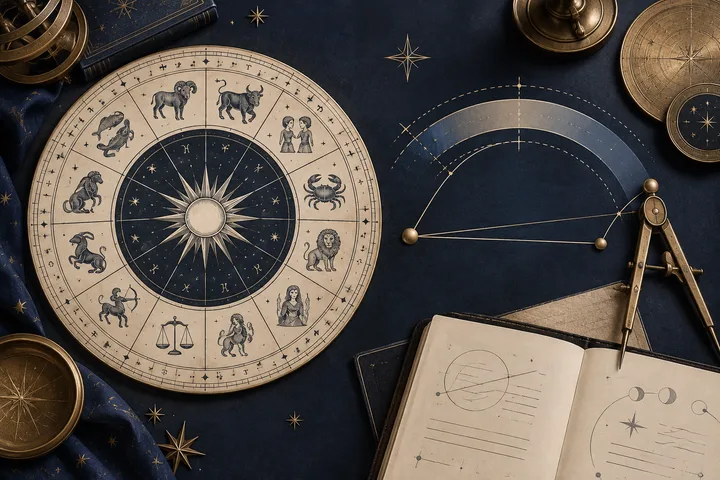
Use the exact placements supplied for both people. You need the planet, sign, degree, and minute when available. Then find the shortest zodiac distance between the two positions. Compare that distance with the major aspect angles: 0 degrees for a conjunction, 60 for a sextile, 90 for a square, 120 for a trine, and 180 for an opposition. The difference between the measured distance and the exact angle is the orb.
For this publication’s comparison report, use a six-degree maximum orb for selected major contacts, and say whether degrees were supplied. A six-degree limit is a clear editorial rule. It is not a claim that every astrologer uses the same boundary. Astrodienst notes that astrologers use different orb practices and that synastry charts may use smaller orbs because two charts create many more possible contacts. The smaller the orb, the tighter the contact usually is, but the chosen boundary still belongs to the method you stated. [2]
Now separate three cases. A degree-based aspect falls within the stated orb. A sign-based contact comes from the signs themselves, such as planets in the same sign or in signs that naturally form a square, but it may not meet your degree rule. A dissociate aspect has the right numerical angle but crosses signs that do not carry the usual sign relationship. Astrodienst describes this last case as irregular and says it can take on some qualities of the sign relationship as well as the geometric aspect. [5]
Imagine Maria has Venus at 4 degrees Taurus and Daniel has Mars at 8 degrees Leo. Their planets are 94 degrees apart. Under a six-degree orb, that is a Taurus-Leo square with a 4-degree orb. It qualifies as a degree-based major aspect. Now change Maria’s Venus to 28 degrees Taurus and Daniel’s Mars to 2 degrees Virgo. Their planets are still 94 degrees apart, so this is also a 4-degree square, not a conjunction. But Taurus and Virgo form an earth-sign trine by sign, so the square crosses a sign boundary and carries two layers at once: geometric friction and a shared element. Call it a cross-sign or dissociate square, then read both layers. The aspect is not erased. Its tone is altered.
If a report counts a whole-sign relationship but your chosen degree rule excludes it, label it honestly. You can say, ‘This is a sign-based contact, not a selected degree-based aspect under a six-degree orb.’ That sentence gives the reader a usable scope. It also prevents a wide or symbolic contact from taking over the interpretation.
Check the aspect’s distance before you check your feelings about it. If the contact is outside the chosen orb, set it aside or mark it as background. If it is close, keep reading. If the sign relationship is unusual, describe both layers. Technical precision doesn’t flatten astrology. It tells you which part of the chart you’re actually reading.
There is a practical reason to keep sign-only and degree-based contacts apart. A same-sign connection can create recognition because the planets share a field, while an exact angular aspect can create a sharper exchange between the two functions. Both may be meaningful. They answer different questions. One says, ‘These energies speak the same language.’ The other says, ‘These energies meet at this particular angle.’
If you’re reviewing a report that gives no degrees, don’t reverse-engineer them from the signs. Record what you know and what you don’t. You can still discuss the planet pair and sign blend. You can’t honestly rank a 0-degree conjunction against a 5-degree conjunction, or a 6-degree square against an 8-degree square, without the positions. Missing precision is a boundary, not a flaw in the relationship.
Keep a small record of the calculation scope beside the interpretation. Note whether you have signs only, signs plus degrees, or complete chart data with reliable birth times. Note the aspect list, the maximum orb, and whether the method includes only major aspects. When the relationship feels different later, you can see whether the change belongs to life circumstances or to a change in what was actually measured.
Do the same with software language. If a tool says ‘strong,’ find out whether it means exact, close by its own orb table, or simply included in the list. If it says ‘compatibility,’ translate that word into the actual contact it calculated. A clear report names the planets, angle, orb, and method. A vague report invites you to mistake formatting for interpretation.
Sources: Orb, Astrodienst Astrowiki; Aspects Between Charts, Cafe Astrology; Dissociate Aspect, Astrodienst Astrowiki
Read the planets, signs, and roles as one sentence
Once the contact is verified, stop asking, ‘Does this aspect happen?’ Ask, ‘What does this pair ask us to do together?’ That shift moves you from a label to a reading.
The planets come first. Moon contacts speak to feeling, safety, memory, and instinctive care. Venus contacts describe affection, taste, pleasure, value, and the way love is offered. Mars contacts bring desire, pursuit, assertion, anger, and physical energy. Saturn contacts introduce time, duty, boundaries, standards, and the work of making something durable. These meanings are broad. The aspect gives them a relationship grammar.
A Moon-Saturn square may not look like emotional rejection. It may show that one person asks for reassurance while the other answers with practical help, rules, or a plan. The care is real, but the languages differ. A Venus-Mars conjunction may not look like constant fireworks. It may show that attraction is easy to access, then become ordinary and embodied. A Mercury-Moon square may not mean endless arguments. It may show that one person reaches for words while the other needs time to feel before speaking.
Then add the signs. Cafe Astrology notes that the sign and house placements change how an interaspect is expressed, and it gives different styles for squares in mutable, cardinal, and fixed signs. Mutable friction can scatter into fussing and restlessness. Cardinal friction can arrive openly and quickly. Fixed friction can settle into stand-offs. [3] The aspect tells you there is pressure. The signs suggest the pressure’s accent.
Finally, assign the roles without turning them into permanent identities. If her Moon touches his Saturn, she may experience him as the person who sets the emotional temperature, or he may feel responsible for containing her feelings. That doesn’t mean she is needy or he is withholding. It means the interaction can organize itself around Moon and Saturn themes. The same contact may reverse emphasis in a different moment, because both people participate in the exchange.
This is where a seemingly inaccurate interpretation can become accurate at a deeper level. A Saturn person who is affectionate may still be the person who makes the bond feel serious. A Mars person who never starts a fight may still be the one who gets the other moving. A Venus person who dislikes romantic display may still shape what the couple values and protects.
Use a three-part rewrite for any report sentence. First name the planet function. Next name the aspect’s manner. Then offer two expressions, one obvious and one quieter. For example: ‘Your Venus square his Mars joins affection with desire through friction. It could appear as teasing and pursuit, or as careful timing around touch and closeness.’ The second possibility keeps the interpretation alive without making it vague.
The role layer also protects you from assigning gendered behavior to a planet. Venus and Mars can describe different functions in either partner’s chart. The Venus person may be the one who defines the terms of closeness. The Mars person may be the one who acts, initiates, protects, or pushes for clarity. Don’t decide in advance who is soft and who is forceful. Read the chart positions, then observe the exchange.
House information, when it is genuinely available, adds location. A partner’s Venus in your fifth house may make affection vivid in pleasure, creativity, and romance. The same Venus in your sixth may show care through routines, help, and shared work. But if the report uses only supplied signs and optional degrees, leave houses out. A precise smaller reading serves the reader better than a larger invented one.
Natal context adds another safeguard. If Saturn is already prominent in one person’s chart, they may recognize Saturnian responsibility as familiar rather than oppressive. If Mars is already part of someone’s emotional style, a Mars contact may feel energizing instead of startling. Synastry doesn’t replace the natal chart. It shows how one person’s established pattern meets another person’s established pattern.
This is also why a planet’s dignity, condition, and existing aspects matter in a full reading. A planet doesn’t arrive empty-handed when it crosses into synastry. It brings its own habits and resources. With only selected supplied placements, you can describe the contact clearly, but you shouldn’t pretend to have judged every natal condition. Say what the available layer supports, and let the rest remain open.
Sources: Aspect, Astrodienst Astrowiki; Aspects Between Charts, Cafe Astrology; Synastry: Love and Relationship Astrology, Cafe Astrology
Let the wider synastry and the present relationship rank it
No single contact should outrank the chart comparison without earning that authority. A tight personal-planet aspect matters. So does repetition. If the same theme appears through another aspect, a house overlay, or a planet’s role in both charts, the contact has more support. If it stands alone against a very different pattern, keep it in proportion.
Astrological sources consistently point readers toward the wider chart. Cafe Astrology recommends considering the signs and houses of the planets, giving closer attention to inner-planet interaspects and to factors that carry relationship meaning in the individual charts. Its broader synastry material also treats Saturn contacts as capable of binding people while remaining difficult to manage. [3][6] The point isn’t to collect more indicators until you get the answer you want. It’s to see whether the contact belongs to the relationship’s main pattern or sits at its edge.
Rank the evidence in this order. First, technical strength: does the contact meet the stated degree and orb rule? Second, symbolic coherence: do the planets and signs describe a recognizable exchange? Third, repetition: does another strong contact echo the same theme? Fourth, lived activation: can you point to a recurring behavior, feeling, or choice between you? Fifth, timing: is there a current transit or progression bringing the natal contact forward? In this article’s supplied-placement scope, the fifth step requires separate timing data. Don’t pretend a synastry comparison alone has calculated it.
The present relationship gets the final vote on expression, not on whether the symbol exists. If a close Venus-Mars square is not producing conflict, look for its other forms: sexual tension handled with care, different speeds of approach, a need to negotiate privacy, or a creative charge that the couple directs into work and play. If none of these are present, don’t keep escalating the claim. The aspect may be latent, lightly expressed, or less important than the rest of the chart.
Here is the strongest exception. A relationship can temporarily look unlike a powerful contact because the bond has not reached the life area it describes. Saturn themes often unfold with commitment and time. Outer-planet contacts can change register as a relationship develops. Cafe Astrology describes several outer-planet interaspects as interactions that evolve over time, and its Saturn material emphasizes stages, initial reluctance, and later familiarity or safety. [6][7] This doesn’t mean every quiet relationship is waiting for a dramatic future turn. It means timing and duration can affect visibility.
Keep the exception narrow. ‘It hasn’t happened yet’ is not a license to predict that it will. If a supposed aspect has no technical strength, no symbolic coherence, no repetition, and no lived trace, lower it. Respect the chart by refusing to make it carry more than it can carry.
A useful journal test takes three weeks. Write the contact at the top of a page. Under it, record only concrete moments: who initiated, who slowed down, what each person needed, what was said, and what changed afterward. Don’t interpret each event as proof. At the end, look for a repeated pattern. If the chart’s language and the relationship’s language meet, you have an expression to work with. If they don’t, the honest reading is that this contact isn’t central right now.
You can make the ranking even cleaner by separating presence from prominence. Presence asks whether the aspect qualifies. Prominence asks whether it organizes the relationship. A close contact between the Moon and Saturn may be present and prominent if emotional safety and responsibility are recurring themes. A close contact between two slower planets may be present but less personal, especially if it doesn’t connect to the relationship’s inner planets or angles. A report should not let every valid line shout at the same volume.
Also watch for confirmation bias in both directions. If you love the relationship, you may dismiss a difficult contact because you want the chart to bless everything. If you fear the relationship, you may inflate a hard aspect because it gives the fear a symbol. Write the behavior first. Interpret second. Astrology becomes clearer when observation and symbolism can sit beside each other without either one being bullied.
Make the record specific enough that another reader could recognize the event without knowing your conclusion. ‘He was Saturnian’ is an interpretation. ‘He asked us to agree on a time before we discussed the move, and I felt steadier afterward’ is an observation. The second sentence may support a Saturn reading, but it might also point to care, planning, or simple compatibility. Good chart work keeps those possibilities visible until the pattern repeats.
The wider chart can explain why a contact feels different from its textbook version. A Venus-Mars square may be softened by supportive Moon contacts. A Saturn contact may become trustworthy when Jupiter or Venus offers warmth. A tense Mercury contact may find an outlet through shared work or humor. The aspect still matters, but its expression is negotiated by the whole pattern.
A pattern can also distribute one theme across several people and planets. One contact may show attraction, another may show how you repair, and a third may show why commitment feels possible. If you ask one aspect to explain attraction, communication, safety, conflict, and endurance, you have given it an impossible job. Rank the contact by the question you’re asking. The most important aspect for desire may not be the most important aspect for trust.
Sources: Aspect, Astrodienst Astrowiki; Aspects Between Charts, Cafe Astrology; Synastry, Skyscript Glossary
Turn the mismatch into a better conversation
The goal of synastry isn’t to make two people confess to a script. It’s to show where their energies meet so they can choose how to meet there. A mismatch between chart language and relationship experience gives you a precise place to ask better questions.
Begin with the narrow version. Don’t say, ‘Our Saturn aspect means you hold me back.’ Say, ‘When I take the lead, do you experience me as demanding, or do you feel supported by the structure I bring?’ Don’t say, ‘Our Venus-Mars square means we have unresolved sexual tension.’ Say, ‘Do we move toward closeness at different speeds, and what helps each of us feel wanted without feeling pushed?’ Specific questions protect the relationship from theatrical astrology.
Use the aspect’s two gifts as well as its friction. Saturn can name the care required to keep a promise, not only the fear of restriction. Mars can show courage and initiative, not only anger. A square can reveal a skill the couple must practice. An opposition can show a polarity that needs room for both ends. A trine can show ease, but ask what you’re taking for granted. The aspect becomes useful when it changes a choice you can make.
Imagine Maria and Daniel from the earlier example. Maria’s Venus square Daniel’s Mars qualifies by degree, yet their relationship feels gentle. A shallow reading would insist that hidden conflict must be waiting. A stronger reading notices their different rhythms: Maria names affection through steady touch and shared comfort, while Daniel reaches for closeness through action and spontaneous plans. They may not argue about desire. They may simply need to say when a plan feels loving to one and rushed to the other. The square is not a sentence of trouble. It is a place where style requires translation.
If you only have signs and no degrees, keep the conversation at the sign level. You can compare a Moon in one sign with Venus in another and discuss emotional style and affection, but don’t call the contact exact or assign a selected major aspect. If you have degrees, state the orb. If you don’t have birth times, don’t claim houses or angles. A report built from supplied Moon, Venus, and Mars placements can still be valuable, but it must stay inside that boundary.
The best ending is not ‘the chart is right’ or ‘the relationship wins.’ The best ending is a question that makes the symbolic pattern testable in ordinary life. Ask where the contact shows up, who feels it, what form it takes, and what response would make the exchange kinder or more honest. Then listen to the answer.
Try this tonight: ‘I found an aspect that links our way of loving with our way of acting. I don’t want to force an interpretation. When do you feel us moving at different speeds, and what would help us meet in the middle?’ That conversation can confirm the aspect, refine it, or release it. Any of those outcomes is a better reading than a dramatic label that doesn’t belong to you.
If your partner doesn’t care about astrology, keep the chart vocabulary to yourself and ask about the behavior. ‘Do you feel rushed when I make plans quickly?’ works better than ‘Your Mars is activating my Venus.’ The chart can guide your curiosity without becoming a test your partner has to pass. You’re looking for mutual understanding, not a confession that proves the report correct.
If the conversation reveals a genuine strain, name the decision in front of you. Maybe one person needs a slower pace. Maybe affection needs to become more visible. Maybe a boundary needs a clear consequence. The aspect can help you describe the pattern, but the relationship changes through choices. That is the practical dignity of synastry: it gives meaning to the work without doing the work for you.
And if nothing in the relationship matches the aspect after careful checking, let it be minor. Not every contact becomes a headline. Some are background notes. Some belong to a possibility that never becomes central. Some reports simply use a broad phrase for a narrow technical fact. You don’t have to rescue the interpretation. Keep the contact in its proper place and return to what the two of you actually share.
That last move is a form of astrological discipline. Conviction doesn’t require exaggeration. You can honor a symbol and still give it a modest role. The chart offers a language for the meeting; your choices give that language a life.
So return to the original question with a firm answer. If the aspect fits the chart but not the current relationship, keep the aspect, revise the interpretation, and lower its rank until the wider pattern and the lived bond support it. Don’t erase the symbol. Don’t obey it blindly. Read it closely, then ask the person in front of you what the relationship is actually asking for.
That approach leaves room for reverence and judgment at once. You can trust the language of the chart without surrendering your eyes, your memory, or your consent. If the symbol helps you notice tenderness, name it. If it helps you name a recurring strain, address it. If it explains nothing after a careful check, let it go quiet. A useful interpretation makes the relationship clearer, more honest, and easier to tend.
Sources: Orb, Astrodienst Astrowiki; Aspects Between Charts, Cafe Astrology; Synastry: Love and Relationship Astrology, Cafe Astrology
A little more clarity
Can a synastry aspect be real if I don’t feel it?
Yes. A verified aspect describes a connection between chart factors, but it may work quietly, belong more strongly to one person’s experience, or be outweighed by the wider synastry. Check the degrees and orb first, then look for a repeated behavior or feeling before giving it major weight.
What should I do if a report counts an aspect but my orb rule excludes it?
Label it as a sign-based or wide contact and keep it separate from the selected degree-based aspects. Don’t treat the two categories as equal. A six-degree maximum orb is the comparison rule used in this report framework, while other astrologers may choose different limits.
Why can a difficult aspect feel easy in a relationship?
Squares and oppositions create pressure or polarity, but they don’t guarantee visible conflict. The couple may already have skills that let the energy move well, or the aspect may show different speeds, private tension, or productive effort instead of arguments. Read the planets and signs before choosing the expression.
How can I tell whether an aspect matters right now?
Rank it by orb, planet importance, repetition in the wider synastry, and a clear lived pattern. Timing may bring a natal contact forward, but a supplied-placement comparison doesn’t calculate transits or progressions. Use present behavior as evidence of current expression, not as a reason to force a prediction.
Sources & further reading
- Aspect, Astrodienst Astrowiki
Defines major aspects, aspect angles, and the need to read the planets involved before assigning meaning.
- Orb, Astrodienst Astrowiki
Defines orb as the allowed deviation from an exact aspect and describes how orb practice varies.
- Aspects Between Charts, Cafe Astrology
Explains planetary roles in interchart aspects and the importance of signs, houses, and inner planets.
- Synastry: Love and Relationship Astrology, Cafe Astrology
Describes how conjunctions, flowing aspects, squares, and Venus-Mars contacts can express attraction and friction.
- Dissociate Aspect, Astrodienst Astrowiki
Explains why a geometrically valid aspect can cross signs with a different natural relationship.
- Synastry, Skyscript Glossary
Defines synastry as chart comparison and places aspects within the wider condition of the planets.
- Saturn in Synastry, Cafe Astrology
Shows how Saturn interaspects may unfold through stages of reluctance, responsibility, familiarity, and safety.
Synastry Comparison Report
Enter known placements for two people. Get an input-by-input comparison, selected aspect calculations and a clear record of what remains uncertain.
Compare our placements