The retrograde mark changes the reading, not the relationship question
You are comparing two charts. One of the planets is marked with an R, and suddenly a clean Venus-Mars contact feels suspect. Should you count it? Should you reverse it? Should you read it as a sign that the attraction will stall, return, or never become simple?
The best answer is calmer and more useful. Keep the aspect. Then add the retrograde condition as a second layer.
A synastry aspect describes an exchange between two natal charts. One person's Venus may meet the other person's Mars by conjunction, square, trine, opposition, or sextile. That contact still exists when Venus is retrograde at birth. The signs still describe the style of affection and desire. The degrees still determine whether the contact is close. The aspect still tells you how the two functions meet.
Retrograde motion describes a different quality in one of those functions. In modern natal astrology, a retrograde planet is often read as more inward, reflective, private, or individually worked out before it becomes easy to show. Astrodienst's retrograde reference describes the force as directed inward, while Astrology.com connects personal-planet retrogrades with a stronger inner focus and a need to depart from the usual path. Those ideas give you a starting point. They do not give you a verdict.
So if her Venus is retrograde and it aspects his Mars, do not jump to 'she cannot love' or 'he will chase her forever.' Ask a better question. What does her Venus need to understand privately before she can receive, name, or return his Mars openly? What does his Mars activate in her? What does her way of valuing, choosing, and attaching teach his desire to do?
That is the governing rule for this whole reading: retrograde motion modifies expression and timing. It does not replace the planet, sign, aspect, or orb. It adds a turn in the sentence.
Read the aspect first, then read the retrograde motion as a change in how that planet approaches, revisits, or internalizes the contact. A retrograde faster planet does not cancel a synastry aspect, make it unlucky, or prove that the relationship will repeat an old story. It changes the motion story. If you know both planets' signs and degrees, identify the major aspect, measure its orb, and check the planets' apparent direction at each person's birth. Then ask what the retrograde planet is bringing back for review, and how the other person's planet gives that process a human outlet. In a synastry comparison, the natal contact remains a standing exchange between two charts. Applying and separating language can add texture, especially when the faster body is close to a station, but it should not outrank the planet meanings, sign condition, exactness, and the rest of the chart.
Sources: Synastry - Astrodienst Astrowiki; Retrograde Motion - Astrodienst Astrowiki; Planets In Retrograde: Meanings & More
First, separate the four chart facts
Retrograde synastry gets muddy when several questions are answered at once. Keep them apart. You need four chart facts before you interpret the story: the planet, the sign, the aspect, and the degree distance.
The planet tells you what is meeting. Venus speaks to affection, taste, attraction, pleasure, values, and the way a person gives and receives love. Mars speaks to desire, initiative, pursuit, anger, heat, and the way a person acts. Mercury brings speech, thought, listening, and interpretation. The Moon brings feeling, habit, comfort, and instinct. A retrograde Venus-Mars contact is not the same reading as a retrograde Mercury-Saturn contact, even if the aspect and orb match.
The sign tells you how the planet works. Venus in Taurus does not offer love in the same manner as Venus in Gemini. Mars in Cancer does not pursue like Mars in Sagittarius. A retrograde planet may make its sign expression less immediately legible, but it does not make the sign disappear. Read the sign as the language. Read the retrograde condition as the private editing process behind that language.
The aspect tells you the shape of the exchange. A conjunction blends the two functions so closely that they can feel inseparable. An opposition creates a strong polarity and a need to recognize the other side. A square presses the planets into friction and action. A trine gives the functions a natural current. A sextile offers an opening that grows through choice and use. None of these aspects is automatically better in a relationship. Easy flow can become passive. Friction can become skill.
The orb tells you how close the contact is to exactness. An orb is the degree allowance around an exact angle. Astrodienst notes that astrologers use different rules, and its partner-chart guidance uses a smaller drawing orb for synastry because two charts create many more possible contacts. This report's working scope is a six-degree orb for selected major aspects. Treat a one-degree contact as sharper than a five-degree contact, but do not pretend that the number alone tells you how two people behave.
Write the facts down in one line before you interpret them. For example: her Venus, 18 degrees Scorpio, retrograde; his Mars, 20 degrees Taurus, direct; opposition, 2-degree orb. That line gives you a stable object to read. Without it, 'retrograde synastry' becomes a cloud of general meanings.
Sources: Synastry - Astrodienst Astrowiki; Applying and separating: meaning in astrology; Planets In Retrograde: Meanings & More
What applying and separating mean when motion reverses
Applying and separating describe motion toward or away from exactness. They are not alternate names for good and bad. An applying aspect is tightening. A separating aspect has already passed its exact point and is widening.
In a simple direct-motion picture, you can often see the faster planet closing the distance to the aspect. But the retrograde symbol changes the direction of travel through the zodiac. AstroAk's current glossary makes the key point plainly: direction depends on motion, not on which planet is called the faster planet. When a body is retrograde, the sense can reverse. Around a station, the same two bodies can apply, separate, and apply again.
This is where many readers make the wrong call. They look at the numbers, see the faster planet at a lower degree, and label the aspect applying. That shortcut can fail when the faster planet is moving backward. Compare actual motion instead. If the retrograde body is moving back toward the exact aspect, the contact is applying even if its zodiacal degree seems to be traveling the other way. If it has moved past exactness in reverse, the contact may be separating.
There is a second complication. Synastry compares two natal moments, not one moment in the sky. The charts were cast for different people, different dates, and often different places. That makes applying and separating less straightforward than it is in a transit chart. Some astrologers use the planets' speeds at each birth. Some use a traditional hierarchy in which the faster body applies to the slower one. Some modern readers treat the phase as a minor descriptive detail and give most of their attention to the aspect itself.
You do not need to hide that choice. State it. If your data includes speed and motion, you can say that you are using the actual motion at each birth. If you only have signs and rounded degrees, do not invent an applying or separating label. A precise reading knows when its input stops.
The practical meaning is modest but real. Applying can describe a live, unfinished approach to the contact. Separating can describe a familiar pattern, an established reflex, or something the person has already begun to understand. With a retrograde faster planet, the contact may feel like it has to revisit its own meaning before it can move cleanly. That is a texture of experience, not a prediction that the couple must break up and reunite.
Sources: Synastry - Astrodienst Astrowiki; Applying and separating: meaning in astrology
A worked example: retrograde Venus opposite direct Mars
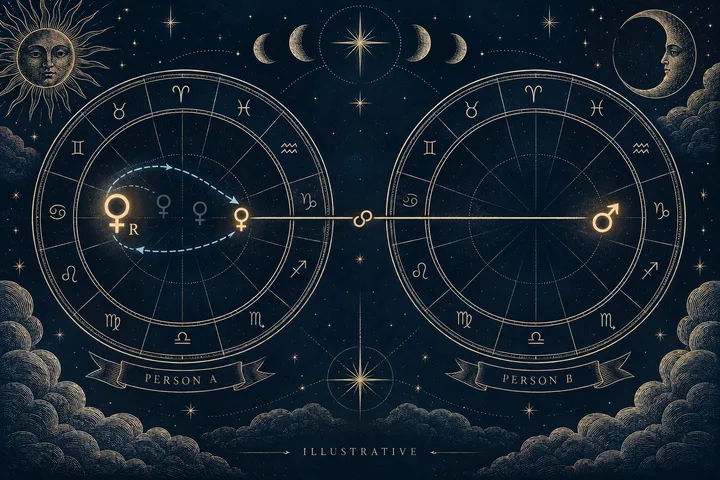
Consider an example. Maria has Venus retrograde at 18 degrees Scorpio. Daniel has Mars direct at 20 degrees Taurus. Their Venus-Mars opposition has a two-degree orb, so it falls inside the six-degree working orb and deserves attention.
Start with the planets. Maria's Venus describes how she values, receives pleasure, chooses intimacy, and recognizes what feels beautiful or worth keeping. Daniel's Mars describes how he pursues, initiates, protects his desire, and moves when he wants something. Venus-Mars contacts often create a clear exchange between attraction and response. They can make each person feel noticed by the other's style of relating.
Then read the signs. Scorpio and Taurus sit across the zodiac. Scorpio Venus may want depth, privacy, emotional honesty, and proof that desire has substance. Taurus Mars may act through steadiness, touch, patience, and a strong attachment to what feels dependable. The opposition asks them to meet across different instincts. Her intensity can challenge his pace. His consistency can soothe her, or make her wonder whether he is willing to enter deeper water.
Now bring in the retrograde Venus. Maria may not show her values at first glance. She may need to test her own feelings before she names them. She may return to old questions about trust, loyalty, or what makes desire safe. That does not mean she is unavailable. It means the Venus function may develop through inward review, and Daniel's direct Mars can make that private process visible by asking for a response in the real world.
Finally, check motion. If Maria's retrograde Venus is moving back toward the exact opposition with Daniel's Mars, the contact may be applying by the chosen method. The desire question is still approaching a point of recognition. Maria may feel that Daniel brings an issue into focus before she has finished deciding what it means. If Venus has just passed exactness while moving retrograde, the contact may be separating. Then the emphasis can fall on a pattern already activated: the two of them know the pull, but they are learning what to do after the first strong reaction.
Notice what this example does not say. It does not say Maria is secretly in love. It does not say Daniel is destined to pursue her. It does not turn an opposition into a score. The aspect gives a field of attraction and tension. The signs give the style. The retrograde Venus gives the inward turn. The motion phase gives a possible sense of approach or review. Their choices still give the contact a life.
A useful conversation might sound like this: 'When you move toward me, what helps me feel safe enough to answer honestly?' That question belongs to this aspect. It translates symbolism into a decision without reducing the symbolism.
Rank the interpretations instead of giving every layer equal weight
A crowded reading treats every detail as equally loud. That is how a retrograde mark overwhelms the chart. Rank the evidence.
First, give the tight major aspect the most weight. A two-degree conjunction, square, trine, sextile, or opposition is usually more immediate than a six-degree contact, all else equal. Exactness sharpens the exchange. It does not decide whether the exchange is easy or difficult.
Second, give the planets their proper jobs. A retrograde Mercury contact will show up through thought, speech, memory, and the process of reaching an answer. A retrograde Venus contact belongs to value, affection, attraction, pleasure, and consent to closeness. A retrograde Mars contact belongs to action, desire, assertion, and anger. Do not borrow a Mercury retrograde cliché and paste it onto Venus or Mars.
Third, read the signs and their relationship. The same Venus-Mars square feels different in fixed earth signs than in mutable air signs. Signs can show whether the pair repeats one another's language, pulls in different directions, or needs translation. Then check whether the aspect is in sign or out of sign, because some astrologers give less weight to a close angle when the signs do not support the expected relationship.
Fourth, add the retrograde condition. It matters. It may show that the planet's function is less automatic, more personal, or more inwardly negotiated. But it usually works as a modifier, not the headline. A close Venus-Saturn square remains a Venus-Saturn square. Venus retrograde can change how one person experiences and voices the issue. It does not remove Saturn's themes of time, duty, fear, structure, and endurance.
Fifth, consider applying or separating only when the data and method support it. In traditional technique, applying aspects can carry more weight because the meeting is still forming. In natal synastry, the contact is permanent on the page, so many modern readers use the phase as a nuance rather than a ranking system. If the faster planet is retrograde, motion deserves a careful check precisely because the obvious visual shortcut may mislead you.
Sixth, look at supporting contacts. Does the retrograde Venus also touch the other person's Moon? Does Mars receive Saturn? Is Mercury available to talk through what Venus and Mars stir up? One contact can describe chemistry while another describes emotional ease or practical endurance. A retrograde aspect is not read in isolation, and neither is any other aspect worth building a whole relationship story around.
This order protects the reading from melodrama. It also gives you a report you can explain. You can tell the reader what is strongest, what modifies it, and what remains unknown. That is far more useful than collecting dramatic meanings until the chart sounds fated.
It helps to name the three readings separately when you write your notes. The first is natal expression. How does the person carry this planet when nobody else is touching it? A retrograde Venus may privately question what love, beauty, loyalty, or pleasure should look like. A retrograde Mars may need to find a personal route into action instead of copying the loudest model of confidence around them. This is the planet's own story.
The second is synastry activation. What does the other person's planet awaken? A partner's Mercury can give a retrograde Venus words for a preference that had stayed vague. A partner's Moon can make a retrograde Mars notice the emotional effect of an action. A partner does not repair or control the retrograde planet. They make its themes harder to ignore.
The third is motion phase. Is the relative motion tightening the aspect, widening it, or changing direction near a station? This layer can describe an approach, an established pattern, or a theme that comes back for another pass. It is useful when the data is good. It is optional when the data is thin.
Keep these readings distinct. 'Retrograde means unfinished business' sounds neat, but it is too empty to guide anyone. Unfinished in what way? Retrograde Mercury may review the words behind a feeling. Retrograde Venus may review the terms of affection and trust. Retrograde Mars may review how desire becomes action. The aspect supplies the relationship subject, and the planet supplies the work being done.
The order also protects both people from an unfair reading. If one person's Venus is retrograde, the other person is not automatically cast as the pursuer who must wait. If one person's Mars is retrograde, the other is not automatically asked to decode every pause. Each person still has an active planet and a responsibility to speak plainly. Astrology can show why a response takes a particular route. It cannot make avoidance into intimacy.
Use the same ranking when the contact is harmonious. A retrograde Venus trine another person's Moon may feel gentle, but the inner review still matters. The person may receive tenderness deeply while taking time to trust it. A retrograde Mars sextile another person's Venus may offer an opening, but the opening still needs action. Easy aspects describe available flow. They do not promise that anyone will step into it.
Use it when the contact is difficult, too. A retrograde Mercury square another person's Saturn may bring repeated edits, delayed answers, or a fear of saying the wrong thing. The square is not a sentence of silence. It can become a discipline of careful speech if both people stop treating hesitation as proof of bad intent and start asking what each person actually heard.
This is why a synastry report should rank rather than pile up. The reader needs to know which contact deserves attention today, which one explains the emotional background, and which technical detail should remain a footnote. Clear order turns a symbolic chart into a usable field guide.
Sources: Synastry - Astrodienst Astrowiki; Retrograde Motion - Astrodienst Astrowiki; Applying and separating: meaning in astrology; Planets In Retrograde: Meanings & More
The strongest exception: a station or a repeated contact
The most meaningful exception comes when the retrograde planet is close to a station or when the aspect repeats through a direct-retrograde-direct sequence. A station is the apparent pause before a planet changes direction. The planet is not literally frozen, but its change of motion makes the symbolism feel concentrated in timing work and in some natal interpretations.
If the faster planet is near station while it contacts the other person's planet, do not treat the retrograde mark as a small footnote. The motion question becomes central. The planet may be changing how it approaches the contact, and the aspect may have more than one exact pass in the sky's sequence. AstroAk describes the possibility of applying, separating, and applying again around a station. That gives traditional-minded readers a real reason to track the motion rather than guessing from the degree numbers.
Still, repeated contact is not the same as guaranteed repetition in a relationship. It can describe a theme that asks to be met more than once. It can show a question arriving, turning inward, and arriving again with a different answer. Whether the couple repeats the behavior depends on the people, the rest of the synastry, and the way they respond when the pattern becomes visible.
A station also raises a data question. If you have only whole-sign placements, you cannot tell whether Venus was two days from station or several weeks from it. If the degree is rounded, you may not even know whether the aspect was exact. If the birth time is unknown, house placements and angles may be unavailable, and a Moon near a sign boundary may need special care. Say what you have. Say what you cannot determine.
This exception defeats two lazy claims. The first is 'retrograde always weakens the planet.' A station can make the planet feel concentrated, not absent. The second is 'a repeated aspect proves a karmic bond.' Repetition can make a theme noticeable, but it does not certify a soulmate story or remove the need for choice. Let the symbolism deepen the conversation. Keep the judgment grounded in the chart.
Sources: Synastry - Astrodienst Astrowiki; Retrograde Motion - Astrodienst Astrowiki; Applying and separating: meaning in astrology
A practical checklist for your own comparison
You can read this kind of contact without a full natal-chart calculation, as long as you are honest about the scope. The Synastry Comparison Report works from supplied placements and optional degrees. It can compare selected Moon, Venus, and Mars contacts and use a six-degree orb for major aspects. It does not calculate a natal chart from birth details, houses, or missing planetary positions.
Start by recording the source data. Write each person's planet, sign, degree if known, and retrograde or direct status. Keep the original precision. 'Venus at 18 degrees 14 minutes Scorpio' is not the same input as 'Venus in Scorpio.' If a degree was rounded, mark it as rounded. If the motion status is unknown, leave that layer open.
Next, name the aspect and calculate the orb only if the degrees support it. For a conjunction, compare the zodiacal longitudes directly. For an opposition, look for roughly 180 degrees between the bodies. For a square, look for roughly 90 degrees. Sextiles sit near 60 degrees and trines near 120 degrees. Use the six-degree working limit consistently. Do not stretch an almost-aspect into a story because the symbolism sounds attractive.
Then read the faster planet's motion. Ask which body is actually moving faster at the relevant birth moment, whether it is direct or retrograde, and whether the angular distance is closing or opening. If you cannot answer those questions from the supplied data, say 'motion phase not assessed.' That is a useful result. It keeps the rest of the reading clean.
Now write one sentence for each planet. What does the first person bring? What does the second person bring? Avoid saying that one planet causes the other person to behave. Synastry describes contact and response. It does not hand one person total control over another.
Add the sign exchange. What does each person need in order to express the contact well? A retrograde Venus may need time and privacy before naming desire. A direct Mars may need a clear invitation rather than an endless test. A retrograde Mercury may need to revise a thought aloud without being rushed. A direct Moon does not become a therapist for another person's retrograde planet.
Finally, check the strongest exception and the next supporting contact. Is the aspect close to a station? Does another personal planet soften, repeat, or complicate the story? If the same theme appears in more than one contact, rank the pattern. If it appears once and nowhere else, keep the interpretation narrow.
You can make the degree check more exact with a small table. Put the first planet's longitude in one column and the second planet's longitude in another. Convert the signs to the zodiac's full 360-degree circle if you are doing the calculation by hand. For an opposition, the two positions should be about 180 degrees apart. For a square, they should be about 90 degrees apart. Take the smaller distance when you measure the gap. Then compare that gap with the exact angle. The difference is the orb.
For example, 18 degrees Scorpio is 228 degrees of zodiacal longitude. Twenty degrees Taurus is 50 degrees. The direct difference is 178 degrees, so the opposition has a two-degree orb. That calculation confirms the contact. It does not yet tell you whether Venus is applying or separating. Motion is a separate fact. This is a small distinction, but small distinctions prevent large interpretive errors.
If you are reading a Mercury, Venus, or Mars contact, pay attention to the planet's speed as well as its direction. A planet can be direct and slow near a station, or retrograde and moving more quickly through the relevant degrees. 'Faster planet' is a comparison, not a permanent personality label. In a synastry method that uses application, record the speed and direction for both bodies rather than assuming the inner planet always supplies the motion that matters.
If the charts come from different software, compare the settings before comparing the meaning. Check the zodiac, aspect list, degree precision, and orb. One program may display a contact in its grid while another leaves it off the wheel because it uses a smaller drawing orb. That difference does not necessarily mean one chart is wrong. It may mean the programs are answering slightly different questions about which contacts to show.
If one person has an unknown birth time, do not let that uncertainty spread to every placement. The planets may still be usable if their sign and degree are secure for the date, but the houses and angles are not. If the Moon changes sign that day, treat the Moon as conditional. If you know only the Moon sign and not the degree, discuss its sign relationship and leave exact aspects unconfirmed. Precision is not an all-or-nothing performance.
The same care applies to retrograde status. Mercury, Venus, and Mars can change direction at their stations, while the slower planets spend longer periods retrograde. A retrograde outer planet can be shared by many people born in the same period, so its personal importance depends on the exact contact it makes to the other chart. A close Pluto-Venus contact may matter greatly in a pair's story, but the retrograde symbol alone is not the reason.
Now write a short provisional interpretation before you look for confirmation in the rest of the chart. Keep it to three sentences. The first names the exchange. The second names the retrograde modification. The third names the practical question. If you cannot write the first sentence without using the word 'fated,' go back to the planet meanings. If you cannot write the second without saying 'blocked,' ask what is being processed inwardly. If you cannot write the third, the reading has not reached the reader's life yet.
For the worked Venus-Mars example, the provisional note might be: 'Her Venus and his Mars oppose each other within two degrees, so affection and desire meet with strong pull and difference. Her retrograde Venus may need private certainty before it offers a visible answer to his direct pursuit. They should discuss what reassurance and pacing would make attraction feel mutual rather than guessed.' That is specific. It is also open enough to be tested by how the pair actually relates.
Do not use a compatibility percentage to settle an ambiguous contact. A number cannot tell you whether an opposition is productive, whether a retrograde planet is being expressed honestly, or whether the pair has the patience to translate different needs. A ranked reading can. It can say, 'This is the strongest contact. This is the modifier. This is the conversation.' That is the decision aid the chart can genuinely provide.
Your final notes should include what would change the reading. Perhaps a closer Moon contact would move the emotional layer above the Venus-Mars chemistry. Perhaps a Saturn trine would give the difficult contact more structure. Perhaps a missing degree would show that the supposed aspect is outside the working orb. Name the condition. Good astrology stays responsive to better information.
A good worksheet ends with two columns: 'what the chart suggests I should notice' and 'what I can ask or do.' The first column belongs to interpretation. The second belongs to life. Keep both.
Sources: Synastry - Astrodienst Astrowiki; Applying and separating: meaning in astrology
Turn the retrograde contact into one honest conversation
The point of reading a retrograde synastry aspect is not to decide whether the connection is allowed to work. It is to see the contact clearly enough to use it with care.
If the retrograde planet belongs to you, name the private step that comes before your visible response. You might need to think before answering, test whether an attraction feels safe, or revisit a value you learned from an earlier relationship. You do not have to apologize for that process. You do have to communicate its shape if the other person is being asked to wait inside it.
If the retrograde planet belongs to the other person, do not turn patience into mind-reading. Ask what they are reviewing. Ask what kind of response they can offer now. Ask whether the contact is bringing a real value into the room or only a compelling story about what might happen later. Retrograde symbolism invites reflection. It does not excuse silence, mixed signals, or refusal to take responsibility.
The planet changes the conversation. With retrograde Mercury, ask which words need more time and which words are being avoided. With retrograde Venus, ask what kind of affection feels genuine rather than merely expected. With retrograde Mars, ask what action is ready now and what action still needs thought. These are not accusations. They are clean ways to separate an inner process from an outward promise.
The partner's role matters, too. A person's direct planet may feel like a clear invitation to the retrograde planet, or it may feel like pressure. A Moon contact can make the exchange tender and immediate. A Saturn contact can make it serious and slow. A Jupiter contact can give it faith and room, while also making a small feeling larger than it needs to be. Read the actual planet involved. Never let the retrograde label do all the talking.
If the conversation reveals a difference in pace, name the pace without turning it into a character judgment. 'I need another day to answer' is different from 'I will keep you waiting indefinitely.' 'I want to move slowly' is different from 'I want the benefits of closeness without a clear agreement.' The chart can help you see why the timing feels charged. The people still need to make the timing fair.
The conversation can be simple. 'I feel this contact strongly, but I need time to understand what I want.' 'When you pull back, are you reviewing your feelings, or do you want more distance from me?' 'What would make this desire feel mutual and clear?' These questions honor Venus, Mars, Mercury, and the retrograde turn without asking astrology to speak for either person.
The supported position is clear. Read the natal aspect as the main relationship exchange. Read the retrograde planet as the inward or less conventional way one person carries that function. Use applying and separating only when the motion data and your chosen synastry method justify it. Give extra attention to a station or repeated contact, but never confuse repetition with destiny.
Before you close the chart, choose one conversation. Not five. One. Ask what the retrograde planet is trying to understand, and what the relationship needs in order to meet that question honestly.
Sources: Synastry - Astrodienst Astrowiki; Retrograde Motion - Astrodienst Astrowiki; Applying and separating: meaning in astrology; Planets In Retrograde: Meanings & More
A little more clarity
Does a retrograde planet cancel a synastry aspect?
No. The aspect remains a contact between the two natal charts. Retrograde motion modifies how one person experiences and expresses that planet. Read the planet, sign, aspect, and orb first, then add the retrograde layer.
Is an applying retrograde aspect stronger than a direct separating aspect?
Not by a simple rule. Traditional astrology gives applying aspects special weight, while many modern synastry readings treat applying and separating as useful texture rather than a relationship ranking. Check actual motion, state your method, and give the tightness and planetary meanings more weight than the label alone.
What if I only know the two signs and not the degrees?
You can discuss the sign relationship, but you cannot confirm a degree-based aspect, orb, station, or applying phase. Keep the reading at the sign level and mark the missing degree information. Supplied placements can be compared, but the report does not calculate missing natal positions.
Can a retrograde synastry aspect show a past-life or destined connection?
Some astrologers connect retrograde symbolism with return, review, or karmic themes. Use that as a spiritual interpretation, not a certificate. The aspect can describe a meaningful pattern to explore, but it does not prove destiny or remove either person's freedom to choose.
Sources & further reading
- Synastry - Astrodienst Astrowiki
Supports reading each natal chart as a whole before interpreting the synastry exchange and treating difficult contacts as possible growth points rather than simple negatives.
- Retrograde Motion - Astrodienst Astrowiki
Supports the interpretation of natal retrograde planets as an inward-directed expression that needs engagement before direct expression becomes easy.
- Applying and separating: meaning in astrology
Supports defining applying and separating by motion toward or away from exactness and checking the direction again when a planet is retrograde or near a station.
- Planets In Retrograde: Meanings & More
Supports the personal emphasis of Mercury, Venus, and Mars retrogrades and the idea that retrograde symbolism can call for a different path rather than automatic misfortune.
Synastry Comparison Report
Enter known placements for two people. Get an input-by-input comparison, selected aspect calculations and a clear record of what remains uncertain.
Compare our placements