
The station modifies a contact; it does not create one
A natal station can shape how you read a planet in synastry, but it cannot create a relationship contact where the charts show none. Check its reported motion and degree, then compare with the other person’s supplied placements. Geometry comes first. The station may qualify a contact’s meaning.
The scope is natal Mercury, Venus, or Mars, degrees when supplied, and selected major aspects under the Synastry Comparison Report’s six-degree rule. That is the report’s method, not a universal standard. “Close to a station” has no single agreed cutoff. AstroAk’s “Planetary Stations: The Power of Retrograde and Direct Turns” distinguishes the exact turning point from a practical slow-motion window, which varies by planet and cutoff. Use the chart source’s station information where available, and name your working window.
The test is two-layered: confirm the natal condition, measure the interaspect, then let the station modify interpretation only if the other chart reaches that planet. “Stationary Planets in Synastry: Why Themes Linger” rightly puts degree-based contact first. Treat emphasis as interpretation, not an automatic boost. Without a close contact, read the station in its owner’s natal chart. It cannot decide what either person feels or whether the relationship will succeed.
First confirm the planet’s reported motion and how near birth was to its station; there’s no universal cutoff for “close.” Then measure its contacts to the other person’s supplied placements under a stated orb rule. The Synastry Comparison Report uses six degrees for selected major aspects. Read the station as a possible interpretive modifier only when a qualifying contact exists. Without one, keep the station in the owner’s natal chart.
Sources: Planetary Stations: The Power of Retrograde and Direct Turns; Stationary Planets in Synastry: Why Themes Linger
What does “close to a station” mean?
“Close to a station” needs a stated definition. A station itself is the apparent turning point when a planet changes direction: station retrograde marks the turn from direct to retrograde motion, while station direct marks the return from retrograde to direct motion. At the exact turning point, apparent motion reaches zero. Astrologers also use “stationary” for a surrounding interval when the planet appears to move very slowly. Those are related meanings, but they are not identical. The distinction matters in a natal chart. A planet can be retrograde without being especially close to the moment it turned; the retrograde glyph tells you its direction, not its distance from the station. To call a planet near-stationary, you need a reference point such as the station date and degree, or a source that reports its motion, plus a rule for how wide a slow-motion interval counts. If the chart source gives only a retrograde label, don’t silently upgrade that information into “born near the station.” There is no universal day count for this label. In “Planetary Stations: The Power of Retrograde and Direct Turns,” AstroAk separates the exact zero-motion instant from a practical slow-motion window and says the window depends on the planet and the astrologer’s cutoff. Its discussion gives different illustrative spans for Mercury and slower outer planets, but presents those spans as orb-dependent judgments, not fixed limits. The companion “Station” glossary describes checking how little a planet moved on the days around the turn. Together, these references support a method, not a single threshold: identify the turn, inspect the nearby motion, and disclose the convention used. The two turns also offer different interpretive starting points. A station retrograde begins a reversal from apparent forward motion; a station direct ends the retrograde interval and resumes apparent forward motion. Some modern astrologers read the first as inward, revisiting, or consolidating, and the second as release or renewed movement. AstroAk presents that contrast as modern interpretation, not a graded rule that one station is inherently stronger or better. Use such language as a symbolic lens, not as a guaranteed description of a person or relationship. Before comparing charts, record the source, the station date or reported distance when available, and the working window you chose. If those details are missing, keep the wording close to the evidence: “the chart source marks this planet retrograde,” or “the source describes it as stationary.” If you can verify the planet’s position around its turn, state the method and its limits. That precision lets the next step remain separate: measure whether the other person’s placements actually contact the planet. A station label alone cannot answer that question.
Sources: Planetary Stations: The Power of Retrograde and Direct Turns; Station
Why ‘emphasis’ and ‘strength’ are not the same claim
A planet near a station can feel prominent in a reading. That does not automatically make it technically stronger. The statements come from different frameworks. In modern interpretive language, emphasis often describes how insistently a theme seems to recur. A planet slows as it approaches a turn, appearing to linger near the same zodiacal degree. “Planetary Stations: The Power of Retrograde and Direct Turns” uses that prolonged contact with one point to explain why some astrologers read a station as concentration or intensification. This describes duration around a degree, not a universal measure of force or relationship impact. The other chart still has to make a meaningful contact. Traditional motion scoring asks a different question. It assesses a planet’s condition through factors such as speed and direction, alongside other dignities and debilities. In the account given by “Planetary Stations,” William Lilly’s scoring penalizes slow and retrograde motion; it does not award a separate bonus for being stationary. The article also summarizes Ptolemy as favoring swift, direct motion. These are historical frameworks, not one rule followed by every astrologer. A slow planet can be read as symbolically concentrated while receiving a lower motion score in traditional assessment. That distinction matters because “strong” can hide two meanings. It may mean that a planet’s themes attract attention in a modern reading. Or it may mean that the planet ranks well under a defined technical scoring method. Those meanings shouldn’t be swapped mid-interpretation. “The station amplifies everything” turns a possible reading of lingering emphasis into a blanket claim of added strength. It also implies that the effect must be favorable or larger in every chart, neither of which follows from the station label alone. The historical discussion in Deborah Houlding’s “The Classical Origin and Traditional Use of Aspects” offers a useful parallel about method: even familiar tools such as aspect orbs have changed in how astrologers define and apply them. A term can mean one thing within a practice without settling every other practice. So name the lens you’re using. “I read this station as a concentrated theme” is more precise than “this planet is objectively stronger.” Traditional scoring treats slow or retrograde motion as a debility; consider the rest of the planet’s condition too. For synastry, return to the geometry. Identify the station owner’s planet and natal context. Then check for a qualifying interaspect from the other person’s supplied placements, using the stated orb consistently. Let the station color that contact only afterward. It may suggest a theme that receives sustained attention in the station owner’s chart; it cannot supply a missing connection or dictate how either person behaves. The soundest phrasing keeps both claims in view: the station may describe emphasis under one interpretive lens, while the measured contact establishes whether that planet has a direct role in this two-chart synastry comparison.
Sources: Planetary Stations: The Power of Retrograde and Direct Turns; The Classical Origin and Traditional Use of Aspects
What can a station add to synastry?
A station belongs first to the natal chart of the person whose planet is turning. It may describe how that person carries a planetary function, but it does not by itself describe an exchange between two people. For that, synastry needs a connection across the charts: one person’s planet or other chart factor must form an interpretable relationship to the other person’s planet. The practical order is simple. Establish the station as a natal condition, then ask what in the second chart actually meets it. In “Aspects Between Charts,” Cafe Astrology organizes synastry around interchart aspects, pairing one person’s planets with the other person’s and advising readers to consider both the planet pair and their sign context. A stationary Venus may be a notable feature of its owner’s chart; a partner’s Moon, Mars, Saturn, or Venus can supply a different channel of contact. The planet pair shapes the subject of the comparison. The station colors the planet being contacted. Those judgments are related, but distinct. Think of a station as a spotlight already resting on one part of a chart. The image is useful only if its limit stays clear: the spotlight tells you where the station may draw attention in the owner’s natal story; it does not show that a partner has entered the scene. An interaspect supplies that relational channel. If the other chart makes a close contact, the station can be read as a modifier of that existing link. The partner’s planet may support, challenge, or activate the stationary planet’s themes, depending on the planets and aspect involved. If no meaningful contact reaches it, the spotlight remains on the owner. Don’t turn an unusual natal feature into evidence of a shared bond. The “Introduction to Relationship Astrology 2: Synastry” teaching paper makes a related methodological point: synastric aspects connect factors in two birth charts, and the reader should record whose factor is whose. It also cautions that the same linkage need not be experienced equally by both people. That gives the reader two useful questions: what does each person bring to the contact, and how might each experience the exchange differently? It doesn’t authorize a claim about either person’s motives or feelings. A chart can frame a symbolic pattern; the people involved describe how it is lived. This also refines the existing article “Stationary Planets in Synastry: Why Themes Linger.” Its useful core is that a station can add emphasis when a partner’s chart contacts the planet. The stronger wording is more precise: a station may shape the reading of a contact, but it cannot supply one. “Amplifier” can suggest that every contact becomes stronger by a measurable amount. Treat it as a loose metaphor, not a technical result. First name the cross-chart contact; then describe the station as one possible reason that planet’s themes may feel concentrated to its owner. So keep the claim in the right chart layer. With a real interaspect, interpret the two planets, their signs, and the measured contact, then ask how the station modifies the station owner’s side of that picture. Without one, describe the station in the natal chart and leave the relationship claim unstated. That boundary doesn’t make the reading less meaningful. It tells you which chart supports each part of it.

Sources: Aspects Between Charts; Introduction to Relationship Astrology 2: Synastry; Stationary Planets in Synastry: Why Themes Linger
Measure the cross-chart contact before interpreting emphasis
Use the supplied signs and degrees to measure the relationship between the station-adjacent planet and a planet in the other chart. The station belongs to one person’s natal condition; the interaspect is the angular connection between both charts. Keep those observations separate. The instructional paper Aspects Between Charts recommends a two-chart grid, recording whose factor is whose, each sign and degree, and the separation for each pair. Check whether a contact exists before deciding what the station adds.
The five major aspects describe familiar angular relationships: conjunction near 0 degrees, sextile near 60, square near 90, trine near 120, and opposition near 180. The exact angle is the aspect’s perfection; the orb is how far the measured separation sits from that angle. A separation of 94 degrees is four degrees from an exact square. It isn’t exact. The Classical Origin and Traditional Use of Aspects explains that astrologers distinguish close, degree-based contacts from broader sign relationships, and that orb approaches have varied across periods and practitioners. Geometry gives you the starting point; the chosen method sets the boundary for what counts.
A sign relationship can describe broad resonance, but it isn’t the same as a degree-measured aspect. Two planets may occupy signs traditionally linked by a trine while their precise degrees form a different close angle. Deborah Houlding’s historical account gives an example where sign-based trine language differs from the closer degree-based square. Name the sign relationship as context, then state the measured angle and orb. Don’t use general sign affinity to make a loose contact sound exact.
Apply one disclosed rule across the comparison. The Synastry Comparison Report uses a six-degree ceiling for selected major aspects. That’s a reproducible working rule, not a universal standard. Aspects Between Charts recommends narrower, aspect-specific synastry limits: six degrees for conjunctions, five for oppositions, four and a half for squares, four for trines, and 2.7 for sextiles. The paper notes that two charts create many possible contacts, so focus on the meaningful ones. One method uses a shared ceiling; another differentiates by aspect. Don’t silently switch between them.
Qualifying under an orb rule doesn’t make every contact equally compelling. Rank first by closeness to exactness, then by how directly the planet pair speaks to the question and whether other close contacts repeat or complicate its theme. Cafe Astrology’s Aspects Between Charts advises considering both planetary roles and sign context. The instructional paper also says to track whose factor is involved, since the two people may not experience an interaspect in the same way. This supports comparison, not a formula for how either person must feel.
A reproducible note might read: “Person A’s Venus, at the supplied degree, forms a square with Person B’s Mars, with an orb of four degrees; the report’s six-degree rule includes it.” Interpret the Venus–Mars contact first, then describe how a confirmed station may color Person A’s Venus. If degrees are rounded or unavailable, say the exact orb can’t be established. Don’t call it exact or widen the limit to preserve a preferred interpretation. Applying or separating motion is a secondary layer when reliable motion data and a chosen convention are available; it doesn’t replace the calculation. Readers should be able to audit the claim from the placements, angle, orb, and rule.
Sources: The Classical Origin and Traditional Use of Aspects; Introduction to Relationship Astrology 2: Synastry; Aspects Between Charts
A six-degree orb is a working rule, not a universal law
A six-degree orb can make a synastry comparison consistent. It does not make six degrees the rule every astrologer must use. An orb is the distance between an exact aspect and the measured positions in a chart. The chosen ceiling determines which contacts qualify, so it should be stated before interpretation and applied to the whole comparison. The assigned Synastry Comparison Report uses a six-degree orb for selected major aspects. Under that method, a contact within six degrees qualifies for consideration. But qualification is only the first sort. A contact at one degree is closer to exact than one at five degrees, even though both fall inside the same ceiling. Treat the closer contact as the stronger candidate for interpretation, then weigh the planet pair and the rest of the chart. A boundary contact can matter, but it should not carry the same emphasis by default. There are other workable conventions. In “Introduction to Relationship Astrology 2: Synastry,” Philip Graves recommends narrower limits for synastry than for natal aspects and varies the allowance by aspect: his listed ceilings are six degrees for a conjunction, five for an opposition, four and a half for a square, four for a trine, and 2.7 for a sextile. He explains the tighter approach by noting that chart comparison brings many possible factors into play; widening every orb can leave a reader with too many contacts to rank. This is one astrologer’s method, not a universal standard. It does show why a single six-degree ceiling should be described as a chosen working rule. The Classical Origin and Traditional Use of Aspects, an article on Skyscript, traces changes in how astrologers have understood aspects and their reach. That history helps explain why modern readers encounter different conventions. It does not establish a modern six-degree rule for synastry. The useful comparison is narrower: Graves offers aspect-specific ceilings for chart comparison, while the report uses one disclosed ceiling for selected major aspects. Each can be applied consistently and transparently; neither should be presented as the only valid practice. If a contact falls near six degrees, say exactly what that means: it qualifies under the report’s stated method, though it is less exact than a closer contact. If you prefer an aspect-specific method, recalculate all relevant contacts under that method. Don’t tighten or widen the orb only when a favored interpretation needs rescuing. That changes the rule after seeing the result. This distinction matters especially when a personal planet is close to a station. The station does not alter the angular distance between the charts, and it does not expand the selected orb. First record the contact and its orb; then decide how much interpretive weight it earns. A consistent rule makes the reading easier to follow, while ranking by closeness keeps a qualifying contact from becoming an automatic headline.
Sources: Introduction to Relationship Astrology 2: Synastry; The Classical Origin and Traditional Use of Aspects
What changes when Mercury, Venus, or Mars is the planet
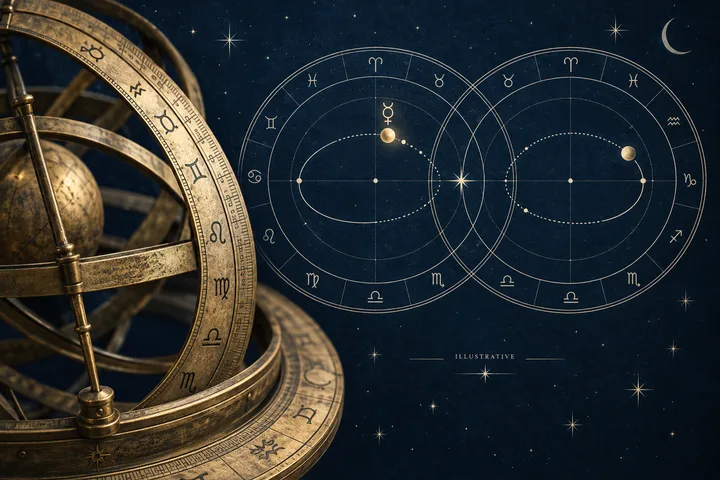
When Mercury, Venus, or Mars is the station-adjacent planet, begin with that planet’s ordinary work in the chart. Mercury speaks to thought, language, questions, and meaning. Venus concerns affection, pleasure, values, and give-and-take. Mars describes initiative, desire, assertion, conflict, and pace. A station may color how its owner lives one of these themes, but it doesn’t make all three the same kind of intensity. First identify the planet; then ask which planet in the other chart forms the measured contact. Cafe Astrology’s “Aspects Between Charts” organizes synastry by planet pair and advises considering sign context. That is more precise than calling a station unusually powerful. The partner’s planet changes the subject of the exchange. If a station-adjacent Mercury contacts the other person’s Moon, the comparison can bring speech and feeling into the same conversation: how do words meet emotional needs, and what needs clarifying? If it contacts Venus, the question may turn to how the pair talks about affection or values. A Mars contact shifts focus toward directness, disagreement, and how quickly a discussion becomes action. These are interpretive prompts, not claims about what either person must say or intend. “Introduction to Relationship Astrology 2: Synastry” stresses that two chart owners need not experience a contact in the same way. Keep both roles visible: name whose station-adjacent planet is involved, whose planet contacts it, and what each contributes. Don’t assign one person a fixed pursuer or receiver role. The aspect adds another layer. A conjunction brings the planetary functions together in the comparison, though the result depends on their signs and wider chart. A trine can suggest easier flow; a square can make a difference more active or harder to ignore. Neither label decides whether the lived exchange is welcome. Graves’s “Introduction to Relationship Astrology 2: Synastry” distinguishes aspect types and notes that chart contacts can be experienced differently by each person. Use that distinction to frame possibilities, not to promise harmony from a trine or conflict from a square. A station doesn’t erase the planet pair or turn a challenging aspect into a verdict. Consider this illustration, not a real couple or calculated chart: one person’s Venus is reported close to a station, and the other person’s Mars is supplied at a degree that forms a square within the chosen orb. Describe a Venus-Mars contact, then ask how affection, desire, initiative, and pace meet. The station may add emphasis to the Venus owner’s way of handling affection or values, if that is the chosen interpretive approach. It doesn’t establish attraction, consent, or the other person’s motives. Change the contacting planet from Mars to Moon and the useful question shifts toward emotional response and care. Keep Venus but change the aspect, and the interpretation’s tone changes without making the station itself stronger or weaker. Tie the practical question to the planet: with Mercury, what needs to be said more clearly? With Venus, which value or preference should be named? With Mars, how do both people handle pace, initiative, and a pause? The chart can organize that conversation; the people decide what they mean and do.
Sources: Aspects Between Charts; Introduction to Relationship Astrology 2: Synastry
Rank the contact and preserve both people’s roles
Once you’ve confirmed that a personal planet is genuinely near a station under a stated convention, don’t let that unusual condition take over the whole comparison. Start with the closest relevant interaspect. Then name the planet pair and sign context. Only after that should you describe the station’s possible emphasis, followed by broader chart symbolism. This order keeps a striking natal detail in view without mistaking it for the relationship’s main connection.
Synastry compares factors from two charts. A station belongs first to the chart of the person whose planet is turning or moving slowly; a contact describes how that planet meets a factor in the other chart. “Aspects Between Charts” advises readers to track each person’s role in an interaspect and consider both planets’ sign and house placements. In a Saturn-Sun contact, the Saturn person and Sun person occupy different roles. That is a prompt, not proof both people experience the contact alike. The 2003 instructional paper “Introduction to Relationship Astrology 2: Synastry” makes the same distinction: one person’s chart factor is connected with the other’s, and each may experience that linkage differently. It also recommends recording signs and degrees and keeping track of whose factor is whose.
So compare the station owner’s natal pattern with the actual cross-chart contacts before deciding what the station contributes. If the stationed Venus makes a close contact to the other person’s Moon, for example, identify whose Venus and whose Moon you’re reading, then interpret that planet pair and aspect. Treat this as an illustrative pattern, not a claim about a real couple. If another, tighter contact to that Venus repeats or complicates the same theme, include it; if a closer non-station contact better explains the pattern, let that lead instead. A long list of aspects can obscure the clearest testimony. The Graves paper explicitly cautions that synastry can produce many possible factors and recommends limiting interpretation to those most likely to matter. The useful rule is to rank by closeness and relevance, then look for repeated meaning, rather than count contacts or give the stationed planet automatic priority.
Keep both people in the reading. The station may describe a concentrated or lingering quality in its owner’s natal planet, as “Planetary Stations: The Power of Retrograde and Direct Turns” presents one modern interpretation. But it doesn’t tell you what the other person intends, and it doesn’t guarantee that the same contact feels alike on both sides. Your wording should show the evidence chain: whose planet is near a station; its sign and degree, if known; the other person’s contacting planet; the aspect and measured orb; the station convention; then the interpretation. If birth times or house cusps aren’t reliable, leave house overlays out. The synastry paper itself says accurate birth times matter for angles and house placements. This sequence lets another reader see where the interpretation comes from and where it remains a judgment.
Sources: Aspects Between Charts; Introduction to Relationship Astrology 2: Synastry; Planetary Stations: The Power of Retrograde and Direct Turns
When no close contact exists, keep the station in the natal chart
A station can matter in its owner’s natal chart and still have no direct role in a relationship comparison. Ask whether the other chart forms a qualifying contact to the planet under the chosen aspect rule. If it doesn’t, keep the station in the individual chart. Don’t turn an unusual natal condition into evidence of an exchange the charts don’t show. | Chart information | What the reading can say | | --- | --- | | Station confirmed, with a close interaspect | The station may modify a measured contact. | | Station confirmed, without a close interaspect | The station remains natal background; no station-based relationship claim follows. | | Station status or degree uncertain | State what is known, stay at sign level, and leave exact geometry open. | In the first, the contact supplies a relational channel. The station may then describe how the planet’s themes are concentrated or revisited, within the interpretive approach already named. In the second, that channel is missing. AstroAk’s “Planetary Stations: The Power of Retrograde and Direct Turns” distinguishes interpretive emphasis from technical strength, helping keep a natal emphasis from becoming a claim about a partner. In the third, the data cannot settle whether a contact exists, so the conclusion must stay narrow. A shared sign, broad resonance, or a partner’s striking behavior doesn’t create a degree aspect. Cafe Astrology’s “Aspects Between Charts” treats interchart contacts as specific planet-pair relationships and advises considering each planet’s sign context. Ask two separate questions: what does the sign comparison suggest, and do the supplied degrees form a qualifying aspect? Degree precision matters near an orb boundary. Rounded placements may not settle a contact near the chosen limit. Say so; don’t call it exact. Out-of-sign contacts also need care: name the aspect geometry and interpretive convention instead of treating sign relationship and degree aspect as interchangeable. The publication’s “Stationary Planets in Synastry: Why Themes Linger” also makes degree and missing-data checks part of its method, but it cannot supply information absent from a reader’s chart. No station contact doesn’t mean the whole synastry is quiet. Other measured contacts may describe a strong theme. A current station in the sky raises a timing question, not a natal one, and belongs in a separate transit reading. If no qualifying contact exists, remove station-driven relationship language and read the actual contacts that remain. If degrees are incomplete, compare only the placements and optional degrees available. Keep the station in its owner’s natal story until the chart supports a more specific connection.
Sources: Planetary Stations: The Power of Retrograde and Direct Turns; Aspects Between Charts; Stationary Planets in Synastry: Why Themes Linger
Turn the reading into one useful relationship question
End with a question both people can answer from experience. Name the contact first: “your Venus forms a close square to their Mercury under the stated orb.” Then explain that the station may make the station owner’s way of expressing affection feel concentrated or repeatedly revisited within that contact. This is an interpretation, not a prediction of the other person’s response. “Aspects Between Charts” grounds synastry in the planets in contact and their context; the people involved give that pattern its lived meaning. Check the placements, degrees, aspect rule, and station status. Identify the closest qualifying contact, describe the planets in ordinary language, and ask where that theme appears between you. For Venus and Mercury, try: “When one of us shows care through words and the other through affection, what helps each of us feel understood?” For Mars, ask how you want to handle initiative, disagreement, or pauses. Make room for either person to disagree or set a boundary. When no close cross-chart contact reaches the planet, keep the station in the natal reading. If you know the placements and optional degrees, the Synastry Comparison Report can compare them under its stated method. It doesn’t calculate natal charts from birth details or decide whether a relationship will succeed. Let the chart frame the conversation; let lived experience guide your decision.
Sources: Aspects Between Charts
A little more clarity
Does a personal planet near a station automatically strengthen a synastry aspect?
No. Measure the interaspect under a stated orb rule first. A station may modify how that contact is interpreted, but it does not create a contact or establish relationship outcomes.
Sources & further reading
- Planetary Stations: The Power of Retrograde and Direct Turns
Distinguishes the exact apparent turning point from a practical slow-motion window and contrasts modern emphasis language with traditional motion scoring.
- Station
Supports checking a planet’s motion around a station while keeping any practical stationary window tied to a stated convention.
- The Classical Origin and Traditional Use of Aspects
Provides historical context for aspect geometry and the distinction between close degree contacts and broader relationships.
- Aspects Between Charts
Explains interchart planet-pair contacts and the relevance of each planet’s sign context in synastry.
- Introduction to Relationship Astrology 2: Synastry
Defines synastric interplanetary aspects, recommends recording signs and degrees, and gives one author’s aspect-specific orb method.
- Stationary Planets in Synastry: Why Themes Linger
Represents existing publication coverage of station emphasis and degree-based contacts; it is not independent corroboration.
Synastry Comparison Report
Enter known placements for two people. Get an input-by-input comparison, selected aspect calculations and a clear record of what remains uncertain.
Compare our placements