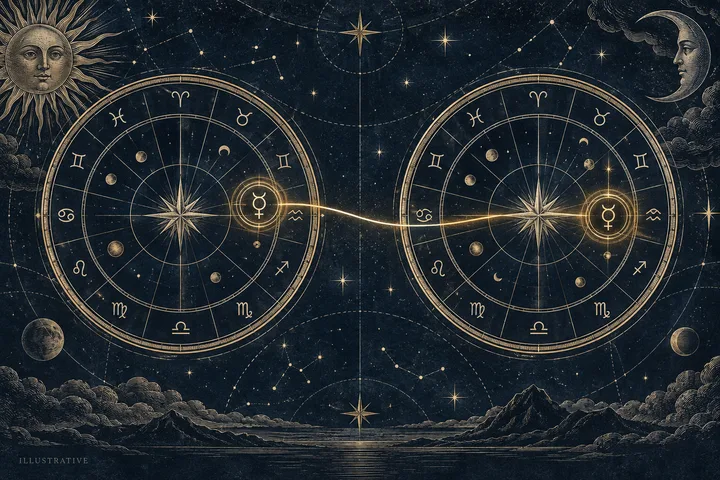
What a stationary planet adds to synastry
You may notice it in conversation before you notice it on a chart. A person returns to the same question. They keep circling the same desire. They respond to closeness, conflict, money, sex, or reassurance with a force that seems larger than the moment. Then you learn that their Mercury, Venus, or Mars was stationary when they were born, and the placement seems to explain the concentration. It can. But it needs a precise reading.
A stationary planet is at a turning point in apparent motion. It slows to almost no movement before it turns retrograde or direct. In the zodiac, it seems to linger around one degree instead of passing cleanly through it. Astrologers therefore read the station as a condition of emphasis. The planet stays in one place, and its signification feels less diffuse. Mercury may hold thought and speech at the center of a life. Venus may make values, attachment, pleasure, or fairness difficult to treat casually. Mars may give pursuit, anger, courage, sex, and self-protection a pressing, unmistakable quality.
That is the first answer to the reader’s question. A stationary planet can make a theme feel concentrated because the planet itself is unusually emphasized in the natal chart. In synastry, though, concentration becomes relational only when the other chart activates it. The partner’s planet, angle, or house may provide that activation. If no close contact exists, you are still reading an important natal feature, but you are not yet reading a strong exchange between two people.
This distinction prevents a common mistake. People see the word stationary and treat it as a relationship verdict. They assume it means obsession, permanence, intensity, or a bond that cannot be escaped. The station says none of those things on its own. It describes how strongly one planetary function may insist on being lived. The relationship question begins after that: what in the second chart meets it, supports it, challenges it, or leaves it alone?
Synastry compares two horoscopes and looks at interaspects, the angular relationships formed between factors in one chart and factors in the other. It also shows where one person’s planets fall in the other person’s chart. That larger method matters because a relationship is not made from a single striking feature. A stationary Venus can be central to one person’s way of loving. A partner’s Saturn may give it structure. Their Mars may provoke it. Their Moon may soothe it. Their Venus may share its values. Or the partner may barely touch it, in which case the station remains mostly personal.
The strongest supported position is simple: read the station as a volume control, not as the song. The planet tells you what is being turned up. The sign tells you the style. The aspect tells you how the two charts exchange the theme. The rest of the natal chart tells you whether that volume becomes skill, friction, defensiveness, pleasure, or a mixture of all four. Once you read the layers in that order, the unusual feeling becomes easier to name without making it larger than the chart supports.
A further nuance comes from the two kinds of station. Station retrograde marks the turn from direct motion into retrograde motion. Station direct marks the turn from retrograde motion back into direct motion. Many modern astrologers experience the first as more inward, reflective, or self-contained, and the second as more ready to move outward. That distinction can sharpen a reading, especially for Mercury, Venus, and Mars, but it remains secondary to the planet’s actual contacts and overall condition. It should modify your language, not replace your method.
Think of the station as a spotlight already fixed on one part of the person’s chart. Synastry asks whether the partner walks into that light. A partner does not need to share the same sign to activate it. An opposition can bring the theme across a polarity. A square can make it impossible to leave unworked. A trine can make the exchange feel natural enough that both people miss how central it has become. The aspect supplies the relationship’s entrance point, while the station explains why the owner may experience that point with unusual depth or persistence.
This is why sign-only readings often feel true and still remain incomplete. Shared signs can describe a common language, element, or mode. They can show why two people recognize a style in each other. But a sign is a field, not a measured meeting. Degrees tell you whether the planets occupy a specific angular relationship. When a stationary personal planet is involved, that difference matters even more. The natal emphasis is already strong. You want evidence before saying the partner is the reason it feels strong.
Sources: Planetary Stations: The Power of Retrograde and Direct Turns; Planetary Stations and Retrograde Motion in the Birth Chart; Synastry - Astrodienst Astrowiki
What information you need before interpreting it
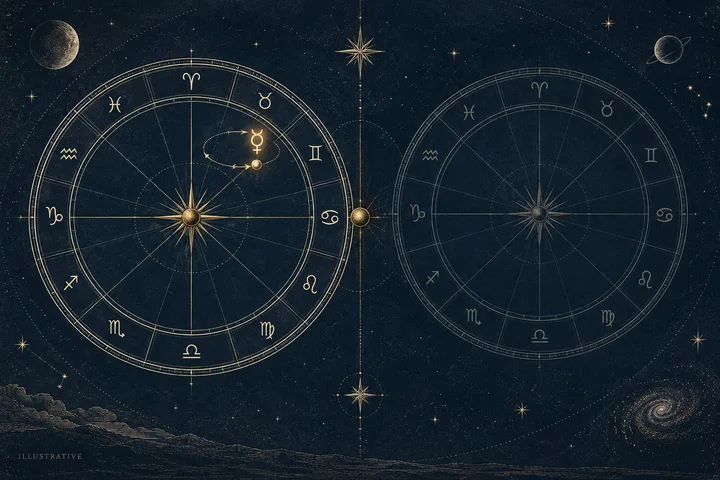
Before you interpret a concentrated synastry theme, check the inputs. This is where many readings become dramatic too soon. A chart may label a planet retrograde without showing whether it was close to the exact station. A sign-only comparison may suggest a connection without proving an aspect. A copied report may use a wide orb in one place and a tight orb in another. Your first task is not interpretation. It is identification.
You need the planet, sign, degree, and motion status for the person who has the suspected stationary planet. You also need enough birth-time and birth-place information for the chart source to establish the moment accurately. The exact station is a time-sensitive astronomical event, and the working window around it is not fixed. Some astrologers use a day or two. Others use a wider window, depending on the planet and the motion they are studying. The closer the birth moment is to the station, the firmer the emphasis claim becomes.
For the partner, you need at least the sign and degree of the personal planets you are comparing. The Moon, Venus, and Mars deserve particular attention in a relationship reading, while Mercury often describes how the theme gets spoken, questioned, negotiated, or misunderstood. If the partner’s degrees are missing, you can compare signs and note possible sign-based relationships, but you cannot honestly call a degree-based conjunction or square exact. Minutes matter when a planet sits near a boundary or when you are testing a very tight aspect.
Keep the zodiac system fixed. Tropical and sidereal charts can place a planet in different signs, so switching systems halfway through changes the material you are interpreting. Keep the aspect list fixed as well. The major aspects are conjunction at 0 degrees, sextile at 60, square at 90, trine at 120, and opposition at 180. If your report uses a six-degree orb for selected major aspects, apply that rule to every comparison in the same set. A 3-degree conjunction is much more immediate than a 5-degree square, even though both pass a six-degree gate.
The report used by this publication works from supplied placements and optional degrees. It can compare Moon, Venus, and Mars signs and select major aspects with a stated six-degree orb. It does not calculate a natal chart from birth details, calculate houses, or create a relationship score. That scope is useful here because the question is about reading a known stationary placement, not asking a machine to decide what the relationship means. Enter what you know. Mark what you do not know. Let the missing piece stay missing.
The station itself also needs a label. Station retrograde and station direct are not interchangeable words. Neither is simply good or bad. A retrograde station may describe a planet whose function turns inward before it finds an outer expression. A direct station may describe a function that gathers itself and then pushes forward. Traditional astrology can also treat slow or retrograde motion as a technical debility, while modern practice often emphasizes concentration or inwardness. These are different lenses. State which lens you are using, and do not borrow a conclusion from one framework to prove a claim in the other.
Finally, record the data trail for yourself. Write down the chart source, zodiac, degrees, motion status, aspect list, and orb. You do not need a page of technical notes in the final reading, but you do need a stable basis for the judgment. If the station is only inferred from a vague label, say the placement is reported as stationary rather than treating the station as confirmed. Precision makes the interpretation stronger. It does not make it colder.
A missing degree changes the kind of sentence you can write. With a sign only, you can discuss element, modality, rulership, and broad sign relationship. With a degree, you can test a conjunction, square, trine, sextile, or opposition and describe its closeness. With a verified station time, you can discuss the motion condition itself. These are three different levels of knowledge. Keep them separate in your notes, and your final reading will feel both more confident and more honest.
You can also ask whether the chart is being read as tropical or sidereal before you compare anything. A stationary label may remain attached to the same planet while its sign changes between systems, which changes the planet’s style and its sign-based relationships. There is no benefit in mixing the labels. Choose the system already used by the supplied placements, state it when it matters, and keep every later comparison inside that frame.
Sources: Planetary Stations: The Power of Retrograde and Direct Turns; Planetary Stations and Retrograde Motion in the Birth Chart; Aspect - Astrodienst Astrowiki
Read Mercury, Venus, and Mars as different themes
A stationary planet does not create one generic kind of intensity. It concentrates the job of the planet that has stopped. Start there. Mercury, Venus, and Mars may all feel unusually present, but they do not ask the same relationship question.
A stationary Mercury can make language the place where the relationship gathers heat. The person may think carefully, revisit a phrase, ask for definitions, or notice a contradiction that others would let pass. When your planet contacts their stationary Mercury, your words can become unusually memorable to them. A conjunction may make conversation feel immediate and constant. A square may turn different thinking speeds or assumptions into repeated friction. A trine can make it easy to follow each other’s mental rhythm, while an opposition may create a strong pull between two ways of naming the truth.
Do not reduce this to “they overthink.” That label is too small. A stationary Mercury may also give persistence, exact recall, careful editing, strong research habits, or a refusal to accept a vague answer. In synastry, ask what your planet supplies. Your Moon may make their thinking more emotionally responsive. Your Venus may make their words pleasing and persuasive. Your Mars may challenge, hurry, or sharpen their speech. The same concentration can become intimacy or argument depending on the aspect and the rest of the charts.
A stationary Venus concentrates values, affection, taste, attraction, pleasure, and the way a person measures fairness. In a relationship, this can feel like a strong preference for a certain form of closeness. They may need tenderness to be visible. They may take loyalty, money, touch, beauty, or social manners seriously. When your Moon meets their stationary Venus, care and affection can lock together quickly. When your Saturn meets it, the contact may ask for reliability, timing, and a clear agreement about what love requires. A Mars contact can bring desire and creative charge, but it can also turn a difference in pace into a live issue.
Here the word concentrated does not mean possessive. It means the Venus function has weight. The person may have a hard time pretending that a value does not matter. That can be a gift. It can also become rigid if the Venus is under strain elsewhere. Read dignity, sign, house, and natal aspects before deciding whether the intensity is warm, exacting, sensual, cautious, or defensive.
A stationary Mars concentrates action. It can make pursuit, anger, sexuality, courage, competition, and boundary-setting more visible in the person’s life. Your Venus contacting that Mars may feel like immediate attraction or a strong difference between what one person wants and how the other moves toward it. Your Moon may touch the person’s instinctive reactions, bringing protective energy or emotional heat. Your Saturn may slow Mars down, which can become discipline, frustration, or both. Your Mercury may give the Mars person a target for debate, teasing, or direct challenge.
Mars needs especially careful wording. A stationary Mars does not prove aggression, and a hard aspect does not prove harm. It shows a concentrated field of action and friction. The lived expression depends on the sign, natal condition, other contacts, and the choices both people make. A Mars in a strong condition can act with courage and clean boundaries. A pressured Mars may react before it explains. The practical question is not “Is this dangerous?” from one placement. It is “How do we handle pursuit, disagreement, sex, and the word no?”
The planet also tells you which partner may feel the contact most directly. In ordinary synastry language, the planet person often experiences the other person as activating a natal function, while the house person experiences that planet in a particular life area. But do not turn those roles into fixed personality types. If your Venus touches their stationary Mars, both people participate in the exchange. Desire moves in both directions, even if each person names it differently.
The cleanest reading keeps the planet’s meaning in front of the station. Say “their stationary Venus makes values and affection a strong theme,” not “their stationary Venus makes them obsessed.” Say “your Mars activates their concentrated drive,” not “you control their anger.” Strong astrology uses specific language. It leaves room for agency.
Notice how the same partner planet can change the meaning of the station. A stationary Venus contacted by another person’s Moon may ask how comfort becomes affection. Contacted by Mercury, it may turn taste and values into a topic of constant discussion. Contacted by Mars, it may bring desire and pace to the front. Contacted by Saturn, it may make commitment, duty, and standards impossible to avoid. The station remains the same. The synastry channel changes.
The house overlay can give the contact a setting, but it should not outrank the exact interaspect when the question is concentration. If the stationary Venus falls in a partner’s fifth house, romance and pleasure may become a visible stage for the contact. If it falls in the second, money, self-worth, and values may carry it. House interpretation needs reliable birth times, so do not invent it from sign placements alone. When that data is absent, stay with planets, signs, degrees, and aspects.
Sources: Planetary Stations and Retrograde Motion in the Birth Chart; Synastry - Astrodienst Astrowiki; Aspect - Astrodienst Astrowiki
Use the degree and aspect to test the feeling
Now test the feeling against the degrees. A stationary personal planet may be important, but importance in one chart is not the same as contact between two charts. The partner’s planet has to reach the station by sign and angle. This is where a striking story either becomes a grounded synastry theme or returns to the natal chart where it belongs.
Consider an example. Imagine Maria has Venus at 17 degrees Taurus, and her chart marks Venus as station direct. Imagine Alex has Mars at 18 degrees Taurus. The 1-degree conjunction gives Alex’s Mars a direct line into Maria’s concentrated Venus. Attraction, values, touch, and initiative can become a central relationship subject. Maria may feel that Alex brings her Venus to life. Alex may feel that Maria’s affection gives his Mars a clear direction. The station strengthens the sense that Venus matters intensely to Maria, but the close conjunction creates the shared theme.
Change one detail. Suppose Alex’s Mars is at 24 degrees Taurus. The sign match remains meaningful in a broad, sign-based way, but the degree gap is 7 degrees. Under the six-degree working orb used for this report, it is outside the selected major-aspect range. You might still discuss shared Taurus ground, but you should not present the contact as a degree-based conjunction. The difference is not pedantic. It changes how confidently you can say that Alex activates Maria’s Venus.
Change it again. Suppose Alex has Mars at 17 degrees Scorpio. That makes an opposition by degree, exact to the sign axis. The theme can still be powerful, but the exchange has a different shape. Taurus Venus seeks steadiness, embodied pleasure, and dependable values. Scorpio Mars presses toward depth, urgency, and total involvement. The pair may feel magnetized because each planet sees the other across an axis. They may also need to negotiate privacy, pace, trust, and control. The station concentrates Maria’s Venus. The opposition makes the difference impossible to ignore.
The aspect type ranks next. A conjunction blends the planets and can make the theme feel inseparable from the relationship’s daily texture. An opposition pulls the functions across a polarity and often makes each person aware of what the other does differently. A square creates pressure that asks for a working response. A trine makes the exchange easier to express, though ease can leave a talent unexamined. A sextile offers a usable opening that grows when both people choose it. None of these aspects gives a complete verdict without the planets involved.
Orb matters inside the aspect, too. A contact within 1 degree is exact in ordinary astrological language and deserves first rank. A contact within 2 or 3 degrees is close. A contact near 6 degrees may count under the stated rule but should not receive the same weight as an exact aspect. If several aspects touch the same stationary planet, rank them by closeness and relevance rather than listing them as if they all speak at one volume.
The station degree can add another layer. Because a planet near a station lingers around a point, a partner’s planet close to that same degree may seem to press the button repeatedly. This is especially compelling when the partner’s planet makes a close major aspect and the station is near exact. Still, the station does not widen the orb by magic. A 9-degree separation does not become a close conjunction because one planet is stationary. Prolonged natal emphasis and synastry contact are related ideas, not interchangeable measurements.
The direction of motion can refine the story. A stationary retrograde Mercury may make a partner’s words enter an already inward, reviewing mental process. A stationary direct Venus may make a partner’s presence help a person move from private value into visible affection. Those are interpretive possibilities, not automatic outcomes. Check whether the natal planet also has supportive or difficult aspects. The same station can be opened by a trine and tested by a square. Let the full pattern decide the tone.
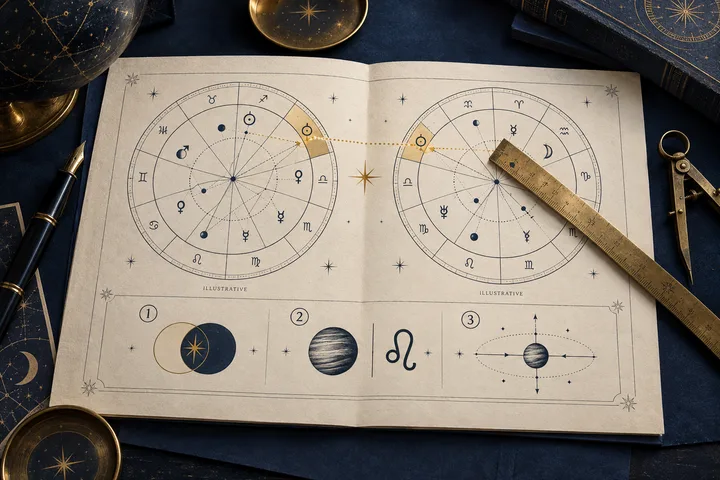
A useful worksheet has five lines: planet, sign, degree, station type, and closest partner contact. Add the orb. Then write one sentence for each planet’s job and one sentence for the aspect’s behavior. Only after that should you use words such as intense, concentrated, magnetic, or persistent. Those words should describe an observed synthesis, not substitute for one.
Applying and separating can add timing to the description when the chart data supports it. An applying aspect is moving toward exactness, while a separating aspect has already passed it. Some astrologers give the applying contact more force because it is building. Others focus more on the exactness and the wider pattern. You do not need to force a timing claim into every synastry report. If you use the distinction, define it and keep it subordinate to the planet pair, aspect type, and orb.
A close contact can also be dissociate by sign. For example, two planets may form an exact opposition by degree while occupying signs that do not carry the usual sign-to-sign opposition symbolism. The aspect still deserves attention, but its expression may contain an extra layer of contrast. This is a good reason to read both geometry and sign meaning. Degrees tell you that the planets meet. Signs tell you the language in which they meet.
Do not count every line in a software aspect grid as equal evidence. A report can contain many contacts because two charts contain many planets. Rank the personal planets first for this question, then note whether slower planets repeat or frame the same theme. One exact Venus-Mars contact can say more about attraction than five loose minor aspects. One close Saturn contact can shape commitment more clearly than a page of general compatibility language.

Yes, a stationary personal planet can make a synastry theme feel unusually concentrated, but the station is an amplifier, not the whole interpretation. First confirm that Mercury, Venus, or Mars was truly near a station at birth. Then read its sign and natal condition, find the other person’s exact degree, and test the major aspects with a consistent six-degree orb. A close conjunction, square, trine, opposition, or sextile to that stationary planet gives the relationship a direct channel for the theme. Without that contact, the station mainly tells you that one person carries that planet’s meaning with unusual insistence. The most useful reading ranks the evidence this way: exact interaspect first, planet and sign second, station condition third, and broad symbolism last. Compare supplied placements and optional degrees in the Synastry Comparison Report, then use the result to name one repeated pattern and one practical way to work with it.
Sources: Planetary Stations: The Power of Retrograde and Direct Turns; Synastry - Astrodienst Astrowiki; Aspect - Astrodienst Astrowiki; Exact aspect - Astrodienst Astrowiki
Rank the station against the rest of both charts
A good synastry reading ranks evidence. It does not let the most unusual label take over the whole chart. Stationary planets matter. So do sign condition, natal aspects, exact interaspects, repeated planet pairs, and the individual charts read as complete entities. The station earns attention because it concentrates a function. It earns first place only when the relationship activates that function closely and repeatedly.
Start with the individual chart. Astrodienst’s synastry guidance recommends understanding each horoscope as a single entity before interpreting the connection. That advice becomes essential with a stationary personal planet. You need to know what the planet already means for its owner. Is Venus dignified or strained? Does Mars have support from benefics, or does it sit inside a pattern of hard contacts? Does Mercury connect with the Moon, Saturn, or Uranus? The partner does not create the natal planet’s whole story. They enter it.
Next, count repetition by meaning, not by aspect name. If a partner’s Moon, Venus, and Mars all contact one person’s stationary Venus, the affection and desire layer has several channels. The theme may feel central because three relational planets keep returning to the same Venus function. If only the station exists and no partner planet reaches it, the chart may still feel concentrated to the station owner, but the synastry case is weaker. A repeated theme beats a rare label.
Then compare the personal planet to the partner’s slower planets. Saturn can give form, responsibility, and staying power to a stationary Venus or Mars, while also creating weight, delay, or fear around the same subject. Uranus can wake the planet suddenly and break old patterns. Neptune can make the contact subtle, idealized, or difficult to define. Pluto can make the exchange feel consuming or transformative. These contacts may be compelling, but they do not cancel the basic planet meanings. They color the channel; they do not write the whole message.
Here is the ranking I recommend for this particular question. First, a close major interaspect to the stationary personal planet, especially one within 3 degrees or repeated by more than one partner planet. Second, the stationary planet’s sign, dignity, house, and natal aspects, because these describe the function being activated. Third, the station’s closeness and direction, which explain why the function may feel unusually insistent or inward. Fourth, looser sign echoes and broad descriptions of intensity. This order keeps the reading useful.
The most meaningful exception is a stationary planet with no close synastry contact. In that case, do not force a relationship theme. You can say the person may carry Mercury, Venus, or Mars with unusual concentration, and the relationship may reveal that quality through ordinary interaction. But you cannot attribute the concentration to the partner’s chart without a contact. The station is then background architecture, not the bridge between the two people.
Another exception involves a close aspect that does not feel obvious yet. Astrology describes potentials and patterns, and a chart factor can remain quiet until the people share the right setting. A partner’s Saturn may become clearer when the couple handles a shared duty. A stationary Mercury may emerge when the pair makes a hard decision. A stationary Mars may show itself during a boundary conversation, not on a romantic weekend. Lack of drama in the first months does not erase a precise contact. It may simply mean the relevant life circumstance has not arrived.
The reverse can happen, too. A couple may feel a theme strongly even when the station is not involved. A tight Moon-Venus conjunction, Venus-Mars square, or Saturn contact can carry the relationship story on its own. Do not use a stationary planet as an explanation for every powerful feeling. If the chart contains a closer or more repeated pattern, let that pattern lead. The unusual feature should sharpen the reading, not flatter it.
This ranking also protects the reader from one-sided interpretation. A stationary planet may make one person’s inner experience more concentrated, but synastry asks what is exchanged. Read both directions. Note who owns the planet, who supplies the contact, and how the aspect behaves for each. Then translate the pattern into a mutual question: what does each person bring, and what does each person need to handle with care?
You can make the ranking visible in the final report without turning it into a score. Write the closest contact first. Explain its planet pair in one plain sentence. Add the stationary condition as the reason the planet carries extra weight for its owner. Then name the strongest supporting contact and the strongest exception. This lets the reader see why one interpretation leads and another stays in second place. It also stops a long list of aspects from sounding like a pile of equal proof.
Suppose a stationary Mercury receives a 1-degree opposition from a partner’s Moon and a 5-degree trine from that partner’s Venus. The Moon opposition should lead because it is closer and puts thought against feeling in a direct line. The Venus trine still matters. It may soften the exchange and help the pair enjoy talking about values or memories. The station explains why Mercury keeps returning to the subject. The opposition explains the friction. The trine explains one way to work with it. That is a reading, not a verdict.
Sources: Planetary Stations: The Power of Retrograde and Direct Turns; Planetary Stations and Retrograde Motion in the Birth Chart; Synastry - Astrodienst Astrowiki; Aspect - Astrodienst Astrowiki
Turn a concentrated theme into a useful choice
The point of a synastry reading is not to make the relationship sound extraordinary. It is to help you see what the relationship asks of you. A stationary personal planet can make a theme harder to ignore. That is valuable when you turn the observation into a clear conversation, a better boundary, or a more honest agreement.
For stationary Mercury, choose one communication practice. If the contact makes every phrase feel loaded, agree on when to pause and return to a difficult subject. Ask for the exact question instead of answering the fear behind it. Repeat the decision in plain words. If the stationary Mercury belongs to you, notice when review becomes repair and when it becomes a loop. If it belongs to your partner, do not mock their need for precision. Ask what information would let the conversation move.
For stationary Venus, choose one value to make visible. Talk about time, affection, money, exclusivity, touch, beauty, or fairness. Do not leave the central value in the realm of hints. If your Moon contacts your partner’s stationary Venus, ask what makes care feel real to them and name what makes it real to you. If your Saturn contacts it, discuss promises and limits before resentment turns a value into a test. If your Mars contacts it, separate desire from entitlement. Attraction still needs consent and timing.
For stationary Mars, choose one rule for conflict and pursuit. Decide how you will ask for space, how you will restart a conversation, and what happens when one person says no. If Mars is concentrated, vague rules can produce repeated friction because the action function keeps meeting the same unanswered question. Give it a clean outlet. Exercise together. Build something. Compete playfully. Make a plan. Then keep the serious boundary clear: intensity is not permission to ignore another person’s pace.
Imagine Maria and Alex again. Maria’s stationary direct Venus at 17 Taurus is conjunct Alex’s Mars at 18 Taurus. The reading is not “they are destined.” It is “affection and desire meet closely, and both people may feel the contact through the body, the senses, and the question of pace.” Their next useful step is practical. They can say what makes attraction feel safe, how often they want contact, and which forms of touch are welcome. If they cannot talk about that, the aspect remains a vivid symbol without becoming a workable bond.
Now imagine the same Maria with Alex’s Mars at 24 Taurus, outside the selected six-degree orb. The sign resemblance may still make their styles recognizable to each other, but the chart has not shown a close Mars-Venus aspect. Maria should not build a major relationship conclusion around the station. She should look for the actual contacts. Perhaps Alex’s Moon squares her Venus, or his Saturn trines it. Perhaps nothing close touches it. The next step changes because the evidence changed.
This is also why a report should show its inputs. When you can see the supplied sign, degree, aspect, and orb, you can tell whether a claim is calculated within the chosen scope or merely inferred from sign symbolism. A report can help you compare the layers. It cannot replace the conversation that gives those layers a human shape. Use astrology to ask better questions about affection, thought, action, timing, and repair.
Do not ask a stationary placement to answer whether someone will stay, whether you should date them, or whether the connection is fated. The chart can describe a concentrated theme. It can show where the two people meet that theme. It can suggest the work required to use the pattern well. The decision still lives in what both people do with the pattern.
A strong ending is observable. Name the closest contact. Name the planet’s job. Name the pressure point. Then choose one action you can test over the next conversation or month. If the action brings more clarity, steadiness, desire, or repair, the chart has become useful. If it only produces bigger words, return to the degrees and start again.
Here is a compact decision guide. If the station is confirmed and a close personal-planet contact repeats the same meaning, treat the theme as central and discuss it directly. If the station is confirmed but the partner’s chart does not contact it closely, treat it as a strong natal background and avoid attributing it to the relationship. If the degree is missing, keep the interpretation at the sign and possible-contact level. If a different, tighter pattern dominates, let that pattern lead even when the station is more unusual.
The next useful question is usually not “How intense is this?” It is “Where does this show up, and what would make it easier to handle?” Mercury points to words and decisions. Venus points to values and affection. Mars points to action, desire, anger, and boundaries. A stationary planet makes the question harder to postpone. A close synastry aspect shows where the two people can meet it. Their choices show what happens next.
Sources: Planetary Stations and Retrograde Motion in the Birth Chart; Synastry - Astrodienst Astrowiki; Aspect - Astrodienst Astrowiki
A little more clarity
Does a stationary Venus automatically mean a more intense romantic synastry connection?
No. It means Venus is emphasized in that person’s natal chart. The romantic connection becomes a strong synastry theme when the partner’s planets make close contacts to that Venus, especially with a clear degree-based major aspect. Read the sign, natal condition, aspect, and orb together. A station can concentrate the Venus story, but it cannot create a relationship contact by itself.
Sources & further reading
- Planetary Stations: The Power of Retrograde and Direct Turns
Defines station retrograde and station direct, explains near-zero motion, and distinguishes modern emphasis from classical technical strength.
- Planetary Stations and Retrograde Motion in the Birth Chart
Explains station as concentrated emphasis and ranks planet, station closeness, overall condition, and sect in natal interpretation.
- Synastry - Astrodienst Astrowiki
Defines synastry as comparison of horoscopes, describes interaspects and house overlays, and advises reading each chart first.
- Aspect - Astrodienst Astrowiki
Defines major aspects and orbs, explains applying and separating contacts, and describes how aspect type changes interpretation.
- Exact aspect - Astrodienst Astrowiki
Provides the practical definition of an exact aspect as a contact within one degree for ordinary chart interpretation.
Synastry Comparison Report
Enter known placements for two people. Get an input-by-input comparison, selected aspect calculations and a clear record of what remains uncertain.
Compare our placements