Imagine the night that makes the question urgent
Imagine Maria has been seeing Alex for three months. She can't call the connection ordinary. He makes her feel awake, brave and strangely exposed. They can spend six hours talking, then go two days without a clear plan. One week he seems fascinated by her. The next, he needs space and answers messages at midnight. She has found a synastry list that shows his Uranus conjunct her Venus, his Neptune square her Moon and his Pluto trine her Mars. Now she wants one clean answer. Which contact is making the relationship feel so large, and what should she do with it?
The honest astrological answer is more useful than a label. These contacts don't tell Maria whether Alex is right for her. They describe the channels through which the bond moves. Uranus agitates her Venus, so attraction may need room, freshness and a less predictable form. Neptune touches her Moon, so emotional closeness may arrive through tenderness, fantasy and a powerful sense of recognition, along with moments when she isn't sure what has actually been promised. Pluto strengthens her Mars, so desire, courage and conflict can all gain force.
That is already a better question than asking whether three outer planets mean fate. Which part of the relationship is electric? Which part is hazy? Which part keeps demanding honesty? Synastry compares two charts. It doesn't turn them into one personality, and it doesn't produce a verdict from one dramatic aspect. A planet describes a function. A sign describes its style. An aspect describes how two functions meet. The lived relationship supplies the examples that tell you which expression is active.
The first rule, then, is simple. Let the personal planet name the room, and let the outer planet describe the weather moving through it. If Uranus contacts Mercury, the room is conversation. If Neptune contacts Venus, the room is affection and value. If Pluto contacts the Sun, the room is identity and recognition. The outer planet changes the atmosphere, but the contacted planet tells you where to look.
That order keeps the reading humane. You aren't asking which planet has more power in the abstract. You're asking what gets activated between these two people, where the activation is felt, and whether they can work with it consciously. The answer may be exciting, tender or demanding. It can also change as the relationship moves from first attraction into routine, conflict, trust and repair.
A precise chart reading can be warm. Technical language doesn't have to flatten the feeling. It gives the feeling a place, a shape and a question you can carry into real life. It gives you language.
This article uses illustrative scenes, not personal charts. Maria and Alex are an example built to show the reading process. Their degrees are not presented as real birth data. If you're comparing your own placements, use the signs you know and add degrees only when you have them. A report based on supplied placements can compare selected sign relationships and degree-based aspects within its stated rule. It can't calculate missing natal positions, houses or angles from a story alone. Precision begins with naming what you actually know.
Sources: Synastry - Astrodienst Astrowiki; Synastry: Love and Relationship Astrology; Synastry: two charts in conversation
Start with the contact, not the reputation of the planet
Uranus, Neptune and Pluto get strong reputations. Uranus is called disruptive. Neptune is called dreamy. Pluto is called intense. Those words can open a reading, but they can't finish one. Start with the personal planet. The same Uranus contact feels different through the Moon than through Mars. Neptune on Mercury does not ask the same questions as Neptune on Venus. Pluto on the Sun doesn't work like Pluto on Venus. The outer planet supplies force. The personal planet supplies the human task.
The Sun is selfhood, vitality, visibility and the wish to be recognized. Mercury is speech, thought, questions and meaning. The Moon is mood, comfort, memory, instinct and the habits that appear before explanation. Venus is attraction, pleasure, taste, appreciation and reciprocity. Mars is initiative, desire, assertion, pursuit and the move from wanting to doing. These functions are the foundation of the comparison.
Now add the outer planets. Uranus brings novelty, independence, disruption and a need to meet life on new terms. Neptune heightens ideals, tenderness, imagination, longing and permeability. Pluto concentrates attention, intensifies attachment and exposes material that cannot stay buried. None of these meanings is automatically kind or cruel. Uranus can free a stale pattern, or make steadiness difficult. Neptune can deepen compassion, or blur an agreement. Pluto can bring courage and renewal, or turn vulnerability into a contest for power.
The aspect tells you how the energy arrives. A conjunction blends the two functions and makes the contact hard to separate from the relationship's main feeling. A square creates friction and keeps pressing on a habit. An opposition pulls the two functions across a relational axis, so each person may experience the other as both compelling and difficult to integrate. A trine tends to flow with less resistance. A sextile offers an opening that still needs participation. The geometry describes the movement. It doesn't grade the people.
This is why a close Pluto trine Venus can be deeply attractive without carrying the same pressure as a Pluto square Venus. It still deserves a serious reading. A flowing aspect may make intensity easy to enjoy, which can hide how much influence each person has gained. A difficult Neptune aspect may create disappointment, but it can also force a couple to give their tenderness a truthful shape. Ease is not automatically intimacy. Friction is not automatically failure.
A useful reading combines four questions. What personal function is contacted? Which person owns that function? Which person brings the outer planet? What exact aspect and orb connect them? Keep the roles visible. If Alex's Uranus contacts Maria's Venus, Maria may feel her style of attraction being awakened or unsettled, while Alex may act as the carrier of surprise, difference or interruption. Both people live the contact, but they don't experience it through the same doorway.
This approach also protects the personal planet from being swallowed by the outer planet's story. Venus remains a person who chooses, values and responds. Neptune doesn't make Venus foolish. Pluto doesn't make Venus powerless. Uranus doesn't make Venus incapable of commitment. The contact describes a meeting between functions. It may reveal a new choice, a wish that needs form, or a fear that needs a boundary. Keep the person larger than the symbol.
The same care applies to the outer-planet person. Calling someone the Uranus person, Neptune person or Pluto person can sound as if they carry one permanent role in every relationship. They don't. A natal chart may show how that planet already works in their life, including its own aspects and sign. The partner's personal planet gives it a particular outlet. Read the contact in that relationship, not as a complete description of either individual.
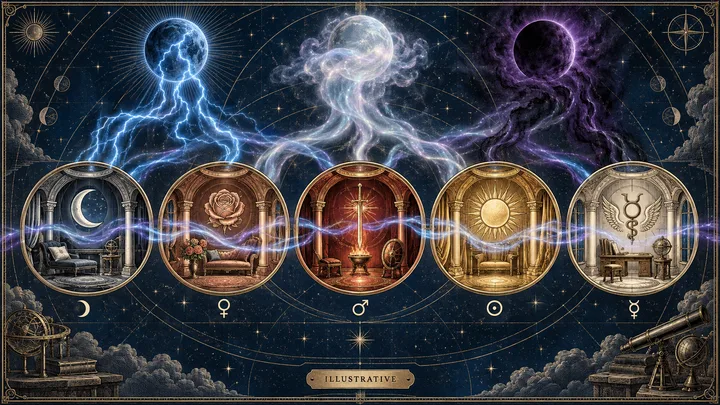
When Uranus, Neptune or Pluto makes a close aspect to a personal planet in synastry, it changes the way that planet behaves between two people. Uranus adds surprise, freedom and breaks in routine. Neptune adds longing, tenderness, imagination and the need to separate love from projection. Pluto adds concentration, depth, vulnerability and pressure around control. The outer planet doesn't replace the personal planet. It turns up one of its themes. Your Moon still describes comfort and instinct. Your Venus still describes attraction and appreciation. Your Mars still describes desire and pursuit. The contact shows what happens when another person's Uranus, Neptune or Pluto enters that function. Read it by exact degrees, aspect type, planet roles and repeated behavior. A close conjunction, square, trine, sextile or opposition matters more than a loose same-sign overlap. In this report's stated scope, selected major aspects use a six-degree orb when the supplied placements support them. No house placement or natal chart calculation is assumed without the required data.
Sources: Synastry - Astrodienst Astrowiki; Synastry: Love and Relationship Astrology; Synastry: two charts in conversation
Uranus changes the rhythm of closeness
Uranus contacts make a relationship feel awake. They often bring a sudden meeting, an unusual bond, a fresh idea of partnership or a strong wish to stop repeating old rules. The attraction may arrive as recognition through difference. You notice the other person because they don't behave like the people you've known before. They may invite a new social world, a new schedule, a new style of honesty or a more spacious idea of commitment.
When Uranus touches the Moon, emotional safety can become more mobile. One person may feel energized by the other's unpredictability, while another part of them wants a dependable rhythm. The Moon person may need to learn that closeness doesn't have to mean constant access. The Uranus person may need to learn that freedom isn't the same as leaving the other person to guess. The strongest expression gives both people room and gives the bond a rhythm they can name.
Uranus and Venus speak directly to attraction, pleasure and relationship style. The Venus person may find the Uranus person fascinating, unconventional or liberating. Dates may be spontaneous. Affection may thrive when the couple keeps discovering each other instead of performing a fixed script. But the same contact can produce a hot-and-cold pattern when excitement becomes the only proof that love is alive. Cafe Astrology describes Venus-Uranus contacts as thrilling and potentially erratic, with flowing aspects often enjoying an offbeat partnership and difficult aspects carrying a more persistent unsettled feeling. [1]
Uranus on Mercury can make conversation quick, original and surprising. You may interrupt each other's old assumptions in a good way. The contact suits brainstorming, unusual interests and candid questions. It can also make one person's statements land like shocks. If every conversation must be novel, ordinary listening starts to feel dull, and the relationship loses the quiet exchange that lets trust grow.
Uranus on Mars can change how two people pursue a goal. It may wake up courage, sexual charge and a taste for risk. The pair can move quickly when they share a project. The difficulty comes when one person's action feels like the other's disruption. A plan changes without warning. A boundary is tested for the thrill of testing it. The answer isn't to remove all spontaneity. It is to distinguish surprise that expands the relationship from surprise that makes consent, time or reliability impossible.
Consider an example. Maria's Venus at 18 degrees Taurus and Alex's Uranus at 20 degrees Capricorn form a trine with a two-degree orb. Maria may enjoy the way Alex breaks her usual romantic pattern. He might encourage a different way of dating, while she gives his independence a warm, tangible form. If her Venus were at 18 degrees Leo and his Uranus at 20 degrees Taurus, the same two-degree distance would describe a square instead. The attraction could remain strong, but the pressure would likely show through mismatched needs for predictability and freedom.
The practical question is not, 'Will Uranus make him leave?' Ask instead, 'What kind of freedom keeps affection alive here, and what kind makes me anxious?' Name the minimum rhythm you need. Name the changes you genuinely enjoy. Then watch whether both people can negotiate the difference. Uranus works best when the relationship has enough structure to make freedom a choice rather than a disappearance.
The contacted sign adds another layer. Uranus in an earth sign may disrupt habits around money, time, body or practical security. In an air sign, the change may arrive through ideas, social networks or the need to keep conversation open. Fire can turn the contact toward risk, play and self-direction. Water may make the disruption emotional, intuitive or hard to explain. These are styles, not fixed outcomes. A Uranus-Venus contact in Taurus won't erase Taurus's wish for steadiness. It may ask what kind of steadiness can remain alive while the relationship changes.
Also check whether Uranus is the only planet making the story. Saturn can give an unconventional relationship a dependable frame. Jupiter can make experimentation feel generous rather than threatening. A strong Moon-Venus contact can offer warmth when the Uranus contact breaks the usual rhythm. If the chart contains no such support, don't pronounce doom. Simply make the need for a conscious rhythm more central to the reading.
Sources: Synastry: Love and Relationship Astrology; Synastry: two charts in conversation
Neptune changes what you imagine and what you can verify
Neptune contacts soften the edges between two people. They can bring compassion, artistic feeling, spiritual language, erotic longing and the sensation that a private world has opened between you. A Neptune person may seem to understand the personal planet person without many words. The personal planet may feel received in a tender, almost dreamlike way. That tenderness is real within the symbolism of the contact. It still needs a clear container.
Neptune and the Moon can make emotional resonance immediate. You may absorb each other's moods, sense the pain behind a brief sentence or find comfort in silence. The gift is sensitivity. The task is differentiation. Which feeling belongs to you? Which feeling did you pick up from the other person? When a plan changes, are you responding to what was said, or to the story your fear built around it? A Moon-Neptune contact asks for emotional truth without demanding that every feeling become a fact.
Neptune and Venus are classic signatures of romantic idealization and devotional feeling. Cafe Astrology describes these contacts as evolving over time: the early bond can feel all-consuming, then reality may reveal that some of what was loved belonged to an image rather than the whole person. The same source also leaves room for the mature expression, in which the couple learns to love the person who is actually present. [1] That is the useful turn. Neptune doesn't ask you to destroy the dream. It asks you to give the dream a human face.
Neptune and Mercury can create poetic conversation, intuitive understanding and shared imagination. It can also make language slippery. A suggestive answer may feel like a promise. A silence may become a message. A person may hear what they hope to hear because the contact makes the exchange emotionally rich. Put important agreements into ordinary words. What are we doing? By when? What does exclusivity mean to each of us? Neptune becomes a gift when inspiration and clarity can sit in the same room.
Neptune and Mars can blend desire with fantasy. The attraction may feel gentle, consuming or strangely difficult to define. The Mars person can awaken the Neptune person's imagination, while the Neptune person can give Mars a softer, more symbolic form of pursuit. The hard expression appears when action loses direction. One person wants a concrete answer. The other keeps the feeling alive without choosing a form. Desire deserves honesty. It shouldn't have to survive on hints.
Imagine Maria's Moon at 11 degrees Pisces and Alex's Neptune at 14 degrees Virgo, an opposition within three degrees. She may feel that he reaches a hidden emotional place in her. He may seem both compassionate and impossible to read. If Alex also shows up consistently, answers direct questions and repairs confusion, the opposition can become a practice of balancing sensitivity with facts. If he makes grand emotional gestures but avoids simple commitments, the same contact may keep Maria attached to potential. The aspect describes the pull. His repeated behavior tells her which version is being lived.
Neptune's personal-planet role can also shift depending on who names the problem first. The Venus person may say, 'I thought we shared a future,' while the Neptune person may say, 'I thought we were sharing a feeling.' Neither sentence settles the matter. It reveals the gap between symbol and agreement. A good reading brings that gap into view before resentment fills it. Ask what each person heard, what each person meant, and what each person is willing to make real now.
Your decision guide is plain. Keep the tenderness, check the details. Ask what was promised, what happened, and what still needs saying. Don't use the intensity of a Neptune feeling as proof of another person's intention. But don't dismiss the feeling either. Let it show you what your heart wants to experience, then ask whether the relationship can hold that wish in daylight.
Signs can show the language of the dream. Neptune in water may deepen feeling, memory and psychic receptivity. In air, the ideal may live in an idea, a conversation or a shared vision. Fire can make faith and longing vivid, while earth asks the dream to become useful, embodied and dependable. The sign doesn't decide whether the contact is honest. It shows the form the longing prefers. A Neptune-Venus contact in an earth sign may still idealize, but it may idealize through practical care, a beautiful home or the promise of a stable future.
Look for a bridge between Neptune and the rest of the comparison. Saturn can give a dream a timetable. Mercury can make the hidden assumption speakable. The Moon can confirm emotional attunement, or show that one person is carrying the feeling alone. Venus-Mars can provide a direct channel for desire, but it can't confirm that the imagined future exists. Neptune's best expression is not less romance. It is romance that survives accurate seeing.
Sources: Synastry: Love and Relationship Astrology; Synastry: two charts in conversation
Pluto changes the depth of attention
Pluto contacts pull attention toward what matters beneath the surface. They can create magnetic attraction, emotional courage and the feeling that the relationship has found a hidden layer of you. A Pluto person may activate the personal planet person's instinct to reveal, protect, merge, resist or transform. The bond can feel consequential before the two people have built enough ordinary history to explain why.
Pluto on the Sun touches identity. The Sun person may feel deeply seen, challenged or changed by the Pluto person. The Pluto person may notice strengths and fears that others miss. In a generous expression, this contact supports honesty and a stronger sense of self. In a strained expression, one person's attention becomes a spotlight the other can't escape. The Sun person may feel judged or consumed. The Pluto person may believe that seeing deeply gives them the right to direct the relationship. It doesn't.
Pluto on the Moon reaches memory, attachment and instinctive safety. The contact can feel intimate before either person has decided to be intimate. Old fears may rise. So may a powerful wish to protect the bond. The Moon person may experience the Pluto person as emotionally penetrating. The Pluto person may feel pulled toward the Moon person's private world. This is where boundaries matter most. Depth should make truthful disclosure safer, not make privacy a betrayal.
Pluto on Venus can intensify attraction, preference and the fear of losing access to love. Cafe Astrology links Venus-Pluto contacts with magnetic attraction, transformation and a demand for physical presence, while its difficult expressions can bring jealousy and sharp swings between devotion and antagonism. [1] Read that as a range, not a sentence. A close trine can make intimacy and creative devotion flow. A square can expose possessiveness or unequal power. Either aspect benefits from explicit agreements about exclusivity, privacy and repair.
Pluto on Mars can concentrate desire and will. The pair may accomplish difficult things together because neither person wants to stay at the surface. Sexual energy can be formidable. So can the struggle over who initiates, who decides and whose anger gets space. A conflict can turn into a test of strength before anyone remembers the original issue. The mature expression uses the force for direct action and honest negotiation. The immature expression tries to win access, obedience or emotional surrender.
Consider an example. Maria's Mars at 5 degrees Scorpio and Alex's Pluto at 7 degrees Scorpio form a conjunction within two degrees. Maria may feel that Alex intensifies her desire to act, while Alex may draw out the force beneath her usual response. If they work toward a shared goal, the contact can give stamina and courage. If one person treats the other's hesitation as a challenge to overcome, attraction can slide into pressure. The same contact contains both possibilities because Pluto amplifies what the relationship chooses to do with power.
Ask three questions when Pluto is involved. Can each person say no without punishment? Can each person keep a private self without being accused of withdrawal? After conflict, does the bond become more honest or more controlled? These questions carry more weight than the word obsessive in an aspect list. Pluto can transform a relationship, but transformation needs consent.
Sources: Synastry: Love and Relationship Astrology; Synastry: two charts in conversation
Rank the contacts by closeness, planet and repetition
A synastry chart may show many lines. You don't need to give every line equal authority. Rank the contacts. The first pass should identify the smallest orbs involving the Sun, Moon, Mercury, Venus or Mars. Then note the aspect type. Then ask whether another contact repeats the same theme. A single close Uranus-Venus aspect may describe attraction that needs space. Uranus also contacting the Moon or Mercury may show that the same need for novelty reaches emotional habits and conversation. Repetition strengthens the pattern. It doesn't turn the pattern into a verdict.
For this article's report scope, use a stated six-degree orb for selected major aspects when the supplied degrees support it. A 0-degree contact is exact. A 2-degree contact is close. A 6-degree contact sits at the edge of the chosen rule and deserves less weight than the tighter aspect, especially when it involves a slow outer planet and a personal planet. If you don't have degrees, say that you have a sign-based comparison only. Same-sign planets aren't automatically conjunct, and opposite signs aren't automatically opposite. The degrees have to support the claim. [2]
The planet person and personal-planet person roles also deserve attention. If your Venus is contacted by your partner's Uranus, you may notice your attraction pattern changing around them. Your partner may bring the interruption, difference or permission to experiment. If your Uranus contacts their Venus, the emphasis shifts to how they receive your way of being different. The geometry is shared. The experience is not identical. Keep both sides in view instead of asking which person feels more in a universal way.
Aspect quality comes next. Conjunctions are loud because the functions merge. Squares and oppositions keep the contact active through friction or polarity. Trines and sextiles may be easier to enjoy, but they can become invisible because nothing forces a conversation. A trine between Pluto and Venus may quietly deepen loyalty. A square may announce itself through jealousy or arguments. Neither shape tells you what the people will choose. It tells you where the choice becomes visible.
Finally, compare outer-planet contacts with the personal-planet foundation. A dramatic Pluto contact can matter, but it shouldn't erase Moon-Moon understanding, Venus-Mars attraction, Mercury communication or Saturn's capacity for structure. The Astro.com Astrowiki describes outer-planet contacts to personal planets as compelling, while its synastry guidance also emphasizes aspects, house emphasis and the difference between flowing and difficult contacts. [0] A close outer-planet contact is a major color. It is not the whole painting.
The same rule helps when a contact is technically present but emotionally quiet. A 6-degree Uranus-Mercury aspect may sit in the list, yet the pair may not experience it as a defining feature because closer Moon, Venus or Saturn contacts carry the daily story. A 1-degree Neptune-Moon aspect deserves more attention even if the couple doesn't use spiritual language. They may simply notice that moods pass between them, that comfort arrives without explanation, or that unspoken expectations need translation. The chart's vocabulary and the couple's vocabulary won't always match.
You can rank each contact on two scales: symbolic volume and practical consequence. Orb and aspect type help estimate volume. Repeated events show consequence. A small contact with a clear recurring effect can become more useful than a louder aspect that never appears in life. This is not a reason to make the chart say whatever you want. It is a reason to let interpretation remain accountable to the relationship's actual pattern.
A compact ranking might look like this. First, a close outer-planet contact to the Moon, Venus or Mars that matches what you repeatedly experience. Second, a close contact to the Sun or Mercury that changes identity or communication in a visible way. Third, a wider or generational outer-planet pattern that lacks a precise personal-planet link. This ranking keeps the reading specific. It also prevents a shared birth-year signature from taking over the relationship story.
When several contacts compete, write one sentence for each. 'His Uranus wakes up my Venus.' 'Her Neptune softens my Moon but makes promises hard to read.' 'His Pluto concentrates my Mars and tests how we share power.' Then place those sentences beside observable examples. Keep the sentence whose examples recur. Revise the others if the relationship doesn't support them.
Sources: Synastry - Astrodienst Astrowiki; Synastry: Love and Relationship Astrology; Synastry: two charts in conversation
Turn the reading into a conversation you can actually have
Astrology becomes useful when it gives language to a pattern you can meet together. Uranus asks for a conversation about freedom and rhythm. Neptune asks for a conversation about hopes, assumptions and clear promises. Pluto asks for a conversation about trust, privacy, desire and power. The chart doesn't replace the conversation. It helps you choose the right one.
If Uranus contacts Venus or the Moon, try this: 'I love that our connection doesn't feel routine. I also need to know what rhythm we can rely on. What kind of space feels healthy to you, and what kind of contact helps you feel close?' This question protects both sides. It doesn't ask Uranus to become Saturn. It asks freedom to become legible.
If Neptune contacts the Moon, Venus or Mercury, try this: 'There is a lot I feel between us, and I want to make sure our words match our hopes. What do you understand us to be doing? What can you promise now, and what are you still discovering?' Don't punish the answer for being unfinished. Do insist that unfinished remains different from promised. Neptune needs compassion, but it also needs names, dates and plain speech.
If Pluto contacts the Sun, Moon, Venus or Mars, try this: 'This bond reaches me deeply. I want us to talk about what feels vulnerable, what stays private and how we handle a no. When we disagree, what would repair look like for both of us?' Notice the response. A person who can discuss power without turning the question into an accusation gives Pluto a constructive path. A person who uses intensity to avoid accountability is showing you the shadow of the contact.
These questions also help with the strongest exception. Sometimes the relationship behaves in a way the aspect description doesn't predict. A Venus-Neptune contact may coexist with excellent clarity. A Uranus-Moon contact may feel safe because both people genuinely value flexible routines. A Pluto-Mars contact may support disciplined teamwork instead of conflict. Don't force the dramatic expression just because the planet has a dramatic name. Let repeated behavior outrank the stereotype.
The reverse exception matters too. A flowing outer-planet aspect can still become difficult when the wider charts repeat the same pressure, when the orb is very close, or when the couple lacks a way to repair ruptures. A trine doesn't cancel possessiveness. A sextile doesn't create honesty by itself. Easy access to an energy can make it easier to use well, but it can also make the pattern so natural that nobody examines it.
You can ask the same questions without turning the reading into an interrogation. What happens when plans change? What happens when one person needs reassurance? What happens when desire is strong but the answer is no? What happens after a misunderstanding? The replies reveal the relationship's working structure. Astrology gives those moments a symbolic frame, but a frame is only useful if it helps you see the picture more clearly.
For couples who only know signs, begin with broad themes and stop there. You can say that a partner's Neptune in the same sign as your Venus may share a field of meaning, but you shouldn't call it a conjunction without degrees. If one person's birth time is unknown, don't add houses or angles. The missing information doesn't make the comparison worthless. It simply narrows the claim you can make with integrity.
Your next step is one specific conversation. Choose the outer planet that best matches the recurring experience, name the personal planet it touches, and ask the question that belongs to that combination. If Uranus is the loudest, ask about space and consistency. If Neptune is loudest, ask about meaning and facts. If Pluto is loudest, ask about vulnerability and power. Then listen to the answer and compare it with action over time.
You can make the comparison even more precise by separating the initiating event from the lasting pattern. Uranus may describe the unusual way you met, but a Saturn contact may describe why you keep showing up. Neptune may describe the song, image or spiritual feeling that opened the bond, while Mercury and the Moon show whether you can talk and soothe one another in ordinary life. Pluto may describe the moment that changed everything, while Venus and Mars show how attraction is expressed after the intensity settles. Outer planets often explain why a connection feels bigger than its first facts. The rest of the chart tells you whether that scale can become a life.
Keep a short observation record for a few weeks. Write the contact at the top, then note one concrete event that fits it and one that doesn't. This isn't a demand for proof or a contest between chart and experience. It is a way to keep the interpretation alive. Uranus may fit your sudden schedule changes but not your emotional bond. Neptune may fit the longing but not the communication. Pluto may fit the depth but not the conflict. A good reading gets narrower as you learn more.
Sources: Synastry: Love and Relationship Astrology; Synastry: two charts in conversation
Sources & further reading
- Synastry - Astrodienst Astrowiki
Supports the distinction between compelling outer-planet to personal-planet contacts, aspect types, and broader synastry interaction.
- Synastry: Love and Relationship Astrology
Supports the specific interpretive ranges for Venus-Uranus, Venus-Neptune, Venus-Pluto and Mars contacts in relationship comparison.
- Synastry: two charts in conversation
Supports chart-data limits, personal-planet roles, aspect geometry, orb discipline, planet meanings and the need to rank close contacts.
- Relationship Astrology
Supports the synthesis that Uranus brings freedom and instability, Neptune tenderness and ambiguity, and Pluto intensity and control questions.
Synastry Comparison Report
Enter known placements for two people. Get an input-by-input comparison, selected aspect calculations and a clear record of what remains uncertain.
Compare our placements