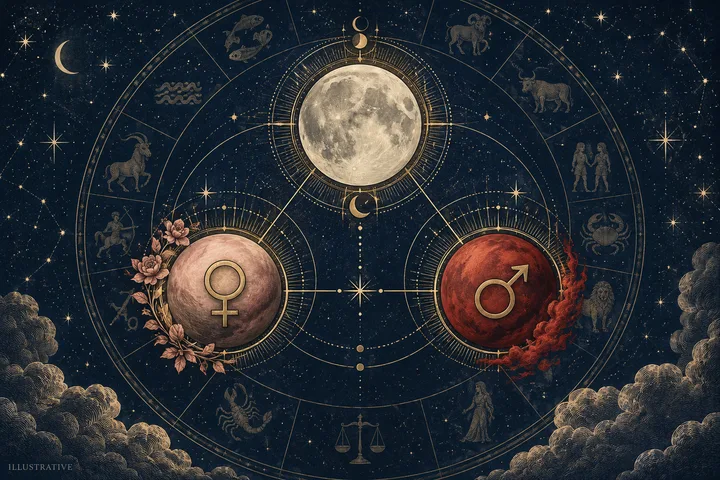
Imagine the night the three layers disagree
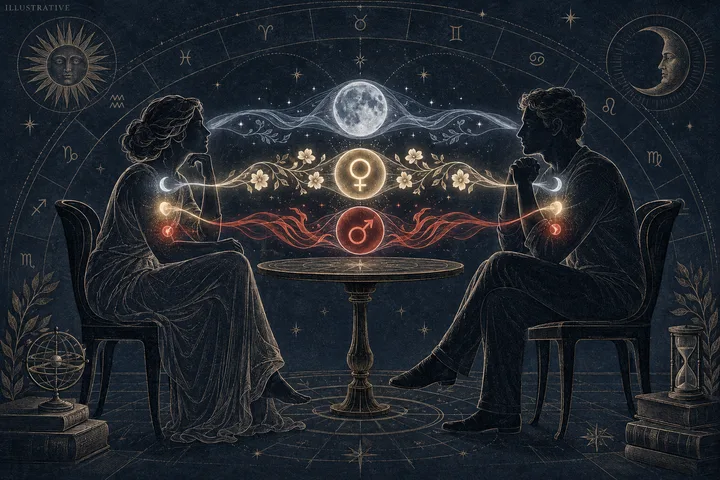
Imagine Maria and Daniel after six months of dating. Maria feels calm when they are together. Daniel remembers small details, brings food when she has had a hard day, and makes room for her quiet moods. That is the emotional story she keeps returning to. Her Moon recognizes something familiar in his presence.
But the affection story is less smooth. Maria wants regular verbal warmth and small signs of appreciation. Daniel shows love by solving problems, sharing time, and assuming that his loyalty is obvious. She sometimes feels cherished in his actions and overlooked in his words. Venus is describing a difference in taste and expression, not the absence of feeling.
Then there is Mars. Their physical chemistry is immediate, playful and hard to ignore. They can spend an evening arguing about a plan and still feel pulled toward each other. Desire arrives faster than agreement. It has its own weather.
If you summarized this pair by saying they are either harmonious or difficult, you would lose the useful truth. Their Moon layer says, 'There is comfort here.' Their Venus layer asks, 'Do we recognize love in the same language?' Their Mars layer says, 'The body moves before the mind has finished negotiating.' Those statements can all be true at once.
That is the case this guide investigates. The goal isn't to choose a winner among Moon, Venus and Mars. It is to decide which layer answers which question, how the layers modify one another, and what the couple should notice in ordinary life before turning a symbolic pattern into a sweeping conclusion.
Notice the difference between a layer disagreeing and a layer being absent. Maria can feel emotionally settled, want more verbal affection, and feel strong physical desire. Nothing is missing from that picture. The planets are describing different kinds of contact. A disagreement becomes important when the couple expects one layer to perform the job of another, such as asking sexual chemistry to prove trust or asking practical loyalty to replace spoken affection.
That distinction also protects the reader from a common mistake: treating one difficult aspect as a hidden answer that cancels every other pattern. A chart is a conversation among symbols. Read the repeated theme, the exact contacts, and the behavior that follows. The summary should become sharper as those three lines meet.
First define what each layer is asking
Synastry compares two charts and studies the relationships formed between their planets. The chart doesn't give you one single relationship feeling. It gives you a set of exchanges. One person's Moon can meet the other person's Venus while the same charts also carry a tense Venus-Mars contact. Each exchange has its own job.
The Moon is the first layer to read when the question is emotional safety. It speaks to instinct, comfort, habits, vulnerability and the way a person responds when life strips away performance. Moon contacts often show what it feels like to share space, recover after a hard day, or ask for care without having a perfect explanation. They don't promise that every feeling will match. They show where feeling meets feeling.
Venus is the affection layer. It describes attraction, pleasure, values, taste and the way each person offers appreciation. In a couple's daily life, Venus appears in the tone of a compliment, the way a person makes time, the pleasures they share, and the small choices that say, 'I like being close to you.' Two people can love one another and still miss each other's preferred signals.
Mars is the desire and activation layer. It describes pursuit, assertion, sexual energy, anger, courage and the impulse to act. Mars can make a connection vivid. It can also turn a small difference into a contest if the energy has no graceful outlet. Mars tells you how quickly the relationship moves and where each person presses forward, resists, or demands a response.
These are not three grades for the same relationship. They are three lenses. A Moon contact cannot replace a Venus conversation about appreciation. A Venus contact cannot prove that the body wants the same pace. A Mars contact cannot certify emotional safety. Read the planet first, then the aspect, then the sign and the wider pattern.
The order matters because the same event can belong to all three layers. A missed call may stir the Moon's fear of being forgotten, offend Venus's sense of consideration, and provoke Mars to demand an answer. If you call the whole moment conflict, you learn very little. If you separate the reactions, you can see what kind of repair each planet needs.
Keep the language concrete. Instead of writing that the relationship has mixed energy, say that comfort is available but affection may need clearer translation, while desire can outrun emotional timing. Plain language doesn't flatten astrology. It lets the pattern arrive intact.
When the emotional, affection and desire layers disagree, don't average them into a compatibility score. Read them as three different questions. Moon shows how safe, understood and settled the connection feels. Venus shows how you give and receive affection, pleasure and appreciation. Mars shows desire, pursuit, heat and the way energy moves between you. Start with the question that matters most right now, then rank the tightest major contacts within that layer. A warm Moon-Venus contact can make a relationship feel caring even when Mars is restless. A strong Venus-Mars contact can create unmistakable chemistry even when the Moons need different kinds of reassurance. If the Moon layer stays chronically unsettled, don't let attraction speak for emotional security. If the Venus layer feels unvalued, don't use sex to cover the hurt. The best summary names the three layers, gives each its proper weight, and ends with the pattern you can actually observe together. It should also state what is known and what remains open. If degrees are missing, keep exact aspects unranked. If the chart shows a strong contact but the couple's repeated behavior contradicts the first impression, describe that tension instead of forcing a tidy answer. The point is not to make every symbol agree. The point is to show which conversation deserves attention first, and why. A useful report can hold tenderness and tension in the same sentence. It can say that a couple feels at home together, misses one another's signals, and needs a slower rhythm around desire. That is not indecision. It is a more exact map of how the relationship works.
Sources: Synastry & Relationship Astrology; What’s Your Sign? An Intro to Synastry Charts and Astrological Compatibility; Introduction to Synastry
Use the Moon to rank emotional safety
When the layers disagree, begin with the Moon if the couple is asking, 'Can we live inside this connection?' Emotional safety is not the same as constant ease. A Moon square can describe a live point of friction that both people feel often. A Moon trine can describe an easier rhythm of comfort. A conjunction can intensify recognition, but it can also make two similar reactions fill the whole room.
Moon-Moon contacts show how two emotional rhythms meet. One person may need immediate discussion while the other needs silence before speaking. One may settle through touch, food and routine. The other may settle through movement, space or a change of scene. The aspect tells you the style of exchange. The signs tell you what kind of comfort each Moon seeks.
Moon-Venus is often one of the most helpful bridges when emotional and affection languages need support. The Moon person may feel received by the Venus person's warmth, while the Venus person enjoys caring for the Moon person. Yet even this contact has a strong exception. If Venus responds to pain with charm, distraction or a beautiful solution instead of presence, the Moon can feel dressed up and still alone. Harmony needs attention.
Moon-Mars deserves a careful reading. It can bring heat, instinctive attraction and fast emotional response. It can also make one person's action press directly on the other's nervous system. Daniel's directness might wake Maria up and make her feel desired. On another night, the same directness could feel like pressure. The contact is not the verdict. The couple's handling of timing is the interpretation.
In a summary, give the Moon layer first place when the relationship is deciding whether closeness feels nourishing or draining. Ask what happens after disappointment. Do they repair, withdraw, tease, attack, explain, or pretend nothing happened? The answer gives the Moon pattern a lived shape. A beautiful sign pairing matters less than the emotional habit the couple repeats.
The Moon also tells you what happens when affection is not immediately available. Can each person tolerate a pause without writing a story about abandonment or rejection? Can they ask for reassurance without testing the other person? These questions help distinguish a lively emotional difference from a pattern that leaves one person constantly braced.
When you write this layer, avoid making either Moon a caricature of its sign. A fire Moon isn't automatically careless, and an earth Moon isn't automatically cold. The sign describes a style of feeling and regulation. The contact describes how that style meets the other person. The relationship shows the range.
Sources: Synastry & Relationship Astrology; What’s Your Sign? An Intro to Synastry Charts and Astrological Compatibility; Introduction to Synastry
Read Venus as the language of affection
Once the emotional floor is clear, read Venus. Venus answers a different question: 'How do we make love feel recognizable to each other?' It covers romance, pleasure, values and appreciation. This is where couples often discover that care is present but poorly translated.
A Venus-Venus contact can show shared taste or a common instinct for tenderness. Flowing contacts often make it easier to enjoy the same pleasures and treat one another with a similar social rhythm. A square or opposition can still attract strongly, but each person may feel unappreciated because their style of relating lands differently than intended. The remedy is not to decide whose Venus is right. It is to name the signal.
Suppose Maria's Venus wants direct reassurance and Daniel's Venus prefers practical devotion. She may wait for a sentence he assumes his actions have already spoken. He may feel that his consistency should count more than a polished declaration. If the couple names this difference, the Venus tension becomes useful. They can stop arguing about whether love exists and start asking how love is being received.
Venus-Moon contacts can soften a hard relationship pattern because affection meets emotional need. Venus-Mars contacts bring a different kind of charge. They can create romantic and physical attraction, but the hard aspects can also make desire and affection arrive at different speeds. One person may feel loving while the other feels aroused. Neither experience cancels the other.
Rank Venus above Mars when the immediate concern is whether affection feels mutual, respectful and visible. Rank it below the Moon when a person feels unsafe, chronically dismissed or unable to relax. Romance needs a home. Venus can decorate the room, but the Moon tells you whether the room feels inhabitable.
Venus is also where values become practical. Two people may enjoy one another yet disagree about money, time, privacy, social life or the meaning of commitment. A sign-pair reading can suggest the style of those preferences, but the aspect and the rest of the chart show how the preferences meet. Don't confuse a different taste with a moral failure.
A useful Venus summary gives the couple a translation sentence. You may both value closeness, but one of you reads closeness through frequent contact while the other reads it through dependable presence. That sentence opens a door. It doesn't force either person to abandon the way they naturally love.
Sources: Synastry & Relationship Astrology; What’s Your Sign? An Intro to Synastry Charts and Astrological Compatibility; Introduction to Synastry
Treat Mars as desire, timing and pressure
Mars gets overpromoted in synastry because it is easy to feel. A charged look, a fast pursuit, a sharp argument or an evening that changes temperature can make the whole relationship seem defined by desire. Mars matters. It just doesn't answer every question.
Mars-Venus is the clearest example. An easy aspect can help affection and desire cooperate. A square or opposition can keep attraction alive while making timing difficult. One person may move forward when the other wants tenderness first. One may experience a bold approach as exciting; the other may experience it as too much. This is not a contradiction in the chart. It is the signature of two planetary functions meeting at different speeds.
Mars-Mars shows how each person acts, competes, protects territory and handles heat. Similar signs can create shared momentum, but they can also produce two people who refuse to yield. Different signs can produce complementary initiative, or a feeling that one person is always pushing while the other is always braking. Watch the behavior around plans, conflict and physical pace.
Mars-Moon can be tender, erotic and volatile. It can make the couple instinctively responsive to one another, yet it can also turn irritation into a body-level reaction. If Maria needs time to settle and Daniel demands an answer now, their Mars-Moon pattern becomes visible in minutes. The useful reading doesn't label either person bad. It identifies the pressure point and asks what slows the escalation.
Rank Mars first only when the question is desire, pursuit, sexual pacing or shared action. Don't use strong Mars to cover a Venus wound or a Moon fear. Chemistry can bring two people into the same room. It can't decide how they treat each other once they are there.
Mars can also explain why a couple feels productive together. Shared action, travel, exercise, building a home or facing a problem can give the planet a clean channel. If the only available outlet is argument or sexual tension, the same energy may become repetitive. Ask where the couple already acts well together before naming Mars as a problem.
The mature reading keeps desire alive without making it sacred. Attraction is meaningful. So are patience, consent, fairness and the ability to stop. A Mars contact becomes easier to work with when both people can say what they want, hear a no, and return to warmth without punishment.
Sources: Synastry & Relationship Astrology; What’s Your Sign? An Intro to Synastry Charts and Astrological Compatibility; Introduction to Synastry
Let degrees and orbs decide what leads
After identifying the layer, check the degree. A sign comparison can suggest a shared tone, but a degree-based aspect tells you whether the two planetary functions form a specific conversation. The closer the aspect, the more likely it is to be felt as a distinct thread in the relationship. It still needs context, but it deserves attention.
For this publication's comparison report, use supplied placements and optional degrees with a stated six-degree orb for selected major aspects. That gives the reading a clear boundary. A contact at one degree receives more weight than the same aspect at six degrees when the rest of the chart is comparable. A sign-based contact can remain meaningful as a background pattern, but it should not be dressed up as an exact aspect.
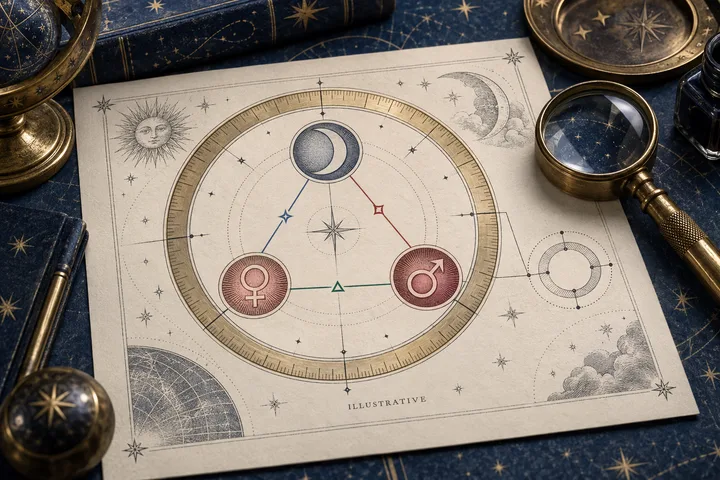
Use a simple ranking pass. First, list the Moon, Venus and Mars contacts that fall within the working orb. Second, sort by exactness and by the question the couple is asking. Third, check whether several contacts repeat the same theme. A tight Moon-Venus contact plus a looser Venus-Mars contact tells a different story from a tight Venus-Mars conjunction with no close lunar bridge.
The aspect type changes the movement. A conjunction blends and intensifies. A trine or sextile can make exchange easier, though ease can become automatic and unnoticed. A square creates friction that demands a method. An opposition creates polarity, often drawing two people together while making them feel pulled to opposite sides. Don't call one type good and another bad before you ask what the couple does with it.
Missing degrees change the confidence of the summary. If a Moon degree is unknown, say that the sign layer can be compared while the exact Moon aspect remains unranked. If the birth time is missing, don't calculate houses or angles. The report can still compare supplied Moon, Venus and Mars placements, but it should keep the boundary visible and let the known pattern carry the reading.
Be especially careful with a list of many wide contacts. Several loose aspects can create the impression of a crowded story even when one close contact carries most of the felt weight. Count is not the same as importance. A compact, repeated pattern is easier to interpret than a long catalogue of every possible relationship between two charts.
The working orb is a method, not a promise that every contact inside it will feel identical. A one-degree square and a six-degree square belong to the same aspect family, but their emphasis may differ. State the rule, rank the closeness, and then let the planetary meanings tell you what kind of exchange is being activated.
Sources: What’s Your Sign? An Intro to Synastry Charts and Astrological Compatibility; Introduction to Synastry; Synastry: Venus-Mars Aspects Between Two Charts
Build one reading and test it in ordinary moments
A strong summary doesn't blend the planets into a soft paragraph about 'connection.' It writes three clean statements and then shows how they interact. This keeps the reading honest and gives the couple something to test in life.
Start with the emotional statement: 'The Moon layer suggests that you settle each other through shared quiet, but your conflict recovery needs different timing.' Then write the affection statement: 'The Venus layer shows attraction and care, but you may recognize appreciation through different signals.' Finish with the desire statement: 'The Mars layer brings quick physical momentum, yet one person may need a slower approach when tension is already high.'
Now connect them. In Maria and Daniel's example, emotional familiarity gives the relationship a soft landing. Venus differences make appreciation easy to miss. Mars chemistry makes the missed signal harder to ignore because desire keeps pulling them back into contact. The pattern is not 'good but complicated.' It is 'emotionally promising, affectionally untranslated, and physically fast.' That sentence can guide a real conversation.
The next question is which layer carries the strongest repeated evidence. If the couple repairs well after friction, the Moon foundation may be stronger than a tense aspect first suggests. If one person repeatedly feels unseen despite dramatic chemistry, Venus deserves more weight than Mars. If desire fades whenever emotional safety drops, Mars is responding to the Moon rather than operating independently.
This is where the astrologer's judgment matters. Don't give each planet equal space simply because the page has three headings. Rank them. Say which layer is the resource, which is the translation problem, and which is the pressure point. Readers need a pattern they can remember, not a museum of disconnected meanings.
A compact template helps. Write, 'Your emotional resource is...' Then, 'Your affection gap may be...' Finally, 'Your desire rhythm asks you to...' After those three sentences, add one sentence that explains the interaction. This prevents the reading from becoming a string of isolated cookbook meanings.
You can also reverse the order when the reader's question demands it. Someone asking why the attraction is overwhelming may need Mars first, followed by Venus and Moon. Someone asking why a caring partner still feels hard to live with may need Moon first. The governing question chooses the entrance, while the full pattern still sets the conclusion.
A synastry interpretation earns its place when it helps you notice a repeatable moment. Take the chart language out of the abstract and place it beside a Tuesday night, a postponed plan, a difficult message or a change in physical pace.
For the Moon, observe the first ten minutes after one person has had a bad day. Does the other offer quiet, questions, food, touch, advice or distance? Does that response soothe the Moon or miss it? The same contact can feel supportive when the timing is right and intrusive when the person has not yet come down from the day's pressure.
For Venus, observe the exchange of appreciation. Who initiates the compliment? Who notices effort? Who plans pleasure? Who assumes that loyalty is enough, and who needs it spoken? If Maria wants words and Daniel brings solutions, they don't need a new identity. They need a translation ritual, such as naming the effort before proposing the fix.
For Mars, observe the moment one person says no, not yet, or try again later. Desire is clearest when it meets a boundary. A healthy Mars can adjust its pace without losing warmth. A strained Mars may turn disappointment into pressure, sarcasm or withdrawal. That behavior doesn't replace the chart, but it tells you whether the symbolic tension is being handled with skill.
Use the reading as a set of questions, not a script that forces every event to fit. If the Moon pattern says comfort but daily life feels guarded, revisit the assumptions. If the Venus pattern says difference but the couple feels appreciated, the people may be expressing the contact at its mature end. Astrology gives the language. Repetition gives the evidence of how that language is living.
You can make the test even more precise by choosing one recent moment for each planet. Write down what happened before the response, what each person did next, and what would have helped. The Moon question is, 'What helped the body settle?' The Venus question is, 'What made care feel visible?' The Mars question is, 'What changed the pace?' This keeps a symbolic reading close to the relationship's actual texture.
A useful observation window doesn't need to become a test the couple can fail. It can be three conversations across a week. After each one, ask what brought ease, what created distance, and what helped the pair return. This is enough to reveal whether the chart's tension is creative, avoidant, or simply being misunderstood.
The reader should also notice where the relationship has choice. A Moon pattern may show a quick defensive response, but the couple can learn a pause. A Venus difference may show unlike tastes, but the couple can learn each other's signals. Mars may show speed, but speed can be negotiated. The chart describes the doorway. Practice decides how people walk through it.
Sources: Synastry & Relationship Astrology; What’s Your Sign? An Intro to Synastry Charts and Astrological Compatibility; Introduction to Synastry; Synastry: Venus-Mars Aspects Between Two Charts
The strongest exception is a steady Moon pattern
The strongest exception to the usual ranking is a steady, well-supported Moon pattern that changes how the other layers land. People often begin with a dramatic Venus-Mars contact because it is obvious. Yet if the Moon connection consistently creates trust, repair and a sense of being emotionally received, it can hold a relationship through differences in style and desire.
This does not mean the Moon overrides everything. A caring Moon contact cannot make coercion acceptable, and it cannot turn chronic contempt into romance. It also cannot make two people want the same future. The exception is narrower: emotional steadiness can give Venus and Mars room to be different without making every difference feel like rejection.
Return to Maria and Daniel. If Daniel learns to say what he appreciates and Maria learns to recognize practical care, their Venus mismatch becomes workable. If they can slow down when Mars runs hot, their physical chemistry becomes an energy they direct instead of a force that directs them. The Moon layer gives them a place to return while they learn.
The reverse exception matters too. A dazzling Mars pattern can dominate the early story, while a fragile Moon pattern quietly drains the bond. The couple may keep returning to chemistry because it feels like proof, but the emotional layer keeps asking whether closeness is safe. In that case, do not let the loudest planet become the most important one.
The same caution applies when all three layers look attractive on paper. A supportive Moon, Venus and Mars pattern can describe genuine ease, affection and desire, but it still needs a question about maintenance. What keeps the tenderness alive when schedules change? What keeps desire warm when one person is tired? What protects affection from becoming an assumption? The chart can show resources. The couple still has to use them.
If the layers disagree in a quieter way, compare their time scales. Moon reactions can appear in a single evening. Venus preferences may become obvious over weeks of giving and receiving. Mars can flare in a moment and settle just as quickly, or remain active through a long campaign of pursuit and conflict. A difference in timing can make one layer feel dominant at first even when another becomes more important later.
A good final reading therefore includes a boundary. State what the chart supports, then state what would change the interpretation. 'This looks emotionally receptive, with a translation problem in affection and a fast desire rhythm. The reading becomes more demanding if the Moon contact is wide, the degrees are missing, or the couple's repair pattern stays poor.' That is a useful exception because it tells the reader what to check next.
This exception prevents two opposite errors. The first is fatalism, where one hard contact becomes a sentence. The second is wishful smoothing, where every difficult signal gets renamed as passion. A steady Moon pattern can help a couple work with difference, but it doesn't erase the need for mutual care. A dramatic Mars pattern can be beautiful, but it doesn't excuse pressure.
When the exception changes the rank, say why. If the Moon contact is exact and repeatedly visible in repair, it may lead the interpretation even when Venus-Mars is louder. If the Moon contact is uncertain and the only close contact is Mars, keep the conclusion narrower. Precision is not a lack of conviction. It is how conviction stays tied to the chart you actually have.
Sources: Synastry & Relationship Astrology; What’s Your Sign? An Intro to Synastry Charts and Astrological Compatibility; Introduction to Synastry
Write the final summary as a decision guide
End with a decision about attention, not a verdict about whether the couple should stay together. A synastry summary is most useful when it tells you where to look, what to ask and which layer should not be ignored.
First, name the emotional foundation. Is the Moon pattern receptive, stimulating, guarded or reactive? Use the closest relevant contact and describe the repair habit it suggests. Don't promise ease. Describe the kind of care the pair may need.
Second, name the affection translation. What does Venus make easy to offer, and what might go unrecognized? Give the couple a concrete exchange to try. One person can ask for a form of appreciation without calling the other uncaring. The other can offer it without treating the request as proof of failure.
Third, name the desire rhythm. Who moves first? What happens when the pace differs? Where does attraction become pressure, and where does tension become playful charge? If the answer is unclear because degrees are missing, say so and keep the Mars claim at sign level.
Then rank the whole picture in one sentence. Maria and Daniel's reading might end like this: 'Your strongest resource is emotional familiarity; your main work is translating affection; your liveliest pressure point is fast desire during disagreement.' That sentence is more useful than a score because it tells them what to practice.
The next step is simple. Compare the supplied Moon, Venus and Mars signs. Add degrees if you have them. Mark major contacts within six degrees. Ask one question for each layer, then compare the answers with the relationship you actually live. If you want the comparison organized into a clear report, compare your placements and let the pattern lead the conversation.
Keep the final record short enough to use. Write three lines for the three layers, one line for the strongest interaction, and one line for the next conversation. You might write, 'Moon: we calm each other but need different repair speeds. Venus: I need spoken appreciation and you show care through action. Mars: the chemistry is fast, so we need to slow down after conflict.' That is already a working synastry summary.
A report has done its job when the couple knows what to notice next. It should leave room for tenderness, friction, desire and choice. The chart doesn't need to be reduced to one answer. It needs to be read in the right order.
The clearest summary is often the one you can repeat without opening the chart again. It names the comfort, the missed signal and the pressure point. Then it turns those three observations into one honest conversation the couple can actually have this week.
If you have only sign placements, keep the conclusion at the level of tendencies and shared themes. If you have reliable degrees, use the closest contacts to sharpen the rank. If one person's data is incomplete, don't fill the gap with invented certainty. Say what the known placements show, identify what remains open, and give the reader a next step that uses the information already available.
That is the difference between a reading that sounds impressive and one that helps. The impressive version names every possible attraction. The helpful version tells you which conversation matters first, what kind of contact supports it, and what would count as a change. When emotional, affection and desire layers disagree, clarity comes from order, attention, and honest practice in real life.
Sources: Synastry & Relationship Astrology; What’s Your Sign? An Intro to Synastry Charts and Astrological Compatibility; Introduction to Synastry; Synastry: Venus-Mars Aspects Between Two Charts
A little more clarity
Which matters more in synastry, Venus-Mars chemistry or Moon compatibility?
It depends on the question, but don't use Venus-Mars chemistry as a substitute for Moon-level safety. Venus-Mars describes romantic and physical attraction, while the Moon describes emotional response and comfort. If you are asking whether the connection feels exciting, rank Venus-Mars. If you are asking whether closeness can feel nourishing and repairable, rank the Moon pattern first. The tightest major contacts and the couple's repeated behavior should decide the final emphasis.
Can a difficult Venus-Mars aspect work when the Moon and Venus layers are supportive?
Yes. A square or opposition can keep desire vivid while creating differences in timing, approach or sensitivity. Supportive Moon and Venus contacts can give the couple enough warmth to talk about those differences instead of turning every frustrated moment into rejection. The strongest test is how each person handles a slower pace or a clear boundary. If Mars can adjust without pressure, the tension can become a living source of attraction rather than a repeating injury.
Sources & further reading
- Synastry & Relationship Astrology
Supports the distinct synastry roles of Venus, Mars, Moon contacts, and major aspect types in relationship interpretation.
- What’s Your Sign? An Intro to Synastry Charts and Astrological Compatibility
Supports the Moon, Venus and Mars layer definitions and the practical importance of tighter aspect degrees.
- Introduction to Synastry
Supports reading inter-aspects as distinct relational dynamics, holding both resources and growth edges, and avoiding one-aspect verdicts.
- Synastry: Venus-Mars Aspects Between Two Charts
Supports the comparison of Venus-Mars attraction, timing differences, tension, and the need to read conflict as part of the aspect.
Synastry Comparison Report
Enter known placements for two people. Get an input-by-input comparison, selected aspect calculations and a clear record of what remains uncertain.
Compare our placements