The assumption that makes retrogrades frightening
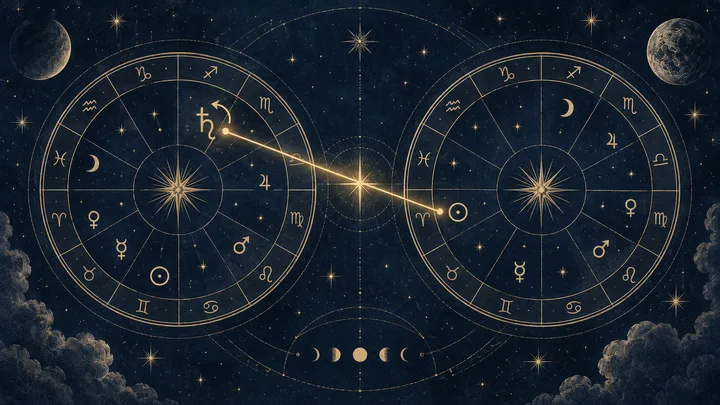
A small R beside a planet can change the mood of a synastry reading before the reading has even begun. People see retrograde and hear delay, reversal, trouble, or a warning to keep their distance. That leap is understandable. Retrograde motion looks like a planet has turned around. Relationship astrology already carries high stakes, so a symbol that appears to move backward can feel like a message about going nowhere.
But the stronger reading is quieter. A retrograde condition tells you that the planet's function may develop inwardly, privately, or through an unusual route. It doesn't tell you that the relationship is bad. It tells you to ask how the person reaches that function before it becomes visible to the other person. In a contact, the question becomes even more specific: how does one person's style of processing meet the other person's planet?
That distinction matters because synastry is not a pass-or-fail chart. It compares the relationship between two natal charts. The planet person and the contacted-planet person each bring a complete life pattern to the meeting. One notation cannot cancel the rest. A close Venus-Mars conjunction remains a Venus-Mars conjunction if one planet is retrograde. The retrograde layer can change the timing, privacy, or direction of the exchange, but it does not erase the planet's basic language.
Here is the position this guide will defend: read a retrograde planet as a modifier of expression, not as a relationship warning. Give the greatest weight to a close major aspect involving a personal planet. Then read the signs. Then ask what the retrograde condition adds. Finally, compare the interpretation with repeated behavior. If the chart suggests careful emotional processing and the person consistently returns to difficult conversations, that is a different lived expression from avoidance. The symbol opens the question. It doesn't answer it for you.
This approach also keeps the two people visible. The person whose planet is retrograde may experience the contact as an inner process becoming visible through the partner. The other person may experience the same contact as a change in pace, tone, or availability. Neither experience is the whole truth. A good synastry reading moves between them. It asks what the contact awakens in each person, what each person expects in response, and where the expectations do not match.
A retrograde planet in a synastry contact does not automatically warn you away from a relationship. Read the contact first as an interaction between two natal planets, then use the retrograde condition to describe the style, pace, and inward route through which the planet works. A retrograde Mercury may take time to sort words before speaking. A retrograde Venus may hold private or carefully tested values. A retrograde Mars may act indirectly, then with great force once desire becomes clear. Those are interpretive possibilities, not verdicts. Start with the planet, sign, aspect, and orb. Add the retrograde layer only after you know what is being contacted, and test the reading against the rest of the chart and the relationship you can actually observe.
Sources: Retrograde Motion - Astrodienst Astrowiki; Retrogrades in Natal Chart - Cafe Astrology; What's Your Sign? An Intro to Synastry Charts and Astrological Compatibility - Astrology.com; Synastry - Cafe Astrology
What retrograde means before synastry enters
Retrograde is an apparent change in a planet's direction as seen from Earth. In a natal chart, astrologers treat the condition symbolically. The planet's function may turn inward, operate on a personal timetable, or resist the most obvious way of expressing itself. Astrodienst describes retrograde planets as carrying an inward-directed force and emphasizes that the planet needs to be read within the whole chart. Cafe Astrology likewise frames natal retrogrades as energies that can be felt strongly while remaining private or undercover.
This is not the same as saying the planet is missing. A retrograde Mercury still thinks, speaks, listens, and makes connections. A retrograde Venus still loves, values, enjoys, and seeks harmony. A retrograde Mars still wants, pursues, protects, competes, and asserts. The route can be less direct. The person may need more time to recognize the impulse, or may express it in a form that does not match the expected script.
The natal condition belongs to the person whose chart contains it. That person carries the retrograde planet into every relationship, not just this one. Synastry shows where the other chart touches it. This prevents a common mistake: treating the other person as the cause of the retrograde behavior. A partner can activate a planet. A partner did not create its natal motion.
There is also room for different schools of astrology. Astrodienst notes that astrologers do not share one fixed doctrine for reading retrograde planets in every chart, house, or aspect. That is not a reason to abandon the symbol. It is a reason to state your method. In this guide, retrograde means inward, less automatic, and potentially more reflective or indirect. The exact meaning still depends on the planet, sign, aspect, strength, and context.
Notice what this definition does not say. It does not say that direct planets are healthy and retrograde planets are damaged. It does not say that every retrograde person must repeat an old story. It does say that the usual social script may not fit neatly. A Venus person may need privacy before display. A Mars person may need reflection before action. If you read the condition this way, you can honor its particularity without making it a defect.
Sources: Retrograde Motion - Astrodienst Astrowiki; Retrogrades in Natal Chart - Cafe Astrology; Personal Portrait FAQ - Astrodienst
Degrees and orbs decide whether the contact speaks loudly
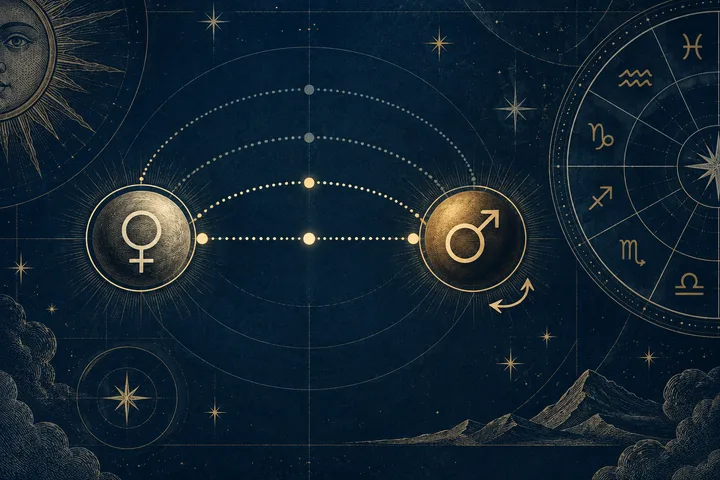
A retrograde planet matters in synastry only when it actually contacts the other chart in a meaningful way. A shared sign is a starting point. It is not automatically a conjunction. Degrees tell you how close the planets are, and the orb is the allowed distance from the exact aspect. The tighter the orb, the more concentrated the contact tends to feel.
For this publication's synastry reading, use a six-degree orb for selected major aspects. A contact at zero or one degree deserves immediate attention. Two or three degrees remains strong. Four to six degrees can describe a real pattern, but you should look for support elsewhere in the chart. A contact outside that range may be a sign-based theme or a loose background resemblance, not a lead interpretation.
Astrodienst explains that orbs vary by aspect, planet, and school, and its partner-chart guidance uses reduced orbs for synastry compared with a single natal chart. Astrology.com also tells readers to pay close attention to degrees and treats six degrees or less as a preferred working range in its synastry introduction. The practical lesson is simple: write down the exact positions before you decide how much weight the retrograde symbol deserves.
Consider an example. One person's retrograde Mercury is at 12 degrees Taurus. The other person's Venus is at 14 degrees Taurus. This is a two-degree conjunction. Start with Mercury-Venus: words meet affection, taste, and the wish to be understood. Add retrograde Mercury: the Mercury person may revise, pause, or communicate affection through carefully chosen language rather than instant disclosure. Now compare it with a retrograde Mercury at 12 Taurus and Venus at 24 Taurus. Both are in Taurus, but the twelve-degree distance does not meet the six-degree rule. You can discuss shared sign tone if useful. You should not present it as the same active conjunction.
If one birth time or degree is unknown, lower the claim rather than abandoning the comparison. You might know that two planets share a sign, but not whether they form a close conjunction. Say that the sign supplies a common tone and that the exact contact remains unconfirmed. This is especially important with fast-moving personal planets. A small change in degree can move a contact from exact to absent. Precision makes the reading more trustworthy and more useful.
Sources: What's Your Sign? An Intro to Synastry Charts and Astrological Compatibility - Astrology.com; Aspect - Astrodienst Astrowiki; Orb - Astrodienst Astrowiki
Retrograde Mercury in synastry: revise the story, not the bond
Mercury retrograde is often given the quickest warning label because Mercury governs speech, messages, decisions, and everyday coordination. In a natal chart, Cafe Astrology describes retrograde Mercury as taking in information differently, with more thinking, checking, and reviewing before communication. That description gives you a much better starting point than 'this person will lie' or 'you will never understand each other.'
In synastry, look at what the other person's planet asks Mercury to do. Mercury-Venus contacts bring language into the field of affection. The two people may bond through humor, notes, shared tastes, or the small phrases that make a relationship feel intimate. With Mercury retrograde, the Mercury person may need to test whether a feeling is safe before naming it. The Venus person may experience this as thoughtfulness, hesitation, or occasional silence. The chart does not select one word for you. The relationship shows which one repeats.
Mercury-Moon contacts bring thought into emotional life. A retrograde Mercury person may listen for a long time, remember details, or return later with a clearer account of what they felt. The Moon person may want an immediate emotional response. Their work is not to force the Mercury person to speak on demand, nor to let the Mercury person make every hard conversation wait forever. They need a shared timing rule: pause when needed, then return at an agreed time.
Mercury-Mars contacts sharpen speech. A retrograde Mercury can make anger come out late, after the conversation seems finished, or through a carefully built argument. That can be constructive when it produces precision. It can also become a habit of storing grievances. So the useful question is behavioral: does the person revisit a conversation to repair and clarify, or to reopen the fight without listening? Retrograde Mercury can describe either a thoughtful second pass or an unhelpful loop. The aspect supplies the heat. Practice determines the form.
The sign of Mercury tells you what the review is trying to protect. Earth signs may check facts and consequences. Water signs may sort emotional meaning. Air signs may compare ideas and wording. Fire signs may return to the question of honesty, courage, or directness. These are broad tendencies, not fixed roles. Let the sign sharpen the question, then let the actual exchange answer it. A delayed reply can mean thoughtfulness. It can also mean a person has chosen not to engage. The chart cannot make that choice for them.
Sources: Retrogrades in Natal Chart - Cafe Astrology; Synastry - Cafe Astrology
Retrograde Venus: private values meet another person's desire
Venus retrograde has an especially strong reputation for relationship anxiety. That reputation usually comes from confusing private feeling with absent feeling. Cafe Astrology describes natal Venus retrograde as deep, serious, and sometimes awkward around social performance, while also noting that love can matter enormously even when the person does not state that depth plainly. Read that as an inward value system first.
When retrograde Venus contacts another person's Moon, the relationship can bring affection into a private room. The Moon person may want warmth that is immediate and visible. The Venus person may show love through loyalty, selective attention, practical beauty, or a refusal to treat intimacy casually. The contact can feel gentle and familiar, but the couple may still need to translate how each person recognizes care.
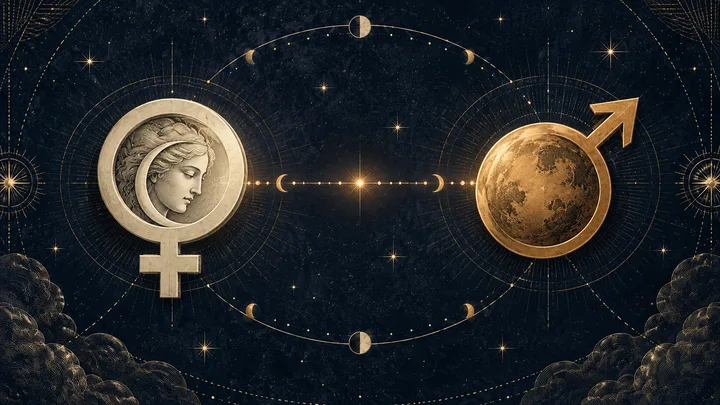
When retrograde Venus contacts Mars, attraction gains a question of timing. Venus receives, appreciates, and values. Mars moves, pursues, and initiates. A close conjunction can create strong chemistry, yet the Venus person may not respond according to a simple chase-and-answer script. They may need desire to feel meaningful before they make it public. The Mars person might read that as mixed signals. A better reading asks whether the two can name pace, consent, and preference without turning difference into rejection.
When retrograde Venus contacts Saturn, the private nature of Venus meets Saturn's seriousness. This can support loyalty and careful commitment. It can also make affection feel measured if both people wait for proof before offering warmth. The contact is not a promise of permanence. It is a study in value and time. Watch whether the bond grows through honest investment or shrinks under tests that no one has agreed to take.
The strongest exception is a retrograde Venus tightly joined to a partner's Neptune or Pluto while the rest of the chart offers little grounding. The private, ideal, or intense quality may become hard to name. That still is not a warning by itself. It means you should give clarity more weight: say what you value, ask what is real, and notice whether actions match the feeling.
The Venus person is not the only one doing the adapting. The partner's planet also receives Venus. A Moon person may feel cherished but may not know when the Venus person needs reassurance. A Mars person may feel desired but may not know whether pursuit is welcome today. Shared language turns a symbolic difference into intimacy. Ask, 'What helps you feel chosen?' and 'How do you show interest when you are still deciding what you feel?' Those questions are better than asking whether Venus retrograde is good or bad.
Sources: Retrogrades in Natal Chart - Cafe Astrology; Synastry - Cafe Astrology
Retrograde Mars: indirect does not mean weak
Mars retrograde is often treated as a sign of blocked desire or suppressed anger. Sometimes a natal reading does show difficulty with direct assertion. Cafe Astrology describes possible roundabout pursuit, bursts of anger, unusual timing, and a desire nature that others can misunderstand. But the same description leaves room for creative, effective physical expression. Mars has not disappeared. It has changed its route.
In synastry, a retrograde Mars contact asks how one person acts when the other person's planet turns on desire. Retrograde Mars to Venus may bring attraction that gathers slowly, privately, or through repeated acts instead of dramatic pursuit. The Venus person may sense heat before the Mars person admits it. That can feel magnetic. It can also feel confusing if neither person states what they want.
Retrograde Mars to the Moon brings action into emotional territory. The Mars person may protect, provoke, or react after a delay. The Moon person can feel energized and unsettled at once. A good reading keeps both possibilities visible. The contact can help the couple move from feeling to action, especially when they share a home task or a goal. It can also turn hurt into stored resentment if the Mars person waits until the pressure breaks.
Retrograde Mars to Saturn asks for a clear account of effort. Saturn may slow Mars, while Mars may push against Saturn's limits. If Mars is retrograde, the frustration may build internally before it is expressed. The constructive form is patient skill, pacing, and a shared plan. The difficult form is passive resistance followed by an explosion. That difference matters more than the letter R.
A useful decision guide is to ask three questions after a charged moment. What did the Mars person want? When did they know it? How did they ask for it? If the answers become clearer over time, retrograde Mars may be helping the person develop a more conscious will. If the answers remain hidden while the other person is expected to guess, the issue is not astrology's warning. It is a communication pattern the couple can see and address.
Mars also needs a body-level reading. Notice how the person handles pace, touch, work, interruption, and recovery after conflict. A retrograde Mars may prefer to act when the conditions feel right rather than perform desire on command. That can support patience and craft. It may frustrate a partner who reads visible initiative as proof of interest. State the difference plainly. Desire does not become safer because astrology names it, but it can become clearer when both people stop asking the other to decode silence.
Sources: Retrogrades in Natal Chart - Cafe Astrology; Synastry - Cafe Astrology
Outer-planet retrogrades need a different scale
Jupiter, Saturn, Uranus, Neptune, and Pluto spend long periods retrograde. Many people born in a broad period will share one or more of these conditions. That makes an outer-planet retrograde less personal by itself than a close, exact contact to someone's Moon, Venus, Mars, Mercury, Sun, or angle. Do not give a generational marker the same weight as a tight personal-planet interaspect.
Retrograde Jupiter contacting a partner's personal planet can turn growth, belief, and confidence inward before it becomes encouragement. The Jupiter person may help through reflection, study, or a quietly different philosophy. Retrograde Saturn can internalize rules, responsibility, and fear of failure. In contact with a partner's Moon, it may look like steady containment or like guarded emotion. The surrounding chart decides which expression leads.
Retrograde Uranus can make independence and change deeply personal. Contact with Venus may describe an unusual value system or a need for freedom inside affection. Contact with Mercury can produce original thought and a different pace of explanation. Retrograde Neptune can internalize spiritual feeling, longing, or vulnerability. Contact with Venus or the Moon can feel tender and visionary, but it needs clear language when assumptions begin filling the gaps.
Retrograde Pluto can turn questions of trust, control, depth, and surrender inward. A close Pluto contact may feel powerful whether Pluto is direct or retrograde. The retrograde layer can make the Pluto person less open about the intensity they carry. That may support careful self-knowledge, or it may hide fear until it becomes controlling behavior. No outer-planet symbol gives permission to excuse coercion, secrecy, or disrespect.
This is where ranking protects the reading. First, ask whether the outer planet makes a close contact. Second, ask whether it touches a personal planet or angle. Third, read the aspect and sign. Only then add retrograde. If the contact is wide and the planet is shared by a whole age group, let it remain background context.
A shared outer-planet retrograde can still matter when it becomes personal through a tight interaspect. The distinction is between background and activation. Many people may share retrograde Pluto in a sign. Fewer will have that Pluto closely contacting a partner's Venus or Moon. Even then, read the contact in layers. Pluto does not become a relationship sentence, and retrograde does not automatically make it darker. The question is how depth, privacy, and power are handled between these two people.
Sources: Retrograde Motion - Astrodienst Astrowiki; Retrogrades in Natal Chart - Cafe Astrology; Synastry - Cafe Astrology
A worked example: retrograde Venus square direct Mars
Imagine Maria has Venus retrograde at 18 degrees Leo. Daniel has Mars direct at 21 degrees Taurus. The three-degree difference forms a square by sign and degree. We have enough information for a focused example, but not a complete chart. We do not know houses, the Moon, the angles, or the rest of either person's aspects. So we will read this contact, not invent a whole relationship around it.
Start with the aspect. The square creates friction that needs translation. Venus in Leo values warmth, visible appreciation, loyalty, and creative pleasure. Mars in Taurus moves steadily, seeks physical certainty, and prefers a pace it can trust. Venus wants a clear sign of affection. Mars may offer presence, touch, persistence, or practical effort. They can want each other and still fail to recognize the other's signal.
Now add Venus retrograde. Maria may take affection seriously and hesitate before displaying what she feels. She may ask herself whether admiration is sincere, whether the connection has value, or whether she can be loved without performing for it. That is one possible inward route. It is not a claim that Maria is insecure, nor a promise that she will hide her feelings. The rest of her chart and her actual choices matter.
What does Daniel experience? He meets a Venus that may not respond at the speed his Mars expects. His steady pursuit could feel reassuring to her, or it could feel stubborn if he mistakes patience for permission to keep pushing. Her need for clear appreciation could delight him, or it could feel demanding if he expresses care through practical acts and assumes those acts speak for themselves.
The ranking is now clear. The strongest theme is attraction with different languages and pacing. The retrograde layer adds privacy and self-review to the Venus side. The Leo-Taurus square asks them to bridge visible affection and dependable embodiment. The decision is practical: can Maria state what makes affection feel real, and can Daniel hear a boundary without treating it as a challenge? If yes, the contact becomes a practice in translation. If no, the square will keep repeating its question.
Notice how little this example needed. It did not need a dramatic claim about fate. It did not need an invented house overlay or a compatibility score. The degrees established the square. The planets established the subject. The signs supplied the style. Retrograde added a possible inward pace. The next step came from the friction itself. That is the method you can carry to any supplied placement, even when the rest of the chart is not available.
Now imagine the same Venus and Mars with the motion labels removed. You would still read a Leo Venus square Taurus Mars as a meeting between expressive affection and steady, embodied desire. Adding the retrograde label should make that reading finer, not replace it. Maria may need to privately establish what affection means before she displays it. Daniel may need direct information about what pace feels welcome. The symbol explains why the first response may not be the final response, while the square explains why their styles keep meeting at an angle.
The example also shows why the planet person and the contacted person should not be assigned fixed roles such as pursuer and pursued. A retrograde Venus can initiate through an invitation, a creative offering, or a clear statement of value. A direct Mars can hesitate when it senses uncertainty. Synastry is relational. The role can change from one moment to the next, and the same contact can feel different when one person is tired, vulnerable, excited, or under pressure. Read tendencies. Leave room for choice.
If the report contains several contacts, use this example as a model for ranking them. A two-degree retrograde Venus square Mars may deserve more attention than a seven-degree conjunction involving a generational planet. A close Moon contact may explain the daily feeling of the bond more directly than a loose outer-planet aspect. One contact may describe attraction. Another may describe the work required to sustain trust. The reader needs that order. A pile of equal-sounding interpretations creates fear because it makes every possibility feel inevitable.
How to separate a chart symbol from a relationship warning
A relationship warning is about conduct. A retrograde planet is a chart condition. Keep those categories separate. A chart may describe someone who processes anger inwardly. It does not excuse intimidation. A chart may describe private values. It does not prove deception. A chart may show intense attraction. It does not establish consent, reliability, or readiness for commitment.
Use the chart to choose better questions. If Mercury is retrograde in a close contact, ask how each person handles pauses, corrections, and unfinished conversations. If Venus is retrograde, ask how each person gives reassurance and what makes affection feel safe. If Mars is retrograde, ask how desire, refusal, frustration, and initiative are spoken. If Saturn or Pluto is involved, ask how responsibility, power, and limits are shared.
Then observe the answers over time. Does the person return after asking for space? Do they explain a changed view without rewriting what happened? Can they hear no? Do they keep promises when no one is watching? These are not replacements for astrology. They are the lived ground where an astrological pattern takes form. A reading becomes useful when it helps you notice the pattern without turning the pattern into a sentence.
The strongest counterargument says that retrogrades can be difficult, and ignoring that difficulty makes a reading soft. That objection is right about one thing. Retrograde symbolism can describe delay, inhibition, reversal, or an awkward first expression. The mistake is turning difficulty into doom. A planet that must be consciously developed can become a source of skill. A person who learns to revisit words may become precise. A person who learns to name desire may become honest. The chart's tension is real. So is the possibility of mastery.
If a contact feels painful, read the chart and the behavior together. Do not use the chart to talk yourself out of what you know. Do not use one symbol to decide what you have not yet learned.
This also prevents a subtle form of fatalism. You may recognize a repeating pattern and assume recognition means permanence. It doesn't. A synastry contact can describe why an exchange feels familiar, charged, or difficult to ignore. It cannot require you to remain inside the exchange. Use astrology for awareness, language, and timing. Use your judgment for the choices that follow.
Sources: Retrograde Motion - Astrodienst Astrowiki; Retrogrades in Natal Chart - Cafe Astrology; Personal Portrait FAQ - Astrodienst
A repeatable reading sequence for your own report
You can read a retrograde synastry contact without drowning in meanings. Write the information down in a fixed order. Begin with the actual placements supplied for both people. Record the planet, sign, degree if known, and retrograde status. If a degree is missing, mark the contact as uncertain rather than filling the gap with an estimate.
Next, identify the aspect and calculate the distance. For this report's selected major contacts, use a six-degree orb. Note whether the contact is a conjunction, opposition, square, trine, or sextile. A sign-based resemblance can enrich the reading, but it should not be described as an exact degree-based aspect when the numbers do not support that claim.
Third, describe the planet pair in plain language. Put the interaction in a sentence you could say aloud. 'Mercury meets Venus, so words touch affection.' 'Mars meets the Moon, so action touches emotional safety.' If you cannot state the pair simply, you probably started too far down the symbolism tree.
Fourth, read the sign difference. Ask how each planet wants to operate. Fire, earth, air, and water are useful broad layers, but the actual signs carry more detail. Notice whether the signs share an element, modality, or practical aim. Name both the ease and the mismatch.
Fifth, add retrograde as a modifier. Use words such as inward, private, reflective, delayed, indirect, revised, or self-directed only when they fit the planet and aspect. Avoid stacking them into a dramatic paragraph. One accurate modifier is better than five ominous ones.
Sixth, rank the interpretation. State the main dynamic, the likely friction, and the constructive practice. Then name the exception. A retrograde Venus may need time, but a tight Venus-Mars contact can still be openly passionate. A retrograde Mercury may review words, but a strong Mercury-Mars contact may still argue quickly. The exception keeps the reading honest.
Finally, turn the reading into one observable next step. Ask a question. Set a return time after a pause. Name the reassurance you need. Say what pace feels mutual. Astrology should leave you with better attention, not more fear.
When you compare a report with your own experience, keep a short note for several weeks. Record the contact, the situation that activated it, the first reaction, and what happened after the two of you spoke. This is not a scorecard. It is a way to distinguish a single mood from a pattern. It also gives you language for a follow-up reading. You may discover that the retrograde planet is less about withholding than about needing a different doorway into the same human need.
If both degrees are supplied, keep the calculation modest and transparent. A two-degree square is not the same as a six-degree square. A sign connection without a confirmed degree is not the same as a calculated conjunction. You can still read the signs and compare the planet roles, but you should label the strength of the claim. This protects the reader from a familiar trap in compatibility work: a long list of possible contacts that gives every symbol equal authority.
You can use the sequence with Moon, Venus, and Mars placements even when you do not have a full birth chart. Compare Moon with Moon, Venus, and Mars for emotional rhythm and response. Compare Venus with Moon, Venus, and Mars for affection and value. Compare Mars with Moon, Venus, and Mars for desire, initiative, and friction. If degrees are available, check the major aspects within the stated orb. If degrees are missing, keep the reading at the sign and planet level. The report can offer a clear map of the supplied placements. It does not need to pretend to know houses or unseen positions.
The final test is whether the interpretation makes you more exact. After reading it, can you name the moment when one person goes quiet, pushes forward, changes pace, or asks for more reassurance? Can you describe what would help? Can you tell the difference between a needed pause and a refusal to return? If the answer is yes, the retrograde contact has done its work. It has turned a frightening label into a usable question.
Then make one decision. Continue the conversation with a clearer request, give the pattern more time to reveal itself, or step back because the conduct is not safe or mutual. Astrology can illuminate the timing and meaning of a contact. It cannot ask you to ignore your own limits. The best reading leaves both the sky and the person intact.
If you are comparing placements with a partner, share the method before sharing the conclusion. Agree on the orb. Mark which degrees are known and which are missing. Read the contact in both directions. Ask what each person recognizes, what each person misreads, and what each person can practice. That small pause changes the tone of the whole comparison. You are no longer searching for a verdict hidden in the retrograde mark. You are learning how two symbolic languages meet, where they differ, and whether the people speaking them can keep listening.
Sources: What's Your Sign? An Intro to Synastry Charts and Astrological Compatibility - Astrology.com; Aspect - Astrodienst Astrowiki; Orb - Astrodienst Astrowiki
A little more clarity
Does a retrograde planet in synastry mean the relationship will fail?
No. A natal retrograde planet modifies how its function is processed and expressed; it does not predict relationship failure. Read the planet pair, aspect, sign, and orb first. Then ask whether the inward or indirect style can be understood and handled well in real life. A close contact may describe strong attraction, careful timing, private feeling, or recurring translation work. The chart shows the pattern. Your shared choices show how the pattern lives.
Sources & further reading
- Retrograde Motion - Astrodienst Astrowiki
Supports reading retrograde planets as inward-directed forces whose meaning depends on the whole chart.
- Retrogrades in Natal Chart - Cafe Astrology
Supports planet-specific natal retrograde interpretations for Mercury, Venus, Mars, and outer planets.
- Personal Portrait FAQ - Astrodienst
Supports the point that astrologers use different rules for retrograde interpretation and chart technique.
- What's Your Sign? An Intro to Synastry Charts and Astrological Compatibility - Astrology.com
Supports comparing natal charts, reading planet meanings, and using degrees and a preferred six-degree synastry range.
- Synastry - Cafe Astrology
Supports reading planets, interaspects, conjunctions, oppositions, squares, trines, sextiles, Venus, Mars, and Saturn in synastry.
- Aspect - Astrodienst Astrowiki
Supports definitions of major aspects and the role of angular relationships between chart factors.
- Orb - Astrodienst Astrowiki
Supports defining orb, explaining variation by aspect and planet, and distinguishing close from loose contacts.
Synastry Comparison Report
Enter known placements for two people. Get an input-by-input comparison, selected aspect calculations and a clear record of what remains uncertain.
Compare our placements