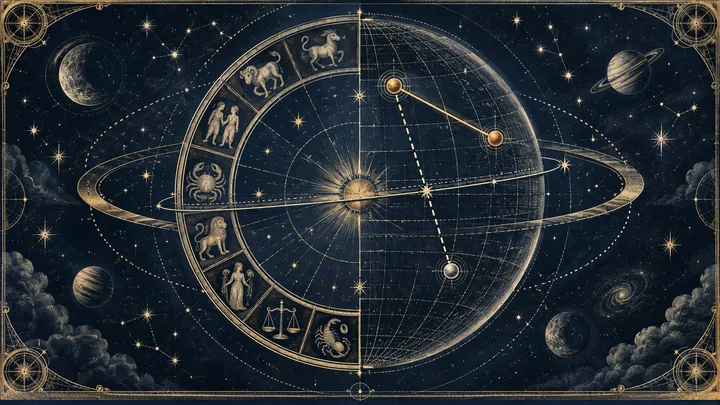
Parallel and contraparallel contacts can sharpen a zodiac-degree synastry reading, but they shouldn't replace it. A parallel links two planets at nearly the same declination, on the same side of the celestial equator. Astrologers commonly read it like a conjunction: the two planetary functions blend and show up easily between you. A contraparallel links planets at similar declination on opposite sides of the equator. It's commonly read like an opposition: the connection is strong, but it pulls across a line. Start with the closest longitude aspects between the supplied planets. Then check declination with a tight, stated orb, usually one degree. Use the parallel or contraparallel to confirm the theme, reveal a hidden contact, or explain why an otherwise modest aspect feels louder. Let the whole pattern decide.
The second map behind the zodiac wheel
A zodiac-degree synastry reading compares planetary longitude. You look at where each planet falls around the zodiac, measure the shortest distance between the two positions, and name the relationship: conjunction, sextile, square, trine, opposition, or another aspect. That map tells you how the planets meet along the ecliptic, the zodiac's working circle.
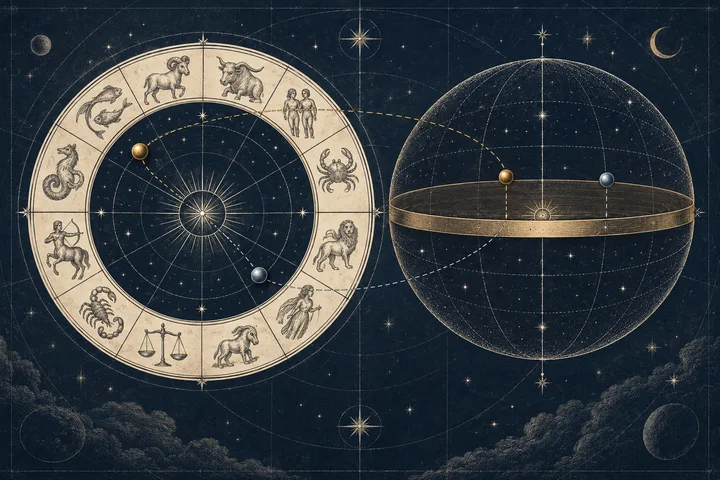
Declination asks a different question. How far north or south of the celestial equator is each body? The answer is written in degrees and minutes, with N for north and S for south. Two planets may be far apart by zodiac longitude yet close in declination. They may also sit in a familiar zodiac aspect while their declinations add another bond. The two measurements don't cancel each other out. They describe different directions of contact.
This distinction matters because a wheel can make a relationship look quiet when the declination table shows a close parallel. It can also make a dramatic longitude aspect more specific. A Venus-Mars square tells you that attraction and desire may meet through friction, timing problems, or different styles of pursuit. If Venus and Mars are also parallel, that friction may carry a natural pull underneath it. The square still speaks. The parallel gives it a second voice.
The distinction is simple once you see the two signs attached to the numbers. +14 degrees 09 minutes and +14 degrees 04 minutes form a parallel. +14 degrees 09 minutes and -14 degrees 04 minutes form a contraparallel. The five-minute difference is comfortably inside a one-degree orb, the working convention used in the synastry guides cited below.
The word contact is useful here. A declination aspect isn't a new zodiac sign placement, and it doesn't erase the signs or houses in a full chart. It's a relationship between two positions measured against the celestial equator. Read it as an added layer of the same two planets.
Keep the units separate when you write the interpretation. A longitude difference is an angle around the zodiac, so 118 degrees can describe a trine with a two-degree orb. A declination difference is a distance from the equator, so 17N02 and 16N41 differ by only 21 minutes. The first tells you how the planets relate around the zodiac. The second tells you how closely they occupy the same north-south band. Neither number can be substituted for the other. If a report places them in one table, label the columns clearly. The reader should be able to retrace the classification without guessing which distance you measured.
That gives you the central answer to the question. Yes, parallels and contraparallels supplement a zodiac-degree reading. They supplement it because they can show a bond the longitude map misses, or tell you which part of a visible aspect has the most force. They don't supplement it by becoming a shortcut around planetary meaning, sign condition, or the rest of the synastry pattern.
Longitude and declination also move through the chart in different-looking patterns. Longitude follows the zodiac signs and their degrees. Declination follows the body's distance north or south from the celestial equator. Because those paths aren't the same line, a pair can be close in one measure and widely separated in the other. That isn't an error in the chart. It's the reason the second map can add information.
This helps explain why the word hidden can be tempting but incomplete. A declination contact isn't secretly a zodiac conjunction waiting to be discovered. It is visible in a different table. The planets haven't changed signs. Their relationship has been measured from another reference plane. Use the extra layer to make the reading more exact, not more mysterious than the input supports.
To assess an actual parallel or contraparallel, you need a declination value for both planets. If you only know Moon, Venus, and Mars signs, begin with sign-pair reading, but don't label a declination contact exact. Precision starts with the input.
Sources: Declination Dynamics - NCGR Geocosmic Journal; Declinations in Synastry: The Astrology of Relationships - Cafe Astrology; Determining Parallels and Contra-Parallels in Synastry - Cafe Astrology
What a parallel and a contraparallel actually measure
Picture the celestial equator as the middle line. Declination measures a planet's angular distance from that line. North declination sits above it. South declination sits below it. The number tells you how far away the body is. The letter tells you which side it occupies.
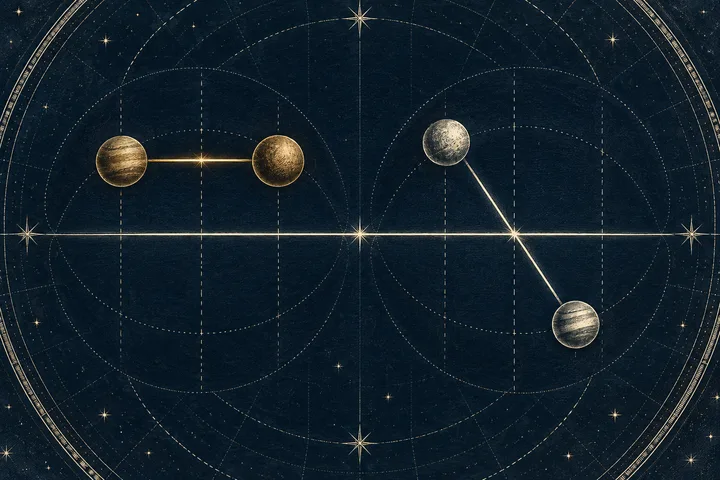
A parallel forms when two bodies are close in number and share the same side. Venus at 12N18 and Mars at 12N52 are parallel by a one-degree working orb. Venus at 9S40 and Mars at 10S11 are parallel too. North parallels and south parallels belong to the same family. What matters is shared side and close distance.
A contraparallel forms when the numbers are close but the sides differ. Venus at 12N18 and Mars at 12S52 are contraparallel. The mirrored distance creates a polarity across the equator. Many astrologers read that as an opposition-like contact. It can show attraction with a push-pull rhythm, a clear awareness of the other person, or a recurring need to balance two valid but different drives.
The geometry gives the symbolism its shape. A parallel brings two functions into the same declination territory. The planets can act together, even when the zodiac wheel doesn't place them in a major aspect. A contraparallel places them across a divide. The planets face each other through a line of tension, much as an opposition asks one person or one chart to hold two ends of a relationship.
The north or south label deserves attention too, although it doesn't create a separate meaning by itself. Two north planets form a north parallel. Two south planets form a south parallel. Both describe shared declination direction. A reader may notice a different tone when the planets are close to the celestial equator or farther from it, but the first classification remains the same: same side and same distance for a parallel, opposite sides and matching distance for a contraparallel.
Use degrees and minutes carefully. A value such as 14N20 means fourteen degrees and twenty minutes north, not fourteen point twenty degrees. A one-degree orb equals sixty minutes. So 14N20 compared with 15N05 differs by forty-five minutes and qualifies under that orb. 14N20 compared with 15N30 differs by seventy minutes and falls outside it. This small arithmetic check prevents a surprisingly large interpretive mistake.
This is why the traditional shorthand helps, as long as you don't treat it as a complete interpretation. Parallel is conjunction-like. Contraparallel is opposition-like. It tells you how to begin reading the contact. It doesn't tell you whether the planets are benefic or difficult in every context, who initiates, which person feels exposed, or how the contact behaves in daily life. Planetary roles still matter.
A Moon parallel Venus, for example, joins feeling, comfort, affection, and receptivity. The Venus person may offer a style of love the Moon person finds soothing. The Moon person may make Venus feel wanted without needing a formal performance. A Moon contraparallel Mars carries a different charge. It may create emotional heat and quick response. It can also turn irritation into chemistry, especially when both people learn what the other is defending.
The same geometry changes with the planets involved. Mercury parallel Saturn can make conversation focused, structured, and durable. It can also make one person's words feel judged if the wider chart repeats that weight. Sun contraparallel Pluto may bring an intense encounter with power, pride, visibility, or transformation. It deserves care, not a dramatic verdict. The declination form tells you that the contact is strong and polarized. The planets tell you what is being polarized.
Don't confuse a contraparallel with an antiscion. Both techniques can reveal a relationship a basic wheel doesn't foreground, but they use different coordinates. An antiscion reflects zodiac longitude across the solstice axis. A contraparallel compares declination across the celestial equator. If both appear, note both. Don't fold them into one aspect or assume one calculation proves the other.
Sources: Declination Dynamics - NCGR Geocosmic Journal; Declinations in Synastry: The Astrology of Relationships - Cafe Astrology; Determining Parallels and Contra-Parallels in Synastry - Cafe Astrology
How the declination layer changes a longitude aspect
The most useful way to add declination is not to scan every line for a new story. Start with the longitude aspect that already matters. Then ask what the declination contact does to it. Does it reinforce the same theme? Does it add a missing kind of contact? Does it complicate an easy reading? Those are three different jobs.
First, reinforcement. Suppose one person's Moon is at 18 degrees Taurus and the other person's Venus is at 20 degrees Capricorn. The signs form a trine by zodiac longitude, with a two-degree separation. If the Moon and Venus are also parallel within one degree, the emotional and affectionate flow gets an extra channel. You might read the trine as ease and the parallel as a more immediate, instinctive pull. The relationship doesn't need to work hard to notice tenderness. It may need to work harder to keep tenderness from becoming assumed.
Second, a hidden contact. Imagine one person's Venus at 7 degrees Gemini and the other person's Mars at 25 degrees Scorpio. Those signs don't form a major traditional aspect by close zodiac distance. Yet their declinations come in at 16N10 and 16N34. The parallel doesn't turn Gemini into Scorpio or invent a sextile. It tells you that Venus and Mars still meet through a conjunction-like declination link. This can explain why the chemistry feels more immediate than the wheel suggests.
Third, complication. Consider a Sun-Moon trine that looks deeply comfortable by longitude, but the same pair is contraparallel. The trine offers recognition and a shared rhythm. The contraparallel introduces a line of difference. One person may feel emotionally held while also feeling that the other person sees life from an opposite angle. Both descriptions can be true. The second layer stops the trine from becoming a promise of effortless understanding.
The reverse can happen too. A longitude opposition may look stark, while a parallel adds a thread of shared purpose. You don't cancel the opposition. You ask where the two people naturally cooperate inside the tension. A Venus-Saturn opposition with a parallel may still bring fear of rejection, rules, or timing. But it may also show a real ability to build affection through loyalty and consistency. The parallel gives the opposition a place to work from.
Cafe Astrology's synastry guide makes this same practical point: parallels are likened to conjunctions, contraparallels to oppositions, and a parallel alongside a zodiac aspect can reinforce that aspect. That is a good working rule because it respects both maps. The visible longitude contact supplies the main sentence. Declination can bold a word, add a clause, or introduce a counterpoint.
Here is a compact comparison you can use while reading. A longitude conjunction says the planets occupy nearby zodiac territory. A parallel says they share a north-south distance. If both occur, the contact is doubled in two coordinate systems. A longitude opposition says the planets face across the zodiac. A contraparallel says they face across the celestial equator. If both occur, the polarity has two matching descriptions. When only declination connects them, call it a declination contact, not a hidden conjunction or hidden opposition that replaces the chart.
The contrast is clearest when the sign relationship and declination relationship disagree in tone. Two planets may be in an earth-sign trine by longitude, suggesting practical ease, while their contraparallel brings a sharper awareness of difference. Or they may sit in a tense square while sharing a parallel, giving the square a current of recognition and cooperation. The correct reading isn't to choose one map and discard the other. It is to describe the way the two layers interact.
This is also where a sign-pair guide stops being enough. Signs tell you the style in which a planet acts. Longitude tells you the angular relationship. Declination tells you whether the bodies share or oppose a north-south position. A useful synastry sentence keeps all three in view: your Libra Moon meets my Aquarius Moon through an airy trine, but the contraparallel makes the emotional exchange more reactive than the trine alone would suggest. That sentence gives the reader something to recognize.
The strongest interpretation usually comes from agreement. If the sign meanings, longitude aspect, declination form, and planet roles point in the same direction, rank the contact high. If they disagree, keep the disagreement. It may be the most revealing part of the reading. A clean contradiction deserves more attention than a pile of loose confirmations.
A useful test is to write the two measurements as separate sentences before combining them. For example: Venus and Mars are 118 degrees apart, so their fire-sign trine is close by the six-degree rule. Their declinations differ by 5 degrees 53 minutes and cross from north to south, so they do not form a one-degree contraparallel. That pair has a clear longitude story and no declination story. By contrast, Venus at 17N02 and another planet at 16N41 has a 21-minute parallel whether the zodiac degrees form a major aspect or not. This split prevents a familiar sign pattern from creating a contact that the numbers don't support, and it keeps a real parallel visible when the wheel looks quiet.
Sources: Declinations in Synastry: The Astrology of Relationships - Cafe Astrology; Determining Parallels and Contra-Parallels in Synastry - Cafe Astrology
A worked example with Moon, Venus, and Mars
A useful example needs two layers and a decision. It also needs honest inputs. The following is an illustrative set of supplied placements, not a calculated personal chart. The point is to show a method you can repeat with your own declination table.
Imagine Maria has Moon at 11 degrees Libra, Venus at 3 degrees Leo, and Mars at 27 degrees Cancer. Her declinations are Moon 14N20, Venus 17N02, and Mars 23N11. Imagine Daniel has Moon at 13 degrees Aquarius, Venus at 9 degrees Virgo, and Mars at 1 degree Sagittarius. His declinations are Moon 14S48, Venus 16N41, and Mars 22S55. We will use a one-degree orb for declination contacts and read the supplied longitudes by their shortest zodiac distance.
Start with the longitude layer. Maria's Libra Moon at 11 degrees and Daniel's Aquarius Moon at 13 degrees are 122 degrees apart, which is a trine with a two-degree orb. That suggests a natural emotional language. They may give each other room, understand the need for perspective, and recover through conversation rather than pressure. This is a close aspect, so it belongs near the front of the pattern.
Now check declination. Maria's Moon at 14N20 and Daniel's Moon at 14S48 are not parallel. They are on opposite sides, but the numerical difference is 28 minutes, well inside one degree. That makes a Moon-Moon contraparallel. The emotional ease of the trine now has a polarity running through it. Maria may seek balance by naming the feeling. Daniel may step back to understand the larger principle. Each can recognize the other and still feel out of phase in the moment.
Next, compare Maria's Venus with Daniel's Mars. Maria's Venus at 3 degrees Leo and Daniel's Mars at 1 degree Sagittarius are 118 degrees apart, a fire-sign trine with a two-degree orb. Under the six-degree zodiac rule, this is a close major aspect. Their declinations, 17N02 and 22S55, are too far apart for a one-degree contraparallel, so the trine carries the pair without a second declination link. The numbers support attraction here, but they don't justify adding a parallel or contraparallel.
Maria's Venus and Daniel's Venus sit at 3 Leo and 9 Virgo. That's a one-sign step, not a major aspect by degree. Their declinations, 17N02 and 16N41, differ by 21 minutes and share the north side. This is a Venus-Venus parallel. It can make their tastes, manners of giving, and sense of pleasure easier to recognize in one another, even though the signs describe different styles. Maria may express love warmly and visibly. Daniel may show it through usefulness, detail, or improvement. The parallel links the affection; the signs show its accent.
Now place the contacts in rank. The Moon-Moon trine is first because a close longitude relationship and a contraparallel describe the same emotional bond while adding different tones. The Venus-Mars trine is second. Its two-degree orb makes it a real attraction contact even without a declination echo. The Venus-Venus parallel is third. It has no close major longitude aspect, so it supplements the pattern by describing shared taste and affection rather than carrying the reading. This ranking is different from a sign-only reading, which might have overlooked the exact strength of both trines.
What decision follows? Not whether Maria and Daniel are guaranteed to work. The chart can't make that decision for them. The useful question is where their attraction needs translation. The Moon pattern says they should name the difference between feeling understood and feeling emotionally synchronized. The Venus parallel says they already share a way of enjoying closeness. So their practical experiment is simple: when one person needs space, agree on how and when the conversation resumes. That gives the contraparallel a mature outlet instead of making it a silent test.
The example shows why a declination table works best after the first longitude pass. Without the trine, the Moon contraparallel might sound like pure tension. Without the contraparallel, the trine might sound smoother than the pair experiences. Together, they make a sharper statement: recognition is real, but it doesn't remove difference. That is a more useful reading than a score or a verdict.
Run the comparison in this order: list the supplied longitudes, measure the shortest distance, apply the chosen six-degree orb to selected major aspects, then compare declinations with the one-degree orb. Remember that the zodiac wraps from 29 degrees Pisces back to 0 degrees Aries. This keeps a close degree contact from getting buried under a long list of possibilities.
Then reverse the direction of the comparison. Maria's Moon to Daniel's Moon is the same pair as Daniel's Moon to Maria's Moon, but the person-to-person language changes. The Moon person receives and responds. In a Moon-Venus contact, the Moon person may experience safety while the Venus person expresses affection. In a Venus-Mars contact, Venus may set the style of attraction while Mars presses for movement. Declination does not remove this role distinction. It makes the link more noticeable.
You can also sort the example by experience instead of planet. If the couple reports ease with planning but quick emotional flare-ups, the Venus contacts may describe shared pleasure while the Moon contraparallel describes the flare-up. If they report intense attraction but little shared taste, don't force the Venus parallel to explain everything. A technique earns its place when it matches the question being asked. The chart should answer the lived pattern, not the other way around.
How to rank contacts without letting them take over
Declination contacts are easy to overuse because they can explain the feeling that a basic synastry wheel missed something. The answer isn't to ignore them. It's to rank them. A good hierarchy keeps a tight contact meaningful without allowing one line in a table to overrule the entire chart.
Rank one goes to a close personal-planet contact that repeats a clear longitude theme. Moon, Venus, Mars, Sun, and Mercury deserve the first pass because they describe the way two people feel, attract, act, speak, and recognize one another. A Venus-Mars parallel beside a close square is more important than a loose parallel between two outer planets. The personal planets meet in lived behavior.
Rank two goes to a tight declination contact that fills a genuine gap. If the Moon and Venus have no major longitude aspect but form a close parallel, the parallel may explain a quiet warmth that the wheel doesn't show. If a contraparallel appears between a personal planet and Saturn, ask whether the relationship carries a repeated tension around duty, timing, boundaries, or approval. The contact earns attention because it answers a question raised by the lived pattern.
Rank three goes to a contact repeated by several techniques. A close longitude conjunction plus a parallel is a strong concentration of the two planetary functions. A longitude opposition plus a contraparallel gives the polarity a second axis. A parallel that also ties into a larger cluster can become a central thread. Repetition is not permission to exaggerate. It is a reason to read the theme carefully and then test its expression against the signs.
Use orb as a gate, not as a score. The synastry guides cited here use one degree for parallels and contraparallels. This article's comparison scope uses a six-degree orb for selected major zodiac aspects and a one-degree orb for declination contacts. State your choice. Don't quietly widen it because a desired interpretation sits just outside the limit.
A four-minute parallel and a fifty-eight-minute parallel both qualify inside one degree, but they don't carry the same precision. The tighter contact gets priority. A one-degree orb isn't a promise that the aspect will dominate. It is one reason to include it. Planetary importance, repetition, and the rest of the pattern still matter.
Check the direction of the contact. A parallel usually gathers the planets toward cooperation or fusion. A contraparallel usually shows a stronger encounter with difference. But don't label one good and the other bad. A parallel can merge boundaries. A contraparallel can create the awareness that helps two people grow. The planet pair decides what kind of ease or friction is present.
Then check for contradiction. If the longitude aspect says attraction but the declination contact says restraint, keep both. Venus parallel Saturn may feel steady and serious, but the same pair can still carry fear of not being enough. Moon contraparallel Mars may spark desire and emotional courage, but it can also shorten the distance between feeling and reaction. The reading becomes trustworthy when it names the gift and the work in the same breath.
Finally, give the contact a behavioral translation. Don't stop at intense, magnetic, karmic, or powerful. Ask what happens at breakfast, during a delayed reply, after a disagreement, or when one person wants closeness and the other wants room. The declination layer matters when it helps you recognize a pattern and choose a better response.
If one person's Moon is parallel the other's Venus and Mars, emotional life may become the place where affection and desire land together. That cluster deserves more attention than an isolated contact. Notice the shared planet and the repeated life area. Don't count mechanically.
Angles can matter when the chart contains them, but they demand accurate birth time. An Ascendant or Midheaven declination contact may describe how one person enters the other's visible life, yet a small time error can alter an angle substantially. With supplied Moon, Venus, and Mars placements, stay with those planets. Don't smuggle in an angle because it would make the story more dramatic. The cleanest reading is the one the data can carry.
The same rule applies to asteroids, nodes, and points. Some astrologers use them in declination work, but a focused comparison should begin with the luminaries and personal planets. Add another point only when it answers a defined question and uses a stated method. More lines don't automatically create more insight. If you find ten contacts inside the orb, group repeated themes and set aside the lines that explain nothing. The reader needs a hierarchy, not a census.
Sources: Declination Dynamics - NCGR Geocosmic Journal; Declinations in Synastry: The Astrology of Relationships - Cafe Astrology; Determining Parallels and Contra-Parallels in Synastry - Cafe Astrology
The strongest exception and the next reading step
The strongest exception is a tight declination contact that seems to contradict the visible zodiac aspect. A parallel doesn't automatically make a square easy. A contraparallel doesn't automatically make a trine difficult. The shorthand describes the declination relationship. It doesn't overrule the signs, the exact longitude, the planetary condition, or the wider pattern.
Take Venus and Mars. A Venus-Mars parallel can add immediate attraction to many kinds of longitude aspects. If Venus and Mars are in a close square, the parallel may make the spark unmistakable while leaving the difference in pace or desire intact. If they are in a close opposition, the parallel can create a private sense of pull inside the obvious polarity. If they have no close longitude aspect, the parallel can show chemistry that needs the rest of the chart to tell you how it behaves.
The same caution applies to the Moon. A Moon-Moon parallel may show easy emotional recognition, but it doesn't mean both people need comfort in the same form. One Moon may want words. The other may want practical care. A Moon-Moon contraparallel may show strong response and difference, but it doesn't condemn the bond to conflict. It asks you to notice the moment when one person's instinct activates the other's defense.
Outer planets need an even wider frame. A Uranus contact can wake up freedom, surprise, and disruption. Neptune can heighten longing, imagination, and projection. Pluto can intensify power, fear, and transformation. A personal planet linked by declination to an outer planet may feel unmistakable, but the feeling still needs a grounded expression. Cafe Astrology describes outer-planet links with inner planets as potentially complicated and spiritually significant. Read that potential through the actual planet pair and through what both charts repeat.
Declination isn't something you can infer from a zodiac sign alone. Two people with Venus in the same sign can have different declinations. A signs-only comparison can explain sign-based compatibility and name the missing input. A degree-based comparison can measure longitude for its chosen aspect set, but it still needs declination values to confirm parallels and contraparallels.
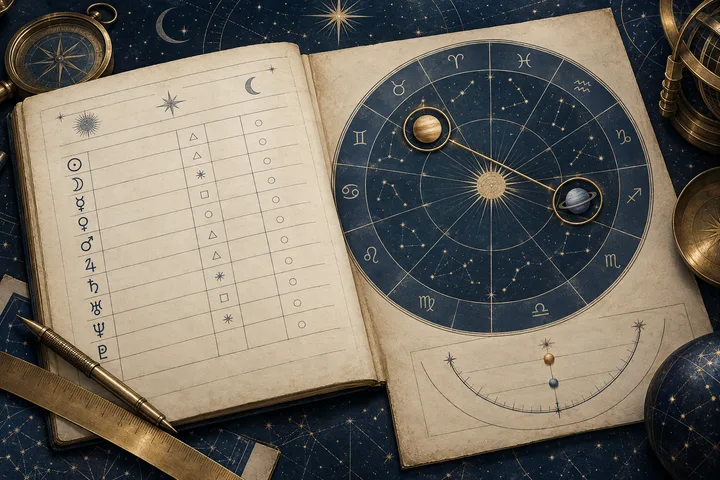
If you have the data, make a small table. Put each person's planet, zodiac longitude, declination, and N or S marker in its own column. Compare the personal planets first. Mark a parallel when the absolute declination difference is within your stated orb and the sides match. Mark a contraparallel when the absolute values are close but the sides differ. Then return to the wheel. Ask what the declination contact changes.
Your next reading should produce three sentences for each important pair. First, name the longitude aspect and its sign expression. Second, name the declination contact and whether it reinforces, reveals, or complicates the first sentence. Third, name one behavior that would let the pair use the contact well. This sequence keeps technique in service of interpretation.
Here is a reusable worksheet in prose. For each pair, write: Planet A in sign and degree, Planet B in sign and degree, shortest longitude distance, major aspect if it falls inside six degrees, declination A with N or S, declination B with N or S, declination difference, and final classification. Then add one line called changed meaning. That line is the heart of the exercise. It answers what the parallel or contraparallel adds to the first reading.
If the changed meaning is only a stronger synonym for the first meaning, you may have reinforcement. If it explains a feeling that the wheel left open, you may have a missing contact. If it introduces a genuine tension, you may have a qualification. These categories aren't rigid technical laws. They're editorial tools for keeping the interpretation honest and useful.
Suppose the longitude reading says, you understand each other's moods. The declination reading may change that to, you recognize each other's moods quickly, but you don't regulate them in the same way. Suppose the longitude reading says, attraction comes through conflict. A parallel may change it to, the conflict has a real current of affection beneath it. Suppose the longitude reading says, you share values. A contraparallel may change it to, you share the goal but argue about the route. Those are decisions a couple can actually use.
A technical limit doesn't weaken a reading. It tells you what the pattern can carry. If houses aren't included, say that birth times weren't supplied. If declination isn't assessed, say that the values weren't supplied. Then name the input that would answer the next question.
This method also keeps the report within its proper promise. A synastry comparison can help you see patterns in attraction, feeling, communication, and friction. It cannot choose a partner for you or certify a future. The practical action belongs to the people reading the chart. Astrology gives the pattern language. You decide how consciously to live it.
So, how do your charts fit together? Begin with the zodiac-degree story because it tells you the main geometry of the relationship. Add parallels and contraparallels when the declination data is available, especially for tight personal-planet contacts. Let a parallel show where the bond flows or fuses. Let a contraparallel show where the bond presses two different needs into contact. Then choose the conversation, boundary, or shared practice that gives that pattern a conscious form.
That is the practical action. Compare the closest Moon, Venus, and Mars contacts in longitude. Add the one-degree declination layer when values are available. Circle only the contacts that repeat or clarify the same theme, then discuss the behavior it describes.
Sources: Declination Dynamics - NCGR Geocosmic Journal; Declinations in Synastry: The Astrology of Relationships - Cafe Astrology; Determining Parallels and Contra-Parallels in Synastry - Cafe Astrology
A little more clarity
Is a parallel stronger than a conjunction in synastry?
Treat a parallel as conjunction-like, not as an automatic replacement for a conjunction. A tight longitude conjunction and a parallel together deserve extra attention because two coordinate systems repeat the contact. A parallel without a close conjunction can still matter, especially between personal planets, but read it with the signs, other aspects, and the full synastry pattern.
Sources & further reading
- Declination Dynamics - NCGR Geocosmic Journal
Provides astrological context for declination as a separate dimension alongside zodiac longitude in chart interpretation.
- Declinations in Synastry: The Astrology of Relationships - Cafe Astrology
Explains same-side and opposite-side declination contacts in relationship comparison and uses a typical one-degree orb.
- Determining Parallels and Contra-Parallels in Synastry - Cafe Astrology
Shows how to compare declination values, identify the north or south side, and classify parallel or contraparallel contacts.
- The Relationship between longitude and declination - The Geocosmic Journal, NCGR
Describes declination parallels and contraparallels as a separate aspect dimension and compares their conjunction-like and opposition-like symbolism.
Synastry Comparison Report
Enter known placements for two people. Get an input-by-input comparison, selected aspect calculations and a clear record of what remains uncertain.
Compare our placements