Start with the real disagreement, not the chart
Different expectations for commitment rarely begin with the sentence, "We have incompatible charts." They begin with a smaller sentence that keeps returning. One person asks where the relationship is going. The other says, "I care about you, but I don't want to rush." One person hears a promise as a plan. The other hears it as pressure. Both may be sincere. They may simply be using the word commitment to name different things.
Synastry helps when you let the lived question lead. Before you compare signs, name the moment that needs attention. Are you deciding whether to become exclusive? Discussing a shared home? Asking for a clearer weekly rhythm? Wondering whether an open-ended relationship can become more defined? A chart can give the conversation shape, but it cannot supply the question. Your actual question does that.
The strongest use of synastry here is translation. It can show why one partner reaches for reassurance through steady contact while the other reaches for reassurance through freedom and return. It can separate attraction from action, tenderness from agreement, and fear from a genuine difference in timing. That separation matters. A couple cannot solve one problem while arguing about another.
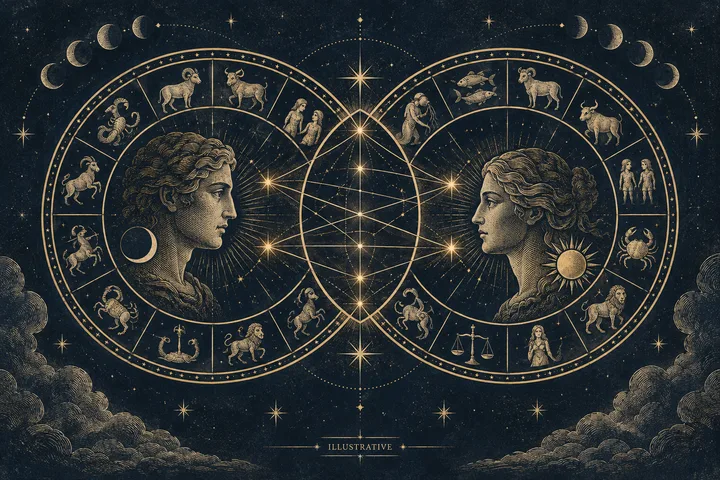
Astrologers compare two natal charts through synastry. The comparison looks at contacts between planets and angles, as well as the signs and houses involved when those chart details are available. A synastry chart is therefore relational. It doesn't erase either natal chart. It shows how one person's chart activates the other person's pattern, and where the exchange feels easy, charged, familiar or demanding. Skyscript's glossary describes the practice as comparing one natal chart with another through the aspects formed between their planetary positions and angles. Astrodienst likewise describes synastry as a way to compare two or more horoscopes and examine interaspects. [0, 1]
For this article, use a smaller and more practical scope. Compare known Moon, Venus and Mars signs, add Saturn contacts when degrees are available, and use selected major aspects within a six-degree orb. That is a focused reading. It is not a full natal chart calculation, a house analysis, a composite chart or a prediction of relationship success. If you only know signs, stay with sign-level themes. If you know degrees, you can rank the contacts more carefully.
Imagine Maria wants an exclusive relationship with a clear path toward shared plans. Leo enjoys the relationship but resists labels because he experiences labels as a loss of room to move. This example does not tell us that Maria is secure or Leo is avoidant. We haven't been given their charts, and we shouldn't invent them. It gives us a question to carry into the reading: which chart layers might describe how each person asks for safety, offers love, takes initiative and handles duty?
Write the question in one sentence before looking at any placement. "We agree that this matters, but we don't agree on what a committed relationship requires each week." That sentence gives the astrology a job. It must clarify the terms and suggest a conversation. It must not become a new way to postpone the conversation.
Sources: Synastry - Astrodienst Astrowiki; What's Your Sign? An Intro to Synastry Charts and Astrological Compatibility; Aspect - Astrodienst Astrowiki
Define what commitment means before you interpret it
Commitment is not one promise. It is a bundle of choices. People often use the same word for exclusivity, emotional availability, future planning, sexual agreements, public recognition, practical reliability, financial cooperation or a willingness to repair after conflict. If you skip this step, the chart will seem to disagree with itself because you are asking it to answer several questions at once.
Make the word concrete. Ask each person to finish four sentences: "I feel committed when..." "I can offer..." "I need more time before..." and "I will not agree to..." Keep the answers behavioral. "You check in when you say you will" gives you something to observe. "You make me feel chosen" matters too, but it needs a second sentence that explains what chosen looks like in ordinary life.
Then separate pace from shape. A person may want a committed relationship but need a slow transition. Another person may want a fast label but not yet want shared finances or family plans. These are different arrangements. Synastry can help describe the temperament behind a preference, yet the relationship still needs an explicit agreement about pace, privacy, contact, sex, time and future planning.
The comparison also needs a ranking. Start with what would make the relationship feel emotionally safe. Move next to how affection is shown. Then ask who initiates difficult or practical steps. Finish with the structure that makes a promise real. This order follows a useful astrological sequence: Moon, Venus, Mars, then Saturn. It moves from felt safety to love language, from desire to action, and from action to responsibility.
Astrodienst's relationship material places the Moon among the central factors in partnership astrology and describes Saturn contacts to personal planets as potentially difficult but capable of lending stability and security. Its synastry guidance also says that a chart should be understood as a whole before the comparison begins. That supports a careful rule for this article: don't turn one striking contact into the relationship's identity. Read the contact in its role, then return to the wider pattern. [0, 4]
A useful worksheet has three columns. In the first, write the commitment request. In the second, write the fear or need beneath it. In the third, write the observable agreement that could answer it. "I want us to define exclusivity" may sit beside "I need to know where I stand" and then "We will not date other people, and we will tell each other if that changes." Astrology belongs beside this worksheet, not above it.
Ask permission before you bring a partner's placements into a tense discussion. A chart can feel intimate, especially when it names a pattern that a person has not chosen to explain. Start with your own placement and your own experience. Say, "I notice I need regular contact when plans are unclear, and my Moon description gives me language for that. Can I ask how this lands for you?" This keeps the reading reciprocal. It also leaves room for the other person to disagree with an interpretation without having to defend their entire character.
Missing birth information changes the level of confidence you can bring to the method. Without a birth time, house overlays and angles may be unavailable. Without a planetary degree, you may not know whether a contact is exact, wide or absent. Without a confirmed placement, don't fill the gap with a guess based on a date alone. A sign comparison can still open a useful conversation, but it should remain a sign comparison. Precision is not decoration here. It tells you which question the chart can actually carry.
The strongest exception is a pair who already shares a clear definition of commitment but differs only in timing. Do not inflate that into a grand chart conflict. A short delay can be a scheduling issue, a recent life change or a reasonable need for trust to grow. Synastry becomes useful when the same disagreement repeats, when both people mean different things by the same word, or when a small request exposes a deeper pattern of giving and receiving.
Sources: Synastry - Astrodienst Astrowiki; Orb - Astrodienst Astrowiki; Synastry - Skyscript Glossary
Read the Moon for the safety each person needs
Begin with the Moon because commitment becomes difficult to receive when the emotional body feels unsafe. In astrology, the Moon describes instinctive reactions, emotional needs, comfort, home and the need for security. It often speaks before a person has found a clean explanation. Someone may say, "I just need to know," when their Moon is asking for continuity. Someone else may say, "I need space to think," when their Moon settles through privacy and quiet.
Compare the Moon signs first. Element gives the broadest clue. Fire Moons may seek warmth through movement, candor and a sense that the relationship is alive. Earth Moons often trust what can be repeated, maintained and touched in daily life. Air Moons may need conversation, mental room and the freedom to name several possibilities before choosing. Water Moons often look for emotional attunement, privacy and proof that tenderness will be handled with care. These are starting points, not verdicts.
Modality adds pace. Cardinal Moon patterns may want to begin the next step and feel better once a decision is moving. Fixed Moon patterns may need time to build trust and can resist changes that arrive without preparation. Mutable Moon patterns may prefer to keep the conversation open while they sense what is true. A couple can have two loving people here and still create friction. One person calls movement reassuring. The other calls movement premature.
Now compare Moon-to-Moon contacts and Moon contacts to the other person's Venus, Sun and Saturn. A Moon-Venus contact can make affection feel naturally responsive: one person's emotional needs meet the other's style of giving love. A Moon-Sun contact can link inner feeling with outward identity. Moon-Saturn contacts need more care. They may give a sense of steadiness and seriousness, yet they can also make one person feel judged, managed or responsible for the other's emotional weather. The aspect tells you what to explore, not which story to accept.
Astrology.com describes the Moon as the place of inner needs, comfort and what soothes a person when depleted. It also describes Moon-Venus synastry as a meeting between emotional needs and love values. Astrodienst's Moon reference similarly treats the Moon as a primary indicator of home, feelings and emotional needs. Together, these sources support a practical reading question: what helps each person return to safety after uncertainty, and does the relationship offer that help in a form the other person can actually receive? [0, 5]
Consider an example. Suppose one person's Moon is in Taurus and the other's Moon is in Gemini. The first may want a clear rhythm, familiar places and a promise that survives a busy week. The second may want frequent conversation, flexibility and permission to revise the plan as new information arrives. Neither sign is more committed. The difference is in the route to reassurance. A useful agreement might combine both: a standing weekly date, plus freedom to change the activity without treating the change as a threat.
If the Moon layer is tense, don't jump to Saturn or breakup language. Ask three small questions. What happens in each person when the future feels unclear? What kind of contact calms that reaction? What kind of contact makes it worse? Then test the answer for two or three weeks. The Moon reading becomes valuable when it changes the care you offer, not when it gives you a label to repeat during an argument.
Sources: Synastry - Astrodienst Astrowiki; What's Your Sign? An Intro to Synastry Charts and Astrological Compatibility; Moon - Astrodienst Astrowiki
Use Venus to compare love, values and the shape of a yes
The Moon asks, "What helps me feel safe?" Venus asks, "What feels loving, valuable and worth choosing?" In a commitment conversation, that difference is easy to miss. A person can feel emotionally held and still not feel cherished. A person can feel deeply attracted and still not see shared values. Venus shows the style of affection, pleasure, harmony and attraction. It also shows what a person tends to value and how they want love to be expressed.
Compare Venus signs with ordinary examples. Venus in an earth sign may recognize love through consistency, tangible care and quality that lasts. Venus in an air sign may value curiosity, fairness, wit and the feeling that the relationship keeps both minds awake. Venus in a fire sign may want enthusiasm, visible desire and room for joy. Venus in a water sign may look for emotional loyalty, softness and a private bond that feels meaningful. The sign says more about the preferred texture of love than its moral quality.
Then compare Venus to the other person's Moon. This is one of the clearest ways to discuss a mismatch that feels personal but may be stylistic. The Moon person may ask for reassurance through tone, presence and emotional memory. The Venus person may offer affection through gifts, touch, beauty, humor or practical peace. If the gestures miss, both people can feel unappreciated while both are trying. Name the translation problem before you name a lack of love.
Venus contacts to Saturn bring the commitment question into sharper focus. A flowing contact may help affection take a durable form. A hard contact may feel serious, delayed or cautious. The Venus person may feel that pleasure must be earned, while the Saturn person may feel responsible for protecting the relationship from risk. This can produce loyalty, but it can also produce a parent-child tone if the pair never discusses equality, pleasure and permission to change.
Venus contacts to Mars tell a different story. They can describe attraction, pursuit and the way desire moves between two people. That charge may help a couple choose each other, but it does not answer whether they can keep an agreement. Cafe Astrology describes Mars in synastry as sexual expression, desire and assertion, and specifically notes that Mars alone does not point to a need to stay together forever. This is the useful boundary: chemistry can start the conversation, but Venus and Mars cannot finish the commitment decision by themselves. [1, 6]
Imagine Maria values public clarity and shared plans, while Leo values private devotion and freedom from outside expectations. If Maria's Venus needs visible partnership and Leo's Venus needs a protected inner world, their disagreement is not solved by declaring one Venus more mature. They need to decide which parts of the relationship stay private, which commitments they name publicly, and which public step would feel supportive rather than performative.
Ask each person to name three acts that feel like love and three acts that feel like obligation. Put the lists beside one another. Look for a translation that preserves both people. A long message may feel loving to one person and invasive to another. A practical errand may feel romantic to one person and merely efficient to another. The Venus reading gives the pair a better vocabulary for these small differences, which are where commitment becomes visible.
The exception is a couple with strong Venus agreement but a major conflict about life values. Similar taste does not equal similar ethics. Two people can enjoy the same dates and still disagree about money, faith, family, privacy or work. Venus can open the door. The actual conversation must still ask what each person is willing to build, give up and protect.
Synastry can frame a commitment conversation by showing where two people seek safety, affection, action and structure in different ways. It won't decide whether either person should commit. It can help you ask a better question: what does commitment need to look like for each of us, and can we build that form together? Start with the placements you actually know. Compare the Moon for emotional security, Venus for affection and values, Mars for initiative and pace, then Saturn for duty, boundaries and staying power. Use degrees when you have them, and read major aspects within the stated six-degree orb. Treat the pattern as a language for the talk, not evidence against your partner. Put the chart beside repeated behavior, then agree on one small, observable commitment to test over the next few weeks.
Sources: Synastry - Astrodienst Astrowiki; What's Your Sign? An Intro to Synastry Charts and Astrological Compatibility; Synastry: Love and Relationship Astrology - Cafe Astrology
Read Mars for pace, initiative and the work of asking
Commitment needs movement. Someone has to raise the topic, suggest the next step, book the visit, ask the hard question or repair the missed promise. Mars shows how a person initiates, asserts, pursues, handles friction and spends energy. It can describe sexual desire, but it is wider than sex. In this conversation, Mars helps you ask who acts when a promise needs a body and a calendar.
Compare Mars signs by pace and style. Cardinal Mars often moves first and learns through action. Fixed Mars may act slowly but persist once it has chosen a direction. Mutable Mars may adapt, experiment and respond to changing conditions. Fire Mars can prefer directness and visible momentum. Earth Mars may want a practical plan. Air Mars may act through discussion, options and clever reframing. Water Mars may need emotional trust before exposing desire or anger. These are patterns of initiative, not guarantees of behavior.
Mars can reveal why one person experiences a request as an invitation while the other experiences it as a demand. A direct Mars may say, "Let's decide tonight." A more cautious Mars may hear a test and withdraw. A flexible Mars may offer several paths, while a fixed Mars hears too many paths as a refusal to choose. The repair begins when the couple asks what a fair pace would look like in practice, rather than debating which person is too much or too little.
Mars contacts to the Moon can activate strong feeling. Mars contacts to Venus can increase attraction and pursuit. Mars contacts to Saturn can create a stop-start pattern, with one person's drive meeting the other's caution, rule or limit. Hard Mars-Saturn contacts deserve especially plain language. They can become a useful training ground for patience and consent, or they can become resentment when one person always pushes and the other always blocks. The chart cannot choose between those paths. Repeated behavior can show which path the couple is taking.
Astrodienst describes Mars as the impulse to initiate, assert and expend energy. Cafe Astrology's synastry guide treats Mars as desire and action, while warning that strong Mars contacts can bring conflict as well as attraction. This gives you a concrete decision guide. When you see a Mars theme, ask who initiates, who responds, what happens after a no, and whether the pair can turn heat into a mutually agreed action. [1, 2, 6]
Consider this example. Maria wants a conversation about exclusivity and proposes a time. Leo agrees, then keeps the conversation vague. The issue is not whether Leo's Mars is slow, mutable or guarded. The issue is whether he will take a real turn in the conversation. A chart comparison might suggest that his way of approaching pressure is indirect, while her way is direct. That interpretation becomes useful only if it leads to an agreement such as: each person will bring one clear request and one clear limit to the next talk.
Use Mars to build a test, not a prosecution. Choose one commitment that requires initiative but does not force a life-changing decision. It might be planning the next month of visits, agreeing on a check-in, or discussing how you will handle a canceled plan. Give each person a visible role. Notice whether the action is shared, delayed, delegated or punished. That result tells you more than a dramatic aspect symbol.
The strongest exception is a pair whose Mars contacts are tense but whose conflict repair is excellent. Tension can create candor and energy. It becomes a problem when anger controls access to love, when a no is treated as an insult, or when one person must manage the other's reaction. No attractive synastry pattern excuses coercion, contempt or repeated broken agreements.
Sources: What's Your Sign? An Intro to Synastry Charts and Astrological Compatibility; Aspect - Astrodienst Astrowiki; Synastry: Love and Relationship Astrology - Cafe Astrology
Let Saturn test whether the promise has a structure
Saturn is the layer to read after Moon, Venus and Mars because it asks whether the relationship can carry weight. Saturn speaks to limits, time, responsibility, patience, rules and the work required to make something last. In synastry, Saturn contacts can feel binding or serious. They can also feel heavy. That is why Saturn should not be treated as a simple marriage stamp. A bond can be durable because it is cared for, or durable because both people are afraid to change it.
Read Saturn as a question of form. What does each person agree to do when life becomes inconvenient? How do they handle time, distance, money, family pressure and competing duties? Who gets to set the pace? What happens when one person needs more support than expected? Saturn does not ask whether the relationship feels intense. It asks whether the couple can make a fair container for that intensity.
A Saturn contact to the Moon may bring steadiness, protection or emotional restraint. A contact to Venus may make affection more serious, loyal or cautious. A contact to Mars may require patience around initiative, sex, anger or timing. The house person may feel that the Saturn person's presence lands in a particular life area, but house overlays require accurate birth times and are outside this focused placement report. Do not pretend to read houses from sign-only data.
The aspect matters. A trine or sextile may make responsibility easier to share. A conjunction can bind the planets closely and make the issue impossible to ignore. A square or opposition can expose a real difference in timing, authority or limits. None of these aspects is automatically good or bad. The question is whether the pair can name the pressure without turning it into a character judgment.
Astrodienst describes Saturn as a symbol of limitation and hardship that can reward patience and hard work, and its synastry guidance says Saturn contacts to personal planets may be difficult while also lending stability and security. Astrology.com similarly connects Saturn with structure, duty and endurance in partnership. Cafe Astrology calls Saturn interaspects a kind of glue that can bind people while remaining tricky to manage. The shared point is strong: Saturn can support commitment, but only when the responsibility is lived rather than merely promised. [0, 1, 4, 6]
Imagine Maria's Saturn makes a close square to Leo's Venus, within the six-degree working orb used for this report. We still do not know their full charts, and this is only an example. The reading might ask whether Maria's caution makes Leo feel evaluated, or whether Leo's need for pleasure makes Maria fear that seriousness will disappear. The useful conversation is not, "Your Saturn ruins my Venus." It is, "How can we make room for joy while keeping the promises we say matter?"
Use Saturn to write an agreement with a review date. Choose the smallest form that answers the central concern. If the issue is exclusivity, define it. If the issue is distance, define contact and visits. If the issue is future planning, choose one decision to revisit on a set date. A review date protects the relationship from both endless vagueness and premature permanence. It lets commitment become a practice that can be observed, discussed and adjusted.
The meaningful exception is Saturn without warmth. A couple may keep every appointment and still feel lonely. Structure cannot replace affection. Nor can loyalty repair a pattern in which one person carries the rules and the other carries the emotional cost. Read Saturn alongside the Moon and Venus. Ask whether the container protects love or merely contains it.
Sources: Synastry - Astrodienst Astrowiki; What's Your Sign? An Intro to Synastry Charts and Astrological Compatibility; Synastry - Skyscript Glossary; Synastry: Love and Relationship Astrology - Cafe Astrology
Put the layers together, then choose one honest next step
A synastry reading becomes useful when the layers agree on a question or reveal a specific tension. Do not collect contacts like evidence in a courtroom. Rank them. Start with the closest major aspects, then consider the planets involved, then the sign relationship, then the wider pattern. A tight Moon-Saturn contact may deserve more attention than a loose Venus-Mars contact. A repeated theme across Moon, Venus and Saturn may matter more than one exciting but isolated conjunction.
For this report's focused method, use a six-degree orb for selected major aspects when both degrees are known. An orb is the distance between the exact aspect and the actual planetary positions. Smaller orbs are usually read as more concentrated. Astrodienst explains that astrologers use different orb rules and that interaspects are often given narrower orbs because a synastry chart doubles the number of planets. Astrology.com also recommends treating six degrees or less as a particularly useful range in its introductory synastry guide. [2, 3]
If you know signs but not degrees, don't manufacture an aspect. You can compare element, modality and the planet's sign meaning. You can say that a Taurus Moon and an Aquarius Moon may seek security through different routes, but you cannot claim a square without degrees or a reliable chart calculation. If the Moon's degree is unknown, record the uncertainty. The report can still discuss the sign, while leaving exact lunar contacts open.
A useful synthesis has four sentences. The Moon shows what reassurance needs to feel like. Venus shows what each person calls love. Mars shows how each person moves toward a request or reacts when blocked. Saturn shows what form can hold the promise. Then add the strongest exception. For example: "You may both want commitment, but you may ask for proof in different languages. Your Moon pattern needs steadiness, while the other person's Mars pattern needs room to choose the next step. Venus can translate the affection, and Saturn can turn the agreement into a routine. The exception is that even a supportive pattern cannot replace a clear answer about exclusivity."
Now return to Maria and Leo. Suppose the illustrative pattern shows a warm Moon-Venus connection, an active Venus-Mars contact and a demanding Saturn link. The first layer says affection can land. The second says desire and initiative are present. The third says the question of timing, duty or boundaries will test the bond. The wrong conclusion is that Saturn proves they are meant to last. The better conclusion is that the relationship may have enough feeling and energy to attempt a serious agreement, but the agreement must be specific and mutual.
Their next conversation might sound like this: "We seem to experience commitment differently. I feel secure when we define what we are and keep a steady rhythm. You seem to need room to move toward a decision without feeling trapped. I want to know whether you can offer exclusivity and a weekly plan now, even if we leave larger future decisions open. What can you honestly offer, and what do you need more time to decide?" This is a chart-informed question. It does not use astrology as a weapon.
Choose one action that can answer the question within a short, agreed period. Set a weekly check-in. Decide how you will handle canceled plans. Name the relationship's current agreement. Plan the next visit. Ask each person to bring one example of care they can offer and one boundary they need respected. Then watch what happens. A promise that survives ordinary life is more informative than a promise made under the pressure of a reading.
Review the agreement without turning the review into a second trial. Ask what worked, what felt difficult, what each person did when the plan became inconvenient, and what needs to change. If the answer is promising, make the next agreement slightly more specific. If the answer is evasive, cruel or one-sided, believe the pattern. The point of a synastry reading is not to make uncertainty disappear. It is to make the next honest choice easier to see.
Keep the first test small enough that both people can participate freely. A promise about one evening, one boundary or one weekly check-in can show whether the relationship handles clarity well. You don't need to settle every future question in one sitting. You do need enough reality to tell whether the conversation changed anything.
A chart comparison can also reveal that the original question was too narrow. You may begin by asking, "Will we commit?" and discover that the real issue is, "Can we make decisions without one person carrying all the emotional labor?" Or you may begin with different timelines and discover that both people agree on the future but disagree about how much contact they need while getting there. Let the reading improve the question. That is a real result, even before a larger decision is made.
The report can support this process when you already know the relevant placements and, optionally, their degrees. It compares the supplied Moon, Venus and Mars signs, notes selected major aspects within a stated six-degree orb, and keeps missing data visible. It does not calculate natal positions from birth details, determine houses, score compatibility or certify a soulmate bond. If you want to compare your known placements, use the Synastry Comparison Report as a preparation tool for the talk, then make the talk in your own words.
Sources: Synastry - Astrodienst Astrowiki; What's Your Sign? An Intro to Synastry Charts and Astrological Compatibility; Aspect - Astrodienst Astrowiki; Orb - Astrodienst Astrowiki; Synastry - Skyscript Glossary; Synastry: Love and Relationship Astrology - Cafe Astrology
A little more clarity
Can synastry tell us whether we will commit?
No chart should make that decision for you. Synastry can describe patterns around emotional security, affection, initiative, timing and responsibility. Use those patterns to ask what each person can offer and what each person needs. Then compare the reading with repeated behavior, clear agreements and the way each partner responds to a boundary or a difficult conversation. Commitment is a choice made through actions, not a verdict extracted from one aspect.
Which placements should we compare first for commitment differences?
Start with the Moon, Venus, Mars and Saturn. Read the Moon for emotional safety, Venus for affection and values, Mars for initiative and pace, and Saturn for structure, duty and limits. Add degrees when you have them. A sign-only comparison can still describe broad styles, but it cannot prove an exact aspect. Keep the sequence simple so the conversation stays about your relationship rather than becoming a hunt for every possible contact.
What if our synastry looks warm but we still disagree about commitment?
Warm synastry can show affection, attraction or emotional recognition without giving you the same timetable. Moon-Venus and Venus-Mars contacts may make the bond feel loving and alive, while Saturn or the natal charts may describe caution, duty or a different pace. Ask the direct question anyway. Define exclusivity, contact, future planning and review dates in ordinary language. A supportive chart can help a couple have that talk. It cannot replace the answer.
Can we use synastry if we only know our signs?
Yes, but keep the scope modest. Compare the Moon, Venus and Mars signs through their elements and modes, then describe possible differences in comfort, affection and initiative. Don't claim a square, trine, conjunction or house overlay without the degrees or chart data needed for it. A placement comparison report can use supplied signs and optional degrees. It won't calculate a natal chart from birth details, and it won't invent missing information.
Sources & further reading
- Synastry - Astrodienst Astrowiki
Supports synastry as comparison of two or more horoscopes, interaspects, personal planets and Saturn themes.
- What's Your Sign? An Intro to Synastry Charts and Astrological Compatibility
Supports Moon, Venus, Mars, Saturn, degree and orb descriptions used in the practical reading sequence.
- Aspect - Astrodienst Astrowiki
Supports definitions of major aspects, angular relationships and the meaning of an orb in chart interpretation.
- Orb - Astrodienst Astrowiki
Supports the explanation that orb is deviation from exactitude and that astrologers use different orb sizes.
- Synastry - Skyscript Glossary
Supports the historical definition of synastry as comparison of natal charts through planetary aspects and angles.
- Moon - Astrodienst Astrowiki
Supports reading the Moon through emotional needs, home, feelings, instinctive reactions and security.
- Synastry: Love and Relationship Astrology - Cafe Astrology
Supports practical distinctions among Mars desire and action, aspect types, and Saturn as binding but difficult.
Synastry Comparison Report
Enter known placements for two people. Get an input-by-input comparison, selected aspect calculations and a clear record of what remains uncertain.
Compare our placements