A sign list can be enough for a first reading
Imagine Maria with a note that lists both partners’ Moon, Venus and Mars signs. She has already looked up a few pairings and wonders whether a report would tell her anything she doesn’t know. The honest answer depends on the question she wants answered. A sign list is enough for a broad first comparison; a report becomes useful when she wants the six placements read together or wants selected contacts checked from degrees she already has.
Astrological synastry compares two charts and the relationships between their placements. A sign guide can help a reader begin that comparison, including Moon-to-Moon or one person’s Venus with the other’s Mars. Those pairings carry symbolic material of their own. Yet a list and an interpretation do different jobs: the list names the placements, while a comparison asks how their themes meet. If Maria only wants a quick sign lookup, she can stop with the list. If she wants a connected reading, the next question is what each sign layer can contribute.
Sources: Love Sign Compatibility Grid; Synastry (Relationship Astrology)
What can a sign list already tell you?
A sign list can support a real first reading. In astrology, the Moon is commonly read through emotional rhythms and needs for comfort; Venus through attraction, affection, pleasure and values; Mars through desire, initiative and the way energy is asserted. These are interpretive starting points. They don’t reduce a person to a placement, and they don’t tell you in advance how either partner will act.
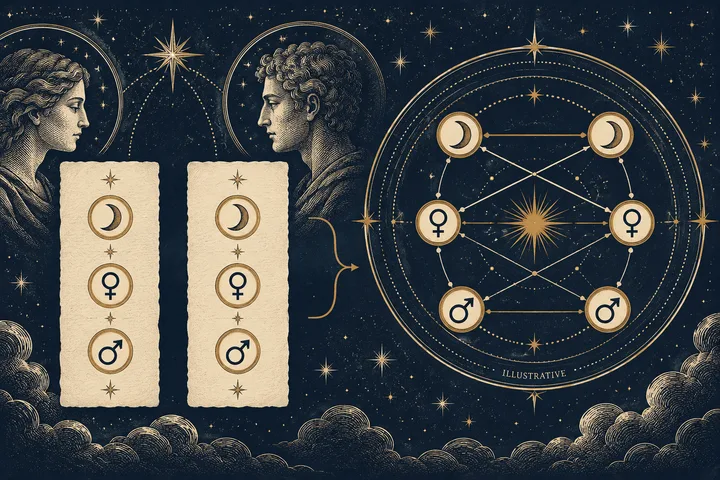
Begin with the same planet in both charts. Moon with Moon asks how each person seeks ease, responds emotionally and experiences familiarity. Venus with Venus can bring attention to what each enjoys, values or offers as affection. Mars with Mars turns toward pace, initiative and ways of pursuing what one wants. Then compare cross-pairs: each person’s Venus with the other’s Mars, for instance, or one person’s Moon with the other’s Venus. The question changes from ‘Are these signs compatible?’ to ‘How might these two styles meet?’
Sign-comparison references use precisely this kind of pairing. Cafe Astrology’s guide describes Venus-Mars, Moon-Moon and other combinations as possible points of comparison, and its method gives readers a way to orient themselves without requiring an elaborate chart reading. That is useful when you want an accessible vocabulary for an initial reflection. But a pairing is still one piece of a larger picture. The guide itself acknowledges that any one sign combination is only one point among many when considering a relationship.
That limit doesn’t make the sign list empty or misleading. It tells you what kind of answer it can give. You can notice, for example, that the two Moon signs are described through different emotional styles, then ask whether that distinction resonates with your experience. You can compare Venus and Mars themes as a way to think about affection and desire. You can also notice when one theme appears to support or complicate another. These are useful prompts for reflection, not a tally of green and red lights.
A report earns its place when it does more than repeat six descriptions. It should arrange them into a coherent comparison and make clear which pairings it is discussing. If you’re comfortable doing that synthesis yourself, your list and a reference guide may already be enough. If you want to know whether a sign relationship also forms an exact aspect, though, signs leave a technical question unanswered.
Yes, a supplied-placement synastry report can be useful if you want your six Moon, Venus and Mars signs read as a connected comparison, or if you know the degrees and want selected major aspects checked under the report’s six-degree orb. If you only need a quick sign-pair lookup, your list and a reference guide may be enough. Signs support a broad symbolic reading of emotional style, affection and desire; they don’t establish an exact aspect or its closeness. Degrees add that bounded technical check, but they don’t create a full natal chart. The report uses placements you provide and does not calculate missing positions from birth details or interpret houses. Choose it for synthesis or its stated aspect checks, not for a relationship verdict.
Sources: Love Sign Compatibility Grid; Synastry (Relationship Astrology); Ep. 165 Transcript: Synastry: The Astrology of Relationships
Why aren't sign relationships the same as exact aspects?
A sign relationship can suggest an aspect family, but it cannot by itself show how close an aspect is. In degree-based astrology, an aspect is an angular relationship between two chart points. The five commonly used major aspects are the conjunction, opposition, trine, square and sextile, each associated with a particular angle. An orb is the allowed distance from the exact angle for the contact to count within a chosen method.
The distinction matters because each zodiac sign spans a range of degrees. Two planets in signs often associated with a trine may sit far from an exact trine within those signs. Conversely, planets on opposite sides of a sign boundary can form a close angular aspect even though a simple sign-distance shorthand misses it. Same-sign placements can be close together, or widely separated. Sign alone doesn’t tell you which.
Nicholas Campion’s accessible technical introduction defines an aspect as a precise distance between points and an orb as the amount by which a planet may deviate from exactness. It also notes that orb conventions vary: modern approaches may assign different orbs by aspect, while some traditional approaches give more prominence to the planets involved. The page’s own table uses its own values. Those figures illustrate a framework; they aren’t a universal rule, and they aren’t this report’s rule.
Some synastry guides begin with sign relationships as an accessible orientation, then distinguish that first pass from a fuller chart comparison. That shorthand can help you see a possible pattern. It shouldn’t be mistaken for a measured orb. A square by sign and a square established from two degrees of longitude are not the same level of information.
The Synastry Comparison Report applies a six-degree orb to its selected major-aspect checks. That is the report’s declared convention, not a claim that every astrologer should use six degrees. When you supply degrees, the report can test whether a selected angle falls within that stated range. Without degrees, the reading stays at sign level. No exact aspect or closeness should be inferred from the six sign names alone.
This gives degrees a precise, limited job. They let you ask whether a particular contact qualifies under one stated method. They don’t settle what the contact means for two people, and they don’t make the chart complete. To see why the planet pair still matters after the geometry is checked, it helps to walk through the three placements as a connected set.
Sources: An Introduction to Aspects and Chart Shaping in Natal Astrology
How do Moon, Venus, and Mars work as a comparison?
Moon, Venus and Mars make a useful comparison because they bring different relationship themes into view. The Moon points toward emotional response and comfort; Venus toward affection, pleasure and values; Mars toward desire, initiative and assertion. Read together, they let you ask how these themes might support or rub against one another. The report’s value lies in making that connection, not in adding a label to every pair.
A restrained sequence starts with Moon to Moon. Ask what each person’s sign suggests about emotional pace and the kinds of responses that feel familiar. Then look at Venus pairings: what each person values, enjoys and tends to offer. Finally, compare Mars placements for desire and initiative. These same-planet comparisons keep like with like. Cross-planet pairings add a different question: how might one person’s affection meet the other’s desire, or one person’s emotional style meet the other’s way of acting?
Direction matters. A’s Venus with B’s Mars is a distinct comparison from B’s Venus with A’s Mars. A list may tempt a reader to blend the two into a single ‘Venus-Mars match,’ but the charts don’t become interchangeable. Each person brings a different planet to the contact, so a careful interpretation preserves who is represented by which placement. The signs provide context for those roles; the aspect, when known, describes a particular relationship between them.
Moon-Mars offers a clear example of why a connected reading adds something beyond two sign definitions. Cafe Astrology’s interpretation guide distinguishes conjunctions, squares and oppositions from trines and sextiles. It presents the same planet pair through different forms of interaction: emotional response meeting action, with the aspect shaping whether the contact is described through heightened activation, friction or a more flowing exchange. This is the guide’s interpretive framework, not a report of how couples behave. Its usefulness is that it shows why ‘Moon and Mars’ alone is not yet a full interpretation.
The broader synastry guide likewise treats sign context and aspect type as parts of reading an inter-chart relationship. Nicholas Campion’s technical overview describes aspects as ways planets combine and notes that even tense aspects can have more than one face: friction may create difficulty, but it can also call for effort and development. In that tradition, an aspect is not a relationship grade. A challenging contact isn’t automatically bad, and an easy one doesn’t guarantee that a couple will use its potential well.
So the reader’s useful question is not ‘Which planet wins?’ It is ‘What distinct themes appear, and where do they meet?’ A report that connects emotional style, affection and desire can help organize that reflection. Still, an interpretation based on signs alone remains broad. Degrees add a narrower technical layer when they are available.
Sources: Synastry (Relationship Astrology); Synastry (Relationship Astrology) Moon Mars Aspects; An Introduction to Aspects and Chart Shaping in Natal Astrology
What changes when you add degrees?
Degrees let a reader move from a sign-level possibility to a selected angular check. With the placements supplied, the report can compare their degree positions, test selected major angles and show which contacts meet its six-degree orb. That makes the comparison more specific. It doesn’t convert six placements into a full natal chart or turn an interpretation into a verdict.
Think of the workflow as two layers. First, the sign layer asks what symbolic styles the placements bring to the comparison. Second, the degree layer asks whether particular cross-chart pairs form selected major aspects under the report’s stated rule. The technical question is whether a contact qualifies and how close it is to exact. The interpretive question is what that contact may mean for those planets in their signs. Both matter, but they are not the same answer.
Campion’s overview says that, in the framework it presents, a closer aspect is read as stronger and a looser one as weaker. It also makes clear that orb conventions differ. The practical lesson is to keep the rule visible. A result inside a six-degree orb means that it meets this report’s chosen boundary. It doesn’t prove that every astrologer would select the same orb, or that the contact outweighs every other factor in a larger chart.
Without inventing a couple’s placements, consider the difference in questions. Someone with only the six signs can ask whether two sign styles appear to complement or contrast with one another. Someone who also knows the degrees can ask whether a named cross-pair sits near a major angle under the report’s rule. The second person has a more specific technical result to interpret. The first still has meaningful material, but not enough information to claim an exact aspect or orb.
Degrees are most useful when that distinction would change what you want to learn. If you’re content with broad sign themes, the added precision may not matter to you. If you want to know whether a particular Moon, Venus or Mars contact qualifies as a conjunction, square, trine, opposition or sextile under a consistent rule, the degrees provide an answer the sign list cannot. The next check is whether this particular report accepts and interprets the information you have, and where its scope ends.
Sources: An Introduction to Aspects and Chart Shaping in Natal Astrology
What does this report add, and where does it stop?
The Synastry Comparison Report reads the Moon, Venus and Mars signs you supply for both people. If you also provide degrees, it can check selected major inter-chart aspects using a six-degree orb. That is its confirmed scope. It does not calculate natal placements from birth details, calculate houses or supply a complete synastry chart.
That distinction is important because synastry as a broader practice can involve more material than this report uses. The Astrology Podcast’s transcript on relationship astrology describes comparing two charts and discussing cross-chart planetary relationships. Other approaches may bring in additional planets, chart angles or house overlays. Knowing that these layers exist helps define what a focused comparison leaves out; it doesn’t make them part of this offer.
The report begins with your supplied data. If you already know both partners’ Moon, Venus and Mars signs, those are the inputs it can organize. Optional degrees support the selected aspect checks. If a degree is unknown, the report cannot derive it from a birth date or correct an uncertain placement by calculating a chart. Don’t enter a guess and treat the result as verified. A useful reading depends on knowing which facts came from your list and which layer the interpretation actually covers.
A focused scope can still be worthwhile. It can keep attention on three placements that many readers already know, compare them in a consistent order and add a defined technical check where the extra data is available. That may be exactly what you want if the confusing part is how several themes fit together. It is not a substitute for a service that calculates charts, interprets houses or considers a wider set of placements.
The strongest case against using it is straightforward: if your sign guide already answers your question, the report may add little. If what you need is birth-data chart calculation or house interpretation, this isn’t the tool for that task. And if you expect any report to decide whether a relationship will succeed, this scope cannot provide that verdict. Synastry offers a symbolic way to reflect on patterns; it doesn’t remove the need to interpret those patterns in context.
The decision, then, turns on the value of synthesis and the aspect layer, not on whether a report is automatically more complete than a list. The next section separates those cases so you can choose without buying more interpretation than you need.
Sources: Ep. 165 Transcript: Synastry: The Astrology of Relationships; Synastry Comparison Report
When is the report worth using if you already know the signs?
Use the report when you want the six Moon, Venus and Mars signs connected in one reading, or when you have degrees and want selected major aspects checked under its stated six-degree orb. Stay with your list when a broad sign comparison already answers your question. Neither option makes a relationship decision for you.
If you have the signs but no degrees, the report can still organize sign themes across the three placements. Its contribution is synthesis: instead of opening separate references for Moon, Venus and Mars pairings, you can consider how emotional style, affection and desire sit together. That may be useful if you’re new to reading the placements or find that isolated descriptions don’t give you a coherent picture. But you should expect a sign-level reading, not an exact aspect inventory.
If you have both signs and degrees, there is a second reason to use it. You can ask whether the selected major cross-chart contacts meet the report’s six-degree threshold. That’s a better fit when your question is technical: ‘Does this pair form a close contact by the method being used?’ The result can sharpen interpretation, but it is still bounded by the selected placements and aspect types. More digits don’t make the scope wider.
If one or more placements or degrees are uncertain, pause before treating the interpretation as firm. You can proceed with the known signs and keep the reading at that level, or first confirm the missing information from a source you trust. The report won’t generate missing positions from birth details. A partial input set is not useless, but the answer should stay proportionate to what was supplied.
A free sign-pair guide remains a fair alternative. Cafe Astrology’s grid offers a way to compare sign combinations and explicitly frames an individual pairing as one point among many. That makes it suitable for a quick first pass. The report has a different advantage when you want several placements read together or want optional degree-based checks; it does not make the free guide wrong or insufficient for every reader.
The strongest exception is a tempting but unhelpful conclusion: a close or tense contact can feel important in a reading, yet it cannot carry the whole relationship. Campion’s aspect introduction describes tense contacts as capable of challenge and development, while the synastry interpretation guides give different meanings to different planet pairs and aspect forms. Within astrology, that supports a layered reading, not a simple pass-or-fail score. A vivid contact may deserve attention without becoming destiny.
There is also a difference between a useful interpretation and a useful purchase. If what you want is to see your signs arranged and connected, the report may save you the work of combining separate descriptions. If you already make that comparison comfortably, its synthesis may be redundant. If the only unresolved issue is an exact major aspect and you have degrees, its calculation layer is more relevant. If you need a complete chart, neither the sign list nor this report meets that need.
The decision rule is simple: choose the report for organized synthesis or the stated degree checks; choose the sign list for a quick, broad reflection; seek a chart-calculation tool if your missing input is the natal placement itself. That is a choice about fit, not a judgment about the relationship. Once you know which information you have, the next step can be brief.
Sources: Love Sign Compatibility Grid; Synastry (Relationship Astrology); An Introduction to Aspects and Chart Shaping in Natal Astrology
Choose the next step your information supports
Put the six known signs in front of you and ask what remains unclear. If you want a broad reflection on emotional style, affection and desire, keep working with the list or use a sign reference. If you want those themes connected in one reading, compare your placements in the Synastry Comparison Report. Add degrees only when you genuinely know them and want its selected major-aspect checks.
Then read the result at the level your information supports. Treat sign interpretations as symbolic themes to consider, and any aspect as one relationship between two placements within the report’s stated method. Compare that reading with what you already understand about the relationship. If a missing birth-chart position is the real question, find that information first; this report won’t calculate it for you. The decision point is whether connected interpretation or a degree-based check would add something useful to the list you already have. If so, compare your placements. If not, your list is enough for now.
Sources: An Introduction to Aspects and Chart Shaping in Natal Astrology; Synastry Comparison Report
A little more clarity
Can a synastry report read our Moon, Venus and Mars signs without birth details?
This report reads the placements you supply. It does not calculate natal positions from birth details, so you need to know the signs you want compared. Optional degrees support its selected major-aspect checks.
Can we identify an exact synastry aspect from sign names alone?
No. Sign relationships can suggest an aspect family, but an exact aspect and its orb depend on the placements’ degrees. Without degrees, keep the interpretation at sign level.
Sources & further reading
- Love Sign Compatibility Grid
Shows how sign-pair references compare Moon, Venus and Mars combinations and cautions that one pairing is only one point among many.
- Synastry (Relationship Astrology)
Provides interpretive examples of inter-chart planet pairings and explains how sign and aspect context shape a reading.
- Ep. 165 Transcript: Synastry: The Astrology of Relationships
Describes synastry as comparing two charts and discusses cross-chart planetary relationships as one layer of that practice.
- An Introduction to Aspects and Chart Shaping in Natal Astrology
Defines aspects as angular distances and orbs as allowed deviation, while noting that aspect strength and orb practice vary.
- Synastry (Relationship Astrology) Moon Mars Aspects
Contrasts Moon-Mars interpretations across major aspect types to show how planet pair and aspect form alter the symbolic reading.
- Synastry Comparison Report
Confirms the offer uses supplied Moon, Venus and Mars placements, optional degrees and selected major-aspect checks under a six-degree orb.
Synastry Comparison Report
Enter known placements for two people. Get an input-by-input comparison, selected aspect calculations and a clear record of what remains uncertain.
Compare our placements