The specific question this article must settle
A close Mars-Mars aspect describes the exchange between two people’s ways of acting, asserting, pursuing, and handling friction. Natal Mars retrograde adds a second question: how might one person’s Mars become visible? Read both layers, but don’t turn either into a verdict about the relationship. The aspect is a connection between two supplied chart positions; retrograde is a condition of one person’s natal Mars. They answer different questions. Start with the geometry. If both Mars degrees confirm a major aspect within the stated working orb, read that contact as the shared Mars pattern. Then consider retrograde as a possible modifier of the retrograde person’s route into action: perhaps more reflective, inward, or less immediately legible. Those are interpretive possibilities, not guaranteed traits. The actual chart inputs matter. Without degrees, a sign pairing can suggest style, but it cannot confirm a close aspect or its orb. This distinction sharpens what earlier coverage already establishes. “How to Read a Synastry Aspect When a Planet Is Retrograde” says to keep the aspect and add retrograde as another layer. “Natal Retrograde Mars in Synastry: Desire and Conflict” separates the person’s natal route into action from the contacts Mars makes in synastry. Here, the question is narrower: when Mars meets Mars closely, how much weight belongs to that shared contact, and what does one natal retrograde condition change? The answer is an order of reading, not a ranking of people. Confirm the contact first; then ask how retrograde may shape its expression. A tense aspect doesn’t predict conflict, and a reflective Mars doesn’t prove weak desire. Use the reading to name a pattern worth discussing, then compare it with what each person actually says and does.
Sources: How to Read a Synastry Aspect When a Planet Is Retrograde; Natal Retrograde Mars in Synastry: Desire and Conflict
Confirm the contact before assigning it weight
Before interpreting a Mars-Mars connection, check that the two placements actually form the aspect you have in mind. An interaspect is an angular relationship between planets in two natal charts. The sign names can suggest a familiar pattern, but the degrees establish whether the contact falls near an aspect’s exact angle and how wide its orb is. The major aspects use five reference angles: conjunction at 0°, sextile at 60°, square at 90°, trine at 120°, and opposition at 180°. To test one, first find the shorter angular distance between the two Mars positions around the zodiac. Then compare that distance with the exact angle. The absolute difference is the orb: a separation of 92° is two degrees from an exact square, so the square has a 2° orb. A separation of 117° is three degrees from an exact trine, so the trine has a 3° orb. AstroNet’s “Astrological Orbs Explained” lays out this calculation and defines an orb as the permitted distance from exactness. For this report, selected major aspects count when their orb is six degrees or less. That gives you a clear working rule: an exact aspect has a 0° orb; a 4° orb is within scope; a 7° orb is outside it. The six-degree boundary belongs to this method. Astrologers use different limits, and aspect-specific rules also vary. Nicholas Campion’s “An Introduction to Aspects and Chart Shaping in Natal Astrology” lists different orb allowances for different aspects, while AstroNet notes that there is no universal orb rule. The point is to state the rule you are using and apply it consistently, rather than quietly stretching it when a sign pairing feels compelling. A tighter orb means the measured angle sits closer to exact. In this method, a 1° square is geometrically closer than a 5° square. That helps rank how directly to foreground the contact in a reading, but it does not tell you that the pair will feel more intense, work better, or struggle more. AstroNet distinguishes geometric closeness from the importance an experience may have in life; Campion likewise describes closer aspects as stronger within an interpretive framework, while noting that aspect meanings have more than one face. Keep the claim modest: tightness ranks precision under the chosen method, not relationship quality. Sign geometry is a useful first scan, not a substitute for degrees. Signs commonly associated with a major aspect can help you anticipate which angle to check. Yet placements in signs that do not usually form that pattern may still sit near an exact angle across a sign boundary. Astrologers call such contacts out-of-sign or dissociate aspects. Campion’s discussion of “Aspects in Dissociate Signs” treats them as possible, while noting that their interpretation can be more varied. So don’t reject a contact because the signs look unexpected, and don’t confirm one because the signs look textbook. Measure it. If you know only the signs, you can compare their broad styles, but you cannot claim a close Mars-Mars aspect or assign it an orb. Degrees are the missing evidence. Once both positions are known, record the angle, the exact aspect angle, and the resulting orb; then apply the six-degree rule. That small audit prevents a sign-level resemblance from carrying the weight of a measured contact. When the raw difference between two zodiac positions exceeds 180°, use the remaining arc back to 360° as the shorter distance. This keeps the calculation consistent on either side of the zodiac.
Sources: Astrological Orbs Explained; Aspects in Astrology; Astrology and Romance Compatibility
What natal Mars retrograde changes in the reading
Natal Mars retrograde does not erase Mars or cancel a Mars-Mars interaspect. It adds a second question: how does one person’s drive become visible? In modern natal interpretation, retrograde Mars can describe a more inward, reflective, delayed, or individually developed route into desire and assertion. That is a possible style of expression, not a fixed trait or a measure of how much someone cares. Mars describes initiative, effort, pursuit, assertion, anger, and the way a person moves toward what they want. Retrograde status modifies the reading of that function; it does not replace the planet’s job. Cafe Astrology’s “Retrogrades in Natal Chart” describes natal retrograde energy as more inward and notes that direct expression can feel awkward or less overt. Its Mars passage gives more specific possibilities: a person may pursue desire indirectly, find timing difficult, hold anger in before expressing it, or discover a more effective personal way to use physical energy with maturity. These are interpretive possibilities offered by the source. They aren’t a checklist that every person with natal Mars retrograde must fulfill. That distinction matters when comparing two charts. Suppose a confirmed Mars aspect describes how the pair’s initiative and friction meet. The retrograde placement may suggest that one person thinks, feels, or experiments internally before acting, while the other person experiences the outward exchange more immediately. Or the retrograde person may act decisively, but through a route that doesn’t match the other person’s expectations. The aspect remains the shared pattern; retrograde raises a question about timing, visibility, or the path from impulse to action. It doesn’t assign one partner the role of pursuer, the other the role of obstacle, or either person the blame. A pause, indirect approach, or uneven burst of assertion can have many meanings in a real interaction. Natal retrograde alone can’t tell you which meaning applies. Delay isn’t proof of disinterest, just as strong pursuit isn’t proof of lasting commitment. Read the symbolism beside what the person says and does: do they explain their pace, return to a conversation, make a clear choice, or follow through? The chart can help you name a pattern to explore. It can’t supply the other person’s intentions or turn an ambiguous moment into certainty. There’s also a time distinction to keep clear. Natal Mars retrograde is a feature of the birth chart: Mars was retrograde in the chart’s birth data. A Mars retrograde transit is a later period when Mars appears retrograde in the sky and makes contacts to natal placements. Cafe Astrology’s “Transits: Mars Retrograde” treats that as a time-bound cycle, describing its duration and transit contacts separately from natal interpretation. Transit themes don’t belong in this reading unless the question concerns a particular period and the relevant dates and chart contacts have been established. A natal retrograde doesn’t mean the person is currently experiencing a Mars retrograde transit. Use the natal condition as a working hypothesis about process, not a diagnosis. Ask whether this person’s way of initiating, handling conflict, or returning after a pause matches the inward or less direct Mars symbolism. If it does, describe that nuance without shrinking the shared aspect. If it doesn’t, keep the verified geometry and revise the expressive interpretation. Either way, let communication and repeated choices show how the pattern operates between you.
Sources: Retrogrades in the Natal Chart; Transits: Mars Retrograde
What the aspect contributes to the shared Mars pattern
The aspect describes how two Mars functions meet: conjunction blends their impulses, sextile offers room for cooperation, trine suggests easier flow, square presses friction, and opposition heightens polarity. These are starting meanings, not outcomes. The natal retrograde mark adds a separate question about how one person's Mars may become visible. It doesn't change the angle between the charts. In a conjunction, the two Mars placements occupy nearly the same zodiacal point. Cafe Astrology's “Synastry: Mars-Mars Aspects” describes this as a strong identification around instincts and desire, with the potential to spur one another's competitive drive. That can feel like a shared readiness to act. It can also mean that both people reach for the same role, push at the same time, or mistake similar urgency for agreement. If one Mars is retrograde, the conjunction remains a conjunction. The modifier invites you to ask whether that person's initiative tends to emerge after reflection, through a less direct approach, or in a way that is harder to read at first. It doesn't assign the other person the job of interpreting silence. A sextile suggests an opening for coordinated effort. The two people may find it easier to encourage each other's plans or take action side by side, though an opportunity still needs to be taken. A trine points more toward ease: their preferred pace or methods may fit without much negotiation. Cafe Astrology groups these two aspects as supportive of one another's impulses and methods, including when the people pursue separate interests. The distinction here is a useful interpretive emphasis, not a promise that every sextile requires effort or every trine feels effortless. With one Mars retrograde, cooperation may still arrive by a less immediate route. One person might need time to settle on a plan before joining in. The chart suggests a question about timing, not a guaranteed delay. A square brings pressure. Cafe Astrology associates it with tension, impatience, and the need for room to pursue separate interests. In practical terms, two people may want action but disagree about pace, method, or who leads. A retrograde Mars can make one person's response less legible to the other: the pressure may build inwardly before it becomes direct, or assertion may take a form the partner doesn't expect. That's one possible reading, not a diagnosis. Naming the actual point of friction can help turn activation into a choice: divide the task, slow the exchange, or agree on a pause before resuming it. An opposition puts the two Mars functions across from one another. Its polarity can make differences in initiative or conflict style easier to see. Cafe Astrology notes that this aspect may bring challenge and rivalry, while also allowing greater awareness of why the conflict exists and room for give and take. The interpretive task is to notice the pull between the two approaches without deciding that one person must always oppose the other. Retrograde status may affect when or how one side states its position; it doesn't remove the possibility of exchange. Across all five aspects, “supportive” and “tense” describe different kinds of contact, not a ranking of couples. Cafe Astrology gives the aspects distinct starting patterns, while AstroNet's “Astrological Orbs Explained” separates geometric closeness from lived intensity: a tighter orb measures proximity to exactness, but doesn't by itself measure how dramatic or important an experience will feel. So don't treat an easy aspect as automatically active or a tense one as automatically harmful. Ask what the two Mars placements seem to coordinate or press, then consider whether retrograde changes the timing or visibility of one person's contribution. The aspect names the shared pattern. The retrograde modifier helps frame how one part of that pattern may be expressed.
When both Mars degrees confirm a major aspect within the stated six-degree working orb, read the aspect as the pair’s shared pattern of action and friction. Then read natal Mars retrograde as a possible modifier of one person’s route into action and how it becomes visible. Tightness measures closeness to exactness, not relationship quality. Without degrees, leave the aspect unconfirmed; neither the aspect nor retrograde decides how a relationship will fare.
Sources: Synastry: Mars-Mars Aspects; Astrological Orbs Explained
How close is close, and what changes when the degrees move?
A three-degree square is closer to exact than a six-degree square under the same method. A ten-degree separation falls outside this report’s six-degree scope, even when the signs suggest a square-like relationship. The difference is geometric: orb measures how far the actual angle between two placements departs from an exact aspect. In “An Introduction to Aspects and Chart Shaping in Natal Astrology,” the aspect is described as a precise distance between chart points, and a tighter orb is conventionally read as stronger than a looser one. That gives us a way to compare closeness. It does not tell us whether a relationship is good or bad. Consider this illustrative example, not a chart for real people. One person’s Mars is at 12° Taurus; the other’s is at 15° Leo. Taurus begins at 30° of the zodiac, so the first placement is at 42°. Leo begins at 120°, placing the second at 135°. The shorter distance between them is 93°, three degrees from the exact 90° square. Under the report’s six-degree working orb, this qualifies as a close Mars-Mars square. The sign pairing points toward a square, and the degrees confirm it. “Synastry: Mars-Mars Aspects” associates this contact with possible tension around impulses, pace, or anger. Treat that as an interpretive starting point, not a prediction that the pair will fight. Now keep the first Mars at 12° Taurus and move the second to 22° Leo. The positions are 42° and 142°, a 100° separation. That is ten degrees from an exact square, so it sits outside the report’s stated scope. The signs still have a square relationship, which can support a broad sign-level comparison, but they cannot establish a close degree-based contact. Don’t let the familiar sign pattern smuggle in an aspect claim the degrees don’t support. For a second comparison, keep the first Mars at 12° Taurus and place the other at 10° Virgo. The zodiac positions are 42° and 160°, making a 118° separation, two degrees from an exact 120° trine. The aspect has changed from square to trine, and the orb is now tighter. The retrograde status, if one Mars is natal retrograde, has not changed in any of these examples. Only the geometry has. Cafe Astrology’s “Synastry: Mars-Mars Aspects” gives the trine a more cooperative starting interpretation than the square, while still describing a possible shared energy pattern rather than a guaranteed outcome. These examples use whole degrees to make the arithmetic easy to follow. If a chart source rounds placements, a displayed degree near the six-degree boundary may conceal a small difference in the underlying positions. Use the most precise supplied degrees available, and name the report’s orb rule. If minutes are missing, don’t pretend to know whether a borderline contact falls just inside or outside the cutoff. The clean distinction is this: orb tells you how closely the two Mars placements match an aspect angle; retrograde describes one person’s natal Mars condition. Move a degree and the orb may change. Mark Mars retrograde and the geometry does not.
Why should the aspect lead without overruling the person?
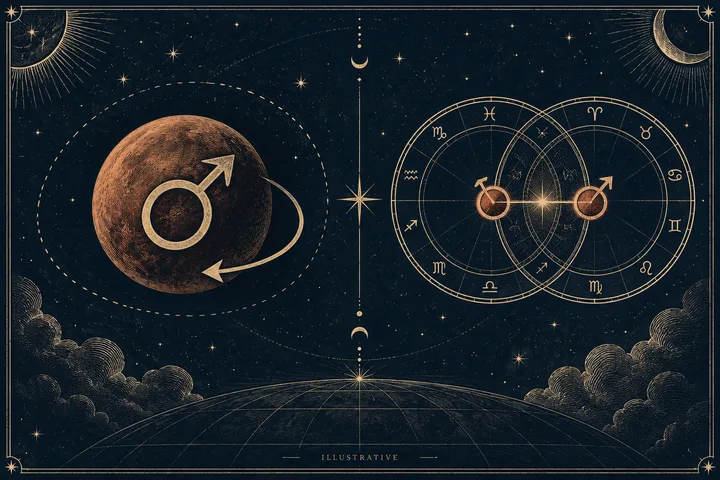
Let the confirmed aspect lead because it describes the contact between the two Mars placements; let natal retrograde refine how one person may experience or express that contact. This is a reading order, not a claim that geometry matters more to every astrologer. The sources address different layers. “Astrological Orbs Explained” treats synastry as a comparison of two natal positions and says astrologers often use tighter orbs there, while also stressing that orb rules vary. “Retrogrades in Natal Chart” describes possible inwardness, roundabout pursuit, uneven timing, or bursts of assertion for natal Mars retrograde. Put together, those ideas support a layered interpretation: first establish the shared pattern, then consider one person’s route through it. A compact way to hold the comparison is to track two questions at once. How close is the aspect to exact, and what kind of aspect is it? Separately, is either Mars retrograde, and what does that suggest about the person’s style of acting? A tighter contact sits nearer the exact angle than a wider one within the same chosen orb. That ranks geometric closeness, not force, compatibility, or relationship quality. “Astrological Orbs Explained” explicitly cautions that a tighter orb does not guarantee a stronger lived experience; its discussion ranges across chart techniques, so use its point here narrowly: closeness is a geometric measure, not an outcome scale. “An Introduction to Aspects and Chart Shaping in Natal Astrology” likewise discusses aspects through angular relationships and allowed orbs. Neither source establishes a universal Mars-Mars cutoff or a formula for relationship success. Now keep aspect character distinct from tightness. A close square and a close trine are both close contacts, but synastry interpretation gives them different starting tones: the square can describe pressure or friction, while the trine can describe easier flow. A wider square remains a square-like contact only if it falls within the stated working limit; it does not become more exact because one person has retrograde Mars. The natal condition can suggest that this person’s initiative is less direct, takes time to gather, or comes in a burst. It cannot change the angle between the charts. “Retrogrades in Natal Chart” offers these as possible expressions of Mars retrograde, not a fixed description of every person. Treat them as questions to test: does this person pause before acting, choose an indirect approach, or speak up after holding back? Some astrologers may put a planet’s natal condition or the whole natal chart first. That is a reasonable exception when the supplied chart context changes the meaning of Mars substantially. This comparison does not contain that full context, so it should not pretend to settle every hierarchy. Its narrower rule is practical: use the confirmed interaspect to name the shared action pattern; use retrograde as a modifier for one person’s expression; then compare both with what repeatedly happens between you. If the degrees are missing, there is no verified close aspect to lead with. If the measured separation exceeds the chosen six-degree orb, withdraw that aspect claim. If broader natal placements contradict the simple retrograde reading, revise the modifier. And if the person’s observable behavior does not fit the proposed style, let the interpretation change. The chart offers a lens for a conversation about initiative, delay, pressure, or repair. It does not overrule the person in front of you.
Sources: Astrological Orbs Explained; Retrogrades in the Natal Chart; Aspects in Astrology
When the rest of the chart changes the emphasis
Other close contacts can repeat, soften, or complicate a Mars theme, but they describe different functions. Keep the confirmed Mars-Mars aspect as evidence about how the two Mars principles meet. Then ask whether another contact adds a distinct layer. The distinction matters: a chart can show both a shared style of action and a separate pattern around affection, emotional response, or restraint. Those statements can sit beside each other without being collapsed into one claim. Consider a clearly illustrative comparison. If one person's Venus closely aspects the other person's Mars, that contact adds a Venus-Mars layer: Cafe Astrology's Synastry overview associates these interaspects with attraction, while distinguishing the Venus person's relating and pleasure from the Mars person's direct desire and action. That can help explain how affection and initiative meet. It doesn't prove that the pair's Mars-Mars square is easy, nor does it replace that square's reading. The Venus-Mars contact answers a neighboring question, not the same one. A close Saturn-Mars contact would add a different complication. Cafe Astrology's Synastry overview describes difficult Mars-Saturn contacts in terms of tension, frustration, and blockage. Read that as a possible theme of pressure around action or limits, not as a fixed account of who controls whom. Direction matters here: the Saturn person's planet contacts the Mars person's planet, so note whose function is being engaged before describing the exchange. The contact may sharpen a question about pacing or constraints. It does not turn retrograde Mars into a diagnosis, and it cannot establish what either person intends. Orb is the next filter. AstroNet's Astrological Orbs Explained says synastry orbs are often kept narrower than natal-chart orbs, while also stressing that astrologers use different limits and that no universal rule governs them. Under this article's stated six-degree working scope, a contact must first meet that declared boundary before it joins the reading as a selected major aspect. A dramatic interpretation can't make a wider contact closer. Nor should several loose contacts be counted as if they were one exact, repeated pattern. State which contacts qualify, which remain sign-level possibilities, and which are outside the chosen method. Then return to the question each placement can answer. Mars-Mars describes the shared action pattern. Venus-Mars may add how desire and affection interact; Saturn-Mars may add a question about limits and effort. The full natal charts can refine those readings through sign, house, and other aspects, as Cafe Astrology's overview notes, but the comparison here uses only supplied placements and optional degrees. If you know another close contact, name it as its own layer and say what new question it raises. Keep the Mars conclusion provisional when the degrees or broader context are missing. That way, added chart detail deepens the interpretation without quietly changing what the original aspect actually showed.
Sources: Synastry; Astrological Orbs Explained
What can you conclude when a degree or motion detail is missing?
With signs but no degrees, compare sign styles and leave the aspect and orb unconfirmed. Without reliable natal retrograde status, leave that modifier open. Missing information narrows the reading; it doesn’t turn what you do know into nothing. A sign comparison can still describe different ways of pursuing, asserting, or responding, but it can’t establish that the two Mars placements form a close square, trine, or other aspect. Keep those statements on separate levels.
A sign tells you where Mars is expressed in the zodiac. A degree lets you measure the angular distance between the two natal Mars placements and test it against the chosen aspect angle. AstroNet’s “Astrological Orbs Explained” defines an orb as the distance from an aspect’s exact angle and notes that astrologers use different limits. Under this report’s six-degree working rule, the calculation requires both degrees. If one is missing, you can’t confirm that the contact falls within the rule. A familiar sign pairing may suggest an angle to investigate, but it doesn’t supply the missing measurement.
Retrograde status is another distinct input. When a reliable chart identifies natal Mars as retrograde, “Retrogrades in Natal Chart” describes possible inwardness, roundabout pursuit, delays in assertion, or a more self-directed pace. Those are interpretive possibilities, not a diagnosis. If the motion detail is unknown, don’t assign those possibilities to someone by inference. You can still discuss the known Mars sign, while leaving the retrograde modifier undecided. Unknown does not mean direct, just as it doesn’t mean retrograde.
Birth-time uncertainty doesn’t automatically make every planetary placement unusable. But this comparison report works from placements you supply; it doesn’t calculate or verify them from birth details. Use a source you trust for each sign, degree, and motion label, and mark any uncertain input as uncertain. If you have signs only, stay with sign-level interpretation. If both degrees are available, calculate the angle and orb before calling the contact close. If retrograde status alone is missing, keep the geometric reading and set aside only that modifier.
Don’t infer whether a natal aspect is applying or separating, or how near Mars was to a station, from signs alone. Those claims concern motion at the birth moment and require precise positions and motion information. A natal synastry contact is a comparison of two fixed birth charts; it isn’t a current Mars transit moving toward exactness. The practical move is simple: list what is known, what is missing, and what each permits you to say. Then either gather the missing placement or keep the reading appropriately narrow.
Sources: Astrological Orbs Explained; Retrogrades in the Natal Chart
Turn the comparison into one useful next step
Turn the chart reading into one sentence you can test in conversation. For example: “Our Mars contact may describe how we coordinate action, while your natal Mars retrograde could make asserting a preference more inward or deliberate.” Keep it conditional. “Mars-Mars Aspects in Synastry” offers starting meanings for the contact, but it can’t tell you how either person will act in a particular moment.
Then ask about something you can both recognize: When plans change, who tends to restart the conversation? When one of you needs time before answering, what helps the other understand that pause? If tension rises, what repair lets you return to the issue? Choose one question that fits your experience. Repeated behavior should reshape the interpretation. The chart gives you language for a possibility, not a reason to dismiss what you observe.
If you have both Mars signs and degrees, compare them within a stated orb and note any supplied retrograde status. The Synastry Comparison Report organizes supplied Moon, Venus, and Mars placements, with optional degrees. It doesn’t calculate natal charts from birth details, so bring known placements. Keep one shared Mars theme, one possible difference in expression, and one conversation worth having. That’s enough to make the comparison useful without asking it to decide the relationship.
Sources: Synastry: Mars-Mars Aspects
Sources & further reading
- How to Read a Synastry Aspect When a Planet Is Retrograde
Existing coverage discusses retrograde planets in synastry; this article narrows the question to weighing natal Mars retrograde against a close Mars-Mars contact.
- Natal Retrograde Mars in Synastry: Desire and Conflict
Existing coverage addresses natal Mars retrograde and synastry contacts, but does not settle the assigned Mars-Mars weighting question.
- Astrological Orbs Explained
Explains orb measurement, variation in orb practices, and why a declared working limit should not be treated as universal.
- Aspects in Astrology
Supports explaining aspects as angular relationships and orb as distance from exactness.
- Astrology and Romance Compatibility
Assigned in the validated plan as a source for discussion of synastry orb practices.
- Retrogrades in the Natal Chart
Describes possible inward, indirect, or delayed expressions of natal Mars retrograde as interpretive possibilities.
- Synastry: Mars-Mars Aspects
Gives distinct starting interpretations for major Mars-Mars synastry aspects, including possible cooperation, friction, and polarity.
- Synastry
Distinguishes planetary contact themes, including Venus-Mars and Mars-Saturn, for bounded chart-context comparisons.
- Transits: Mars Retrograde
Distinguishes a time-bound Mars retrograde transit from natal Mars retrograde.
Synastry Comparison Report
Enter known placements for two people. Get an input-by-input comparison, selected aspect calculations and a clear record of what remains uncertain.
Compare our placements