Read natal retrograde Mars as a changed route for desire and self-assertion, not as proof of weak desire or hidden anger. Start with Mars’s sign and known natal context, then compare its degree with the other person’s Moon, Venus, and Mars using one consistent six-degree orb for major aspects. A close contact can make attraction or conflict feel personal, but retrograde describes how the Mars person may process the impulse: privately first, after reflection, or through repeated attempts to find the right moment. It doesn’t erase desire or guarantee withdrawal. Your practical test is simple: when this person wants something or feels crossed, do they name it, act on it, and repair the result? Synastry can show the pressure point. Their choices show how they use it.
Start with Mars, then add the retrograde condition
If you’re comparing charts, don’t begin with the word retrograde. Begin with Mars. What does this person do when they want something? How do they pursue it? What happens when somebody blocks the path? Mars gives the symbol a living shape before the retrograde condition changes its route.
Mars describes heat, initiative, appetite, courage, competition, anger, and the act of separating yourself from what you don’t want. It can show how a person approaches sex, work, a goal, a boundary, or a fight. In synastry, Mars also shows how one person’s action lands in the other person’s field. It may energize, provoke, pursue, protect, or challenge.
Read the natal Mars in four passes. Note its sign for style, its house for the life area where it acts, its condition by sign and traditional dignity if you use that method, and its major natal aspects. Then add the retrograde condition. A complete chart can supply the house and natal aspects. A placement-only report cannot calculate them, so don’t pretend it can. For the comparison, record both people’s Moon, Venus, and Mars signs and degrees when supplied.
Sources: Retrograde Motion - Astrodienst Astrowiki; The Planets - Celestial Organs and Their Functions; Synastry | Cafe Astrology
What natal retrograde Mars changes
Retrograde describes a planet’s apparent motion as seen from Earth. In natal interpretation, astrologers often read that reversal as an inward-directed force. For Mars, the impulse may develop privately before it becomes visible. The person may test a desire, revisit a decision, or wait until they know what they’re willing to defend.
That isn’t weak Mars. A person with natal retrograde Mars may be driven, sexually expressive, competitive, or formidable. The difference lies in the path between wanting and doing. Direct Mars tends to send the impulse outward and assess the result afterward. Retrograde Mars often assesses first, then chooses how to act. That can look thoughtful and deliberate. It can also look delayed, indirect, or sudden after a long quiet stretch.
Sign and natal aspects decide which version you’re seeing. Mars in a cardinal sign may still initiate quickly. Mars in a fixed sign may hold a position for a long time. Mars in a mutable sign may revise the plan as new facts appear. A close natal Mars-Saturn contact may add restraint or endurance; a Mars-Uranus contact may break the silence abruptly. If the birth degree is close to a station, investigate that separately. Without the degree and motion, claim retrograde Mars, not stationary Mars.
Sources: Retrograde Motion - Astrodienst Astrowiki; The Planets - Celestial Organs and Their Functions; Ep. 70 Transcript: The Astrology of Mars Retrograde Periods - The Astrology Podcast
Read desire through the synastry contact
The useful question isn’t ‘Does retrograde Mars want me?’ It’s ‘What does this Mars activate in the other person, and what response does that activation invite?’ A Mars contact can create heat without creating ease. It can make someone feel pursued, challenged, awakened, irritated, or vividly alive.
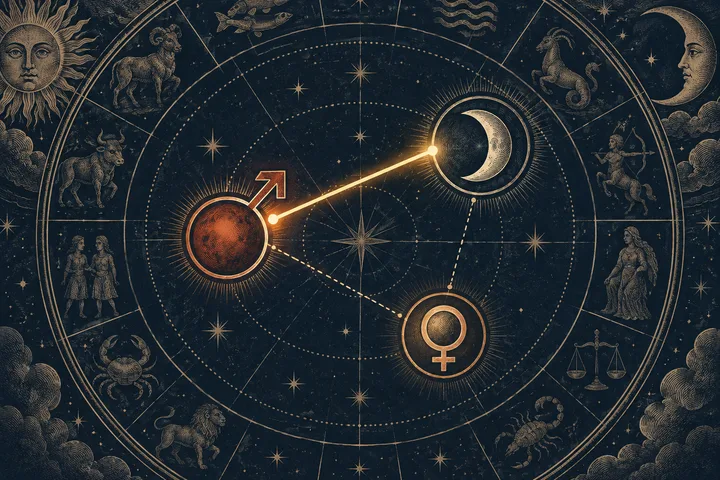
Mars to Venus is the classic desire comparison. A conjunction can blend pursuit and receptivity so strongly that the two people quickly feel each other’s presence. A square or opposition can keep attraction active while styles clash. A trine or sextile can make initiative feel welcome. These aspects describe a charged pattern, not a promise about what either person will choose.
Mars to Moon changes the emotional stakes. Mars may stir the Moon’s instinctive reactions, while the Moon can make Mars feel received or rejected. Mars to Mars shows how the two people act, compete, pursue, and fight. With one natal Mars retrograde, compare the contact and the tempo. One person may act while the other is still deciding. Name both sides: ‘Your Mars conjuncts their Venus, so the pull may be strong, but you may approach after private certainty while they read your waiting as a mixed signal.’
Sources: Aspect - Astrodienst Astrowiki; Synastry | Cafe Astrology
A worked comparison with signs and degrees
Consider an example. Maria has natal retrograde Mars in Virgo at 14 degrees. Daniel has Venus in Pisces at 16 degrees and Moon in Gemini at 12 degrees. These are illustrative placements, not a calculated personal chart. Maria’s Mars opposes Daniel’s Venus within two degrees and squares Daniel’s Moon within two degrees. We’ll use the report’s stated six-degree orb for major aspects.
Start with Maria’s Mars. Virgo gives the drive a practical, observant, improvement-focused style. She may show desire by helping, planning, noticing, and refining. Retrograde turns that Mars inward before it becomes obvious. She may question whether a desire is mutual or worth the risk.
The opposition to Daniel’s Venus in Pisces places two styles of pleasure across one charged line. Maria may want to make the connection workable. Daniel may want to feel it fully before defining it. Maria could experience him as elusive; he could experience her as evaluating. The opposition doesn’t cancel attraction. It gives the attraction a disagreement about timing and form.
The square to Daniel’s Gemini Moon adds emotional friction. He may ask questions or change topics when Maria wants a clear plan. She may hear evasion and hold the irritation inside, then raise it later with extra force. The ranking is clear: the tight Mars-Venus opposition leads the desire reading, the Mars-Moon square describes the emotional snag, and retrograde modifies Maria’s timing. It doesn’t outrank the exact aspects by itself.
The practical translation is short. Maria can say, ‘I need time to know what I want, but silence doesn’t mean I don’t care.’ Daniel can say, ‘When plans stay vague, I fill in the blanks. Tell me whether you’re interested, uncertain, or unavailable.’ The chart supplies a question. Their answer supplies the evidence.
Rank degree, aspect, and repetition
A synastry reading gets clearer when you rank evidence instead of collecting meanings. Start with the closest major aspect involving the retrograde Mars. An aspect is an angular relationship, and its orb is the distance from exactness. A two-degree conjunction deserves more attention than a six-degree sextile when the planets and context are otherwise comparable. The six-degree orb here is a working boundary, not a claim that every included aspect is equally loud.
A close aspect can cross a sign boundary. Mars at 29 degrees of one sign and Venus at 3 degrees of the next may be four degrees apart by longitude. Record the angle first, then describe the signs as its texture. Conversely, two planets can share a sign without being close enough to call a conjunction. The angle is the relationship. The signs tell you how it speaks.
Next, rank the planets. Contacts to the other person’s Moon, Venus, and Mars speak most directly to desire and conflict. Slower planets may deepen, restrict, intensify, or destabilize the pattern, but establish the personal-planet story first. Then look for repetition. If the Mars person’s natal aspects and the synastry contacts all repeat a theme of action versus emotional timing, that theme deserves more weight than one isolated symbol.
Finally, check the inputs. Sign-only placements show sign relationships, not a proven close aspect. Missing degrees mean you should not invent an orb. When degrees are supplied, calculate once and state the method. Clean inputs prevent a dramatic retrograde label from overshadowing the strongest evidence.
Sources: Aspect - Astrodienst Astrowiki; The Planets - Celestial Organs and Their Functions; Synastry | Cafe Astrology
Separate private desire from hidden resentment
The common mistake is to treat inward Mars as proof of buried anger. Sometimes a person with natal retrograde Mars swallows anger until it turns sharp. Sometimes they’re simply private about desire. Sometimes they need a second pass before they know what they believe. The chart can describe all three possibilities, so behavior has to separate them.
Private desire has a different rhythm from resentment. The person may take time to approach, but once they choose, their action is steady. They can name what they want without making the partner guess forever. Hidden resentment keeps score. The person agrees while withholding the real objection, then returns with a complaint much larger than the immediate event.
Watch what happens after the pause. A direct request shows reflection becoming action. Sarcasm, punishment, or a scorecard shows the inward pressure has become resentment. Disappearance leaves the other person carrying the uncertainty. Retrograde Mars doesn’t make anyone passive-aggressive, sexually blocked, or dangerous. Read the sign, house, natal aspects, and the person’s actual conduct.
Sources: Retrograde Motion - Astrodienst Astrowiki; Aspect - Astrodienst Astrowiki
Let Moon, Venus, and Mars answer different questions
Mars can’t carry the whole relationship reading. The Moon asks what feels safe and immediate. Venus asks what feels pleasing, lovable, and worth valuing. Mars asks how each person acts under pressure. Give each planet its own job before you combine the answers.
When retrograde Mars contacts the other person’s Moon, the Mars person may stir instinctive reactions before either person has a theory about the connection. A trine can make action feel supportive. A square can make initiative feel intrusive even when it is well meant. An opposition can create a strong pull that needs pacing. With Venus, compare attraction and style. With Mars, compare timing, competition, anger, and shared effort.
Then ask what the three layers agree on. Intense Mars with strained Moon contacts and little Venus support may describe activation without much ease. Warm Moon and Venus contacts can give the Mars tension somewhere kinder to land. Venus may feel affectionate while Mars struggles with pursuit, sex, boundaries, or conflict. A useful report says which layer leads, which one needs care, and what the difference asks the couple to discuss.

Sources: Aspect - Astrodienst Astrowiki; Synastry | Cafe Astrology
The strongest exception: retrograde Mars can be decisive
The strongest exception to the cautious retrograde picture is a Mars that is strongly placed or well supported. A retrograde Mars can be decisive, athletic, sexually confident, competitive, or fearless. The inward turn may sharpen the will instead of slowing it. An angular Mars or a close connection to the Sun, Venus, or Jupiter can make its action visible and forceful.
The retrograde condition still matters. It may describe a private standard for action, a nonstandard route, or a person who seems quiet until a line is crossed. Suppose retrograde Mars conjuncts a partner’s Venus while also trining the Sun. Desire may be obvious in action even if the Mars person doesn’t narrate every feeling. Suppose that Mars instead squares Saturn and opposes the partner’s Moon. The person may remain powerful, but caution and emotional defensiveness shape the delivery.
So don’t let the label defeat strong natal testimony. Let it explain the source, timing, privacy, or unusual route of the Mars expression. The decisive question remains follow-through: does the person choose, pursue what they value, and return to repair?
Sources: Retrograde Motion - Astrodienst Astrowiki; The Planets - Celestial Organs and Their Functions; Ep. 70 Transcript: The Astrology of Mars Retrograde Periods - The Astrology Podcast
Turn the reading into one clear next step
End with a ranked sentence, not a pile of symbols. ‘The close Mars-Venus opposition describes the pull. The Mars-Moon square describes where it becomes reactive. Retrograde Mars may make the Mars person process the impulse before showing it.’ That sentence tells the reader what leads, what modifies it, and what remains open.
Now turn the pattern into one observable agreement. If a pause is part of the Mars person’s process, name its meaning and its limit: ‘I’m upset and need an hour. I’ll come back tonight.’ If desire is the question, ask for a next action: an invitation, a clear answer, or a plan that survives the week. The point isn’t to force the chart into a promise. It’s to let the symbol meet conduct.
Natal retrograde Mars may explain why desire takes a private route or why conflict arrives after reflection. The synastry contact shows what gets activated between two people. Compare the supplied placements, rank the closest personal-planet contacts, and watch whether both people act clearly and return with care. That’s the reading you can use.
Sources: Retrograde Motion - Astrodienst Astrowiki; Aspect - Astrodienst Astrowiki; The Planets - Celestial Organs and Their Functions; Synastry | Cafe Astrology
Sources & further reading
- Retrograde Motion - Astrodienst Astrowiki
Supports retrograde motion as an apparent reversal and the inward-directed natal interpretation of a retrograde planet.
- Aspect - Astrodienst Astrowiki
Supports major aspect angles, orb as distance from exactness, and ranking exact contacts in interpretation.
- The Planets - Celestial Organs and Their Functions
Supports reading planetary functions through natal chart context rather than treating one condition as a complete personality judgment.
- Ep. 70 Transcript: The Astrology of Mars Retrograde Periods - The Astrology Podcast
Supports Mars-specific retrograde cycle features, stations, changes in speed, and the interpretive importance of natal Mars activation.
- Synastry | Cafe Astrology
Supports the distinct roles of Moon, Venus, and Mars contacts and the attraction or friction described by Venus-Mars aspects.
Synastry Comparison Report
Enter known placements for two people. Get an input-by-input comparison, selected aspect calculations and a clear record of what remains uncertain.
Compare our placements