Imagine a couple who shares a fight style but not a pace
Imagine Maria and Daniel. This is an illustrative example, not a report about real people. Both have Mars in fixed signs. Both remember what happened. Both want a real answer, not a vague apology.
But Maria wants to name the sharp comment before dinner ends. Daniel goes quiet, sleeps on it, and returns two days later with a careful account. Maria hears avoidance. Daniel hears pressure. Their Mars signs may describe a shared willingness to hold ground, yet their conflict clocks tell a different story.
Synastry compares two horoscopes and the interaspects between them. The contact describes an exchange, not a verdict about either person. So start with the event you can observe: who reaches for movement, who needs space, and what does each person assume that timing means?
This article uses supplied placements only. It doesn't calculate natal positions, houses, or a personal chart from birth details. With Mars signs, and degrees when available, you can still build a useful comparison. Begin with the style. Then measure the contact. Then ask what the pair can change.
Sources: Synastry | Cafe Astrology; Synastry | Astrodienst Astrowiki
Read Mars for energy, element, and modality
Mars shows how desire becomes action. In synastry, it can describe assertion, pursuit, physical attraction, and the way tension moves into a decision. Cafe Astrology's Mars material treats the planet as a source of drive and notes that a major Mars contact can raise both passion and competitiveness.
Read the sign in two passes. Element gives the tone. Fire often acts plainly, earth builds and persists, air works through words and ideas, and water protects feeling and trust. These are interpretive starting points, not personality verdicts.
Modality gives the timing. Cardinal Mars wants to begin or force a change. Fixed Mars holds a position and may need proof before moving. Mutable Mars adapts, revises, and keeps options open. Two fixed placements can share endurance while disagreeing about when a response is ready. Two cardinal placements can both demand movement while one pushes through action and the other through questions.
Use a verb for each placement: starts, presses, waits, tests, explains, withdraws, repeats, or settles. Then add the protective need beneath it. Aries Mars may guard autonomy. Cancer Mars may guard safety. Virgo Mars may guard order. Those meanings need the rest of the chart and the lived situation, but they give you a precise question to ask.
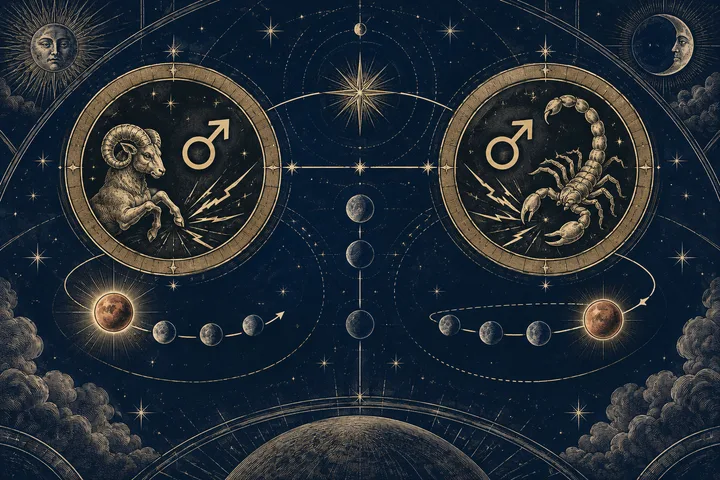
When two Mars signs handle conflict in a similar way but move at different speeds, compare timing before you judge compatibility. Start with each Mars sign's element and modality. Fire may act quickly, earth may wait and persist, air may talk through the issue, and water may need emotional safety before speaking. Then check the exact Mars-to-Mars aspect, its degree distance, and any close contacts to the Moon, Mercury, Venus, or Saturn. A six-degree orb is the working limit for this report, but a tighter contact gets priority. The key question isn't whether one person is right. It's whether one person is pressing while the other is still gathering enough safety or clarity to respond. In the example below, two fixed Mars signs share stubborn follow-through, yet one wants the disagreement named now and the other needs time. Compare the pattern, name the pause, and agree on when the conversation resumes.
Sources: Synastry | Cafe Astrology; Conflict Styles Through Mars: Signs, Houses, and What to Do About It
Turn similar signs into a timing comparison
Don't average two Mars signs into one label. Put them side by side. Record whether each person tends to act fast or slowly, speak directly or indirectly, solve the practical issue first or name the feeling first, and return alone or through immediate discussion.
Consider two earth Mars placements. Both may dislike emotional spectacle. One wants a workable plan before discussing hurt. The other needs the hurt acknowledged before any plan can feel sincere. They share restraint, but not the order of operations. That difference is the useful part of the reading.
Now consider two air Mars placements. Gemini Mars may open five questions at once. Libra Mars may weigh the cost of choosing one answer. Both use language, but one experiences more questions as progress while the other experiences them as a widening argument. Same element. Different pace.
Rank the mismatch instead of dramatizing it. A request for an evening to think is not the same as weeks of disappearance. A direct opening is not the same as coercive access to another person's thoughts. Astrology can help name the pattern. Conduct tells you how serious the pattern is.
Sources: Synastry | Cafe Astrology; Conflict Styles Through Mars: Signs, Houses, and What to Do About It
Let the Mars-to-Mars aspect change the emphasis
After signs and modalities, calculate the angle between the two supplied Mars positions. A conjunction brings the drives into one field. A sextile or trine can support shared action. A square can expose friction between methods. An opposition can create a strong counter-movement in which each person feels the other from across the issue.
Cafe Astrology's Mars-Mars guide links conjunctions with shared instinct and competition, while squares and oppositions can expose different ways of expressing anger and initiative. It also gives soft aspects a role in helping the pair work toward a common aim. The point isn't to sort aspects into good and bad. It is to ask what kind of work the contact demands.
Suppose Maria's Mars and Daniel's Mars form a close square. Their fixed signs already suggest persistence. The square adds friction between the ways they hold position. Maria's request for an answer presses Daniel's resistance; Daniel's resistance makes Maria press harder. The aspect helps explain the loop. It doesn't choose a culprit.
If the signs suggest a relationship but no close major aspect is present, lower the volume of the sign story. If a tight Mars contact is present, let it lead the Mars section. A conjunction asks whether the pair can share initiative. A square asks whether they can stop turning pressure into a contest. An opposition asks whether they can make room for two valid drives without making every choice a counter-choice.
Sources: Synastry | Cafe Astrology; Synastry | Astrodienst Astrowiki; Synastry: Mars-Mars Aspects
Use degrees and orbs to rank the evidence
An aspect is an angular relationship between chart positions. The orb is the distance from exactness that you allow. Astrodienst notes that interaspects are often read with a smaller orb because comparing two charts can quickly create too many contacts. Celestia's guide likewise gives tighter contacts more weight and treats wider contacts as more diffuse.
This report uses a six-degree working orb for selected major contacts. That is the scope of the comparison. It isn't a universal rule. A Mars-Mars conjunction at one degree ranks above one at five degrees, while a contact outside six degrees stays outside this report's selected aspect list.
Record the inputs plainly: Person A's Mars sign and degree, Person B's Mars sign and degree, the shortest angular distance, the aspect name, and the orb. If degrees are missing, compare element and modality but leave aspect strength unranked. The report uses supplied placements. It doesn't invent the missing ones.
For a worked calculation, Mars at 2 degrees Taurus and Mars at 8 degrees Leo sit 96 degrees apart. That is a square with a six-degree orb in this method. Mars at 2 degrees Taurus and Mars at 17 degrees Leo sit 105 degrees apart. The fixed-sign contrast remains, but the square falls outside the stated orb. Same sign pair. Different technical reading.
Don't turn an orb into a compatibility score. Use it to decide which contact deserves the first paragraph. Then check whether that contact describes the lived question. Precision means showing the inputs and their limits.
Sources: Synastry | Astrodienst Astrowiki; Synastry Aspects Explained
Let Moon, Mercury, Venus, and Saturn refine the picture
Mars-to-Mars tells you how two drives meet. Other contacts tell you what that meeting touches. Rank the tightest personal-planet contact first, then ask whether it repeats or modifies the Mars story.
Moon-Mars can make an argument feel personal. The Moon person may need reassurance before action feels safe, while the Mars person experiences that need as a demand or delay. Cafe Astrology's Moon-Mars guide describes strong attraction alongside touchiness and quick emotional reactions. Read that contact when the disagreement seems larger than the practical issue.
Mercury-Mars moves the tension into language. A challenging contact can turn questions into sparring or make interruptions feel like attacks. A flowing contact can make talk lively and useful. Ask who needs to finish a thought, who needs a clear answer, and which words reliably raise the temperature.
Venus-Mars can mix attraction with irritation. Saturn-Mars can describe restraint, pressure, or a structure that helps initiative become dependable. These contacts don't cancel one another. One may name the heat, another the hurt, and another the practice that keeps the couple from repeating it.
The strongest supporting contact is often the one that offers a route through the pattern. Mercury can name the issue. The Moon can identify the tender place. Saturn can hold a promise. Read for the planet that can carry the repair, not only the planet that explains the clash.
Sources: Synastry | Cafe Astrology; Synastry: Mercury-Mars Aspects; Synastry (Relationship Astrology) Moon-Mars Aspects
End with a testable agreement, not a compatibility label
Return to Maria and Daniel. Their chart comparison is useful only when it changes the next conversation. They can agree that the person who asks for a pause names the return time. Tomorrow at seven is an agreement. Someday is not.
The person who wants an immediate answer opens with one clear sentence instead of a prosecution. The person who needs time returns with one concrete point, one feeling, and one request. That structure gives action somewhere to go without treating delay as abandonment or urgency as proof of love.
Adapt the agreement to the chart. Cardinal Mars may need a first step. Fixed Mars may need evidence that the step will be kept. Mutable Mars may need a written summary so the issue doesn't keep changing shape. Fire may need movement before talking. Earth may need a practical plan. Air may need accurate words. Water may need reassurance before exposure.
Then watch the behavior. Did the pause happen? Did the return happen? Did both people stay with one issue? If the answer is yes, keep refining the practice. If one person repeatedly uses urgency or delay to punish, disappear, or control, stop asking the chart to explain away the conduct. That is the meaningful exception.
So compare Mars signs for tone and modality, rank the closest contact by degree, add the personal planets that change the experience, and make one agreement you can observe. Similar conflict style helps. It doesn't guarantee shared timing. The decision is whether both people will work with the difference.
Sources: Synastry | Cafe Astrology; Synastry | Astrodienst Astrowiki; Synastry: Mars-Mars Aspects
A little more clarity
Can two people with compatible Mars signs still argue about timing?
Yes. Compatible elements can make action feel natural, but modality, degree contacts, and other planets can create a pace mismatch. One person may want the issue named now while the other needs time to gather safety, facts, or emotional clarity. Read the sign tone and the timing pattern separately, then agree on when a pause ends.
Sources & further reading
- Synastry | Cafe Astrology
Supports Mars as a symbol of assertion, desire, physical attraction, and conflict in synastry, plus the differing meanings of major aspects and modalities.
- Conflict Styles Through Mars: Signs, Houses, and What to Do About It
Supports the element and modality comparison of Mars signs, including different tones and tempos in conflict.
- Synastry | Astrodienst Astrowiki
Supports the technical definition of synastry as comparing two horoscopes and reading the interaspects between them.
- Synastry Aspects Explained
Supports the meaning of angular aspects and the editorial distinction between tighter and wider orbs in synastry.
- Synastry: Mars-Mars Aspects
Supports the direct Mars-to-Mars reading: conjunctions combine instinct and drive, while squares and oppositions can expose different ways of expressing anger and initiative.
- Synastry: Mercury-Mars Aspects
Supports the language layer of Mars contacts, including lively exchanges, interruptions, mental sparring, and the contrast between challenging and flowing Mercury-Mars aspects.
- Synastry (Relationship Astrology) Moon-Mars Aspects
Supports the emotional layer of Moon-Mars contacts, including attraction, touchiness, instinctive reactions, and the Moon person's need for sensitivity or security.
Synastry Comparison Report
Enter known placements for two people. Get an input-by-input comparison, selected aspect calculations and a clear record of what remains uncertain.
Compare our placements