
What does a Chiron-Mars contact actually describe?
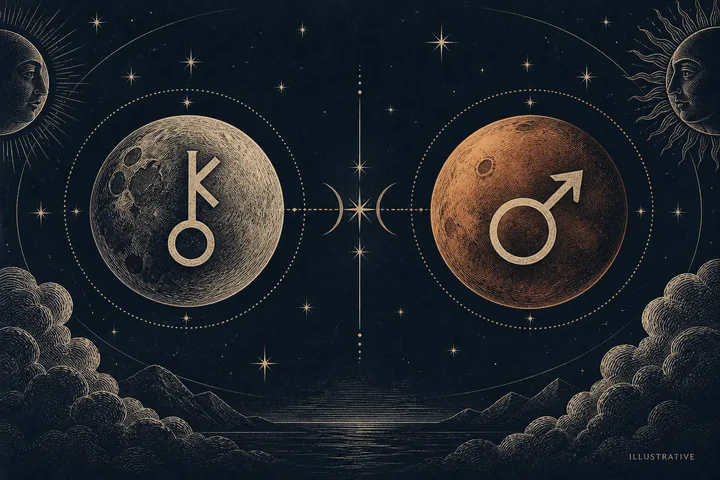
A Chiron-Mars contact joins two very different forces. Mars moves toward what it wants. It cuts through hesitation, takes action, pursues desire, meets resistance and protects what matters. Chiron carries the story of the wounded healer. In a chart, astrologers read it as a tender place that can become a source of insight, teaching and repair. When these two points meet between charts, action touches vulnerability.
That contact can feel immediate. The Mars person may activate the Chiron person's fear of being overpowered, dismissed or shamed for wanting something. The Chiron person may make the Mars person feel that ordinary directness has become dangerous, or that every assertion will be judged. Sometimes the roles reverse from one argument to the next. Synastry does not hand out permanent character labels. It shows the field between two people and the themes that field can awaken. That field is relational, so both people help shape its expression.
The strongest reading is not that one person wounds and the other heals. That is too neat. The better reading is that the pair's way of acting, fighting, desiring and defending becomes tied to an old tender place. The contact asks a difficult question: Can force become clear action without becoming force against the other person? Can vulnerability become honest information without becoming a weapon, a test or a reason to avoid every hard conversation?
Cafe Astrology's Chiron aspect reference places the Chiron-Mars theme around asking for what one wants, trusting anger as information and expressing self-assertion with confidence. That gives the contact a useful center. The symbol is not simply conflict. It is the struggle to act without shame and to meet another person's action without losing one's dignity. In synastry, read that struggle as a shared pattern, then check whether the two people handle it with care. That is why the contact deserves a question, not a verdict: what happens when direct action meets a tender place?
Sources: Chiron in Aspect in the Natal Chart; Planetary Aspects
Which chart information do you need before interpreting it?
Start with the actual data. You need the sign and degree of one person's Chiron, the sign and degree of the other person's Mars, and the reverse pairing as well. Person A's Chiron at 14 degrees Gemini contacting Person B's Mars at 16 degrees Gemini is a different contact from Person A's Mars at 14 degrees Gemini contacting Person B's Chiron at 16 degrees Gemini. Both may matter. They do not tell the same story.
Then identify the aspect. A conjunction brings the symbols into the same place. An opposition puts them across the chart and can make the other person feel like a direct counterpart. A square creates friction that demands a response. A trine or sextile tends to give the symbols an easier route, though ease can make a pattern less visible. An inconjunct, or quincunx, asks for adjustment because the signs do not share a simple element or mode.
Degrees decide whether the contact is close enough to lead the reading. This report's comparison scope uses a six-degree orb for selected major aspects. A contact at one degree deserves more weight than a contact at five degrees. A sign-only match without degrees remains a possibility, not a confirmed aspect. Do not fill the gap with an invented chart. Say what you know, what you don't know, and how that changes the strength of the interpretation.
Birth time matters for houses and angles. It can also affect the exact placement of fast-moving points and the house overlay. This article does not calculate a natal chart from birth details. If you already have the placements, you can compare them here. If you have only birth dates, use a proper chart calculation first, then bring the resulting positions into the comparison. Keep the method visible. Precision makes the reading kinder because it stops a broad symbol from carrying more weight than it can hold.
A useful worksheet has four lines for each direction of the contact: Chiron sign and degree, Mars sign and degree, aspect and orb, then the question this combination raises in ordinary life. For example: Libra Chiron, Capricorn Mars, square at two degrees, 'Can we make decisions without turning fairness into a contest?' This keeps the reading connected to a real question. It also stops the astrologer from drifting into grand claims about the entire relationship.
If you don't know the degrees, write 'sign resonance' rather than 'square' or 'conjunction.' If one person's birth time is uncertain, don't build a house interpretation around it. You can still read the supplied sign and degree relationship, but lower the confidence of any angle or house claim. Missing information tells you where to stop. Keep direction in your notes: A's Chiron to B's Mars may describe where B's action touches A's tender ground, while the reverse pairing may describe a different sensitivity.
How does Chiron set the sensitive point?
Read the Chiron person first, but don't reduce that person to a wound. Ask what part of selfhood feels exposed when another person acts with Mars. The sign describes the style of the tender point. Chiron in Aries may bring sensitivity around independence, courage, initiative or the right to go first. Chiron in Taurus may make security, the body, money or personal values the charged ground. Chiron in Gemini may react around being heard, answered or understood.
Chiron in Cancer can make protection, family feeling and emotional safety central. Chiron in Leo may feel exposed around pride, visibility or the right to take up space. Chiron in Virgo may react to criticism, usefulness and the fear of getting something wrong. Chiron in Libra can make conflict, fairness and mutual consideration especially important. Chiron in Scorpio may touch trust, control, sex, loss or the fear of being betrayed.
With Chiron in Sagittarius, a Mars person's certainty or blunt conviction may touch beliefs and meaning. Chiron in Capricorn can be sensitive to authority, competence, status and the burden of responsibility. Chiron in Aquarius may guard difference, freedom or belonging to a group. Chiron in Pisces may register harshness through empathy, porous boundaries or spiritual trust. These are starting lenses, not diagnoses. The house and natal aspects refine the picture.
Now add the Chiron person's natal story. A natal Chiron-Mars aspect can make self-assertion a lifelong lesson before any partner arrives. The synastry Mars may not create the sensitivity. It may press the existing place, make it visible or offer a new way to practice directness. This is why the same partner's Mars can feel liberating in one chart and unbearable in another. Chiron shows where the contact lands. It does not tell you what the other person intends.
The sign also suggests a question for repair. Libra Chiron might ask for fair turns, Cancer Chiron for a gentler entry, Virgo Chiron for criticism without contempt, and Scorpio Chiron for plain truth about trust or privacy. Test the symbolism against the person's own language. Recognition helps, but it isn't resolution. The pattern still has to change.
Sources: Chiron in Aspect in the Natal Chart; Planetary Aspects
What does the Mars person bring into the contact?
Mars describes the way someone acts, pursues, fights, desires and uses energy. In synastry, the Mars person may feel that they are simply being honest or efficient. The Chiron person may experience that same movement as pressure. Neither label settles the matter. You have to ask what Mars is doing in the actual exchange.
Mars in Aries tends to act fast and directly. Mars in Taurus can hold its ground and resist being hurried. Mars in Gemini may argue through words, questions and quick changes of position. Mars in Cancer can act protectively, defensively or indirectly when feeling exposed. Mars in Leo may bring pride and dramatic self-expression. Mars in Virgo may fix, correct and focus on the detail that seems wrong.
Mars in Libra may fight for balance but avoid a clean statement until pressure builds. Mars in Scorpio can pursue with intensity and remember what others would rather leave behind. Mars in Sagittarius may speak frankly and move toward freedom. Mars in Capricorn can act with control, patience and clear aims. Mars in Aquarius may detach, challenge convention or insist on room to choose. Mars in Pisces may act through feeling, imagination and changing boundaries.
A current synastry reference describes Chiron-Mars as a meeting of assertive energy and deep sensitivity, with the square asking the Mars person to refine force and the Chiron person to develop agency. That gives this contact a useful standard. Mars has to become directed energy. If it never becomes accountable action, the constructive interpretation has not earned its place.
Mars is also libido, initiative, competition, courage and the body's urge to move. That wider range keeps the reading from becoming a fight forecast. The contact may surface while a couple plans a move, negotiates sex, divides work or decides who leads. Shared action can give the energy a clean channel, but it can't replace accountability when someone has been hurt.
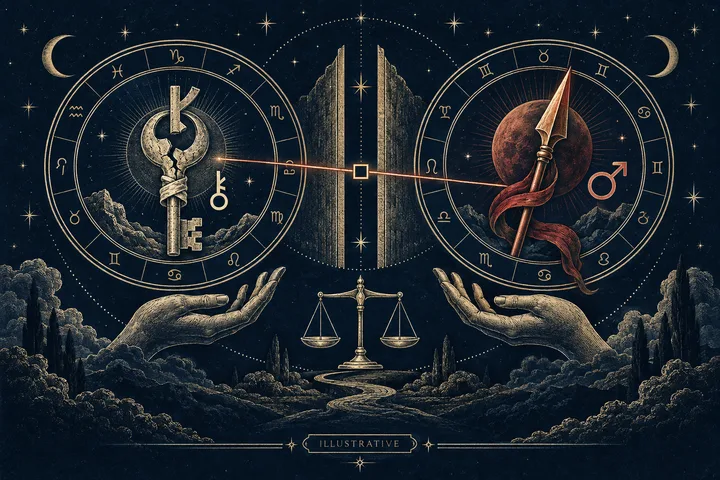
Yes, a Chiron-Mars contact can describe a tender place around anger, desire, assertion and conflict. It can show why one person feels exposed when the other pushes, acts quickly or speaks with force. It can also show where a couple might learn cleaner self-assertion together. But the contact describes a charged pattern, not a pardon. A close square may make a disagreement feel raw; it doesn't make intimidation acceptable. Read the aspect only after checking which person's Chiron and Mars are involved, the exact degree and the wider synastry. Then compare the symbolism with observable behavior: Does the Mars person slow down, hear no, repair and change? Does the Chiron person get to name hurt without being punished for it? If you know only the signs, keep the reading broad. If you have degrees, use the supplied placements and a six-degree orb to test the contact. Your next step is simple: name the trigger, name the boundary, and watch what happens after you say it.
How do conjunction, square, opposition, trine and sextile differ?
The aspect tells you how the two symbols meet. It does not rank a person as good or bad. Start with the conjunction. Chiron and Mars occupy the same area, so action and sensitivity can fuse. Attraction may be strong. So can reactivity. The Mars person may hit the Chiron person's tender point without realizing it, while the Chiron person may make every Mars move feel personally loaded. The gift is immediacy. The task is separation: this is my feeling, that is your action, and we can speak about the link.
A square creates a sharper rub. The Mars person may push for movement while the Chiron person needs time to gather confidence. A request for space can look like rejection. A request for an answer can feel like an attack. Read the square as a recurring difference in tempo and self-protection, then ask which other contacts help the pair translate that difference.
An opposition places each person on a different side of the same axis. The Chiron person may see Mars as the force that disturbs peace. The Mars person may see Chiron as the force that stops honest action. They can alternate roles. One pushes, the other retreats; then the retreat makes the push harder. The opposition needs mutual recognition. Neither person gets to own the truth of the conflict.
A trine can make Mars seem naturally helpful to Chiron. The Mars person may encourage the Chiron person to take a risk, speak up or defend a need. A sextile can offer a similar opening, but it usually asks for conscious use. Easier aspects still need consent and timing. A flowing contact may hide the issue because the couple enjoys acting together, yet a tender point can surface when fatigue or fear removes the usual grace.
Use the aspect as the first sentence of the interpretation, not the last word. The sign tells you how the energy speaks. The degree tells you how close it is. The natal chart tells you what each person carries. The rest of the synastry tells you whether this contact has support, pressure or an entirely different outlet.
A practical ranking helps when several aspects appear. Give the closest major Chiron-Mars contact the first look. Then ask whether the aspect is hard or flowing. After that, compare the signs and the natal condition of both points. Finally, check whether Mercury, Moon, Venus or Saturn repeats the same subject. A wide square with no support should not outweigh a close Moon-Mercury pattern that shows how the couple names and processes experience.
A conjunction deserves care because its concentration can feel like destiny. It may bring instant recognition or physical charge. Those feelings show intensity, not permanence.
Sources: Planetary Aspects; Synastry Chiron-Mars Aspects; Chiron in Astrology
Can an illustrative chart show sensitivity without excusing harm?
Consider an example. Maria has Chiron at 12 degrees Libra. Daniel has Mars at 14 degrees Capricorn. The two placements form a square within a two-degree orb. This is an illustrative chart, not a calculation for a real couple. Maria's Chiron in Libra makes fairness, mutual regard and the tone of conflict especially tender. Daniel's Mars in Capricorn may act through control, plans, blunt priorities and a wish to solve the problem efficiently.
The first reading says Daniel's way of taking charge can touch Maria's fear that her needs will be weighed, dismissed or treated as an inconvenience. Maria's hesitation or careful wording can touch Daniel's frustration with delay. If they are both resourced, he can help make a decision real while she helps him include the relationship in the decision. The square gives them a live practice: act decisively without making one person smaller.
Now change the scene. Daniel interrupts Maria, calls her oversensitive and refuses to stop when she says the conversation has become too heated. The chart still describes why the contact might feel piercing. It doesn't change the event. Maria can name the interruption and the refusal to pause before she interprets the square. The useful question is not whether Daniel meant to touch a wound. It is whether he can hear the limit and change what he does next.
Change the scene again. Daniel hears the boundary, takes a twenty-minute pause, returns when he promised and answers the original concern without mocking it. Maria names the exact action that hurt and does not use her hurt to demand total control over his speech. Now the symbolism has a constructive path. He learns that restraint is not weakness. She learns that directness need not mean abandonment. The aspect hasn't become easy. The people have become more skillful.
This comparison gives the contact a practical test. Astrology can describe the trigger and the possible lesson. The next exchange shows whether the lesson has entered the relationship. Look for a named action, a return to the subject and a change when the same trigger appears again. A moving apology matters, but repeated conduct carries the interpretation further.
The example also shows why a chart cannot replace a conversation about consent. Suppose the couple is discussing sex. Maria says she wants to stop. Daniel feels rejected and the Chiron-Mars charge rises, but the meaning of his feeling is not permission to continue. The correct Mars response is to stop. The correct Chiron response may include naming the fear, asking for reassurance or taking time to settle. Attraction can remain real. The boundary remains real too. This is the difference between reading desire and surrendering judgment.
The same pattern can appear around travel, money or the future. Daniel may want a quick answer; Maria may need a fair process. The aspect can name the friction, but it can't decide who gets the final say.
Which chart layers should outrank the contact?
A close Chiron-Mars contact matters, but it shouldn't become the whole relationship. Rank it in this order: exactness, wider chart support, then lived pattern. A close aspect leads a sign-only resemblance. A repeated theme across Mercury, Moon, Venus or Saturn gives it more weight. Houses can refine the story only when the birth times and house method are dependable.
Then return to the natal charts. Ask whether each person already has a way to express anger, desire and self-protection with steadiness. Chiron-Mars may press an old sensitivity, but it doesn't create every reaction from nothing. The natal context tells you what each person carries before the partner's Mars arrives.
The Synastry Comparison Report can help with the surrounding comparison: it uses supplied Moon, Venus and Mars placements, optional degrees and selected major aspects within a six-degree orb. It doesn't calculate Chiron, houses or natal positions from birth details, so it can't produce this Chiron-Mars contact. You can record the known Chiron and Mars placements separately, then use the report to see whether the relationship planets repeat the same theme. When you're ready, [Compare our placements](/compatibility-test).
Sources: Planetary Aspects; Synastry Chiron-Mars Aspects; Chiron in Astrology
What is the strongest exception to a sensitive reading?
The strongest exception is simple: an exact contact may not describe the couple's main conflict. Another synastry aspect may carry the pressure, or the natal charts may give Mars a steady outlet and Chiron a practiced voice. Intensity alone doesn't make Chiron-Mars the lead story.
The reverse can happen too. A wider contact may matter when an angle, natal aspect or repeated synastry pattern reinforces it. Keep the six-degree orb as the report's working limit for selected major aspects, then ask whether the lived pattern supports giving anything wider a place in the reading.
If the symbolism clashes with what you repeatedly observe, rank the conduct higher. Give Chiron-Mars authority only when the contact is close enough to matter, another chart layer repeats its subject, and both people can respect a limit and repair a mistake. If one is missing, hold the interpretation lightly.
Sources: Chiron in Aspect in the Natal Chart; Planetary Aspects; Synastry Chiron-Mars Aspects
How can you use the reading in a real conversation?
Don't open with, 'Your Mars is hurting my Chiron.' Name the event first: 'When you kept pressing after I asked for a pause, I felt cornered. I need us to stop when either person calls a pause and agree on when we'll return.' The chart can come later. The human sentence has to lead.
Use one question to test the pattern: 'When I say no or ask for time, what do you hear?' Then watch what follows. The Mars person can trade speed for clarity, ask whether the other person wants comfort or a solution, and repair a sharp action without calling hesitation a flaw. The Chiron person can name the trigger, make a clear request and keep the right to choose.
Write down what happened, what you needed and what behavior would help next time. Keep it to one event. Then watch for action: respect for the pause, a promised return, and a changed response when the trigger appears again. If someone threatens, coerces, stalks, blocks exits or punishes your no, seek safety and support. Leaving harm isn't failing a healing lesson.
Sources: Chiron in Aspect in the Natal Chart; Synastry Chiron-Mars Aspects; Chiron in Astrology
A little more clarity
Does Chiron-Mars synastry mean the relationship will be painful?
No. It means action and vulnerability meet in a charged way. A hard aspect may make conflict feel personal, while a trine or sextile can make courage easier to access. The wider synastry and repeated choices matter more than the label.
Which person is the wounded one in a Chiron-Mars contact?
The Chiron person usually feels the contact in the tender area represented by Chiron, while the Mars person often experiences themselves as the actor, pursuer or challenger. But synastry is interactive. The Mars person can feel judged or blocked, and the roles can change across different arguments. Don't turn the aspect into a fixed victim-and-healer script.
Can astrology explain abusive behavior in a Chiron-Mars contact?
It can help name why a pattern feels activated, but it can't excuse abuse. Intimidation, coercion, threats and punishment for a boundary are behavior choices. Name what happened, decide what you need and seek support when safety is at risk.
Sources & further reading
- Chiron in Aspect in the Natal Chart
Supports the Chiron-Mars themes of self-assertion, anger, desire, shame and learning to express these needs with confidence in a natal chart reading.
- Planetary Aspects
Supports treating an aspect as chart-comparison material whose meaning depends on the specific planetary combination, aspect form and wider chart context.
- Synastry Chiron-Mars Aspects
Supports the synastry-specific reading of assertive Mars meeting Chiron sensitivity, including the square's call to refine force and develop agency.
- Chiron in Astrology
Supports reading Chiron through sensitive chart areas, self-understanding and the possibility of becoming a guide in the same themes of life.
Synastry Comparison Report
Enter known placements for two people. Get an input-by-input comparison, selected aspect calculations and a clear record of what remains uncertain.
Compare our placements