Imagine a quiet pattern that keeps returning
Imagine Maria and Daniel. They are not fighting all the time. That is what confuses Maria. Daniel is warm in person, remembers small details, and can make an ordinary Tuesday feel intimate. But when Maria goes quiet, he pushes for an answer. When she wants comfort, he offers a plan. When she asks for a little space, he hears distance. The same scene keeps returning in new clothes.
Both people know a few placements. Maria’s Moon is in Taurus. Daniel’s Venus is close to it, his Mars makes a square to it, and his Saturn forms a wider trine. They have not entered exact degrees into a chart comparison yet. They want to know whether the three contacts tell one story or three unrelated ones.
They tell one story with three voices. Maria’s Taurus Moon sets the emotional ground: steadiness, touch, predictable care, and time to settle. Daniel’s Venus brings fondness and a wish to create ease. His Mars adds heat and movement, so his attempts to help can arrive as pressure. His Saturn offers endurance, but it can also make emotional safety feel like a duty that must be managed correctly.
This is the first rule for repeated Moon contacts. Do not count aspects as points on a scoreboard. Ask what keeps happening when the Moon person needs something. Which planet answers first? Which planet complicates the answer? Which contact describes the repair that is actually available?
The chart does not replace the scene. It gives the scene a language. Maria still has to say, “I need you to listen before you solve this.” Daniel still has to show whether he can hear it. The astrological pattern helps them notice why the same moment has such force, then choose a better response.
That is the question beneath the technical one. Repetition matters because it concentrates attention. It does not prove that every Moon contact has equal weight, or that a bond must last. It tells you where the relationship’s emotional weather gathers.
Maria and Daniel might notice this pattern first in a small moment. Maria sends a message saying she had a hard day. Daniel replies with three solutions and asks why she has not answered his last question. Maria feels more alone, so she withdraws. Daniel reads the withdrawal as proof that something is wrong and pushes harder. The chart does not cause this exchange. It can help them see why care, urgency, and silence keep joining hands.
A repeated Moon pattern can also feel good. The same contact that makes one person sensitive may make the other unusually attentive. Daniel may know when Maria needs food, quiet, or a hand to hold. Maria may notice that Daniel works hardest to repair after he reacts. The reading should keep both sides in view. Emotional intensity is not automatically a wound. Sometimes it is the place where devotion becomes visible, provided both people can stay responsible for their own feelings.
The phrase “one person’s Moon” matters here. It identifies the chart factor receiving several contacts, not the person who owns all emotional truth. The Moon person may feel the pattern first, while the other person’s planets describe the forms of response available in the relationship. But both people have a Moon, a history, and a way of seeking safety. A careful reading leaves room for the second Moon even when the assignment centers on the first.
Before interpreting anything, write down what is known. Record each Moon sign, each contacting planet, and the degrees if supplied. Then separate confirmed contacts from possible ones. That small editorial act changes the reading. You stop asking the chart to solve a mystery it cannot answer and start asking the right question of the information you actually have.
What does the Moon person bring into the synastry?
In synastry, one person’s Moon is the chart factor being touched. It carries emotional needs, instinctive responses, memory, habits of comfort, and the conditions that help that person feel safe. Astrodienst describes the Moon as a key indicator of home, feelings, emotional needs, and the instinctive emotional response. That gives us a firm starting point: a repeated Moon pattern is about lived feeling before it is about romance, attraction, or public chemistry.
The Moon’s sign tells you the style of the need. A Taurus Moon may settle through consistency, physical ease, and dependable routines. A Gemini Moon may need words, movement, and room to name changing feelings. A Scorpio Moon may need trust deep enough to withstand exposure. These are interpretive examples, not calculations for Maria or Daniel. The sign is the emotional dialect. It is not the whole sentence.
The contacted planet shows what meets that dialect. Venus may offer affection, pleasure, and a wish to keep the bond kind. Mars may activate the Moon quickly, bringing courage, desire, irritation, or a push toward action. Saturn can contain and commit, but it can also make the Moon feel judged or controlled when the contact is strained. Uranus can wake the Moon up and disturb its usual timing. Neptune can soften boundaries and heighten sensitivity. Pluto can draw buried feelings to the surface.
This is why the same person can feel both cherished and unsettled. A Venus contact may say, “I like your way of being.” A Mars contact may say, “Your feelings move me now.” A Saturn contact may say, “This matters enough to carry.” None of those messages cancels the others. They describe different jobs in the same bond.
The roles also move in both directions. The Moon person is not the only one who feels. The planet person is not a machine that acts on the Moon. Each person experiences the contact through their own natal chart, sign, house, and history. Cafe Astrology’s synastry guidance makes the same point in practical terms: the sign and house placements change how an interchart contact expresses, and each person can take on the role of the planet involved.
So begin with two questions. What does the Moon need in order to soften? What does each contacting planet naturally do when it meets that need? Once you answer those questions, repeated contacts stop looking like noise. They become a pattern of need, response, friction, and repair.
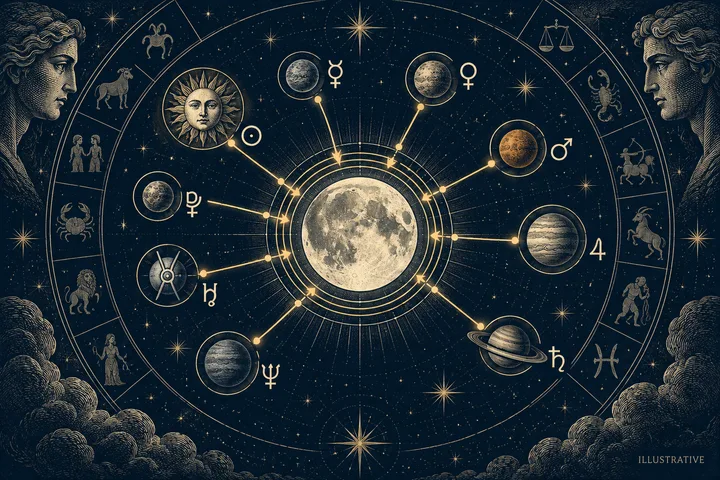
When one person’s Moon makes several close contacts to the other person’s chart, read the pattern as a layered emotional story, not as several separate verdicts. Start with the Moon’s sign, then rank the contacts by exactness, planet, and aspect. A Moon-Venus contact can show affection and shared comfort; Moon-Mars can stir quick reactions; Moon-Saturn can make safety feel serious; Moon-Uranus, Neptune, or Pluto can change the rhythm or depth of feeling. The repeated Moon person is often the one whose needs, moods, and habits become the relationship’s recurring subject, but the other person’s planets describe how that lunar life gets met. Use a six-degree orb for the report, give the closest major contact first, then test the story against the wider chart and the couple’s ordinary behavior. If you only know signs and not degrees, describe themes without pretending to know which contact leads. The practical question is simple: does the pattern help both people name needs and respond to them, or does one person carry all the emotional work?
Sources: Moon - Astrodienst Astrowiki; Aspects Between Charts - Cafe Astrology
Why several Moon contacts should be read as a hierarchy
A synastry list can make every line look equally important. It is not. Repeated contacts need a hierarchy, or the reading becomes a pile of descriptions that never tells you what to notice first.
Rank the contacts in this order: exactness, aspect strength, planet relevance, and repetition of the same emotional theme. Exactness comes first because a close aspect describes a tighter meeting between the two chart factors. Astrodienst defines an orb as the allowed distance from an exact aspect and notes that narrower orbs generally carry more force. The report scope here uses a six-degree orb for selected major aspects, but a contact at one degree deserves more attention than the same contact at six.
Aspect type comes next. A conjunction fuses the two symbols and makes them hard to separate. An opposition pulls them into a visible polarity. A square creates pressure that keeps asking for action. A trine lets the symbols cooperate with less resistance. A sextile offers help that still needs to be used. Astrodienst’s aspect guide names the major angles and describes the square as tension and the trine as complementary flow. Read those qualities as movement, not moral grades.
Planet relevance comes third. A Moon-Venus contact and a Moon-Pluto contact can both feel intense, but they do not ask the same question. Venus asks how affection, pleasure, and appreciation land. Pluto asks what becomes exposed, compelling, or difficult to keep at the surface. Moon-Saturn asks how care survives responsibility. Moon-Mars asks how feeling becomes action. The planet supplies the subject of the contact.
Then look for repeated themes. Suppose the Moon has a close trine to Venus, a square to Mars, and a sextile to Saturn. The hierarchy might be Venus first because it is exact, Mars second because the square keeps activating reactions, and Saturn third because it provides a stabilizing path. The reading is not “good, bad, good.” It is “affection is easy, activation is quick, and durability requires structure.”
A wider contact can still matter when it explains what the closer contact cannot. Maria’s wider Saturn trine may not outrank Daniel’s close Venus conjunction, but it can explain why the pair keeps trying after a difficult exchange. Conversely, a very close contact with a planet that repeats no meaningful theme in either natal chart may need less emphasis than a slightly wider contact that touches the relationship’s central question.
The strongest reading is therefore ranked and conditional. Name the lead contact. Name the contact that changes its expression. Name the contact that offers the best practice. That is more useful than declaring that three Moon aspects mean a “strong connection.”
You can make the ranking visible in a short table for yourself, even if the published reading stays in prose. Write the contact, exact orb, aspect, planet job, likely gift, likely snag, and practical response. This prevents the most dramatic planet from taking over simply because its language sounds intense. A close Moon-Pluto contact may be vivid, while a quieter Moon-Mercury contact may be the reason the pair can actually talk through the vivid material.
Do not confuse repetition with confirmation of a single outcome. Three contacts can repeat the need for safety while disagreeing about how to reach it. Venus may seek peace, Mars may seek immediate action, and Saturn may seek a rule. The Moon is then not receiving three votes for the same behavior. It is standing at a crossroads. The reading should name the crossroads and rank the route that seems most workable.
The natal chart supplies another layer of priority. A person with a natal Moon-Saturn pattern may experience a partner’s Saturn contact differently from someone whose Moon already moves easily with Saturn. A partner’s Moon-Mars contact may awaken a familiar strength or a sensitive place. Because this article works from supplied placements, not calculated personal natal charts, it offers the method rather than claiming which natal layer applies to you.
Sources: Aspects Between Charts - Cafe Astrology; Aspect - Astrodienst Astrowiki; Synastry: Moon - Saturn Aspects - Cafe Astrology
How each Moon contact changes the emotional story
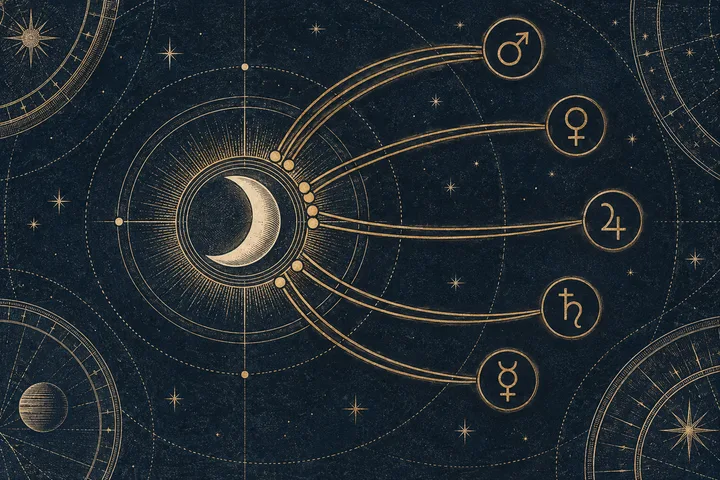
Repeated contacts become readable when you give each planet a clear job. The Moon remains the emotional receiver, but the other planet changes the way the feeling moves through the relationship.
Moon-Venus contacts soften the room. In an easier aspect, affection can arrive naturally, and the pair may enjoy making daily life pleasant together. A conjunction can make simple chores feel companionable. A square or opposition does not remove the liking. It can show that one person’s habits or values fail to land as the other expects, which turns affection into a negotiation about appreciation, taste, money, or fairness. The useful question is not whether they love each other. It is whether they notice and name the care already being offered.
Moon-Mars contacts speed the room up. Mars can defend, pursue, provoke, protect, or push. A trine may help the pair act on feelings quickly and support one another’s initiative. A square can turn a small mood into an argument because the Mars person responds before the Moon person has finished feeling. An opposition can create a strong polarity between vulnerability and action. The repair is timing: ask whether the Moon wants comfort, a solution, or a direct response before Mars takes the wheel.
Moon-Saturn contacts make the room serious. Saturn can give the Moon a reliable container, and an easier aspect may support steadiness and long-term effort. A hard contact can make the Moon person censor needs, expecting disapproval or restraint. Cafe Astrology’s Moon-Saturn guide describes that tension clearly, while also giving the stronger exception: Saturn can be a dependable source of safety when both people avoid turning emotional expression into a test. The question is whether responsibility protects tenderness or replaces it.
Moon-Uranus contacts change the room’s rhythm. The connection may feel fresh, freeing, and alive, yet moods or availability can shift quickly. The Moon person may need to know whether surprise is playful or destabilizing. Moon-Neptune contacts heighten sensitivity, imagination, and compassion, but they require clear language because each person can fill silence with a private meaning. Moon-Pluto contacts deepen the room. They can support brave honesty, but they also ask both people to handle fear, attachment, and power without using emotional exposure as a weapon.
Moon-Jupiter contacts enlarge feeling. They can bring generosity, humor, and encouragement, though excess can also become overpromising or emotional inflation. Moon-Mercury contacts make feeling more speakable. They help when Mercury listens for the Moon’s actual need instead of treating every feeling as a problem to solve. Moon-Sun contacts join emotional life to identity and visibility. The Moon may feel recognized, while the Sun may feel personally affected by the Moon’s responses.
These meanings are not a menu of fixed outcomes. They are the planet’s role in the scene. If one person’s Moon receives three contacts, ask which role arrives most often in real life. Does the Venus person soothe? Does the Mars person mobilize? Does the Saturn person stay? The answer tells you how the pattern is being lived.
There is also a difference between being touched and being understood. A close Moon-Mars contact may make the Mars person highly responsive to a mood, but responsiveness can still be clumsy. A close Moon-Venus contact may make affection obvious, but obvious affection can still miss the Moon’s actual need. The contact describes sensitivity between symbols. It does not guarantee skill. Skill grows when the people learn what the symbol asks for in this particular relationship.
Notice the direction of the story without turning it into a fixed hierarchy of people. If Daniel’s Mars contacts Maria’s Moon, Daniel may be the one whose action stirs Maria’s feeling. Maria is still an active participant, and her Moon sign and natal aspects shape what the activation means. If Maria’s Moon also contacts Daniel’s Venus, Daniel may feel drawn toward comfort while reacting defensively in another moment. The same person can be tender in one role and urgent in another.
A repeated Moon pattern also deserves a check for duplication within the placements you actually have. If the Moon contacts Venus and Mars through signs or aspects that both point to quick reassurance, that theme may be genuinely repeated. If the Moon contacts Mars and Saturn in different ways, the pattern may be activation followed by restraint rather than simple conflict. Similar symbolism strengthens a reading. Different symbolism asks you to keep it plural and precise.
Sources: Aspect - Astrodienst Astrowiki; Synastry: Moon - Saturn Aspects - Cafe Astrology; Synastry: Moon - Venus Aspects Between Two Charts - Cafe Astrology
A worked comparison: one Moon, three different responses
Consider an example with no personal birth chart attached. Person A has a Libra Moon at 15 degrees. Person B’s Venus is at 14 degrees Libra, Mars is at 18 degrees Cancer, and Saturn is at 20 degrees Aquarius. Within this report’s six-degree scope, the Moon is conjunct Venus by one degree, square Mars by three degrees, and trine Saturn by five degrees.
The pattern has a clear order. Venus leads because it meets the Moon closely and in the same sign. Libra Moon seeks reciprocity, civility, beauty, and visible consideration. Venus in Libra speaks that language, so warmth may be easy to recognize. Mars follows because the square turns feeling into quick action. Person B may protect the bond by reacting before Person A has finished explaining what hurts. Saturn comes third. Its trine offers steadiness and respect for difference, but its wider distance makes it a supporting practice rather than the opening note.
Read the three contacts as a sequence, not a verdict. Person A wants a civil exchange. Person B reacts to the emotional charge. The Venus contact helps them remember that they like each other, while Saturn gives them a way to remain present until Mars cools down. The useful question is not whether the chart is easy. It is whether affection can slow reaction long enough for reliability to take over.
Now separate a repeated need from repeated symbolism. If Venus and Saturn both describe reassurance, the chart may show two routes toward safety: warmth first, then proof through consistency. If Mars and Uranus both touch the Moon, the repetition may be speed rather than comfort. If Venus, Mars, and Saturn all point in different directions, do not force a single mood onto the pattern. Name the emotional need, then describe the competing responses around it.
This distinction changes the conversation a couple has. “You have three Moon contacts” is information without direction. “When I need reassurance, you offer affection, urgency, and a plan, and I need us to choose the order” gives both people something to work with. The chart becomes useful when the symbols explain the shape of a moment without taking responsibility for the choices inside it.
Change the Mars degree to 29 Cancer. The square leaves the stated orb, so the report no longer presents repeated activation as a confirmed part of this pattern. Change the Venus degree to 21 Libra instead. Venus remains within six degrees, but Mars is now the closest contact and leads the reading. The same planets are present. The emphasis changes.
Change the sign as well. If Mars moves to 15 Capricorn, the Libra Moon still forms a close square, but the scene shifts from protective Cancer reactions toward timing, control, duty, and practical results. The aspect supplies pressure. The signs show what kind of pressure it is. If the Moon degree is missing, stop at the level the data supports. “Libra Moon with Libra Venus” can suggest shared Libra themes and invite questions about courtesy, fairness, and pleasure. It cannot confirm a conjunction or produce an orb. For a related guide, see [what a synastry report can say when a Moon degree is unknown](/journal/synastry-report-moon-degree-unknown).
That is the practical value of a degree-aware example. It shows exactly when a repeated pattern is confirmed, when one contact drops away, and when another takes the lead. Precision does not cool the symbolism. It tells you which conversation to have first.
What can a supplied-placement report actually compare?
Use the report as a placement comparison, not as a replacement for a full natal chart. It can read each person’s Moon, Venus, and Mars by sign, compare optional degrees, and identify selected major aspects within the stated six-degree orb. It does not calculate natal positions from birth details, establish houses or angles, or turn a domestic feeling into proof of a fourth-house overlay.
The cleanest intake has three labels: sign-only, degree-known, and degree-unknown. A sign-only entry supports an emotional theme. A degree-known entry can support an aspect and an orb when the geometry fits. A degree-unknown entry stays possible rather than confirmed. This keeps the strength of the language matched to the strength of the placement data.
The fixed six-degree scope makes this report consistent. It is a working boundary, not a command to every astrological school. A one-degree contact deserves a closer look than one at the edge of the orb, and a sign resemblance is not the same thing as an aspect. If a close contact crosses a sign boundary, state whether your chosen method counts it before the interpretation begins.
The aspect describes the meeting. Conjunction joins the symbols. Square presses them into action. Opposition makes a polarity visible. Trine supports a natural flow. Sextile offers a resource that still needs choice. The signs and planets describe the emotional subject, while the aspect shows how that subject moves. None of these terms labels either person as good, difficult, mature, or doomed.
The method is most useful when the layers disagree. A Moon sign may suggest ease by element, while a close square adds pressure. Venus may offer affection, while Mars changes the pace. Saturn may provide the agreement that lets both people stay through the harder moment. For a broader comparison of these layers, continue with [how to read synastry when Moon, Venus and Mars disagree](/journal/summarize-synastry-when-emotional-affection-desire-layers-disagree).
Keep the direction of the contact visible in your notes. Person A’s Moon to Person B’s Mars is not the same sentence as Person B’s Moon to Person A’s Mars, even though both charts contain the same two planets. The first centers how A’s feeling meets B’s action. The second centers how B’s feeling meets A’s action. Read both directions when the data includes them, and do not let the more dramatic planet erase the person whose Moon is being touched.
A mutual pattern can still have different lived roles. One partner may feel the contact as a need for immediate response, while the other experiences it as pressure to act correctly. That is why a synastry table should sit beside real examples. Note who initiates, who withdraws, who repairs, and what happens after the repair attempt. Those observations do not replace the symbolism. They tell you which side of the symbolism is active now.
The missing layers matter, but they need not stop the reading. Without birth-chart calculations, stay with Moon, Venus, and Mars themes, the degrees supplied, and the selected aspects the report can actually compare. Do not guess houses, rulers, or natal aspects. A narrower reading often gives the couple a better question because it leaves fewer places for a vague story to hide.
Make one small worksheet before you read. Write the confirmed contact, its plain emotional theme, and one question to test in ordinary life. “Moon square Mars, quick activation, what helps us pause?” is enough. If several contacts touch the same Moon, list the one that leads, the one that complicates it, and the one that offers repair. Then move from the chart to the conversation.
This keeps the report in its proper role. It organizes known placements and gives the couple language for a recurring pattern. It does not decide what they owe each other. The next useful step is to compare the pattern with the relationship’s actual responses, especially after silence, a request for care, a disagreement, or a need for space.
Sources: Moon - Astrodienst Astrowiki; Aspects Between Charts - Cafe Astrology; Aspect - Astrodienst Astrowiki
How to turn repeated Moon contacts into a useful relationship practice
Astrology becomes useful when the symbols lead to a better question. Repeated Moon contacts give you a short list of questions to test in ordinary life, especially around silence, care, conflict, and repair.
Start by naming the Moon need in plain language. “I need consistency.” “I need room to process.” “I need you to ask before touching the problem.” “I need affection that I can feel, not only promises about later.” The sign may help you find the words, but the person still has to choose them. Do not make your partner guess from a chart.
Next, give each planet a response rule. Venus contacts need appreciation made visible. Say thank you. Notice the effort before you ask for more. Mars contacts need a pause between feeling and action. Ask, “Do you want comfort or a solution?” Saturn contacts need agreements that protect softness, not rules that punish need. Uranus contacts need honest room for change. Neptune contacts need direct questions when silence starts to feel full. Pluto contacts need consent around disclosure, conflict, and emotional intensity.
Then watch for one-sidedness. A repeated Moon pattern can make one person the emotional center while the other becomes the manager, rescuer, critic, or trigger. That is not the only possible expression, but it is a useful warning sign. The Moon person deserves care. The planet person deserves a relationship in which their planet is not reduced to a service role. Both people need to speak from their own experience.
Use a simple review after a charged moment. What happened first? Which need was present? Which planet role took over? What response helped? What response made the feeling larger? This turns a symbolic pattern into observable material. Over time, the couple can see whether the chart’s easier contact is becoming a real resource or whether the hard contact keeps deciding the atmosphere.
A synastry report can help you organize supplied Moon, Venus, and Mars signs, optional degrees, and selected major aspects within the stated six-degree orb. It cannot replace missing birth information, calculate houses without the needed data, or announce whether a relationship will succeed. Its best use is narrower and more personal: compare the placements you know, identify the lead emotional pattern, and choose the conversation that pattern asks for.
For Maria and Daniel, the next step is not another abstract label. Maria can ask for listening before solutions. Daniel can repeat back what he heard before offering a plan. They can decide whether space means a timed pause or a disappearing act. Their chart pattern may explain why this matters. Their practice will show whether they can do it.
You can also choose a sentence for each planet before the next difficult conversation. Venus: “I want appreciation to be spoken.” Mars: “I need us to slow down before we act.” Saturn: “I need an agreement that we can keep.” Uranus: “I need room without making the bond uncertain.” Neptune: “I need us to say what we know instead of guessing.” Pluto: “I need honesty without threats.” These sentences turn symbolism into a request another person can answer.
When the Moon is repeated, take special care with emotional labor. The Moon person may become the one who reports every mood, explains every reaction, and teaches the partner how to respond. That is too much weight for one person. The planet person must learn their part, too. Venus can notice. Mars can pause. Saturn can soften. The relationship becomes more balanced when both people study the pattern instead of assigning one person the job of carrying it.
Use the pattern to choose a small experiment, not to stage a final judgment. For a Moon-Venus emphasis, let each person name one form of care that actually lands. For Moon-Mars, agree on a pause and a return time before the next argument. For Moon-Saturn, replace an unspoken standard with one promise that both people can keep. The point is not to perform the chart. It is to see whether a different response changes the emotional weather.
Give the experiment a fair reading. One awkward attempt does not cancel a supportive contact, and one tender evening does not erase a repeated strain. Look for direction across several ordinary moments: does the request become clearer, does the response arrive sooner, and does repair leave both people less tired? Those are better signs of a usable pattern than intensity alone.
If the answer changes depending on which partner speaks, keep both accounts. A Moon-centered reading grows stronger when it can hold the need, the response, and the response to the response in the same frame.
A useful decision point comes after several real attempts, not after one perfect conversation. Has the pattern become easier to name? Do repairs happen sooner? Can both people ask for what they need without punishment? If yes, the repeated Moon contacts are becoming a shared practice. If no, return to the ranking. Perhaps the lead contact was misidentified. Perhaps the strongest contact explains the cycle but not the repair. Either way, choose the next observable action before you seek another label.
Sources: Moon - Astrodienst Astrowiki; Aspect - Astrodienst Astrowiki; Synastry: Moon - Saturn Aspects - Cafe Astrology
A little more clarity
Does having several Moon contacts in synastry mean the relationship is emotionally strong?
It means the Moon is a major meeting point in the comparison. Emotional strength depends on what the contacts are, how close they are, whether the aspects support or challenge one another, and how both people handle the needs they reveal. Several contacts can bring warmth, pressure, steadiness, or deep sensitivity. Read the pattern, not the count.
Which Moon contact should I read first in synastry?
Read the closest major aspect first, then consider its planet and aspect type. A one-degree Moon-Venus conjunction usually deserves more attention than a six-degree Moon-Saturn sextile, but the wider Saturn contact may still explain commitment or restraint. After that, rank the contacts by the emotional theme they repeat in real life.
Can Moon-Mars and Moon-Saturn contacts happen together?
Yes. Moon-Mars can describe quick activation, pursuit, irritation, or protective action, while Moon-Saturn can describe responsibility, containment, and the fear of getting emotional needs wrong. Together, they may show a bond that reacts quickly but needs deliberate pacing. The strongest expression depends on the signs, degrees, aspect types, and each person’s natal chart.
What if I know the Moon signs but not the degrees?
Compare the sign-based emotional themes, but don’t confirm exact aspects or rank their orbs. Without degrees, you can say that the signs may speak to one another by element or mode when that is actually true. You cannot claim a conjunction, square, trine, or other major contact unless the supplied information supports it.
Sources & further reading
- Moon - Astrodienst Astrowiki
Supports the Moon’s astrological meanings of home, feelings, emotional needs, instinctive response, and emotional security.
- Aspects Between Charts - Cafe Astrology
Supports reading interchart roles through each planet’s symbolism and considering signs, houses, and inner-planet contacts together.
- Aspect - Astrodienst Astrowiki
Supports the definitions and interpretive contrast among conjunction, opposition, square, trine, sextile, and orb.
- Synastry: Moon - Saturn Aspects - Cafe Astrology
Supports the tension between emotional censorship and dependable commitment in Moon-Saturn synastry contacts.
- Synastry: Moon - Ascendant Aspects Between Two Charts - Cafe Astrology
Supports the interpretation of Moon-Ascendant contacts as heightened awareness of emotional expression and mutual moods.
- Synastry: Moon - Venus Aspects Between Two Charts - Cafe Astrology
Supports Moon-Venus themes of affection, shared comfort, appreciation, compromise, and different habits landing awkwardly.
Synastry Comparison Report
Enter known placements for two people. Get an input-by-input comparison, selected aspect calculations and a clear record of what remains uncertain.
Compare our placements