
The assumption to test: a hard conversation needs one perfect compatibility answer
When a couple has been hurt, the first astrological question is often, "Are we compatible enough to get through this?" It sounds sensible. It rarely helps. A single compatibility answer turns a living conversation into a pass-or-fail test, and repair needs more detail than that. You don't need a score. You need to know what felt unsafe, what kind of care can reach it, and what each person will do differently.
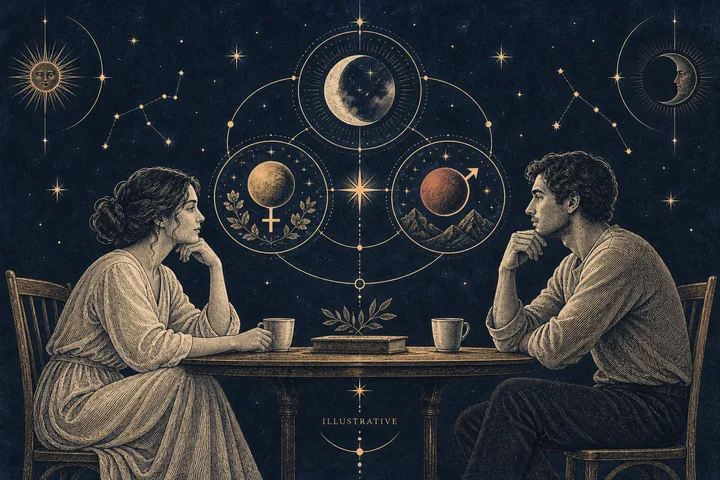
Moon, Venus, and Mars give you that order. The Moon describes emotional needs, instinctive reactions, and the conditions that help a person settle. Venus describes affection, values, pleasure, and the way love becomes recognizable in ordinary life. Mars describes drive, anger, assertion, and the way a person takes action. Read together, they form a practical sequence: soothe the wound, show regard, then change the behavior. That sequence is my supported recommendation for a repair conversation.
The three planets don't tell you whether a couple should stay together. They help you ask better questions before a difficult talk, especially when one partner calls for closeness while the other reaches for space, or when a loving intention lands as pressure.
That distinction changes the way you read a report. Don't scan for the prettiest contact and build the conversation around it. Find the point that is most active in the actual rupture. If the argument began with feeling ignored, start with the Moon. If the apology keeps missing its mark, examine Venus. If the same argument returns because nobody changes the response, bring in Mars. The chart becomes a map of the question you already have, not a replacement for the question.
A repair conversation has a time order. The person who feels hurt may need acknowledgment before explanation. The person who made the mistake may need a clear request before they know what to change. That is the work of the three layers: make room for feeling, make regard visible, then decide what will happen next time.
The strongest exception is a relationship in which the real problem is not a difference in style but a refusal to listen, take responsibility, or respect a boundary. A chart can illuminate a pattern. It cannot excuse cruelty. If the observable behavior stays unsafe, interpret the chart as a prompt for clarity, not a reason to keep explaining the harm.
If you arrive asking whether the relationship is compatible, leave with a more useful question: what would repair require from both of us? The chart earns its place when it helps you answer that in plain language.
Moon, Venus, and Mars placements help a couple prepare for repair by giving three different jobs to three different chart layers. The Moon names what each person needs to feel safe enough to stay present. Venus shows how care, respect, and an apology become recognizable. Mars turns the conversation into one behavior each person can practice when the pattern returns. Read them in that order: safety, care, action. Use the sign for style and a close aspect, calculated from known degrees, for emphasis. This report uses a six-degree orb for major contacts. It compares supplied signs and optional degrees; it does not calculate a natal chart, houses, or relationship outcome from birth details. Before talking, each person should write one Moon need, one Venus request, and one Mars action.
Sources: What’s Your Sign? An Intro to Synastry Charts and Astrological Compatibility; What Is a Synastry Chart? Birth Chart Compatibility
Why the Moon should lead: repair begins with emotional safety
The Moon is the first layer because it speaks before polished language arrives. In astrological tradition, it describes the inner emotional make-up, instinctive reactions, home, habits, and the need for security. In a synastry discussion, ask what each person does when they feel exposed. Do they go quiet? Ask for reassurance? Need time alone? Move toward practical tasks? The answer gives you the doorway into the repair conversation.
Consider an example. Maria has Moon in Cancer, and Leo has Moon in Aquarius. Neither Moon is wrong. Maria may need warmth, presence, and a sign that the bond still holds. Leo may need room to think and a calm, uncluttered exchange before he can name what he feels. If Maria begins with repeated questions, Leo may experience an emotional demand. If Leo disappears into analysis, Maria may experience abandonment. Their first repair agreement should address the pause itself: how long it lasts, what reassurance is offered, and when the conversation resumes.
A Moon sign is a style, not a script. Water Moons often seek emotional attunement and a sense of feeling together, while earth Moons may settle through steadiness, practical help, or a reliable plan. Air Moons may need words, perspective, and breathing room. Fire Moons may recover through honest directness, movement, and the freedom to express a strong feeling without being shamed for it. These are starting hypotheses. The person's actual history and present behavior still tell you how the placement lives.
Look for the difference between a need and the strategy built around that need. A person with a strong need for reassurance may call repeatedly, but the Moon placement doesn't require the repeated calls. A person who needs space may leave the room, but the Moon placement doesn't require vanishing. Name the need first and negotiate the strategy second. That separation prevents astrology from turning a habit into an unchangeable identity.
You can also ask what the partner's Moon receives from your presence. Does your way of listening calm them, or does it make them defend themselves? Does your timing give them a place to land? These questions make synastry relational rather than one-sided. The Moon is not only my feelings. It is the meeting point between an inner rhythm and the atmosphere another person creates.
Before you bring Venus or Mars into the room, each partner can complete one sentence: "When I am hurt, I feel safer when you..." Don't answer for the other person. Let the Moon placement suggest the question, then let the person supply the answer. If the Moon is unknown by degree but known by sign, keep the emotional theme broad and skip claims about a precise Moon aspect.
Write the answer before you read the partner's placement. That order protects you from borrowing a story too quickly. Then compare the two answers and ask where they fit, where they pull apart, and which small agreement could honor both.
Sources: What’s Your Sign? An Intro to Synastry Charts and Astrological Compatibility; What Is a Synastry Chart? Birth Chart Compatibility
What Venus adds: translate apology into a form of care
The Moon tells you what helps the heart settle. Venus tells you how care becomes visible. Astrologically, Venus speaks to attraction, affection, harmony, values, pleasure, and the ways we give and receive love. During repair, that matters because two people can want reconciliation and still offer it in forms the other person cannot feel. One brings flowers. The other wants an honest account of what happened. One says, "I love you." The other needs changed follow-through.
Imagine Maria has Venus in Virgo and Leo has Venus in Sagittarius. Maria may read care through attention, useful help, and a willingness to improve the small things that caused friction. Leo may express love through openness, humor, shared adventure, and a frank conversation that leaves room for the future. If he gives a grand promise but misses the practical detail, she may not trust the gesture. If she edits every sentence of his apology, he may feel that love has become a performance review.
Use Venus to ask two questions. What action would make the apology feel sincere to you? What kind of response helps you stay open while the other person speaks? The first question names a love language without reducing the person to a label. The second protects the conversation from becoming a trial. Venus doesn't ask you to make the repair pretty. It asks you to make regard legible.
Venus can also show where a couple confuses agreement with love. Two partners may share a taste for peace, but peace that depends on silence won't repair anything. Another couple may value honesty, yet use honesty as a license for bluntness. Ask what value you are trying to protect. Is it fairness, loyalty, freedom, consistency, tenderness, privacy, or pleasure? Once the value is named, the repair can serve it without making the other person guess what the argument was really about.
When Venus placements differ by element, don't rush to call the difference a mismatch. Fire Venus may want enthusiasm and a clean expression of desire. Earth Venus may trust what is repeated and useful. Air Venus may need conversation and mental ease. Water Venus may need emotional presence and proof of devotion. A good repair can include more than one language. Say the care aloud, show it in a practical act, and leave a clear path back into warmth.
A Venus-Moon contact can make emotional care easier to recognize, especially when the aspect is close. A Venus-Mars contact can add attraction, courage, and heat, but it may also make the conversation lively before it becomes safe. Don't rank chemistry above trust. If sign patterns and exact aspects point in different directions, let the exact contact refine the broad sign story, then check it against the behavior you can actually name.
Venus is not appeasement. Offer care without erasing the consequence of what happened, and keep the request honest.
Sources: What’s Your Sign? An Intro to Synastry Charts and Astrological Compatibility; What Is a Synastry Chart? Birth Chart Compatibility
What Mars adds: turn the repair into one changed behavior
Mars is the part of the preparation that asks, "What happens next?" In the chart, Mars describes drive, assertion, heat, anger, physical desire, and the way a person meets resistance. In a repair talk, that can show the couple's conflict rhythm. Does one person push for an immediate answer while the other defends, withdraws, or counterattacks? Does anger become action, or does it circle the same accusation? Mars helps you name the movement without pretending it is the whole character.
Consider an example. Maria's Mars is in Libra, while Leo's Mars is in Capricorn. Maria may try to restore balance through dialogue, fairness, and a shared decision. Leo may want a clear problem, a clear responsibility, and a plan that can be carried out. Under stress, Maria may keep talking because unresolved tension feels intolerable. Leo may shorten the exchange because he believes action proves sincerity. Their agreement might be: ten minutes of uninterrupted listening, one specific acknowledgment from each person, then one task and one date for follow-through.
A Mars-Moon contact deserves care. It can make one person's action press directly on the other's emotional body. It may show protective action, quick responsiveness, or a reliable instinct to defend. It can also show that anger reaches the place where the other person is most tender. A Mars-Venus contact can bring desire and initiative, yet the same spark can turn a disagreement into a contest if nobody slows the pace. The aspect doesn't choose the expression. The couple does.
Mars also shows the difference between an explanation and a repair. An explanation tells you why the pressure rose. A repair changes what happens when pressure rises again. If someone says, "I get defensive when I feel accused," that is useful self-knowledge. The Mars question is, "What will you do with that knowledge?" Maybe they will ask for one example instead of arguing with the whole story. Maybe they will take a brief pause and return at a named time. The act matters more than the insight.
Watch the speed of the exchange. Fast Mars can mistake a pause for rejection and a question for attack. Slow Mars can mistake urgency for manipulation and delay the answer until the other person feels abandoned. Neither pace is automatically mature. Mature Mars can state its pace without making the other person pay for it. It can say, "I need ten minutes to gather myself, and I will come back at 8:30," or, "I can listen now, but I need us to discuss one event at a time."
Ask each person to finish this sentence: "Next time this pattern begins, I will..." Keep the answer observable. "I will be more considerate" is a wish. "I will tell you I need twenty minutes, give you a return time, and come back when I said I would" is a Mars agreement. Repair needs the second kind.
Choose only one action at first. Three new rules can become three ways to fail. One clear action gives Mars something it can practice, measure, and strengthen.
Sources: What’s Your Sign? An Intro to Synastry Charts and Astrological Compatibility; What Is a Synastry Chart? Birth Chart Compatibility; Astrology Aspect Symbols and Meaning
How to compare the three layers without flattening them
The common mistake is to read every Moon, Venus, and Mars placement as if it answered the same question. It doesn't. Give each planet one job. Moon answers, "What helps me feel safe enough to stay present?" Venus answers, "What makes love and respect visible to me?" Mars answers, "What action will I take when the pattern returns?" Once the jobs are separate, the comparison gets calmer and more precise.
Start with each person's three signs. Note the element and modality. Fire brings heat and initiative. Earth seeks form, reliability, and results. Air needs language, perspective, and exchange. Water responds through feeling, bonding, and sensitivity. Cardinal signs begin. Fixed signs hold and persist. Mutable signs adapt and change shape. These qualities can describe pace and style, but they don't prove a specific aspect. Sign affinity is the first layer of interpretation, not the final one.
Then compare across the charts. Person A's Moon with Person B's Venus asks how emotional needs meet affection. Person A's Moon with Person B's Mars asks how action touches feeling. Person A's Venus with Person B's Mars asks how desire and initiative meet. Repeat the comparison in the other direction. The planet person and the receiving person can experience the same contact differently, so don't collapse both sides into one sentence about "the couple." Name who is moved, who is activated, and who may need more care.
Finally, rank the evidence. A close major aspect by degree leads. A wider major aspect within the stated six-degree orb supports it but speaks more softly. A sign relationship without a close aspect describes a background style. A repeated pattern across several contacts outranks a single attractive phrase. If the Moon, Venus, and Mars disagree, don't average them into a bland middle. Let the Moon set the safety condition, Venus set the tone, and Mars set the action.
This ranking keeps the reading from becoming a pile of adjectives. Instead of saying one person is emotional, loving, and fiery, describe a chain. Their Moon may need quiet reassurance. Their Venus may trust care that is consistent. Their Mars may push for a solution as soon as discomfort appears. Now the couple can see the sequence: reassurance first, evidence of regard second, a solution third. The description has become a decision guide.
Read directionally as well. If your Moon receives your partner's Venus, you may feel that their affection understands your private needs. If your Venus receives their Moon, you may feel valued by the way they reveal vulnerability. If your Mars receives their Moon, your actions can stir their feelings quickly. These are angles of attention, not fixed roles. Switch the sentence around and ask whether the other partner recognizes the same contact in a different way.
A good comparison ends with a sentence both people can use. For example: "Your Mars activates my Moon, so let's slow the first ten minutes of conflict. My Venus meets your Moon, so I'll begin by naming what I still value here." That sentence keeps the symbolism alive while giving it a job.
If the contact is one-sided in feeling, honor that asymmetry. The person whose Moon is touched may feel exposed, while the Venus or Mars person may simply feel affectionate or motivated. Neither experience cancels the other. Ask the receiving person what landed, then ask the planet person what they intended. Repair improves when impact and intention can sit in the same room.
Sources: What’s Your Sign? An Intro to Synastry Charts and Astrological Compatibility; What Is a Synastry Chart? Birth Chart Compatibility; Astrology Aspect Symbols and Meaning
Degrees and orbs change the strength of the story
A sign-only comparison can start the conversation, but degrees tell you whether two placements form a measured synastry contact. An aspect is an angle between chart factors. The major aspects are conjunction at 0 degrees, sextile at 60, square at 90, trine at 120, and opposition at 180. The orb is the distance from exactness that an astrologer allows. In this report's method, use a six-degree orb for these Moon, Venus, and Mars contacts.
Consider this example. Maria's Moon is at 14 degrees Taurus and Leo's Venus is at 18 degrees Taurus. That is a four-degree conjunction, so the emotional and affection layers are tightly linked in the comparison. The placement does not guarantee a gentle conversation. It suggests that care can reach the emotional center quickly, and that a failure of affection may also feel personal. Now imagine Maria's Moon is at 14 degrees Taurus and Leo's Venus is simply listed as Taurus with no degree. You can discuss the shared sign, but you cannot claim that exact conjunction.
The same discipline applies to a square or opposition. A close Moon-Mars square may describe a strong activation between emotional need and the other person's way of pushing forward. That can become a fight, but it can also become protective energy when both people know the trigger and choose a slower response. A Moon-Venus trine may make reassurance easier to offer and receive. A Venus-Mars sextile may give the couple a workable opening, though it still needs initiative.
Degrees also keep you from double-counting. A shared sign may already create a familiar tone, but it isn't a second aspect on top of a conjunction. Write the placement once, then record the measured contact beside it. If two contacts describe the same planet pair from opposite directions, treat them as one geometric relationship with two lived experiences. This makes the final interpretation cleaner and keeps a dramatic-looking table from overpowering the actual evidence.
The six-degree rule is an editorial method for this report, not a universal command for every astrology school. Astrologers use different orb systems, and some give the Moon more room than a personal planet. What matters here is consistency. Use one rule for both charts, record the orb, and compare close contacts before wide ones. A reader should be able to follow the path from the supplied degrees to the interpretation without guessing which standard was used.
Keep the calculation scope visible. This article uses supplied Moon, Venus, and Mars signs and optional degrees. It doesn't calculate natal positions from birth details, houses, angles, or a complete chart. If either person's degree is missing, report the uncertainty plainly and keep the reading at the sign level for that contact. Precision is part of respect.
Don't let a rounded degree do more work than it can. A placement recorded as 12 degrees may really be 12 degrees and 48 minutes, and that difference can matter near an orb boundary. If the result changes when you use the unrounded value, record both the source notation and your chosen interpretation.
The closer contact deserves your first attention, not necessarily your loudest claim. Exactness shows concentration. It doesn't tell you whether the concentrated energy will be handled with tenderness, courage, or avoidance. That judgment comes from the sign, the wider chart context when available, and the couple's conduct.
Sources: What’s Your Sign? An Intro to Synastry Charts and Astrological Compatibility; What Is a Synastry Chart? Birth Chart Compatibility; Astrology Aspect Symbols and Meaning; What Does Sextile Mean? An Astrologer Explains
A worked preparation: from rupture to three clear questions
Consider an example in full. Maria and Leo argued after Leo cancelled a plan without telling her until the last minute. Maria says she felt unimportant. Leo says he felt cornered when she asked for an explanation in the middle of a busy day. Their known placements are Maria Moon in Cancer, Venus in Virgo, Mars in Libra; Leo Moon in Aquarius, Venus in Sagittarius, Mars in Capricorn. No degrees are supplied, so this is a sign-level comparison only.
First, the Moon question is not "Who overreacted?" It is "What would help each person return to emotional safety?" Maria can ask for a timely message and a clear sign that the plan still matters. Leo can ask for a defined time to talk instead of an immediate demand for emotional access. Both needs can fit in one agreement: if plans change, Leo sends a direct message; if Maria needs to discuss the hurt, she names a time instead of pursuing the answer through repeated texts.
Next comes Venus. Maria's Virgo Venus may want care shown through accuracy and repair of the overlooked detail. Leo's Sagittarius Venus may respond to candor, generosity, and a chance to move forward without being trapped in the old scene. Their Venus questions are, "What would make the apology feel real?" and "What tone lets me hear the request without feeling reduced to my mistake?" Maria might ask for a specific acknowledgment. Leo might offer one without defending the whole day.
Mars makes the agreement concrete. Libra Mars can keep weighing every side. Capricorn Mars can become terse and task-focused. Their Mars rule could be simple: no disappearing, no prosecuting. Leo names the pause and the return time. Maria names the one behavior she wants changed. They end by writing the next practical step. The chart didn't solve the argument. It helped them stop asking one question, "Do you care?" and ask three answerable ones instead.
Notice what the example does not do. It doesn't declare Maria more sensitive or Leo less loving. It doesn't treat Cancer, Aquarius, Virgo, Sagittarius, Libra, or Capricorn as a verdict. It uses each sign as a clue about pace and preference, then asks the people involved to confirm, correct, or reject the clue. That is the difference between an astrological reading and a personality sentence pasted onto a partner.
The couple can also choose a stopping point. They don't need to explain the entire history of the relationship in one sitting. If the Moon agreement is clear, Venus has a believable gesture, and Mars has a next action, pause there. Follow-through will reveal more than another hour of interpretation. A repair conversation earns trust by doing what it said it would do.
Maria and Leo can return to the same page a week later and ask what changed. If Leo sent the message he promised and Maria requested a talk without pursuing it through a stream of texts, the Mars layer has become practice. If either person missed the agreement, they have a new fact to discuss. The chart stays still. The relationship gives the reading its living evidence. Ask what made the agreement easy or difficult to keep. That answer may reveal a second layer the first conversation missed, and it gives the couple something concrete to adjust.
The strongest exception: a beautiful contact cannot do the work for you
A close Moon-Venus contact can feel tender. A Venus-Mars conjunction can feel magnetic. A supportive trine can make goodwill easier to access. None of these contacts guarantees that a partner will listen, apologize, keep a promise, or respect a limit. This is where the tempting assumption fails most sharply. Astrological ease is not the same as relational skill.
The reverse is also true. A square or opposition is not a sentence of failure. Astrological tradition gives challenging aspects a force that can expose friction and demand conscious effort. A hard Moon-Mars contact may show where one person's urgency stirs the other's vulnerability. Once the couple sees that sequence, they can build a pause, choose less loaded words, and use the heat to protect what matters instead of winning the exchange.
Rank the chart below conduct. First ask whether both people can stay in the conversation without intimidation. Next ask whether each person can name their own part. Then ask whether the promised change appears in ordinary life. Only after those questions should you use the planets to refine the conversation. A chart should sharpen accountability, not soften it.
If one person uses astrology to diagnose, corner, or overrule the other, stop the chart discussion. Return to consent and direct language. You can say, "This placement gives me a question about how we handle pressure. It doesn't give me permission to tell you what you feel." That sentence protects the reading's proper role.
This exception matters when a chart looks exceptionally sweet. A strong Moon-Venus connection may make reconciliation feel natural, so the couple skips the hard sentence about what happened. A vivid Venus-Mars connection may pull them back into physical closeness before the hurt has been understood. A supportive chart can make reunion easier. It can also make avoidance feel romantic. Let the repair be complete before you call it complete.
The same caution applies to difficult charts. If a Moon-Mars contact keeps exposing the same wound, the answer may be a firmer boundary or a slower process, not a better interpretation. Astrology can name the pressure point. Wisdom chooses the container.
Sources: What’s Your Sign? An Intro to Synastry Charts and Astrological Compatibility; What Is a Synastry Chart? Birth Chart Compatibility
The better method: bring a one-page Moon, Venus, and Mars plan
Before the conversation, each partner should write three short answers. Under Moon, write the condition that helps you feel safe enough to be honest. Under Venus, write the act or tone that makes care believable. Under Mars, write the behavior you will practice when the same pressure returns. Keep each answer to one or two sentences. Long explanations often hide the request.
Then compare the pages in order. Start with the Moon answers and look for a clash in timing, space, or reassurance. Don't solve it yet. Ask what each person can offer without betraying their own need. Move to Venus and identify the form of apology or affection that can actually land. If the two forms differ, choose one action from each side. Finish with Mars and write a rule that can be observed by someone who wasn't in the room.
Give the first pass a clear boundary. One person reads their Moon answer while the other repeats what they heard, without correcting the feeling or explaining the event. Switch roles. Only after both people feel accurately heard should you move to Venus and discuss what care might look like. This order matters because a request made too early can sound like a defense, while an acknowledgment made too late can feel empty. The worksheet isn't a script for winning the conversation. It's a small container that keeps listening, care, and action from competing for the same sentence.
Here is a useful sentence frame: "When X happens, my Moon needs Y. I can receive care through Z. Next time, my Mars action will be W." For example: "When plans change without warning, my Moon needs a direct message. I can receive care through a clear acknowledgment. Next time, my Mars action will be to ask for a time to talk instead of sending five follow-up texts." The frame keeps the chart connected to a real event.
If you have degrees, add the relevant aspect and orb beside the question. Write "Moon conjunct Venus, 4 degrees" or "Moon square Mars, 2 degrees" rather than saying the chart is simply good or bad. If you have no degrees, mark the contact as sign-level. If the Moon sign itself is uncertain, leave that layer open. A missing input is a boundary, not an invitation to invent certainty.
After the talk, revisit the page once. Circle the answer that felt most accurate and cross out the sentence that made either person feel labeled. Add one detail from the actual exchange. Did a pause help? Did a practical act land? Did the agreed behavior happen? This makes the next reading more faithful because it joins astrological symbolism to lived observation without forcing the event to match the chart.
You can use the page again after a later milestone, but don't turn it into a permanent scorecard. People grow. A Moon need can become easier to express. Venus can learn a new form of generosity. Mars can trade reflex for choice. The placements remain the same, while the relationship's way of carrying them changes. That is why the best chart question is not "What are we?" It is "How can we meet this pattern with more skill?"
That returns us to the couple preparing to talk after a rupture. They don't need one placement to prove the bond. They need a usable order of attention. Name the feeling. Make care recognizable. Choose the action. Bring the page to the conversation, then put it away once the real person is speaking. Afterward, keep the one promise that can be seen in daily life and revisit it when the next difficult moment arrives. When you have the placements ready, use the Synastry Comparison Report to compare the Moon, Venus, and Mars signs and any supplied degrees before you bring that page into the room.
Sources: What’s Your Sign? An Intro to Synastry Charts and Astrological Compatibility; What Is a Synastry Chart? Birth Chart Compatibility; Astrology Aspect Symbols and Meaning
A little more clarity
Can we use Moon, Venus, and Mars synastry without exact birth times?
Yes, if the placements are already known and stable. You can compare the supplied signs and any verified degrees. The report cannot calculate houses or confirm a Moon that changed signs during the date without the needed birth information. Keep the reading at the level the inputs support, then ask each person whether the suggested pattern matches lived experience.
Which placement matters most in a repair conversation?
Lead with the Moon because repair needs emotional safety before affection or action can land. Use Venus next to shape care into a form the other person can recognize. Use Mars last to choose one changed behavior. A close aspect can raise a layer's priority, but no single contact outranks consent, accountability, and repeated behavior.
Sources & further reading
- What’s Your Sign? An Intro to Synastry Charts and Astrological Compatibility
Connects the Moon with inner needs, Venus with love expression, Mars with anger and drive, and close aspects with stronger contacts.
- What Is a Synastry Chart? Birth Chart Compatibility
Defines synastry as a comparison of charts and distinguishes signs, elements, planets, houses, and aspects as separate interpretive layers.
- Astrology Aspect Symbols and Meaning
Defines major aspects as zodiac angles and explains how conjunctions, squares, trines, sextiles, and oppositions differ.
- What Does Sextile Mean? An Astrologer Explains
Defines the sextile as a 60-degree major aspect and describes its cooperative, supportive role in relationship astrology.
Synastry Comparison Report
Enter known placements for two people. Get an input-by-input comparison, selected aspect calculations and a clear record of what remains uncertain.
Compare our placements