
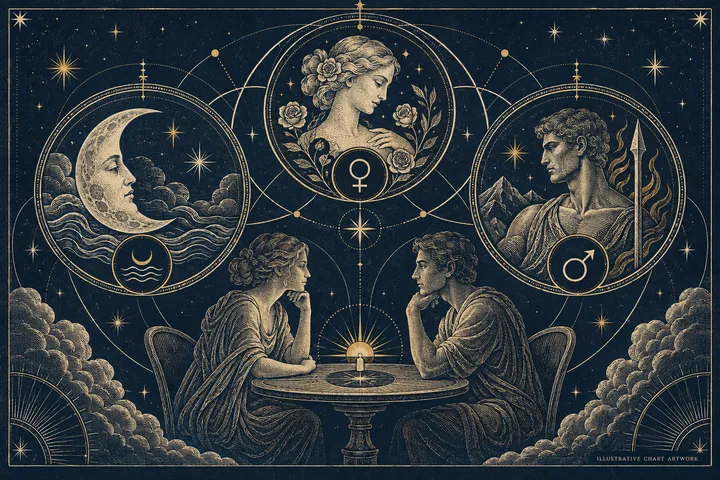
Use the Moon first, Venus second, and Mars third. The Moon shows what each person needs in order to stay emotionally present. Venus shows the tone, values, and kind of reassurance that can keep affection in the room. Mars shows how each person pushes, defends, pursues, or takes action. Read the three together, then turn the pattern into a plan: name the feeling, protect the bond, and make one clear request. A tense Moon-Mars contact may describe quick reactions, while a Venus-Mars contact may add heat or pursuit. Neither one tells you what your partner will choose. Before the talk, write down both people’s signs and any known degrees, identify the tightest relevant contacts, and agree to discuss one issue at a time. The chart gives you a language for the pattern. Your conversation gives it a direction.
Start with the question beneath the argument
A hard talk rarely begins with the sentence that matters most. One person says, ‘You never help,’ and the other hears, ‘You are failing me.’ Someone asks for more time together, but the request arrives wrapped in anger. A disagreement about money turns into an argument about respect. The visible topic is real. It is not always the whole topic.
Moon, Venus, and Mars placements can help you separate those layers before you sit down. They give you three different questions. What feeling needs care? What kind of affection or value is at stake? What action, boundary, or desire is pushing for expression? That sequence matters because a couple can discuss the right subject in the wrong order and still leave feeling unheard.
The strongest use of these placements is preparation, not prediction. You aren't asking, ‘Who is right?’ You’re asking, ‘What might each of us protect when this gets difficult, and what would help the conversation stay honest?’ The answer belongs to the chart pattern and to the behavior you have actually seen. Astrology sharpens attention. It doesn’t replace listening.
Write the immediate issue in one plain sentence. ‘We keep making plans without checking each other’s schedule.’ ‘I shut down when you raise your voice.’ ‘We disagree about how much time we spend with family.’ Then write the deeper question underneath it. Is this about security, appreciation, desire, control, rest, trust, or shared effort? You don’t need to make the deeper question dramatic. A small household dispute may carry a large need for consideration.
Now look at the Moon. In relationship astrology, the Moon speaks to feeling, emotional needs, habits, and the sense of home. It is the part of the chart that notices whether a room feels welcoming or exposed. Astro.com’s discussion of the Moon in relationship life describes it as a guide to habitual emotional life and domestic comfort, while Venus and Mars carry other layers of passion and attraction. That distinction gives you a clean opening: first ask what helps each person feel safe enough to answer honestly.
Then look at Venus. Venus describes attraction, pleasure, affection, taste, and the values that make relating feel worthwhile. If the hard talk is about effort, Venus may show what each person counts as a loving gesture. One partner may value practical help. Another may value warm words, shared leisure, or a thoughtful invitation. Neither preference is automatically more loving. They are different forms of value, and the talk gets easier when you name them.
Mars comes last in the preparation. Mars describes drive, pursuit, assertion, anger, and the way a person moves toward what they want. It can make a conversation direct and brave. It can also make the first sentence land like a challenge. You want Mars in the room, because a hard talk needs a request and sometimes a boundary. You don’t want Mars driving without the Moon and Venus beside it.
This is the central contrast. A couple may read a tense contact and expect a fight, or read a flowing contact and expect an easy discussion. Both readings are incomplete. The tense pattern can show the exact place where a new skill is needed. The easy pattern can offer goodwill without supplying courage. Use the chart to prepare a better exchange, not to pre-write the other person’s response.
Sources: The Moon; Astrology and Sex: What the Horoscope Reveals About Our Actual Needs; Synastry - Skyscript Glossary
Let the Moon choose the emotional starting point
The Moon should lead because people rarely solve a hard subject while feeling invisible. This doesn’t mean the Moon gets everything it wants. It means the emotional fact gets named before the practical solution is pushed across the table.
Ask each person to finish this sentence: ‘When this happens, I feel...’ Keep the answer close to the experience. Hurt, rushed, dismissed, lonely, exposed, or unimportant are useful words. ‘You’re selfish’ is a judgment. It may contain truth about the pattern, but it gives the other person something to fight rather than something to understand.
Next ask: ‘What would help me stay in this conversation?’ One person may need a slower pace. Another may need a clear time limit so the discussion doesn’t feel endless. Someone with a strong need for privacy may want to talk at home with phones away. Someone who processes feelings out loud may need permission to take a few minutes and gather the words. These are Moon questions because they concern the conditions of emotional presence.
The Moon sign can suggest the kind of care a person recognizes quickly, but it never gives permission to stereotype. A Cancer Moon may respond to warmth and reassurance. A Capricorn Moon may trust steadiness and follow-through. A Gemini Moon may need room to name several angles before settling. A Scorpio Moon may require honesty deep enough to feel real. These are starting images, not scripts. Your partner’s repeated behavior outranks a sentence from a cookbook interpretation.
The Moon also shows the habit that appears before thought catches up. Under pressure, one person reaches for closeness. The other needs space. One asks question after question. The other goes quiet. One offers food, touch, or practical care. The other wants a direct acknowledgment of the wound. If you know this pattern, say it before the talk begins: ‘When I go quiet, I’m trying to regulate. I’m not ending the conversation. I’ll come back in twenty minutes.’ Or: ‘When I ask several questions, I’m looking for reassurance. I’ll ask one at a time.’
Moon contacts in synastry can make these reactions feel immediate. Cafe Astrology describes Moon-Mars contacts as emotionally vivid and sometimes volatile, with the Mars person’s assertion able to feel threatening to the Moon person’s security. That reading is useful when it helps you catch the moment before the pattern runs itself. It is not useful if you use it to label your partner as insensitive forever.
Prepare one Moon sentence each. ‘I need to feel considered when plans change.’ ‘I need to know that disagreement won’t become punishment.’ ‘I need a pause that has a return time.’ Bring those sentences to the conversation. They make the emotional ground visible, which gives Venus and Mars somewhere safer to work.
Sources: The Moon; Synastry - Skyscript Glossary; Synastry: Love and Relationship Astrology
Use Venus to protect the bond while you tell the truth
Venus gives the conversation its human temperature. It asks what you value in the relationship and what kind of language lets that value remain visible while you discuss a problem. A hard talk can be clear without becoming cold. It can be affectionate without becoming vague.
Begin with what you’re trying to protect. ‘I want us to feel like a team when money gets tight.’ ‘I care about our closeness, and I don’t want resentment to become the way we speak.’ ‘I value our freedom, so I want a plan that gives both of us room.’ This isn’t a compliment pasted onto criticism. It explains why the conversation deserves care.
Venus asks you to translate love into a form the other person can recognize. Suppose one partner says, ‘I show love by solving problems,’ while the other says, ‘I feel loved when you sit with me before solving anything.’ The first person may be offering Mars and calling it Venus. The second may be asking for Moon care and hearing only a practical answer. Once the difference is named, the couple can make a request that has a chance of landing.
Look at Venus by sign as a clue to preference. Fire Venus may value enthusiasm, candor, and a sense that the relationship is alive. Earth Venus may trust reliability, touch, and useful effort. Air Venus may need conversation, fairness, and a partner who stays curious. Water Venus may need tenderness, emotional loyalty, and a feeling of private understanding. No sign loves only one way. The point is to ask which expression feels meaningful to you, then ask your partner the same question.
In synastry, Venus contacts can soften a subject or reveal where values rub. Venus-Mars contacts often bring attraction and active desire, but they can also put affection and assertion in the same small room. Cafe Astrology describes flowing Venus-Mars aspects as smoother and hard aspects as more friction-filled while still magnetic. That gives you a practical question: when desire and preference differ, do you pursue connection or make the other person prove love by yielding?
Protecting the bond does not mean avoiding the sharp sentence. Venus can make the sentence more accurate. Instead of ‘You don’t care about my family,’ say, ‘Family loyalty matters deeply to me, and I need us to decide together how much time we give them.’ Instead of ‘You only want me when it suits you,’ say, ‘I value regular affection, not only intense moments. Can we choose a rhythm we can both keep?’
Write one Venus line before the talk: ‘What I value here is...’ Then write one translation: ‘The loving behavior I’m asking for is...’ That second line keeps the conversation from drifting into a debate about whether either person is good. You’re discussing a behavior that can be offered, adjusted, or declined honestly.
Sources: The Moon; Astrology and Sex: What the Horoscope Reveals About Our Actual Needs; Synastry: Love and Relationship Astrology
Give Mars one clean job
Mars is the part of the preparation that turns insight into movement. It helps you say what must change, what you want to try, and what you will do if the pattern continues. Mars is not only conflict. It is initiative.
Give Mars one job because an overloaded Mars turns a request into a prosecution. Choose one verb: ask, stop, share, decide, repair, schedule, or protect. ‘Please tell me by Thursday whether you can take the Saturday shift’ is a Mars sentence. ‘You always leave everything to me’ is a record of frustration, but it does not tell the relationship what to do next.
Mars by sign can show the preferred pace and style of action. Aries Mars may want the direct point now. Taurus Mars may need time, but once committed can be steady. Gemini Mars may argue through words and options. Cancer Mars may act from protectiveness and feel exposed when challenged. Leo Mars wants dignity. Virgo Mars wants a fix. Libra Mars may delay direct conflict until the pressure grows. Scorpio Mars can pursue the real issue beneath the stated one. Sagittarius Mars wants room and truth. Capricorn Mars wants a plan. Aquarius Mars wants freedom to rethink. Pisces Mars may move indirectly until the emotional atmosphere feels right.
These descriptions are most helpful when they become questions. ‘Do I push because I want clarity, or because waiting makes me anxious?’ ‘Does my partner need a concrete plan, or am I using a plan to avoid the feeling?’ ‘What would assertiveness look like without humiliation?’ Mars becomes skillful when it can act without making the other person smaller.
Moon-Mars synastry deserves special care in a hard talk. The Moon person may experience the Mars person’s urgency as pressure. The Mars person may experience the Moon person’s sensitivity as delay or resistance. Cafe Astrology’s interpretation emphasizes both attraction and the possibility of defensive, instinctive reactions. Prepare for that loop by agreeing on a pause signal before the conversation begins. A pause is not a win for Moon over Mars. It is a way for Mars to return with aim.
Mars also governs boundaries. A boundary describes your action, not a threat designed to control another person. ‘If voices rise, I’ll leave the room and return tomorrow at seven’ is a boundary with a return path. ‘You’d better calm down or else’ is an attempt to dominate the exchange. The difference matters. Hard talks need force, but force should serve clarity and safety.
Finish your preparation with one Mars sentence: ‘The change I’m asking us to try is...’ Make it observable and small enough to test. ‘We’ll check the calendar before inviting family.’ ‘We’ll take a twenty-minute pause and return at a named time.’ ‘We’ll each name one expense before deciding.’ The chart may show the heat. The request gives that heat a hearth.
Sources: Astrology and Sex: What the Horoscope Reveals About Our Actual Needs; Synastry - Skyscript Glossary; Synastry: Love and Relationship Astrology
Read the three placements as a sequence
Moon, Venus, and Mars become more useful when you stop treating them as three separate personality labels. Read them as a sequence that carries a difficult conversation from reaction to meaning to action. The point is practical: three planets, three questions, one sentence you can take into the room.
The Moon question is, ‘What is happening inside me, and what would help me remain open?’ Venus asks, ‘What do I value here, and how can I express the concern without erasing affection?’ Mars asks, ‘What do I want us to do now?’ The order prevents a common mistake. Couples often jump from feeling straight to action, then wonder why the proposed solution feels like rejection.
Consider an example. Maria feels abandoned when her partner, Daniel, changes weekend plans without telling her. Her Moon response is to seek reassurance. Her Venus value is consideration and shared pleasure. Her Mars request is simple: check with her before committing their shared time. If she begins with Mars, she may say, ‘Stop making plans without me.’ If she begins with the full sequence, she can say, ‘When our weekend changes without a conversation, I feel pushed out. I value having time we choose together. Please check with me before you commit our shared plans.’
Daniel has a sequence too. His Moon may feel trapped by what he experiences as constant approval-seeking. His Venus may value spontaneity and trust. His Mars may want the freedom to accept an invitation quickly. That does not cancel Maria’s need. It gives the conversation a second side. He might say, ‘When every plan feels like it needs a long negotiation, I feel boxed in. I value room to be spontaneous. I’ll check with you before I commit our shared time, and I’d like us to mark some weekends as open for separate plans.’
Notice what the chart did not do. It did not announce that Maria is needy or Daniel is careless. It did not decide which person has the better sign. It gave each person a way to name feeling, value, and action. The lived exchange still decides whether they can honor the request.
You can use the sequence for different subjects. In a talk about physical intimacy, Moon names safety and tenderness, Venus names pleasure and mutual regard, and Mars names desire, initiation, or a boundary. In a talk about money, Moon names security, Venus names values and priorities, and Mars names the decision or task. In a talk about family, Moon names belonging, Venus names loyalty and fairness, and Mars names the limit or plan.
If one layer is missing, don’t force it. Some people have an easy time describing actions but struggle to name feelings. Others know exactly what hurts but cannot ask for a change. Use the next planet as a bridge. A Moon question can lead to Venus language. Venus can turn a vague hope into a Mars request. Mars can reveal the feeling that has been hiding beneath an argument.
When the layers pull in different directions, let the disagreement sharpen the question. A couple may feel at home together through the Moon and still fight over pace through Mars. Another pair may share Venus-Mars magnetism but struggle with the quiet habits of daily life because their Moon needs differ. Ask which layer describes the wound, which describes the value under it, and which describes the action that could help.
Use the issue to choose your entry point, not a fixed idea about which planet matters most. Missed calls and emotional distance call for the Moon, followed by Venus for the language of care and Mars for follow-through. Sexual pace may begin with Mars and Venus, while the Moon tells you what safety and tenderness require. The order is a method of attention. It isn't a universal hierarchy of planets.
Now compare the two sides of each contact. In synastry, the person whose planet is being contacted may feel the other person's energy in a particular part of life, while the planet person may feel that their own style is being activated. A partner's Mars contacting your Moon can feel like urgency entering your emotional space. Your Moon contacting their Mars can make your need for care stir their instinct to act. Both descriptions can be true at once. Write one sentence from each position before you decide what the pattern means. That small act prevents the familiar mistake of making one partner the whole problem.
Sources: The Moon; Astrology and Sex: What the Horoscope Reveals About Our Actual Needs; Synastry - Skyscript Glossary; Synastry: Love and Relationship Astrology
Use signs to choose the form of the conversation
The planet tells you what is moving. The sign tells you something about how that energy prefers to move. A Moon in an earth sign may seek proof, steadiness, and a workable plan before it relaxes. A Moon in a water sign may need emotional acknowledgment before facts can be heard. A Venus in an air sign may want a fair exchange of ideas. A Venus in a fixed sign may want loyalty shown through consistency, not a new speech every week.
Read elements first. Fire brings heat, courage, and immediacy. Earth asks whether care can be trusted in ordinary life. Air needs words, perspective, and room to think. Water listens for emotional truth, tone, and the feeling beneath the sentence. A hard talk can fail when one partner offers an air answer to a water question. ‘Let’s be rational’ may sound like abandonment when the person first needs ‘I understand why that hurt.’
Then read modality. Cardinal signs initiate and may want the issue moved. Fixed signs hold their ground and may need proof that a change won’t erase what works. Mutable signs adapt, compare, and revise, but can also scatter the conversation. If both Mars placements are cardinal, agree on turn-taking before the talk gets stormy. If both are fixed, write down the one point each person is willing to reconsider. If both are mutable, choose one decision and put it in writing before exploring five more possibilities.
The sign pair between two planets adds another layer. A trine by element can make the exchange familiar. A square by modality can make the timing and method clash. An opposition can create a powerful polarity, with each person feeling that the other holds the missing half of the question. These patterns don’t need moral labels. They need a translation into a conversation skill.
Imagine a Libra Venus meeting a Capricorn Venus in a disagreement about spending. Libra Venus may begin with fairness, shared enjoyment, and the quality of the experience. Capricorn Venus may begin with duty, durability, and the future cost. One says, ‘We never do anything fun.’ The other says, ‘We can’t keep spending like this.’ The Venus work is to name both values before Mars chooses a budget rule. ‘We want pleasure and security. Let’s reserve a set amount for enjoyment and protect the rest.’
Now imagine a Leo Mars and a Scorpio Mars facing a disagreement about privacy. Leo Mars may want the issue spoken plainly and with respect. Scorpio Mars may want the hidden concern exposed and the answer to be complete. If each interprets the other’s style as a personal insult, the talk becomes a contest. If they name the styles, they can agree on a direct question, a truthful answer, and a limit around what remains private.
Use sign symbolism to choose the room, pace, and opening. Earth may prefer notes and a practical agenda. Air may prefer a walk where ideas can move. Water may need a quiet setting and time to feel. Fire may need the conversation to start before resentment turns into distance. These are invitations, not rules. Ask what your partner can actually do. A chart can suggest the key. The person still turns it.
Sources: Astrology and Sex: What the Horoscope Reveals About Our Actual Needs; Synastry: Love and Relationship Astrology
Add aspects and degrees without letting them take over
A sign-pair reading gives you a broad style. An aspect shows how two chart factors meet. In synastry, you compare one natal chart with another and examine the relationships formed between their planets and angles. Skyscript describes the method as chart comparison rooted in the same principles used within a single chart: aspects show connection, while planetary condition describes the quality of the exchange.
The major aspects give different kinds of contact. A conjunction concentrates the two symbols in one place. An opposition pulls them across a polarity and can feel compelling, complementary, or competitive. A trine allows an element to flow. A sextile offers an opening that becomes useful when someone chooses to use it. A square creates friction that asks for work. The Astrology Podcast describes these five as the major aspects and treats them as geometrical relationships through which planets interact.
For a hard talk, ask what the aspect changes about the preparation. Moon conjunct Mars can make the emotional and assertive responses arrive together. Prepare a pause and a softer first sentence. Moon square Mars can make security and action rub against each other. Separate the feeling from the demand. Venus opposite Mars can bring attraction and polarity while making pursuit and receptivity feel out of step. State desire as an invitation, not a test.
A flowing aspect is not a promise that the talk will be easy. It may show a resource. Moon trine Venus can help affection move toward comfort. Venus sextile Mars can help desire find expression. Moon sextile Mars can help feeling become action. Ask how you can use that resource on purpose. Comfort can help you begin, but it cannot make the difficult sentence for you.
Degrees tell you how close the contact is. This article’s report scope uses optional supplied degrees and a six-degree orb for selected major aspects. If no degrees are available, keep the interpretation at the sign level and say what remains unknown in your own notes. Don’t invent an exact conjunction because two planets share a sign. A same-sign relationship may matter, but degree-based precision changes the weight you give it.
The role of the planet matters too. A Moon-Venus contact speaks differently from a Venus-Mars contact. The first joins feeling with affection and value. The second joins attraction with pursuit and desire. A Moon-Mars contact can bring instinctive heat to domestic or emotional matters. Cafe Astrology’s synastry material describes hard aspects as capable of producing both friction and excitement, which is why the strongest reading includes both the gift and the pressure.
Don’t count contacts like points in a game. A chart with many aspects is not automatically more loving, and a single contact is not a complete relationship portrait. Read the tightest relevant contact, then check whether the other placements repeat or correct its story. If the Moon says safety is tender, Venus says values differ, and Mars says action is shared, the couple has a workable sequence. If all three point to strain, the preparation needs more care and the request needs to be smaller.
When data is incomplete, be precise about the limit. Supplied sign placements can support a sign-based discussion. Supplied degrees can support selected aspect analysis. This report does not calculate natal positions from birth details, calculate houses, or produce a relationship verdict. That boundary protects the reading’s usefulness. You know what the chart can speak to, and you know what belongs to the couple’s direct conversation.
Use a simple three-pass check when you have several possible contacts. First, mark the planet pair and the aspect type. Moon-Mars is not read the same way as Venus-Mars, even when both are squares. Second, note the orb, which is the distance between the exact aspect and the supplied positions. A contact at one degree usually deserves more attention in this report than the same aspect at five degrees, provided the signs and planets remain relevant to the question. Third, ask whether the contact repeats a theme already visible in the signs. Repetition strengthens an interpretation. A lone dramatic phrase should not overrule the rest of the pattern.
For example, suppose you know that one partner's Moon is in Virgo and the other's Mars is in Sagittarius, but you do not know either degree. You can discuss an earth-versus-fire mismatch in emotional pace and action, and you can ask whether practical caution meets blunt momentum. You cannot responsibly call it an exact square without degrees. If the degrees later show a close square, sharpen the reading toward a specific pressure point. If they do not, keep the interpretation at the sign level. Precision doesn't make the reading colder. It tells you where conviction belongs.
Sources: Astrology and Sex: What the Horoscope Reveals About Our Actual Needs; Synastry - Skyscript Glossary; Synastry: Love and Relationship Astrology
Turn the reading into one conversation you can have
The chart becomes useful when it changes the next sentence you speak. You do not need a grand relationship summit. You need a bounded conversation with a clear beginning, a real request, and enough room for both people to answer.
Prepare separately first. Each person writes three lines: Moon, ‘The feeling I want you to understand is...’; Venus, ‘What I value or want to protect is...’; Mars, ‘The action I’m asking for is...’ Keep the lines short. If you need a page to explain them, you may still be in the history rather than the conversation.
Choose a time when neither person is rushing out the door. Agree on the subject before you begin. One issue is enough. Decide what a pause means and when you’ll return to the subject. This is especially important when the Moon-Mars pattern is strong, because the instinct to pursue or withdraw can otherwise become the entire event.
Open with the Moon line. ‘I want to talk about our plans because I’ve been feeling left out when they change without a check-in.’ Pause. Let the other person answer. Don’t add the Venus and Mars lines while they are still finding their footing. A conversation is not a speech with interruptions. It is a sequence of turns.
Add the Venus line once the feeling is understood. ‘What I value is having shared time that we choose together. I’m not asking us to do everything as a pair.’ This protects the bond and narrows the issue. It tells the other person what the request is not, which can lower the urge to defend against an exaggerated version.
Finish with Mars. ‘Could you check with me before you accept plans that use our shared Saturday?’ The request has a behavior, a context, and a chance of being answered. If the other person says no, you have information. You can ask why, adjust the request, or decide what boundary you need. Astrology has done its part by helping you arrive with a clear pattern. The relationship now speaks through choice.
Listen for the other person’s three lines. Don’t translate them into your chart before they finish. Ask, ‘What did you need in that moment?’ ‘What did you think my action meant?’ ‘What would you be willing to try?’ These questions keep the reading alive without letting it become a verdict. The other person’s meaning is part of the data.
Afterward, note what changed. Did the Moon need get acknowledged? Did Venus value become visible? Did Mars produce a real agreement? If not, don’t make the chart carry the failure. Perhaps the request was too broad. Perhaps the timing was poor. Perhaps one person is not willing to participate. Those are relationship facts, and they deserve their own clear names.
There is one exception that outranks the chart. If you feel afraid of your partner's anger, if they threaten you, block your movement, punish you for speaking, or use private information to control you, do not turn that behavior into a Mars lesson or a difficult synastry pattern. Leave the interpretive exercise. Contact someone you trust, make a practical safety plan, and choose distance when you need it. Astrology can help name a pattern, but no placement asks you to remain available for intimidation. A hard talk is useful only when both people can participate freely.
For a supplied-placement comparison, you can use the Synastry Comparison Report to organize Moon, Venus, and Mars signs and optional degrees, then review selected major aspects with the stated six-degree orb. Bring the report in as a shared map. Never bring it in as evidence against your partner. The most respectful question is also the most useful one: ‘Does this description help us name what happens, and what would we like to do differently?’
Sources: The Moon; Astrology and Sex: What the Horoscope Reveals About Our Actual Needs; Synastry - Skyscript Glossary; Synastry: Love and Relationship Astrology
A little more clarity
Should we compare our placements before or after a hard talk?
Compare them before the talk only as a preparation tool. Use the Moon to name the emotional need, Venus to choose language that protects affection, and Mars to make one direct request. Then have the conversation without using the chart as evidence against your partner. Afterward, you can revisit the pattern and ask which interpretation matched what you actually experienced. Lived behavior should refine the reading, not be forced to serve it.
Can an easy synastry aspect still need a conversation plan?
Yes. A trine or sextile can show a resource, such as comfort, goodwill, or an easier way to act together. It doesn't remove the need to name the issue or make a request. Use the easy contact as support: let Moon-Venus warmth soften the opening, let Venus-Mars ease make desire easier to state, or let Moon-Mars cooperation help feeling become action. Then ask for one observable change. Flow helps, but someone still has to speak clearly and follow through.
Sources & further reading
- The Moon
Supports the reading of the Moon as emotional life, habitual responses, home, and everyday relational comfort, with Venus and Mars carrying different relationship layers.
- Astrology and Sex: What the Horoscope Reveals About Our Actual Needs
Supports the distinction between Venus as attraction, bonding, values, and pleasure and Mars as libido, pursuit, instinct, and action.
- Synastry - Skyscript Glossary
Supports the definition of synastry as comparison of natal charts through planetary and angular aspects and planetary condition.
- Synastry: Love and Relationship Astrology
Supports interpretations of conjunctions, oppositions, flowing aspects, squares, Moon-Mars volatility, and Venus-Mars attraction in synastry.
- Aspects in Astrology: The Five Major Configurations
Supports the definition of aspects as geometrical relationships between planets and the use of conjunction, opposition, trine, square, and sextile in synastry.
Synastry Comparison Report
Enter known placements for two people. Get an input-by-input comparison, selected aspect calculations and a clear record of what remains uncertain.
Compare our placements