
The assumption to test: a strong Moon should comfort everyone
A common reading mistake starts with a flattering idea. If someone's Moon is dignified, the relationship must feel easy. If the Moon is in fall or detriment, the person must be difficult to comfort. Neither conclusion holds. A Moon's condition describes the planet's working environment. It doesn't hand out a character verdict.
The Moon speaks to instinctive needs, bodily rhythms, emotional response, and the kind of atmosphere that helps a person return to themselves. That is why Moon synastry can feel immediate. You aren't only comparing opinions. You're comparing ways of settling, attaching, remembering, and asking for care. Yet two people can both have a strong Moon and still miss one another. One may offer conversation when the other needs quiet. One may solve the practical problem while the other is waiting to be held.
The position this article supports is simple: condition changes the delivery system of comfort more than it changes the depth of feeling. A Moon in Cancer often has easy access to lunar language, but can absorb the room and need reassurance that the bond is safe. A Moon in Taurus may remain calm and physically present, but may resist a sudden emotional conversation. A Moon in Capricorn may be the person who keeps life standing when everyone else is shaken, even if direct tenderness takes time. A Moon in Scorpio may protect private feelings so fiercely that casual reassurance doesn't reach them.
This matters in a comparison report because the question isn't, ‘Which Moon wins?’ It is, ‘What does each Moon recognize as care?’ Start there. The dignity labels become useful only after you translate them into a real exchange between two people.
In traditional astrology, essential dignity asks how at home a planet is in a sign. The Moon rules Cancer, so Cancer is its domicile. It is exalted in Taurus, while Capricorn is its detriment and Scorpio its fall. These labels describe the Moon's working environment, not a verdict about a person's goodness or emotional depth. Domicile suggests familiarity. Exaltation suggests an elevated expression. Detriment and fall suggest that the Moon has to work through a less natural set of priorities.
That difference often appears as timing. A Cancer Moon may name the need while it is still forming. A Taurus Moon may wait until the body settles. A Capricorn Moon may translate feeling into responsibility. A Scorpio Moon may protect the feeling until trust is certain. None of these routes is automatically superior. The useful question is whether a partner can recognize the route and respond without demanding that it look like their own.
The sign itself still matters outside the four main conditions. A Moon in Gemini may need words and movement. A Moon in Virgo may need useful order. A Moon in Libra may need a peaceful exchange. A Moon in Pisces may need a quiet space where impressions can separate. Read the condition first, then let the sign, element, modality, ruler, phase, house, and aspects refine it.
The word condition keeps the reading from becoming a popularity contest. Comfort is not one thing. A person who needs to talk may feel abandoned by silence, while a person who needs silence may feel crowded by questions. Before you call a pattern compatible, identify the need underneath the gesture. Then ask whether the partner can meet it without abandoning their own way of settling. That is the first real test of lunar fit.
The first exchange often happens before either person has a theory about it. Someone reaches for a familiar chair, lowers the lights, tells the story, checks the facts, or asks for a promise. The partner then decides what that gesture means. This is where projection enters. A quiet response can mean thoughtfulness, fear, fatigue, or withdrawal. The Moon condition suggests which interpretation to test first, but it does not let you skip the question.
The Moon's sign condition changes the route comfort takes between two people. A Moon in Cancer may reach for closeness, memory, and a protective home base. A Moon in Taurus may settle through food, touch, sleep, and dependable routines. A Moon in Capricorn may care by taking responsibility, while a Moon in Scorpio may need privacy, trust, and proof that vulnerability will be held safely. Traditional dignity names these differences in ease: the Moon is in domicile in Cancer, exaltation in Taurus, detriment in Capricorn, and fall in Scorpio. That ranking doesn't measure who feels more, or label any Moon as good or bad. It tells you where lunar needs flow readily and where the person may use more control or strategy. In synastry, compare each person's need with the other's actual way of responding. Then check close Moon contacts, using the supplied degrees and a consistent six-degree orb. Ask one practical question: what kind of comfort can each person reliably recognize and provide?
Sources: Exaltation (and Fall) - Skyscript Glossary; Moon in Domicile, Exaltation, Detriment & Fall - Augurine; What's Your Sign? An Intro to Synastry Charts and Astrological Compatibility - Astrology.com
Cancer and Taurus show two kinds of lunar ease
Cancer and Taurus are often grouped together as ‘comfortable Moon’ placements, but they don't comfort in the same way. Cancer is the Moon at home. Its care is intimate, responsive, and protective. It may notice a change in tone before anyone names it. It may remember the meal someone likes, the date that still hurts, or the room where a difficult conversation should happen. Cancer comfort says, ‘You belong here. I know what this means to you.’
Taurus is the Moon exalted. Its care is slower and more embodied. It may make soup, turn down the noise, sit close, or restore a routine. Taurus comfort says, ‘You can come back to your body. Nothing needs to be rushed.’ The distinction is useful when two people compare Moon signs. Cancer may want emotional contact before practical calm. Taurus may create practical calm before discussing the feeling.
Imagine Maria has the Moon in Cancer and her partner has the Moon in Taurus. Maria comes home upset and begins explaining every detail. Her partner puts on the kettle, orders dinner, and reaches for her hand. If Maria reads the quiet as indifference, she misses Taurus's language. If the Taurus partner assumes the meal solves everything, he misses Cancer's need to be emotionally received. Their lunar fit improves when they add one translation step: he listens and names what hurts, while she lets steady physical care count as a real answer.
This is why dignity should never become a ranking of lovable and unlovable Moons. Cancer can over-absorb. Taurus can dig in. Ease gives a resource, not perfection. In synastry, ask whether the other person can receive the resource in the form it arrives.
The difference can be small but decisive. Cancer may ask, ‘Are you with me in this feeling?’ Taurus may ask, ‘Can we make the room calm enough for the feeling to pass?’ When both people understand that they are answering different lunar questions, the same evening changes shape. Maria can ask for ten minutes of full attention before dinner. Her Taurus partner can give it, then return to the quiet routine that helps both of them settle. The chart has not removed the mismatch. It has made the repair visible.
Sources: Moon in Domicile, Exaltation, Detriment & Fall - Augurine; What's Your Sign? An Intro to Synastry Charts and Astrological Compatibility - Astrology.com
Capricorn and Scorpio show effort without emotional absence
Capricorn and Scorpio carry the most misleading labels in popular Moon interpretation. Detriment and fall are often turned into coldness, damage, or emotional danger. The more precise reading is about method. Capricorn's Moon works through structure, duty, and control. Scorpio's Moon works through depth, privacy, intensity, and the need to know what lies beneath the surface.
A Moon in Capricorn may comfort by making the appointment, covering the bill, driving through bad weather, or staying calm during a family crisis. That person may not say, ‘Tell me everything you feel,’ because their first instinct is to make the situation containable. Their care is real, but the recipient may experience it as distance if they need visible softness first.
A Moon in Scorpio may not accept a bright, quick reassurance. It may need time to decide whether the reassurance is true. This Moon can detect a hidden shift in trust and may guard its vulnerable material until the bond proves itself. Its comfort can be fierce and loyal. It can also become testing, suspicious, or hard to read when fear takes over.
Consider an example. A Capricorn Moon partner notices that the Scorpio Moon partner has gone quiet after an argument. Capricorn sends a plan for the next day and offers to handle the shared task. Scorpio wants an honest account of what changed beneath the argument. Neither is empty of care. They are answering different questions. Capricorn asks, ‘How do we keep life functioning?’ Scorpio asks, ‘Are we safe enough to tell the whole truth?’ A useful exchange answers both, in that order or the reverse depending on the moment.
The strongest exception belongs here: a so-called difficult Moon can become the steadier partner in a crisis. Condition shows friction in expression, not a shortage of devotion.
A Capricorn Moon may look restrained during a romantic conversation but become unmistakably present when a parent is ill or a home needs rebuilding. A Scorpio Moon may dislike public displays yet remember every private promise. Their partners still deserve spoken affection and clear reassurance. The point is not to excuse silence. It is to notice where care already has roots, then ask for the missing form directly.
Capricorn and Scorpio also differ in what makes vulnerability feel safe. Capricorn often trusts a container: a plan, a commitment, a private agreement, or proof that the practical consequences have been considered. Scorpio often trusts depth: a confession that isn't polished, a promise kept when nobody is watching, or the courage to name the resentment beneath the polite answer. A partner who offers only one kind of proof may leave the other unconvinced.
This is not a reason to dramatize every pause. It is a reason to observe what happens after the pause. Does the Capricorn Moon return with a useful action and a clearer feeling? Does the Scorpio Moon come back with the truth instead of a test? When both people do, the so-called difficult condition becomes a disciplined form of intimacy.
Maturity also changes the way a condition is expressed. A Cancer Moon can learn not to absorb every mood in the room. A Taurus Moon can learn to move before comfort becomes stubborn delay. Capricorn can name tenderness instead of hiding it inside work. Scorpio can share uncertainty before it turns into a private test. These are not replacements for the sign meanings. They are the developed forms of the same lunar material.
Sources: Exaltation (and Fall) - Skyscript Glossary; Moon in Domicile, Exaltation, Detriment & Fall - Augurine; Moon's Essential Dignities - Hellenistic Reference
The same Moon sign can give and receive care differently
Synastry becomes sharper when you separate giving comfort from receiving it. The Moon describes both, but not as two identical skills. Someone may know exactly what calms them and still fail to recognize that their partner needs something else. Someone else may provide excellent practical care while struggling to ask for it when they are the one in pain.
A Taurus Moon may receive through touch and familiar surroundings but give through food, patience, and material steadiness. A Cancer Moon may receive through verbal reassurance and emotional presence but give through memory, protection, and caretaking. A Capricorn Moon may receive best when a partner respects their competence and gives them room to regain control, yet secretly want someone to notice the burden without being asked. A Scorpio Moon may receive through confidentiality and unwavering honesty, then give through loyalty that remains present after the easy words have ended.
The sign condition adds a question about effort. Does the person offer care from a natural reflex, or do they construct a reliable practice around a need that isn't easy to express? A Moon in detriment or fall may need more conscious translation. That can become a strength when the person learns the translation well. A dignified Moon may need to notice its own habits, especially when ‘I know what helps me’ becomes ‘I know what must help you.’
Try this two-column test. For each person, write ‘When I am upset, I look for...’ and ‘When you are upset, I usually offer...’ Then compare the answers. If the columns match, comfort may move quickly. If they don't, the difference is the work of the synastry, not proof that the bond is wrong. The chart tells you what to study. The exchange tells you whether both people can learn.
You can also compare recovery time. Cardinal Moons may want to address the rupture now, fixed Moons may need a settled inner position before they speak, and mutable Moons may move through several versions of the story. A pair can work across those tempos if neither calls the other's pace a moral failure. Agree on a return point. Structure gives the faster Moon reassurance and gives the slower Moon room.
Sources: Moon in Domicile, Exaltation, Detriment & Fall - Augurine; What's Your Sign? An Intro to Synastry Charts and Astrological Compatibility - Astrology.com
Element and modality explain the first mismatch
Dignity gives the Moon's condition. Element and modality show how that condition moves. Fire Moons often need action, warmth, and room to recover their confidence. Earth Moons tend to trust steadiness, tangible help, and time. Air Moons may need language, perspective, or a little space to understand what they feel. Water Moons often seek emotional attunement, privacy, and a bond that can hold changing moods.
Modality adds pace. Cardinal Moons may respond by initiating a solution or changing the emotional weather. Fixed Moons may hold a feeling until it settles, and they may resist being pushed into a new state. Mutable Moons may talk, adapt, move between interpretations, or need several passes before they know what comfort means today.
Now combine the layers. A Taurus Moon is fixed earth and exalted. It may offer durable calm, but a partner who demands instant emotional movement can mistake its pause for refusal. A Cancer Moon is cardinal water and domicile. It may respond quickly and personally, but a partner who needs distance can experience its concern as pressure. A Capricorn Moon is cardinal earth and detriment. It may act decisively in a crisis, while a water Moon waits for emotional acknowledgment. A Scorpio Moon is fixed water and fall. It may protect the bond through intensity and loyalty, while an air Moon needs words before it can trust the atmosphere.
These are starting hypotheses. They are not substitutes for the actual signs in front of you. Use them to form one precise question: when distress arrives, does this pair need more speed, more space, more proof, more touch, or more words? The answer often reveals the practical difference faster than a long list of sign adjectives.
The contrasts become clearest when the element and modality disagree. A Cancer Moon and a Libra Moon are both relational in different ways, but cardinal water may move toward raw feeling while cardinal air moves toward a fair conversation. A Taurus Moon and a Gemini Moon may both avoid emotional force, yet fixed earth settles through repetition while mutable air settles by naming several possibilities. Neither person is failing. They are trying to restore safety through different channels. Ask which channel must come first, and which one can follow.
Sources: Moon in Domicile, Exaltation, Detriment & Fall - Augurine; Skyscript: Beginners Astrology Course, Lesson 3; Skyscript: Beginners Astrology Course, Lesson 8
Moon-to-Moon contacts tell you how the needs meet
The two Moon signs describe each person's comfort pattern. A Moon-to-Moon aspect describes what happens when those patterns meet. Sign similarity can help, but an aspect needs degrees. If you have only signs, you can discuss elemental or modal resonance and sign-based rapport. You cannot honestly call a conjunction, square, trine, sextile, or opposition without the positions and an orb policy.
For this comparison, use the supplied Moon degrees when available and keep a six-degree orb. Astrology.com notes that planets have specific degrees and that closer contacts tend to speak more strongly, with six degrees or less a useful preference for synastry examples. A contact at one degree deserves more weight than a contact at five degrees. A sign resemblance without a close aspect remains a resemblance, not a calculated contact.
A conjunction can make the two emotional rhythms feel immediate. That may be easy when the signs cooperate, but it can also amplify the same habit until neither person brings a different resource. A trine or sextile can help comfort move with less resistance, especially when the elements support one another. A square can show a real mismatch in timing or need, yet it can also force both people to learn a broader emotional vocabulary. An opposition often makes the difference visible. One person's instinct becomes the other's missing perspective or direct challenge.
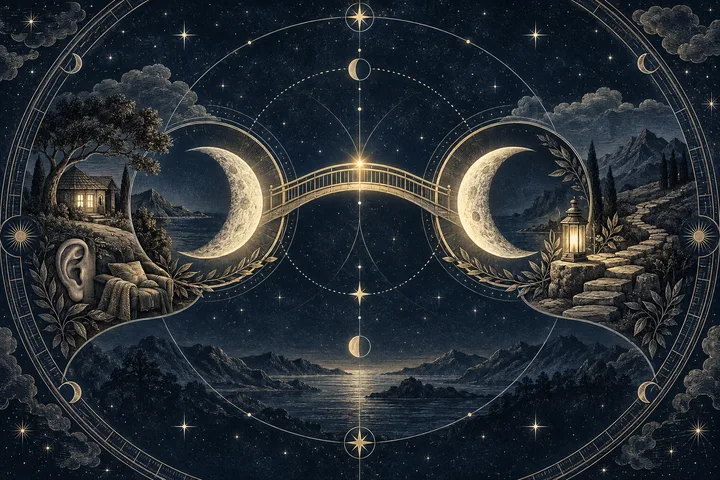
Imagine Maria's Cancer Moon is at 14 degrees and her partner's Capricorn Moon is at 16 degrees. Their signs oppose one another and their two-degree separation makes the Moon-to-Moon opposition a central theme. Maria may ask for closeness and shared feeling. He may answer with responsibility and a plan. The aspect doesn't decide who is right. It tells you to examine the bridge between sanctuary and structure. If that bridge exists, they can provide what the other lacks. If neither crosses it, each may experience the other's care as pressure or rejection.
A close aspect deserves priority, not panic. Write the contact in plain language before reaching for a conclusion. ‘Your Moon needs emotional presence, and my Moon restores safety through action’ is more useful than ‘we have a difficult opposition.’ Then check whether the chart contains a supporting contact. Let each contact earn its place. The Moon-to-Moon aspect is the meeting point, not the final sentence.
Don't let an exact number create false drama. A two-degree contact is important because it is close within the chosen method, not because two degrees carry a universal relationship score. Compare the contact with the signs and conditions. A close square between two Moons may describe work that keeps returning. A close trine may describe ease that becomes dependable when both people use it consciously. The aspect names the pattern; the condition names the style.
The same rule helps with sign changes. If one person gives only a sign and the other gives a degree, don't pretend the data has equal precision. Read the signs, record the known degree, and mark the aspect question as unresolved if the missing information could alter the orb. A careful reading can still say something useful without forcing certainty where the inputs don't support it.
Sources: Exaltation (and Fall) - Skyscript Glossary; What's Your Sign? An Intro to Synastry Charts and Astrological Compatibility - Astrology.com
Moon-Venus and Moon-Mars add different kinds of warmth
Moon-to-Moon is not the whole emotional story. The partner's Venus shows how affection, pleasure, and values enter the exchange. A close Moon-Venus contact can make one person's emotional needs feel recognizable to the other's way of showing love. That can be sweet and sustaining. It still doesn't erase the Moon's condition. Venus may offer affection in a form the Moon doesn't know how to receive.
If a Taurus Moon meets a partner's Venus in a compatible earth or water pattern, physical ease and affection may reinforce one another. If a Cancer Moon meets a partner's Venus by close aspect, the Venus person may instinctively validate the Moon person's need for tenderness. But a Venus person can also prefer harmony and pleasantness when the Moon needs a difficult truth. Comfort isn't always softness. Sometimes it is staying present when the room becomes uncomfortable.
Moon-Mars brings heat and activation. Mars can stir protective action, irritation, sexual energy, and the urge to do something now. In a supportive pattern, Mars helps the Moon move out of paralysis. In a hard pattern, the Mars person may push when the Moon person needs safety, or the Moon person may experience ordinary initiative as intrusion. The Moon's condition changes the reception. A Capricorn Moon may appreciate a Mars person who takes useful action. A Scorpio Moon may react strongly if that action feels invasive. A Taurus Moon may need time before responding.
Rank the layers. First ask whether each person can identify the other's lunar need. Then ask whether Venus can make affection legible. Then ask whether Mars acts at a pace the Moon can tolerate. A beautiful Venus contact cannot replace emotional safety, and a forceful Mars contact cannot manufacture trust.
Use role language carefully. The Moon person is not always the needy one, and the Venus or Mars person is not always the giver. Synastry describes an exchange that can reverse from moment to moment. In one argument, the Moon person may need reassurance. In the next, the same person may be the one who steadies the partner. Planet roles show the channel being activated, not a permanent division of emotional labor.
Sources: Moon in Domicile, Exaltation, Detriment & Fall - Augurine; What's Your Sign? An Intro to Synastry Charts and Astrological Compatibility - Astrology.com
What changes when the Moon is close to a special degree
Optional degrees let you refine the condition without pretending to know more than the chart data provides. The Moon is exalted throughout Taurus in the traditional sign-based scheme, while the third degree of Taurus receives special recognition as the Moon's exaltation degree. That is a refinement, not a new sign category. A Moon at 3 degrees Taurus may carry a particularly concentrated version of the exaltation symbolism, but you still read its aspects, phase, ruler, house, and full chart context.
The same discipline applies to synastry. A sign pair may sound harmonious, yet the degrees may show no major aspect within the chosen six-degree orb. Or two signs may sound unlike one another, while a close opposition or square makes the emotional exchange impossible to ignore. Degree precision ranks what deserves attention. It doesn't turn an interpretation into a score.
Birth information matters to the supplied data. If the report gives Moon signs and optional degrees, work with those inputs. If minutes are missing, preserve the uncertainty around the exact degree and don't invent one. If only birth dates are supplied, this product's scope doesn't calculate the natal Moon, houses, or aspects from them. The report compares known placements. That boundary keeps the reading honest and useful.
A practical worksheet can hold the details. Record each Moon sign, exact degree if supplied, dignity condition, element, modality, and any close major contact. Add the Moon's ruler and relevant Moon-Venus or Moon-Mars contacts only if the report includes them. Then rank the evidence. An exact aspect with a clear input outranks a broad sign stereotype. A refined degree claim outranks neither the person's stated need nor their repeated behavior.
If a degree is uncertain, say so in the reading and lower the weight of any aspect that depends on it. Minutes can move a fast body enough to change an orb judgment, especially near a boundary. A sign-only comparison can still be meaningful, but describe it as sign-based. Precision tells the reader which part can be tested, which part is symbolic comparison, and where a future chart correction could change the emphasis.
Sources: Exaltation (and Fall) - Skyscript Glossary; Moon's Essential Dignities - Hellenistic Reference
The strongest exception: an easy Moon can still miss the moment
The clearest exception to a dignity-first reading is simple. A Moon can be in Cancer or Taurus and still fail to comfort a partner. Ease in the sign doesn't guarantee generosity, timing, self-awareness, or interest in the other person's needs. A person may have a familiar lunar language and use it only for themselves. They may assume that because their care feels obvious, the partner should understand it without explanation.
The reverse is just as important. A Moon in Capricorn or Scorpio may have learned a precise, dependable way to care. It may not look spontaneous. It may come through keeping confidences, returning after conflict, taking on an unglamorous task, or refusing to abandon someone in a hard season. A sign condition that requires effort can produce skill when the person has practiced it.
This is where chart reading must meet observation. Does the person notice distress? Do they ask what would help? Can they change their response when the first attempt misses? Do they receive a correction without treating it as rejection? These questions don't cancel astrology. They show the Moon's symbolism in lived form. A chart offers the pattern; the relationship reveals its maturity.
If the Moon contacts are difficult, don't rush to call them incompatible. Name the friction precisely. One person may need emotional naming while the other supplies logistics. One may need privacy while the other seeks immediate reassurance. Then look for a repeatable translation. ‘Do you want listening, touch, a plan, or space?’ is a better synastry practice than waiting for a sign to read the mind.
Make the request small enough to answer. ‘Comfort me better’ is too broad. ‘Please listen for five minutes before offering a solution’ gives a partner something they can do. ‘I need quiet now, but I will come back to this after dinner’ protects space without creating abandonment. ‘Help me make a plan for tomorrow’ lets a Capricorn Moon receive care in a language it trusts.
Then watch the second response. A partner may perform the requested gesture once and still refuse the underlying need. Another may need practice but genuinely try. The Moon is especially clear in repetition, because lunar matters return in cycles: after work, during illness, around family, and when the relationship feels uncertain. One successful evening is encouraging. A pattern of repair is stronger evidence for how the two Moons actually fit.
Sources: Moon in Domicile, Exaltation, Detriment & Fall - Augurine; What's Your Sign? An Intro to Synastry Charts and Astrological Compatibility - Astrology.com
A ranked method for reading comfort in two charts
Use a fixed order. It keeps a dramatic aspect from swallowing the rest of the reading and gives both people a fair place in the comparison.
First, identify each Moon's sign and condition. Put the symbolism into a concrete need. Cancer may seek emotional shelter and belonging. Taurus may seek sensory steadiness. Capricorn may seek competence, order, and respect for responsibility. Scorpio may seek trust, privacy, and emotional truth. Keep the wording flexible. The person is more than the label.
Second, compare elements and modalities. Decide whether the first issue is pace, pressure, distance, language, touch, or practical support. State the likely ease and friction in one sentence each. This is where a sign description becomes a useful comparison instead of a list of adjectives.
Third, check Moon-to-Moon aspects from the supplied degrees. Use the six-degree orb consistently. Rank a close major aspect above a sign-only resemblance, then explain how it changes the first-stage reading. Don't let ‘harmonious’ mean effortless or ‘hard’ mean doomed.
Fourth, add Moon-Venus and Moon-Mars only when those inputs are available. Venus shows how affection becomes visible. Mars shows how activation, pursuit, anger, and action enter the emotional field. These layers can support the Moon, irritate it, or compensate for a mismatch. They don't replace it.
Fifth, turn the interpretation into a small practice. Ask what each person should do when the other is distressed, what each person should stop assuming, and what evidence over the next few conversations would show that the translation works. The reading should end with behavior you can observe, not a verdict about the relationship's fate.
Start with the known inputs: each Moon sign, any supplied degree, the zodiac system used by the report, and the stated aspect orb. Read the condition before adding extra planets. If one Moon is in Cancer and the other in Capricorn, ask how sanctuary and structure can join. If Taurus meets Scorpio, ask how steadiness can meet depth without either person forcing the pace. If the Moons share an element, ask whether ease has become assumption.
Then test the translation in a small moment. One person says what kind of comfort they want. The other gives it in a form they can sustain. Then switch. Notice what changes. A good synastry reading doesn't make the conversation unnecessary. It makes the conversation more exact.
A simple worksheet keeps the ranking visible. Make one line for each person: Moon sign, condition, element, modality, supplied degree, and the comfort request they recognize most quickly. Beside it, write the partner's first response and whether it landed. Only after that add a Moon-to-Moon aspect, then any Moon-Venus or Moon-Mars contact. This order prevents a striking aspect from becoming the whole story before you have described the two people it connects.
Give each observation a time and a setting. Comfort at home after work may look different from comfort during family trouble or public conflict. A Moon's condition can be easier to recognize in one setting than another, and the same contact may become more visible when the relationship is tired. Record the repeated pattern, not the most dramatic evening. Then ask whether the requested adjustment is possible without asking either person to abandon the way they naturally recover.
When you're ready to compare the placements, use the Synastry Comparison Report with the Moon, Venus, and Mars signs you already know, plus optional degrees. It can organize selected major contacts under a consistent six-degree orb. It doesn't calculate a natal chart from birth details, houses, or a relationship outcome. The useful question isn't ‘Are we destined?’ It's ‘Can we learn how the other person receives care?’
Return to that question after a real disagreement. Did each person state the need? Did the other respond in a recognizable form? Did either person adjust without keeping score? If the answers improve, the symbolism is becoming practice. If they don't, the chart may explain the pattern, but explanation alone hasn't changed it.
That is the line between interpretation and projection. Interpretation gives the couple a precise place to work. Projection uses the chart to defend a conclusion already chosen. Keep asking what happened, what each person needed, what each person offered, and what changed after the request.
The decision point is simple. Name the comfort difference. Ask for one form of care that would land. Watch whether the other person makes room for it, then offer the same care in return. A dignified Moon can't do the listening for either of you. Repeated choices decide whether the chart's language becomes a living practice.
Sources: Exaltation (and Fall) - Skyscript Glossary; Moon in Domicile, Exaltation, Detriment & Fall - Augurine; What's Your Sign? An Intro to Synastry Charts and Astrological Compatibility - Astrology.com; Moon's Essential Dignities - Hellenistic Reference
Sources & further reading
- Exaltation (and Fall) - Skyscript Glossary
Supports the traditional meanings of exaltation and fall, including the Moon in Taurus, Scorpio, and the specific third degree of Taurus.
- Moon in Domicile, Exaltation, Detriment & Fall - Augurine
Supports the Moon's emotional and bodily significations and the practical distinction between ease of processing and emotional depth in a relationship reading.
- What's Your Sign? An Intro to Synastry Charts and Astrological Compatibility - Astrology.com
Supports the Moon's link with comfort and depletion, Moon-Venus rapport, and the use of planetary degrees and close orbs in synastry.
- Moon's Essential Dignities - Hellenistic Reference
Supports the classical Moon dignity pattern, nocturnal symbolism, the third degree of Taurus, and the role of phase and chart context.
- Skyscript: Beginners Astrology Course, Lesson 3
Supports reading the four elements as distinct ways signs express a planet's basic meaning and emotional style.
- Skyscript: Beginners Astrology Course, Lesson 8
Supports reading cardinal, fixed, and mutable signs as three qualities that describe pace and movement.
Synastry Comparison Report
Enter known placements for two people. Get an input-by-input comparison, selected aspect calculations and a clear record of what remains uncertain.
Compare our placements