When two Moons share a modality but not an element, the comparison can catch the rhythm of their reactions while missing the language of emotional safety. Two cardinal Moons may both move quickly, yet a cardinal fire Moon may act to clear the air while a cardinal water Moon acts to protect a bond. Two fixed Moons may both hold their ground, but fixed earth seeks steadiness and fixed air may need distance to think. Two mutable Moons may both adjust, while mutable air explains feelings aloud and mutable water absorbs the room. So shared modality is useful, but it is not enough. Read the Moon sign as an element-plus-modality combination, then check the exact signs, degree-based aspects, house context if available, and the person’s lived pattern. If you only have signs, compare needs and habits. If you also have degrees, test whether a major Moon contact changes the story.
The same pace can hide a different emotional language
A Moon sign comparison often begins with a promising match. Both Moons are cardinal, fixed, or mutable. The couple seems to share a way of moving through feeling. That observation matters. It just doesn't finish the reading.
The element tells you what kind of emotional substance the Moon is carrying. Fire brings heat, instinct, courage, and a need for life to keep moving. Earth looks for steadiness, useful care, and something it can trust through repetition. Air processes through thought, words, perspective, and room to breathe. Water registers mood, memory, vulnerability, and the invisible ties between people. The modality tells you how that substance moves. Cardinal energy begins. Fixed energy holds, deepens, and preserves. Mutable energy adapts, translates, and changes shape.
Put the two together and the sign becomes more exact. Cardinal fire is not simply active emotion. It is feeling that wants a direct opening. Cardinal earth begins by making a plan. Cardinal air starts a conversation or a negotiation. Cardinal water initiates care, protection, or an emotional bond. They all begin, but they don't begin for the same reason.
This is the central answer to the question. Shared modality can describe matching tempo, but different elements can describe different motives, needs, and forms of reassurance. A pair may respond at the same speed and still fail to recognize what the other person is trying to protect.
Astrodienst describes the modes as three ways of acting: cardinal signs initiate, fixed signs consolidate, and mutable signs adapt. It also explains that each mode changes as it combines with an element. The same principle applies when you compare two Moons. A Moon is never only cardinal, fixed, or mutable. It is a Moon in one particular sign, with an element and a mode working together.
That is why a shared modality can feel obvious at first. Both people may react quickly, resist change, or shift with the circumstances. The missing element appears later, usually at the point where the couple has to answer a more precise question: What would make this feeling safe enough to settle?
The answer may be action, proof, conversation, or tenderness. If you call all four responses ‘emotional compatibility,’ you lose the useful part of the comparison.
A good reading therefore keeps two sentences separate. The first says how the Moons move. The second says what each Moon needs while moving. Only then can you ask whether the pair can meet each other without asking one person to become the other.
Sources: The Divine Zodiac: Elements and Modes; A Brief Introduction to Astrology: The Four Elements; The Signs of the Zodiac: Qualities and Meanings, Part 1
Cardinal Moons can act together and still want different care
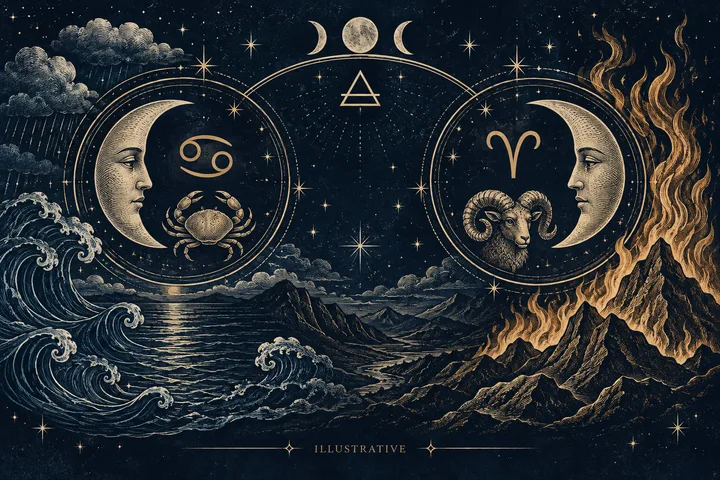
Cardinal signs are Aries, Cancer, Libra, and Capricorn. Their common thread is initiation. They don't like emotion to remain entirely suspended. A cardinal Moon may reach out, decide, confront, organize, protect, or change the arrangement around a feeling. It wants a response from life.
But the four cardinal signs divide into four elements. Aries is cardinal fire. Cancer is cardinal water. Libra is cardinal air. Capricorn is cardinal earth. The modality gives them a shared forward motion. The element gives that motion its purpose and tone.
Consider an example. Imagine Maria has a Moon in Aries and her partner has a Moon in Cancer. Both Moons are cardinal, so neither person is content to let a tense mood drift for days without some movement. Maria may say what is wrong, suggest a solution, and expect the relationship to feel better once the issue is named. Her Moon's fire wants an honest opening and a sense that the emotional atmosphere can change.
Her partner's Cancer Moon may also act quickly, but the action comes from water. He may check who was hurt, protect the private bond, remember what happened last time, or create a safer setting before speaking. He isn't necessarily avoiding the issue. He may be trying to keep the conversation from damaging the connection further.
This pair shares cardinal urgency. They don't share the same first definition of care. Aries Moon may experience Cancer Moon's caution as delay, moodiness, or indirectness. Cancer Moon may experience Aries Moon's directness as pressure or a failure to notice vulnerability. Neither description is the whole truth. The same cardinal impulse has been shaped by different elements.
The practical question is not which Moon is more emotional. Both are emotional. Ask what each person does with the first wave. Does one person make a clean break from the feeling while the other stays close to its history? Does one seek a clear answer while the other seeks evidence that the bond is still intact? Those are elemental differences inside a shared cardinal style.
The other cardinal pairings show the same pattern. Aries Moon with Libra Moon may share a quick need to address the atmosphere, but fire moves from instinct while air moves through comparison and dialogue. One may want a candid statement. The other may want to understand every side before choosing words. They can cooperate beautifully when they agree to name both needs: directness first, fairness second, or fairness first, directness second.
Cancer Moon with Capricorn Moon can look like a powerful practical-emotional team. Both are cardinal. Water protects belonging; earth protects structure. One asks, ‘Are we emotionally safe?’ The other asks, ‘What can we reliably do?’ If the couple respects both questions, care becomes concrete. If not, Cancer can call Capricorn cold, while Capricorn calls Cancer difficult to satisfy.
Libra Moon with Capricorn Moon may both want a workable arrangement, but air seeks a balanced exchange and earth seeks a dependable result. They can spend too long discussing an agreement that one person wants to feel and the other wants to implement. The solution is plain: decide which part belongs to conversation and which part belongs to a specific action.
When cardinal Moons share a modality but not an element, watch the opening move. It is the clearest clue. The first move reveals whether the person is trying to energize, protect, negotiate, or stabilize the emotional field. Don't reduce that move to ‘they both like to take initiative.’ Ask what the initiative is for.
Sources: The Divine Zodiac: Elements and Modes; The Signs of the Zodiac: Qualities and Meanings, Part 1; Aspects in Astrology: The Five Major Configurations
Fixed Moons may both hold on, but not to the same thing
Fixed signs are Taurus, Leo, Scorpio, and Aquarius. Their shared modality gives them continuity. A fixed Moon often needs time to establish trust, settle into a response, and decide what deserves to remain. It may not change its feeling because another person asks for a faster answer. Once attached, it has staying power.
That can feel reassuring when two fixed Moons meet. Neither person is likely to treat every mood as disposable. They may build rituals, remember preferences, stay loyal through a difficult season, and give a bond weight. Yet the element still decides what each person is holding.
Taurus is fixed earth. Leo is fixed fire. Scorpio is fixed water. Aquarius is fixed air. The shared fixed quality can make all four seem stubborn, but stubbornness is too blunt a word. Taurus may preserve comfort and material reliability. Leo may preserve warmth, pride, and a sense of heartfelt recognition. Scorpio may preserve emotional truth, privacy, and depth. Aquarius may preserve principle, autonomy, and a clear view of the larger pattern.
Imagine Maria has a Taurus Moon and her partner has an Aquarius Moon. Both may resist being pushed into a new emotional arrangement before they are ready. Maria may need steady presence, familiar routines, and evidence that love will show up in ordinary life. Her partner may need space to think, freedom from emotional pressure, and the right to care without performing closeness in a conventional way.
They share fixed endurance. They do not necessarily share a picture of security. Taurus Moon may think, ‘Stay near me and make this dependable.’ Aquarius Moon may think, ‘Respect my inner space and let us build a relationship that makes sense to both of us.’ When these needs are unnamed, each person can believe the other is withholding the very thing that would help.
The conflict is not simply fixed versus fixed. It is a dispute over the object of loyalty. Taurus may be loyal to continuity. Aquarius may be loyal to an ideal or a principle. Leo may be loyal to the heart of the bond. Scorpio may be loyal to the emotional truth beneath its polite surface. A useful comparison names that object instead of praising or blaming persistence.
Leo Moon with Scorpio Moon can show great devotion and strong feeling, but fire wants visible warmth while water wants emotional honesty that cannot be staged. Leo may ask for appreciation in clear words and gestures. Scorpio may test whether the feeling remains true when no one is applauding. If both people wait for the other to prove love in the preferred language, the relationship can become a silent contest.
Scorpio Moon with Aquarius Moon can share depth and conviction without sharing the same route to intimacy. Scorpio protects the private emotional field. Aquarius protects independent thought. Both may reject shallow connection, yet one moves toward fusion and the other toward perspective. A successful conversation must make room for both, with explicit agreements about privacy, time alone, and what honesty requires.
Taurus Moon with Leo Moon often understands the value of loyalty, pleasure, and a warm home base. Still, Taurus may show love by maintaining comfort while Leo may need active appreciation. The fixed bond is real, but it doesn't speak for itself. Ask what should be repeated, what should be celebrated, and what must never be assumed.
With fixed Moons, patience helps, but patience alone can turn into a locked door. The decision guide is simple. Identify what each Moon wants to preserve, then name the small change that would make preservation possible. If neither person can say what the other is protecting, the shared modality has become a label instead of a reading.
Sources: The Divine Zodiac: Elements and Modes; A Brief Introduction to Astrology: The Four Elements; The Signs of the Zodiac: Qualities and Meanings, Part 1
Mutable Moons can adapt together while processing in opposite ways
Mutable signs are Gemini, Virgo, Sagittarius, and Pisces. Their common mode is adjustment. Mutable Moons notice movement in the situation. They can revise a response, translate between viewpoints, learn from what happened, and find another route when the first one fails. This flexibility can keep a relationship alive through changing schedules, beliefs, families, and seasons of life.
It can also make the comparison look easier than it is. Gemini is mutable air. Virgo is mutable earth. Sagittarius is mutable fire. Pisces is mutable water. All four can change course, but they do so with different inner materials. Air gathers information. Earth improves the process. Fire searches for meaning and possibility. Water receives and dissolves boundaries.
Imagine Maria has a Gemini Moon and her partner has a Pisces Moon. Both are mutable, so both may dislike a rigid emotional script. Maria may ask questions, talk through several interpretations, and use language to discover what she feels. Her partner may absorb the mood before finding words. Pisces Moon may need quiet, music, sleep, prayer, or gentle contact before a clear sentence arrives.
The couple shares adaptability. They don't share a processing channel. Gemini Moon may believe conversation creates emotional clarity. Pisces Moon may believe emotional space creates the clarity that conversation can later express. If Maria keeps asking for a definition, her partner may feel crowded. If her partner keeps offering atmosphere without an answer, Maria may feel abandoned inside uncertainty.
The answer is not to decide which style is mature. It is to create a two-stage practice. First, allow the water Moon to register the feeling without forcing a finished account. Then give the air Moon a real time to ask and answer questions. Adaptability becomes useful when it has a container.
Virgo Moon with Sagittarius Moon offers another contrast. Both may revise their response, but Virgo's mutable earth often looks for a specific improvement while Sagittarius's mutable fire looks for a wider truth or future direction. Virgo may ask what needs to be fixed by tomorrow. Sagittarius may ask what this teaches about the life they are building. One can hear the other as nitpicking or preaching unless both levels are honored.
Virgo Moon with Pisces Moon shares a mutable sensitivity to what is changing, but earth sorts, names, and tends to details while water feels the whole field. Virgo may offer care through a list, a task, or a practical adjustment. Pisces may offer care through presence, compassion, and emotional merging. Each can miss the gift if it arrives in the wrong form.
Gemini Moon with Sagittarius Moon can move quickly from one idea to the next. Air collects angles. Fire searches for a horizon. They may enjoy a lively emotional life, but a hard conversation can become a debate or a story about the future before either person has admitted the immediate hurt. The useful question is, ‘What happened in your body and heart before we explain it?’
Sagittarius Moon with Pisces Moon may share faith, imagination, and a wish for emotional freedom. Fire seeks a guiding meaning; water feels the unseen bond. This can be tender and generous. It can also become vague. One person may promise a future in broad terms while the other needs the present relationship to feel safe today. Mutable compatibility improves when hope gets a schedule and compassion gets a boundary.
For mutable Moons with different elements, watch what happens after the first reaction. Does the person ask for facts, make a repair, seek meaning, or merge with the mood? That second move often exposes the elemental difference more clearly than the initial flexibility.
Sources: The Divine Zodiac: Elements and Modes; The Signs of the Zodiac: Qualities and Meanings, Part 1; Aspects in Astrology: The Five Major Configurations
Rank the interpretation by the moment that keeps repeating
When the elements and modalities disagree, don't ask which one wins. They answer different questions. Modality describes how the response moves: it begins, holds, or adapts. Element describes what the response is protecting and what kind of care feels nourishing. Rank the reading by the repeated moment, then use the chart to explain it.
Start with an ordinary pattern. What happens when plans change, someone feels ignored, or a private fear enters the room? A cardinal difference may produce competing opening moves. A fixed difference may reveal different ideas of loyalty. A mutable difference may show two ways of processing uncertainty. The lived moment tells you which part of the symbolism is active.
Next, name the elemental need beneath the behavior. Fire may want candor and room to act. Earth may want reliability. Air may want words and perspective. Water may want emotional safety and recognition. These are working interpretations, not boxes. The Moon's condition, ruler, and other contacts can change how the need appears.
Then check the geometry. A trine joins signs of the same element. A square joins signs of the same modality. An opposition joins signs with the same modality and opposite elements. A conjunction depends on the signs and degrees involved. Cancer and Capricorn, for example, are both cardinal and also oppose by sign. Don't call every shared modality a square, and don't let a sign label stand in for a measured contact.
If degrees are supplied, this report's scope uses selected major-aspect calculations with a six-degree orb. Give a close conjunction, opposition, square, trine, or sextile more weight than a wide contact or a loose keyword match. If degrees are missing, keep the reading at the sign level. If house information is missing, don't invent where the emotional contact lands.
Bring in Venus and Mars after the Moon story is clear. Venus can show how affection supports emotional comfort. Mars can show how the pair handles initiative and friction. Those contacts may soften a Moon difference or make it louder. They refine the question. They don't replace it.
Imagine Maria's Aries Moon and her partner's Cancer Moon. Both want movement when tension rises, but Maria may seek a frank opening while Cancer seeks reassurance that the bond is safe. Their agreement could be simple: name the issue tonight, take ten minutes to settle the room, then return to the conversation. The chart has become a choice.
Keep the interpretation open to what each person has learned. A cardinal water Moon may speak quickly because silence once felt unsafe. A cardinal fire Moon may soften its directness because an earlier opening caused harm. The sign shows a tendency. Repeated behavior shows its lived shape. Read both.
A useful record has five lines for each Moon: sign, element, modality, first response under pressure, and the repair that works. Watch several ordinary moments, not one dramatic night. If the same issue returns, ask whether your agreement addressed the element or only the modality. Then revise it.
The strongest reading explains the repeating moment with the fewest extra assumptions. Shared modality explains the pace. Different element explains the mismatch in care. A close aspect explains how strongly the pattern engages. Stop there unless another layer changes what you can see or do.
Sources: The Divine Zodiac: Elements and Modes; A Brief Introduction to Astrology: The Four Elements; The Signs of the Zodiac: Qualities and Meanings, Part 1; Understanding the Free Natal Chart Report
Turn the difference into a conversation you can actually use
A Moon comparison earns its place when it changes a conversation. It should help you ask a better question, notice a familiar moment sooner, and choose a response that respects both people. The goal isn't to erase the elemental difference. It is to stop mistaking different care for absent care.
Start by describing the pattern without astrological blame. Say, ‘When something feels wrong, I want to talk and change the atmosphere quickly.’ Or say, ‘When something feels wrong, I need to feel that our bond is safe before I can explain it.’ Those sentences are more useful than, ‘You are too sensitive,’ or, ‘You are too detached.’ They name the need and leave room for a reply.
Then ask, ‘What does your first move mean to you?’ This question is especially valuable when the Moons share a modality. The action, pause, persistence, or adjustment may look familiar on the outside while carrying a different purpose inside. A cardinal person may act to begin repair. Another may act to prevent further injury. A fixed person may hold on out of loyalty. Another may hold on because trust takes time. A mutable person may change the subject to find perspective. Another may change shape because the room feels overwhelming.
Next, agree on a translation. Fire can ask for a direct sentence without turning urgency into attack. Earth can offer a practical next step without pretending the feeling is solved. Air can explain the pattern without talking over the emotion. Water can ask for tenderness without requiring mind reading. These are not roles assigned forever. They are options for the next difficult moment.
Make the agreement observable. ‘We will talk soon’ is vague. ‘We will name the issue tonight, take a short pause if voices rise, and return before bed unless one of us is too flooded to speak clearly’ gives the Moon something it can trust. Adapt the exact practice to the pair. A fixed Moon may need a promised return. A mutable Moon may need permission to revise the first conversation. A cardinal Moon may need proof that movement will happen. The element tells you what makes that practice feel alive.
If the comparison includes degrees, bring the major contact into the conversation as a pattern to explore, not a sentence handed down from above. You might say, ‘This close Moon square fits the way we both react strongly but solve the feeling differently. Where do you notice that?’ If the comparison includes only signs, say only what the signs support. You can still have a precise conversation. You simply keep the claim at the right level.
The Synastry Comparison Report is useful at that point because it works from supplied Moon, Venus, and Mars placements, with optional degrees and selected major aspects using a six-degree orb. It can organize the comparison and show which contacts deserve attention. It doesn't calculate a natal chart from birth details, calculate houses, or decide whether a relationship should continue. The decision remains yours, and the useful work is the conversation you have with the pattern in view.
Before you compare, write down the placements you actually know. Record each Moon sign. Add degrees if you have them. Note any major Moon-to-Moon, Moon-to-Venus, or Moon-to-Mars contacts you want checked. Mark missing information instead of filling it in. A clean input list makes a cleaner reading.
After you compare, choose one experiment for the next two weeks. It might be a calmer opening, a promised return after a pause, a practical act of care, or a boundary around emotional processing. Watch what changes. If the same issue returns, ask whether the practice addressed the element or only the modality. Then revise the agreement.
Your final decision point is simple. Can both people recognize the other's emotional language and make a real adjustment without losing themselves? If yes, the difference can become a shared skill. If no, a beautiful sign comparison won't do the work for them. Read the chart clearly. Then watch the choice.
Sources: Understanding the Free Natal Chart Report; The Signs of the Zodiac: Qualities and Meanings, Part 1
A little more clarity
Is sharing a Moon modality more important than sharing a Moon element?
Neither is automatically more important. Modality describes how a Moon responds over time: it begins, holds, or adapts. Element describes the emotional language behind that response: fire, earth, air, or water. Read them together. A shared modality can create a familiar pace, while a shared element can create easier recognition of what comfort feels like. A close degree-based aspect may add more weight than either broad category, so check the actual Moon contact when degrees are available.
What does it mean if two Moons share a modality but have different elements?
It often means the two people move through emotional situations at a similar pace but seek different kinds of care. Cardinal Moons may both want movement, while fire seeks candor and water seeks safety. Fixed Moons may both value continuity, while earth seeks reliability and air seeks space or principle. Mutable Moons may both adjust, while air processes by talking and water processes by absorbing. The exact signs and any major aspects refine the pattern.
Can different Moon elements work well together?
Yes. Different elements can bring translation and balance. Earth can give feeling form, water can soften earth, air can give a conversation perspective, and fire can restore motion when a bond feels stuck. The difference becomes difficult when one person treats their own comfort language as the only valid one. Look for repeated behavior, name each Moon's need, and create a concrete way to meet both people in the next difficult moment.
What should I do if I only know our Moon signs, not our degrees?
Keep the reading at the sign level. Compare each Moon's element and modality, describe the likely emotional needs, and avoid claiming a precise conjunction, square, trine, or opposition. If you later obtain degrees, check selected major aspects with a stated six-degree orb. You can use a Synastry Comparison Report with supplied placements and optional degrees, but it won't calculate a natal chart from birth details or fill in missing chart information.
Sources & further reading
- The Divine Zodiac: Elements and Modes
Supports the distinction between elements as sign substance and cardinal, fixed, and mutable modes as different ways of acting, including how each mode changes across elements.
- A Brief Introduction to Astrology: The Four Elements
Supports the four elements and the three qualities, and explains that placements in cardinal, fixed, and mutable signs reveal different basic modes of expression.
- The Signs of the Zodiac: Qualities and Meanings, Part 1
Supports reading each sign as an overlapping combination of element, modality, planetary ruler, and other sign qualities rather than treating a modality as a complete meaning.
- Aspects in Astrology: The Five Major Configurations
Supports the interpretive order that connects trines with shared element, squares with shared modality, oppositions with shared modality and opposite elements, and aspects with planetary interaction.
- Understanding the Free Natal Chart Report
Supports the standard sign groupings for cardinal, fixed, mutable, fire, earth, air, and water, and explains that a smaller aspect orb means a closer contact that astrologers may weigh more strongly.
Synastry Comparison Report
Enter known placements for two people. Get an input-by-input comparison, selected aspect calculations and a clear record of what remains uncertain.
Compare our placements