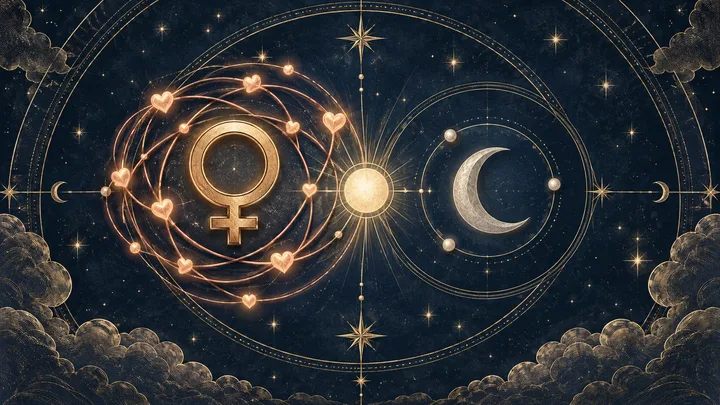
Read the pattern as strong affection and shared pleasure first, not as proof of deep emotional ease. Venus contacts show what draws you together, how you express liking, and what feels beautiful or worth choosing. Moon contacts show how each person reacts, rests, seeks comfort, and handles ordinary vulnerability. If Venus is busy but the Moon is quiet, the relationship may feel charming, romantic, and easy to enjoy while still requiring deliberate care around moods, domestic habits, reassurance, conflict, repair, ordinary fatigue, and the way misunderstandings are repaired. Rank the tightest contacts before counting them. Use the supplied signs and degrees, keep one six-degree orb policy throughout, and check the Moon's contacts to Mercury, Saturn, Mars, Jupiter, and the angles before calling it unsupported. The useful next step is simple: compare how each of you gives affection with how each of you asks for comfort. That conversation tests the missing layer and shows whether the bond can turn pleasure into reliable care.
The short answer: Venus is active, but the Moon still needs a voice
Imagine Maria and Daniel looking at a synastry list that seems full of Venus. Her Venus touches his Sun and Mars. His Venus touches her Mercury and Jupiter. They like the same music, flirt without much effort, and keep finding small reasons to stay close. Then they notice something else. Almost nothing touches either Moon.
That pattern doesn't cancel the attraction. It changes the question. The Venus layer says the pair knows how to enjoy one another. It can describe charm, affection, shared taste, social ease, romance, and the feeling that being together adds beauty to the day. The Moon layer asks whether the pair knows how to meet one another in quieter states: tiredness, homesickness, irritation, fear, silence, and the need for familiar care.
So the first judgment is favorable but limited. Many Venus contacts can make a relationship feel wanted and pleasant. Few Moon contacts mean you shouldn't treat that pleasure as emotional understanding. A person can adore the way you laugh, admire your style, and want your company without yet knowing what helps you settle after a hard day. Both layers matter, but they do different work.
This is why counting contacts alone gives a poor reading. A tight Venus-Saturn conjunction may carry more weight than three loose Venus links. A close Moon-Saturn square may say more about emotional responsibility than a long list of minor Venus aspects. Begin with exactness, planet roles, and repeated themes. Then ask what the chart describes in daily life.
Sources: Synastry: Moon-Venus Aspects Between Two Charts; Synastry; Partner horoscopes: How does synastry work?; Introduction to Relationship Astrology 2: Synastry
What Venus contacts actually bring into the relationship
Venus is the planet of attraction, pleasure, harmony, sociability, and the values that shape affection. In synastry, a contact from one person's Venus to the other person's planet colors that planet with Venusian qualities. The Venus person may appreciate, soften, beautify, or choose the planet person. The planet person receives the Venus energy through the area that planet represents.
A Venus-Sun contact often makes admiration visible. The Venus person likes the Sun person's way of being, while the Sun person may feel more attractive, welcomed, or understood in the Venus person's presence. Venus-Mercury can make conversation pleasant and encourage shared interests. Venus-Mars adds heat, pursuit, and embodied attraction. Venus-Jupiter can enlarge generosity and enjoyment, though it can also make spending or indulgence easy.
Venus-Saturn deserves a more careful reading than the word difficult suggests. It can feel serious, loyal, and willing to make affection concrete. It can also make one person feel judged, restricted, or responsible for keeping the bond respectable. Venus-Uranus can bring excitement and unusual tastes, while Venus-Neptune may heighten romance and tenderness but blur what has actually been promised. Venus-Pluto can intensify desire and attachment. The sign, aspect, orb, and natal condition decide how those themes land.
The important point is that Venus answers a relational question: What do we enjoy, value, and find attractive in each other? It doesn't answer every emotional question. A person may offer beautiful dates but avoid difficult feelings. Another may show love through practical gifts while missing a partner's need for quiet reassurance. Venus describes the style of giving and receiving pleasure. It doesn't automatically describe the nervous system's response to stress.
When many Venus contacts repeat one message, take that repetition seriously. Several links to Mercury, Jupiter, or the Sun may create an easy social and romantic current. Several links to Saturn, Pluto, or Neptune change the tone. Don't flatten all Venus contacts into sweetness. Name the exact Venus pattern first.
You can also ask whether the Venus contacts are mutual in emphasis. If both people's Venus reaches the other's personal planets, the exchange may feel more balanced. If one person's Venus makes most of the contacts, that person may be doing more of the admiring, pursuing, smoothing, or aesthetic shaping. The other person can still care deeply, but the relationship may not feel equally Venusian from both seats. State that difference. It often explains why one partner calls the bond effortless while the other calls it flattering but demanding.
Sources: Synastry: Moon-Venus Aspects Between Two Charts; Synastry; Introduction to Relationship Astrology 2: Synastry
What the Moon layer adds that Venus cannot supply
The Moon describes feeling tone, receptivity, instinct, memory, rhythm, and the ways a person adapts to change. In a relationship reading, it brings the private body of the connection into view. Who needs time alone after conflict? Who wants to talk immediately? Who notices a change in tone? Who creates the familiar meal, checks the room, or reaches for a hand without being asked? Those questions belong to the Moon.
A Moon contact doesn't have to be romantic in a polished way. It can be messy, habitual, and deeply ordinary. Moon-Moon contacts can show similar emotional rhythms or a shared instinctive language. Moon-Mercury can help feelings become words, though a hard aspect may turn every mood into an argument about facts. Moon-Mars can make care active and protective, but it can also make irritation quick. Moon-Saturn can give structure and endurance, while asking both people to handle heaviness with maturity.
Moon-Venus is especially useful because it joins feeling with affection. Cafe Astrology describes easier Moon-Venus aspects as supportive of natural liking, warmth, compromise, and a pleasant shared environment. It also treats squares and oppositions as contacts that can preserve affection while creating friction around habits, values, praise, and feeling understood. The aspect doesn't remove every problem. It tells you where tenderness and adjustment meet.
If Moon contacts are scarce, don't conclude that the relationship lacks feeling. The Moon may still be activated through sign resonance, house overlays, an angle contact, the Moon's ruler, or contacts from Saturn, Jupiter, Mars, Mercury, or the outer planets. But those layers must be present in the supplied data. If you only have Moon signs and a short aspect list, keep the claim narrow. The chart may show affection clearly while leaving emotional habit less described.
This is the central distinction: Venus says, ‘I like what we share.’ The Moon says, ‘I can let my guard down here, or I know what happens when I can't.’ A reading that has the first sentence but not the second is unfinished.
That difference shows up before language arrives. A Venus contact may help you say the kind thing or restore a pleasant atmosphere. A lightly connected Moon may mean the pair needs to name small signs of withdrawal instead of expecting them to be noticed automatically. Watch for that in real life.
Sources: Synastry: Moon-Venus Aspects Between Two Charts; Synastry; Introduction to Relationship Astrology 2: Synastry
How to check whether the Moon is truly quiet
Before interpreting a missing pattern, verify what was actually compared. Write Person A's Moon, Venus, and Mars signs and degrees, then do the same for Person B. Keep the zodiac system, aspect list, and orb policy fixed. This report uses supplied placements and optional degrees, so a missing Moon degree limits what you can confirm.
Next, apply the chosen orb consistently. The editorial report scope here uses a six-degree orb for selected major aspects. Astrodienst notes that synastry commonly uses tighter orbs than natal work because two charts produce many more possible contacts. A reference text gives even narrower recommendations for some major aspects. The lesson is practical: state your rule, use it everywhere, and rank a one-degree contact above a six-degree contact when the planet roles are otherwise comparable.
Then separate major aspects from sign-based resemblance. A Moon in Taurus and Venus in Virgo share an earth emphasis, but that isn't the same as a Moon-Venus trine by degree. A Venus in Libra and Moon in Aries may oppose by sign, but the degree distance determines whether the major aspect is active under your policy. Sign symbolism can support an interpretation. It shouldn't masquerade as a calculated aspect.
Finally, inspect the Moon's whole contact list. ‘Almost no Moon contacts’ might mean no Moon-to-personal-planet aspects, no Moon contacts within six degrees, or simply fewer contacts than Venus. Those are different findings. Name the one you have. Precision here protects the rest of the reading.
Check what the aspect list includes. Some reports omit minor aspects, angles, house overlays, or outer-planet contacts. A quiet Moon in a selected personal-planet table may become more active in a fuller comparison, but don't assume hidden contacts. Record the scope so another reader can follow the same choices.
One more check is worth making: look at the same planet pair in both directions. If Person A's Moon aspects Person B's Venus, that is a Moon-Venus contact. If Person B's Moon also aspects Person A's Venus, the double emphasis can make the theme more obviously shared. If only one direction exists, preserve the distinction in the wording. The Venus person may be the one offering affection, while the Moon person may be the one receiving it as comfort. Synastry is relational, but it isn't always symmetrical in experience.
If your method records applying or separating contacts, keep that detail with the aspect. A Moon person may experience another person's Venus as soothing, while the Venus person experiences the same link as a wish to please. Those meanings are close, not identical.
For a quick audit, circle every claimed Moon contact and ask four things: whose Moon is involved, which planet receives it, how close is the aspect, and what experience does that planet describe? If one answer is missing, soften the sentence. If all four are present, the contact deserves a place in the ranked reading. This small audit catches the common mistake of treating a sign pairing or an attractive story as proof of an aspect.
Sources: Synastry; Partner horoscopes: How does synastry work?; Introduction to Relationship Astrology 2: Synastry
Rank the Venus contacts instead of adding them up
A long aspect list can create a false sense of certainty. Ten contacts aren't automatically stronger than two. Synastry doubles the number of planets under consideration, so a disciplined reading has to reduce noise. Start with the closest major aspects involving personal planets and angles that are actually available. Then look for repetition. Does Venus keep meeting Saturn? Does Venus keep touching Mercury? Does the same person repeatedly receive the other person's Venus?
Give first place to the contact that combines three things: a tight orb, a central relationship planet, and a theme repeated elsewhere. A Venus-Moon conjunction at one degree deserves more attention than a Venus-Mercury sextile at six degrees if the question concerns emotional care. A Venus-Mars square at two degrees may describe potent attraction, but it doesn't by itself describe comfort. A Venus-Saturn trine at one degree may show an ability to make affection steady, even if the relationship isn't theatrically romantic.
Second, ask who is carrying which role. In synastry, the Venus person and the contacted planet person can experience the same aspect differently. The Venus person may feel drawn to the other person's Sun, while the Sun person feels seen and admired. With Venus-Saturn, the Venus person may seek approval or commitment, while the Saturn person may feel responsible for defining limits. Don't write ‘you both feel’ unless the aspect is genuinely reciprocal in the interpretation.
Third, classify the contact by function. Attraction, affection, communication, desire, commitment, and transformation aren't the same thing. A chart with many Venus-Mercury and Venus-Jupiter contacts may be generous and talkative. A chart with Venus-Saturn and Venus-Pluto may feel weightier. A chart with Venus-Uranus may need freedom. The word Venus doesn't erase the planet receiving it.
Only after that ranking should you describe the pattern as Venus-heavy. The phrase becomes useful when it tells the reader what the relationship does easily and what it may ask them to practice.
A simple ranking table can keep the interpretation honest. Put the aspect in the first column, the orb in the second, the receiving planet in the third, and the lived theme in the fourth. A Venus-Mercury conjunction at one degree might read as affectionate conversation. A Venus-Saturn square at four degrees might read as affection tested by standards or timing. A Venus-Moon trine at five degrees could still matter, especially if it repeats a larger theme, but it should not automatically outrank the closer contact. The table is not the reading. It is the guardrail that lets the reading stay clear.
Don't let the word close become a substitute for meaning. A one-degree Venus-Pluto aspect may dominate the atmosphere, but its intensity can feel very different from a one-degree Venus-Jupiter aspect. Likewise, a six-degree Moon contact may be less prominent than a two-degree contact to a planet that repeatedly rules the personal story. Exactness helps you rank. Planet symbolism tells you what you are ranking. The two steps belong together.
When the question is emotional fit, move any Moon contact with a personal planet or angle to the top of the review, even if the Venus list is longer. When the question is attraction, start with Venus-Mars, Venus-Sun, and Venus-Ascendant contacts, then ask whether the Moon can receive the resulting intensity. When the question is durability, give Venus-Saturn and Moon-Saturn a careful place, but read the aspect itself: a trine may support steadiness, while a square may show work that must be handled rather than a simple refusal. The same chart can receive different rankings for different questions. A good astrologer chooses the layer that answers the reader's concern.
Mark each contact as direct, supporting, or background. Direct contacts join the planet named in the question. Supporting contacts repeat its theme through another planet, ruler, or angle. Background contacts add color but shouldn't carry the conclusion alone. This keeps a Venus-heavy list from swallowing every other observation. It also gives you a clean sentence for the reader: ‘Affection is the clearest current, communication supports it, and emotional timing remains the part to observe.’ That ranks the chart without pretending symbols behave like points in a scoreboard.
Sources: Synastry; Partner horoscopes: How does synastry work?; Introduction to Relationship Astrology 2: Synastry
The three questions that reveal the missing Moon layer
When Venus dominates, ask three practical questions. They turn a symbolic pattern into a reading you can use without forcing a verdict.
The first is: how do we show affection when nothing is wrong? Look for the Venus pattern in real behavior. Do you make plans, touch often, bring small gifts, praise each other's work, share food, or make the room beautiful? Venus contacts tend to show the forms of appreciation that arise naturally. If the answer is yes, name that strength. It matters. A relationship needs pleasure, and pleasure is not superficial when it gives two people a reason to keep meeting each other with goodwill.
The second is: what happens when one of us is upset? This is where the Moon enters. Does the affectionate person become more attentive, or reach for charm and skip the painful part? Cafe Astrology's Venus-Moon material makes this exception vivid: a Venus person can be kind and playful yet fail to meet the Moon person's feelings directly. If your Venus-heavy chart has few Moon contacts, watch for exactly that move. Warmth may be plentiful while emotional timing remains unlearned.
The third is: what kind of care can we sustain on an ordinary week? The Moon is not only crisis. It is sleep, food, privacy, family memory, household rhythm, and the pace at which the body settles. A couple can have striking Venus chemistry and still disagree over noise, visitors, money, bedtime, or how much reassurance is enough. Those details don't disprove attraction. They show whether affection can find a routine.
Answer the questions in that order. Enjoyment gives the relationship its welcome. Conflict reveals its habits. Ordinary life tells you whether the welcome has somewhere to live.
You can turn the answers into a three-line summary. ‘We connect through...’ names Venus. ‘We lose each other when...’ names the Moon problem or its absence. ‘We can practice...’ names the choice that joins them. For example: ‘We connect through humor and beauty. We lose each other when one of us uses charm to move past hurt. We can practice asking what kind of care is wanted before trying to improve the mood.’ That is more useful than a label such as emotionally compatible or emotionally incompatible.
Sources: Synastry: Moon-Venus Aspects Between Two Charts; Synastry
Worked example: a beautiful courtship with a practical blind spot
Consider an example. Maria has Venus at 14 degrees Gemini. Daniel has Mercury at 12 degrees Gemini and Jupiter at 16 degrees Libra. Daniel's Venus is at 3 degrees Taurus. Maria has Mars at 5 degrees Cancer. The supplied chart shows Maria's Venus trine Daniel's Jupiter by two degrees, Maria's Venus conjunct Daniel's Mercury by two degrees, and Daniel's Venus sextile Maria's Mars by two degrees. Neither Moon forms a major aspect within the stated six-degree orb to the other's personal planets.
The Venus story is easy to see. Maria enjoys Daniel's mind and feels encouraged by his humor and generosity. Daniel's Venus and Maria's Mars create a responsive attraction, with affection meeting pursuit in a way that keeps the connection lively. They may talk for hours, plan spontaneous outings, and forgive small social awkwardness because the bond feels good in motion. Those are strong Venus findings.
The missing Moon story is not ‘they have no emotional bond.’ We don't have enough information for that claim. The narrower reading is that the supplied major contacts don't show an obvious Moon-to-personal-planet bridge. When Maria needs quiet after a family call, Daniel may offer a clever distraction. When Daniel feels discouraged, Maria may suggest a date instead of asking what hurt. They aren't uncaring. They simply reach for the Venus language they already share.
Their decision guide is therefore concrete. Keep the dates, the teasing, the music, and the generous praise. Add a care protocol. Ask, ‘When you're upset, do you want comfort, advice, space, or company?’ Ask it before the next difficult evening, not while either person is defending a position. Then notice whether the answer changes behavior. The chart's Venus strength becomes more useful when the couple gives the Moon a practiced place in the relationship.
If later data reveals Daniel's Moon conjunct Maria's Saturn or trine her Mercury, the reading changes. His emotional life may have a serious, verbal, or stabilizing bridge after all. The example shows why missing Moon contacts must remain a measured finding, not a dramatic conclusion.
Now reverse the roles for a moment. Daniel may experience the relationship as emotionally nourishing because Maria's Venus reaches his Mercury and Jupiter, making him feel welcomed whenever he speaks or shares an idea. Maria may experience it as less settled because her Moon receives no direct bridge in the listed contacts. Neither person is misreading the relationship. They are standing in different chart layers. Ask both people what the connection feels like after the date ends, when the social glow has faded and the body has to return to its own rhythm. That answer may reveal the exact place where Venus needs Moon.
Notice what this example does not claim. It doesn't say Maria and Daniel will stay together. It doesn't say either person is emotionally unavailable. It doesn't calculate a full natal chart, assign houses, or infer a birth time. It uses only the stated placements and the stated orb. The scenario is useful because it shows the interpretive order: identify the clear Venus exchange, name the Moon evidence that is missing, then give the couple a behavior that can test the open question. That sequence works with a real report without inventing a personal history.
The strongest exception: Moon silence can hide support elsewhere
The strongest exception is a chart where the Moon has few direct interaspects but still receives meaningful support through another layer. A Moon may sit in the other's fourth house when accurate birth times are available. It may connect by sign and ruler to a strongly placed Venus. It may receive a close aspect from Saturn, Jupiter, Mercury, or an angle. The emotional story can also be carried by the natal condition of each person's Moon before synastry begins.
House overlays require more birth-time confidence than a comparison of supplied Moon, Venus, and Mars signs. If the birth time is uncertain, don't build the reading around a fourth-house or seventh-house claim. State what is known. If only signs and selected degrees are supplied, stay with those. A clear limit is part of a clear interpretation.
A second exception runs the other way. Many Moon contacts don't guarantee ease. A tight Moon-Saturn square can make care feel serious, delayed, or conditional. A Moon-Uranus opposition can keep the emotional rhythm exciting but unsettled. A Moon-Pluto conjunction can create profound intensity and a need to handle power carefully. A sparse Moon list may be less difficult than a crowded one if the crowded contacts all repeat pressure without relief.
This is why ‘more contacts’ and ‘fewer contacts’ are not moral scores. Astrodienst's synastry guidance treats harmonious aspects as easier to express, while dynamic aspects can create friction that demands engagement. A relationship often needs both welcome and work. The useful question is not whether the Moon is busy. It is whether the contacts describe a workable way to notice, answer, and repair emotional needs.
Read silence as absence of a specific bridge in the supplied comparison. Read the rest of the chart before turning that absence into a relationship story.
There is another useful distinction between a missing contact and an unexpressed contact. A chart can show Moon support, yet the people may not have learned how to use it under pressure. A Moon-Saturn trine can offer steadiness, but someone still has to answer the late-night call. A Moon-Mercury contact can support honest naming, but someone still has to stop performing certainty and tell the truth. Astrology gives a symbolic language for the pattern. The couple supplies the conduct.
The same principle applies to a quiet Venus. If Venus has few contacts but the Moon is busy, the pair may share instinctive familiarity without an obvious style of romance. They may care for each other in private, practical ways and still disagree about what counts as courtship. Comparing the two patterns prevents Venus from becoming the only measure of love. In the present question, Venus is the loud layer, so start there. Just don't confuse the loudest layer with the whole chart.
Use a three-part exception test before you downgrade the Moon layer. First, is there a confirmed contact from either Moon to the other person's Mercury, Saturn, Jupiter, Mars, Sun, or angle? Second, is there a reliable house overlay or ruler connection, supported by birth-time information rather than guessed from a sign? Third, does the natal condition of either Moon make its needs unusually visible in the comparison? One clear answer can change the reading. Several absent answers leave the original judgment intact: Venus leads, while comfort still needs to be learned through experience.
Sources: Synastry; Partner horoscopes: How does synastry work?; Introduction to Relationship Astrology 2: Synastry
How to write the final interpretation without overpromising
A strong summary should make one supported judgment and name its boundary. For this pattern, the judgment is: the relationship's easiest language is likely Venusian. It may offer attraction, appreciation, shared pleasures, and a graceful way back to one another. The boundary is: the supplied chart shows less direct evidence about instinctive comfort, emotional timing, and domestic habit, so those themes need observation and conversation.
Avoid the two lazy extremes. ‘Venus contacts are wonderful, so you're perfect together’ ignores the Moon and turns astrology into a verdict. ‘There are no Moon contacts, so the relationship is cold’ mistakes a quiet layer for a negative one. Both statements say more than the chart supports. The better reading ranks what is visible, names what is less visible, and tells the couple what to check in life.
Use planet roles accurately. Say that Venus person A contacts Mercury person B if that is what the supplied aspect says. Say ‘may’ when the interpretation depends on an unconfirmed house, missing degree, or natal condition. Don't invent exactness. Don't add a compatibility percentage. Don't call the connection destined. Synastry describes patterns of exchange. It doesn't remove choice, maturity, or the need to act well.
Keep the report's scope visible when you summarize. A placement comparison can use supplied signs and optional degrees, with selected major aspects under a six-degree orb. It cannot establish houses without reliable birth times or turn the comparison into a dating verdict.
When the prose ends, the reader should know what the chart favors, what it leaves open, and what conversation will test the open question. That is enough.
A useful final paragraph follows three moves: name the easiest current, name the less developed layer, then name the practice that joins them. ‘There is plenty of affection and attraction here. The available contacts say less about automatic emotional attunement. Ask for the kind of comfort you want, and learn whether the other person can offer it consistently.’ Warmth stays intact. So does the boundary.
Use a comparison grid when the chart feels crowded. Put the strongest Venus contact beside the strongest Moon contact, even if the second space is empty. For each one, write the planet roles, aspect, orb, and likely daily expression. Then add one observation that could confirm or challenge the interpretation. This turns a pile of meanings into a working map. It also helps you see whether the missing Moon layer is truly absent or simply buried under a longer Venus list.
Sources: Synastry: Moon-Venus Aspects Between Two Charts; Synastry; Partner horoscopes: How does synastry work?
The conversation that gives the Moon a place
Start with this question: ‘When life gets heavy, what kind of care helps you feel close instead of crowded?’ Let the other person answer without correcting the answer. Then answer it yourself. You may want reassurance. They may want practical help. You may need an hour alone before you can speak. They may hear silence as rejection. None of those needs is automatically right or wrong, but each changes how Venus affection reaches the Moon. This question works because it asks for a preference, not a confession. It gives both people a fair way to explain their inner weather before the next misunderstanding decides the story for them.
Follow with a specific example. ‘Last Tuesday, when I went quiet, what did you think I needed?’ Keep the focus on the event. Don't turn one evening into a fixed identity. Ask what each person noticed, what each person did, and what would help next time. This is the kind of ordinary evidence that gives a sparse Moon layer a lived shape.
Then make one small agreement. You might agree to ask before offering advice. You might promise a text when plans change. You might protect one quiet hour after work. You might say plainly, ‘I want comfort, not a solution.’ Venus gives the agreement warmth. The Moon gives it timing and repetition.
Keep the agreement small enough to remember. A grand promise about always being available will fail the first time work, family, or fatigue interrupts it. A sentence such as ‘I'll ask before I advise’ can survive a real week. So can ‘I'll tell you when I need space, instead of disappearing.’ These are Moon practices because they respect timing and safety. They are Venus practices too because they protect the goodwill that brought you together.
After a week or two, review the agreement without scoring the relationship. What did you ask for? What did the other person hear? Did either of you repair a miss without being pushed? This follow-up matters because a single caring conversation can feel beautiful in the moment, just as a single awkward evening can feel alarming. Repeated conduct gives the symbolic reading its clearest context.
Many Venus contacts are a real gift. They make liking visible and keep pleasure alive. Few Moon contacts ask for attention, not fear. Let the relationship learn its care language, then return to the question after a real difficult week: what did each of you notice, ask for, and do? That answer matters more than the number of contacts, and it tells you where affection becomes dependable care for both people.
Sources: Synastry: Moon-Venus Aspects Between Two Charts; Synastry
A little more clarity
Do many Venus contacts make up for having almost no Moon contacts?
They can make attraction and affection strong, but they don't perform the Moon's job. Venus may help you enjoy, admire, praise, and choose one another. The Moon describes comfort, instinct, habits, and emotional timing. Read Venus as a strength, then watch how you handle tiredness, conflict, privacy, and reassurance. Other Moon contacts may add support when the supplied data confirms them.
Should I count sign connections as Moon contacts?
No. A shared element or compatible sign can support an interpretation, but it isn't a degree-based major aspect. Compare supplied degrees under one orb policy before calling a conjunction, trine, sextile, square, or opposition. If a Moon degree is missing, keep the conclusion narrow.
What should we do if the relationship feels warm but emotionally confusing?
Keep the warmth and ask, ‘When you're upset, do you want comfort, advice, space, or company?’ Use a recent example, listen, and make one small agreement for next time. Then review the tightest Moon contacts and Venus contacts by role before making a larger interpretation.
Sources & further reading
- Synastry: Moon-Venus Aspects Between Two Charts
Supports the distinction between easier and challenging Moon-Venus aspects, including affection, compromise, habits, values, and emotional acknowledgement.
- Synastry
Supports synastry as a comparison of two horoscopes and the use of harmonious and dynamic aspects as different relationship dynamics.
- Partner horoscopes: How does synastry work?
Supports the bi-wheel comparison method and the use of tighter synastry orbs because two charts create many possible aspects.
- Introduction to Relationship Astrology 2: Synastry
Supports separating planet roles, recording sign and degree positions, ranking tighter aspects, and distinguishing Moon-Venus from Venus-Mars relationship themes.
Synastry Comparison Report
Enter known placements for two people. Get an input-by-input comparison, selected aspect calculations and a clear record of what remains uncertain.
Compare our placements