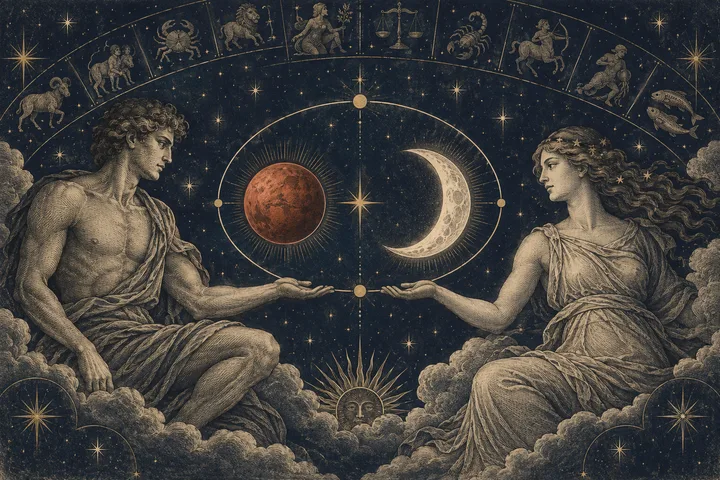
Keep Mars in view as one interchart connection, then compare it with each person’s Moon. First identify whose Mars contacts which planet, and verify the aspect and orb if degrees are available. A contact to Venus or the Sun is not a Mars–Moon aspect; without degrees, keep the comparison at the sign level. Next, consider each Moon’s sign and any verified Moon contacts separately. A close Mars–Moon aspect can make action and emotional response a focused interpretive question, but it does not replace either person’s wider Moon picture. The useful result is a question to discuss: when energy rises, what response helps each person feel met?
How can you keep Mars from becoming the whole story?
Keep the Mars contact in view, but read it as one connection rather than the whole account of how your charts fit. In the first pass, identify which two placements actually meet and whether the named aspect and stated orb support calling it a strong contact; a vivid description alone does not establish that. In the second, set that contact beside both people's Moon placements, keeping each person's emotional symbolism distinct. If the prominent Mars link is to Venus, the Sun, or another planet, preserve that identity: it may be central to your question, but it is not a Mars–Moon contact. This two-pass reading lets you examine what makes Mars stand out while still asking what the Moon layer adds to the comparison. The distinction matters when one contact dominates attention: first ask what that specific link describes, then ask what it leaves unanswered about each person's Moon. If Mars does not touch either Moon, keep the Mars reading and Moon comparison as separate chart layers rather than implying a direct connection between them. That gives the comparison a clear center without making one contact carry more than it says.
What exactly are you calling the Mars contact?
Synastry is the astrological comparison of two people's natal charts. A natal chart describes planetary placements for one person; synastry places the two charts in relation so a reader can examine how identified factors connect across them. In “What Is a Synastry Chart? Birth Chart Compatibility,” Astrology.com describes comparing layered charts and considering aspects alongside signs and other chart factors. For this question, the useful unit is narrower: an interchart contact, meaning a relationship between a placement in one person's chart and a placement in the other's. That is different from a Mars–Moon conjunction within one natal chart, where one person's own Mars and Moon are being compared.
Keep ownership visible in the wording. “Person A's Mars to Person B's Moon” names two different chart factors and the direction of the comparison: A contributes the Mars placement; B contributes the Moon placement. Reverse the people and you have a different statement, not an interchangeable shorthand. A label such as “Mars–Moon” names the planetary pair but can hide whose placement belongs to whom, so expand it at least once before interpreting it. Philip Graves's “Synastry Aspects: Introduction to Relationship Astrology” recommends an X–Y grid that keeps each person's factor identifiable while recording cross-chart aspects. The grid is a practical bookkeeping aid: it reduces the chance of turning a comparison between two charts into a claim about one person's natal pattern.
An aspect is a named angular relationship between two planetary positions, such as a conjunction, square, opposition, trine, or sextile. A reported Mars-to-Moon aspect therefore connects Mars in one chart with the Moon in the other. Mars-to-Venus and Mars-to-Sun identify different pairs, even if an interpretation of either feels especially vivid. Likewise, two placements sharing a sign is a sign-level comparison; by itself, that wording does not establish that the pair forms a particular major aspect. The title “Synastry Aspects: Introduction to Relationship Astrology” describes recording signs and degrees and calculating the angular separation to identify interchart aspects. If a chart summary does not name a calculated aspect, use the supplied positions to establish which relationship is being described before calling it a verified contact. Keep any sign-based observation labeled as such until the pair's aspect is clear.
Astrology.com uses synastry broadly, including layered-chart considerations beyond the pair of placements at issue here. That broader usage can include houses and other factors, but the present comparison needs only the cross-chart relation between named planets. The Synastry Comparison Report works from supplied placements and optional degrees; it does not calculate a natal chart from birth details. So a reader can accurately describe the scope as “A's Mars in relation to B's Moon,” then specify whether the supplied information establishes an aspect. This wording leaves room for broader chart work where the necessary information is available, without quietly importing a house placement or another unprovided factor into this particular reading. Once the pair is identified, the next task is to check the geometry and state the convention used to judge its closeness. This precision also prevents a familiar shorthand from changing the subject midway through the reading: a Mars contact can remain important while the Moon-to-Moon comparison contributes a separate question.
Sources: What Is a Synastry Chart? Birth Chart Compatibility; Synastry Aspects: Introduction to Relationship Astrology
What information verifies an interchart aspect, and whose planet is whose?
To verify a degree-based interchart aspect, preserve the two placements separately, calculate their angular separation, identify the nearest named major aspect, and state the orb convention used. A sign resemblance can guide symbolic comparison, but without degrees it does not establish exact geometry or whether the pair falls within an orb. Philip Graves's “Synastry Aspects: Introduction to Relationship Astrology” recommends an X–Y grid precisely because it keeps the factors from each chart distinct while the reader checks their relationship.
Use a record that another reader could audit: A Mars — sign and degree, if supplied; B Moon — sign and degree, if supplied; measured angular separation; nearest named major aspect; chosen orb; confidence in the label. For the reverse direction, record B Mars and A Moon as a separate row. The ownership labels matter as much as the aspect name. “Mars conjunct Moon” alone does not tell you whether the Mars belongs to A or B, and it can be mistaken for a conjunction inside one person's natal chart. Keep the record tied to the two-chart comparison.
With degrees available, compare the longitudes around the zodiac and record the smaller angular distance between the two positions. Then compare that distance with the exact angle of a named major aspect: conjunction at 0 degrees, sextile at 60, square at 90, trine at 120, or opposition at 180. The difference between the measured distance and the aspect's exact angle is its orb. This describes the geometry; deciding whether the distance qualifies as a usable aspect also requires a declared orb rule. The same pair can therefore be described accurately at two levels: the measured relationship, and whether it meets the reader's selected threshold.
If the degrees are missing, write “sign-level comparison; aspect unconfirmed.” Keep the supplied signs and their symbolism, but do not fill in an angular separation, aspect name, or orb from sign labels alone. If the only known contact is A's Mars to B's Venus, Sun, or another body, record that body as the receiver and leave the Moon contact unasserted. The Mars link may be prominent for the question being considered; B's Moon remains a separate placement to read, not the recipient of a contact that the supplied information has not established.
There is a useful interpretive exception: some astrologers treat a conjunction by sign as meaningful even when the planets are not close by degree. That can be recorded as a sign-based conjunction or shared-sign reading, with the method named. It should not be silently upgraded to a degree-confirmed major aspect or used to imply a verified orb. Keeping both statements distinct preserves the symbolic observation while making clear what the available inputs actually show. The audit can then carry forward a confident label, a provisional sign-level interpretation, or an explicitly unknown contact without pretending those are the same result.
The confidence label should describe the evidence, not the strength of the interpretation. “Confirmed within stated orb” means the supplied positions permit the geometry check and meet the named rule. “Sign-level only” means signs are available but the aspect has not been calculated. “Unverified” is appropriate when the necessary position or convention is absent. These labels prevent a reader from treating an evocative description as proof of a particular interchart link. They also make later discussion easier: someone can revisit the interpretation if exact degrees become available, without rewriting what was originally known.
Record the source of each position alongside the notation when comparing notes from different chart summaries. If one summary supplies signs and another supplies degrees, retain which values were actually provided and check that the person and planet labels still match. A tidy record is useful only when its inputs remain traceable; otherwise an accurate-looking aspect label can attach to the wrong placement.
Sources: Synastry Aspects: Introduction to Relationship Astrology
What does Mars make prominent, and what remains outside its job?
In the modern interpretive vocabulary used by Astrology.com, Mars describes action and drive: assertion, initiative, desire, energy, and anger. Those meanings make a Mars contact a useful prompt about how momentum is expressed between two placements. They do not make it a complete account of the relationship. A vivid Mars theme can become the headline because action and friction are easy to notice, while quieter questions about comfort, emotional rhythm, and what helps each person feel met remain unanswered.
Astrology.com’s “What’s Your Sign? An Intro to Synastry Charts and Astrological Compatibility” distinguishes Mars's drive from the Moon's inner needs and comfort. That distinction gives the reading a practical boundary. Mars can frame a question about who initiates, asserts, pursues, or reacts with force in the symbolism of the contact. By itself, it cannot tell you what either Moon needs in order to feel settled, how either person processes an emotional moment, or which response will feel caring to them. Those questions belong to the Moon placements and their own comparisons.
A strong contact can still be central when it is the particular feature under review. Proportion does not mean minimizing it; it means assigning it the right job. If the verified Mars contact is the focus, follow its action-and-drive symbolism closely, then stop before translating intensity into a conclusion about emotional fit. A Mars contact to Venus, the Sun, or another planet may explain why that connection draws attention, but its meaning remains attached to that planetary pair. It cannot stand in for a Moon link merely because the Mars theme feels prominent.
This boundary also keeps interpretation open to different expressions. Assertion might be read as initiative or as pressure; heightened energy might feel engaging in one context and poorly timed in another. Mars symbolism raises the question of action and response, but it does not settle which description applies to a particular couple. The reader can use the contact to name a theme worth examining while leaving each person's emotional needs to the Moon layer and the partners' own account of what feels supportive.
The distinction matters especially when a contact is described with dramatic language. Words such as intense or magnetic may make the reader expect Mars to explain the entire dynamic, but they still refer to one symbolic function in one pair of placements. They do not establish how either person experiences safety, how feelings are processed, or whether the two people are well suited overall. A sound reading keeps the question narrow: what action, initiative, or heat does this Mars relationship invite us to consider? It then turns to the Moon for a different question about emotional needs, without making either symbol answer the other's question.
Keeping Mars in proportion does not require flattening its importance. If the concern is precisely a forceful or energizing contact, Mars deserves sustained attention as the central feature of that inquiry. The limit is about scope: a focused reading can describe what Mars makes salient and still acknowledge the parts it does not describe. This lets the contact remain meaningful without letting vividness substitute for a fuller account of comfort, emotional response, or relationship fit.
Mars remains important when it is the vivid contact under review. Keeping it in proportion does not flatten its importance; it keeps the scope clear. A focused reading can describe what Mars makes salient while acknowledging the parts it does not describe. This lets the contact remain meaningful without letting vividness substitute for a fuller account of comfort, emotional response, or relationship fit. What it cannot do is make that focused account stand for every layer of the comparison.
Sources: What’s Your Sign? An Intro to Synastry Charts and Astrological Compatibility
What does each Moon contribute that Mars cannot answer?
Each person's Moon contributes a distinct symbolic account of needs, habits, instinctive responses, comfort, and security. Astrology.com’s “What’s Your Sign? An Intro to Synastry Charts and Astrological Compatibility” describes the Moon through inner needs and comfort, while distinguishing it from Mars's drive. In this reading, that distinction gives each Moon its own interpretive job: one placement describes one person's symbolic rhythms, and the other describes the second person's. Neither Moon is merely a reaction to Mars, and neither can be replaced by a generic label such as “the Moon person.”
The chart comparison therefore contains two Moon placements even when only one is directly contacted by Mars. If A's Mars makes a verified aspect to B's Moon, the contact brings those two factors into relation. It does not turn A's Moon into background material or make B's Moon the sole source of emotional meaning. A's Moon still carries A's own symbolism for comfort and response; B's Moon carries B's. Reading both keeps the comparison from assigning one person's needs to the other or treating the Mars placement as the definition of their emotional exchange.
This distinction also changes the questions a reader can ask. At the contacted Moon, consider how Mars's symbolism of initiative or force meets that Moon's symbolic needs and rhythms. At the other Moon, ask separately what its sign suggests about comfort, pace, and instinctive response, without claiming Mars has contacted it. That second reading is not a substitute contact or a prediction; it is an independent layer in the two-chart picture. The known aspect may draw attention to one pairing, while the second Moon helps preserve the full set of placements under comparison.
Keeping the Moon placements distinct also prevents a directional shortcut. A Mars-to-Moon contact names which person's Mars is being compared with which person's Moon; it does not establish that both people occupy matching roles, or that the receiving Moon speaks for the pair as a whole. The second Moon is not an implied receiver simply because it belongs to the same relationship. Give it a separate line in the reading, and describe only the contacts that the available chart information actually supports. This lets the reader hold a prominent pairing and an independent placement side by side without blending their meanings. That separation is especially useful when one contact has already become the main story.
If both Moon signs and degrees are available, a Moon-to-Moon aspect may offer another comparison. It must be checked as its own relationship, with the two Moon placements identified and any aspect convention stated. Similar sign language alone does not prove a degree-based aspect, and a Moon-to-Moon contact should not be assumed just because the chart contains two Moons. If the information is not available, keep the two signs as separate symbolic descriptions and leave the aspect question open.
The Moon is not the only layer that can shape a synastry reading, and this distinction does not make it the final authority over Mars. It restores the layer the reader asked not to lose. Mars can remain the focus of a vivid contact, while each Moon retains its own symbolic needs and rhythms. The useful result is a more exact comparison: one can name the contact that is present and still ask what each person's Moon contributes on its own terms.
Sources: What’s Your Sign? An Intro to Synastry Charts and Astrological Compatibility
How do both Moon signs keep Mars from standing in for emotional fit?
Compare the two Moon signs in parallel before deciding what their relationship might suggest. Write each sign's symbolic style separately, then ask what it may describe about comfort, pace, and response. Only after both descriptions are visible should you note whether they resemble, complement, or differ. The result is a comparison of symbolic vocabularies, not a ranking of which Moon is easier or a verdict about emotional fit. Astrology.com’s “What Is a Synastry Chart? Birth Chart Compatibility” treats signs and elements as parts of a layered reading and cautions against reducing compatibility to a simple same-element or complementary-element rule.
A blank template makes the distinction practical: “Moon A may seek or offer…”; “Moon B may seek or offer…”; “A difference to explore…” Fill it with the signs you actually know and the meanings your interpretive source assigns to them. Keep each entry tentative: a sign description gives language for reflection, not a complete account of a person's habits. If a sign is unknown, leave that column open. Do not infer a placement from someone's behavior or fill a blank with a familiar stereotype.
Keep the wording balanced when the two notes are not equally detailed. If one sign description feels immediately familiar and the other remains abstract, that difference may reflect the source language or the reader's current understanding, not a stronger placement. Look up both signs in the same interpretive framework where possible, and give each the same kind of questions: what feels comforting, what pace feels natural, and what response might be welcome? Matching the prompts helps prevent one person's symbolism from becoming the standard by which the other is judged.
Then return to the Mars contact without letting it erase either column. The same Mars symbolism of initiative or urgency could be read as welcome momentum by one Moon and as a pace that needs adjustment by the other. Those are possible interpretive alternatives, not claims about a particular couple. A reader can ask each person which description feels closer, whether another expression fits better, and what kind of timing actually feels supportive. The chart supplies a symbolic prompt; the people comparing it decide what, if anything, matches their experience.
Element and modality can help organize this comparison after the two sign descriptions are written. Element groups signs by a broad symbolic mode, while modality offers another way to compare how signs are framed in the tradition. These categories may make similarities or contrasts easier to notice, but they do not determine whether two people understand one another. Astrology.com’s guide explicitly resists a formula in which same-element signs must fit or complementary elements settle the question. Use those groupings to generate a question, then test the question against both complete sign descriptions and the couple's own account.
For example, a perceived similarity might suggest that two people use comparable symbolic language around comfort, yet they may still differ in pace or in what response they welcome. A contrast might point to different ways of seeking security, but difference can be complementary, inconvenient, or simply descriptive depending on the circumstances. Neither outcome follows automatically from the category. Keep more than one reading available until the specific signs and context give you a reason to narrow it.
The finished comparison can stay compact: two independent sign notes, one sentence about resemblance or difference, and one open question for discussion. Do not let the Mars contact answer that question in advance. Its symbolic activation may be relevant to one Moon directly; the second Moon still deserves its own description, and the side-by-side reading only becomes useful when it preserves both rather than converting sign keywords into a compatibility score.
Sources: What Is a Synastry Chart? Birth Chart Compatibility
Why does direction matter when you read Mars to Moon?
Direction answers a bookkeeping question: whose Mars is being compared with whose Moon? Philip Graves's Synastry Aspects: Introduction to Relationship Astrology recommends an X–Y grid that keeps each person's factors on their own axis. In this notation, the row identifies the factor from one chart and the column identifies the factor from the other. A reader can then describe A Mars to B Moon without losing track of either placement while interpreting the contact.
That record is different from the reversed statement, B Mars to A Moon. The labels have changed, so the chart observation has changed too. A Mars to B Moon names A's Mars and B's Moon; B Mars to A Moon names B's Mars and A's Moon. They are not two phrasings for one placement pair. Even when both readings involve the same two planets, each one must be checked against the placements actually supplied. A worksheet that lists only “Mars–Moon” hides this useful distinction.
An X–Y grid makes the distinction visible. Put A's placements down one side and B's across the top, or reverse the axes and label them clearly. At the intersection of A Mars and B Moon, record the contact only if the information supports it. At the intersection of B Mars and A Moon, make a separate entry. If that second contact is also verified, it adds another connection to consider; it does not follow automatically from the first. The grid is a way to preserve identities and keep observations auditable, not a claim that the two people occupy fixed roles.
For clarity, label both axes with the person's name and the planet, then add only the sign or degree information actually available. The cell should preserve the pairing, not imply a result from a blank space. If no contact is confirmed at one intersection, leave that entry unmarked rather than treating the reverse direction as evidence for it. This simple discipline is especially useful when notes are revisited later, because the original ownership remains visible even after the interpretive discussion grows.
This is why directional notation should lead to questions, not a script for either person. In a particular moment, who is initiating the action or raising the pace? What kind of response feels welcome to the other person? Does either person want time to respond before the exchange continues? The contact label cannot answer these questions on its own. It can help a couple name which symbolic pairing they are discussing, then compare that reading with how each describes the moment.
A useful note keeps the chart statement and the conversation distinct: “A Mars to B Moon is the contact under review; we should ask how initiative and response feel in this situation.” If the reverse contact is present, give it its own line and its own questions. One person might recognize the description, neither might recognize it, or both may describe the dynamic differently. Those possibilities are part of the conversation rather than errors to force into a single interpretation.
Astrologers may understand an aspect as a relationship involving both charts, not as a one-way cause. Direction does not deny that shared reading. It clarifies which chart factor belongs to which person before the interpretation begins. Keeping those roles visible lets each person speak for their own experience and prevents a symbolic shorthand from assigning motives, reactions, or responsibility in advance.
Sources: Synastry Aspects: Introduction to Relationship Astrology
Why must you state an orb convention instead of assuming one?
An orb is the distance between an aspect's exact angle and the measured separation of the two placements. Report the aspect, the actual orb when degrees are available, and the rule used to decide whether that distance qualifies. A tighter orb is often given more weight within a chosen approach, but the allowed distance is a convention, not a property that can be read without stating a method. If the degrees are not supplied, the orb is unverified; keep the comparison at sign level and do not label the aspect exact or degree-confirmed.
Astrology.com’s What’s Your Sign? An Intro to Synastry Charts and Astrological Compatibility gives a broad modern guide: an orb may extend up to ten degrees, preferably six or less. That is the source's stated preference, not a universal ceiling shared by every school or every aspect. Its range illustrates why a reader needs to say which convention is in use. A placement pair close to exactness may qualify under several approaches, while a wider separation may be included by one and excluded by another. Naming the rule lets someone understand what the label means in that reading.
A different framework appears in Deborah Houlding's The Classical Origin and Traditional Use of Aspects. Her historical account describes varying orb systems, including Claude Dariot's planetary moiety method, in which the planets' allowances contribute to the permitted range. This method is planet-dependent: the rule does not simply apply one identical number to every pair. Its historical presence helps explain why astrologers may use different thresholds. It does not establish a single modern standard or settle which convention a couple should choose for a current comparison.
Philip Graves's Synastry Aspects: Introduction to Relationship Astrology makes another distinction. It recommends narrower allowances for synastry than for natal aspects and presents an X–Y grid for comparing the two people's placements. Those are Graves's technical recommendations, not a threshold to combine silently with Astrology.com's broad preference or Dariot's planetary method. A reader following a different school can use its rule, but should identify it and keep its logic intact instead of borrowing a number from one framework and a rationale from another.
For this article's comparison method, use a six-degree ceiling for selected major aspects. This is a declared working convention. It gives the reader a consistent way to describe which degree-based contacts are included in this method; it does not claim that six degrees is objectively correct for every aspect, planet, or astrological tradition. The article's convention also should not be confused with a source's more expansive allowance or a historical method that varies by planetary pair.
An orb rule also affects which contacts enter the reading at all. If the chosen allowance includes a contact, it can be discussed as part of that method; if it falls outside the allowance, the reader may leave it out of the degree-based aspect list while still noting the supplied signs separately. This is a threshold decision, not a ranking of the people or of their bond. Keeping the threshold explicit prevents a list assembled under one rule from being compared as though it used another. It also helps readers see why two reports or astrologers can describe different sets of contacts without either silently changing the measured positions.
The Synastry Comparison Report similarly offers selected major-aspect calculations using a stated six-degree orb when the needed placements and optional degrees are supplied. A sign-only comparison can still discuss sign symbolism, but it cannot establish the measured separation or orb of a degree-based aspect. And the report does not calculate a natal chart from birth details. These are distinct inputs and outputs, so describe the result at the level the available information supports.
When degrees are known, a concise record might read: “A Mars to B Moon; named major aspect; measured orb; six-degree ceiling used.” The angle-minus-exact-angle difference supplies the orb once the separation and aspect are known. If the degrees are missing, write “A Mars to B Moon: sign-level comparison; degree aspect and orb unverified.” Do not fill the blank with an assumed number or a guessed aspect. The record stays useful because it shows both what the comparison says and what its chosen rule permits.
Readers who prefer a traditional planetary or moiety approach can report that method instead, with its pair-specific allowance made clear. Readers using the six-degree method should likewise state its ceiling. The practical choice is not to blend systems until they produce a preferred result, but to keep the rule beside the interpretation. That makes a comparison easier to revisit if someone later supplies degrees or chooses to read the same placements under a different convention.
Sources: What’s Your Sign? An Intro to Synastry Charts and Astrological Compatibility; The Classical Origin and Traditional Use of Aspects; Synastry Aspects: Introduction to Relationship Astrology
How does the aspect alter the tone of a verified Moon–Mars link?
A verified Moon–Mars aspect gives the comparison a particular symbolic tone, but it does not settle what the contact means for a couple. Cafe Astrology’s “Synastry (Relationship Astrology) Moon Mars Aspects” and Kerykeion’s “Mars-Moon Synastry Aspects” both distinguish the five major aspects rather than treating every Moon–Mars link alike. Their descriptions overlap in broad strokes: conjunction concentrates the meeting, square and opposition can bring friction or strong activation, and trine or sextile can ease expression. Yet these remain interpretive vocabularies, not promises of attraction, conflict, resilience, growth, or relationship outcome. The Moon stays visible in each reading because the subject is how Mars’s action meets the Moon’s emotional response, not Mars acting alone.
In a conjunction, the two planetary symbols meet at the same point, so these guides describe a concentrated or blended expression. Cafe Astrology emphasizes strong involvement and attraction, while Kerykeion describes Mars’s initiative as closely entwined with the Moon’s needs and possible pace. This can be read as immediacy: action may feel closely connected to emotional response. But closeness is not the same as automatic understanding. A concentrated contact could make a response feel vivid while leaving the people involved to discover whether that response is welcome. The conjunction tells the reader to examine how the two functions meet; it cannot say in advance whether the meeting feels supportive, intense, or too much.
A square is traditionally treated as a tense angle, and both sources use frictional language for Moon–Mars squares. Cafe Astrology describes the possibility of irritation alongside attraction; Kerykeion focuses on mismatched pacing and a possible push-and-withdraw pattern. The shared emphasis is not that a couple must quarrel, but that action and emotional timing may call for adjustment in this reading. A square's counter-reading matters: friction is not the whole contact, nor does it prove hostility. Its symbolic tension can make a useful question more visible: when one person wants movement and the other needs a different response, what helps them understand the difference? The chart supplies a lens for asking, not evidence that a conflict has occurred.
An opposition places the two symbols across from one another, making contrast a natural interpretive theme. Cafe Astrology groups opposition with square in describing possible friction, while Kerykeion also stresses polarized or opposing rhythms. That overlap supports reading the aspect as a meeting of contrasting poles, but not as proof that the people themselves are opposed. One pole may help bring an unspoken need into view; another reading may emphasize strain when each side seeks a different tempo. Even within the source vocabulary, intensity and attraction can coexist with sensitivity. The opposition therefore invites attention to how action and emotional response are being balanced, while leaving open whether the contrast becomes complementary, awkward, or unimportant in practice.
A trine is commonly described in these guides as a more flowing or readily expressed connection. Cafe Astrology associates it with lively attraction and encouragement; Kerykeion describes easier coordination between initiative and emotional receptivity. In symbolic terms, Mars may seem to find a natural channel toward the Moon. Still, ease does not mean every need will be recognized without words. A smooth-looking aspect could describe a familiar style of response, but the individuals still need to say what comfort and timing mean to them. Neither source can establish that a particular couple will be resilient, consistently supportive, or free from difficulty because a trine appears in their comparison.
The sextile also belongs to the easier aspect family, though its tone is often framed as an opening or opportunity rather than the effortless flow associated with a trine. Cafe Astrology describes attraction and encouragement, and Kerykeion presents cooperation as available when the pair engages with it. Read this as potential room for collaboration: action and emotional response may find a workable exchange, but the symbol does not guarantee that either person will notice or use that opening. A sextile can therefore prompt a practical question about what kind of initiative feels welcome. Its counter-reading is not hidden trouble; it is simply that possibility still calls for attention and choice.
Aspect geometry also shapes how the comparison is phrased, not what either person must feel. A conjunction names closeness of symbolic functions; it does not establish that the Moon welcomes every Mars expression. A square names a challenging relationship between factors in the interpretive tradition; it does not establish that the people cannot cooperate. An opposition makes contrast legible, yet two contrasting needs can be discussed without turning either person into an antagonist. A trine can suggest ease while leaving emotional needs unspoken, and a sextile can suggest an opening that goes unused. These qualifications are not exceptions that cancel the aspect. They keep its tone proportionate: describe the symbolic quality, then leave lived meaning open to the two people and their wider chart context.
These five descriptions are a spectrum of interpretive emphasis, not a scale for ranking bonds. Cafe Astrology and Kerykeion broadly converge on concentration for conjunction, tension for square and opposition, and relative ease for trine and sextile. Their distinctions also caution against compressing each pair into “good” or “bad”: square and opposition are not identical, and trine and sextile need not describe the same kind of ease. Most importantly, the sources discuss meanings astrologers may assign to a chart, not measured outcomes for couples. Read the aspect as a question about style: how could initiative meet emotional response here, and what alternative expression should remain possible? The supplied signs and broader chart context may refine that question; the aspect alone cannot answer it.
Sources: Synastry (Relationship Astrology) Moon Mars Aspects; Mars-Moon Synastry Aspects
What does the two-pass method look like in an imagined recurring moment?
Consider one imagined recurring moment, offered only to show the method: a conversation becomes urgent because a decision seems to need attention, while one partner wants time to feel before deciding. No chart placements or personal history are assumed here. The scene could fit some couples and miss others entirely. Its purpose is to show how a reader can keep a known chart statement separate from what two people actually say about timing, urgency, and support.
In the first pass, record only the chart information already supplied and verified. A useful note might state that one person’s Mars is being compared with the other person’s Moon, identify the direction, name the major aspect if the degrees establish it, and state the orb convention being used. Do not fill in signs, degrees, or an aspect because the imagined moment seems to fit a familiar description. If the contact is known only at sign level, write that the degree-based aspect remains unverified. If no contact has been established, the chart column should say so plainly. A clean record keeps the interpretation tied to actual inputs instead of turning a scenario into a made-up chart result.
Then give the two layers separate places on the page. In the first, write what the verified Mars contact supports symbolically: perhaps a question about how initiative meets emotional response, using only the source vocabulary already under discussion. In the second, list what remains unknown, including an unprovided degree, unconfirmed aspect, or either Moon sign that is not available. This is not a failure of the reading. It marks the boundary between an actual chart observation and an inference the reader cannot yet make. The imagined exchange cannot supply missing placements, and the apparent urgency in the scene cannot be used to infer that Mars must be forceful or that a Moon must need a pause.
The second pass begins with each person describing their own Moon symbolism separately, if the sign is known and they want to use that language. The prompt is not “What does your chart make you do?” but “What helps you feel settled enough to respond?” One person might say that they need quiet before they can tell what they feel; the other might say that a direct question helps them understand what needs attention. Those responses are imagined possibilities, not claims about a real couple or consequences of particular placements. If either person does not recognize the sign description, leave room for that answer. The point is to hear each account in its own terms before comparing it with the Mars contact.
Now bring the accounts back to the recurring moment. The person seeking time might experience an immediate proposal as caring initiative, especially if it communicates that the issue will not be ignored. The same quick move could feel too fast if they have not had a chance to understand their own response. Likewise, a pause could help one person settle and choose words, while the other experiences the silence as distance. These alternatives prevent either action or pause from being assigned a fixed emotional meaning. The chart may make those questions worth asking, but each person’s description supplies the information about what feels supportive in this particular exchange.
It can help to keep the first conversation concrete. Each person can describe one recent version of the imagined situation in their own words: what made the decision feel urgent, what they noticed in themselves, and what they wanted the other person to do next. They can then distinguish a request from an interpretation. “Please tell me when we will return to this” describes a request about timing; “you are avoiding me” assigns a motive that the chart cannot verify. In the other direction, “I need ten minutes before I answer” names a pause, while “you are pushing me” may be a feeling worth explaining rather than a fact about intent. The couple need not use these exact lines. Their value is in making the practical question specific enough to discuss without asking Mars or the Moon to speak for either partner.
If the answers differ, the worksheet can preserve both instead of forcing a single compromise into the chart reading. One person may prefer to talk immediately; the other may need an agreed return time. They could explore a pause with a clear time to resume, or choose another arrangement that suits them. That is a conversational option, not advice dictated by an aspect. If the proposed arrangement does not work in a later conversation, they can change it. The chart note remains the same unless better placement information or a different interpretive framework changes the chart statement; the account of what helps can change as the people learn more about one another.
A compact worksheet keeps the two passes visible without converting the scene into proof: | Chart supports | Still unknown | Ask each other | |---|---|---| | Record the supplied Mars–Moon contact and its verified direction and aspect. | Leave unavailable signs, degrees, aspects, and orb measurements blank or marked unknown. | “When a decision feels urgent, what response helps you feel heard?” | | Note the interpretive question raised by the aspect, without assigning a behavior. | Do not infer a personal reaction from the imagined situation. | “Would a pause help, and when should we return to the conversation?” | The worksheet records a reading and a conversation prompt side by side. It does not measure the couple, test the aspect, or show that one symbolic interpretation is correct.
After both people answer, revise the interpretation rather than forcing their accounts into the first symbolism that came to mind. If initiative felt responsive and the pause felt reassuring, those observations can be described as this couple’s account of that moment; they do not prove a general effect of the aspect. If quick action felt pressuring or the pause felt distancing, that account also deserves to stand. And if neither partner recognizes the chart language, keep the concrete conversation while leaving the symbolism unresolved. An interpretation earns its place by helping name a question; it should remain open when the people’s own descriptions point elsewhere.
This is why the two passes need to stay in order. First, preserve what the supplied chart actually supports and mark missing information without guessing. Then, ask what each person says helps in the situation, compare their answers with the symbolic prompt, and change the reading if it does not fit. The urgent-conversation example is only one possible scene; a couple can substitute a recurring moment that matters to them. The method does not require them to accept a chart description as an account of their relationship. It lets the Moon remain a visible layer beside Mars while the people involved retain the final say about their needs and timing.
What should you ask each other next?
Ask each other: “When our energy rises, what helps you feel emotionally met before we move into action?” Let each person answer once, in their own words. One may want a moment to name a feeling; the other may feel met by a clear response or a sign that the conversation will continue. Those are possible answers, not chart-assigned roles. The point is to hear what each person means by feeling met before deciding what to do next.
If one person finds a pause helpful, agree on a simple cue for taking it and returning to the conversation. Choose a return time or signal that feels workable to both; if neither person wants a pause, there is no need to add one. And if the question does not fit the moment, keep the discussion concrete: what happened, what response would help, and what each person wants to try. You can leave the astrological interpretation open while still learning something useful about each other.
The Synastry Comparison Report can organize supplied Moon, Venus, and Mars signs, with optional degrees, if you want those placements together in one comparison. That can make the supplied information easier to review side by side, while the conversation remains yours to shape. You can decide together whether it helps. It does not calculate natal placements from birth details or include houses. If that format would help you compare the information you already have, [Compare our placements](/compatibility-test).
A little more clarity
What if the prominent Mars contact is to Venus, the Sun, or another planet?
Name the planet actually involved and keep that connection in view. It is not a Mars–Moon contact unless the Moon is one of the placements; compare both Moon placements as a separate layer.
Can signs alone verify a degree-based Mars–Moon aspect?
No. Signs support a sign-level comparison, but degrees are needed to verify the angular separation and orb of a degree-based aspect. State the orb convention you use; the report’s selected major-aspect calculations use a six-degree orb.
Sources & further reading
- What Is a Synastry Chart? Birth Chart Compatibility
Astrology.com describes synastry as layering and comparing two birth charts, then considering aspects, signs, elements, and other chart factors; supports keeping one aspect within a wider chart reading.
- What’s Your Sign? An Intro to Synastry Charts and Astrological Compatibility
The editorial describes Moon symbolism as inner needs and comfort, Mars as drive and anger, and gives a broad orb preference of up to 10 degrees, preferably 6 or less; use the meanings as a modern editorial interpretation and the orb only as that source's convention.
- Synastry (Relationship Astrology) Moon Mars Aspects
Cafe Astrology interprets Moon–Mars conjunction, square/opposition, and trine/sextile as distinct forms of attraction, activation, and possible sensitivity or friction; it presents alternative valences for the same planetary pair by aspect type.
- Mars-Moon Synastry Aspects
Kerykeion's modern interpretive guide describes Mars as drive meeting Moon needs and develops pacing, activation, overwhelm, and differing expressions across conjunction, sextile, square, trine, and opposition.
- The Classical Origin and Traditional Use of Aspects
Deborah Houlding's historical account describes competing historical orb systems, including Claude Dariot's planetary moiety method and planet-specific allowances; this supports stating a convention instead of treating one orb as universal.
- Synastry Aspects: Introduction to Relationship Astrology
Philip Graves's technical guide recommends an interchart X–Y grid that preserves which person's factor is which, uses sign and degree positions to calculate angular separations, recommends narrower synastry orbs than natal orbs, and cautions against interpreting an unwieldy number of minor factors.
Synastry Comparison Report
Enter known placements for two people. Get an input-by-input comparison, selected aspect calculations and a clear record of what remains uncertain.
Compare our placements