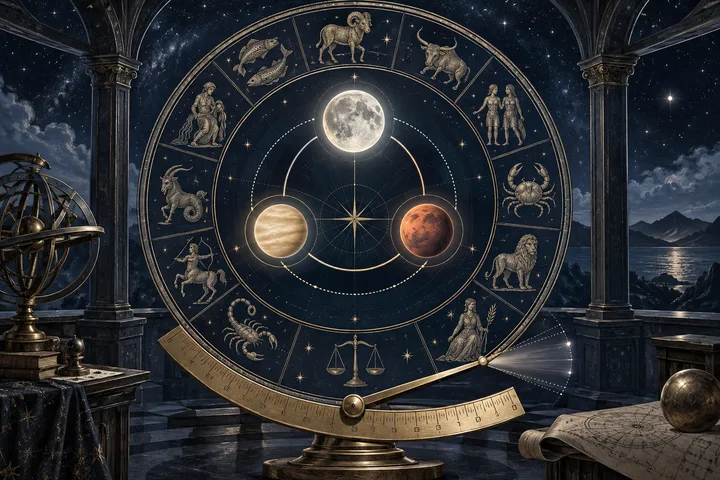
A degree without minutes is a range, not a precise point
You open a chart to compare two people. The placements look promising. Then you see Moon 14° Taurus, Venus 22° Libra, and Mars 3° Leo, with no minutes anywhere. Should you stop? No. Should you treat every aspect as exact? Also no.
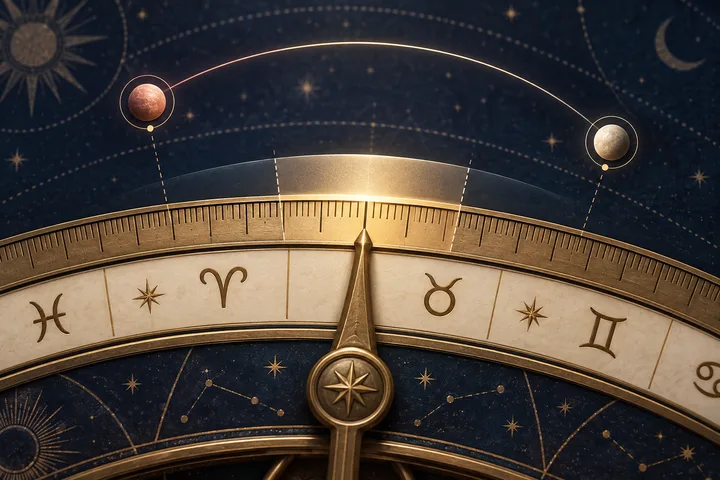
In the usual zodiac notation, the number before the degree mark locates a planet inside a 30-degree sign. Minutes divide each degree into sixty smaller parts. So 14° Taurus is not one mathematical point when the minutes are absent. If the chart truncates, it means 14°00' through 14°59' Taurus. If it rounds to the nearest whole degree, it usually means about 13°30' through 14°29'59" Taurus. Check the display rule before you assign a final minute.
That small gap matters because synastry asks how far apart two planets are. A conjunction, square, trine, or opposition is defined by an angle, then judged through an orb, the distance from exact. A planet at 14°02' and another at 20°02' can form an exact sextile. A planet shown only as 14° might sit at 14°58', changing the separation by almost a full degree. The sign story stays. The precision of the aspect changes.
This is the first distinction to keep in front of you: placement meaning and measurement confidence are different things. You can read Moon in Taurus as a lunar style. You can discuss Venus in Libra as an affection style. You can compare Mars in Leo with Mars in another sign. You simply shouldn't dress a degree-only estimate in the language of certainty. Astrology's 12 signs divide the zodiac into 30-degree sectors, and each planet occupies a degree within its sign. The sign gives the field. The degree gives the location. The minute sharpens the location.
A good report therefore labels the input honestly. Write 14° Taurus, minutes unavailable. Then interpret what remains stable before testing what could move. That order prevents a missing minute from swallowing the useful part of the chart, and it prevents a tempting near-aspect from becoming a false headline.
Sources: Glossary of Astrology Terms, Cafe Astrology; Understanding the Free Natal Chart Report, Cafe Astrology
First check the chart's notation and rounding rule
Before you interpret the placement, inspect how the chart writes it. A degree-only list can come from several display choices. The chart may have hidden the minutes to save space. It may have rounded a full position to the nearest degree. It may have truncated the minutes. Those choices create different ranges.
A chart that shows 14° Taurus may be giving you less information than the same label suggests. In a truncated display, 14° means at least 14°00' and less than 15°00'. In a nearest-degree display, it generally points to about 13°30' through 14°29'59" Taurus. The exact convention belongs to the chart, so use the wider interval when the page doesn't explain it.
Look for a nearby example elsewhere in the same report. Does it show 14° Taurus or 14°37' Taurus? Does it list an aspect orb as 0°30'? Does a planet at the end of a sign appear as 29°? A report that displays minutes for some points but not others may be applying a table setting, not withholding a special secret about the Moon. The legend or settings page may answer the question.
Record the uncertainty, use the wider range until the source explains itself, and lower confidence only for contacts that depend on the edge. A standard nearest-degree display of 29° Libra covers roughly 28°30' through 29°29'59" Libra. It does not reach 0° Scorpio. Missing minutes alone don't change the supplied sign.
A full chart report usually separates the planetary table, the aspect table, and the house positions. That makes the practical lesson plain: notation and zodiac system are part of the input. Preserve them. If two charts use different systems, stop and standardize before comparing signs or degrees. A missing minute is a small uncertainty. A changed zodiac system is a different map.
Sources: Understanding the Free Natal Chart Report, Cafe Astrology; Timing with the Moon in Astrology, Cafe Astrology
Keep the sign reading when the degree is incomplete
The missing minute does not erase the sign. If the supplied placement is Moon 14° Taurus, begin with the Moon in Taurus layer. The Moon describes instinctive response, comfort, emotional rhythm, and the way a person receives or offers care in an astrological reading. Taurus gives that lunar material a steady, sensory, patient tone. It may seek calm, reliability, familiar pleasures, and time to settle before responding.
That is a sign-based interpretation. It doesn't require you to know whether the Moon is at 14°03' or 14°51'. The degree adds a finer note, but the sign remains the broad container. The same principle works for Venus and Mars. Venus in Libra gives you a relational language shaped by balance, reciprocity, beauty, and social grace. Mars in Leo gives you a drive that can be warm, expressive, proud, and eager to act from the heart. Those descriptions are not complete readings, but they are valid first layers when the minutes are absent.
Don't confuse a broad layer with a weak one. In synastry, signs tell you how each planet wants to operate before the aspect tells you how the two functions meet. A Moon in Taurus and Venus in Libra may both appreciate ease and beauty, yet they may not seek closeness in the same way. Taurus Moon may want dependable presence. Libra Venus may want dialogue, charm, and a sense of mutual consideration. The sign comparison gives you that difference without a single minute.
The same discipline keeps you from reducing the chart to a sign stereotype. A sign is not a verdict. It is a style and a field of expression. The Moon still has aspects. Venus still has its condition. Mars still has its own contacts and role. Read the sign, then add the degree and aspect layers only as far as the input supports them.
Cafe Astrology's glossary makes the geometry useful here: the zodiac is divided into twelve 30-degree signs, and each planet has its own sign and degree within that structure. A degree-only placement therefore carries real location information. It just carries less of it than a degree-and-minute placement. Keep what you know. Mark what you don't.
Sources: Understanding the Free Natal Chart Report, Cafe Astrology; Glossary of Astrology Terms, Cafe Astrology
Use degrees to screen aspects, not to manufacture exactness
Now compare the positions. Put each placement on a 360-degree circle, keeping the sign order intact. Aries begins at 0°, Taurus at 30°, Gemini at 60°, and so on. Moon 14° Taurus is approximately 44° of the zodiac. Venus 20° Libra is approximately 200°. Their shortest separation is 156°, six degrees beyond a quincunx and 24 degrees short of an opposition. It isn't a major opposition. The sign relationship may still be worth reading, but the degree screen should leave this aspect out.
Here is a cleaner example. Imagine Maria's Venus is listed as 10° Gemini and her partner's Mars as 16° Libra. The sign-degree centers are about 70° and 196°. Their shortest separation is about 126°, close to a trine. If the minutes are missing, the actual separation could shift by nearly two degrees in total. With a six-degree orb, the trine remains a plausible major contact. But you should report it as a likely trine within the available degree-only range, not as 120°00'. The difference is modest in the arithmetic and large in the honesty of the reading.
The key test is a range test. Take the earliest and latest plausible positions for each planet, calculate the smallest and largest possible separation, and see whether the entire interval stays inside your chosen orb. If it does, the contact is stable. If the interval crosses the boundary, call it conditional. If it never reaches the aspect, leave it out. A midpoint that lands exactly six degrees from an aspect is an edge case, not a stable contact.
A displayed degree is useful for ranking candidates, not for inventing minutes. Cafe Astrology defines an orb as the distance from exactness and notes that astrologers use different allowances. For this report family, six degrees is the working boundary for selected major aspects. State that policy, test both ends of the plausible range, and call a contact stable only when it survives the test. A 1°20' conjunction deserves more weight than a degree-only contact hovering near 6°.
You can make the range test concrete without turning the reading into a math lesson. Suppose the first planet is listed at 12° and the second at 18°, both in signs that place them near a sextile. Under a simple truncation assumption, the first could occupy 12°00' through 12°59', while the second could occupy 18°00' through 18°59'. The gap between them can move by almost two degrees. If the aspect remains inside the selected orb at both ends, keep it. If one end leaves the orb, lower its rank.
Also separate applying from separating only when your data supports motion and timing. A static degree-only comparison can identify the angular relationship, but it may not tell you enough to make a fine claim about which planet is moving toward exactness at a particular moment. Synastry is a comparison of natal placements, not a dated transit table. Don't borrow a transit conclusion just because an aspect calculator uses the word applying.
Treat a listed degree without minutes as a range, not as an exact point. If a chart says Moon 14° Taurus, read it first as somewhere from 14°00' to 14°59' Taurus, unless the chart uses a different rounding rule. The Taurus sign and the Moon's broad role remain usable. A close aspect, sign boundary, or Moon contact may not. For Venus and Mars, a trusted degree-only placement often gives you a useful first pass because the missing minute usually refines an existing sign rather than changing it. For the Moon, separate missing minutes from missing birth-time confidence. Keep sign-based meaning, mark degree-based contacts as provisional, and don't call an aspect exact when the minutes are missing. In a comparison, use the supplied signs and degrees, apply one stated orb policy, and rank only the conclusions that survive the whole possible minute range. If you want a report, provide Moon, Venus, and Mars placements with degrees when you have them. The report can compare supplied placements and optional degrees, but it doesn't calculate a natal chart from birth details.
Sources: Synastry: Love and Relationship Astrology, Cafe Astrology; Aspects Between Charts, Cafe Astrology
The Moon deserves the narrowest confidence band
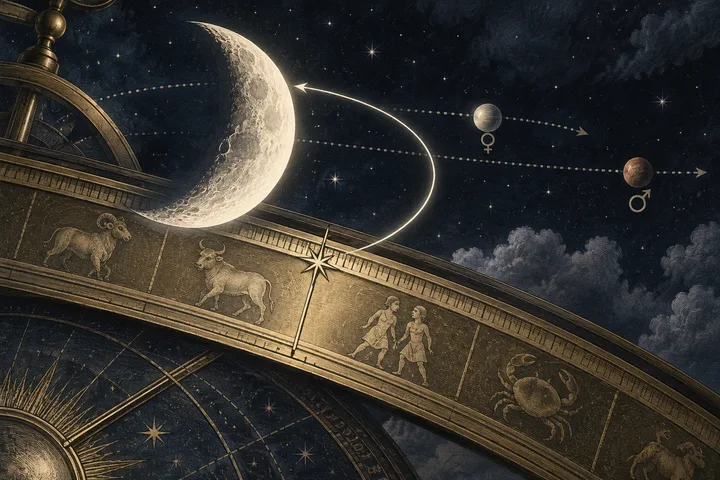
Moon, Venus, and Mars don't all create the same missing-minute problem. The Moon is the one to handle most carefully. It moves quickly, changes zodiac signs about every two and a half days, and completes its cycle in roughly 28 days. A small change in time can therefore produce a meaningful change in lunar degree, especially when the source chart itself came from an uncertain birth time.
That doesn't make every Moon degree unusable. It tells you where to slow down. If a supplied chart says Moon 14° Taurus and the underlying birth time is known well enough to trust the sign, you can use the Taurus Moon layer and screen degree-based contacts. If the birth time is unknown and the Moon was near a sign boundary that day, even the sign may need confirmation. A degree-only list cannot solve that uncertainty after the fact.
Cafe Astrology's lunar timing material treats the Moon as the fastest-moving planet and uses its movement to judge applying aspects and sign changes. That speed means a chart made from a day-level estimate can place the Moon several degrees away from where it would be at the actual birth time, and in some cases the Moon can change signs. Those are not reasons to throw out the Moon. They are reasons to separate a known supplied placement from a placement that still depends on birth-time confidence.
When the Moon is involved, ask three questions. Is the sign secure? Is the listed degree tied to a recorded birth time or only a day-level estimate? Does the suspected aspect survive the full possible range? Your answer may be different for each Moon contact in the same comparison. A Moon-Venus conjunction near the middle of a sign may remain strong. A Moon-Mars contact near a boundary may need a second scenario.
The Moon's speed is the strongest exception to the easy rule that missing minutes are minor. For Venus and Mars, minutes usually refine the picture. For the Moon, missing time can widen the picture before missing minutes even enter the room. Read the lunar sign with care, and make the degree layer earn its place.
Sources: Timing with the Moon in Astrology, Cafe Astrology; Understanding the Free Natal Chart Report, Cafe Astrology
Venus and Mars usually keep their broad comparison intact
Venus and Mars still need precise degrees for tight synastry, but their missing minutes usually affect a narrower part of the reading. If Venus is listed at 22° Libra, it remains in Libra across the ordinary minute range. If Mars is listed at 3° Leo, it remains in Leo. Their sign roles and broad sign-to-sign relationship stay available.
Venus speaks to attraction, affection, taste, values, and the way love is offered. Mars speaks to pursuit, desire, assertion, anger, and the way a person moves toward what they want. In a couple's comparison, Venus-Mars contacts can show the meeting of receptivity and initiative. A conjunction may blend the two functions. A square may create heat and friction. A trine or sextile may make the exchange easier. Those are interpretive patterns, not relationship scores.
The minutes decide how tight the contact is. Suppose one chart lists Venus at 22° Libra and the other Mars at 28° Libra. The center positions suggest a six-degree conjunction. But the real positions could place the contact just inside or just outside a six-degree orb, depending on the rounding convention. The honest wording is not, They have an exact Venus-Mars conjunction. It is, Their listed degrees suggest a possible Venus-Mars conjunction at the edge of the stated orb; minutes would decide whether to include it.
The missing minute refines a supplied placement only when that placement already sits securely inside its sign. If Venus or Mars appears at 29° or 0°, check whether the sign itself is secure before building a sign story around it. That is a boundary check, not a reason to discard the placement.
Cafe Astrology's synastry guidance gives the right interpretive order: consider the sign and house placements, then pay close attention to inner-planet interaspects. For this report, house overlays are outside scope, so the useful sequence is sign, personal-planet role, major aspect if supported, then the lived pattern the pair can actually recognize. Venus and Mars can be read warmly without pretending their missing minutes are invisible.
This also helps with a common mistake: treating Venus or Mars as a single answer to attraction. Venus may show what feels pleasing or valuable, while Mars shows how desire moves and how conflict starts. A sign comparison can reveal a difference in pace even when no aspect is secure. One person's Libra Venus may want a graceful exchange before naming a problem. Another person's Leo Mars may act openly and expect a clear response. If the degrees later confirm a square, the aspect sharpens that story. If they don't, the sign contrast still deserves a place in the reading.
Read the planet person and the sign person together. In synastry, the person whose planet is involved often experiences and expresses that planet's role in the exchange. A Venus person may feel that affection is being invited, judged, or received through the other person's Mars style. A Mars person may feel encouraged or slowed by the Venus response. The exact experience depends on both charts and the contact, so use this as a lens for inquiry rather than a fixed label.
Sources: Synastry: Love and Relationship Astrology, Cafe Astrology; Aspects Between Charts, Cafe Astrology
A worked comparison shows what stays and what waits
Consider an example. One chart lists Moon 14° Taurus, Venus 10° Gemini, and Mars 3° Leo. The other lists Moon 20° Scorpio, Venus 16° Libra, and Mars 9° Aquarius. None of the entries includes minutes. This is enough for a careful first pass, not a final claim about every aspect.
Start with the signs. Taurus Moon seeks steadiness and tangible reassurance, while Scorpio Moon tends to read emotional undercurrents and wants depth. Gemini Venus often shows affection through talk, wit, curiosity, and movement. Libra Venus looks for balance, courtesy, and mutual agreement. Leo Mars acts with warmth and pride. Aquarius Mars may prefer independence, principle, and an unusual route toward action. Already you can see a relationship question: can steadiness and intensity make room for each other while the Venus styles negotiate pace and attention? No minutes are needed to ask it.
Next, screen the degree contacts. The Taurus Moon at about 44° and the Scorpio Moon at about 230° are separated by about 174°, which suggests an opposition at the displayed-degree midpoint. Under a truncation rule, each placement can move forward by less than one degree, so the shortest separation can run roughly from 173° to 175°. The six-degree orb boundary is 174° to 186° for an opposition, making this contact conditional rather than stable. Report it as a possible Moon-Moon opposition pending minutes. It deserves attention because the Moon-to-Moon exchange can make comfort feel both magnetic and exposing, but it shouldn't lead the reading until the data is checked.
The Venus pair sits near 70° and 196°, a separation of about 126°. The trine orb is therefore about six degrees at the displayed midpoint, and hidden minutes can move it to roughly five to seven degrees. Keep it as a candidate, not a settled aspect. The Mars pair sits at about 123° and 309°, a separation of 174°. Under truncation, it can run roughly from 173° to 175°, so the opposition is conditional too. Label both contacts provisional until the underlying positions are available.
Then integrate. The sign layers suggest different emotional needs and different love languages. The possible Moon opposition raises the charge, but its rank stays below any contact that survives the range test. The possible Venus trine may offer some ease in affection, while the possible Mars opposition adds a charged push-pull in action, desire, and conflict. One doesn't cancel the other. What you can say is that the comparison holds emotional and energetic tension alongside a possible smoother Venus exchange. What you can't say is the exact minute orb, a house overlay, or a guaranteed outcome. The useful result is a ranked reading: clear sign themes first, conditional aspects second, and exact contacts only after verification.
Rank aspects by stability, then by tightness
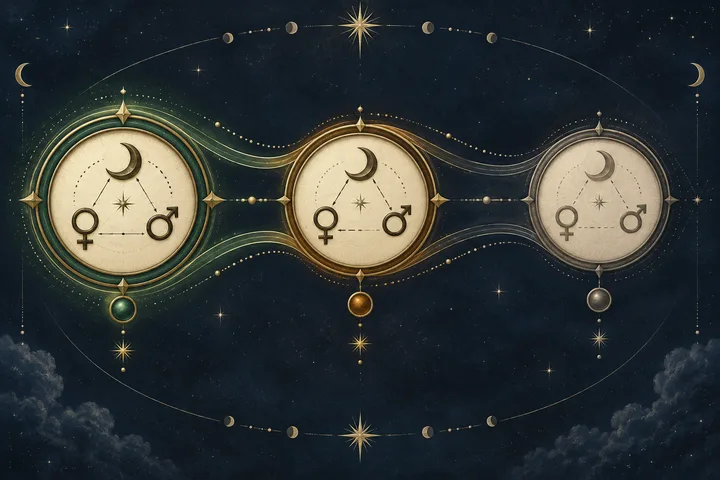
When minutes are absent, don't treat every candidate aspect equally. Use three labels. Stable means the contact stays inside your stated orb across the whole plausible minute range. Provisional means the interval crosses the boundary and needs the rounding rule or full data. Unsupported means the interval never reaches the aspect.
This short ranking beats a long list of maybes. It keeps the chart from turning every near-angle into a message. A stable Moon-Venus sextile can outrank a speculative Venus-Mars conjunction, while a stable Mars-Mars square may deserve more attention than a loose trine that disappears when the minutes are restored. The planet pair, aspect type, sign context, and orb still shape the meaning.
Use the six-degree rule consistently for the report's selected major aspects. For each candidate, record the displayed separation, the smallest and largest plausible separation, and the label. You don't need to publish a spreadsheet, but you should think in those terms. If Moon 14° Taurus and Mars 20° Cancer appear to form a sextile, the displayed separation is about 66°. With simple truncation, the actual separation can run roughly from 65° to 67°, so the contact spans a five-to-seven-degree orb. Keep it provisional unless the chart's display rule or full minutes narrows that range. If the displayed degree is rounded, model that interval instead of silently treating 14° and 20° as exact.
Orbs aren't only about strength. They help you decide what belongs in the headline. Cafe Astrology notes that a smaller orb is generally considered closer and stronger, while also noting that astrologers use different orb allowances. In a degree-only chart, confidence and tightness are linked but not identical. A contact can look tight and still be uncertain if a boundary or rounding rule changes its classification.
End the ranking with a plain label: stable, provisional, or not supported. Readers can work with that. They can also tell which extra data would improve the reading. Precision becomes a service instead of a performance.
Sources: Synastry: Love and Relationship Astrology, Cafe Astrology; Aspects Between Charts, Cafe Astrology
Don't let a missing minute hide a sign-boundary problem
A listed 29° or 0° deserves a separate check only when the supplied sign itself is uncertain. Missing minutes alone don't move a standard whole-degree display of 29° Libra into Scorpio. If the chart rounded to the nearest degree, 29° Libra represents roughly 28°30' through 29°29'59" Libra. If it truncated, it represents 29°00' through 29°59'59" Libra. Neither interval reaches Scorpio. At 29°59' Pisces, a planet is still in Pisces; at 0°00' Aries, it has entered Aries.
Consider an example. Maria's Moon is shown as 29° Pisces, but the chart gives no reliable birth time and the Moon changed signs that day. The issue isn't the omitted minute by itself. It's that the supplied Pisces sign may not be secure. Pisces Moon may absorb atmosphere and respond through feeling. Aries Moon may react quickly and directly. Keep both bounded possibilities only until the underlying time confirms the sign.
A different issue arises when the supplied sign is genuinely uncertain, often because the Moon changed signs during an unknown birth-time window. Then you may need two bounded readings. That's a birth-time problem, not a missing-minute problem. For any aspect that crosses a sign boundary, use the 360-degree circle: Pisces ends at 360° and Taurus begins at 30°, so the shortest separation cannot be guessed from the printed labels alone.
This is where the chart's date and time matter more than a polished paragraph. The report in scope uses supplied Moon, Venus, and Mars signs, with optional degrees. It doesn't calculate natal positions from birth details or infer a house system. Missing minutes limit aspect precision. Missing birth time can change the Moon's degree and, near an actual lunar ingress, its sign. Missing birthplace affects houses and angles. Missing zodiac system can change the sign labels used in the comparison.
Keep a small input ledger. Write the source's zodiac system, each supplied sign, each supplied whole degree, whether minutes are present, whether the Moon's birth time is known, and which points are actually in scope. If a field is unknown, write unknown. That one word stops an accidental upgrade from supplied data to invented data.
A report that stays inside its inputs gives each layer the room it actually has. Cafe Astrology's chart guidance separates planetary tables, aspect tables, and house positions, and notes that houses may be absent when birth time is unknown. Don't patch one missing field with assumptions from another.
If you're reading a partner's chart from a screenshot, ask for the underlying data when a conclusion depends on a tight lunar aspect or a sign boundary. Otherwise, keep the comparison at the level the supplied placements support.
Sources: Glossary of Astrology Terms, Cafe Astrology; Timing with the Moon in Astrology, Cafe Astrology; Understanding the Free Natal Chart Report, Cafe Astrology
Turn the uncertainty into a useful synastry conversation
A good chart reading ends with a decision about what to do with the information. When minutes are missing, that decision is often simple: keep the stable sign layers, mark the degree contacts by confidence, and verify only the contacts that would change the reading. You don't need to interrogate every number.
Start with the observable relationship. If one person's Moon seems to need reassurance while the other withdraws to regain calm, name that pattern in ordinary words. Then let the chart offer a lens. A possible Moon opposition can describe a pull between different emotional rhythms. A Venus contact can show where affection feels easy or where values need translation. A Mars contact can show how desire and initiative meet. The chart helps you ask a better question. It doesn't replace the answer you learn from each other.
Use the missing-minute note as a conversation prompt. Ask, Does this contact feel like a central pattern, or does it only appear because the whole degrees line up? Ask, What happens when one of us wants closeness and the other wants space? Ask, Which part of the sign reading already matches our daily life? Those questions keep the interpretation grounded in the relationship without turning it into a verdict about whether you should date, stay, or leave.
If the reading is for a couple comparing known placements, the most useful report can show three layers side by side: supplied signs, likely major aspects, and confidence. For example: Moon Taurus to Moon Scorpio, likely opposition, verify minutes. Venus Gemini to Venus Libra, possible trine, moderate confidence. Mars Leo to Mars Aquarius, possible opposition, high priority for confirmation. That format tells the reader what the chart says, what the data supports, and where the next useful question lies.
A practical handoff can be short. Copy the placements exactly as supplied, note whether the chart rounded or truncated, flag only genuinely uncertain sign boundaries, and write the lived question each supported or conditional contact raises.
If the full data later arrives, update the aspect table instead of rewriting the whole reading from scratch. Keep the stable sign interpretation. Replace provisional language with the measured orb where it is confirmed. Remove a contact if the exact position rejects it. Add a new contact only if it changes the ranked pattern, not because a longer list looks more impressive.
That is the decision point. Verify the number that could change the meaning. Read the rest with confidence. A careful comparison doesn't become less romantic when it names its limits. It becomes easier to use, because you know which pattern is clear, which one needs a closer look, and which question belongs in the room with both people.
The offering here follows that boundary. A Synastry Comparison Report can use supplied Moon, Venus, and Mars signs, optional degrees, and selected major-aspect calculations with a six-degree orb. It doesn't calculate natal positions from birth details, calculate houses, or promise a relationship outcome. That is enough for a precise comparison when the input ledger is clear.
Sources: Synastry: Love and Relationship Astrology, Cafe Astrology; Aspects Between Charts, Cafe Astrology
A little more clarity
Can I read synastry aspects if the chart lists only whole degrees?
Yes, but treat the aspect as a range. Use the displayed degrees to screen major contacts, test the full plausible minute range, and apply one stated orb policy. Keep contacts that remain stable, label edge cases provisional, and don't call any aspect exact without the minutes. The sign-based Moon, Venus, and Mars layers remain useful even when the degree layer needs confirmation.
Is missing Moon data more serious than missing Venus or Mars minutes?
Usually. The Moon moves quickly and changes signs about every two and a half days, so an unknown birth time can widen the possible lunar position or even change the sign near an ingress. Missing minutes alone still limits precision for Venus and Mars, especially at an orb boundary, but it usually leaves their supplied sign intact. Check the Moon's sign, birth time, and degree before giving a tight lunar aspect top billing.
Sources & further reading
- Glossary of Astrology Terms, Cafe Astrology
Defines the 360-degree zodiac, 30-degree signs, major aspects, personal planets, and orbs.
- Understanding the Free Natal Chart Report, Cafe Astrology
Shows degree-and-minute placement tables and explains why tighter orbs carry greater emphasis.
- Timing with the Moon in Astrology, Cafe Astrology
Explains the Moon's fast movement, sign changes, and the meaning of applying aspects.
- Synastry: Love and Relationship Astrology, Cafe Astrology
Supports reading relationship charts through planetary roles, signs, and interchart contacts.
- Aspects Between Charts, Cafe Astrology
Supports comparing planets across charts and weighing inner-planet contacts in synastry.
Synastry Comparison Report
Enter known placements for two people. Get an input-by-input comparison, selected aspect calculations and a clear record of what remains uncertain.
Compare our placements