What question does Ceres answer?
Imagine Maria and Leo comparing their known Moon, Venus, and Mars placements. They already have a strong map. The Moon shows how each person seeks comfort. Venus shows what each person enjoys, values, and offers in love. Mars shows how desire turns into action.
Ceres asks what keeps closeness nourished once the first spark becomes an ordinary day. Who notices that the other is tired? Who cooks, checks in, protects quiet, or makes room after a difficult conversation? What happens when care arrives in the wrong form?
That is the useful addition. A couple can have Venus warmth and still miss practical needs. They can have Mars chemistry and still argue about pace, effort, or who takes over when the other is vulnerable. Cafe Astrology links Ceres with food, nourishment, nurturing, family, caregiving, grief, and separation. The symbolism points toward the small acts that sustain a bond.
Don't ask whether Ceres is good in synastry. Ask what care the contact describes, whether it's welcome, and what boundary keeps it mutual. Ceres refines the reading. It doesn't issue a relationship verdict.
Sources: Ceres | Cafe Astrology; Aspects Between Charts | Cafe Astrology
What information should you gather first?
Record each person's Ceres, Moon, Venus, and Mars sign. Add degrees when you have them. Keep the person and body in separate columns. Maria's Ceres conjunct Leo's Moon is not the same interpretive role as Leo's Ceres conjunct Maria's Moon, even though both people take part in the contact.
For this comparison, use a six-degree orb for selected major aspects. A conjunction is near 0 degrees, a sextile near 60, a square near 90, a trine near 120, and an opposition near 180. A contact at 0 degrees 40 minutes deserves more weight than one at 5 degrees 50 minutes.
If you know signs but not degrees, read the sign relationship and stop there. Don't call two placements a trine just because their elements feel compatible. If birth times are missing, leave out houses and angles. The Synastry Comparison Report uses supplied placements and optional degrees. It doesn't calculate a natal chart from birth details or produce a compatibility score.
Ceres is an additional chart point. Cafe Astrology notes that it isn't part of every standard natal reading. Establish the personal-planet pattern, then decide whether Ceres adds a distinct piece of information.
Sources: Ceres | Cafe Astrology; Aspects Between Charts | Cafe Astrology; Synastry Aspects Explained
How do Moon, Venus, and Mars form the baseline?
Read the three personal planets as different relationship functions. The Moon speaks to instinct, habit, emotional safety, and the response that helps someone settle. Venus speaks to attraction, affection, pleasure, and values. Mars speaks to initiative, pursuit, heat, assertion, and the way desire moves into behavior. Cafe Astrology's Love Styles material separates these functions in its relationship readings, while its synastry guidance recommends close attention to inner-planet interaspects.
Compare the two charts in both directions. Maria's Moon to Leo's Venus may show how his affection lands on her emotional needs. Maria's Venus to Leo's Mars may show attraction and how her style of loving meets his way of acting. Maria's Mars to Leo's Moon may show how her directness reaches his instinctive world.
Ceres belongs after this baseline because it answers a narrower question. Suppose the Moon contacts show comfort, but the couple keeps clashing over meals, chores, rest, or who remembers practical details. Ceres may explain the missing exchange. Suppose Venus and Mars are magnetic, but help feels intrusive. Ceres may show why.
The order matters. Start with what each person feels, values, and does. Then ask how the bond is tended.
Sources: Aspects Between Charts | Cafe Astrology; Love Styles: About Her Report | Cafe Astrology
What does Ceres add to a Moon contact?
A Ceres-Moon contact joins caregiving with emotional need. The Moon is the wider field of comfort, memory, privacy, habit, and belonging. Ceres narrows the focus to nourishment, tending, attachment, and the experience of being cared for or separated from what sustains you.
Imagine Maria's Ceres at 14 degrees Taurus conjunct Leo's Moon at 15 degrees Taurus. This is an illustrative example, not a calculated personal chart. Maria might offer care through reliable food, touch, a calm home base, or practical steadiness. Leo could experience her presence as settling. But her preferred care could become possessive if she expects every offer to be accepted. Taurus can nourish. It can also hold on.
A trine or sextile may make the exchange easier to receive. A square or opposition may bring a mismatch in timing or form. The Ceres person may solve a problem when the Moon person wants listening. The Moon person may seek closeness when Ceres thinks space would help. The aspect describes the meeting, not a fixed outcome.
Read the signs next. Earth may tend through tangible help, air through conversation, fire through encouragement, and water through emotional presence. Then ask the Moon person what actually feels supportive.
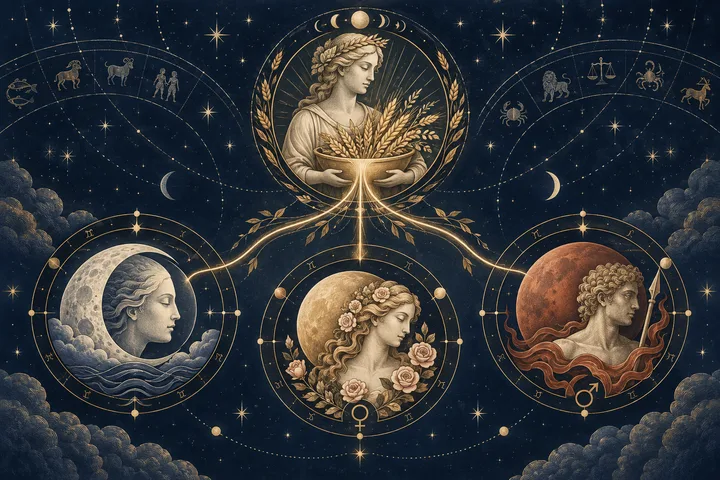
Ceres adds the care layer to a Moon, Venus, and Mars comparison. The Moon shows emotional needs and comfort, Venus shows affection and values, and Mars shows pursuit, desire, and action. Ceres asks how care is given through food, practical help, protection, rest, reassurance, or room to breathe. Read it after the personal planets, especially when a close Ceres contact repeats a theme already present. Ceres-Moon can clarify emotional tending. Ceres-Venus can show whether affection feels nourishing and reciprocal. Ceres-Mars can expose the link between help, effort, desire, and boundaries. Use the signs and optional degrees you actually have. With a six-degree orb for selected major aspects, rank the closest verified contacts first. Then test the symbolism against one ordinary exchange. If Ceres makes the pattern clearer, keep it. If it only adds a dramatic story, let the personal planets lead.
Sources: Ceres | Cafe Astrology; Ceres-Moon Aspects in Synastry; Synastry Aspects Explained
What does Ceres add to Venus?
Ceres-Venus contacts connect care with affection, pleasure, beauty, and shared values. Venus says what feels lovely and loving. Ceres asks whether that affection helps daily life continue. Venus may bring flowers, music, or a beautiful evening. Ceres may remember the allergy, protect the rest period, prepare the meal, or ask whether the gift is wanted.
Consider an example. Maria's Ceres at 22 degrees Libra is within two degrees of Leo's Venus at 24 degrees Libra. Maria may care by creating balance, sharing decisions, making a space pleasant, or smoothing a social difficulty. Leo may feel cherished when she gives attention to his preferences. Yet the same pattern can become appeasement if the wish for peace hides resentment.
A harmonious contact can make affection feel nourishing. A square or opposition can reveal a gap between romance and support. One person offers practical help; the other wants delight. One offers charm; the other wants a dependable change in routine. Neither function is lesser. Romance needs pleasure, and a shared life needs tending.
Ask who plans, hosts, pays, remembers, and receives. Then ask whether generosity leaves both people freer. That is where Ceres turns Venus into a useful relationship question.
Sources: Ceres | Cafe Astrology; Aspects Between Charts | Cafe Astrology; Ceres Synastry: Nurturing Patterns and Caregiving Dynamics | Deep Oracle
What does Ceres add to Mars?
Ceres-Mars contacts put care beside action, heat, pursuit, and conflict. Ceres can give Mars a place to land. Mars can help Ceres turn concern into movement. The same contact can bring friction when care feels like supervision or effort is used without appreciation.
Imagine Leo's Ceres at 8 degrees Cancer square Maria's Mars at 9 degrees Libra. Leo may protect through emotional presence and attention to home. Maria may act through quick decisions and a strong wish for fairness. His help could feel to her like a claim on her choices. Her speed could feel to him like a dismissal of the emotional work behind the plan. The square doesn't forbid cooperation. It shows where cooperation needs words.
Look beneath the symbol. Who initiates repair? Who handles the task nobody wants? Who decides what the other person needs? Ceres-Mars may describe teamwork and protective action, but it can also expose arguments about chores, anger, pace, and control.
The contact can speak to physical intimacy as well. Mars may initiate while Ceres attends to comfort, pacing, privacy, nourishment, and aftercare. Desire still leads its own life. Ceres shows whether the body feels respected while desire moves.
Sources: Ceres | Cafe Astrology; Aspects Between Charts | Cafe Astrology; Ceres Synastry: Nurturing Patterns and Caregiving Dynamics | Deep Oracle
How should you rank the contacts?
Don't give every contact equal space. First identify the closest verified contact to the Moon, Venus, or Mars. Then identify the closest Ceres contact. A tight major aspect inside the chosen six-degree orb deserves more attention than a wide background link.
Celestia's synastry guide explains an orb as the allowed distance from an exact aspect and gives tighter contacts more force. Sources use different orb systems, so print your method and apply it consistently. The number isn't magic. Consistency makes the comparison readable.
Next judge the aspect's shape. A conjunction fuses functions. An opposition makes polarity visible. A square creates work. A trine supports natural flow. A sextile offers an opening that grows through participation. Easy care can become invisible labor. Difficult care can teach a couple to ask better questions.
Finally look for repetition. If the Moon contacts emphasize steadiness and Ceres also touches the Moon closely, care may be central. If Ceres suggests closeness while Mars repeatedly stresses independence, autonomy becomes the pressure point. Rank closeness, relevance, repetition, and lived fit.
Sources: Aspects Between Charts | Cafe Astrology; Synastry Aspects Explained; Ceres Synastry: Nurturing Patterns and Caregiving Dynamics | Deep Oracle
What is the strongest exception?
A close Ceres contact can remain background symbolism when the lived relationship doesn't enact its care pattern. It may describe a private expectation, a sensitive point, or a way support is imagined rather than exchanged. It shouldn't lead the reading simply because it looks exact.
Ceres isn't a replacement for the Moon. The Moon carries the broader story of instinct, feeling, habit, and security. Ceres refines nourishment, caregiving, attachment, and separation. A supportive Ceres contact may help a strained Moon pattern, but it won't erase the emotional work.
The myth of Demeter and Persephone adds depth through nourishment, loss, return, and letting go. Don't turn it into a parent-child script. Adult partners can care for each other without one becoming the other's mother. Ask whether care moves both ways, whether either person can say no, and whether the giver can stop without making love conditional.
Deep Oracle's Ceres reference makes the practical point that tight orbs keep the symbol from appearing everywhere, and a contact can show a care pattern without dictating a permanent role. Let the relationship test the interpretation.
Sources: Ceres | Cafe Astrology; Ceres-Moon Aspects in Synastry; Ceres Synastry: Nurturing Patterns and Caregiving Dynamics | Deep Oracle
How can you turn the reading into a comparison?
Give each chart layer one job. First write what each person's Moon needs, Venus enjoys, and Mars does under pressure. Then add Ceres in four lines: care offered, care wanted, friction, and boundary.
A note might read: ‘Leo offers food and protection. Maria wants quiet before help. Advice arrives too quickly. Ask first.’ That is more useful than a page of keywords. It keeps the Ceres contact connected to a choice both people can recognize.
Use the sign to describe the style, the aspect to describe the meeting, and the degree to decide how much weight it receives. Then test the reading against one ordinary scene. Consider an example in which Maria is ill after a demanding week. Does Leo bring food, ask what she wants, take over, or wait for an invitation? What does Maria experience? If the symbol fits, keep it. If not, revise the interpretation.
Finish with a sentence each person can answer: ‘When I care, I tend to ___. When I need care, I want ___. Please don't ___.’ The blanks make the chart a conversation tool and protect the receiver's choice.
Sources: Aspects Between Charts | Cafe Astrology; Ceres-Moon Aspects in Synastry; Synastry Aspects Explained
What decision does the Ceres layer support?
Ceres helps you choose the care question that deserves attention now. It can show whether affection is fed by daily support, whether desire leaves room for comfort, and where help has started to feel like control. It cannot decide what the relationship should become.
For Ceres-Moon, name the comfort each person wants and the closeness that feels safe. For Ceres-Venus, name the generosity, pleasure, and shared labor that make affection reciprocal. For Ceres-Mars, agree on initiative, physical boundaries, practical help, and repair.
If no degree-verified Ceres contact exists, let the personal planets lead and keep Ceres at sign level. If a close contact repeats the main pattern, give it a clear place. If it doesn't match daily life, treat it as a question rather than a conclusion.
Your next step can be small: ask before fixing, divide one invisible task, or agree on what happens when either person needs space. Try it in an ordinary moment. Then decide whether Ceres made the exchange clearer.
Sources: Ceres | Cafe Astrology; Aspects Between Charts | Cafe Astrology; Ceres-Moon Aspects in Synastry
A little more clarity
Is Ceres more important than the Moon in synastry?
No. The Moon is the wider symbol for emotional needs, habits, instinct, and security. Ceres refines that picture through nourishment, caregiving, attachment, and separation. Read the Moon first, then use Ceres to explain how care is offered and received.
Which Ceres contact deserves the most attention?
Give priority to the closest Ceres contact that repeats a theme already shown by the personal planets. Ceres-Moon often clarifies emotional tending, Ceres-Venus affection and reciprocity, and Ceres-Mars practical effort, protection, and boundaries.
Can a difficult Ceres aspect be supportive?
Yes. A square or opposition can make care harder to translate, but it can also force both people to name what support means. Watch whether the tension produces a fair conversation or a cycle of control, withdrawal, overgiving, and resentment.
Can I read Ceres synastry without birth times?
You can compare supplied Ceres, Moon, Venus, and Mars signs and verified degrees without birth times. Leave out houses and angles when the required chart data isn't available. A focused sign-and-aspect comparison is enough for this reading.
Sources & further reading
- Ceres | Cafe Astrology
Supports Ceres themes of nourishment, caregiving, attachment, grief, separation, and its status as an additional chart point.
- Aspects Between Charts | Cafe Astrology
Supports reading synastry through interchart roles, signs, houses, and closer attention to inner-planet contacts.
- Ceres-Moon Aspects in Synastry
Supports interpretive links between Ceres-Moon contacts, care styles, attachment patterns, and boundaries around caregiving.
- Synastry Aspects Explained
Supports aspect angles, orb meaning, tighter-contact emphasis, and synthesis of repeated synastry themes.
- Love Styles: About Her Report | Cafe Astrology
Supports separating Moon, Venus, and Mars as distinct feeling, romantic, and desire functions in relationship readings.
- Ceres Synastry: Nurturing Patterns and Caregiving Dynamics | Deep Oracle
Supports tight-orb Ceres interpretation, care-style mismatch, mutuality, and the distinction between symbolic themes and fixed roles.
Synastry Comparison Report
Enter known placements for two people. Get an input-by-input comparison, selected aspect calculations and a clear record of what remains uncertain.
Compare our placements