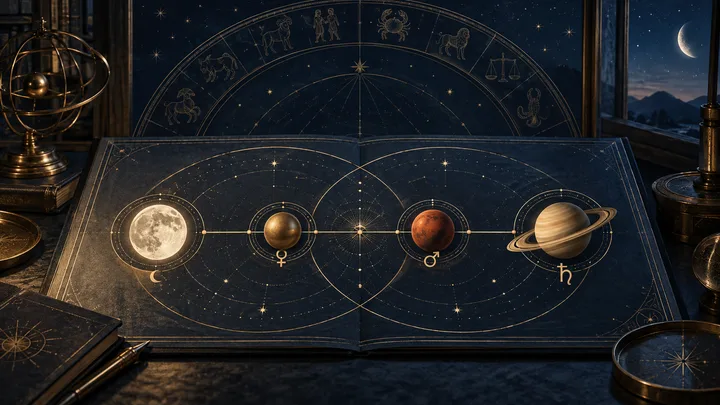
Imagine Maria and Daniel looking at the same crowded chart
Imagine Maria and Daniel at a kitchen table with a synastry list open between them. Maria sees her Moon touching Daniel's Saturn. Daniel notices his Mars close to Maria's Venus. Both of them circle the same words: attraction, seriousness, tension. Then they stop. Which contact comes first?
That question matters because a synastry chart can tell several true stories at once. Moon contacts describe the way the relationship lands in the body and in the private emotional life. Venus contacts describe liking, affection, taste, and the ways love is offered. Mars contacts bring appetite, initiative, heat, and the possibility of arguments. Saturn adds time, rules, duty, patience, fear, and form. None of these planets cancels the others.
Maria and Daniel make the common mistake. They read the most dramatic line first. The Venus-Mars contact feels exciting, so they call it the relationship. Then they see Saturn and decide that the relationship is blocked. Both conclusions are too fast. An aspect is a relationship between two planetary functions. Its meaning changes when you place it beside the rest of the pattern.
The better reading moves from reception to expression to structure. First ask how each person feels and settles with the other. Then ask how they show fondness and pleasure. Next ask how they pursue, touch, provoke, and repair. Only then ask what can be sustained, and what responsibility the bond creates. The order is not a ritual. It is a way to keep the interpretation honest.
In Maria and Daniel's case, the Moon-Saturn contact does not erase the Venus-Mars attraction. It asks what safety and restraint do to that attraction. If Daniel's Saturn gives Maria steadiness, the contact may help desire become dependable. If it arrives as criticism or fear, Maria may enjoy the chemistry while feeling watched. The chart shows the tension. Their conduct shows which form it takes.
That is the central rule for this article. Read the layers in sequence, then read the cross-current between them. A crowded chart becomes clearer when every contact gets one job before you ask what the whole pattern means.
Set the chart inputs before you interpret the story
Begin with the data you actually have. For this field guide, the useful inputs are each person's Moon, Venus, Mars, and Saturn sign, plus degrees when they are known. Use one zodiac system throughout. If your report uses tropical positions, keep both charts tropical. If it uses sidereal positions, keep both charts sidereal. Do not switch systems because one label sounds more romantic.
A sign tells you the style of a planet. A degree tells you whether two planets form a close angular relationship. Synastry compares planets from one chart with planets from the other. The chart may list a conjunction, opposition, square, trine, or sextile, along with an orb. The orb is the distance between the exact aspect and the actual positions. A smaller orb usually gives the contact more weight.
This article uses a six-degree maximum orb for the selected major contacts in the report scope. That is a working editorial rule, not a reason to treat every six-degree contact as equal. A conjunction at 0°30' deserves more attention than one at 5°50'. A close square may describe more pressure than a loose trine describes ease. Rank the contacts by exactness, then by the importance of the planets involved.
The traditional practice of narrowing synastry orbs has a practical reason. Two charts create many possible pairings. If you accept every loose connection, the list grows until every feeling has a planetary excuse. Astrodienst's discussion of interaspects recommends a smaller orb in synastry because combining charts increases the number of possible aspects. A practical synastry guide also recommends recording the signs and degrees before deciding which aspects qualify.
Do not fill a missing degree with a guess. If you know that Maria has Venus in Taurus and Daniel has Mars in Scorpio, you can discuss the sign polarity and the different relationship styles. You cannot claim that they form an opposition at 2°40' without the degrees. If Maria's Moon degree is unknown, treat any Moon aspect as unconfirmed. The reading becomes narrower, not useless.
Birth time matters more for houses, angles, and the exact Moon position than for a simple supplied-sign comparison. The report described here does not calculate natal positions from birth details, calculate houses, or produce a compatibility score. It compares the placements you provide and, when available, selected major aspects under the stated orb. Precision starts by naming that boundary.
Now make a short table. Put the contact in the first column, its orb in the second, the aspect type in the third, and the two planet roles in the fourth. That table will keep the later prose from wandering. You are not trying to read everything. You are deciding what deserves to be read first.
Chart printouts may show the same geometry in different ways: a degree difference, an aspect name, or applying and separating symbols. Keep the angle in view. A conjunction brings planets near the same zodiac degree; a square places them roughly ninety degrees apart. The label is a shortcut, not a new planetary fact.
Separate confirmed contacts from sign-based possibilities. Two signs can suggest a polarity without proving a degree aspect. You can interpret that sign relationship, but say clearly whether you are reading a style or a calculated contact.
When a synastry chart contains Moon, Venus, Mars, and Saturn contacts together, read them in layers. Start with the tightest major contacts and the Moon, because emotional safety tells you how the connection is received. Move to Venus for affection, values, and pleasure. Read Mars next for pursuit, desire, and conflict. Put Saturn last, not because it matters least, but because it shows what the other three layers must learn to hold over time. Then return to the strongest aspect and ask whether Saturn supports it, restricts it, or gives it form. This order keeps one exciting Venus-Mars contact from swallowing the whole reading. It also stops a heavy Saturn contact from becoming a verdict. Use the supplied signs and degrees, one zodiac system, and a stated six-degree orb. If degrees are missing, compare sign roles without inventing an aspect. Your next step is practical: name the emotional need, the affection style, the desire pattern, and the responsibility each person can actually discuss.
Sources: Interaspect, Astrodienst Astrowiki; Introduction to Relationship Astrology 2: Synastry
Rank closeness and repetition before you rank intensity
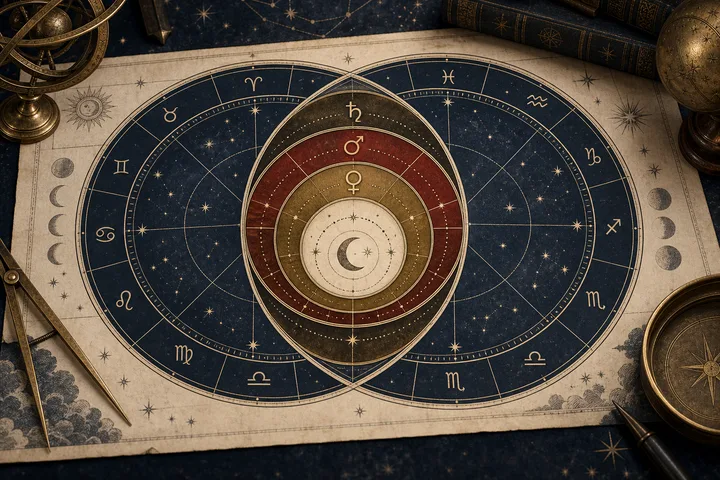
The best reading order begins with strength, not with the planet you personally find most fascinating. Scan the list for close major aspects among Moon, Venus, Mars, and Saturn. Mark conjunctions, oppositions, squares, trines, and sextiles. Then look for repetition. If three contacts all pull toward the same question about safety and control, that repeated theme may matter more than one glamorous but isolated contact. This first pass is about focus, not judgment.
Closeness comes first because an exact aspect has a concentrated voice. A 1° Moon-Venus trine deserves an earlier look than a 5° Venus-Mars sextile. But closeness is not the whole chart. A 1° Saturn-Mars square and a 1° Moon-Venus trine do different work. One may press on action and inhibition. The other may make affection easy to feel. Strength tells you where to look. Planetary function tells you what you find.
Aspect type changes the movement. A conjunction combines the planets so closely that their functions can be hard to separate. An opposition creates a line of tension between two poles. A square asks the people involved to act through friction. A trine allows energy to move with less resistance, while a sextile offers an opening that still needs participation. Calling an aspect good or bad loses the useful part of the description.
Count repeated roles, not just repeated planet names. Suppose one person's Moon receives the other person's Venus and Saturn, while that same Saturn also touches Mars. The chart repeats a theme of feeling, affection, action, and responsibility. You should not read the Moon-Venus contact, Moon-Saturn contact, and Mars-Saturn contact as three unrelated paragraphs. They describe one relationship problem from three angles: how closeness feels, what makes it safe, and what happens when desire meets limits.
Direction matters, too. In synastry, the Moon person and Venus person may not experience the same contact in the same way. One person may feel soothed while the other feels responsible for soothing. One may experience Mars as motivating, while the other experiences it as pressure. Keep the planet roles visible. Avoid turning the person who owns Saturn into a fixed personality type or the person who owns Mars into a permanent aggressor.
A useful ranking is simple. First, mark the tightest contacts. Second, mark contacts that repeat one theme across more than one planet. Third, note whether the aspects agree or disagree. Only after that do you write the interpretation. The chart's loudest contact is not always its governing contact. The governing contact is the one that changes how the rest of the pattern is lived. That distinction keeps an exact aspect in proportion to the whole relationship.
Repetition can be direct or indirect. Direct repetition occurs when one partner's Saturn touches the other person's Moon and Venus. Indirect repetition occurs when Moon-Saturn and Mars-Saturn bring feeling and action under the same question about timing, trust, fear, or responsibility. Keep the count modest. Three contacts describing one theme are three views of the same room, not three independent proofs.
Sources: Interaspect, Astrodienst Astrowiki; Introduction to Relationship Astrology 2: Synastry
Read the Moon first because it shows how closeness lands
Start with the Moon. In relationship astrology, the Moon speaks to instinct, comfort, memory, habit, and the need to feel received without performance. It is not the whole emotional life, but it tells you where the connection becomes private. Ask what happens when the two people are tired, worried, hungry, or quiet. That is where the Moon layer becomes visible.
A Moon-Venus contact can link emotional need with affection. The Moon person may feel cherished by the Venus person's style of care. The Venus person may find the Moon person's emotional nature pleasing, familiar, or beautiful. Cafe Astrology describes the easier contacts as natural liking and sweetness, while its harder contacts can expose different habits, values, and needs. The sign and aspect still matter. A square may make the two styles rub against each other even while attraction remains.
A Moon-Mars contact brings movement. The Mars person can energize the Moon person's feelings, protect them, provoke them, or irritate them. The same contact can feel warm when action answers emotion and reactive when action interrupts it. Ask a concrete question: when one person says, 'I need comfort,' does the other move closer, offer a solution, become defensive, or turn the moment into a debate? The chart gives the pattern. The answer shows its expression.
A Moon-Saturn contact asks whether seriousness becomes safety or weight. Saturn may steady the Moon, keep promises, and create a dependable container for feeling. Saturn may also judge, delay, or manage the Moon until the Moon stops showing what it needs. The aspect type and natal condition matter. A trine may make care easier to organize. A hard aspect may make emotional timing feel uneven. Neither one proves coldness or permanence.
Read the Moon before Mars because desire can hide an emotional mismatch. Maria may feel strong chemistry with Daniel, yet tense each time she asks for reassurance. Daniel may feel devoted, yet respond to her feelings by solving them. If you read Mars first, you might call the tension passion. If you read the Moon first, you can ask whether the passion leaves room for tenderness.
Look for support elsewhere in the supplied placements. A difficult Moon contact may be easier to hold when Venus contacts the Moon or when Saturn forms a constructive link to Venus. A soft Moon contact may not solve a repeated Mars-Saturn conflict. The Moon is the first layer, not the final verdict. It tells you what the connection needs in order to feel livable.
The Moon layer also helps you read silence. Some people experience quiet as rest. Others experience it as withdrawal. A synastry contact cannot decide which meaning is correct from a single symbol, but it can show why the same pause lands differently for each person. If the Moon is under Saturn, ask whether silence has a clear limit. If the Moon meets Mars, ask whether an attempt to help becomes an interruption.
When a Moon degree is missing, do not throw away the whole emotional reading. Use the Moon sign if it is supplied, and distinguish sign style from confirmed aspect. You can discuss how a person tends to seek comfort by sign. You cannot claim that the other person's Venus or Saturn is touching that Moon by degree.
Sources: Synastry, Cafe Astrology; Introduction to Relationship Astrology 2: Synastry
Move to Venus to see how affection becomes a shared language
After the Moon, read Venus. Venus describes attraction, taste, pleasure, values, receptivity, and the style through which someone says, 'I like being with you.' In synastry, Venus tells you how affection is offered and recognized. It can describe a soft voice, a generous gesture, a shared aesthetic, a desire for peace, or the values that decide whether pleasure feels worth the cost.
A Venus-Moon contact can make care feel natural. A Venus-Venus contact may show shared tastes or different standards of beauty and fairness. A Venus-Mars contact adds heat because affection meets pursuit. Cafe Astrology calls Venus-Mars a classic synastry contact and notes that even difficult aspects can carry strong attraction alongside friction. That is the right way to read it. Chemistry is real in the symbolism. It is not the same thing as ease.
Now ask what each person calls love. Does one person show love through touch while the other shows it through practical help? Does one want frequent reassurance while the other assumes loyalty can remain unspoken? Venus can reveal those preferences, but it cannot promise that either person will adapt. The reading becomes useful when it leads to an observable question: what gesture makes you feel chosen, and what gesture feels like pressure or waste to you?
Venus and Saturn deserve special care. Saturn may give Venus loyalty, patience, and a reason to build. It may also make Venus feel evaluated, rationed, or responsible for keeping the peace. Cafe Astrology describes challenging Venus-Saturn interaspects as capable of producing a strong need to stay together while also bringing restriction and day-to-day power struggles. Read both sides. Attachment and inhibition can occupy the same contact.
Venus is where many readers stop because it feels pleasant to talk about love. Do not stop there. If Venus wants harmony but Mars expresses anger through blunt pursuit, the couple needs a conflict language. If Venus wants freedom but Saturn demands proof, the couple needs a clear agreement about time, commitment, and privacy. The Venus layer names the value. The next layer asks what happens when the value is tested.
Your summary at this stage should fit in one sentence. For example: 'The Moon contacts show that reassurance matters, while Venus contacts show that affection is easiest through consistency and physical warmth.' Keep the sentence provisional. Mars and Saturn may sharpen it, complicate it, or reveal that the two people want the same tenderness but reach for it in opposite ways.
Venus also tells you where a relationship can become unfair without anyone intending harm. If one person's way of showing love is expensive time, constant availability, or public affection, the other person may not be able to offer the same form. Shared values do not require identical habits. They do require enough honesty to say what each habit costs and whether both people choose it freely.
This is why a synastry reading should describe preferences before it describes compatibility. 'You may value steady contact' gives the reader something to check. 'You are perfectly compatible' gives the reader nothing to do. The first sentence opens a conversation. The second closes one too soon.
Sources: Synastry, Cafe Astrology; Introduction to Relationship Astrology 2: Synastry
Read Mars next for desire, pursuit, and the shape of conflict
Mars comes third because it shows what the connection does when feeling turns into movement. Mars describes pursuit, courage, libido, initiative, anger, defense, and the way a person goes after what they want. In synastry, Mars can wake up the body. It can also wake up impatience. Read both possibilities without confusing intensity with quality.
A Venus-Mars contact links attraction and action. The Venus person may feel desired. The Mars person may feel welcomed or challenged. The aspect can bring a strong erotic current, but the sign tells you how the current moves. Fire may act quickly. Earth may build through touch and reliability. Air may need conversation and play. Water may require emotional permission before desire feels safe. These are styles, not stereotypes.
A Moon-Mars contact brings the emotional body into the field of action. The Moon person may feel awakened by the Mars person. They may also feel rushed or exposed. Ask what happens after the spark. Does Mars notice when the Moon has had enough? Does the Moon tell Mars directly what it needs, or expect Mars to guess? This is where the reading can become a real decision aid instead of a list of aspect meanings.
Mars-Saturn is the contact to slow down and examine closely. Cafe Astrology describes hard Mars-Saturn aspects as capable of producing blocking, criticism, frustration, and control when the people involved do not handle the difference between action and restraint with care. Its constructive expression is different: Saturn can give Mars patience and structure, while Mars can help Saturn act instead of waiting forever. The aspect has a task.
Do not assign blame by planet. The Mars person is not automatically reckless. The Saturn person is not automatically controlling. A natal Mars that already knows how to pace itself may meet Saturn as a coach. A Saturn person with a strong fear of failure may experience ordinary initiative as threat. The synastry contact describes a field between them. Each natal chart changes how that field feels.
At the end of the Mars layer, write the conflict sentence. It might be, 'Desire rises quickly, but one person needs time before responding.' Or, 'Both people want action, yet they disagree about whose timing leads.' That sentence will help you read Saturn without turning Saturn into a punishment.
Mars can also show the difference between attraction and cooperation. A person may feel drawn to another person's boldness and still resent being hurried. A person may admire restraint and still feel unwanted when restraint becomes distance. The useful reading names the moment when the energy changes. Is the pursuit welcome until a boundary appears? Does anger become clearer after it is spoken, or sharper after it is postponed?
When you describe Mars, use verbs. Pursues. Initiates. Defends. Interrupts. Protects. Challenges. Retreats. Verbs keep the interpretation alive. They show what the planets do between people, and they leave room for choice.
Sources: Synastry, Cafe Astrology; Introduction to Relationship Astrology 2: Synastry
Read Saturn last because it tells the other planets what they must carry
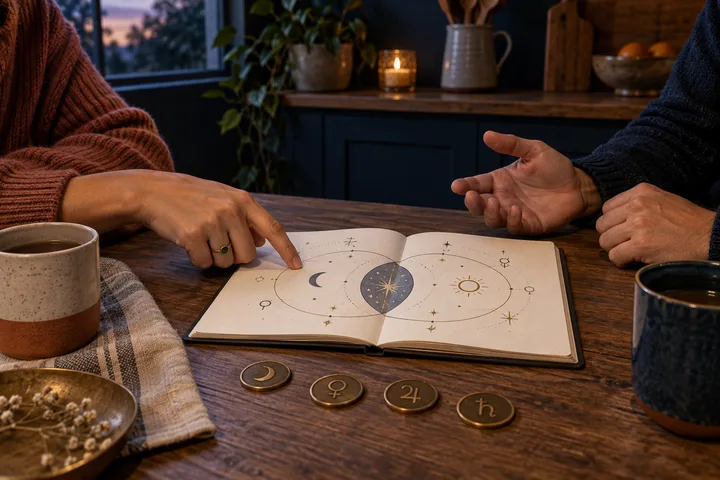
Saturn comes last in the first pass. It is not less important. It is the planet that asks whether the Moon's needs, Venus's values, and Mars's desires can take a workable shape. Saturn rules limits, time, duty, patience, fear, authority, and the structures that make effort repeatable. It can bind. It can harden. It can also make devotion visible through what a person keeps doing.
A Saturn contact to the Moon may create emotional responsibility. The Saturn person may offer steadiness, or the Moon person may feel they must earn warmth. A Saturn contact to Venus can test values, pleasure, and the willingness to make room for another person's preferences. A Saturn contact to Mars can slow action, frustrate initiative, or train desire into disciplined effort. Always name the constructive and difficult expression before you rank either one.
The pattern around Saturn matters more than the word 'karmic.' Saturn is often described as binding or serious, but a serious bond can be supportive, burdensome, or both. The source tradition treats Saturn as a stabilizing and restricting force. It also warns that too little Saturn can leave a relationship without structure, while too much can drain its joy. That is a better question than asking whether Saturn means forever.
Now compare Saturn's job with the earlier layers. If Venus needs warmth and Saturn answers with reliability, the connection may feel safe after trust grows. If Venus needs freedom and Saturn answers with monitoring, attraction may become a negotiation. If Mars wants quick action and Saturn offers pacing, the couple may learn patience. If Saturn uses pacing as a way to deny Mars, desire turns into resentment. Same planet. Different practice.
Read the sign and aspect before making a judgment. A Saturn trine to Venus may make commitment easier to express through routine. A Saturn square to the Moon may require deliberate emotional care. A conjunction can blend support and pressure so closely that the two people need clear boundaries to tell the difference. The six-degree orb tells you whether the contact belongs in the report. It does not decide the tone for you.
Saturn should therefore be the last major layer in the initial sequence and the first planet you revisit during synthesis. It tells you whether the earlier story has a container. It does not answer whether the relationship will last. It answers a more useful question: what must these two people practice if this connection is to become dependable without becoming heavy?
The word structure deserves a precise meaning here. It does not mean one person gets to make the rules. It means the relationship has a way to repeat care: a plan for difficult talks, a shared expectation about contact, an honest account of time, or a boundary that both people can keep. Saturn becomes constructive when responsibility is mutual. It becomes heavy when one person carries the agreement and the other person merely benefits from it.
A Saturn contact can also explain why a relationship feels more serious than its history would suggest. The people may meet a theme of duty, timing, or fear before they have built enough trust to hold it comfortably. That feeling is information. It is not proof of destiny. Ask what responsibility is actually present, and what responsibility the two people are imagining.
Sources: Synastry, Cafe Astrology; Introduction to Relationship Astrology 2: Synastry
Synthesize the four layers instead of averaging them
Once you have read Moon, Venus, Mars, and Saturn, do not average the results. Astrology is not a points system in which three soft aspects cancel one hard aspect. Put the layers into a sentence that shows their relationship. For example: 'The Moon and Venus contacts support tenderness, Mars adds strong pursuit, and Saturn makes trust depend on patience and clear limits.' That sentence has a direction. It tells you what the bond asks for.
Use the strongest contact as the hinge. If the tightest aspect is Moon-Saturn, begin your synthesis with emotional safety and responsibility. If Venus-Mars is exact while Saturn is loose, describe the chemistry first and then explain the weaker structural theme. If Saturn forms close contacts to both Moon and Mars, it may govern how the whole relationship handles vulnerability and action. Rank the interpretation. Do not hide behind a long list.
Then test the strongest meaningful exception. A hard Saturn contact does not always feel cold. It may be the very contact that helps two people keep faith during pressure. A flowing Venus-Mars contact does not always feel easy. It may encourage attraction without teaching either person how to repair conflict. A warm Moon-Venus contact does not erase different values. The exception is not a footnote. It protects the reading from becoming a slogan.
Consider an example without inventing chart data. Suppose the supplied report lists a close Moon-Venus trine, a close Venus-Mars square, and a close Saturn-Mars sextile. The first contact says affection can soothe. The second says desire can provoke. The third offers a method for turning pursuit into steadier action. The reading is not 'good with one bad aspect.' It is 'tenderness and heat need a deliberate rhythm, and Saturn can help create it if both people use structure as support rather than control.'
Now reverse the example. Suppose the supplied list has a close Moon-Saturn square, a loose Venus-Mars sextile, and no confirmed Moon-Venus aspect because one Moon degree is missing. The correct reading is narrower. You can describe a serious emotional pressure and a possible attraction pattern, but you cannot claim a precise Moon-Venus bond. The next useful step is to verify the missing Moon degree, then ask how each person responds when reassurance takes time.
The sources agree on one practical point: many factors can obscure the main picture. Record degrees, limit the orb, and keep planet roles distinct. The original synthesis is the ranking. Show what leads, what modifies it, and what the couple can discuss next.
When the layers disagree, choose the contact that explains the disagreement. Suppose Moon-Venus is gentle but Mars-Saturn is tight and difficult. The answer is not that the chart is half good and half bad. The answer is that affection may be present while timing, initiative, or sexual expression requires care. Suppose Venus-Mars is exact but Moon-Saturn is wider. Then chemistry may arrive first, while emotional seriousness develops more slowly. Your language should preserve that sequence.
You can also write two versions of the same interpretation and test which one has more explanatory power. Version one says, 'There is attraction, but Saturn makes things hard.' Version two says, 'Attraction is easy to access, yet the relationship may need explicit agreements before either person feels safe enough to act freely.' The second version is stronger because it names the mechanism and the decision it creates.
A quick synthesis test helps. Give every important contact one of three jobs: lead, modify, or wait. A tight Moon-Saturn square might lead because it explains why closeness feels guarded. A Venus-Mars trine might modify it by keeping warmth and desire available. An unconfirmed Moon-Venus aspect must wait until the missing degree is known. This prevents the most flattering contact from taking over, and it prevents an incomplete data point from becoming a dramatic conclusion. It also gives you a clean sentence for the report: 'Emotional caution leads; attraction softens it; the missing degree limits what we can say about comfort.' That is precise enough to use and open enough to test in life.
Ranking doesn't make the reading rigid. It makes uncertainty legible. The reader can see what is confirmed, what comes from signs, what is strongest by orb, and what still needs observation.
Sources: Interaspect, Astrodienst Astrowiki; Synastry, Cafe Astrology; Introduction to Relationship Astrology 2: Synastry
Let the chart change the conversation, not replace it
The final reading should leave the reader with one useful conversation. Not a verdict. Not a promise. A conversation. The chart can name a pattern that deserves attention, but the two people still need to observe how they live it. Astrology becomes practical when a symbol gives you better language for a choice you already have to make.
Start with the Moon question: 'When you are stressed, what kind of care helps you feel close, and what kind makes you pull away?' Keep the answer concrete. More time together is vague. A quiet check-in before bed is clear. So is being given an hour alone. The Moon layer turns comfort into something the couple can recognize.
Then ask the Venus question: 'What makes you feel valued, and what do you tend to mistake for love?' One person may count thoughtful planning. Another may count touch, praise, or shared pleasure. If their Venus contacts differ, this conversation prevents each person from offering the care they would want while missing what the other can receive.
Ask the Mars question next: 'How do we want to handle pursuit, refusal, anger, and repair?' Desire needs consent and timing. Conflict needs a way back. A Mars-Saturn pattern can make this especially important because one person may experience a pause as wisdom while the other experiences it as rejection. Name the pause. Name when the conversation resumes.
End with Saturn: 'What responsibility are we both willing to carry, and what would become too heavy?' This is the question that turns seriousness into a shared agreement. It can cover time, exclusivity, money, domestic effort, privacy, family boundaries, or the pace of physical intimacy. Saturn works best when the rules are spoken rather than silently enforced.
For Maria and Daniel, the next step is not to ask whether the chart proves they belong together. It is to compare their lived pattern with the chart's central tension. Maria can say, 'I feel close when you stay present after I tell you I'm upset. When you go quiet to give me space, I feel abandoned instead.' Daniel can answer with what he needs, too. Their response to that exchange tells them more about the health of the pattern than a dramatic label ever could.
Use the synastry report when you want to organize supplied Moon, Venus, and Mars placements, optional degrees, and selected major aspects under a stated six-degree orb. It can help you see which layer leads and which one needs care. Then bring the result back to real life. Read the chart in order. Speak plainly. Let the relationship show you what the symbols are asking you to practice.
If the answer changes after the conversation, the symbols have done useful work: they helped you ask a sharper question. A person who welcomes emotional honesty gives Moon-Saturn a different expression from a person who punishes it. The same is true of Mars-Saturn when a couple can name desire, timing, and repair.
The final test is simple. Can each person describe what they need, what they offer, and what they will not carry alone? If yes, the reading has moved from symbols to practice.
Sources: Interaspect, Astrodienst Astrowiki; Synastry, Cafe Astrology
Sources & further reading
- Interaspect, Astrodienst Astrowiki
Supports using a narrower orb in synastry because combining two charts creates many possible interaspects.
- Synastry, Cafe Astrology
Supports the Moon, Venus, Mars, and Venus-Saturn interpretations, including attraction with friction and restriction.
- Introduction to Relationship Astrology 2: Synastry
Supports recording signs and degrees, limiting synastric orbs, preserving planet roles, and weighing Saturn as structure and restraint.
Synastry Comparison Report
Enter known placements for two people. Get an input-by-input comparison, selected aspect calculations and a clear record of what remains uncertain.
Compare our placements