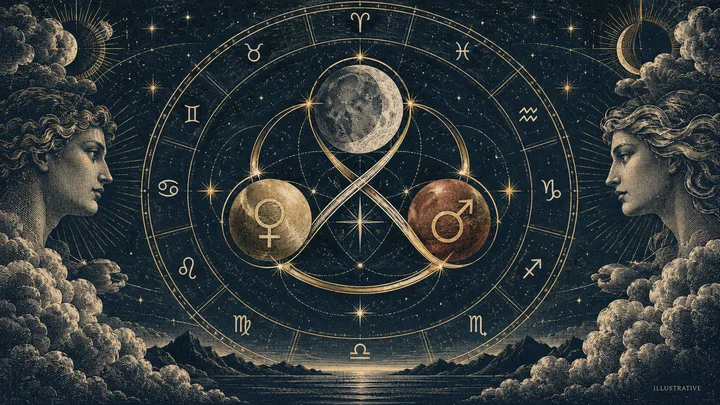
One relationship story can have three planetary layers
Read a Moon, Venus, and Mars cluster as one pattern with several functions. Don't count a warm Moon contact, a pleasant Venus contact, and an exciting Mars contact as three votes for the same conclusion. Ask what changes when each planet enters the story.
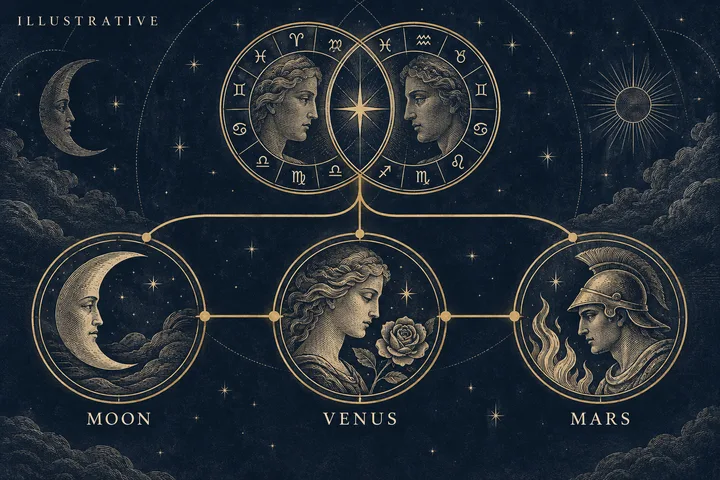
The Moon receives and responds. It points toward emotional familiarity, private habits, comfort, and the conditions that help a person soften. Venus draws people together through pleasure, appreciation, affection, and shared values. Mars moves. It pursues, asserts, desires, and brings heat to action or disagreement. These meanings overlap in life, but they aren't interchangeable in a reading.
Cafe Astrology treats Moon, Venus, and Mars interaspects as distinct comparisons within the larger synastry field. Philip Graves stresses that synastry creates many possible factors and that the reader must limit attention to contacts likely to matter. Name the shared theme once, then let each planet explain a different part of it.
A couple may feel at home together, enjoy one another's company, and move quickly toward physical closeness. The Moon can describe the first experience, Venus the second, and Mars the third. If those contacts all become a paragraph about feeling deeply compatible, the interpretation has repeated itself. If they become comfort, pleasure, and initiative, each contact adds information.
The aim isn't to make the chart smaller. It's to make the meaning sharper. A shorter reading can hold more information when every sentence has a clear planetary owner.
Sources: Aspects Between Charts; Introduction to Relationship Astrology 2: Synastry; Synastry
Fix the inputs before you interpret the pattern
Double-counting often begins before interpretation. A report may show a sign comparison, a degree-based aspect, and a phrase such as emotional compatibility. Those aren't automatically three findings. First record what was actually supplied.
For each contact, write down the planet from Person A, the planet from Person B, each sign, each degree if known, the aspect type, and the orb. Keep the direction visible. A Moon person and a Venus person may experience the same contact differently because one person's planet is being activated by the other's. This distinction prevents the vague claim that both people feel exactly the same thing.
This article's scope is placement-based. It can work from known Moon, Venus, and Mars signs and optional degrees. A complete natal chart, houses, angles, and birth-time-dependent overlays require additional inputs and aren't part of this reading.
Use a six-degree ceiling for the selected major aspects in the report, and preserve the actual orb when available. An aspect is an angular relationship, not a mood label. Skyscript defines an aspect as a precise distance between points and explains that the closer it is to exact, the stronger it is generally read. A tight square may therefore deserve more attention than a loose trine.
The input sheet exposes duplicates. A single Moon-Venus contact may appear in a grid, a wheel, and written prose. It is still one contact. Sign affinity and an exact aspect can reinforce one another without becoming two independent planetary events.
Sources: Introduction to Relationship Astrology 2: Synastry; An Introduction to Aspects and Chart Shaping in Natal Astrology
Let the Moon answer what feels safe and familiar
Give the Moon the first question: what happens to emotional ease and daily rhythm when these people are together? Read comfort, instinctive response, domestic habits, and the need to feel received. The Moon doesn't own every tender moment. It owns the emotional and habitual layer.
Suppose the supplied comparison shows a close Moon-Venus trine. Start there if it is the tightest relevant contact. The Moon person may experience the Venus person as soothing or considerate, while the Venus person may find the Moon person's feelings easy to appreciate. That is one contact with a two-way exchange, not a separate Moon proof and Venus proof.
Now ask what the contact doesn't tell you. A Moon-Venus connection can describe warmth and familiarity without settling how quickly either person acts, handles pressure, or shares every practical taste. Those questions belong to other layers.
Three earth-sign contacts may look steady at first glance. The Moon may turn that steadiness into a preference for reliable routines, regular contact, or a calm home base. Venus can add pleasure in simple, tangible affection. Don't repeat reliable three times. Say what reliability means in the Moon's domain, then move on.
Your Moon conclusion should fit in one sentence: this connection may feel emotionally familiar when both people have enough consistency to settle. That sentence gives the next planet a job.
Sources: Aspects Between Charts; Introduction to Relationship Astrology 2: Synastry; Synastry
Let Venus answer how liking becomes affection
Venus gets the second question: what do these people enjoy, value, and offer when attraction becomes a style of relating? Venus helps you read pleasure, charm, affection, taste, reciprocity, and the ways a person signals that someone matters.
If the same example includes a Venus-Mars sextile, don't call it another sign of emotional safety. Read it as a link between attraction and action. Venus may make Mars feel welcomed or appreciated. Mars may give Venus's preferences movement, pursuit, and physical energy. The sextile suggests an opening that can be used; it doesn't use the opening for either person.
Venus is often described as love, so every Venus contact can get inflated into a claim about the whole relationship. Keep the claim smaller and truer. Venus can show what feels pleasing or lovable in the exchange. It cannot, by itself, describe every argument, shared duty, or commitment pace.
Imagine a supplied comparison in which the Moon-Venus trine is close, while Venus-Mars is wider but still inside the chosen orb. The Moon-Venus contact leads the emotional reading. Venus-Mars supports it by showing that attraction can find an active outlet, but it shouldn't be written as equally strong evidence. This is how orb becomes judgment instead of decorative math.
A useful Venus sentence might be: affection is easier to show when pleasure and initiative meet, especially through invitations, touch, shared food, art, or time chosen on purpose. It adds behavior instead of repeating that the pair likes each other.
You avoid double-counting by giving the Moon, Venus, and Mars separate jobs before you combine them. The Moon describes emotional safety, habit, and the way two people settle into daily life. Venus describes attraction, affection, taste, and the style of liking. Mars describes pursuit, heat, initiative, and conflict pace. If all three contacts point toward closeness, name one shared pattern with three expressions, not three separate proofs. Record the supplied signs and optional degrees, identify the aspect and orb, then rank the tightest major contact and use the others as modifiers. A useful reading says what the pattern is, what each planet adds, and where the planets disagree. It ends with one observable question. The chart gives you a pattern to examine. Your conversation shows how that pattern is being lived.
Sources: Aspects Between Charts; An Introduction to Aspects and Chart Shaping in Natal Astrology; Synastry
Let Mars answer what happens when feeling turns into action
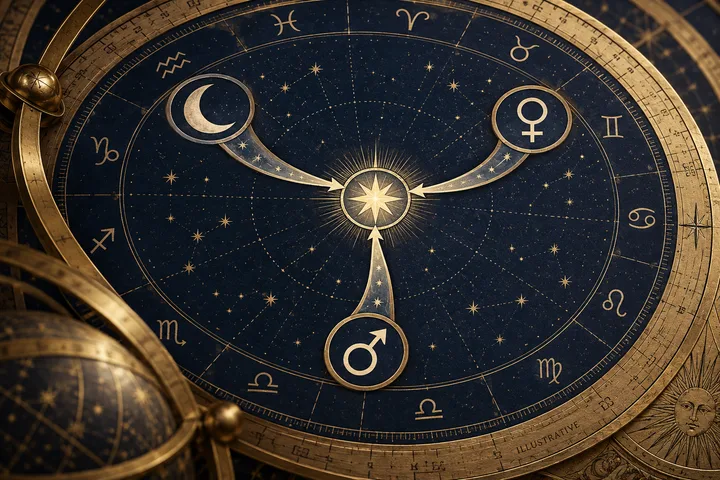
Mars gets the third question: what do these people do with desire, urgency, and friction? Mars can describe pursuit, sexual charge, initiative, competitiveness, and the speed with which a disagreement becomes active. Venus says what draws and pleases. Mars says what moves.
In the worked example, add a Moon-Mars square to the Moon-Venus trine and Venus-Mars sextile. The cluster is no longer a simple story of ease. The Moon may want reassurance and a settled pace, while Mars pushes for an immediate response. Venus can keep attraction alive, but it doesn't erase the difference between comfort and action.
The square shouldn't be filed as one more negative sign. Give it a precise role. Perhaps one person reaches for direct action when the other needs time to feel safe. Perhaps desire wakes up a defensive habit. The chart gives you a pattern to observe, and the aspect shows where the pattern may press.
This explains why a difficult contact can matter more than a long list of easy ones. Skyscript describes harmonious aspects as flowing and tense aspects as friction that can demand development. Cafe Astrology treats squares as energies that need work but can create useful tension. Notice the contact that changes the couple's next decision.
Your Mars sentence might be: attraction has movement, but the pair needs to agree on the speed of pursuit and repair. That is more useful than calling Mars passionate three times.
Sources: An Introduction to Aspects and Chart Shaping in Natal Astrology; Synastry
Rank the cluster instead of counting its contacts
Once each planet has a job, rank the pattern in four passes. Start with the tightest relevant major aspect. Ask which planet describes the reader's actual question. Identify whether the other contacts confirm, modify, or contradict the lead contact. Then translate the result into one observable situation.
For the example, the close Moon-Venus trine leads if the reader asks why the connection feels easy and familiar. The wider Venus-Mars sextile confirms that affection can become active attraction. The Moon-Mars square modifies the story with a pressure point around timing, pursuit, or reactivity. The final reading isn't three positives and one negative. It is one pattern: warmth and attraction are available, but action can arrive at a different speed from emotional settling.
Don't let aspect type do all the work. A conjunction isn't automatically a relationship verdict. An opposition can create polarity and recognition. A trine can be effortless without solving a practical problem. Read the planets, aspect, orb, and signs as layers. Their order can vary with the question, but their meanings must remain visible.
Use a simple writing test. If two paragraphs have the same subject, verb, and consequence, they probably belong together. Replace them with one group sentence and one planet-specific sentence. If a contact changes the outcome, keep it. If it only makes the previous sentence sound more romantic, cut it.
The strongest exception is a contact that isn't the tightest but speaks directly to the live issue. A wider Moon-Mars square may deserve the lead when the couple asks why closeness keeps turning into a timing fight. Rank by orb, relevance, and function together.
A compact report can use this shape: lead pattern, Moon expression, Venus expression, Mars pressure point, practical question. Every listed contact doesn't deserve equal space.
Sources: Aspects Between Charts; Introduction to Relationship Astrology 2: Synastry; An Introduction to Aspects and Chart Shaping in Natal Astrology; Synastry
Turn the merged reading into one conversation
The reading is finished when the repeated story becomes a useful question. Don't end by adding more aspects. Ask what the chart's pattern looks like in a real exchange between these people.
For the example, try this: When one of us wants closeness or action quickly, what helps the other person feel safe enough to stay present? That question holds all three planets. The Moon asks for safety. Venus asks how care and liking are shown. Mars asks what happens next when desire or frustration rises.
Make the conversation concrete. Ask how each person recognizes affection, how much time each needs before responding, and what repair should look like after a sharp moment. These aren't substitutes for the chart. They're the lived questions that let the chart speak with precision.
For this report, the scope stays clear. Known Moon, Venus, and Mars signs can support a layered comparison, and optional degrees can support selected major aspects with the stated six-degree orb. The report doesn't calculate new natal placements, houses, or a score. It gives you a disciplined way to compare what you already know.
Remember the final rule. Count contacts for the audit. Count meanings only when they add a new function. If Moon, Venus, and Mars all describe closeness, write one closeness pattern, then show how comfort, affection, and action differ inside it. That is how a synastry reading becomes clearer, shorter, and more useful.
Sources: Aspects Between Charts; Introduction to Relationship Astrology 2: Synastry
Sources & further reading
- Aspects Between Charts
Supports reading inner-planet interaspects by planet, sign, house, and relational role rather than as an undifferentiated list.
- Introduction to Relationship Astrology 2: Synastry
Supports preserving planet direction, recording degrees, using restricted synastry orbs, and limiting a large field of contacts.
- An Introduction to Aspects and Chart Shaping in Natal Astrology
Supports the definitions of aspect, orb, major and tense contacts, and the general weight given to closer aspects.
- Synastry
Supports distinct Moon, Venus, and Mars functions and the different relationship questions raised by flowing and tense interaspects.
Synastry Comparison Report
Enter known placements for two people. Get an input-by-input comparison, selected aspect calculations and a clear record of what remains uncertain.
Compare our placements