Imagine Maria and Daniel reading two different stories in one chart
Imagine Maria has shared a synastry report with Daniel after a month of intense dates. The report shows her Moon square his Saturn at 2 degrees, her Venus trine his Jupiter at 1 degree, and her Mars opposite his Mercury at 5 degrees. She reads the Moon-Saturn contact and feels a weight settle in her chest. Daniel reads Venus-Jupiter and talks about how easy it feels to laugh together. Then the Mars-Mercury opposition appears, and suddenly every conversation about plans turns sharp. One chart seems to promise tenderness. The same chart seems to warn of defensiveness and arguments. Maria asks the real question: which story is true?
A useful synastry conclusion doesn't choose the prettiest contact and hide the rest. It also doesn't pile every aspect into a flat list. It explains how the contacts operate together. Maria and Daniel may genuinely enjoy one another, forgive easily, and still trigger a pattern in which Maria feels judged when she shows vulnerability while Daniel feels pushed when she asks for an immediate answer. Attraction and strain can share a room. In fact, the contrast often tells you more than either contact alone.
This is an illustrative case, not a calculated personal chart. The degrees are supplied only to make the method visible. In a real comparison, you would use the placements and optional degrees you actually have. You would not fill a missing degree with an assumption, and you would not turn a chart pattern into a dating verdict. Synastry describes the field of interaction. The couple still chooses how to meet it.
Astrodienst defines synastry as a comparison of two horoscopes and interaspects as the contacts formed between them. So don't stamp one label across the relationship. Compare the symbolic systems, decide which contacts organize the exchange, and write a map rather than a score. The useful conclusion names what draws the pair together, what creates the recurring work, and what behavior could help them meet it.
Sources: Synastry, Astrodienst Astrowiki; Partner Horoscopes, Astrodienst FAQ
What is the question beneath the mixed signals?
The person asking for a synastry conclusion rarely wants a catalogue of aspects. She wants to know why the relationship can feel safe on Tuesday and brittle on Thursday. Begin with the lived pattern the chart is being asked to illuminate.
Ask what changes from one contact to the next. Is the warmth strongest during affection, while the tension appears during decisions? Does the couple feel close in private but misunderstood when they speak about money or timing? Does one person pursue contact while the other withdraws? These questions give the planets somewhere to land. Moon contacts speak to emotional rhythm and felt safety. Venus contacts describe attraction, pleasure, taste, and the style of giving and receiving affection. Mars contacts bring desire, initiative, anger, assertion, and the way the pair gets moving. Mercury contacts describe the exchange of words, ideas, and interpretations. Saturn adds limits, duty, fear, durability, and the tests that require patience.
A mixed conclusion becomes readable when each contact answers a different part of the same question. For Maria and Daniel, Venus-Jupiter can explain why they enjoy each other and recover goodwill. Moon-Saturn can explain why vulnerability feels serious, exposed, or delayed. Mars-Mercury can explain why a practical discussion becomes a contest over whose wording is correct. The chart isn't sending three unrelated messages. It is showing pleasure, emotional weight, and verbal heat around the same bond.
Cafe Astrology's interchart guidance makes a similar point in technical terms: the planet person and the contacted planet person can take on different roles in the exchange, and the signs and houses change how an aspect plays out. That keeps you from writing a generic sentence such as ‘Saturn is bad for love.’ Saturn may be the one who slows the tempo, names the obligation, or asks whether affection can survive a hard week. The experience can feel restrictive, stabilizing, or both, depending on the rest of the charts and the people involved.
Your first paragraph should name the situation, not deliver a verdict. Try this shape: ‘This synastry has real affection and a serious pressure point. You may enjoy one another freely, yet feel the relationship tighten when one person needs reassurance and the other responds with correction or delay.’ That gives the reader a working hypothesis to test.
When the strongest synastry contacts point in different directions, don't average them into a vague verdict. Write one clear sentence about the bond's main promise, one about its main work, and one about the choice the couple faces. Rank contacts by the planets involved, the exactness of the aspect, repetition of the same theme, and the way each pattern appears in ordinary life. A tight Moon-Saturn square may describe emotional pressure, while a close Venus-Jupiter trine may describe warmth, pleasure, and forgiveness. Both belong in the conclusion. The trine doesn't erase the square, and the square doesn't cancel the affection. It tells you that ease and effort live in the same bond. Start with supplied placements and optional degrees. Use a stated six-degree orb for the selected major aspects, and say when missing degrees limit the conclusion. Then end with a practical question, such as whether the pair can make emotional safety stronger than the friction that keeps demanding attention.
Sources: Partner Horoscopes, Astrodienst FAQ; Aspects Between Charts, Cafe Astrology
How should you rank the contacts before writing?
Don't rank aspects by how dramatic their names sound. Rank the whole contact. Ask which planets are involved, what aspect connects them, how close the orb is, and whether another contact repeats the theme. This turns a crowded report into a readable argument.
Planet first. A Moon contact reaches feeling, habit, protection, and the body's need for safety. Venus brings affection and value. Mars brings heat, pursuit, conflict, and sexual expression. Mercury tells you how meaning travels between two people. Jupiter can widen generosity and hope. Saturn can bind, test, mature, or harden. Uranus can awaken freedom and surprise. Neptune can inspire longing and blur perception. Pluto can intensify and transform. The planet tells you what part of life the contact is asking you to watch.
Aspect second. A conjunction concentrates two functions in one place. It can feel immediate and unmistakable, but its quality depends on the planets involved. An opposition creates polarity. One person may pull toward one end while the other person responds from the other, producing attraction and a see-saw effect. A trine often offers ease. A sextile offers a door that opens when the pair uses it. A square creates friction that needs active integration. The language of ‘easy’ and ‘hard’ is only a starting point. A trine can be unused. A square can become skill.
Orb third. The orb is the distance between an exact aspect and the actual degree separation. A close aspect usually deserves more weight than a wide one, especially when you're comparing several contacts. Astrodienst's partner-chart guidance says its synastry wheel uses half the natal-chart orb because a comparison contains twice as many planetary factors. This is a practical reminder to keep the aspect list selective. In this report, state the chosen six-degree orb for selected major aspects and treat contacts close to exact as the loudest voices within that rule.
Repetition fourth. If Venus squares Saturn and the Moon also touches Saturn, the relationship may carry a repeating Saturn story around affection, comfort, and emotional timing. If Venus trines Jupiter and the Moon receives Jupiter too, warmth may operate across more than one layer. Repetition doesn't mean you count the same feeling twice. It means you notice a theme returning through different doors.
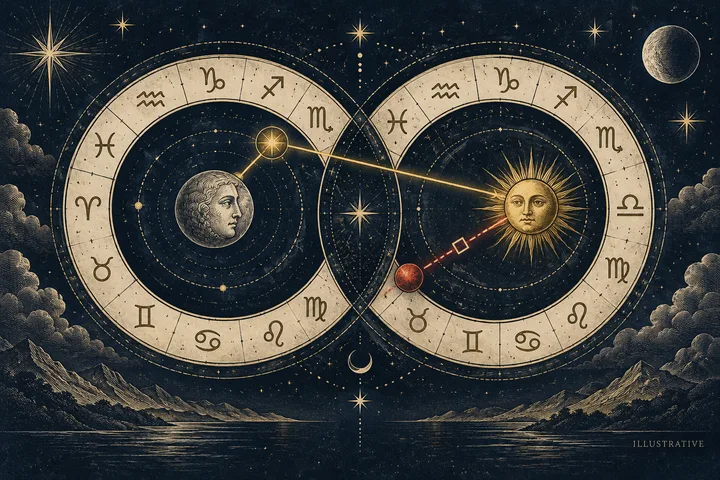
In the illustrative example, Moon square Saturn at 2 degrees outranks Mars opposite Mercury at 5 degrees because it is tighter and reaches emotional safety, while Venus trine Jupiter at 1 degree leads the supportive side because it is both close and relationally generous. Mars-Mercury still matters. It may describe the moment the deeper insecurity becomes audible. Ranking is not deletion. It is order.
Rank for the question in front of you. If future planning feels heavy, Saturn contacts deserve the first look. If desire feels immediate but unstable, Venus-Mars or Venus-Uranus may lead. Intensity isn't the same as importance. A quieter Mercury-Saturn pattern may decide whether the couple can make a plan and keep it.
Sources: Synastry, Astrodienst Astrowiki; Partner Horoscopes, Astrodienst FAQ; Aspect, Astrodienst Astrowiki
How do you combine a supportive contact with a difficult one?
Use contrast, not cancellation. A supportive aspect tells you what comes more naturally. A tense aspect tells you where the pair spends energy. The conclusion becomes honest when it names the natural gift and the required practice in the same breath.
Suppose the strongest supportive contact is Venus trine Jupiter. You can say that affection, pleasure, humor, and forgiveness have room to grow. You can say the pair may want to give one another the benefit of the doubt. But you shouldn't use that trine as evidence that every conflict will resolve itself. Ease is a resource. It is not a repair plan.
Now add Moon square Saturn. The emotional story changes shape. One person may feel that the other person is hard to reach, too cautious, or quick to correct a feeling. The Saturn person may feel responsible for containing the Moon person's needs, or may believe that practicality is an act of care. The same contact can stabilize a shared life when both people respect its limits. It can feel cold when duty replaces listening. Your wording should hold both possibilities, then identify the condition that separates them.
A clean synthesis might read like this: ‘The bond has a generous heart, but emotional reassurance won't happen automatically. Venus-Jupiter helps you enjoy each other and return to goodwill. Moon-Saturn asks you to make care visible when one of you feels vulnerable. If reassurance arrives as advice, the contact hardens. If responsibility includes patient listening, the same seriousness can become a source of trust.’
That synthesis gives each contact a job and turns symbolism into an observable choice. Lead with the pattern the reader recognizes, then name its astrological source. A Venus-Jupiter contact may describe the reunion, Moon-Saturn the conflict, and Mars-Mercury the first sharp exchange. Time sequence often explains why apparently opposing contacts all feel true.
Sources: Synastry, Astrodienst Astrowiki; Aspect, Astrodienst Astrowiki; Love and Relationship Astrology, Cafe Astrology
What does the same contact look like from each side?
Synastry is relational, so don't write as if an aspect belongs to only one person. A contact can be felt differently by the two people involved. The planet person and the receiving person may trade roles across situations, but the pattern still needs two perspectives.
Take the illustrative Moon-Saturn square. Maria, as the Moon person, may notice Daniel's pauses, corrections, or practical responses most sharply when she wants emotional presence. Daniel, as the Saturn person, may notice the weight of her feelings and respond by trying to solve the problem, set a boundary, or make a plan. Maria experiences distance. Daniel experiences responsibility. Neither description automatically proves intention. It shows the two ends of the same contact.
Then look at Venus-Jupiter. Maria's Venus may feel welcomed by Daniel's Jupiter, while his Jupiter encourages her pleasure and appetite for life. That fondness can soften the serious contact, but it can also become an escape if jokes or generous promises replace the hard talk.
Mars opposite Mercury adds another loop. The Mars person may push for action while the Mercury person defines and qualifies the plan. One experiences delay. The other experiences pressure. Write that in active, careful language: ‘When Maria asks for comfort, Daniel may reach for structure before warmth, and Maria may hear that structure as rejection.’ The couple can then see where either person might interrupt it.
A contact can describe intensity without proving equal investment or a shared future. The chart names the interaction. The couple's words and repeated actions show whether they can meet it.
Sources: Partner Horoscopes, Astrodienst FAQ; Aspects Between Charts, Cafe Astrology
When should signs, houses, and chart context change the conclusion?
An aspect never speaks in a vacuum. After you rank the interchart contacts, bring in the signs, houses, and each natal chart's condition. This is where a short list becomes an interpretation rather than a set of keywords.
Start with signs. Venus-Jupiter in earth signs may express generosity through food, money, work, and reliable presence. In fire signs, it may grow through adventure, praise, creative risk, and shared enthusiasm. Moon-Saturn in water signs can make vulnerability especially deep and private. In air signs, the pressure may show through words, distance, or the need to explain feelings before they can be felt. These are interpretive directions, not fixed outcomes. The signs describe the style and language of the contact.
Then use houses, but only when the birth times support them. A partner's planet falling in the other's fourth house brings the connection into home, family, memory, and private belonging. A fifth-house emphasis may animate romance, play, pleasure, and creative expression. A seventh-house overlay can make partnership itself feel central. An eighth-house emphasis can pull the reading toward intimacy, trust, shared resources, and vulnerability. If birth time is missing or rounded, don't pretend house placement is exact. Say what remains dependable and leave the unsupported layer out.
Next, read each natal chart on its own. Astrodienst's synastry guidance recommends understanding the individual horoscopes before interpreting the comparison. That keeps you from treating a contact as a foreign force dropped onto a blank person. If Daniel already has a strong natal Saturn story around emotional responsibility, Maria's Moon may activate a familiar pattern. If Maria has natal Moon-Saturn themes herself, the synastry may feel recognizable rather than wholly imposed by Daniel. The same interaspect can wake different material in each chart.
A useful conclusion can name this hierarchy: ‘At the sign level, your Venus-Jupiter trine supports shared enjoyment. At the interplanetary level, Moon-Saturn makes emotional timing the main work. If the birth times are reliable, the house overlays can show where that work appears. If they aren't, stop at the planets, signs, and degrees you can actually support.’ That gives the reader depth without pretending that every chart layer is equally secure.
Don't let extra objects steal the center. Asteroids, midpoints, nodes, angles, and declination contacts can add nuance when the data supports them. They shouldn't displace a close personal-planet contact simply because the label looks rare. A precise angle or nodal contact can lead when the question depends on it and reliable birth-time data supports it.
Sources: Synastry, Astrodienst Astrowiki; Partner Horoscopes, Astrodienst FAQ; Aspect, Astrodienst Astrowiki
How do missing degrees change what you can responsibly say?
A mixed conclusion depends on its inputs. Sign-only placements support a broad comparison of planetary style, element, modality, and possible sign relationships. They don't prove a close conjunction, square, trine, or opposition. Degrees show whether a potential contact is active and how much weight it deserves.
If you know both degrees, state the aspect and the orb. ‘Moon at 14 degrees Taurus squares Saturn at 16 degrees Leo, a 2-degree square’ gives the reader a reproducible basis for the interpretation. If you know only the signs, write ‘Taurus Moon and Leo Saturn can create a fixed-sign tension around comfort and control, but the exact aspect and strength remain unconfirmed.’ That sentence still helps. It doesn't pretend to know more than the chart data offers.
The six-degree rule in this report gives you a clean working scope for selected major aspects. It doesn't turn every contact within six degrees into an equal voice. A 0-degree conjunction and a 5-degree square may both qualify, but the closer one usually leads. The planet pair and the type of aspect still matter. You can also state when an aspect falls outside the chosen rule, rather than quietly importing a wider orb from another calculator.
Be especially careful with angles and houses. A rounded birth time can move the Ascendant, Midheaven, and house cusps. It can change the story of where a partner's planet falls. If the report has precise Moon, Venus, and Mars placements but uncertain birth times, keep the conclusion on those supplied placements and any supported degree aspects. Don't let a beautiful wheel tempt you into a house claim you can't reproduce.
The strongest meaningful exception is a close sign relationship that remains useful even without exact degrees. Two planets in the same sign may suggest shared language, while planets in opposing signs may describe a compelling polarity. But call that a sign-level interpretation. Don't call it a confirmed conjunction or opposition. Precision makes the reading stronger, not colder.
Record the settings before interpreting. One report may show a wider aspect list, include minor aspects, or handle angles differently. If two reports disagree, compare the zodiac, aspect type, orb, house system, and degree rounding. A conclusion that states those settings can be checked.
When only one degree is exact, offer the sign-level theme and name the degree-dependent question: ‘This attraction may be more exact than the sign comparison suggests, but confirm the second degree before giving it a leading role.’ If several contacts depend on missing degrees, lead with what is confirmed and add the possible contact as a question to check.
When birth times are missing, keep the conclusion on the supplied Moon, Venus, and Mars signs and supported degree aspects. State the scope once, then interpret.
Sources: Synastry, Astrodienst Astrowiki; Aspect, Astrodienst Astrowiki
What conclusion should the couple actually receive?
After the analysis, choose the pattern that governs the reader's next decision. Don't end with ‘there are positives and negatives.’ Name the main resource, the main work, and the situation in which the work appears.
For Maria and Daniel, the ranked judgment is clear: this is a warm bond with a serious emotional task. Venus trine Jupiter gives pleasure, humor, and a way back to goodwill. Moon square Saturn at 2 degrees makes reassurance the hinge. Mars opposite Mercury at 5 degrees shows how an unspoken need can turn into an argument about wording or timing. The relationship doesn't need more chemistry first. It needs care to become recognizable when one person feels exposed.
That judgment is stronger than a score because it gives the couple something to watch. If Daniel listens before solving and Maria makes one clear request, Venus-Jupiter can support the harder contact. If vulnerable moments keep ending in correction or verbal combat, Moon-Saturn carries more weight in lived experience than the attractive trine does on paper.
Test the reading in the next two difficult conversations. Each person can name what happened, what they felt, and what they need now. Watch the sequence. Does warmth make honesty easier? Does Saturn show patient responsibility or correction? Does Mars-Mercury create clarity or raise the temperature? This isn't a scorecard. It's a way to see how the pattern is being lived.
The decision can change the order without changing the chart. If Maria is asking whether she feels emotionally met, Moon-Saturn leads. If she is asking about the ease of early courtship, Venus-Jupiter may lead. If the decision concerns a home or budget, Saturn and reliable house overlays deserve more attention. Rank for the decision in front of the reader, not for a permanent label on the relationship.
Write the ending as resource, central work, and observable action: ‘You have warmth and a path back to goodwill. Emotional safety leads because the close Moon-Saturn square governs what happens when vulnerability enters the room. Practice listening before correction, then notice whether both people can stay present.’ That is the point of a mixed chart. Not a verdict. A ranked next step.
Sources: Synastry, Astrodienst Astrowiki; Partner Horoscopes, Astrodienst FAQ; Aspects Between Charts, Cafe Astrology; Love and Relationship Astrology, Cafe Astrology
A little more clarity
Should a difficult synastry aspect outweigh several supportive ones?
Not automatically. Weigh the planets, aspect type, orb, repetition, and lived pattern together. A tight Moon-Saturn square may deserve the lead when emotional safety is the couple's recurring issue, even if Venus and Jupiter add warmth. Supportive contacts remain important because they show where goodwill, pleasure, and repair can grow. The right conclusion names the difficult contact as the main work and the supportive contacts as resources. It doesn't turn either side into a final relationship verdict.
Sources & further reading
- Synastry, Astrodienst Astrowiki
Supports defining synastry as chart comparison and reading harmonious and challenging contacts as interacting relationship themes.
- Partner Horoscopes, Astrodienst FAQ
Supports the synastry bi-wheel definition and the use of a smaller orb for partner-chart comparisons.
- Aspects Between Charts, Cafe Astrology
Supports considering planet roles, signs, houses, and relationship-relevant interchart aspects together.
- Aspect, Astrodienst Astrowiki
Supports defining aspects by angular relationships and orbs while avoiding a simple good-versus-bad split.
- Love and Relationship Astrology, Cafe Astrology
Supports the interpretive roles of Venus, Jupiter, Mars, Saturn, and major aspect types in relationship synastry.
Synastry Comparison Report
Enter known placements for two people. Get an input-by-input comparison, selected aspect calculations and a clear record of what remains uncertain.
Compare our placements