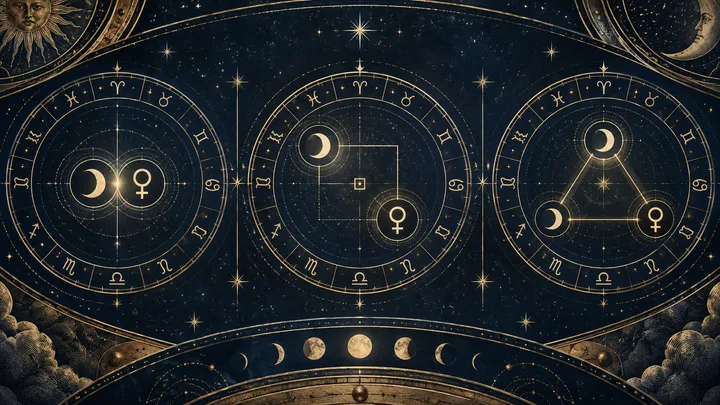
Two charts can repeat the same planet pair because a planet pair names the participants, while an aspect names the exact angle between them. Moon and Venus might meet by conjunction in one comparison, then sit 90 degrees apart in another and form a square. The deciding inputs are each planet's zodiac degree, the zodiac system, and the orb used for the report. Start with the angle, judge its closeness, then bring in signs and planet roles. Record both placements, use one orb policy, and rank the tightest major aspect before reading the wider pattern.
A planet pair names the meeting, not its shape
Moon-Venus tells you which functions meet: emotional need, comfort, affection, pleasure, and response. Venus-Mars brings attraction, desire, initiative, and pursuit into the same question. The pair name doesn't tell you whether those functions blend, press against each other, or sit without a close major contact.
The aspect supplies that shape. Astrologers measure the distance between two points around the zodiac. The major angles are 0 degrees for a conjunction, 60 for a sextile, 90 for a square, 120 for a trine, and 180 for an opposition. A conjunction concentrates. A square creates work. A trine supports flow. The planets give the contact its subject; the angle gives it its manner.
So keep the labels separate. Moon-Venus is the subject. A one-degree conjunction is the contact.
Sources: An Introduction to Aspects and Chart Shaping in Natal Astrology; A Brief Introduction to Astrology: Aspects; Synastry - Skyscript Glossary
Signs give the style, while degrees test the aspect
Signs describe the setting through element, modality, and style. Degrees locate each planet more precisely. To test an aspect, place both points on the 360-degree zodiac, find the shorter distance between them, and compare it with the major angles.
Imagine Maria has Venus at 28 degrees Leo and the other chart has Mars at 2 degrees Sagittarius. Leo and Sagittarius suggest a trine by sign. Their positions are 148 degrees apart, so the shorter separation is 94 degrees. That is about four degrees from a square, not 26 degrees from a trine. The sign story is broad context. The degree contact is the sharper testimony.
Check the angle first, then bring in signs. You can then describe both layers without forcing them to agree: a degree-based square with a fire-sign trine by sign. The contrast isn't an error. It gives the contact a precise form and a different elemental flavor.
Sources: An Introduction to Aspects and Chart Shaping in Natal Astrology; The Classical Origin and Traditional Use of Aspects; A Brief Introduction to Astrology: Aspects
An orb decides whether a near-angle belongs in the report
An orb is the distance allowed between an actual separation and an aspect's exact angle. Venus at 14 degrees and Mars at 18 degrees are four degrees apart. A report using a six-degree conjunction orb can include them. A stricter report may leave them out.
Orb customs vary. Some tables vary the allowance by aspect, while traditional practice may give the Sun and Moon more room than smaller planets. That can make two reports disagree even when their placements match. Within one policy, rank the closer contact first. The Synastry Comparison Report uses a six-degree orb for selected major aspects.
Sources: An Introduction to Aspects and Chart Shaping in Natal Astrology; The Classical Origin and Traditional Use of Aspects; A Brief Introduction to Astrology: Aspects
The same Moon-Venus pair can become three different contacts
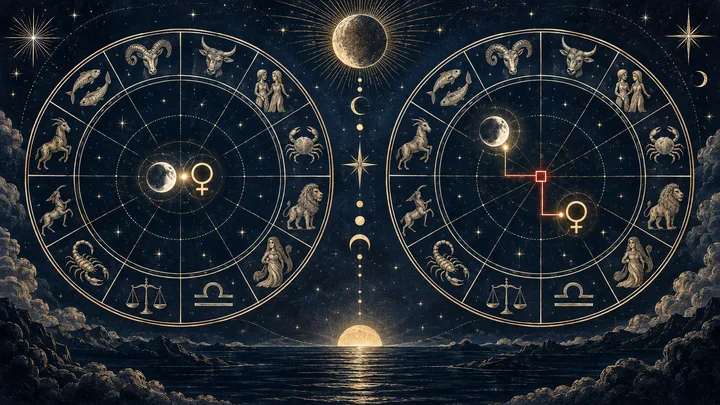
Consider an example. In Chart A, one person's Moon is at 12 degrees Taurus and the other's Venus is at 13 degrees Taurus. The one-degree separation makes a tight conjunction. Feeling and affection occupy the same patch of zodiac, so comfort, tenderness, and reassurance may arrive as one blended experience.
In Chart B, keep the Moon at 12 degrees Taurus but place Venus at 12 degrees Leo. Now the pair forms an exact square. The contact remains vivid, but the habits may not merge. One person's way of seeking comfort can press against the other's way of giving warmth. The pair repeats. The aspect changes.
In Chart C, place Venus at 12 degrees Virgo. The pair forms an exact trine. Care may move through steadiness, practical help, and shared earth-sign instincts. These invented positions isolate the principle: the same planet roles can blend, negotiate, or flow depending on the angle.
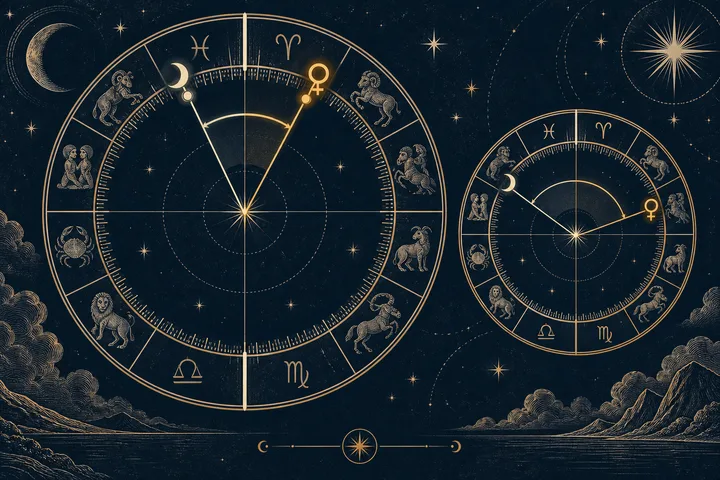
Aspect names describe different kinds of work
A conjunction combines. Read it as concentration, not automatic ease. In Moon-Venus, feeling and affection can become hard to separate. In Venus-Mars, attraction and desire may feel immediate and personal.
A square creates pressure between functions that still clearly see each other. Moon-Venus may ask for translation between different forms of comfort. Venus-Mars may put timing, pursuit, and pleasure under strain. An opposition makes the polarity visible. A trine supports flow. A sextile offers a useful opening that still needs participation.
These are starting points, not scores. A square can describe a recurring mismatch or a skill the couple has learned to practice. A trine can offer easy support that nobody uses. Moon-Mars square and Venus-Mars square still ask different questions.
Sources: An Introduction to Aspects and Chart Shaping in Natal Astrology; The Classical Origin and Traditional Use of Aspects; A Brief Introduction to Astrology: Aspects
A sign match can exist without a close major aspect
Two placements can share a sign or element and still fall outside the selected orb. A same-sign pair separated by 18 degrees shares a field, but it isn't a close conjunction under a six-degree rule. The sign connection can describe familiar style or pace. It can't be promoted into an aspect it doesn't meet.
This explains many report disagreements. One table may show sign relationships; another may list only degree-based major aspects. Both can describe real layers. Say exactly what you found: the placements share an element, but their degrees don't form a close major aspect under this method.
No close aspect means no qualifying major degree relationship here. Let tighter contacts lead.
Sources: An Introduction to Aspects and Chart Shaping in Natal Astrology; The Classical Origin and Traditional Use of Aspects; Synastry - Skyscript Glossary
Sign boundaries explain the apparent contradiction
The zodiac is continuous even though we draw it as twelve 30-degree signs. A planet at 29 degrees Aries and another at 1 degree Taurus occupy different signs, yet they are only two degrees apart. They can form a close conjunction across the boundary.
The classic example is 28 degrees Leo with 2 degrees Sagittarius. By sign, the placements belong to a trine relationship. By degree, they sit 94 degrees apart, close to a square. Traditional astrology has made room for both sign-based, broad contacts and close degree-based contacts. The terms partile and platick are often used to distinguish exact or near-exact degree contact from a looser sign relationship.
Name the close angle first, then explain what the signs add. A late Aries to early Taurus conjunction may blend neighboring styles rather than resemble one deep inside a sign. Geometry says they meet. Signs give the flavor.
Sources: The Classical Origin and Traditional Use of Aspects; A Brief Introduction to Astrology: Aspects
Other contacts decide which repeated pair leads
A synastry comparison rarely turns on one contact. Suppose Moon-Venus forms a loose trine, Moon-Mars forms a tight square, and Venus-Saturn forms a close sextile. The repeated Moon-Venus pair still matters, but it may not be the leading theme.
Rank tight major aspects first, then repeated involvement of a central planet, then sign elements and modalities as background style. Several contacts involving the Moon can make emotional response the main field of work. A loose trine may be a resource, not the headline.
Counting pairs fails. Two comparisons might both contain Moon-Venus and Venus-Mars, yet one blends those functions through conjunctions while the other puts desire under a tight square. Shared pairs show the subjects. The ranked pattern shows what deserves attention first. That order keeps broad resemblance from outweighing clear geometry.
Sources: An Introduction to Aspects and Chart Shaping in Natal Astrology; The Classical Origin and Traditional Use of Aspects
Use one worksheet for both comparisons
Use the same worksheet for both charts. For each repeated pair, record the signs and degrees, shortest angular distance, nearest major aspect, deviation from exactness, sign context, and orb. If a degree is missing, mark the aspect unconfirmed.
For a wraparound case, use the shorter route. A point at 28 degrees Pisces is at 358 degrees; one at 2 degrees Aries is at 2 degrees. The raw difference is 356 degrees, but the meaningful distance is 4 degrees, a close conjunction under a six-degree orb. Applying and separating describe motion toward or away from exactness; they don't create new aspect names.
Sources: An Introduction to Aspects and Chart Shaping in Natal Astrology; The Classical Origin and Traditional Use of Aspects; A Brief Introduction to Astrology: Aspects
Turn the leading contact into a useful question
Let the leading contact shape a question, not a verdict. A Moon-Venus conjunction asks whether comfort comes naturally. A square asks whether care arrives in a form the other person can receive. A trine asks what easy kindness could become a steady ritual.
Imagine Maria's close Moon-Venus square sits beside a steadier Venus-Saturn contact. The square may name a mismatch in timing or language; Saturn may describe patience for working with it. The decision still rests on behavior. Ask for one recent example of comfort, initiative, or repair, depending on the planets involved.
For the Synastry Comparison Report, supply the Moon, Venus, and Mars placements you actually know. Optional degrees allow selected major aspects under a six-degree orb. The report doesn't calculate natal positions from birth details or houses. When your inputs are ready, you can [compare your placements](/compatibility-test) and use the result to choose the next conversation.
Sources: An Introduction to Aspects and Chart Shaping in Natal Astrology; The Classical Origin and Traditional Use of Aspects; Synastry - Skyscript Glossary
Sources & further reading
- An Introduction to Aspects and Chart Shaping in Natal Astrology
Defines aspects as precise planetary distances, lists major angles, explains orbs, and distinguishes tighter from looser contacts.
- The Classical Origin and Traditional Use of Aspects
Explains sign-based and degree-based aspects, sign-boundary examples, partile and platick contacts, and differing orb traditions.
- A Brief Introduction to Astrology: Aspects
Provides an additional reference for the major aspect angles and the astrological use of angular relationships and orbs.
- Synastry - Skyscript Glossary
Defines synastry as a comparison in which aspects describe connections and planetary condition helps describe the exchange.
Synastry Comparison Report
Enter known placements for two people. Get an input-by-input comparison, selected aspect calculations and a clear record of what remains uncertain.
Compare our placements