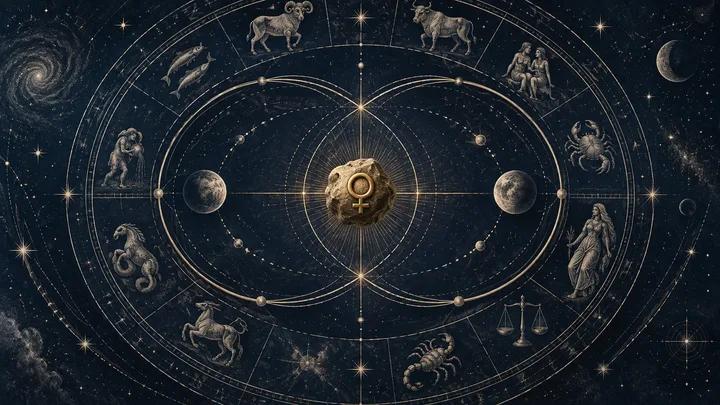
A synastry reading should name the asteroid because a myth is only the interpretive key, not the chart factor itself. Ceres, Juno, Vesta, Eros, Psyche, and Black Moon Lilith do not carry the same story, and even two bodies with related myths can describe different forms of closeness. The reading becomes useful when it states the exact object, the person who carries it, the planet or point it touches, the aspect, and the orb. A tight Ceres-Moon conjunction asks about care and emotional nourishment. A loose, unnamed ‘goddess contact’ says almost nothing. Start with the asteroid's full name and calculation type, then test its strongest contact against the Moon, Venus, Mars, or another personal point. Let the myth sharpen the question. Let the chart contact decide how much weight it deserves.
The name is part of the astrological data
When someone says, ‘There is a strong asteroid connection between us,’ you still don't know what the connection means. Strong how? Which asteroid? Between which chart factors? At what degree? In which direction? The sentence sounds specific because it contains the word asteroid. It isn't specific yet.
A synastry reading compares two charts. It looks at how one person's planets, points, and selected bodies meet the other person's chart. An asteroid is one of those selected bodies. Its name identifies the symbolic field you are bringing into the comparison. Ceres is not Juno. Vesta is not Eros. Psyche is not Black Moon Lilith. The myth behind each name gives you a different question to ask.
This is why a good reading names the body before it interprets the story. The name anchors the reader. It tells you what was actually examined and keeps a broad myth from floating free of the chart. ‘Her Ceres conjuncts his Moon’ gives you a care-and-nourishment contact to explore. ‘A goddess asteroid touches his feelings’ turns several distinct symbols into one soft cloud.
The name also protects the reading from accidental substitution. Black Moon Lilith is a calculated lunar apogee, not the same object as asteroid Lilith. Chiron is a centaur, not one of the four major asteroids. Ceres is often discussed with the major asteroids even though it also has dwarf-planet status in astronomical classification. These distinctions matter because the calculation changes the chart factor, and the chart factor changes the reading.
Astrology has always worked through layers of meaning. A planet has a name, a sign, a house, and relationships to other factors. Asteroids deserve the same discipline when you choose to include them. Their stories may be vivid. The chart still needs a clear noun and a clear verb: Ceres meets the Moon. Juno squares Venus. Vesta opposes Mars.
That grammar is not fussiness. It is the beginning of interpretation. Once the body is named, you can ask whether the myth fits the contact, whether the aspect is close enough to matter, and whether the theme supports what you already see in the main synastry. Without the name, you can't rank anything.
Sources: Asteroid - Astrodienst Astrowiki; Interaspect - Astrodienst Astrowiki; Composite Chart: Asteroids, Eros
Myth opens the door, but the contact tells you where to look
Myth gives an asteroid its first language. That doesn't mean you copy a deity's entire story into a relationship. You take the central image, then watch how the chart contact gives it a place to live.
Ceres offers a useful example. The Demeter-Ceres myth carries themes of nourishment, separation, loss, return, and the conditions under which care can continue. In a synastry reading, that does not automatically mean one person becomes the other's mother, savior, or permanent caretaker. It may describe the way one person notices hunger, protects what is vulnerable, or reacts when closeness is interrupted. The planet or point receiving Ceres tells you what area becomes sensitive.
Ceres to the Moon brings the myth toward emotional needs, habits, and the felt experience of being cared for. Ceres to Venus can make affection practical, attentive, and tied to comfort or value. Ceres to Mars may turn care into action, protection, sexual boundaries, or conflict about who is doing the work. The asteroid remains Ceres in every case. The contacted factor changes the sentence.
Juno narrows the question differently. Its myth can open a discussion about partnership, loyalty, agreement, jealousy, and the terms of a bond. A Juno-Venus contact may invite a conversation about what each person calls devotion and what each person expects from affection. Juno-Saturn may bring duty and endurance into focus. Neither contact is a marriage guarantee. The name helps you discuss commitment without pretending the asteroid has made a promise.
Vesta turns attention toward devotion, sacred focus, privacy, and the ways a person protects a central flame. Vesta touching the Sun can describe recognition around a person's purpose or identity. Vesta touching Mars can raise questions about energy, desire, sexual boundaries, and where action becomes consecrated or withheld. Again, the myth supplies a lens. The planet supplies the room.
This is the first reason a reading should name the asteroid: the name keeps the myth stable while the contact changes the expression. You can compare contacts without flattening them. You can say, ‘The same Ceres theme appears twice, but it reaches her Moon through emotional care and his Mars through protective action.’ That is a reading. ‘There is a nurturing goddess energy’ is only a mood.
Sources: Composite Chart: Asteroids, Eros; The Asteroids in Astrology, with Demetra George
A named asteroid keeps similar myths from becoming interchangeable
Asteroid language gets confusing when several bodies appear to belong to the same emotional neighborhood. Love, desire, devotion, grief, protection, partnership, and vulnerability overlap in real relationships. They still aren't the same experience, and astrology becomes more useful when it keeps the distinctions alive.
Consider Eros and Psyche. Eros can bring erotic charge, appetite, fascination, and the wish to meet through desire. Psyche can point toward sensitivity, psychic recognition, and the experience of being met at a deep inner level. A close Eros-Mars contact and a close Psyche-Moon contact may both feel intense, but they don't ask the same question. One may describe how desire moves. The other may describe how exposure and emotional recognition move.
Now compare Juno and Vesta. Both can appear in a conversation about commitment, but Juno is more concerned with the terms of partnership and the recognition of a bond, while Vesta concerns devotion, focus, and protected inner space. A Juno contact may ask, ‘What are we promising each other?’ A Vesta contact may ask, ‘What do we keep sacred, and what must remain ours?’ If you call both contacts commitment asteroids, you lose the choice between partnership and consecrated attention.
Ceres and the Moon offer another important distinction. The Moon describes a person's instinctive emotional life, familiar rhythms, and need for safety. Ceres adds a particular way of sustaining life and responding to separation or deprivation. A Ceres-Moon contact doesn't erase the Moon's sign, house, or other aspects. It adds a mythic and relational layer to the Moon's existing language.
The body must also be named when the symbol has variants. ‘Lilith’ can refer to different chart factors, including asteroid Lilith and Black Moon Lilith. A reading that leaves the label vague asks the reader to trust a distinction the writer has not made. Name the object. If a calculation uses mean Black Moon Lilith or true Black Moon Lilith, say which one. If the supplied report doesn't calculate that point, don't imply that it did.
Naming is how you preserve the strongest meaning in a crowded chart. It lets you reject the lazy sentence that every intense contact means the same thing. It also gives the reader a way to revisit the interpretation later. They can ask, ‘Was that Ceres, Juno, or Vesta?’ A serious field guide should make that question easy to answer.
Sources: Composite Chart: Asteroids, Eros; The Asteroids in Astrology, with Demetra George
The exact aspect ranks the myth's role
A named asteroid still isn't enough. You need the aspect. The aspect tells you how the two symbols meet, and the degree tells you how closely they meet.
A conjunction brings the two factors into one field. A Ceres-Moon conjunction can make care, nourishment, and emotional response hard to separate. An opposition creates a relational axis. Ceres opposite Mars may show a pull between protecting and acting, tending and pursuing, or asking for care and resisting dependence. A square creates pressure that demands a new arrangement. A trine may make the exchange familiar and easy, though ease doesn't always make a theme conscious. A sextile can offer a usable opening that grows when both people engage it.
These are not fixed verdicts. A square isn't a failed contact, and a trine isn't a guarantee of ease. The aspect describes the shape of the exchange. The bodies describe the material. The signs describe style. The houses, when accurately available, show where the story enters lived experience.
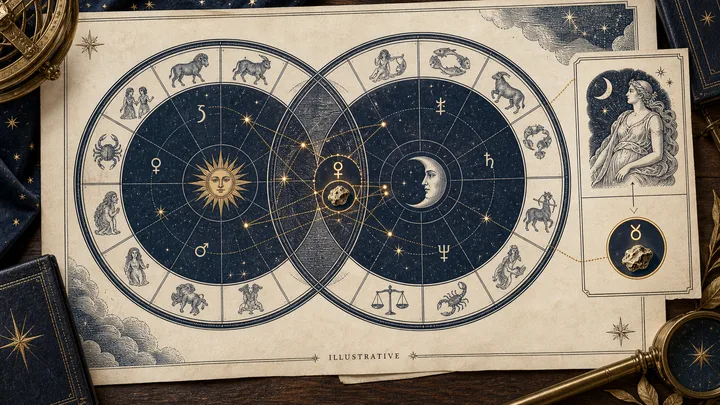
Degree closeness helps you decide whether an asteroid contact deserves a headline or a footnote. Astrodienst's reference material describes orbs as the margin around an exact aspect and notes that astrologers often use narrower orbs for interchart aspects because synastry already produces many possible contacts. Its asteroid reference also emphasizes that astrologers disagree about asteroid orbs and that asteroids should not be applied indiscriminately. That is a useful editorial rule: the more optional the body, the more carefully you should rank its contact.
For this publication's comparison report, a selected major-aspect calculation uses a six-degree orb when degrees are supplied. That stated scope matters. It tells the reader which contacts the report is willing to inspect. It doesn't mean every asteroid contact within six degrees deserves equal weight. A one-degree conjunction to the Moon should lead a seven-asteroid list. A six-degree sextile between two minor bodies should not push aside a close Venus-Saturn contact.
The reading should therefore name the full chain: ‘Her Ceres at 14 degrees Taurus conjuncts his Moon at 15 degrees Taurus, a one-degree conjunction.’ That sentence gives the reader the body, position, aspect, and orb. The interpretation can now be tested. If the degrees are missing, say ‘Ceres-Moon conjunction reported without degrees’ and lower the certainty of the emphasis. Precision isn't a decorative extra. It is how the reading knows where it stands.
Sources: Interaspect - Astrodienst Astrowiki; A Brief Introduction to Astrology: Aspects
Read the asteroid through the personal planet, not above it
Asteroids work best as modifiers of the chart's main story. They add texture. They shouldn't replace the Moon, Venus, Mars, Sun, Saturn, or the angles when those factors are available and closely involved.
Start with the receiving planet or point. Ask what that planet already means in the person's chart and in the relationship comparison. Then let the asteroid refine it. Ceres touching his Moon may describe how her way of tending meets his emotional body. Juno touching her Venus may show how his presence activates her expectations around partnership, affection, and value. Vesta touching his Mars may describe where desire, action, and devotion meet or pull apart.
This order prevents a myth from swallowing a person. The Moon remains the Moon. It still has a sign, a house if the chart scope supports one, and other synastry contacts. Ceres may make the Moon's care story more specific, but it doesn't turn the Moon into a single mythological character. Venus remains the way someone relates, values, and receives pleasure. Juno can sharpen its partnership questions without declaring that the relationship must become formal.
The same asteroid can also behave differently with different planets. Ceres to Venus may describe feeding affection through gifts, comfort, touch, beauty, or practical support. Ceres to Mars may describe protection that becomes active, defensive, or sexually charged. Ceres to Saturn may bring care into duty, scarcity, endurance, and the fear of failing a responsibility. If a reading uses the same paragraph for all three, it has named the asteroid but still hasn't read the chart.
Watch the direction of the contact, too. In synastry, each person contributes a factor. Her Ceres conjunct his Moon is not identical to his Ceres conjunct her Moon, even if the degree distance is the same. The Ceres person may embody, provoke, or carry the care theme in a way that reaches the Moon person directly. The Moon person may feel emotionally fed, watched, protected, or managed, depending on the signs, aspect, and wider pattern. Name both roles without turning them into permanent identities.
The practical result is simple. When you see an asteroid contact, write the sentence with the personal planet first in your mind, then add the asteroid's question. ‘His Moon is receiving her Ceres’ is more useful than ‘Her Ceres makes him feel mothered.’ The first stays open to several expressions. The second invents a role before the chart has earned it.
Sources: Asteroid - Astrodienst Astrowiki; Interaspect - Astrodienst Astrowiki; Composite Chart: Asteroids, Eros
A worked example: how Ceres-Moon becomes a real reading
Imagine Maria and Daniel comparing supplied placements. Maria's Ceres is listed at 14 degrees Taurus. Daniel's Moon is listed at 15 degrees Taurus. The report uses a six-degree major-aspect scope, so the one-degree conjunction qualifies. This is an illustrative example, not a calculated personal chart.
The first sentence should be plain: Maria's Ceres is conjunct Daniel's Moon in Taurus with a one-degree orb. The second sentence should state the interpretive center: Maria's way of offering steadiness and tangible care can meet Daniel's emotional need for consistency, comfort, and a reliable rhythm. That is already more useful than ‘They have a nurturing connection.’ It tells you what kind of nurturing to look for.
The Taurus layer matters. Care may appear through food, touch, a calm home, patient repetition, practical help, or the protection of shared resources. Daniel may feel that Maria understands what settles his body before he has to explain it. Maria may instinctively create the conditions in which he can rest. But the same contact can become fixed. If Daniel expects care to arrive in one familiar form, or Maria assumes that stability gives her the right to decide what he needs, the conjunction can feel enclosing rather than nourishing.
The next step is to check the main chart. What sign and house does each Moon occupy if that information is available? What does Daniel's Moon do with his Venus, Saturn, or Mars? What does Maria's Ceres contact in her own chart suggest about how she gives care? The synastry contact doesn't answer all of those questions. It points to the place where they need to be answered.
The behavior to watch is not grand. It is ordinary. Does Maria remember the small condition that helps Daniel feel safe, and can she do that without keeping score? Can Daniel receive her care without making her responsible for every change in his mood? Do they name what comfort means instead of assuming Taurus will make them agree? These questions translate the symbol into a relationship practice.
A second pass would compare the conjunction with each person's Venus and Mars, but it would keep the questions separate. Maria's Ceres to Daniel's Venus could describe how her practical care feeds his sense of affection and value. Maria's Ceres to Daniel's Mars could show how her tending meets his way of acting, defending, or pursuing. Those contacts might support the Moon story, complicate it, or reveal that the care is felt differently in his emotional life and his desire life. Naming each factor prevents one word, nurturing, from doing all the work.
The signs can also change the manner without changing the central symbol. Ceres in Taurus tends to make care steady, physical, and resource-minded. Ceres in Gemini may care through questions, messages, errands, and shared information. Ceres in Scorpio may protect through depth, loyalty, and attention to what remains hidden. None of these sign expressions tells you whether the care is welcome. The receiving Moon, the aspect, and the lived pattern still matter. A sign describes style. It doesn't settle consent, capacity, or character.
Suppose Maria's Ceres is close to Daniel's Moon, but Daniel's Moon also squares Saturn in his own chart. Maria's steadiness may feel deeply supportive, yet Daniel may still expect care to disappear or arrive with a price. The synastry cannot erase his natal pattern. It can activate it. A careful reading would say that Maria may touch a tender need for reliability, while the couple should watch whether reassurance becomes testing, withdrawal, or overwork. The contact opens a door. It doesn't promise what happens after they walk through it.
The reverse case matters, too. Daniel may have a comfortable Moon-Venus pattern, and Maria's Ceres may meet that ease without becoming the central story. He might receive her care naturally, while other contacts explain their attraction or conflict more strongly. The report should not force Ceres into the lead simply because the myth is appealing. Rank it. Let the close Venus-Mars or Moon-Saturn pattern lead if that is what the degrees and chart structure show.
A good worked example therefore includes both the invitation and the limit. Maria's Ceres-Moon conjunction invites them to name the forms of steadiness that help. Its Taurus setting suggests tangible rituals. Its one-degree orb gives it weight. But the contact cannot tell them how much care each person can give, whether either person wants that role, or how they repair when care misses the mark. Those answers belong to the conversation the symbol makes possible.
Now compare the same asteroid with another point. Suppose the illustrative chart also lists Maria's Ceres at 14 degrees Taurus and Daniel's Mars at 20 degrees Leo. Those positions are 96 degrees apart, a square with a six-degree orb. It is a different contact from the Ceres-Moon conjunction, not a contact to discard. The reading should name it accurately, then decide whether the Ceres-Mars tension supports or complicates the Moon story. The degree check stops the interpretation from expanding beyond its evidence.
This example shows why names, degrees, and myth belong together. Ceres tells you which story to open. Taurus and the Moon tell you how the story may feel. The one-degree conjunction tells you why it deserves attention. The practical questions tell you what the couple can actually do with it.
When the asteroid should stay in the background
Naming an asteroid doesn't give it automatic priority. Sometimes the best reading mentions the body briefly and moves on. Restraint is part of astrological skill.
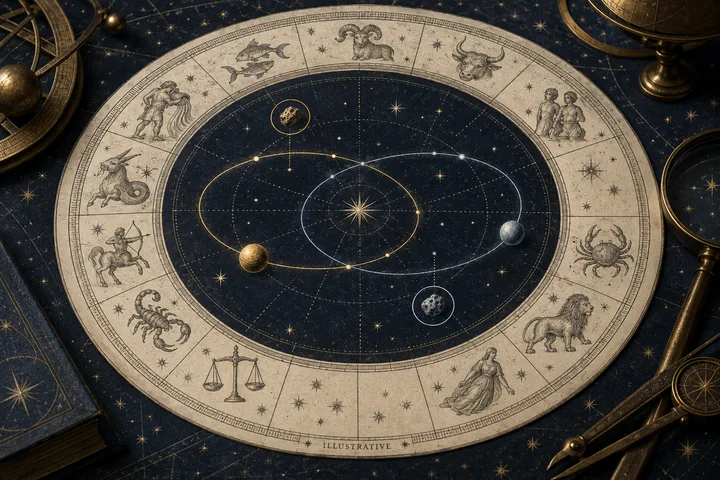
First, lower the weight when the orb is wide. Astrodienst's material notes that asteroids don't support very wide orbs, and that interchart work benefits from tighter margins because synastry already multiplies possible contacts. A close asteroid contact can add a fine line to the picture. A distant one may be background color. Don't let an exact mythic phrase overpower a loose aspect.
Second, lower the weight when the body is not tied to a meaningful chart factor. A minor asteroid making a distant contact to another minor asteroid can be interesting for private study, but it rarely belongs in the opening interpretation. A selected asteroid meeting the Moon, Venus, Mars, Sun, Saturn, or an angle can have a clearer relational job. Even then, the sign, aspect, and orb still decide how much space it receives.
Third, lower the weight when the contact has no echo. If the reading claims that a Juno contact defines partnership but the couple's main chart offers no supporting relationship pattern, the asteroid may be a narrow theme rather than the governing story. It can still matter. It shouldn't become the headline just because its myth sounds dramatic.
Fourth, lower the weight when the object itself is uncertain. If the reader says ‘Lilith’ without identifying asteroid Lilith or Black Moon Lilith, pause before interpreting. If degrees are absent, distinguish a supplied sign placement from a calculated aspect. If two house systems produce different house contacts, don't present one house story as settled unless the method has been stated.
A background placement isn't a useless placement. It may become important when the reader asks a narrower question, or when a later contact confirms it. But a field guide must teach proportion. The myth earns attention. The exact contact earns emphasis. The wider chart earns the final rank.
In practice, the report can use a simple label: lead, supporting, or background. A one-degree Juno-Venus conjunction to a personal planet may lead. A four-degree Ceres-Moon trine may support. An unnamed Lilith contact without degrees stays background until the calculation is clarified. Those labels make the reading easier to trust because they show that not every symbol received equal weight.
Sources: Interaspect - Astrodienst Astrowiki; Composite Chart: Asteroids, Eros; The Asteroids in Astrology, with Demetra George
The meaningful exception: a loose contact can still be a clue
The strongest rule here has an exception. A loose asteroid contact can still deserve a sentence when it repeats a theme that the chart already carries clearly. Repetition gives the symbol more life than the orb alone would provide.
Suppose a couple has a close Moon-Saturn conjunction, a close Ceres contact to the Moon, and a wider Ceres contact to Saturn. The wider contact shouldn't be promoted as if it were exact. But it may echo the same question about care, responsibility, fear of deprivation, and the work required to make safety last. The asteroid is not proving the pattern by itself. It is joining a pattern already supported by closer factors.
The same principle applies to a myth that has become active through several contacts. A close Vesta-Sun conjunction may make devotion and protected purpose central. A wider Vesta-Mars contact could then describe how that focus affects action, sexuality, or boundaries. The second contact gets meaning from the first. Its orb remains part of the sentence.
Personal symbolism can matter, too. An asteroid whose name, place, or story has direct meaning for the people involved may become a useful prompt. Astrologers who work with asteroids often pay attention to namesake bodies and to the symbolic resonance of names. That doesn't remove the need to state the object and contact. It tells you why a particular body may deserve a closer look for this person rather than for everyone.
The exception must stay honest. ‘This is a wide aspect, but it repeats the close Ceres-Moon theme’ is strong. ‘This wide Ceres contact explains your entire bond’ is not. Say what the contact adds. Say what it cannot carry. A reader can hold both statements at once.
This ranking also honors the way astrology is actually read. Charts speak through patterns, not isolated tokens. A single asteroid may whisper. A named asteroid that repeats a close personal-planet theme can become a clear second voice. The astrologer listens for the harmony without pretending every note has the same volume.
Sources: Interaspect - Astrodienst Astrowiki; Composite Chart: Asteroids, Eros; The Asteroids in Astrology, with Demetra George
What a precise asteroid section should include
If you're checking a synastry report, audit the paragraph before you absorb its mood. A vivid myth can make a weak contact sound central. The cure is a small record of what the report actually used.
First, look for the object. ‘Ceres’ is usable. ‘The goddess asteroid’ isn't. If the label is Lilith, ask whether it means asteroid Lilith, mean Black Moon Lilith, or true Black Moon Lilith. Those are different chart factors. A name that hides the calculation leaves the reader unable to repeat the reading.
Next, identify the two chart roles. ‘Her Juno conjuncts his Venus’ tells you who carries the partnership symbol and whose Venus receives it. ‘Their Juno is strong’ does not. For asteroid to asteroid, say asteroid to asteroid. For an angle, name the angle and the chart method that supplied it. The roles matter because the same aspect can feel different when the carriers change.
Then check the numbers. With degrees supplied, the report should show the aspect and the orb: ‘Her Vesta at 22 degrees Virgo squares his Mars at 24 degrees Gemini, a two-degree square.’ If the placements are sign-only, the report can discuss a possible theme, but it shouldn't claim an exact aspect. If a contact crosses a sign boundary, calculate the shortest angular distance rather than judging from sign labels alone. Taurus and Leo, for example, can be square by degree even though their signs are fixed and differently placed.
The report's scope belongs in the same audit. This Synastry Comparison Report works from placements you supply, with Moon, Venus, and Mars signs, optional degrees, and selected major aspects within a six-degree orb. It doesn't derive a natal chart from birth details, calculate houses, or turn an asteroid into a relationship forecast. If the input doesn't contain a degree, the prose must not smuggle one in.
After the data check, read the interpretation in layers. Does the myth give a clear symbolic field? Does the contacted planet tell you what part of the person receives it? Does the sign describe the manner? Does the aspect show ease, tension, blending, or polarity? Does the wider synastry support the theme? One sentence should answer each question. When a paragraph leaps from myth to a claim about the whole bond, it has skipped the chart.
A strong report also shows its ranking. A close asteroid contact to a luminary or personal planet can lead when it repeats a central pattern. A contact to Saturn or an angle may deserve serious attention when the method and degrees are clear. A loose asteroid-asteroid aspect can support a reading, but it usually shouldn't displace a close Venus-Mars or Moon-Saturn contact. The point isn't to dismiss minor bodies. It is to give every symbol the weight its evidence can carry.
Watch for verbs that turn symbols into identities. ‘Ceres makes him feel mothered’ assigns a role too quickly. ‘Her Ceres may meet his Moon through tangible care, protection, or pressure around dependency’ leaves room for the actual relationship. ‘Juno guarantees marriage’ is not interpretation at all. ‘Juno can bring the terms of partnership into focus’ is a question the couple can examine.
The best paragraph ends in a testable human question. For Ceres and the Moon, ask what comfort looks like before either person assumes. For Juno and Venus, ask which behavior makes affection feel like a promise. For Vesta and Mars, ask what time, desire, or private work needs protection. The question should grow from the contact, not arrive as a generic relationship exercise.
Use this order when you write: record the object and version, list both placements and roles, verify the angular relationship, state the orb, add the myth, interpret through the receiving factor, rank the contact, and finish with one question. That's enough. A technical frame earns trust because it makes the meaning visible, not because it makes the prose sound official.
If the report cannot pass that audit, keep its language modest and ask for the missing input. If it can, let the asteroid do its smaller, sharper work. The strongest minor-body reading usually clarifies one live theme. It doesn't need to become the relationship's master key.
Sources: Asteroid - Astrodienst Astrowiki; Interaspect - Astrodienst Astrowiki; Composite Chart: Asteroids, Eros; The Asteroids in Astrology, with Demetra George
Turn the named contact into one conversation
Once the contact has survived the audit, use it for one conversation. Not seven. The chart's value appears when a symbol helps you name a need that ordinary language has kept blurry.
Choose the live issue before you choose the perfect question. If the Ceres-Moon example keeps circling food, chores, rest, or reassurance, talk about that pattern. Maria might say, ‘I show love by making life steady. When I cook, plan, or fix things, I hope you feel held.’ Daniel might answer, ‘I do feel held, but when I'm upset I sometimes need listening before solutions.’ The Ceres-Moon conjunction gives them a frame. Their exchange gives it a shape.
Notice the difference between an offered form of care and an assigned duty. Maria's Taurus Ceres may prefer tangible help, but Daniel still gets to say what helps and what crowds him. He can receive the gesture without making Maria responsible for every change in his mood. This is where the chart becomes useful: it reveals a pattern to negotiate, not a role either person must perform forever.
Use the aspect to name the friction. A conjunction may blur giving and receiving, so ask where the couple needs clearer boundaries. A square may make care and action collide, so ask what happens when one person wants to help and the other wants room to act alone. An opposition may pull the pair between tending and pursuing. A trine may make support so natural that neither person says what they need until the rhythm breaks.
Then make one small agreement. They might decide that ‘help’ starts with a question, that a meal is welcome but a solution waits, or that either person can ask for quiet without turning quiet into punishment. The agreement should answer the actual scene you can point to. It shouldn't try to settle the whole relationship.
If you're comparing known placements, bring the asteroid's exact name and any degrees already supplied by your chart source. The report can compare the Moon, Venus, and Mars placements you provide, then use a selected asteroid contact to sharpen the conversation. Missing birth data means the scope stays with those supplied placements and optional degrees. That boundary keeps the question clean.
End with this: ‘When this contact is active between us, what do you want me to notice, and what would respectful care look like this week?’ Listen for an answer you can act on. A named asteroid has earned its place when it changes that conversation.
Sources: Asteroid - Astrodienst Astrowiki; Composite Chart: Asteroids, Eros; The Asteroids in Astrology, with Demetra George
A little more clarity
Is the asteroid myth enough to interpret a synastry contact?
No. The myth gives the symbolic starting point, but the reading should also name the asteroid, the contacted planet or point, the aspect, the orb, and the available chart scope. A Ceres-Moon conjunction and a Ceres-Mars square share Ceres but describe different relationship questions. If degrees are missing, keep the interpretation broad and don't invent an exact orb.
Which asteroid contacts deserve the most attention in synastry?
Prioritize a named asteroid making a close contact to the Sun, Moon, Venus, Mars, Saturn, or a clearly identified angle, especially when the theme repeats elsewhere in the comparison. Use tighter orbs for optional asteroids and rank the contact behind the main planetary pattern. A wide or isolated minor-body contact can stay in the background while still offering a useful clue.
Sources & further reading
- Asteroid - Astrodienst Astrowiki
Supports naming the asteroid, using its myth as symbolic context, distinguishing asteroid types, and keeping asteroid orbs restrained.
- Interaspect - Astrodienst Astrowiki
Supports defining synastry as comparison between charts and using smaller orbs for interchart aspects.
- Composite Chart: Asteroids, Eros
Supports reading asteroids through their basic meanings, aspects, and relationship themes such as Eros, Psyche, Juno, Ceres, and Vesta.
- The Asteroids in Astrology, with Demetra George
Supports the symbolic significance of asteroid names, mythology as an interpretive tool, and prioritizing prominent contacts.
- A Brief Introduction to Astrology: Aspects
Supports defining aspects as angular relationships and orbs as the margin around an exact aspect.
Synastry Comparison Report
Enter known placements for two people. Get an input-by-input comparison, selected aspect calculations and a clear record of what remains uncertain.
Compare our placements