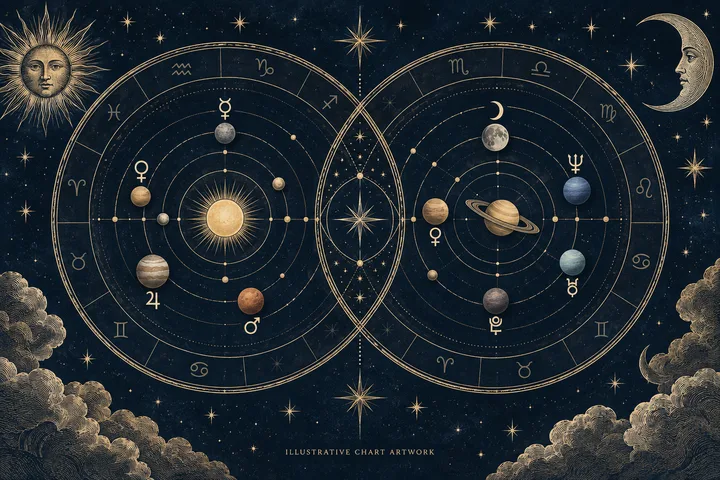
Imagine the same sign match telling two different stories
Imagine Maria and Daniel comparing the placements they already know. Maria has Venus in Taurus. Daniel has Mars in Taurus. They read the same sign and feel the click at once. Taurus sounds steady, sensual, loyal, and patient. It is easy to move from that description to a warm conclusion: they must want love in the same way.
But what exactly are they comparing? Maria's Venus describes her taste, her way of giving and receiving affection, and what she values in closeness. Daniel's Mars describes his drive, pursuit, anger, sexual energy, and way of taking action. The shared sign gives those functions a common texture. It does not turn Venus into Mars, or Mars into Venus. The sign can make the exchange earthy and deliberate. The planets still carry different jobs.
Now change one detail. Suppose Maria's Venus is at 4 degrees Taurus and Daniel's Mars is at 27 degrees Taurus. The signs match, but the degrees sit far apart. There may be a broad resemblance in style without a close conjunction. In another version, Maria's Venus is at 11 degrees Taurus and Daniel's Mars is at 13 degrees Taurus. The sign match now has a tight conjunction behind it. The attraction is easier to describe as a direct, active meeting between desire and pleasure.
That difference is the reason a careful reader starts with the planets. If you begin with Taurus, you may describe comfort and shared preferences. If you begin with Venus and Mars, you ask the more useful question: how do affection and pursuit meet between these two people? The sign answers how. The planet answers what.
The distinction matters in every pair. Moon and Moon in Cancer is not the same as Venus and Venus in Cancer. Mercury and Mercury in Gemini is not the same as Mars and Mars in Gemini. The sign may be identical, but the relationship function changes. A reading that names the signs first risks treating every same-sign contact as the same kind of bond.
This is an illustrative scene, not a calculated chart for Maria or Daniel. No personal chart has been invented here. The degrees simply show why sign-only comparison and degree-based synastry answer different questions. The scene gives you a method you can carry to your own supplied placements.
The governing rule is simple: identify the players before describing their costumes. In astrological language, the planets are the players, the signs shape their manner, the aspects describe how they meet, and the houses show where the meeting takes place when the birth data supports that layer. That order turns a list of labels into a reading.
Sources: Synastry - Astrodienst Astrowiki; Planet - Astrodienst Astrowiki; Lesson 2: The Symbolic Meaning of the Planets
What the planets contribute to a synastry reading
Planets give the reading its subject. They name the human function that enters the relationship. This is why a synastry reading can say something precise even before it knows every sign, house, or minor point. Start by asking what each planet is trying to do.
The Sun speaks to identity, vitality, purpose, and the way a person takes up space. When one person's Sun contacts another person's planet, the exchange often centers on recognition. Does the other person encourage self-expression, challenge it, warm it, or put pressure on it? Sun-Sun contacts compare two centers of identity. Sun-Moon contacts bring conscious purpose into conversation with feeling and instinct. Sun-Saturn can make responsibility and authority part of the bond. The sign then shows whether that recognition arrives through directness, caution, play, depth, or another style.
The Moon describes feeling, memory, instinct, comfort, and the habits that help someone feel held. Moon contacts often show how two people respond when the room gets quiet or the day goes badly. A Moon-Mercury contact may join feeling with words. A Moon-Venus contact can bring tenderness and ease. A Moon-Mars contact can make emotional needs meet action, heat, or irritation. You still need the signs to see how that exchange sounds, but the Moon tells you why the exchange matters.
Mercury carries thought, speech, listening, naming, and practical exchange. It is the planet to bring forward when the question is, Can we understand each other? Mercury-Mercury tells you something about the meeting of two mental styles. Mercury-Venus can connect language with affection and taste. Mercury-Mars can sharpen debate and quicken responses. The sign gives the speech its pace and mood, yet Mercury remains the part of the chart that is trying to make contact through meaning.
Venus describes attraction, pleasure, affection, values, and the ways a person creates harmony. In synastry, Venus matters when you are asking what feels lovable, beautiful, enjoyable, or worth preserving. Venus-Sun can bring admiration and warmth. Venus-Moon can soften the bond and make care feel natural. Venus-Mars can join desire with attraction. Those are not interchangeable experiences, even when the signs repeat. A Venus in Virgo and a Mars in Virgo do not perform the same role simply because both prefer a practical rhythm.
Mars describes desire, initiative, assertion, heat, competition, anger, and the act of going after something. It shows how energy moves from impulse into action. When Mars contacts Venus, the reading can speak about attraction and pursuit. When Mars contacts the Moon, action presses on feeling. When Mars contacts Mercury, words can become brisk, challenging, or energizing. The sign tells you whether Mars acts through patience, speed, analysis, openness, or force. The planet tells you that action is the live wire.
Jupiter can enlarge, encourage, teach, and give faith. Saturn can bind, test, structure, and ask for endurance. Uranus can awaken and disrupt. Neptune can inspire, soften, or blur. Pluto can intensify and transform. The outer planets need careful context because their contacts can describe a generation as well as a personal meeting. A close cross-chart contact to a personal planet makes the exchange more immediate. Even then, begin with the planet pair. Do not let a dramatic sign word stand in for the actual function.
A useful sentence frame is: Person A's [planet] meets Person B's [planet], so the relationship brings [function] into contact with [function]. In [aspect], that meeting tends to operate through [geometry]. The signs show the style. This sentence forces the reading to carry meaning before decoration.
A synastry reading should name the planets first because planets tell you what part of the relationship is meeting: the Moon brings feeling and instinct, Venus brings affection and values, Mars brings desire and action, and Mercury brings speech and thought. The signs come next. They show how each planet performs its role. A Venus-Mars contact in Taurus does not carry the same tone as Venus-Mars in Gemini, but the contact is still about attraction, pleasure, and pursuit before it becomes a Taurus or Gemini story. Start with the planet pair, identify the aspect and its exactness, then read the signs as the style of the exchange. Add houses only when reliable birth times provide them. For a useful comparison, work from function to style to geometry to lived choice. That order keeps a vivid sign match from hiding the relationship theme underneath it.
Sources: Planet - Astrodienst Astrowiki; Lesson 2: The Symbolic Meaning of the Planets; Aspects Between Charts
Why a sign cannot carry the whole interpretation
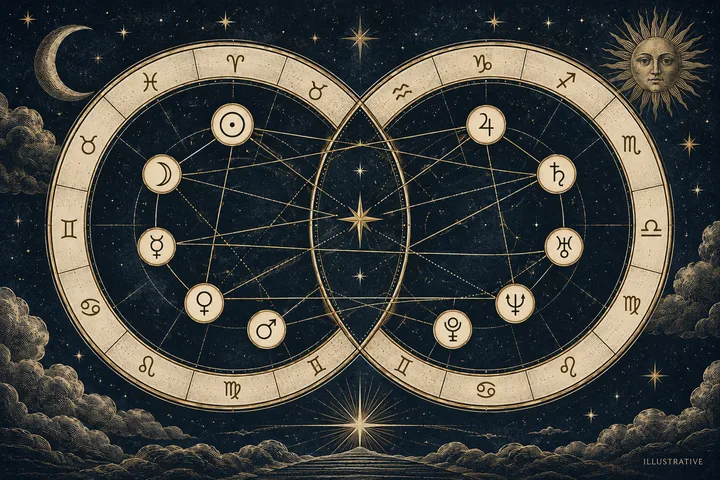
A zodiac sign is not a complete relationship sentence. It is a field of style. It describes the manner in which a planet expresses itself: the element, modality, polarity, ruler, and symbolic tone that color the planet's work. That is valuable. It is not enough on its own.
Think of the sign as the way a person uses a tool. Venus and Mars may both stand in Libra, but Venus uses Libra to seek balance, beauty, reciprocity, and social ease in love. Mars uses Libra to pursue, compete, and assert through negotiation, charm, debate, or a fight over fairness. The sign provides the room and the lighting. The planet still determines what the person came there to do.
The same principle explains why Sun, Moon, Venus, and Mars sign comparisons can feel useful while remaining incomplete. Two people with water-sign Moons may recognize one another's emotional depth. That does not tell you whether their Moons form a close aspect, whether one Moon is in a fixed sign and the other in a mutable sign, or whether another personal planet is carrying the strongest contact. Similar signs may create a shared language. They do not prove that the same needs are being activated.
Elements are a good second layer. Fire signs often give a planet a more expressive, initiating, or spirited style. Earth signs can make its expression practical, measured, or sensory. Air signs bring thought, exchange, and social movement. Water signs draw the function toward feeling, instinct, and emotional meaning. But the element modifies the planet. It does not replace it. A water-sign Mars is still Mars. A fire-sign Moon is still the Moon.
Modality adds another useful distinction. Cardinal signs begin. Fixed signs sustain, consolidate, and resist change. Mutable signs adapt, translate, and shift. A fixed Venus may hold tightly to a preference or bond. A mutable Venus may keep affection moving through curiosity and adjustment. A cardinal Mars may act quickly and set events in motion. These are refinements to the planet's role, not verdicts about a person's character.
Rulership adds a further thread. Each sign has a ruling planet in the chosen astrological tradition. That ruler can show where the sign sends its attention. A Venus in Aries carries Mars into Venus's story. A Mars in Libra carries Venus into Mars's story. This can deepen a synastry interpretation, especially when the rulers connect across the two charts. It still comes after you identify the planets involved. Otherwise the reader loses the main road in a side street.
Sign-only readings have a proper place. They can compare broad styles when exact degrees are missing. They can help someone understand why two placements feel alike in element or modality. They can offer a first sketch. The error comes when the sketch pretends to be the whole portrait. A sign can suggest a shared tone. A planet pair tells you what the relationship is asking the two people to bring together.
So when a reader asks, Are our Taurus placements compatible?, translate the question. Which planets are in Taurus? Are they in the same chart or across charts? Are they close by degree? What happens when Venus, Mars, the Moon, or Mercury carries that Taurus style? The translation turns a vague sign match into a question you can actually read.
Sources: Planet - Astrodienst Astrowiki; Lesson 2: The Symbolic Meaning of the Planets; Aspects Between Charts
The aspect tells you how the planetary functions meet
Once you have named the planets, read the aspect. An aspect is the angular relationship between two chart points. In synastry, it describes the channel through which one person's function encounters the other's. The same planet pair can feel different in a conjunction, trine, square, opposition, or sextile because the geometry changes the work of the relationship.
A conjunction brings the two functions into the same place. It can feel immediate, familiar, and hard to separate. Sun and Moon together may create a strong recognition between identity and feeling. Venus and Mars together can put attraction and desire in the same conversation. But a conjunction does not automatically mean ease. The planets still matter, and the signs still shape the shared ground.
An opposition places the functions across an axis. It can create attraction through difference, a sense of completion, or a recurring pull between two positions. Venus opposite Mars may make desire vivid while asking the pair to negotiate pace and preference. Moon opposite Mercury can make one person feel that emotion and explanation are facing each other. The opposition gives the bond polarity. It does not decide whether the polarity becomes complement or strain.
A square creates friction. It makes the functions press against one another in a way that demands movement. Venus square Mars can stir attraction and disagreement at once. Mercury square Mars can produce quick conflict, but it can also keep a conversation alive and active. A square is not a sentence of failure. It is a problem with energy in it. The signs tell you the style of the friction, while the planets tell you what is rubbing.
A trine offers a fluent exchange through related elements. A sextile offers opportunity and cooperation that grows through participation. These aspects can make a connection easier to enter, yet ease can remain underused. A smooth Moon-Venus contact may feel kind without guaranteeing that the couple speaks about difficult needs. A flowing Mercury contact may make conversation pleasant without making every decision easy. Harmony is a resource. Someone still has to use it.
The aspect also helps you rank what you see. A close major aspect between personal planets usually deserves more attention than a distant, minor contact. The exact system varies by astrologer, so state the scope. For this publication's comparison report, selected major aspects use a six-degree orb when degrees are supplied. A six-degree orb means the measured distance from the exact aspect is no more than six degrees. It is a working boundary for the report, not permission to treat every near-match as equally strong.
Degree distance matters because geometry is not just a label. Maria's Venus at 11 degrees Taurus and Daniel's Mars at 13 degrees Taurus are two degrees apart. That is a close conjunction in the illustrative example. If the positions were 11 degrees Taurus and 17 degrees Taurus, the conjunction would sit at the report's six-degree limit. If one position were 11 degrees Taurus and the other 27 degrees Taurus, the same sign would remain, but the close conjunction would not. The reading should say so plainly.
If you have no degrees, you can still name the planet pair and sign style. You should not pretend to know the exact strength or aspect. If you have rounded degrees, treat the boundary with care. If you have precise degrees, use them to rank the contacts. This is where a planet-first method becomes practical: it prevents the sign story from outranking the actual geometry.
Sources: Synastry - Astrodienst Astrowiki; Aspects Between Charts; Lesson 5: The Houses
A worked comparison: Venus and Mars in the same sign
Consider an example with only supplied placements. Maria has Venus in Taurus at 11 degrees. Daniel has Mars in Taurus at 13 degrees. The comparison report does not calculate either natal chart. It reads the placements provided and, because degrees are available, recognizes a two-degree Venus-Mars conjunction within the stated six-degree working orb.
Begin with the planets. Maria's Venus describes her relationship to pleasure, affection, values, and attraction. Daniel's Mars describes his pursuit, desire, initiative, and heat. The contact joins what one person enjoys and draws toward with what the other person pushes toward and activates. That is the central theme. It is more informative than saying only that both people have Taurus placements.
Now bring in the conjunction. Venus and Mars share the same region of the zodiac, so attraction can feel direct and embodied. Maria may experience Daniel's way of acting as energizing or desirable. Daniel may experience Maria's way of loving as inviting and responsive. The contact can be warm. It can also make the relationship quickly physical, impatient, or difficult to keep in a purely friendly category. The conjunction concentrates the meeting; it does not remove choice.
Then read Taurus as the style. Taurus favors steadiness, touch, appetite, patience, loyalty, and the pleasure of what can be felt and sustained. In this example, the Venus-Mars exchange may grow through reliable plans, shared food, unhurried time, and a sensual rhythm that does not need constant novelty. The sign tells you how the attraction may prefer to move. It does not turn every moment into peace. Fixed earth can hold its ground. Desire can become stubborn when neither person wants to adjust.
Next ask what the contact needs in lived terms. Can Maria say what makes her feel valued without making Daniel guess? Can Daniel express desire without treating speed as proof of feeling? Can both people name money, time, exclusivity, and physical boundaries before Taurus's wish for security turns into silent expectation? The astrological reading becomes useful when it points to the choices the symbol raises.
Now change the planets while keeping the sign. Maria has Moon in Taurus at 11 degrees. Daniel still has Mars in Taurus at 13 degrees. The sign and degree relationship look similar, but the reading changes. The meeting is now between Maria's emotional security and Daniel's drive. Daniel's urgency may stir Maria's body and feelings, but it may also unsettle her when she needs calm. The question is no longer simply, How do attraction and pursuit meet? It becomes, How does action affect safety and regulation?
Change them again. Maria has Mercury in Taurus at 11 degrees, and Daniel has Mars in Taurus at 13 degrees. Now the contact joins thought and action. Conversation may become decisive, practical, and blunt. Daniel can push Maria to speak or choose. Maria can give Daniel a grounded way to name a plan. The same Taurus field remains, but the relationship problem has moved from desire to words and timing.
This is the strongest reason to name planets before signs. The sign match survives the substitutions. The interpretation does not. Planet first protects the reading from a beautiful but empty shortcut.
The exception: a sign pattern can lead when the planet layer is thin
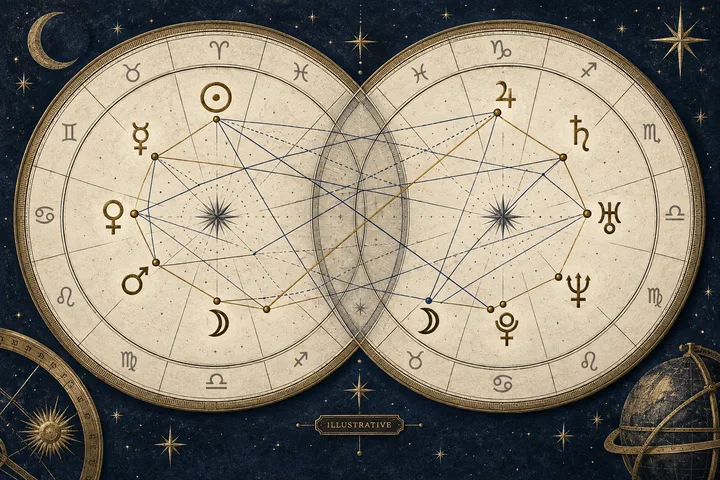
The planet-first rule has a meaningful exception. Sometimes the available information is thin. You may know only the Sun signs, or only that both people carry several placements in the same element. In that case, a sign pattern can lead the conversation because there is no richer planetary contact to name yet. The reading must label the pattern for what it is: a broad style comparison, not a complete synastry judgment.
Imagine a couple who knows that both charts contain strong air-sign emphasis but has no degrees, houses, or full planet list. Air can point toward thought, language, distance, social exchange, and the need to understand before settling. That observation may help them notice how they solve problems. It does not tell you whether the pattern rests in Mercury, Venus, Mars, the Moon, or slower planets. The same air emphasis could describe very different relationship experiences.
A second exception appears when a sign pattern repeats through several important planets. Suppose both people have Moon, Venus, and Mars in earth signs. Now the pattern deserves weight because it crosses several relationship functions. Even then, do not flatten the planets into one earth-style personality. Read the Moon for safety, Venus for affection and value, and Mars for action and desire. The repeated element becomes a theme that ties the functions together.
A third exception involves a striking same-sign conjunction that is close by degree. Here the sign can feel unusually loud because the planetary functions occupy the same place and the contact is tight. Still, the correct sentence begins with the planet pair. A close Sun-Moon conjunction in Scorpio is not merely a Scorpio connection. It is identity meeting feeling through Scorpio's depth, privacy, intensity, and instinct for emotional truth.
The strongest exception, then, does not defeat the rule. It shows why the rule needs judgment. When the planet data is missing, use the sign layer and state its reach. When several planets repeat the same sign or element, let the pattern organize the reading after each planet has been named. When a close conjunction makes the sign unmistakable, let the sign describe the shared atmosphere after the geometry and planets are clear.
This is also where a reader should resist ranking based on drama. A sign pattern may feel poetic. A tight personal-planet aspect may be quieter but more useful. A broad element match may explain ease in conversation, while a close Moon-Saturn contact explains why care and responsibility feel weighty. Read for the function that changes the couple's actual question. The loudest symbol is not always the load-bearing one.
If two chart tools use different labels, return to the inputs. Check whether they use the same zodiac, the same degree precision, the same aspect list, and the same orb. A label such as compatible, challenging, or strong can hide the actual contact. Planet, aspect, sign, degree, and house are the parts you can inspect. Let those parts lead.
In practice, a sign pattern leads when it is the best supported layer available. It does not lead because signs are more romantic. It leads because the evidence in the supplied placements stops there. That distinction lets you honor the pattern without asking it to answer a question it cannot carry.
Sources: Synastry - Astrodienst Astrowiki; Planet - Astrodienst Astrowiki; Lesson 2: The Symbolic Meaning of the Planets
A planet-first reading order you can use tonight
You do not need to decode an entire wheel at once. Use a fixed order, then let the chart surprise you within that order.
First, name the chart inputs. Write down the placements you actually have. Include the zodiac system if it is known, the planet, sign, and degree, plus birth-time limits. If you know only signs, mark the comparison as sign-only. This keeps a vivid symbol from quietly becoming an invented calculation.
Second, choose the relationship function that matches the question. For tenderness and emotional safety, begin with the Moon. For attraction, affection, and shared values, bring in Venus. For desire, pursuit, and conflict energy, bring in Mars. For communication and interpretation, bring in Mercury. For identity and recognition, bring in the Sun. You are not ignoring the rest of the chart. You are giving the reader a door.
Third, name the planetary pair in both directions. Venus in Maria's chart contacting Mars in Daniel's chart is one expression. Daniel's Mars is also meeting Maria's Venus. The roles can feel different. The person whose planet is contacted may experience the other as carrying the contacting function, while the contacting person may feel the urge to express that function toward the other. Describe the exchange without turning the planet into a fixed personality label.
Fourth, identify the aspect and rank its exactness. Say conjunction, opposition, square, trine, sextile, or another aspect only when the supplied degrees support it. Note the orb. A close major aspect leads a wide minor contact. If there is no aspect, say that the sign relationship is the available layer. Do not call a same-sign placement a close conjunction without degrees.
Fifth, read the signs as style. Ask what element, modality, polarity, and ruler add to the planetary function. A Venus-Mars square in fixed signs may hold tension in place until someone names the real issue. A Mercury-Moon trine through water may make emotional understanding feel fluid, but the couple still needs words. Use sign language to sharpen the picture, not to replace the sentence's subject.
Sixth, add houses and angles only when the birth information supports them. Ask where the contact lands in each person's life. A planet-to-house overlay can explain why one partner experiences the relationship through romance, work, home, friendship, intimacy, or public purpose. If that layer is unavailable, leave it out. A clean omission is better than a false address.
Seventh, translate the reading into one observable question. For Venus-Mars, ask how each person signals desire and how they handle pace. For Moon-Mercury, ask whether feelings get named before solutions arrive. For Sun-Saturn, ask how admiration and responsibility share the room. The question should invite a conversation, not deliver a verdict about whether the couple should stay together.
Finally, look for the exception. What would make the first interpretation less complete? A soft Venus contact may coexist with a difficult Mars pattern. A strong sign match may lack a close aspect. A compelling outer-planet contact may describe a wider generational story. Name the exception, then rank it. A reading becomes trustworthy when it can hold both the clear view and the strongest complication.
The order is planet, aspect, degree, sign, house, then decision. You can shorten it when the inputs are limited. You should not reverse it just because the signs are easier to recognize.
When several contacts compete for attention, use the question as your filter. Suppose a comparison shows a close Moon-Saturn square, a wide Venus-Jupiter trine, and matching Sun signs. If the couple is asking why one person feels emotionally guarded, Moon-Saturn leads. If they are asking what makes time together generous and enjoyable, Venus-Jupiter deserves the first paragraph. The same chart can support several true statements. A good reading chooses the one that answers the question in front of the reader.
Then ask whether the contact repeats elsewhere. A Venus-Mars theme becomes stronger when another aspect joins desire, affection, or embodiment, but do not count the same contact twice simply because a wheel and a table display it differently. Look for a pattern of meaning, not a pile of labels. One close contact can be the hinge. Several related contacts can show the room around it.
This ranking also protects the reader from the seduction of rare language. A yod, midpoint, antiscia contact, or declination parallel may deserve attention in a specialist reading when the data and method support it. It should not automatically outrank a close major aspect between personal planets. Start with the part of the chart that most directly answers the lived question. Add the unusual layer when it clarifies the pattern rather than stealing the page.
Keep the layers separate while you read, then bring them together in the final paragraph. First write one sentence for the planetary function. Then write one for the aspect. Then write one for the sign style. If houses are available, add a sentence for the life area. This small pause stops the common blur in which a reader says, Taurus means loyalty, so Venus-Mars must be loyal. Astrology is more exact than that. Taurus may favor continuity, but Venus and Mars still describe different needs, and a square still asks for a different kind of work than a trine.
The method also helps when the placements seem to disagree. A couple may share Venus signs but have a difficult Moon aspect. Their tastes can line up while their comfort needs pull in different directions. Another pair may have different Sun signs but an easy Mercury contact and a close Moon-Venus connection. Their identities may develop in different styles, yet they can understand and soothe one another. Planet-first reading gives each statement its proper domain. It keeps one appealing similarity from overruling the whole chart.
You can make a small worksheet with five columns: planet pair, aspect, orb, signs, and lived question. Fill it in before you interpret. For a sign-only entry, leave the aspect and orb blank rather than guessing. For a degree-based entry, write the measured distance. For a house overlay, write the house only when the birth time is known. The blank cells teach you where the reading should stay quiet. That quiet is part of good astrology because it leaves room for the symbols you truly have.
When you compare a report with your experience, look for expression rather than proof of a predetermined story. A Venus-Mars contact might show up as flirtation, creative chemistry, shared appetite, or conflict over pace. Ask which expression fits the relationship and what other chart layer explains it. If the contact feels gentle rather than heated, a supportive aspect, earth signs, or other calming factors may shape its expression. If it feels consuming, an outer-planet or Pluto contact may be part of the picture. The first planet pair opens the inquiry. It does not close it.
This approach is especially helpful for readers who meet a long aspect table with mixed feelings. You do not have to give every line equal space. Mark the close major contacts involving the Sun, Moon, Mercury, Venus, and Mars. Group related contacts by function. Put broad sign similarities in a second tier. Put unusual points, minor aspects, and uncertain house claims in a third tier until they prove useful. The result is not a compatibility score. It is a ranked map of what the two charts may be asking you to notice.
The map should end in language two people can use. Instead of saying, Your Mars activates her Venus, try: You may move toward desire at different speeds, and the attraction may grow when you name the pace rather than assume it. Instead of saying, His Saturn squares her Moon, try: One person's way of handling duty may land heavily on the other's emotional safety, so ask what support feels supportive rather than controlling. The astrology stays intact. The couple gets a question they can answer in real life.
You can also revisit the order after the conversation. If the lived example changes your sense of the contact, return to the chart and ask which layer explains that change. Perhaps the sign suggested steadiness, but the square showed why steadiness takes work. Perhaps the planet pair sounded intense, but a trine and supportive house overlay made the expression easy to share. Reading is a loop, not a one-line label. The first pass names the pattern. The conversation shows how the pattern is being lived.
That return keeps the chart alive. It lets symbols describe a relationship without forcing the relationship to perform a script. You notice, you ask, you compare, and you refine the meaning. The chart becomes a language for attention, not a substitute for attention. That is the balance a useful synastry reading should keep from its first noun to its final question.
Write the conclusion in three moves. Name the main planetary exchange. State the sign and aspect style that shape it. Give the couple one thing to ask, try, or observe. For the illustrative Venus-Mars conjunction, that might be: Your affection and desire meet directly, and Taurus makes the bond seek steadiness and touch. Ask each other what pace makes desire feel safe and mutual. That conclusion is specific without pretending to know the couple's future. It leaves the couple with language, attention, and a real choice.
Sources: Synastry - Astrodienst Astrowiki; Planet - Astrodienst Astrowiki; Aspects Between Charts; Lesson 5: The Houses
Sources & further reading
- Synastry - Astrodienst Astrowiki
Defines synastry as comparing horoscopes and locating interaspects and cross-chart placements.
- Planet - Astrodienst Astrowiki
Explains that planets represent archetypal energies colored by signs and expressed through houses.
- Lesson 2: The Symbolic Meaning of the Planets
Provides a beginner reference for planetary roles and explains how signs modify planetary expression.
- Aspects Between Charts
Supports reading interchart aspects through the planets involved, their signs, and their relationship roles.
- Lesson 5: The Houses
Distinguishes signs as modes of expression from houses as areas of life and notes birth-time dependence.
Synastry Comparison Report
Enter known placements for two people. Get an input-by-input comparison, selected aspect calculations and a clear record of what remains uncertain.
Compare our placements