
A sign tells you how a planet works. A house tells you where it speaks
The short answer is no. A placement-only synastry report shouldn't assign houses. It can compare planets in signs and, when degrees are supplied, measure contacts between them. Houses ask a different question, one the supplied list doesn't answer.
A sign describes style. Venus in Cancer may seek tenderness, continuity, and a feeling of shelter. Venus in Leo may show love through warmth, praise, generosity, and visible delight. Those are sign-based ways of reading Venus. A house describes the area of life where a planet's symbolism finds expression. The fourth house brings home, roots, privacy, and family into focus. The seventh brings one-to-one partnership. The sign and the house can both matter, but they don't mean the same thing.
That distinction is central to synastry. ‘Your Venus is in Cancer’ describes your Venus. ‘Your Venus falls in my seventh house’ describes how your Venus enters my chart. The first statement needs the Venus placement. The second needs the receiving person's chart wheel, including its Ascendant and house cusps. A report that has only two placement lists has the first kind of evidence, not the second.
Astrology.com defines houses as twelve sections linked with areas of life, and identifies the Ascendant as the beginning of the chart's house sequence. The Astrology Podcast makes the same technical point from another angle: birth time is needed to calculate the Ascendant, and the Ascendant sets up the houses. These sources support a clean rule. Don't turn a known sign into an uncalculated house.
The mistake often looks harmless because chart software can draw a complete wheel after someone enters a default time. The wheel may show neat cusps and precise-looking labels. A neat picture doesn't turn an assumed time into a supplied fact. If the report never received the moment and place needed to orient the chart, it should not present those houses as findings.
Houses aren't forbidden. They are a later layer. In a placement-only report, the honest question is, ‘What exchange do these known planets describe?’ That gives you something real to examine: how each person seeks comfort, offers affection, handles desire, and responds under pressure.
Sources: TAP Ep. 270 Transcript: How to Read a Natal Chart With No Birth Time; What Do ‘Houses’ Mean in Your Birth Chart?; The Ascendant (Rising) Sign Meaning in Astrology
The chart inputs that make a house overlay possible
To say that one person's planet falls in another person's house, you need two different kinds of information. You need the planet's position from the first chart. You also need the second chart's orientation. That orientation comes from the birth date, birth time, birth place, and the time-zone treatment used for that date and location.
Birth time identifies the zodiac sign rising on the eastern horizon, the Ascendant. The Ascendant then starts the house sequence. It moves quickly enough that even a short uncertainty can change the rising sign or shift a planet across a boundary. The Astrology Podcast notes that the rising sign changes about every one to two hours and that even thirty minutes can sometimes change the houses.
Birth place supplies the local frame. The same clock moment in different places does not produce the same horizon, so it does not produce the same Ascendant degree or cusps. A country name, nearby city, or location selected by a form may be too vague for a precise overlay.
Then state the house system. Whole-sign houses use the rising sign as the first house. Equal houses begin each house at the same degree as the Ascendant. Quadrant systems divide the chart through its angles and calculate intermediate cusps in another way. The choice can change the house assigned to a planet, especially near a boundary. A report should name the system instead of treating ‘the house’ as if only one method exists.
The missing-data rule applies to both people, but not in exactly the same way. If your Venus is known and my birth time is missing, your Venus can still be read by sign. What cannot be established is where your Venus lands in my houses. Your accurate birth time cannot supply my missing horizon. Synastry joins two charts, yet each chart still needs its own inputs.
An approximate time can sometimes support a conditional reading. If every plausible time keeps the Ascendant in one sign and keeps the planet in the same house under the stated system, describe that stability. If the planet moves from the sixth to the seventh during the time window, preserve both possibilities or set the overlay aside. Precision should follow what stays fixed.
Sources: TAP Ep. 270 Transcript: How to Read a Natal Chart With No Birth Time; What Do ‘Houses’ Mean in Your Birth Chart?; The Ascendant (Rising) Sign Meaning in Astrology
What supplied Moon, Venus, and Mars placements can show
Removing houses doesn't remove the heart of a synastry reading. It changes the order. Begin with the planets you actually have, and keep their functions distinct.
The Moon gives you a language for comfort, emotional response, habit, and the way each person receives atmosphere. Venus describes affection, attraction, taste, and the gestures that make love feel welcome. Mars shows pursuit, desire, assertion, and the way a person meets friction. A house can tell you where these themes may appear. The planet and sign tell you much about how they move.
Read each placement before comparing the pair. A Libra Moon may seek balance through dialogue. An Aquarius Moon may need room to think before naming a feeling. A Cancer Venus may offer private care. A Leo Venus may offer open warmth. A Virgo Mars may fix the practical problem. A Scorpio Mars may protect privacy and act with concentrated intensity. These are symbolic styles, not fixed verdicts.
Then compare elements and modalities. Fire can bring heat and directness. Earth can bring patience and practical attention. Air can bring language and perspective. Water can bring emotional depth. Cardinal signs initiate, fixed signs sustain, and mutable signs adjust. The point isn't to give the pair a grade. It's to find the translation the relationship may need.
Keep sign evidence separate from aspect evidence. Two Venus signs can share an element without forming a close aspect. Two planets can form a close square across signs that feel unlike each other. The sign gives the tone. The aspect shows a measured meeting between two planetary functions. If degrees are missing, don't write a degree-based aspect as if you measured it.
For this report, selected major aspects use a six-degree orb. That is a boundary for inclusion, not a promise that every six-degree contact carries the same force. A two-degree Moon-Venus contact ranks ahead of a six-degree contact of the same type. Name the planets, aspect, degrees supplied, and orb used. The reader should see why one indication leads.
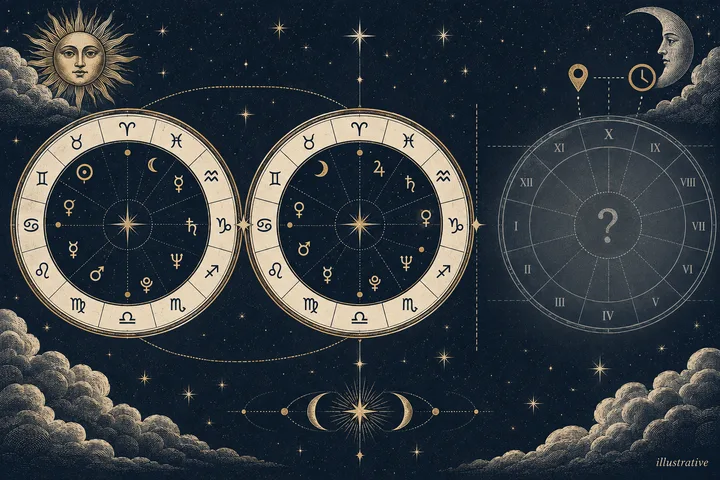
The Moon deserves extra care near a lunar sign change. The Astrology Podcast's no-birth-time guidance recommends checking what remains stable across the day, then focusing on planets in signs and aspects while setting the Ascendant and houses aside. For a placement-only synastry report, that is a useful method.
Sources: TAP Ep. 270 Transcript: How to Read a Natal Chart With No Birth Time; The Ascendant (Rising) Sign Meaning in Astrology
A worked example: keep the sign story and remove the invented house
Consider an example. Maria supplies Moon in Libra, Venus in Cancer, and Mars in Virgo. Daniel supplies Moon in Aquarius, Venus in Leo, and Mars in Scorpio. The names are illustrative, and no birth details have been calculated. Neither person has supplied a reliable birth time or birth place. They want to understand why conversation feels easy while reassurance feels less simple.
Start with the Moons. Libra and Aquarius share an air emphasis, so both people may value perspective and conversation when emotion rises. That can help explain their mental rapport. It doesn't mean they regulate feelings in the same way. Maria may seek balance through a warm exchange. Daniel may need distance or a wider view before he can answer. When Maria asks for reassurance and Daniel sends an analysis, each may believe he or she is helping.
Now compare Venus. Maria's Cancer Venus may read steady care as proof of love. Daniel's Leo Venus may express love through praise, enthusiasm, a generous invitation, or open delight. These styles can nourish each other. Cancer offers shelter to Leo's brightness. Leo brings confidence and warmth to Cancer's sensitivity. They can also miss. Public enthusiasm may feel too broad when Maria needs quiet care, while quiet care may feel invisible to Daniel when he wants affection named.
Mars adds practical friction. Virgo Mars may improve the plan or fix the immediate problem. Scorpio Mars may protect privacy and wait until trust is strong before showing the full force of desire or anger. Maria might experience Daniel as difficult to read. Daniel might experience Maria's corrections as pressure. The interpretation comes from the supplied planets and the lived question. It doesn't need a house overlay.
If the supplied degrees later show Maria's Venus at 14 degrees Cancer and Daniel's Mars at 16 degrees Scorpio, the six-degree method can consider a water trine with a two-degree separation. That supports a more specific reading of instinctive attraction and emotional magnetism. It still doesn't tell the couple how to handle privacy, time, or conflict. Those choices belong to the people living the pattern.
What would a house claim add? If Daniel's calculated chart placed Maria's Venus in his fourth house, the reading could explore home, roots, and emotional shelter. If it placed that Venus in his seventh, the focus would turn toward direct partnership. Those are different questions. Without Daniel's reliable chart orientation, choosing one is an unsupported guess.
The guide is simple: use signs for style, aspects for contact, orbs to rank degree evidence, and houses for life-area context only after the receiving chart has been calculated. In this example, ask, ‘When you show care, what response tells you it has landed?’
You shouldn't use houses in a synastry report built only from supplied placements because a house depends on a chart's orientation, not on a planet's sign alone. The Ascendant, birth time, birth place, and house system establish that orientation. Without those inputs for both people, a report can't honestly say that one person's Venus falls in the other's seventh house or that their Mars activates the fourth. The comparison still has plenty to say. Read the supplied Moon, Venus, and Mars signs, then add major aspects only when reliable degrees support them. Label the result as placement-based, keep sign themes separate from degree contacts, and connect the reading to one real question between you. If accurate birth data turns up later, add houses as a new layer. Don't use them to rewrite a reading that never contained them.
How to rank the reading when the layers seem to disagree
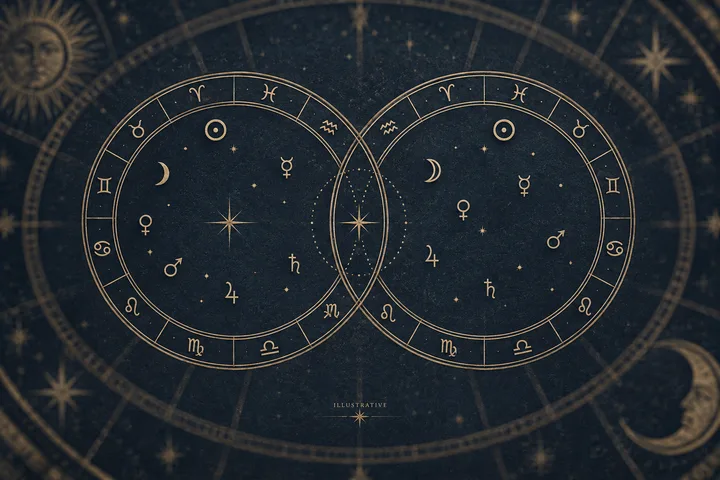
A placement-only report needs a hierarchy. Otherwise one vivid phrase can drown out the evidence that answers the couple's question. Rank the reading in this order: the lived question, relevant personal planets, close degree contacts, repeated themes, and only then any house information that reliable data makes available.
Let the question choose the planets. For emotional reassurance, start with the Moon and Venus. If conflict escalates, start with Mars and the Moon, then include Mercury if supplied. If attraction feels strong but the pace is uneven, compare Venus and Mars with the signs' modalities. A house may later show where the pattern becomes visible, but it doesn't replace the planets that describe it.
Next, rank exactness. A close personal-planet aspect deserves more attention than a wide contact of the same kind. A six-degree orb tells you what the method will consider. It doesn't make a six-degree contact equal to a one-degree contact. Give the reader the distance, then explain why the closer indication leads.
Then look for repetition. If the Moon comparison, Venus signs, and a close Moon-Venus aspect all point to different ways of seeking safety, that is a strong thread. If one isolated contact points elsewhere, let it qualify the story rather than replace it. Repetition is more useful than drama.
Separate ease from skill. A trine can make a response feel natural, but natural doesn't always mean conscious. A square can create friction, but friction can teach direct speech. An opposition can bring fascination and difference together. Read the aspect as an available exchange, then name the choice that helps the pair use it well.
The strongest exception matters. A report with no houses can contain a very close personal-planet contact that deserves more weight than a house overlay built from uncertain times. If one person's Venus is closely conjunct the other's Moon, that contact may be a clearer starting point than an uncertain claim about the seventh house. Missing houses don't erase strong evidence elsewhere.
The reverse is also true. When both birth times and places are reliable, and the system is stated, a house overlay can add life-area context that signs and aspects don't provide by themselves. Add that layer carefully. Don't force it into every report.
Sources: TAP Ep. 270 Transcript: How to Read a Natal Chart With No Birth Time; What Do ‘Houses’ Mean in Your Birth Chart?; The Ascendant (Rising) Sign Meaning in Astrology
The next step is a better question, not a larger chart
Use the placement-only report as a focused conversation tool. Write down the supplied signs exactly as given. Mark each degree as known, approximate, or missing. Keep sign observations in one column and degree-based contacts in another. Put every statement that depends on an Ascendant, cusp, angle, or house ruler in a third column marked ‘not available yet.’
Choose one lived question. ‘Why do we miss each other when one of us wants reassurance?’ gives the Moon and Venus something concrete to illuminate. ‘Why does a small disagreement become a shutdown?’ gives Mars and the Moon a job. ‘Are we compatible?’ is too wide to guide a useful first reading. Astrology can organize attention. It can't have the conversation for you.
Ask for a scene, not a label. When did care feel clear? When did it fail to land? Who asked for what, and what answer came back? The scene may support the sign symbolism, complicate it, or reveal a detail the chart doesn't name. That gives the interpretation somewhere to live.
If you later want houses, confirm the birth place, record whether the time is exact or remembered, check the time-zone treatment, and name the house system. Ask four questions: Whose chart supplies the house? What fixed its Ascendant? Which system set the cusps? Is the planet near a boundary? If the report can answer all four, the overlay has a method behind it.
The Synastry Comparison Report uses supplied Moon, Venus, and Mars signs, with optional degrees and selected major aspects using a six-degree orb. It doesn't calculate natal positions from birth details, calculate houses, or turn the connection into a score. That scope gives the reading a clear promise. If your information is limited, compare what you know. If it becomes complete, add the house method openly.
A missing birth time doesn't require silence. It requires a narrower question and a narrower promise. Houses can wait until the maps are real. The relationship question is already here.
Start with this: ‘When you show love in the way that feels most natural to you, what would help me recognize it, and what would help you recognize mine?’ Let the answer test the Venus story. Then bring in the Moon, Mars, signs, and any supported aspects that clarify what each person needs next.
Sources: TAP Ep. 270 Transcript: How to Read a Natal Chart With No Birth Time; What Do ‘Houses’ Mean in Your Birth Chart?
A little more clarity
Can I use whole-sign houses without an exact birth time?
Whole-sign houses still begin with the rising sign, so you need a reliable Ascendant and its birth-time and place inputs. If the Ascendant is unknown, don't assign house overlays in a placement-only report. Use the supplied signs and supported degree aspects instead, and label any later house reading as conditional when the time remains uncertain.
Sources & further reading
- TAP Ep. 270 Transcript: How to Read a Natal Chart With No Birth Time
Supports the Ascendant and house dependence on birth time, the speed of rising-sign change, and reading signs and aspects when time is unavailable.
- What Do ‘Houses’ Mean in Your Birth Chart?
Supports the distinction between planets and signs and the life areas represented by houses, including the fourth and seventh houses.
- The Ascendant (Rising) Sign Meaning in Astrology
Supports the Ascendant as the eastern-horizon point that starts the house sequence and depends on both birth time and location.
Synastry Comparison Report
Enter known placements for two people. Get an input-by-input comparison, selected aspect calculations and a clear record of what remains uncertain.
Compare our placements