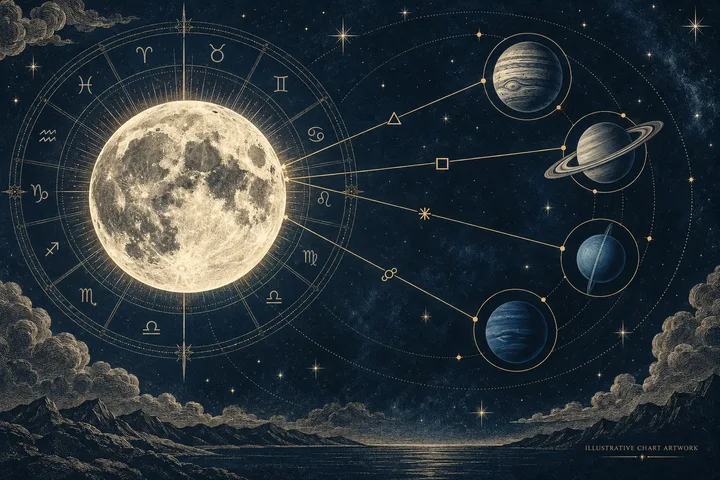
What exactness can tell you, and what it cannot
You have two lines in front of you. One is a Moon square Pluto at 5°42′. The other is a Moon trine Uranus at 1°08′. Which one should lead? Start with the tighter contact, then ask what kind of planets are meeting. That second question keeps a precise outer-planet line from becoming a dramatic but empty headline.
An aspect is an angular relationship between two chart factors. A square aims for 90 degrees. A trine aims for 120. The orb is the distance between the actual separation and that exact angle. AstroNet gives the working formula as |actual distance - exact aspect angle|. So a 92°14′ separation is a square with a 2°14′ orb. Astrodienst describes an exact aspect, in ordinary astrological use, as one within about one degree.
That gives you a useful scale. A contact under one degree is concentrated. A two-degree contact is still close. A five- or six-degree contact sits near the edge of the method and needs more context. It isn't worthless. It simply shouldn't speak with the same volume as a nearly exact contact.
Synastry compares two fixed natal positions, so the orb doesn't move after the comparison is made. The report's six-degree limit is a selection rule. It tells you which major contacts enter the reading. It doesn't claim that every eligible contact carries equal weight, and it doesn't calculate any missing placement.
Use three notes for every contact: eligible, priority, and question. 'Eligible' means the aspect falls within six degrees. 'Priority' tells you whether it leads, supports, or stays in the background. 'Question' turns the symbol into something the couple can recognize in daily life. That is the whole method in miniature.
Sources: Aspect - Astrodienst Astrowiki; Exact aspect - Astrodienst Astrowiki; Personal Planet - Astrodienst Astrowiki; Astrological Orbs Explained: Natal Charts, Transits and Synastry - AstroNet
Why the Moon reaches the personal layer quickly
The Moon speaks through basic needs, habits, reactions, security, and private feeling. Cafe Astrology describes it as the part of the chart that shows how we instinctively respond and what helps us feel safe. In synastry, that symbolism can appear in ordinary moments: who needs quiet after a hard day, who reaches for reassurance, and which routines begin to feel like home.
This is why Moon contacts often become noticeable before a couple has a polished explanation for them. The Moon is one of the personal planets, and it changes signs quickly. A reliable degree can therefore sharpen the reading. A sign-only Moon placement still gives you an emotional style, but it can't prove a precise aspect or a close orb.
Imagine Maria has the Moon at 22°18′ Taurus and her partner has Venus at 23°02′ Virgo. The trine has a 0°44′ orb. Taurus steadiness meets Virgo care through a clean, practical channel. Now move Venus to 28°02′ Virgo. The sign relationship remains, but the trine widens to 5°44′. You can still describe shared earth-sign preferences, yet the aspect should sound softer. It no longer carries the whole story of affection.
The aspect changes the way the needs meet. A trine can make an exchange easy to access. A square can make two needs collide often enough that the pair must develop a habit of repair. An opposition can create a strong pull between unlike forms of comfort. The signs supply the language. The aspect supplies the shape.
Don't turn a close Moon contact into a promise of ease. Moon-Saturn can make care dependable, restrained, or heavy. Moon-Uranus can make emotional life fresh and changeable. Moon-Neptune can heighten empathy and longing. Moon-Pluto can draw out deep attachment and old patterns. Exactness helps you decide how directly to examine the theme. The planets and aspect tell you what the theme is.
Sources: The Moon in Astrology/Zodiac - Cafe Astrology; Synastry - Astrodienst Astrowiki; Astrological Orbs Explained: Natal Charts, Transits and Synastry - AstroNet
Why outer planets need a personal bridge
Uranus, Neptune, and Pluto move slowly. In modern astrology, Uranus speaks to disruption and freedom, Neptune to permeability, imagination, and ideals, and Pluto to intensity and transformation. These planets can mark powerful exchanges. They can also describe a background shared by many people born in the same period.
Astrodienst distinguishes the personal planets from Uranus, Neptune, and Pluto partly by speed. The Moon, Sun, Mercury, Venus, and Mars contribute more individual signatures, while the outer planets can remain in one sign long enough to characterize a generation. That doesn't make an outer-planet contact unimportant. It changes the question. Is this contact about the two people, or about a pattern they carry from their cohort?
A close Uranus contact to one person's Moon can make the emotional atmosphere feel unusual, liberating, or unstable. A close Neptune contact to Venus can bring tenderness, beauty, longing, and the risk of loving an imagined possibility. A close Pluto contact to Mars can intensify desire, conflict, and the need to understand power. Each contact has a receiver in the personal chart.
An outer-planet-to-outer-planet contact often needs that receiver. Consider a Uranus-Pluto conjunction at 7°20′ between people of a similar age. It may describe a shared historical mood or appetite for change. It says less about why these two people affect one another than a 1° Moon-Uranus conjunction. The first is a backdrop. The second enters a private function.
This is also why dramatic vocabulary can mislead you. Pluto can sound more important than Venus. Neptune can sound more spiritual than the Moon. But a chart isn't ranked by the most intense word in the interpretation. Look for a tight contact, a personal planet or luminary, and a theme that repeats elsewhere.
Sources: Personal Planet - Astrodienst Astrowiki; Synastry - Astrodienst Astrowiki
A worked comparison with real degree math
Consider this example. Person A has the Moon at 16°12′ Cancer. Person B has Neptune at 17°01′ Capricorn. The opposition is close, with a 0°49′ orb. Person B's Pluto is at 21°48′ Libra, forming a 5°36′ square to Person A's Moon. Both contacts enter a six-degree report. They do not enter it at the same level.
Read the Moon-Neptune opposition first. The Moon brings private needs and instinctive responses. Neptune brings imagination, permeability, ideals, and the wish to merge. The contact may feel tender or uncanny. Person A may sense that Person B understands an unspoken mood. Person B may awaken compassion, fantasy, or a spiritual atmosphere. The opposition adds pull and difference, so the useful question is how the pair gives clear form to its sensitivity.
Then read the Moon-Pluto square as a secondary pressure. At 5°36′, it is eligible but broad. It may become vivid during jealousy, family material, privacy concerns, or moments when one person's reaction exposes an old attachment. Don't let it carry the conclusion by itself. Look for another close contact involving Pluto or the Moon before you raise its rank.
The sign layer adds texture. Cancer Moon wants a protective emotional base. Capricorn Neptune may draw the imagination toward duty, achievement, or a dream of lasting structure. Libra Pluto brings intensity into partnership and asks how power is shared. Those meanings don't replace the degrees. They explain the vocabulary of each contact.
Now test repetition. Does Saturn also touch the Moon? Does Venus repeat Neptune's theme? Does Mars connect with Pluto? Repetition doesn't create a compatibility score. It gives the interpreter a stronger pattern because separate contacts point toward related material. If nothing repeats, keep the reading narrow: Moon-Neptune leads, and Moon-Pluto remains a possible undertow.
Finally, turn each contact into a question. For Moon-Neptune, ask, 'When we feel close, what keeps tenderness clear and concrete?' For Moon-Pluto, ask, 'When fear or attachment rises, how do we name it before it becomes control?' Exactness chose the order. It didn't decide what the people must do.
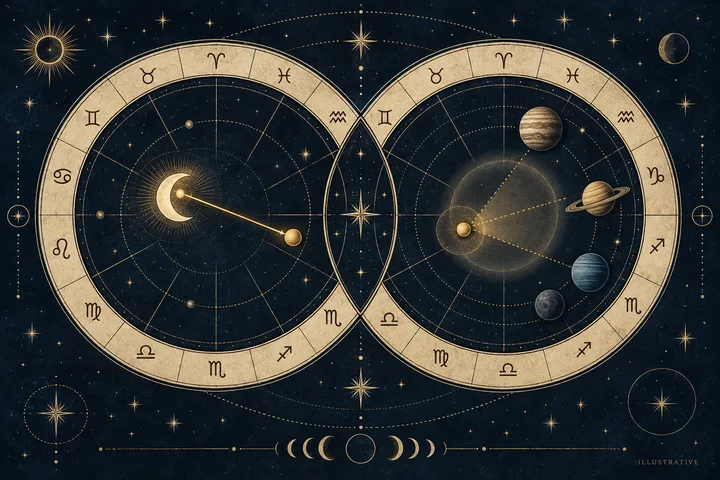
Aspect exactness tells you where to look first, but it doesn't decide the whole reading. A close Moon contact usually deserves early attention because the Moon describes feeling, habit, comfort, and the quick ways two people respond to each other. Uranus, Neptune, and Pluto need a second check: do they touch a personal planet or luminary, or are they mainly shared by an age group? For this guide, use the placements and optional degrees you already have. The report selects major contacts within a six-degree orb. It doesn't calculate houses, angles, or missing natal positions. Write down the planet pair, aspect, exact orb, and lived question. Then rank the contact by both geometry and personal relevance.
Sources: Aspect - Astrodienst Astrowiki; Exact aspect - Astrodienst Astrowiki; Astrological Orbs Explained: Natal Charts, Transits and Synastry - AstroNet; The Moon in Astrology/Zodiac - Cafe Astrology
The exception that changes the ranking
A wide outer-planet contact can matter more than a tighter contact when it anchors a pattern that the rest of the comparison repeats. The orb still describes concentration. It just isn't the only evidence in the room.
Suppose Person A's Sun is at 25°40′ Pisces and Person B's Neptune is at 20°52′ Pisces. The conjunction is 4°48′ wide. On its own, it sits below a 1° Moon-Venus conjunction. But Person A also has Venus at 21°10′ Pisces, making Person B's Neptune tightly conjunct that Venus. The wider Sun-Neptune line now helps describe how the same Neptune theme reaches both identity and affection. Venus-Neptune supplies the sharper contact; Sun-Neptune gives it a wider field.
The same logic applies to Pluto. A 5° Pluto contact to a personal planet gains weight when another close contact activates the same planet or theme. If Venus, Mars, and Pluto gather around intimacy, desire, or power, Pluto may describe a deeper layer that the personal contacts make visible. The cluster earns attention. One glamorous line doesn't.
Angles can also change the picture, but only when the birth time and angle are known accurately. A close outer-planet contact to the Ascendant, Descendant, Midheaven, or Imum Coeli may be meaningful. If the birth time is uncertain, don't manufacture that precision. A placement-only comparison can work with supplied Moon, Venus, Mars, and other known placements. It doesn't calculate houses or angles from absent data.
There is a final test: lived recurrence. If the couple keeps meeting the same freedom, idealization, or power question, a broad contact may be useful even when it isn't the first line you read. State what raises its weight. Then state what would keep it in the background. A strong exception has a visible chain from degree, to planet, to repeated pattern, to daily question.
Don't use this exception to rescue every favorite aspect. If the contact only sounds intense, it hasn't earned a higher rank. If the angle depends on an uncertain birth time, it hasn't earned precision. If the outer planet touches another outer planet and nothing personal repeats it, let it remain background.
Sources: Exact aspect - Astrodienst Astrowiki; Personal Planet - Astrodienst Astrowiki; Astrological Orbs Explained: Natal Charts, Transits and Synastry - AstroNet; Synastry - Astrodienst Astrowiki
A practical reading order for your report
Use this sequence when you have known placements and optional degrees. It keeps the technical work visible without turning the report into a pile of aspect lines.
First, copy the inputs exactly. Record each person's planet, sign, degree, and minute. Mark sign-only placements and missing degrees. A sign comparison can still be useful. It simply belongs to a broader layer than an orb-based claim.
Second, calculate the contact. Write the actual separation, the exact aspect angle, and the difference between them. Keep the orb in the sentence. 'Moon trine Venus, 0°44′' tells the reader why the contact deserves attention. 'Strong Moon-Venus energy' hides the method.
Third, translate the planetary functions. Moon describes feeling and security. Venus describes affection, taste, and values. Mars describes desire, action, and conflict style. Uranus disrupts and liberates. Neptune softens boundaries and enlarges longing. Pluto intensifies and transforms. The aspect shows whether those functions flow, press, merge, or pull apart.
Fourth, look for a personal bridge and repetition. A close outer-planet contact to the Moon, Sun, Venus, or Mars belongs in the active layer. An outer-planet contact with no personal receiver may stay in the background. A repeated theme can raise a wider aspect's usefulness, but it shouldn't erase the exact orb.
Fifth, record the strongest exception. Maybe a close Moon-Uranus contact describes the need for space, while a wider Moon-Saturn contact explains why that freedom feels risky. Keep both. Rank them, and say what would make the secondary theme more visible.
Sixth, finish with one observable question. Ask what helps each person feel at home, how much space the relationship needs, where hope should become an agreement, or how both people handle privacy and power. Stop when the chart has produced a useful conversation. More contacts aren't automatically more clarity.
Your final worksheet can use four columns: contact, orb, rank, and lived question. If one person's degree is missing, leave the orb blank and mark the contact unranked. You can still compare known Moon, Venus, and Mars signs. You can't recover a precise gap from a sign alone.
So, return to the opening choice. Give the 1°08′ Moon-Uranus trine attention before the 5°42′ Moon-Pluto square, then ask whether Pluto repeats a personal pattern that the first contact misses. Exactness opens the door. Personal relevance decides how long you stay.
Sources: Aspect - Astrodienst Astrowiki; Personal Planet - Astrodienst Astrowiki; Astrological Orbs Explained: Natal Charts, Transits and Synastry - AstroNet; Synastry - Astrodienst Astrowiki
A little more clarity
Is a one-degree Moon aspect always stronger than a five-degree outer-planet aspect?
It usually deserves earlier attention, especially when the Moon contact involves Venus, Mars, Saturn, or another personal planet. But a five-degree outer-planet contact can rise when it touches a luminary, repeats a theme, or matches a clear pattern in the relationship. Treat one degree as a priority signal, not a final verdict.
Should I ignore a wide Uranus, Neptune, or Pluto contact?
No. Record it and identify its role. It may describe shared generational material or a background tone. It becomes more personal when the outer planet touches a luminary, Venus, Mars, or another known personal placement, or when a close contact repeats the same symbolism. A six-degree limit makes it eligible for review, not automatically central.
Why can the Moon receive more orb than an outer planet?
Many astrologers give the Moon more room because it is a luminary and carries emotional, instinctive, and habitual symbolism. That allowance doesn't erase the degree. A 5°50′ Moon contact should sound less concentrated than a 0°40′ contact, and the supplied Moon degree still needs to be reliable before you make a narrow claim.
What can I do if I know the signs but not the degrees?
Read the sign layer and stop short of an exact aspect claim. You can compare broad emotional, affection, and conflict styles from known Moon, Venus, and Mars signs. You can't rank a Moon-Uranus contact by orb or confirm a close Pluto aspect without both degrees. Record what is missing and keep the interpretation tied to what you actually know.
Sources & further reading
- Aspect - Astrodienst Astrowiki
Defines aspects as angular relationships and explains how an orb keeps an aspect within an accepted range.
- Exact aspect - Astrodienst Astrowiki
Defines an exact aspect as generally falling within one degree of the precise angle.
- Personal Planet - Astrodienst Astrowiki
Distinguishes personal planets from slower outer planets and describes their more individual signatures.
- Astrological Orbs Explained: Natal Charts, Transits and Synastry - AstroNet
Explains orb calculation, static synastry positions, and the value of tighter inter-chart limits.
- The Moon in Astrology/Zodiac - Cafe Astrology
Describes the Moon through needs, habits, reactions, security, comfort, and private emotional life.
- Synastry - Astrodienst Astrowiki
Defines synastry as chart comparison and distinguishes personal-planet contacts with outer planets.
Synastry Comparison Report
Enter known placements for two people. Get an input-by-input comparison, selected aspect calculations and a clear record of what remains uncertain.
Compare our placements