Imagine the contact that makes the question urgent
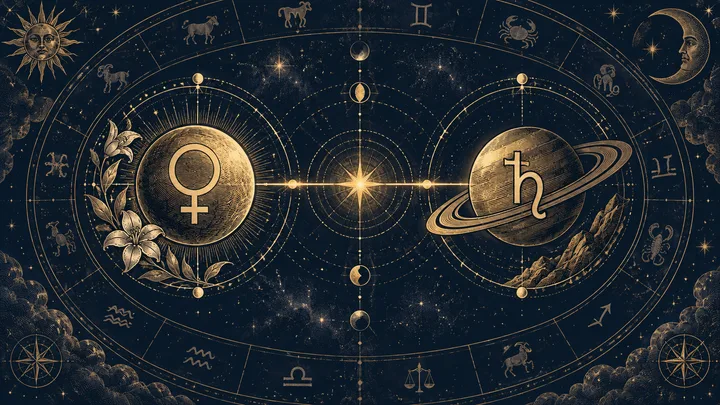
Imagine Maria and Daniel beginning a relationship after weeks of easy conversation. Maria's Venus is close by degree to Daniel's Saturn. Maria says the bond feels serious and that Daniel's pauses make her wonder whether her affection is being judged. Daniel says he wants to do things properly, yet every promise feels weighty. Maria looks more exposed. Daniel looks more guarded. Which one is feeling the aspect more?
The strongest answer is that the contact is mutual in effect but unequal in expression. Maria's Venus brings affection, pleasure, value, and the wish to be received. Daniel's Saturn brings time, limits, duty, caution, and the need to make something durable. Her warmth presses on his standards. His standards shape how safe or restricted her warmth feels. Neither planet is a passive screen.
This is an illustrative scene, not a supplied couple's chart. For a real comparison, write down the two planets, their signs, their degrees if known, the aspect, and the orb. Keep four questions separate: who notices first, how each person expresses the contact, what each person changes, and what the relationship must learn to hold. That separation prevents a visible reaction from masquerading as the whole meaning.
Cafe Astrology's guide to interchart aspects makes the same essential move: each person takes on the role of the planet they contribute, and the signs and houses alter how that exchange appears. The useful question isn't who wins the aspect. It's what passes between the two planets.
Sources: Aspects Between Charts; Aspect - Astrodienst Astrowiki
Name both planetary jobs before judging intensity
Start with the planets, not the people. The Moon brings instinct, memory, mood, and the need for safety. Venus brings attraction, taste, affection, and value. Mars brings desire, pursuit, anger, and action. Saturn brings structure, delay, duty, and limits. A contact between them describes an exchange between those jobs.
In a Moon-Mars contact, the Moon person may experience the Mars person as too quick, blunt, or intrusive. The Mars person may experience the Moon person as a changing emotional climate that slows action. The Moon isn't simply the sensitive one, and Mars isn't simply the difficult one. Each planet alters the conditions in which the other operates.
The aspect tells you the geometry of the meeting. A conjunction brings the functions close together. A square asks them to work through friction. An opposition puts them across a polarity, so one person's expression can call out the other's counter-expression. A trine may flow so easily that the couple overlooks its gift. A sextile often becomes useful when both people choose to engage it.
Then read the signs. Venus in Leo values open warmth and visible appreciation; Venus in Virgo may show care through attention and practical help. Saturn in Capricorn can set a clear standard, while Saturn in Pisces may manage limits through sensitivity and porous boundaries. The same planet pair changes voice when the signs change.
Use houses only when the birth times and house framework are reliable. A partner's planet in the seventh house can bring the contact into partnership awareness, while an eighth-house overlay can draw it toward trust and shared vulnerability. If the chart data doesn't support houses, leave them out. A smaller true claim beats a larger invented one.
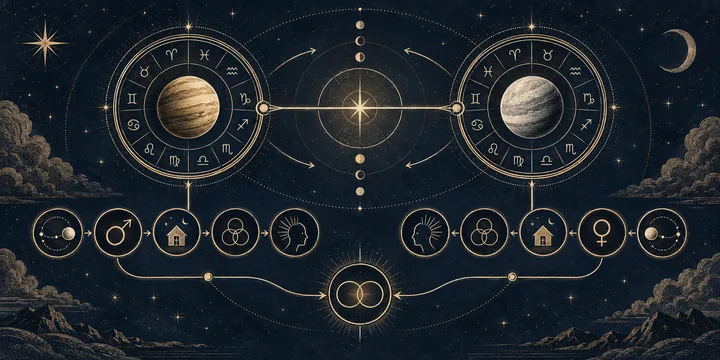
You can't identify the more affected person by naming the planet and calling its owner the receiver. A synastry contact joins two functions, so begin with what each planet contributes. Then rank the contact by exactness, a six-degree working orb, sign, reliable natal context, repetition, and observable behavior. Application can show which faster planet is moving toward exact contact, but it doesn't prove obsession or vulnerability. One person may feel the contact in private while the other changes plans, boundaries, or responsibilities. Those are different forms of impact. The clearest reading names both, then asks what each person needs to make the exchange workable. If degrees or birth times are missing, narrow the claim to the placements you actually have.
Sources: Aspects Between Charts; Synastry - Astrodienst Astrowiki
Use degrees and motion as roles, not verdicts
Degree information tells you how close the contact is. Astrodienst recommends smaller orbs for interaspects because comparing two charts already produces many possible contacts. For this report's working method, use a six-degree orb for selected major aspects, and describe a two-degree contact as more exact than one at the edge of that range.
Applying and separating language adds a second layer. An applying aspect is forming as the faster planet approaches exact contact with the slower one. A separating aspect has already passed exactness. In traditional practice, the faster planet can be described as applying or committing its motion, while the slower planet receives that movement. This can suggest who reaches, presses, or brings the matter forward.
It still doesn't answer who feels more. A Venus applying to Saturn may show affection moving toward a standard, while Saturn supplies the condition that Venus must meet. Reverse the motion and the emphasis changes. Daniel may be seeking a dependable form for care, while Maria's Venus becomes the place where that request lands. The symbolism shifts, but both planets remain active.
Consider the illustrative values Venus at 10 degrees Taurus and Saturn at 12 degrees Taurus. That is a close conjunction by degree. If Venus is the faster body and the aspect is applying, describe movement toward Saturn's structure. Don't turn the example into a claim about any real person, and don't claim application when the report gives no motion data. Degrees without motion establish closeness, not direction.
A separating contact can still describe a living pattern. The couple may already know how affection meets caution, and the work may now concern repair or repetition. Application is a useful role. It isn't a psychological ranking.
Sources: Aspect - Astrodienst Astrowiki; A brief comparison of the use of reception by historical authors
Let natal condition explain why the contact lands loudly
Synastry planets arrive with a natal history. A partner's Saturn doesn't create an entirely new Saturn in the other person's life. It activates the Saturn that person already carries. That is why one Venus-Saturn contact can feel like welcome commitment for one couple and like scrutiny for another.
If a person's Venus is already closely tied to natal Saturn, affection may already be linked with loyalty, proof, and time. The partner's Saturn can feel familiar. If Venus is strongly tied to Uranus, the same Saturn contact may feel like an anchor or a brake. Neither response is automatic, but natal context gives the contact somewhere to land.
Read sign and house, then inspect major natal contacts to the involved planets. Traditional condition can add another shade. A planet with support and dignity may have more resources for expressing its function. A pressured planet may show the same contact through defensiveness, delay, exhaustion, or overcompensation. This doesn't make one person right. It explains why their responses have different volume.
The important limit is data. If you have supplied Moon, Venus, and Mars signs with optional degrees, you can compare those placements and selected aspects. You can't responsibly add houses, angles, rulers, or a natal pattern that wasn't provided. A placement-only reading should stay a placement-only reading.
Sources: Aspects Between Charts; Synastry - Astrodienst Astrowiki
Check reception and repetition for the strongest exception
Reception belongs to a traditional layer of chart reading. In simple terms, one planet may occupy a sign or dignity associated with the other. Mutual reception occurs when the exchange runs both ways. It can describe recognition, support, or a route through which the planets help one another, even when the aspect itself is tense.
Deborah Houlding's historical review describes the faster planet as committing its disposition as it applies, while the slower planet receives it. It also treats reception as a form of attendance and support. That makes reception useful for judging resources inside a contact. It doesn't erase a square, soften every opposition, or certify equal satisfaction.
Repetition is often easier to use. One Venus-Saturn contact may be important. Venus-Saturn plus Moon-Saturn, a prominent natal Saturn, and a reliable Saturn house overlay gives the theme more weight. Count the repeated theme once as a major pattern. Don't call it three times stronger unless your method defines such a measure.
This is the strongest meaningful exception to a simple two-sided rule: one person's planet may be activated by several personal planets, an angle, or a natal pattern, while the other person's planet remains relatively quiet. The first person may then feel the contact as more intrusive or life-changing. Even here, greater activation isn't moral authority. The second person still participates through the role of their planet.
Sources: A brief comparison of the use of reception by historical authors; Synastry - Astrodienst Astrowiki
Compare private feeling with visible behavior
The person who talks most may not be the person most changed. A Moon person may describe every shift in atmosphere. A Saturn person may say little while changing their schedule, setting a boundary, or deciding whether a promise can be kept. If you measure only language, you'll confuse expression with impact.
Return once to the illustrative Venus-Saturn scene. Maria says, 'I feel judged when he takes so long to answer.' Daniel says, 'I don't want to promise what I can't carry.' Her reaction is easier to hear. His response is easier to miss. Both are responding to the contact, but Venus protects warmth while Saturn protects responsibility.
Now look at conduct. Does one person ask for a label? Does the other make time more consistent? Does one pursue reassurance while the other offers practical help but avoids direct affection? These actions don't prove a planet's effect by themselves. They give you material to compare with the symbolism.
Write two short lines for each person: what I feel and what I do. Then record the trigger, the first response, the other person's reply, and what repairs or prolongs the moment. A chart can suggest the pattern's language. It can't grant access to a private motive. If someone is unreliable, don't rename that behavior as hidden Saturnian devotion.
The best follow-up question is concrete. Ask, 'When I ask for reassurance, what do you hear me asking you to promise?' Or ask, 'When you slow this down, are you asking for time, privacy, or a clearer agreement?' Those questions let both people speak for themselves.
Sources: Aspects Between Charts; Synastry - Astrodienst Astrowiki
Make the judgment, then choose the next step
When you need a direct answer, rank the evidence in this order. First, identify the planets, aspect, signs, and orb. Second, check whether the contact repeats or connects with a relevant natal pattern. Third, use application, reception, and reliable house context only when the data supports them. Fourth, compare the chart roles with what each person actually feels and does.
This ranking produces a useful distinction. One person can be more activated in feeling, while the other is more affected in structure. One can initiate the conversation, while the other changes the relationship's pace. If a close contact repeats through several chart layers, name the person whose chart is more activated. Don't use that finding to declare who loves more, who suffers more, or who must be correct.
For Maria and Daniel, the supported reading is narrow and clear: Maria's Venus may experience Saturn as a test of warmth and worth, while Daniel's Saturn may experience Venus as a request to make care dependable. The question to answer in life is whether they can turn that exchange into behavior. Can Maria ask for warmth without treating every pause as rejection? Can Daniel offer reliability without making affection pass an endless test?
The Synastry Comparison Report on this site works from supplied Moon, Venus, and Mars placements, optional degrees, and selected major aspects using a six-degree working orb. It doesn't calculate natal positions from birth details or determine houses. With signs only, describe the planetary exchange and sign relationship and mark the exact aspect as unconfirmed. With degrees but no birth times, compare planetary longitudes and leave houses and angles aside.
Your final record can be brief. Write the contact and orb. Name what Person A's planet seeks and what Person B's planet requires. Note the strongest repeated theme. Add one observable behavior for each person. Then agree on one practice that would make the exchange more trustworthy this week. Watch what happens next. That's where the chart reading becomes a decision.
Sources: Aspect - Astrodienst Astrowiki; Aspects Between Charts; A brief comparison of the use of reception by historical authors
Sources & further reading
- Aspect - Astrodienst Astrowiki
Supports applying and separating aspect definitions, the role of the faster body, and energy moving in both directions.
- Aspects Between Charts
Supports reading both planetary roles and considering the sign and house placement of each planet in synastry.
- Synastry - Astrodienst Astrowiki
Supports defining synastry as the comparison of two or more horoscopes through interaspects.
- A brief comparison of the use of reception by historical authors
Supports traditional reception language, disposition, applying planets, receiving planets, and mutual reception.
Synastry Comparison Report
Enter known placements for two people. Get an input-by-input comparison, selected aspect calculations and a clear record of what remains uncertain.
Compare our placements