The natal pattern comes first
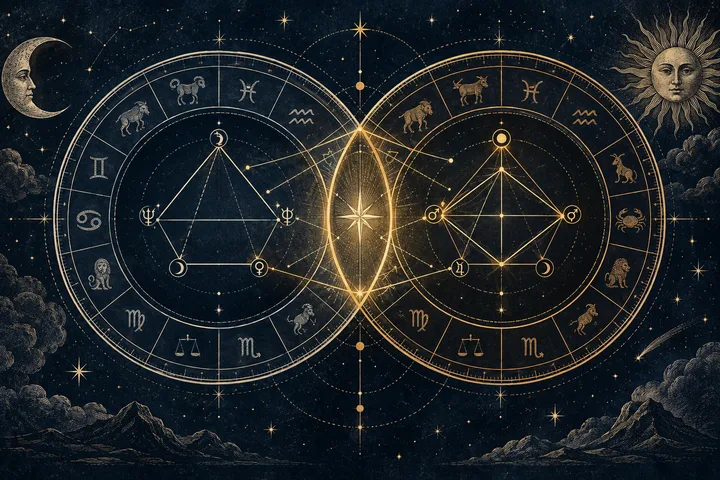
A synastry contact can feel startlingly personal. Someone arrives, and an old reaction has a new face. In astrological terms, the partner's planet may be touching a natal aspect pattern that was already part of the person's chart. The relationship activates it. It doesn't manufacture it.
An aspect pattern is a group of linked aspects involving three or more chart factors. A T-square joins an opposition to a third point through squares. A grand trine links three points by trines. A smaller network can matter too if one planet carries several close aspects. The pattern is a system, not a stack of unrelated labels. Cafe Astrology describes the T-square's focal planet as the point where activity and pressure gather. That gives us a useful starting place: find the planet that already concentrates the natal story.
The first question is not, 'What does this person do to me?' Ask, 'What does my chart already do with these planets?' A natal Moon-Mars square may describe quick feeling and quick action. A partner's Venus touching the Moon can make that emotional circuit feel tender, visible, or easier to soothe. The contact changes the setting. The person's own pattern supplies the material.
That distinction protects the reading from blame. The partner is a participant in the story, not its sole author. A natal pattern can express through habit, talent, tension, or a skill the person has slowly learned. Synastry shows where another person makes one expression harder to ignore.
Sources: Aspect Patterns in an Astrology Chart; What Is a Synastry Chart? Birth Chart Compatibility
What activation means in a placement comparison
Use activation carefully. In this article, it means that one person's supplied Moon, Venus, or Mars makes a close major aspect to a planet in the other person's natal pattern, or reaches a degree that connects more than one natal aspect. The contact must be close, relevant, and connected to the pattern. A loose contact to an unrelated point may add tone. It shouldn't lead the reading.
Astrology.com describes synastry as layering two birth charts and reading the interaction of signs, planets, houses, and aspects. The report covered here is narrower. It compares supplied Moon, Venus, and Mars placements, with optional degrees, and selects major aspects using a six-degree orb. It doesn't calculate a natal chart from birth details. It doesn't calculate houses.
Degrees decide whether the contact is exact enough to name. Suppose the natal Moon is 12 degrees Taurus and natal Mars is 12 degrees Leo. They form a close square. If a partner's Venus is 13 degrees Taurus, it conjuncts the Moon within one degree and also squares Mars within one degree. Venus has entered two linked parts of the natal pattern. That is a strong activation in the example.
The word 'strong' still needs a reason. Here, the reason is the close degree contact and the fact that one partner's planet reaches more than one member of the natal pattern. Don't call every nearby placement a trigger. Precision makes the interpretation useful.
Sources: Aspects Between Charts; What Is a Synastry Chart? Birth Chart Compatibility; Aspects Between Charts
Set the inputs before you read the story
Start with a clean record. Write down Person A's Moon, Venus, and Mars signs. Add degrees when they are available. Record Person B's same placements separately. Then list the natal aspects that actually appear in the supplied data. Keep the people distinct. Person A's Moon and Person B's Venus don't become one anonymous Moon-Venus symbol.
If you have signs only, you can read a broad symbolic meeting. Moon in Taurus may seek steadiness, touch, and tangible reassurance. Venus in Taurus may show affection through consistency and presence. That is meaningful sign language. It isn't proof of a precise conjunction or activation. Degrees are what let you name the angular relationship and measure the orb.
Record the zodiac reference frame and aspect method when you know them. A sign boundary can change the way a close contact is described. An out-of-sign contact may still be close by degree, but its geometry and sign story need separate sentences. Don't hide the distinction. Explain which layer leads.
This is also where the report's limit matters. It uses placements you supply. It doesn't infer missing Moon, Venus, or Mars degrees, add houses, or turn an illustration into a person's calculated natal chart. State the evidence you have, then read that evidence directly.
Sources: Aspects Between Charts; What Is a Synastry Chart? Birth Chart Compatibility; Aspects Between Charts
Read the natal planets as one pattern
Before adding the partner, read the natal pattern on its own. What does each planet seek? What does the aspect make difficult, urgent, or natural? Which planet carries the pressure? Which one gives the person a way to respond? This prevents a bright synastry contact from becoming the whole story.
Consider an example. Imagine Maria has a Moon at 12 degrees Taurus square Mars at 12 degrees Leo. Her Moon wants calm, physical security, and dependable care. Mars in Leo wants direct expression, pride, and a clear outlet for desire or anger. The square links feeling and action, but it doesn't make them move at the same speed. Maria may react quickly when her need for safety meets a strong demand for expression.
The square isn't a verdict. It is the pattern's pressure point. Maria may learn to give feeling a name before turning it into action. She may also become excellent at protecting what matters once she trusts her own response. The same configuration can show a reflex and a capacity.
Astrology.com likewise treats a synastry aspect as an interaction between chart factors, not as an isolated planet meaning. Read the natal arrangement first. Then ask what the partner's planet adds to that arrangement.
When synastry activates one person's natal aspect pattern, it brings an existing inner arrangement into a live relationship. It doesn't create a new trait or rewrite the natal chart. The partner's planet gives one part of the pattern a voice, a mirror, or a point of pressure. Read the natal planets and aspects first. Then add the other person's Moon, Venus, or Mars and check which planet it touches, how close the degree is, and whether the contact repeats the pattern's central theme. A close contact to one planet can make the whole pattern more noticeable, but the natal pattern remains the main frame. If you know signs only, stay at the sign level. If you have degrees, this report uses selected major aspects within a six-degree orb. The best next step is simple: turn the activation into one observable question about pace, care, desire, or repair.
Sources: Aspect Patterns in an Astrology Chart; What Is a Synastry Chart? Birth Chart Compatibility
Add the partner's planet and identify the role
Now add the partner's placement. Ask three questions. Which natal planet does it contact? What function does the partner's planet bring? Which other natal aspect already includes the contacted planet? These questions turn a vague feeling into a sequence you can follow.
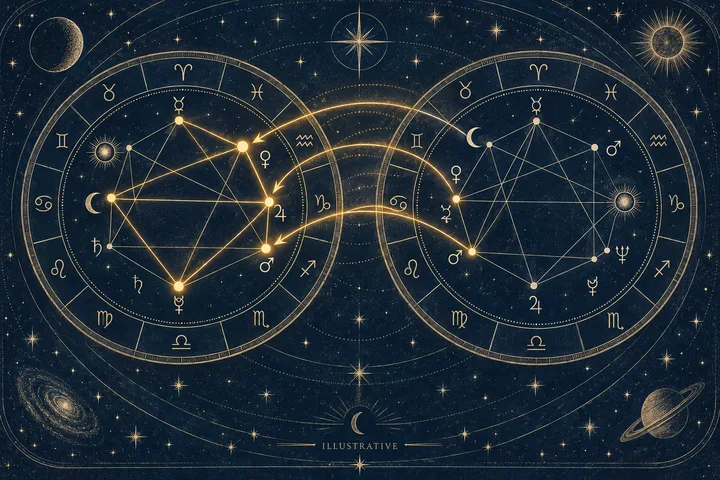
Imagine Daniel has Venus at 13 degrees Taurus. His Venus conjuncts Maria's Moon at 12 degrees Taurus and squares her Mars at 12 degrees Leo. The first layer is comfort and attraction. Daniel may bring warmth, steadiness, or a clear appreciation that helps Maria feel received. The second layer is more active: his Venus also reaches the Moon-Mars square, so tenderness enters a pattern that can move quickly from feeling to reaction.
Maria may feel unusually understood, yet also more exposed. Daniel's affection can soothe the Moon, but it can make the Mars response more visible when reassurance arrives late or feels uncertain. Daniel isn't 'the cause' of Maria's Moon-Mars pattern. His Venus gives it a relational setting.
The role is never permanent. Daniel can be the Venus person in one exchange, while Maria's Moon or Mars becomes the quality he responds to. The chart describes functions that move between people. It doesn't assign costumes or intentions.
Sources: Aspects Between Charts; What Is a Synastry Chart? Birth Chart Compatibility
Let the aspect type describe the movement
The same partner planet can activate the same natal pattern in different ways depending on the aspect. A conjunction blends. The partner's planet joins the natal function and can make it immediate. In Daniel's example, Venus is close to Maria's Moon, so affection and emotional comfort may arrive together.
An opposition externalizes. The partner can seem to carry a quality across from the natal planet, making an inner tension easier to see between two people. A square presses. It can show up as a clash of pace, emphasis, or response. A trine offers a natural channel. A sextile opens a door, but someone still has to walk through it.
These are starting meanings, not grades. Cafe Astrology's T-square material is useful here because it locates the pattern's activity in the focal planet, while the other aspects show how energy moves through the figure. For synastry, ask how the partner's contact changes that movement. Does it blend the pattern, oppose it, press it, or offer it a route out?
Then return to closeness. This report method uses a six-degree orb for selected major contacts, with the closest contact taking priority. A wide trine shouldn't automatically outrank a one-degree square that reaches the pattern twice.
Sources: Aspect Patterns in an Astrology Chart; Aspects Between Charts
Use signs to explain how the activation feels
Degrees tell you whether the contact is close. Signs tell you its style. In the example, Maria's Taurus Moon receives Daniel's Taurus Venus. The shared earth-sign language can make care feel legible through presence, touch, food, routine, or practical follow-through. That doesn't erase the Moon-Mars square. It gives the activation a particular instrument.
If Daniel's Venus were 13 degrees Scorpio instead, it would oppose Maria's Taurus Moon rather than conjunct it. The contact could still be close and important, but the mood would change. Scorpio Venus may draw the Moon toward deeper disclosure, stronger loyalty questions, and emotional intensity. The natal Mars in Leo would receive a different kind of pressure. Same natal pattern. Different relational style.
This is why sign and degree belong together. The degree tells you which door opened. The sign tells you what entered. When they seem to tell different stories, keep both. Name the aspect first, then describe the sign tension or ease.
If degrees are missing, stop at the sign layer. You can compare needs and styles. You can't responsibly rank a conjunction, square, or opposition that you haven't established.
Sources: Aspects Between Charts; What Is a Synastry Chart? Birth Chart Compatibility; Aspects Between Charts
Rank the activation against the rest of the comparison
A busy synastry list needs an order. Start with the closest major contact that reaches the natal pattern. Next, ask whether the same partner planet touches more than one natal planet in that pattern. Then check whether another close Moon, Venus, or Mars contact repeats or modifies the same theme. The point isn't to count aspects. It is to find the contact that explains the most.
In Maria and Daniel's example, Venus at 13 degrees Taurus is more central than a separate, wide contact elsewhere because it reaches both sides of the Moon-Mars square. It links comfort to reaction. A close Moon-Venus contact that touches only an unrelated planet may still describe care, but it answers a different question.
This ranking also prevents double-counting. Daniel's Venus-Moon conjunction and Venus-Mars square are two angles of one activation. Read them together before adding a new headline. If several contacts repeat the same natal planet, treat the repetition as emphasis, not as proof of an inevitable outcome.
The strongest reading is usually the narrowest one you can defend: this planet reaches this natal pattern, through this aspect, in this sign, within this orb. Everything else is supporting context.
Sources: Aspects Between Charts; Aspect Patterns in an Astrology Chart
The exception is an easy contact that stays unused
A close contact can be present without becoming a practiced strength. This is the exception worth keeping in view. A trine or sextile may give the natal pattern a graceful outlet, but people can leave that outlet untouched. Ease doesn't guarantee awareness.
The reverse is true as well. A square can become workable when the pair names its pressure and builds a habit around it. Maria's Moon-Mars pattern may react quickly, but Daniel's Venus can give the couple a reason to pause, reassure, and try again. The aspect doesn't solve the pattern. It gives the relationship material to work with.
This is where chart interpretation meets observation. Watch what happens after the contact is felt. Do they slow down? Do they ask for reassurance? Does affection make honest anger safer, or does it cover the issue until it returns? The answer belongs to the lived exchange, not to the aspect name alone.
So keep the ranking and soften the claim. A close contact tells you where to look. Repeated choices tell you how the energy is being used.
Turn the pattern into a question you can use
The reading earns its place when it changes a conversation. Don't ask, 'Are we compatible?' Ask what the activated pattern needs in ordinary life. If Moon is involved, ask what helps each person feel safe. If Venus is involved, ask how care and value are shown. If Mars is involved, ask how desire, initiative, and anger can have a clean channel.
For Maria and Daniel, the useful question is: What helps attraction feel steady when one of us reacts quickly? Daniel might offer clear follow-through instead of vague reassurance. Maria might name the need before turning it into a test. Those are small actions, but they give the Moon-Mars pattern a better route.
Keep the question proportionate to the data. With signs only, ask about style and needs. With reliable degrees, name the closest contact and ask about its repeated theme. Don't add houses or personal history to make a supplied-placement reading sound intimate. More detail isn't always more truth.
The report can help you compare the placements and selected major aspects. You still decide what to notice, ask, and practice. That is the point of an activated pattern: not a sentence about the relationship, but a clearer place to begin.
Sources: Aspects Between Charts; What Is a Synastry Chart? Birth Chart Compatibility
A little more clarity
Does synastry change the natal aspect pattern itself?
No. The natal pattern remains the person's birth-chart structure. Synastry brings another person's planet into close contact with one of its planets or degrees, which can make the pattern more visible and relational. Read the natal arrangement first, then describe the setting the partner's placement creates.
Can I read an activated pattern without exact degrees?
You can read the sign symbolism and describe possible resonance, but you shouldn't claim a precise activation or major aspect without degrees. This comparison can use supplied Moon, Venus, and Mars signs, then use optional degrees for selected major aspects within a six-degree orb. Missing degrees narrow the claim.
Sources & further reading
- Aspects Between Charts
Supports interpreting interchart planetary roles and comparing close personal-planet contacts in synastry.
- Aspect Patterns in an Astrology Chart
Defines multi-planet aspect patterns and explains the focal planet and pressure of a T-square.
- What Is a Synastry Chart? Birth Chart Compatibility
Explains layering two charts and reading signs, planets, houses, and aspects as interaction.
Synastry Comparison Report
Enter known placements for two people. Get an input-by-input comparison, selected aspect calculations and a clear record of what remains uncertain.
Compare our placements