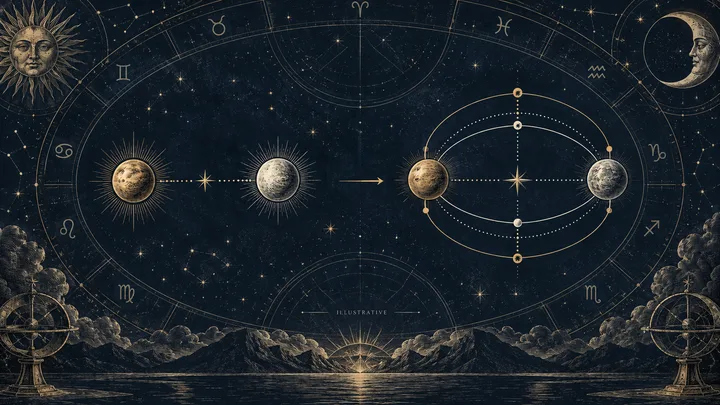
Imagine the report that adds one mysterious line
Imagine Maria and Daniel comparing the placements they already know. Maria has Moon in Taurus, Venus in Gemini, and Mars in Leo. Daniel has Moon in Scorpio, Venus in Cancer, and Mars in Libra. Their signs give them a real starting point: different emotional habits, different ways of showing affection, and different speeds of action.
Then a second report lists Maria's Venus parallel Daniel's Moon. It calls the contact a hidden conjunction. Maria wonders if this line matters more than the placements they began with. Daniel wonders if it explains the pull between them. The new label feels important because it looks rare.
The better question is smaller. What does this contact add, and can you verify it? A parallel can sharpen a reading. It can't turn supplied signs into a fully calculated synastry chart, and it can't decide whether the relationship is wise. In this report, signs and optional degrees are supplied by the reader. Houses aren't calculated. A six-degree orb applies to selected major zodiac aspects when degrees are supplied, not to declination.
That gives us the rule for the whole article: add a parallel only when it is verified, tight, relevant, and secondary. If the data is missing or the contact must carry the entire interpretation, hold it back. Technical depth should make the main story clearer.
Sources: Declination; Determining Parallels and Contra-Parallels in Synastry; Synastry in More Detail
What a parallel measures
Most sign and aspect work uses ecliptic longitude, the position measured around the zodiac. Declination uses a different coordinate. It measures how far a celestial body sits north or south of the celestial equator, much as latitude measures position north or south on Earth. JPL defines declination as angular distance from that equator. That is why a parallel is not just another name for a conjunction.
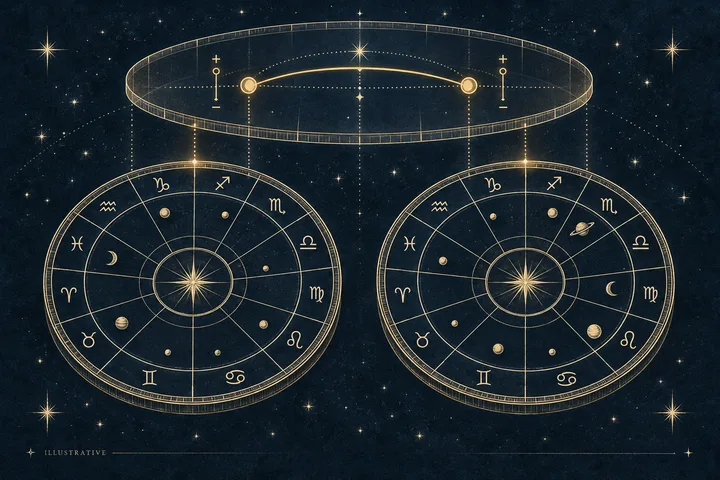
Two bodies form a parallel when their declinations are close and both are north or both are south. Venus at 14° N 00' and the Moon at 14° N 32' make a same-side contact under a one-degree orb. If the Moon is 14° S 32', the contact is a contraparallel instead. The values are close, but the directions differ.
Astrologers often read a parallel in a conjunction-like way and a contraparallel in an opposition-like way. That is a useful starting image, not a license to swap the terms. Venus parallel Moon may join affection and emotional comfort. Venus contraparallel Moon may set those functions across a polarity. The planets and signs tell you what the connection is about.
Declination is also not ecliptic latitude, antiscion, or out-of-bounds status. Those are separate techniques. If a report prints several of them in one list, preserve the labels and the measurements. Otherwise you can't tell which coordinate system produced the claim.
A synastry parallel is too advanced for a placement-only comparison when the report gives you a label but not the two declinations, their north or south directions, and the orb used. It is also too advanced when you want it to replace the sign and major-aspect layer. A parallel compares two bodies at similar declinations on the same side of the celestial equator. A contraparallel places them on opposite sides. Read either as a secondary contact, then ask whether it repeats a theme already visible in the supplied Moon, Venus, or Mars placements. If it stands alone, keep it in a note. Your next step is to record both declinations, their difference, and the report's method. If you can't, compare the placements you actually know and leave the parallel out.
Sources: Declination; Determining Parallels and Contra-Parallels in Synastry; Chapter 2: Reference Systems
The first gate is evidence
Before interpreting a parallel, make a four-line record: the two bodies, each declination with N or S, the difference between them, and the method or source. A report that says only Venus parallel Moon has not shown enough for you to audit the contact.
Here is a useful example. Maria's Venus is 17° 04' N. Daniel's Moon is 16° 28' N. The difference is 36 minutes, so the pair falls inside a one-degree convention. The contact is a parallel because both values are north. If Daniel's Moon is 16° 28' S, it is a contraparallel. The interpretation changes with that one letter.
A zodiac degree does not substitute for a declination. Two planets can miss a longitude aspect and still meet on the declination axis, or form a longitude aspect without a parallel. A table or chart report must show the declinations directly. Cafe Astrology's worked method tells readers to use the listing marked Declin and compare the values across both charts.
Be especially careful with the Moon when birth information is rounded or incomplete. If the value isn't supplied, don't present a calculated declination as settled. This comparison can organize known signs and confirmed degrees. It does not calculate natal positions from birth details. Missing input is a boundary, not an invitation to guess.
Sources: Declination; Determining Parallels and Contra-Parallels in Synastry; Chapter 2: Reference Systems
How close is close enough?
An orb is the allowed distance between two positions. For declination, one degree is a clear working boundary. Cafe Astrology's synastry example uses one degree, and its sample compares 14° N 09' with 14° N 04'. Astrodienst's Astrowiki describes a parallel orb as no more than one degree, with a maximum of about 1.3 degrees. Traditions vary, so name the convention instead of hiding it.
Use the words close, loose, and unverified with care. A 32-minute contact inside a stated one-degree orb is close. A contact at 1° 09' may be included by a wider practice, but it is borderline under the one-degree rule. A printed label without values is unverified. Those distinctions tell the reader how much room the contact deserves.
Don't carry the report's six-degree longitude orb into declination. The systems measure different coordinates. A six-degree declination allowance would turn a narrow technique into a crowded net. The contact also needs relevance. A close Venus-Moon parallel has a better reason to appear in a love reading than a loose contact that doesn't speak to the reader's question.
Exactness opens the door. It doesn't write the interpretation. A precise contact can be quiet when the planets' signs and the rest of the comparison point elsewhere. Let the number set the strength of your wording, then let the planets supply the meaning.
Sources: Declination; Determining Parallels and Contra-Parallels in Synastry; Synastry in More Detail; Parallel
When the extra line strengthens the story
The best use of a parallel is confirmation with texture. It repeats a theme already visible in the placements or a major longitude aspect, then adds a different angle. Cafe Astrology describes parallels as conjunction-like and says they can reinforce an existing synastry aspect. That is the right level of authority for a placement-only comparison: useful reinforcement, not a new ruler.
Return to the example. Maria's Venus in Gemini and Daniel's Moon in Scorpio describe different emotional languages. If their verified declinations form a tight parallel, you might say that affection and emotional receptivity meet quickly between them. Gemini may show care through words, wit, and movement. Scorpio may seek privacy, loyalty, and emotional depth. The parallel links the functions without erasing the translation work.
The same logic applies to Mars. Imagine Maria's Mars in Leo and Daniel's Mars in Libra, with a close verified parallel but no major longitude aspect. Their drive may meet with unusual immediacy. Leo acts visibly and decisively. Libra weighs the social field and looks for a workable response. The contact can describe shared activation. It can't promise that they will choose the same pace.
Use a simple editorial placement test. Main text means the contact helps answer the reader's question. A note means the contact is sound but adds little to the main decision. Omit means the evidence or relevance fails. One strong line is better than a catalogue of labels.
Sources: Determining Parallels and Contra-Parallels in Synastry; Synastry in More Detail
When complexity starts hiding the question
A placement-only reader usually wants to understand Moon, Venus, and Mars first. If the report begins with declination, antiscia, out-of-bounds status, and minor contacts, the reader may lose the reason she opened it. The problem isn't that the techniques exist. The problem is that they arrive before the main question has an answer.
Watch for three warning signs. First, the parallel is being used to fill in missing data. Second, every printed contact receives equal weight. Third, the reader wants a striking label to rescue a sign comparison she dislikes. In each case, the advanced layer is doing more work than its evidence allows.
Use an observation, interpretation, application sequence. Observation: Venus is 17° 04' N and Moon is 16° 28' N. Interpretation: they form a close Venus-Moon parallel. Application: ask what makes each person feel cared for when their styles differ. Keeping these jobs separate lets a couple see what belongs to the chart and what belongs to the conversation.
A parallel doesn't answer whether someone respects a boundary, makes clear plans, or shares the work of repair. Those facts matter more than a hidden-looking aspect. Let astrology name the pattern, then look at the pattern in lived behavior.
Sources: Declination; Synastry in More Detail
A five-step decision guide
Start with the question. Are you studying emotional ease, affection, desire, conflict, or a feeling that the signs don't quite explain? The question decides which planets deserve attention.
Next, read the base layer. List each person's Moon, Venus, and Mars signs. Describe each placement before comparing them. If confirmed zodiac degrees are available, test the selected major aspects using the report's six-degree orb and record the aspect and its orb.
Then check declination. You need both values, their N or S directions, and a stated orb. Same side means parallel. Opposite sides mean contraparallel. Do not rename the contact as a conjunction or opposition, even when the interpretive quality resembles one.
Now rank it. A close personal-planet longitude aspect comes first. A close declination contact that reinforces it comes next. A close declination contact that adds a coherent new theme follows. A loose or undocumented contact stays in a note or gets held. The ranking can change with the question, but you should be able to explain why.
Finally, turn the leading contact into a question. For Venus parallel Moon, ask: What helps each of us feel cared for, and where do our habits differ? For Mars contraparallel Mars, ask: How do we handle different speeds without turning pace into blame? Record what remains unknown. A good chart reading tells you what to examine next and what not to claim yet.
Sources: Declination; Determining Parallels and Contra-Parallels in Synastry; Synastry in More Detail
The exception, and the decision
The strongest exception is a very close, verified personal-planet parallel with no matching major longitude aspect. It can deserve a short main-text passage when it explains a specific felt link the sign comparison leaves unresolved. The absence of a longitude aspect is a reason to test the contact. It isn't permission to exaggerate it.
Suppose Maria's Venus and Daniel's Moon have different signs, no major longitude aspect within six degrees, and a verified declination parallel with an 18-minute difference. That contact is worth asking about. Do affection and comfort meet quickly? Does Maria's way of showing care reach Daniel even when their emotional languages differ? The signs still describe the work. The parallel describes an extra line of connection.
If another person's behavior is plainly dismissive, inconsistent, or unsafe, the contact doesn't turn it into care. A chart symbol can help you name a pattern. It can't overrule what you keep experiencing. That is why the parallel remains secondary, even in the exception.
So, should you add it? Yes, when the declinations agree, the orb is tight, and the contact answers a live question. Put it in a supporting note when it is real but not central. Leave it out when the report gives only a label, the orb is unclear, or the parallel must carry the whole reading. For Maria and Daniel, the next action is to request the two declinations and their method. Until then, their known Moon, Venus, and Mars placements are the reading.
Sources: Declination; Determining Parallels and Contra-Parallels in Synastry; Synastry in More Detail; Chapter 2: Reference Systems
A little more clarity
Is a synastry parallel the same as a conjunction?
No. A parallel compares declinations north or south of the celestial equator. A conjunction compares zodiacal longitude. Astrologers often read a parallel in a conjunction-like way because it can join two planetary functions, but it remains a separate contact. Check the values, directions, and orb before interpreting it.
Can I add a parallel if I only know both people's signs?
Not reliably. Sign placements don't provide the declination values needed to verify a parallel or contraparallel. Compare the known signs first. Add the advanced contact only when a report or table gives both declinations, their north or south directions, and the method used.
Sources & further reading
- Declination
Defines declination as angular distance north or south of the celestial equator, supporting the article's coordinate distinction.
- Determining Parallels and Contra-Parallels in Synastry
Shows how to compare declination values across two charts, distinguish directions, and apply a one-degree orb.
- Synastry in More Detail
Explains the optional role of parallels in synastry and their conjunction-like or reinforcing interpretive use.
- Chapter 2: Reference Systems
Explains declination as celestial latitude, identifies north and south signs, and distinguishes it from right ascension and the ecliptic plane.
- Parallel
States Astrodienst's reference range for a parallel orb, from no more than one degree to a maximum of about 1.3 degrees.
Synastry Comparison Report
Enter known placements for two people. Get an input-by-input comparison, selected aspect calculations and a clear record of what remains uncertain.
Compare our placements