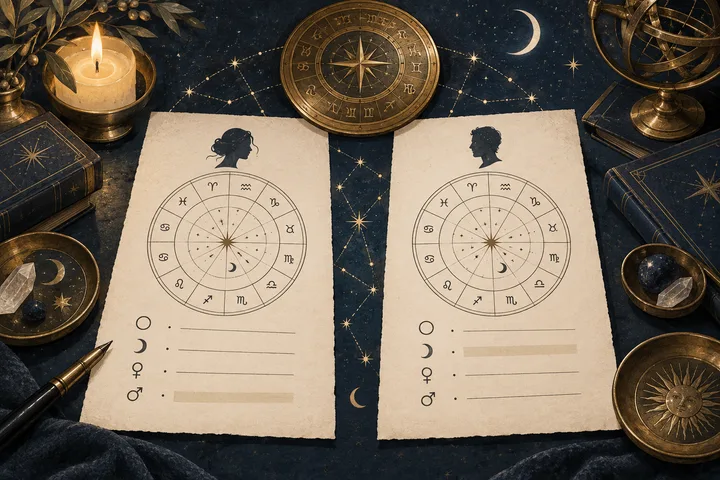
Imagine the comparison starting with two incomplete records
Imagine Maria and Daniel preparing for a synastry comparison after three easy dates and one baffling silence. Maria knows her birth date, Cluj-Napoca, and an exact time from a family document. Daniel knows his date and city. His mother remembers only that he arrived after lunch. They have copied their Sun, Moon, Venus, and Mars signs from different astrology pages, and Daniel's Moon appears as late Cancer on one page and early Leo on another.
Maria doesn't need a stronger interpretation yet. She needs a cleaner record. Beside each fact, she writes its source and confidence: documented, family estimate, remembered, or unknown. She doesn't turn “after lunch” into 1:00 p.m. A tidy guess can create an exact-looking Ascendant, house cusp, or Moon degree that the evidence never supplied.
This is the preparation that matters most. Preserve the data and preserve the uncertainty. A synastry comparison has layers. The sign gives a planet its style. The degree lets you measure distance between placements. An aspect describes that distance through an angle. A house overlay places one person's planet in an area of the other person's chart. Birth time supports the last layer most directly, while the Moon may need special care because it moves quickly.
Maria's two-column sheet therefore has space for the date, town and country, time, time source, zodiac, Moon, Venus, Mars, degrees, and disputed information. At the bottom she writes the scope: compare stable signs first; test degree contacts only where degrees are secure; leave houses and angles aside for Daniel. The question changes from “Which chart is right?” to “Which part can we read with confidence?” That is the better starting point.
Sources: The Astrology Podcast: How to Read a Natal Chart With No Birth Time; Cafe Astrology: Astrological Houses: Divisions; Cafe Astrology: Free Astrology Birth Chart Report
Record birth date, place, and time without smoothing the edges
Use an unambiguous date such as 14 August 1992, not 08/14/92. Record the town and country where the birth occurred, not a current address. If a place has several names, keep the name used by the chart source and add the local or modern name in parentheses. The useful record identifies the location clearly. It doesn't pretend that street-level detail will improve every placement.
Record the local clock time as stated. Write 6:42 p.m. when a document gives 6:42 p.m. Write “around 7 p.m.” when a parent remembers an estimate. Write “unknown” when neither source is dependable. Keep notes about daylight-saving time and the time zone, but don't adjust the clock by hand unless the chart method tells you to. A chart service may apply historical corrections after you select the correct place and enter local time.
The reason is practical. The Ascendant changes quickly, and houses depend on the local sky at the birth moment. The Moon also moves about 13 degrees in a day, so the date alone may not settle its degree or even its sign when a sign change falls within that day. A documented minute and a family estimate do not carry the same weight. Label them differently.
If one time is missing, keep the other person's time exact. Don't make the whole comparison vague. A report can still work with supplied planetary signs and some secure degree contacts, while excluding the unknown person's Ascendant, Midheaven, and house overlays. If the time is bounded, record the range itself, such as 12:30 to 1:30 p.m. That range becomes a question to test, not a defect to hide.
Before asking for a synastry comparison, make one honest record for each person. Write the full birth date, birthplace, birth time exactly as known, source of that time, zodiac reference, and any chart settings you want kept consistent. Then list the Moon, Venus, and Mars signs and degrees, marking every unknown or disputed item. Date and place support the chart's planetary positions. Time adds the Ascendant, house cusps, angles, and a more precise Moon position, so an uncertain time narrows the reading. It doesn't make every comparison useless. For this publication's Synastry Comparison Report, you can submit known Moon, Venus, and Mars signs with optional degrees. Selected major aspects use a six-degree orb. The report doesn't calculate a natal chart from birth details, houses, or a relationship verdict. Your next move is simple: separate verified inputs from estimates, then attach one relationship question to the record.
Sources: The Astrology Podcast: How to Read a Natal Chart With No Birth Time; Cafe Astrology: Astrological Houses: Divisions; Cafe Astrology: Free Astrology Birth Chart Report
Write placements as signs first, then degrees
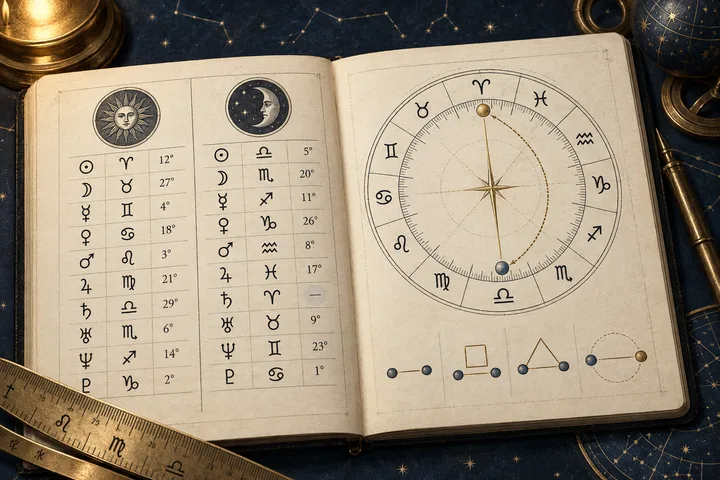
Use one format for both people: planet, sign, degree. For example, “Venus at 18 degrees Taurus.” If you know only the sign, write “Venus in Taurus, degree unavailable.” If two pages disagree, keep both results in a note and record the settings that produced them. Never average the values. A middle degree is not a compromise birth placement.
Signs and degrees answer different questions. Venus in Taurus and Venus in Gemini can both seek closeness, but they express pleasure and affection through different rhythms. The degree tells you where each Venus stands on the zodiacal circle. That lets you test whether two placements form a conjunction, sextile, square, trine, or opposition.
The aspect's exact angle is the center. The orb is the distance allowed on either side of it. A Venus at 18 degrees Taurus and a Mars at 24 degrees Cancer are 66 degrees apart by the shortest route, so they fall within a six-degree sextile. Record the separation and the orb used. A broad sign connection and a close degree contact are not interchangeable evidence.
Consider Maria's Venus at 18 degrees Taurus and Daniel's Mars at 20 degrees Libra. Their separation is 152 degrees, not a major aspect within six degrees. Maria's Mars at 2 degrees Virgo and Daniel's Venus at 24 degrees Cancer are 38 degrees apart, also outside that major-aspect set. The example is useful because it refuses an easy chemistry claim. The signs can still supply themes, but the degree record prevents a sign-pair phrase from becoming a false aspect.
For each possible contact, preserve this trail: person A, planet, sign and degree; person B, planet, sign and degree; aspect; exact separation; orb; confidence. That trail makes the later reading reproducible and exposes duplicate interpretations. One Venus-Mars contact is one contact, even if three paragraphs describe it.
Sources: The Astrology Podcast: How to Read a Natal Chart With No Birth Time; Zodisphere: Aspect Orb
Give Moon, Venus, and Mars different jobs
List the Moon, Venus, and Mars separately because they speak to different relationship questions. The Moon describes instinctive comfort, emotional timing, and what helps someone feel held. Venus describes attraction, pleasure, affection, and appreciation. Mars describes pursuit, heat, assertion, sexual energy, and the way action enters a bond. None of the three stands for the whole relationship.
Start with the Moon. Record its sign and degree, then flag whether the Moon changed signs during the birth date. If the sign stayed constant, the missing time may affect the degree without creating two entirely different sign readings. If the Moon crossed a sign boundary, keep both possibilities visible. Don't choose the more flattering one.
Then record Venus and Mars in the same format. These planets often describe the chemistry a couple notices first, but the contact still needs context. A Venus-Mars aspect can describe attraction and active desire. It can also show two different ways of asking for closeness. Let the aspect sharpen the question, not answer it for you.
Imagine Maria's Venus in Taurus and Daniel's Mars in Cancer. At the sign level, both can value safety, touch, and emotional shelter. If their degrees form a close sextile, rank that as a supportive attraction pattern. If they don't, keep the sign reading as a theme rather than a measured contact. Now add a confirmed Libra Moon to a Libra Mars. The shared sign may suggest a common language of fairness, but it can also raise a practical question: do they name conflict early, or protect the pleasant surface until resentment grows?
Rank the contacts by the question being asked. Emotional pacing puts the Moon first. Attraction puts Venus and Mars first. A repeated theme across the three planets outranks a lone, exciting symbol. A missing degree lowers precision, but it doesn't erase the placement's sign meaning.
Sources: The Astrology Podcast: How to Read a Natal Chart With No Birth Time; Cafe Astrology: Astrological Houses: Divisions; Zodisphere: Aspect Orb
State exactly what an uncertain birth time removes
A missing birth time changes the scope. It doesn't erase every useful comparison. With a date and place, many planetary signs remain available, and some planet-to-planet aspects can remain stable when their degrees are known. But an unknown time cannot support a confident Ascendant, Midheaven, house cusp, or house overlay.
The Ascendant is the sign and degree rising on the eastern horizon. It begins the first house, while the Midheaven marks the tenth-house angle in most house systems. Because these points depend on the birth moment and local sky, a guessed time can move them enough to change the interpretation. A noon entry may organize a display, but it isn't the person's discovered birth moment.
The Moon is the strongest time-sensitive exception among the personal placements used here. If its sign or degree changes across the possible birth interval, the report should present conditional readings. A bounded interval can help. If Daniel's family narrows the time to 1:10 to 1:25 p.m., compare the possible Moon degree and angles across that window. If a planet sits near a cusp, keep the cusp question open.
For this Synastry Comparison Report, the scope is narrower by design. It reads supplied Moon, Venus, and Mars signs, plus optional degrees and selected major aspects using a six-degree orb. It doesn't calculate a natal chart from birth details or add houses. Your record should say what is available, what is conditional, and what is excluded. That sentence protects the meaning of the comparison.
Sources: The Astrology Podcast: How to Read a Natal Chart With No Birth Time; Cafe Astrology: Astrological Houses: Divisions; Cafe Astrology: Free Astrology Birth Chart Report
Attach one real question before you send the record
A pile of placements is not yet a useful request. Add the question that brought you to synastry. You might ask about emotional ease, the pace of attraction, a recurring argument, or the way one person's affection meets the other's need for space. One clear question helps the reader rank the chart instead of reciting every symbol.
Consider this finished intake: Maria's date, place, and time are documented. Daniel's date and birthplace are known, while his time is remembered only as sometime after lunch. Both have Moon, Venus, and Mars signs. Maria has Venus and Mars degrees. Daniel has a Venus degree, but his Moon degree is unknown. Their request says: “Compare emotional pacing first, then attraction. Mark every conclusion that depends on Daniel's missing time.” That is enough direction for a careful comparison.
Before sending it, check five things. Each fact belongs to the right person. The date and place are unambiguous. Sign-only placements are marked as sign-only. Every degree contact includes its separation and orb. The zodiac and chart settings are recorded when they matter. Then write a scope line: stable sign comparison available; degree comparison available where supplied; Moon conditional if time-sensitive; houses and angles excluded unless reliable times support them.
The answer to the opening question is not “collect everything.” Collect the inputs that support the question you actually want answered, and show the gaps plainly. Maria can now compare stable placements, verify Daniel's Moon if possible, and decide whether emotional pacing or attraction should lead. Start there.
Sources: The Astrology Podcast: How to Read a Natal Chart With No Birth Time; Cafe Astrology: Astrological Houses: Divisions; Cafe Astrology: Free Astrology Birth Chart Report; Zodisphere: Aspect Orb
A little more clarity
Can I ask for a synastry comparison if one birth time is unknown?
Yes. Record the known date, place, and placements, and label the missing time clearly. You can compare supplied signs and some degree contacts when they remain stable. Leave the unknown person's Ascendant, houses, angles, and any time-sensitive Moon placement conditional or outside the reading.
Sources & further reading
- The Astrology Podcast: How to Read a Natal Chart With No Birth Time
Explains why birth time supports the Ascendant and houses, why the Moon may change sign during a day, and which sign and close aspect techniques remain usable without it.
- Cafe Astrology: Astrological Houses: Divisions
Defines the Ascendant as the beginning of the first house and identifies the chart angles and house cusps used in house-based interpretation.
- Cafe Astrology: Free Astrology Birth Chart Report
Shows the practical birth-data fields for local time and city selection, including the distinction between entering local time and marking an unknown time.
- Zodisphere: Aspect Orb
Defines an orb as the distance from an exact aspect and explains how the chosen orb determines whether a degree contact counts as active.
Synastry Comparison Report
Enter known placements for two people. Get an input-by-input comparison, selected aspect calculations and a clear record of what remains uncertain.
Compare our placements