
Start with the question, not the first row
A crowded synastry report can look like a spreadsheet. The wheel is full of lines, the table has dozens of entries, and every paragraph seems ready to explain your relationship. Read it from top to bottom and the pattern disappears.
Write the real question first. Are you trying to understand the attraction, the arguments, the tenderness, or the different pace at which you ask for closeness? Synastry compares two charts through interaspects and, when the data allows it, house overlays. That gives you several layers at once. Your question decides which layer leads.
Imagine Maria opening a report after a month of intense dates. Venus trine Jupiter at two degrees catches her eye. Then she sees Moon square Uranus at one degree. The first contact can describe warmth, pleasure, and generosity. The second may describe a less steady rhythm around reassurance or distance. She shouldn't ask which contact is good. She should ask whether the relationship can hold both joy and unpredictability.
That is the first rule. A report contains many facts, but a reading creates rank. Circle the two or three contacts that speak to your question. Leave the rest for later.
Sources: Synastry - Astrodienst Astrowiki; Partner horoscopes - Astrodienst FAQ
Check what the report actually knows
Before you interpret a contact, check its inputs. This guide works from supplied sign placements and, when available, exact degrees. Those inputs support sign comparisons and selected major aspects. They don't support a house overlay, angle, or exact contact that the data cannot establish.
An aspect is the angular relationship between two placements. The major aspects are conjunction at 0 degrees, sextile at 60, square at 90, trine at 120, and opposition at 180. The orb is the distance from the exact angle. If Venus is at 14 degrees Taurus and Mars is at 16 degrees Leo, the six-degree method used here treats their two-degree square as eligible for reading. The degree distance, not a sign shortcut, tells you how close it is.
There is no single orb rule used by every astrologer. Astrodienst says its synastry drawing uses a narrower orb than a natal chart because two charts create twice as many possible contacts, while its additional table can show a fuller set. In this article, a six-degree ceiling is a clear editorial boundary. Rank tighter major contacts first. Don't treat every eligible contact as equally loud.
Record the zodiac framework, degrees, aspect list, and orb setting before you begin. If birth times are missing, keep secure sign placements and verified degrees. Set aside houses and angles. Check the Moon especially closely when a birth date falls near a sign change. Precision makes the reading cleaner because it shows where the chart stops.
Sources: Partner horoscopes - Astrodienst FAQ; Aspect - Astrodienst Astrowiki; Synastry - Astrodienst Astrowiki
Read the planets before the signs
The planet names the part of relationship life being activated. The Sun speaks to identity and vitality. The Moon speaks to feeling, habit, and safety. Mercury describes speech and interpretation. Venus describes affection, pleasure, attraction, and values. Mars describes desire, initiative, anger, and boundaries. Jupiter can enlarge trust and goodwill. Saturn can bring commitment, duty, fear, and endurance.
Start with the personal planets and luminaries because they describe daily relating. Then bring in Jupiter and Saturn. Read Uranus, Neptune, and Pluto after the personal pattern is clear, especially when they make close contacts to a personal planet. An outer-planet contact may feel enormous, but it needs personal contact or repetition before it should lead the story.
Translate the planet pair into a sentence. 'Her Moon square his Saturn' is more useful than 'they have a difficult aspect.' It suggests a meeting between emotional needs and restraint, timing, responsibility, or rules. It doesn't predict failure. 'Her Venus trine his Mars' points to an easier exchange between affection and desire. It doesn't prove equal investment.
Name the roles as well. The Venus person and the Mars person may experience the same contact from different places. Geometry is shared. Experience is not always symmetrical.
Sources: Synastry - Astrodienst Astrowiki; Synastry: Venus-Mars Aspects Between Two Charts - Cafe Astrology
Let the aspect show how the contact behaves
Once you know the planets, read the aspect as the relationship's rhythm. A conjunction combines. An opposition polarizes. A square provokes adjustment. A trine supports an easy flow. A sextile offers cooperation that becomes stronger when the pair chooses to use it.
A square isn't a sentence of doom. It can show different timing, priorities, or methods, and it asks for skill. A trine isn't a promise. Ease can become a quiet resource, but people can also take it for granted. The planets tell you what is meeting. The aspect tells you how the meeting moves.
Return to Maria's example. Venus trine Jupiter can give the pair pleasure and generosity. Moon square Uranus can make emotional availability feel less predictable. Mercury sextile Saturn at five degrees may offer a practical way to name expectations. The reading is not 'good aspect versus bad aspect.' It is a working picture: delight draws them together, unpredictability tests them, and careful speech can steady the bond.
For each leading contact, ask three questions: What meets? How does it meet? What does it ask of the two people? That sequence keeps the interpretation useful.
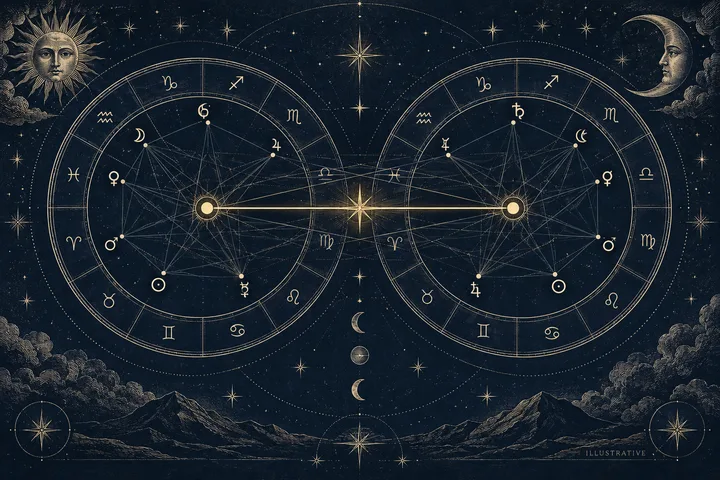
Read a crowded synastry report in layers, not line by line. Start with the personal planets and luminaries that speak to your question, then rank their closest major aspects. The planet names the relationship function. The aspect shows how the two functions meet. The sign gives the style. After that, look for repetition and one strong exception. Add houses only when dependable birth times support them. A tight Moon-Saturn contact may deserve more attention than several wide minor aspects, while Venus-Mars may explain attraction without answering whether emotional needs feel safe. Choose one leading contact and turn it into a question you and your partner can answer in ordinary life.
Sources: Aspect - Astrodienst Astrowiki; Synastry: Venus-Mars Aspects Between Two Charts - Cafe Astrology
Use signs to describe the style
Signs come after planets and aspects. They show tone, pace, instinct, and preference. Fire tends to move through enthusiasm and candor. Earth looks for steadiness and proof. Air works through words and exchange. Water reads atmosphere, attachment, and memory. The sign gives the manner. It doesn't replace the contact.
The same sign can behave differently through different planets. Venus in Gemini may seek affection through talk and curiosity. Mars in Gemini may pursue through quick action or debate. If those placements form a close aspect, the aspect tells you how the functions meet. If you know only the signs, stay at the sign level.
Modality adds another useful layer. Cardinal signs begin, fixed signs sustain, and mutable signs adapt. A fixed-sign square may hold its position long after the original issue is clear. A mutable-sign square may keep discussing the issue without choosing. Those are interpretive possibilities, not verdicts. Watch for the style in actual conversations.
Consider an example. Maria has Moon in Cancer and Venus in Gemini. Her partner has Moon in Libra and Venus in Taurus. A sign comparison suggests different ways of seeking comfort and showing love. It cannot tell you whether a close Moon aspect softens the difference. That requires degrees.
Sources: Synastry: Venus-Mars Aspects Between Two Charts - Cafe Astrology; The Elements in Astrology - Cafe Astrology; The Qualities or Modalities in Astrology - Cafe Astrology
Confirm the theme, then protect the exception
Now step back and look for repetition. A theme becomes stronger when several contacts point toward it. If Venus-Mars appears more than once and Mars also touches the other person's Moon, attraction may reach into emotional life. If Mercury or Saturn supports the same pattern, the report gives you more than one keyword to work with.
Saturn deserves careful placement in the ranking. A close Saturn contact can describe commitment and endurance, but it can also feel like judgment or restriction. Read Saturn with the planet and aspect involved. Saturn trine Venus is not Saturn square Venus. Neither is a relationship verdict.
Then find the strongest exception. If a report has many soft contacts and one tight Mars-Saturn square, don't bury it because the overall mood is pleasant. If it has dramatic Pluto contacts but no close personal-planet support, don't let intensity become the whole story. The exception often names the skill the pair needs most.
Don't double-count a contact because the wheel and table show it twice. They may be two views of one relationship between two placements. Count the contact once, then use the second display to check the orb and details.
Sources: Synastry - Astrodienst Astrowiki; Synastry: Venus-Mars Aspects Between Two Charts - Cafe Astrology
Turn one contact into one honest conversation
A synastry reading is finished when it gives you something clear to notice, ask, or practice. Pick the highest-ranked contact and describe it in ordinary language. Instead of 'your Saturn represses my Moon,' try, 'When I'm upset, your practical response can feel like distance.' That sentence leaves room for both people.
Name one supporting contact if it helps. If Moon-Saturn is the friction, Mercury-Saturn may help you make a plan for hard talks. If Venus-Mars is exciting but sharp, a softer Venus or Jupiter contact may show where warmth can return. Astrology gives the image. The couple chooses the practice.
The Synastry Comparison Report on this site uses supplied Moon, Venus, and Mars signs, optional degrees, and selected major aspects with a stated six-degree orb. It can rank the contacts those inputs support. It doesn't calculate a natal chart from birth details, calculate houses, or predict whether a relationship will succeed. Compare what you actually know, then test the leading theme in daily life.
End with one question: 'When this pattern appears, what would help each of us feel understood?' Bring one recent moment, one contact, and one answer you can observe this week. If the symbol clarifies the moment, keep it. If it doesn't, set it aside. A synastry report is a map for attention, not a demand that every line explain your life.
Sources: Synastry - Astrodienst Astrowiki; Partner horoscopes - Astrodienst FAQ; Synastry: Venus-Mars Aspects Between Two Charts - Cafe Astrology
A little more clarity
Should I read conjunctions before squares in synastry?
Read the tightest major contacts between the planets that answer your question. A conjunction often feels immediate, but its meaning depends on the planets involved. A close square may deserve priority if it repeats the main theme or names the issue that needs skill. Rank the planet pair, orb, repetition, and lived question together.
What if my synastry report has no exact birth times?
You can still read secure sign placements and many planet-to-planet contacts when the degrees are reliable. Treat houses and angles as unavailable or uncertain. Check the Moon if the date is near a sign change. A placement-only comparison can still describe emotional, affectionate, and desire patterns without adding chart layers the inputs don't support.
Can one difficult synastry aspect outweigh many easy ones?
It shouldn't automatically outweigh the chart, but a close difficult aspect can deserve the most practical attention. Read it with the planets, orb, and supporting contacts. A Moon-Saturn square may name the conversation that needs care, while easy contacts provide the goodwill to have it.
Sources & further reading
- Synastry - Astrodienst Astrowiki
Defines synastry as chart comparison, including interaspects and the house placements of one chart in the other.
- Partner horoscopes - Astrodienst FAQ
Explains that synastry uses narrower drawing orbs and distinguishes the chart wheel from the fuller aspect table.
- Aspect - Astrodienst Astrowiki
Defines major aspects, angular distance, orbs, and the interpretive role of aspect patterns and dissociate aspects.
- Synastry: Venus-Mars Aspects Between Two Charts - Cafe Astrology
Provides relationship interpretations for Venus-Mars conjunctions, oppositions, squares, trines, and sextiles.
- The Elements in Astrology - Cafe Astrology
Defines the four elements and distinguishes elemental relationships from a sign's modality or quality.
- The Qualities or Modalities in Astrology - Cafe Astrology
Explains cardinal, fixed, and mutable modalities as different ways signs initiate, sustain, or adapt.
Synastry Comparison Report
Enter known placements for two people. Get an input-by-input comparison, selected aspect calculations and a clear record of what remains uncertain.
Compare our placements