1. Begin with the relationship question, not the aspect list
Imagine Maria and Daniel have been seeing each other for six weeks. They talk for hours, then stumble over small decisions. Maria says Daniel feels warm but hard to reach when plans change. Daniel says Maria reads a pause as rejection. They open a synastry chart looking for an answer. The wheel gives them a dozen lines, several colored symbols, and no obvious story.
That is where a good reading starts. Not with the longest line. With the question underneath it.
Maria's real question isn't, "Is this chart good?" She wants to know why easy conversation turns tense when the relationship needs a decision. Daniel may want to know whether their attraction has enough steadiness to support ordinary life. Those are different questions. They will send you toward different layers of the chart.
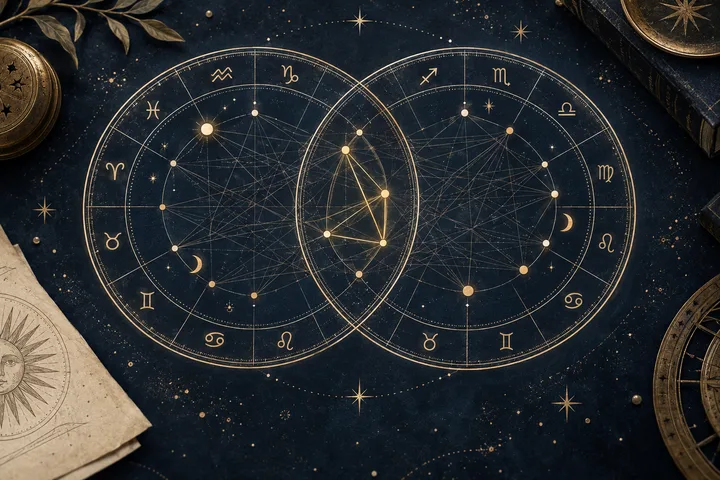
Synastry compares two birth charts. Astrologers look at the planets and angles in one chart in relation to the planets, angles, and houses in the other. Astrodienst describes it as laying the charts over one another to study inter-aspects and house placement. That gives you a field of symbols. It doesn't tell you which question to ask first. The reader supplies that focus.
Write the question in plain language before you inspect the wheel. Try one of these: Where does emotional ease come from? Why does desire feel strong but uneven? What makes conversation break down? What helps this bond become more dependable? A question keeps the reading from becoming a hunt for proof. It also lets you reject an interpretation that sounds impressive but doesn't describe anything the couple recognizes.
This first step matters because a crowded chart can answer too many questions at once. Venus may speak to affection and pleasure. Mars may speak to initiative, heat, and conflict. Saturn may speak to responsibility, delay, or endurance. Neptune may describe longing and porous boundaries. If you read all of those as one undifferentiated verdict, you lose the relationship itself.
The first pass should stay small. Record the birth information and the scope you actually have. If you know signs but not degrees, compare signs and keep the aspect layer limited. If you know degrees, note the closest major contacts. If either birth time is uncertain, leave the Ascendant and house overlays out of the leading interpretation. Precision isn't a mood. It comes from the data you can name.
For a placement-based comparison, you can work with supplied Sun, Moon, Mercury, Venus, Mars, Jupiter, Saturn, Uranus, Neptune, and Pluto signs, plus optional degrees. In the Synastry Comparison Report, selected major aspects use a six-degree orb. That is the calculation scope here. It isn't a full natal chart calculation, and it doesn't create houses from birth details that were never supplied.
Make a small intake note before you begin. Write each person's name or label, the placement, the sign, the degree if known, and whether the birth time is reliable. Mark unknowns with a blank, not a guess. This keeps a missing piece from quietly becoming a false foundation. It also makes the final reading easier to share because both people can see which conclusions rest on solid inputs and which remain open.
If you only have sign placements, don't feel that you have nothing to read. Sign-to-sign comparison can still describe elemental ease, modality, and the way two planets express their functions. Just avoid language that depends on an exact degree or house. You can say that one person's fixed Venus may prefer consistency while the other person's mutable Mars changes pace. You can't honestly call that a three-degree square without the numbers.
Now return to Maria and Daniel. Their question is not whether the chart contains attraction, because it plainly does. Their question is why the same conversation moves from ease to defensiveness. That points first to the Moon and Mercury, then to Venus and Mars, and only after that to a Saturn or outer-planet layer if the repeated pattern supports it.
The practical rule is simple: name the lived pattern, then find the chart layer that can describe it. Don't make the chart invent a question for you.
Sources: Synastry - Astrodienst Astrowiki; Aspect - Astrodienst Astrowiki; What to Compare First in Synastry; How to Actually Read a Synastry Chart: What to Look at First, Second, and Last
2. Sort the noise by data, degree, and planet
A synastry chart looks busy partly because two charts create many possible pairings. The answer isn't to interpret every line. It is to sort the lines before you read them.
Start with what is known. A sign placement tells you the style in which a planet operates. A degree tells you whether two placements form a close aspect. A house overlay tells you where the contact lands in the other person's life, but houses depend on reliable birth times. These are different layers. Keep them separate.
Next, sort by aspect type. The five major aspects are conjunction at 0 degrees, sextile at 60, square at 90, trine at 120, and opposition at 180. An aspect is the angular relationship between two chart factors. The orb is the distance between the actual positions and the exact aspect. A Venus at 14 degrees Taurus and a Mars at 17 degrees Virgo form a trine with a three-degree orb. The sign relationship gives the broad tone. The degree distance tells you how closely the contact speaks.
Notice the difference between a contact and a theme. A contact is one relationship between two placements. A theme is the meaning that survives when you compare several contacts. A single Venus-Mars trine can show attraction. Venus-Mars plus Moon-Venus plus Sun-Mars may show that attraction is supported by recognition and emotional warmth. A single Saturn square can feel heavy. Saturn touching the Moon, Venus, and Mercury can make responsibility the relationship's recurring language. Themes deserve the headline. Contacts supply the sentences.
You can also rank by closeness within the same category. A two-degree Mercury-Moon opposition usually deserves a closer first look than a six-degree Mercury-Moon trine, even though the trine sounds easier. The tighter aspect speaks with more definition. A wider contact may still color the chart, especially when the same symbolism repeats, but it should not be allowed to shout over a closer line simply because its label feels pleasant.
Astrodienst's aspect reference places the conjunction, opposition, square, trine, and sextile among the main aspects and describes the orb as the permitted deviation from exactness. Its partner-chart reference also explains that synastry software may use narrower displayed orbs because two charts create twice as many possible contacts. Practices vary, so state the orb used in the reading. A reader should know why one line made the first page and another did not.
For this guide, rank a contact by four questions. Is it within the stated six-degree orb? Does it involve a personal planet or a chart angle that you can trust? Does it answer the relationship question? Does the same theme appear elsewhere? A tight Moon-Saturn square may matter more to a question about emotional withdrawal than a wide Neptune sextile. A close Mercury-Mars contact may matter more to an argument pattern than a beautiful Venus-Jupiter trine that never appears in the couple's daily life.
This doesn't mean a trine is always minor or a square is always bad. Conjunctions concentrate the planets involved. Trines and sextiles can make a function more available. Squares and oppositions create friction, polarity, or movement. The planet tells you what is moving. The aspect tells you how the movement feels. The orb tells you how sharply the contact enters the reading.
Then sort by planet. Put the Sun, Moon, Mercury, Venus, and Mars in the first basket. These describe identity, emotional needs, communication, affection, pleasure, desire, action, and conflict. Put Jupiter and Saturn in the second basket. They show expansion, meaning, responsibility, limits, and the structures that can help or weigh on the bond. Put Uranus, Neptune, and Pluto in the third basket. They can add disruption, idealization, depth, or transformation, but they need careful weighting because their sign placements often belong to a whole generation.
The last basket isn't unimportant. It is simply easy to overread. A close Neptune contact to someone's Venus may explain why the bond feels enchanted or hard to define. A Pluto contact to the Moon may explain intensity. But those contacts should be translated through the personal planets and the repeated behavior, not allowed to become a grand story by themselves.
Consider an example. Maria has Venus at 12 degrees Cancer, and Daniel has Mars at 15 degrees Scorpio. Their three-degree water trine belongs near the front of a romance reading. Maria also has Moon at 3 degrees Libra, while Daniel's Saturn sits at 18 degrees Libra. That is outside a six-degree orb, so it shouldn't be used as a close Moon-Saturn contact in this method. The chart may show other Saturn themes, but this particular line isn't evidence for one.
Now consider the reverse mistake. Suppose Maria's Moon is at 21 degrees Libra and Daniel's Saturn at 25 degrees Libra. The four-degree conjunction belongs in the emotional structure layer. It may describe seriousness, caution, care, or heaviness. It doesn't tell you which person is controlling or whether the relationship will last. It tells you where responsibility and feeling meet. The lived question decides whether that meeting feels containing or restrictive.
Sorting gives the chart a readable shape. It keeps every entry from pretending to deserve equal weight.
Imagine Maria and Daniel opening a synastry wheel and finding so many lines that every interpretation seems possible. The first thing to read isn't the most dramatic aspect. Start with the relationship question, then sort the chart by signal: verified placements, close major aspects, personal planets, and themes that repeat. Read the Sun and Moon for identity and emotional rhythm. Move to Mercury, Venus, and Mars for conversation, affection, desire, and conflict. Then test the pattern with Saturn, house overlays, and outer planets. A single Pluto square or Neptune conjunction can add intensity, but it shouldn't overrule a stronger repeated pattern. Use the supplied signs and degrees only. If degrees are available, this report's selected major-aspect pass uses a six-degree orb; it doesn't calculate houses or natal positions from birth details. Your goal is a short, honest summary and one useful conversation, not a compatibility score.
Sources: Synastry - Astrodienst Astrowiki; Aspect - Astrodienst Astrowiki; What to Compare First in Synastry; How to Actually Read a Synastry Chart: What to Look at First, Second, and Last
3. Read the personal planets in a useful order
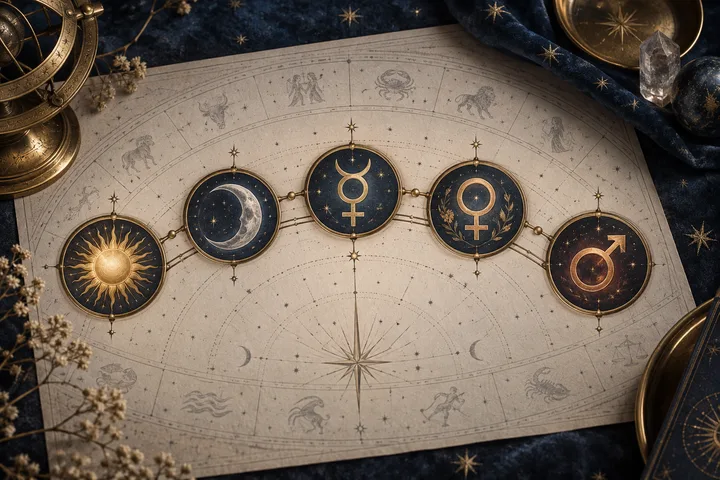
Once the data is sorted, read the personal planets as a sequence. The sequence isn't a rigid law. It is a way to move from who you are, to how you feel, to how you speak, love, want, and act together.
Start with the Sun. Sun contacts show where one person's identity, will, confidence, and sense of direction meet the other person's chart. A Sun-Moon contact can make one person feel recognized by the other's inner world. A Sun-Venus contact may bring admiration and warmth. A Sun-Saturn contact can add seriousness and responsibility, though it may also feel like judgment when the bond is strained.
Then read the Moon. This is the layer many crowded-chart readings skip because it looks less dramatic than Pluto or the Nodes. Don't skip it. The Moon describes emotional timing, instinctive comfort, habits, and the conditions under which a person can soften. Moon contacts help you ask whether the two people know how to settle after stimulation. Can they make room for each other's moods? Do they respond to distress in ways the other can receive?
Moon-Moon contacts compare two emotional rhythms. A conjunction can feel immediate and familiar, but it can also amplify the same fear or mood. A trine or sextile may create ease. A square may show different needs around privacy, reassurance, speed, or expression. An opposition can create a compelling polarity. None of these is automatically a blessing or a problem. The interpretation becomes useful when it names the exchange and points to a practice.
Moon-Venus contacts often bring tenderness and a sense of being liked as you are. Moon-Mars contacts can stir protectiveness, desire, irritation, or fast reactions. Moon-Saturn contacts can create steadiness, duty, fear of disappointment, or a sense that one person must manage the other's feelings. Read the aspect, the orb, and the whole pattern together.
Mercury comes next when the question involves understanding. Mercury contacts describe how two people speak, listen, name facts, make decisions, and repair a misunderstanding. Mercury-Mercury harmony may help the pair find a shared pace. Mercury-Moon contacts can let words reach feelings, or make one person's logic touch the other's vulnerability. Mercury-Mars can sharpen debate and quicken desire, but it can also turn a small difference into a contest if neither person slows down.
This is where Maria and Daniel's case becomes clearer. Suppose Maria's Mercury is in Virgo and Daniel's Mars is in Gemini, with a close square. That doesn't mean they are doomed to argue. It suggests that Daniel's quick, improvising push can meet Maria's careful, precise mind as pressure. If they already recognize the pattern, the chart gives them language for a repair: slow the decision, state the practical question, and don't treat a request for detail as a refusal of desire.
Venus shows affection, values, pleasure, and the way someone receives love. Venus-Venus contacts can reveal shared tastes or different ways of showing care. Venus-Moon contacts can make affection feel emotionally nourishing. Venus-Mars contacts bring attraction, pursuit, and the meeting of receptive and active desire. Venus-Saturn may give loyalty and patience, but it can also make affection feel measured. Venus-Uranus may keep the bond lively and unsettled. Venus-Neptune can soften the edges of reality and invite projection.
A useful discipline is to read each planet in the sentence, "When your planet meets their planet, what does the first person do and what does the second person receive?" If her Venus meets his Mars, her style of affection may draw out his action, while his pursuit may make her feel desired. If her Moon meets his Mercury, her feelings may become the subject of his questions, while his words may give shape to what she sensed but couldn't name. This directional language keeps the interpretation alive and specific.
Don't force every contact into romance. Synastry can describe friendship, family, work, or the bond between two people who never date. Even in a romantic chart, Mercury may be more important than Venus when the couple's central issue is decision-making. Saturn may be more important than Mars when the question is whether responsibilities are shared. Let the question choose the planet, then let the planet choose the vocabulary.
Mars shows initiative, erotic drive, anger, courage, and the way a person moves toward what they want. Mars-Mars contacts can create shared momentum or competition. Mars-Saturn can help a couple work through difficulty, or make action feel blocked. Mars-Neptune can scatter intention. Mars-Pluto can intensify the will. Again, the chart describes a field of force. It doesn't decide how either person uses that force.
A first personal-planet summary should contain no more than three themes. For example: your Moons need different kinds of reassurance; your Mercury contacts make timing important; your Venus-Mars trine gives attraction an easy channel. That is already more useful than naming every aspect in the wheel.
The strongest interpretation is usually the one that explains more than one ordinary moment. If the same contact speaks to how you text, plan, flirt, and repair, it deserves attention. If it only describes a mood you felt once, keep it in the margin.
Sources: Synastry - Astrodienst Astrowiki; Aspect - Astrodienst Astrowiki; What to Compare First in Synastry
4. Look for repeated themes, not a single dramatic line
After the personal planets, stop and ask what repeats. This is the turning point in a crowded chart. You are no longer collecting meanings. You are deciding which meanings belong to the relationship's central pattern.
A repeated theme can appear through several aspects to one planet, several aspects involving the same element, or several contacts that point toward the same relationship function. Three close contacts to the Moon may matter more than one striking outer-planet conjunction because they keep returning to the emotional layer. Several Mercury contacts may explain why conversation is the place where the relationship becomes most alive. Venus and Saturn appearing together in more than one way may give affection a serious, patient, or cautious tone.
Do not count aspects as if they were votes. Repetition isn't a mechanical tally. It is a way to see whether the same image holds from different angles. A chart with Moon trine Venus, Moon sextile Jupiter, and Venus trine Saturn does not simply have three good marks. It may show a pattern in which warmth, generosity, and steadiness support one another. A chart with Mars square Mercury, Mars opposite Moon, and Mercury square Saturn may show that action, speech, and emotional safety keep rubbing against each other.
Now add sign relationships. The aspect tells you the geometry. The signs show the style. A close square between Venus in Aries and Mars in Cancer isn't the same as a close square between Venus in Virgo and Mars in Sagittarius. The first may bring direct desire against protective sensitivity. The second may bring careful standards against blunt movement. You don't need to turn that difference into a fixed personality label. Use it to ask how the contact behaves in real life.
Then check direction. In a synastry contact, one person's planet acts on the other person's planet, and the experience may not feel identical from both sides. Maria's Mars may activate Daniel's Venus, while Daniel experiences her initiative as exciting and Maria experiences his Venus as an invitation. A mutual or mirrored pattern can distribute the theme more evenly. A one-way contact may still matter deeply, but name whose function is being activated rather than writing as if both people receive the same message.
A worked example helps. Imagine Maria and Daniel have these supplied placements: Maria's Moon is at 8 degrees Pisces, Venus at 14 degrees Cancer, and Mercury at 20 degrees Virgo. Daniel's Moon is at 11 degrees Scorpio, Mars at 17 degrees Scorpio, and Mercury at 24 degrees Gemini. Under a six-degree orb, Maria's Moon trines Daniel's Moon by three degrees. Her Venus trines his Mars by three degrees. Her Mercury squares his Mercury by four degrees. The pattern is not random. Water Moon and Venus-Mars contacts support emotional and physical flow. The Mercury square introduces a different pace of thought.
That example gives you a rank. First, read the water pattern because it repeats across feeling and desire. Second, read the Mercury square because it names the problem the couple actually brought to the chart. Third, ask whether any Saturn or house contact adds structure or context. The answer isn't that the relationship is easy. It is that tenderness and attraction may be strong enough to make a communication practice worth building.
The strongest exception is a single extremely tight contact to a personal planet or angle. A one-degree Moon-Saturn conjunction may deserve more attention than several loose minor aspects. Exactness can sharpen a symbol. But even then, the contact is a doorway, not the whole house. Ask what it repeats, what it contradicts, and what it looks like in behavior.
When themes conflict, don't average them into a bland middle. Rank them by the question. A couple may have repeated Venus-Jupiter warmth and repeated Mercury-Saturn difficulty. If they ask why they enjoy each other but keep missing deadlines, the Mercury-Saturn pattern leads and the Venus-Jupiter pattern explains why they keep returning to the conversation. If they ask what makes the bond generous, reverse the order. The chart hasn't changed. Your question has.
A repeated theme can also be hidden in the absence of a contact. If a chart shows strong Venus-Mars chemistry but little Moon or Mercury connection, the reading may need to ask how the pair moves from attraction into emotional knowledge. If the chart shows many Moon contacts but little Mars, the bond may feel caring without making desire easy to name. Absence doesn't prove failure. It tells you which bridge the couple may need to build deliberately.
Outer planets can repeat too. Several tight Neptune contacts may make idealization a central theme. Several Uranus contacts may make independence and surprise central. Several Pluto contacts may make intensity, power, and transformation central. Yet the interpretation remains strongest when you can translate the theme into a concrete question: Are we naming what is real? Can we give each other space? How do we handle jealousy or unequal influence?
Patterns make a crowded chart readable because they force a choice. You don't need to carry every symbol forward. Carry the two or three themes that explain the most, then let the rest qualify them.
Sources: Synastry - Astrodienst Astrowiki; Aspect - Astrodienst Astrowiki; What to Compare First in Synastry; How to Actually Read a Synastry Chart: What to Look at First, Second, and Last
5. Use Saturn, houses, and outer planets as the second pass
Only after the main pattern is visible should you add Saturn, house overlays, and the outer planets. These layers can change the reading. They shouldn't replace it.
Saturn asks what the relationship must carry. Its contacts can describe commitment, duty, limits, timing, fear, and the work of making a bond dependable. Saturn to the Sun may make identity feel tested or respected. Saturn to the Moon may bring containment, responsibility, distance, or emotional weight. Saturn to Venus can bind affection through loyalty and patience, or make love feel earned. Saturn to Mars can discipline action or slow it until resentment builds.
Read Saturn in both directions. The Saturn person may feel responsible, cautious, or authoritative. The personal-planet person may feel held, evaluated, restricted, or taken seriously. The same contact can change over time. Early in a bond, Saturn may feel like a reason to trust. Later, it may show where the couple needs to renegotiate rules. A Saturn contact does not certify permanence, and a lack of Saturn contact does not cancel affection. It tells you where structure enters the story.
House overlays answer a different question: where does the other person's energy land in your life? A partner's Venus in your seventh house may make partnership feel vivid. Their Moon in your fourth may stir home, memory, and belonging. Their Mars in your tenth may activate ambition or conflict around public direction. Their planets in your eighth or twelfth may feel intimate, private, or difficult to name.
But houses require dependable birth times. If a birth time is missing or uncertain, don't turn a guessed Ascendant into a fact. Read the signs and degree-based aspects you can verify, and say less about houses. The chart becomes more trustworthy when its limits stay visible inside the method. This is especially important when a crowded wheel tempts you to use every available symbol.
Outer planets come after the personal planets because they often describe a larger generation unless they make a close contact to a personal planet or angle. Uranus can bring freedom, shock, experimentation, and an uneven rhythm. Neptune can bring devotion, imagination, longing, and blurred boundaries. Pluto can bring depth, compulsion, power, and renewal. These are not small meanings. They are simply meanings that need a stable personal-planet context.
Consider an example. Daniel's Neptune is close to Maria's Venus. He may seem to awaken a romantic image in her, and she may experience their connection as subtle, spiritual, or difficult to define. That contact matters. But before turning it into a story about fate, read Maria's Moon, Mercury, and Saturn contacts. Does the bond also support clear speech, emotional steadiness, and practical follow-through? If yes, Neptune may describe tenderness and imagination. If not, it may describe the gap between longing and what the relationship can actually hold.
The same principle applies to Pluto. A close Pluto-Moon contact can feel profound. It can also make a person feel watched, changed, or emotionally exposed. Read it with the rest of the chart and with the actual choices between the people. Intensity isn't the same as care. Mystery isn't the same as depth. The chart can show why an experience feels powerful; it can't excuse the misuse of power.
This is also where you can bring in the Ascendant and Descendant if the birth times are reliable. Contacts to the angles can describe immediate presence, attraction, and the way each person enters the other's field. They can be strong. They can also distract from a weaker emotional foundation if you read them first. Treat them as a valuable contextual layer, not a substitute for the Moon and personal planets.
House overlays also work best when you connect them to the planets already carrying the story. Venus in the seventh house can make partnership salient, but Venus's sign and aspects tell you how affection behaves there. Mars in the fourth can energize home life, but Mars's contacts show whether that energy becomes protection, activity, argument, or desire. The house is the room. The planet is the guest. The aspect tells you how the guest moves through the room.
If the report contains no houses, you can still make a strong first reading. Say what the supplied contacts support, and leave the uncalculated layer alone. Readers often mistake more detail for more truth. A short interpretation built from reliable Moon, Venus, and Mars placements can be more useful than a full-looking wheel built on a guessed time.
Your second-pass notes should answer three questions. What helps this relationship become more dependable? Where does it feel unusually intense or hard to name? Which life area receives the strongest activation? If you can answer those questions without adding another dozen interpretations, the chart has done its work.
Sources: Synastry - Astrodienst Astrowiki; Aspect - Astrodienst Astrowiki; How to Actually Read a Synastry Chart: What to Look at First, Second, and Last
6. Turn the reading into one clear conversation
A synastry reading is finished when it gives you a better question to ask each other. Not when every line has a paragraph.
Return to Maria and Daniel. Their chart shows a repeated water pattern, a close Mercury tension, and a possible Saturn layer that deserves a careful look. The useful conclusion isn't, "You are compatible but complicated." That sentence says almost nothing. The useful conclusion is sharper: you may find emotional and physical ease quickly, but your different thinking speeds can turn uncertainty into defensiveness. The relationship needs a slower decision process, especially when one person asks for details and the other hears doubt.
That conclusion is an interpretation, not a verdict. It gives the couple something to test. Maria can say, "When plans change, I need us to name what changed before we decide what it means about us. Can we try that?" Daniel can say, "When you ask for more detail, I sometimes hear a no. Could you tell me whether you need information, reassurance, or more time?" Those questions do more than another hour of aspect browsing.
Build your own closing summary in three parts. First, name the strongest ease. It may be a Moon contact, a Venus-Mars connection, shared sign emphasis, or a house overlay you can trust. Second, name the strongest friction in ordinary language. Avoid labels such as "bad aspect" or "karmic problem." Say what might happen: one person moves quickly while the other needs proof; one person seeks privacy while the other processes aloud; one person offers care through action while the other needs words.
A good summary also keeps both people visible. Don't write one person as the cause and the other as the effect unless the chart and the situation truly support that distinction. Say, "Your Mars activates his Venus, and his Venus invites your initiative," rather than assigning all desire to one person. Say, "Your Moon asks for quiet while his Mercury asks for explanation," rather than calling one person needy and the other cold. Astrology gives you finer language than blame.
Before you act on an interpretation, ask whether it makes a difference. If the answer is no, cut it. Knowing that two placements form a sextile matters only if you can say what kind of cooperation it offers. Knowing that an opposition creates polarity matters only if you can describe the two sides and the practice that lets them meet. A useful reading changes what you notice next time the pattern appears.
Third, choose the next conversation. It should be small enough to have, and specific enough to reveal something. Ask how each person wants conflict to pause and restart. Ask what affection looks like on a busy week. Ask how much independence each person needs. Ask what makes a promise feel real. The chart can help you choose the subject. The answer will come from what each person says and does.
Keep chart scope honest in the final write-up. If you compared supplied placements and optional degrees, say that. If you used a six-degree orb for selected major aspects, say that. If you didn't calculate houses, don't write as if you did. If a birth time is missing, don't use an exact Ascendant or house placement. These aren't footnotes to hide. They tell the reader which layer of astrology the interpretation actually belongs to.
You can use the Synastry Comparison Report when you already know the placements you want to compare. It can organize supplied Moon, Venus, and Mars signs, include optional degrees, and select major aspects using the stated six-degree orb. It won't calculate a natal chart from birth details, calculate houses, or issue a dating verdict. That boundary keeps the report focused on the material you bring to it.
The crowded-chart problem often comes from asking astrology to remove all uncertainty. It can't, and it shouldn't. A rich chart can show several truths at once. You may feel strong desire and still need clearer communication. You may feel tenderness and still need better boundaries. You may have a binding Saturn contact and still need to decide whether the responsibilities are shared. Rank the themes. Hold the exception. Then look at the relationship in front of you.
So what should you read first? Read the real question. Then read verified data, close major contacts, the personal planets, and repeated themes. Read Saturn, houses, and outer planets after the core picture forms. Finish with one conversation that tests the interpretation in life.
Ask this tonight: "What part of the way we connect feels easy, and what part needs a clearer agreement?" Listen to the answer.
Sources: Synastry - Astrodienst Astrowiki; Aspect - Astrodienst Astrowiki; What to Compare First in Synastry
Sources & further reading
- Synastry - Astrodienst Astrowiki
Supports the definition of synastry as a comparison of charts, inter-aspects, house overlays, and the differing roles of harmonious and dynamic contacts.
- Aspect - Astrodienst Astrowiki
Supports the definitions of major aspects, aspect patterns, and orb as the permitted distance from an exact angular relationship.
- What to Compare First in Synastry
Supports beginning with a real relationship question, checking data quality, reading personal planets, and looking for repeated themes before isolated aspects.
- How to Actually Read a Synastry Chart: What to Look at First, Second, and Last
Supports a layered reading order that gives priority to personal planets and repeated patterns before house overlays and outer planets.
Synastry Comparison Report
Enter known placements for two people. Get an input-by-input comparison, selected aspect calculations and a clear record of what remains uncertain.
Compare our placements