The moment the picture stops making sense
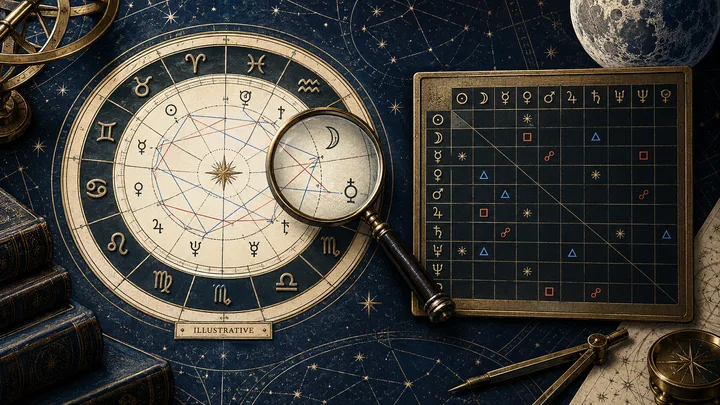
Imagine Maria and Daniel comparing a synastry report after a promising first month. Maria's Venus appears near the top of the wheel. Daniel's Mars sits across the circle. A line seems to connect them, and its shape looks like a square. The selected aspect panel, though, shows no Venus-Mars contact. Maria wonders which part of the report she should trust.
The answer begins with a simple rule. A chart wheel is a drawing. An aspect table is a calculation presented as text. The drawing helps your eye see the two charts at once, but lines can be hard to trace, colors can overlap, and a wheel may round positions for display. The table usually exposes the planet names, aspect symbol, and orb. That makes it the better starting point for verification, provided you can also see the underlying positions.
This matters because the visible sign relationship can suggest one story while the actual angular distance tells another. Taurus and Scorpio are opposite signs, so planets in those signs may look naturally opposed. That does not prove an opposition. A planet at 2 degrees Taurus and another at 2 degrees Scorpio are opposed. A planet at 29 degrees Taurus and another at 1 degree Sagittarius is also close to opposition, even though the signs are different. But 29 degrees Taurus and 1 degree Libra are not a square just because the signs sit in a familiar visual pattern. Degrees decide the contact.
The same problem appears in reverse. Two planets can form a real aspect across a sign boundary. A conjunction can cross from late Aries into early Taurus. A degree-based sextile can connect late Gemini with early Virgo, even though those signs are traditionally read as a square pair. If you judge only by sign labels, you may discard a contact the degrees support. If you judge only by a colored line, you may assign a contact that the selected orb does not support.
So Maria and Daniel should pause before asking what Venus-Mars synastry means. First they need to know whether Venus and Mars actually meet by aspect, what their exact separation is, and which chart settings produced the report. Verification is not a detour from interpretation. It is the first interpretive act.
A useful audit also protects the people in the reading. When a line looks dramatic, it is easy to turn a visual impression into a claim about attraction, conflict, or permanence. But the chart has not yet earned that claim. The first question is narrower: what two factors are connected, by how many degrees, and under which rule? Narrow questions produce stronger readings.
Keep a small record as you work: chart type, ring ownership, zodiac frame, exact positions, proposed contact, and orb. That record leaves a trail another reader can follow.
Sources: Aspect, Astrodienst Astrowiki; Synastry Aspect Grid Calculator, Augurine; Using your Astro Gold program, AstroSynthesis
What an aspect actually measures
An aspect is an angular relationship between two chart factors. In synastry, one factor belongs to one person's chart and the other belongs to the second person's chart. The major aspects use five familiar angles: conjunction at 0 degrees, sextile at 60 degrees, square at 90 degrees, trine at 120 degrees, and opposition at 180 degrees. An orb is the distance between the exact angle and the measured angle.
That definition gives you a repeatable test. Convert each planet's sign and degree into a position on one 360-degree zodiac circle. Aries begins at 0 degrees, Taurus at 30, Gemini at 60, and so on. A planet at 14 degrees Taurus sits at 44 degrees of zodiacal longitude. A planet at 14 degrees Scorpio sits at 224 degrees. The difference is 180 degrees, so the pair forms an exact opposition.
For a pair that crosses 0 Aries, measure both routes around the circle and use the shorter one. Suppose one planet is at 28 degrees Pisces, or 358 degrees, and the other is at 2 degrees Aries. The direct difference is 356 degrees, but the shorter route is 4 degrees. That is a conjunction with a 4-degree orb under the six-degree rule. A wheel may place the points on opposite sides of the sign boundary, but the circle has not broken.
Here is the hand-check in plain form. Find the absolute difference between the two longitudes. If it is greater than 180 degrees, subtract it from 360. Compare the result with 0, 60, 90, 120, and 180. The smallest distance from one of those exact aspect angles is the orb. If that smallest distance is six degrees or less, record the corresponding major contact. If it is larger, leave the pair unlisted under this article's rule.
The last step is ranking. A 0-degree conjunction and a 1-degree conjunction are not interchangeable with a 6-degree conjunction. They share an aspect name, but the tighter contact has greater precision and usually carries more weight in the reading. The table should show that difference. Never let a filled cell turn every contact into an equal-sized event.
The five angles also have different motions in a reading. A conjunction joins the planets and makes their functions hard to separate. An opposition sets them across an axis, so attraction and tension arrive together. A square presses the planets into action. A trine lets them cooperate with little effort. A sextile opens a door that still needs participation. These are interpretive categories, not substitutes for the degree check.
If the shortest distance is 87 degrees, compare it with the square at 90 degrees, not with the trine at 120 degrees. The orb is 3 degrees. If the shortest distance is 123 degrees, the trine has a 3-degree orb. The same pair can never be called both a square and a trine under one consistent major-aspect method, even if a crowded picture makes both lines seem nearby.
Write the calculation in a form you can read aloud: '44 degrees to 224 degrees gives 180 degrees, exact opposition, 0-degree orb.' That sentence is plain, checkable, and enough to stop a visual guess from taking over.
Imagine Maria sees a red square line between her Venus and her partner's Mars, but the aspect table lists nothing. Or the table says trine while the wheel seems to point to a different sign. Start with the positions, not the picture. Write both planets as full zodiac longitudes, measure the shorter angular distance around the 360-degree circle, compare that distance with the five major aspect angles, and then apply one declared orb rule. In this article, that rule is a six-degree maximum orb for major synastry contacts. The table should lead when it displays the exact positions and orb used for its calculation. The wheel remains useful for checking which planet belongs to which person, whether a line lands on the intended points, and whether a sign-boundary contact is being read as an aspect or as sign affinity. If the data still conflict, do not interpret the contact yet. Re-enter the zodiac, birth-time, and display settings, then compare unrounded degrees. A clean verification gives you a better reading and a more useful conversation.
Sources: Aspect, Astrodienst Astrowiki; Using your Astro Gold program, AstroSynthesis; Introduction to Relationship Astrology 2: Synastry
The fastest way to audit the two displays
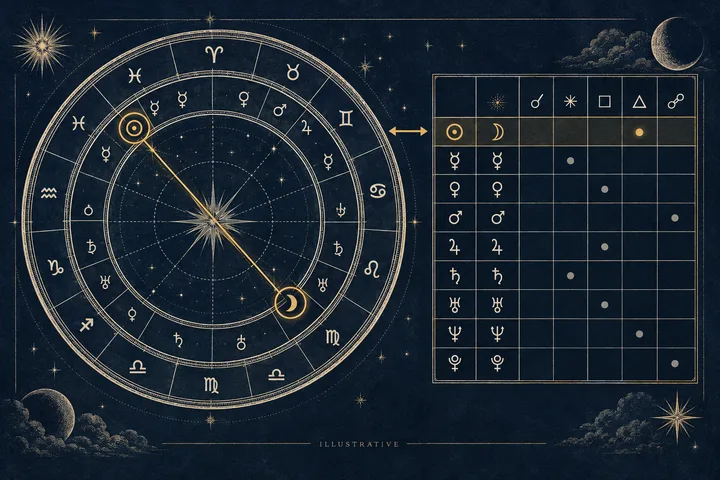
Consider an example with a reported Sun-Moon contact. The wheel shows Person A's Sun at 29 degrees Gemini and Person B's Moon at 2 degrees Virgo. The table calls it a square with a 3-degree orb. Is that possible? Not from those positions. Gemini begins at 60 degrees, so the Sun is at 89 degrees. Virgo begins at 150 degrees, so the Moon is at 152 degrees. The separation is 63 degrees, which is a sextile with a 3-degree orb, not a square. The table's label and the supplied positions cannot both be right.
The table may use a different position, or the reader may have mistaken one line for another. Confirm the row, column, and chart ownership before the symbolism gets inflated. A reversed grid should preserve the aspect, but a misread label changes the story.
Next, compare the full degrees and minutes, not the large wheel labels. If the wheel prints 14 degrees while the table prints 14 degrees 52 minutes, use 14 degrees 52 minutes for the check. A wheel commonly has limited room. It may round or truncate. The table may carry the precision that determines whether a contact sits at 5 degrees 58 minutes or 6 degrees 2 minutes. Under a strict six-degree maximum, those two cases fall on different sides of the line.
Then inspect the aspect glyph and orb together. A triangle usually marks a trine, a square marks a square, and a circle or ring marks a conjunction, but styles vary. The number is not decoration. It tells you how far the pair sits from exact. Some tables also mark applying or separating contacts with a letter. That label can add timing language to a report, but it should not replace the basic angle and orb check.
Trace the wheel line back to both named glyphs, ignoring lines that cross it. If the table names a Venus-Mars trine, the line should connect those planets and their degrees should sit close to 120 degrees apart. If one check fails, inspect the settings.
A useful worksheet records the two factors, measured separation, proposed aspect, orb, and confidence. Mark a contact confirmed when positions, settings, and angle agree; conditional when a degree is rounded or a Moon position depends on uncertain time; unresolved when the reports use different inputs.
If you're checking several contacts, start with the closest ones. Sort the table by orb, then check the personal planets before slower points. This keeps the reading from being hijacked by a long list of weak contacts. The goal is a clear pattern, not an inventory of every line the software can draw.
Only after this pass should you move from 'is there a contact?' to 'what does it describe?' The first question is geometric. The second is astrological. They work in that order. For a second perspective on how a close contact can fit the chart without fitting lived experience, see [when a synastry aspect fits the chart but not the relationship](/journal/synastry-aspect-fits-chart-not-current-relationship).
Sources: Synastry Aspect Grid Calculator, Augurine; Using your Astro Gold program, AstroSynthesis; Introduction to Relationship Astrology 2: Synastry
Why the wheel and table can tell different stories
Maria's original disagreement may come from display design rather than bad astrology. A bi-wheel compresses a great deal of information into one circle. It can show two zodiac rings, house cusps, planet glyphs, and aspect lines at the same time. When several contacts gather in one area, the lines overlap. A line can appear to touch a nearby glyph while actually ending at another one.
The table has its own weakness. It may use a different orb list from the wheel. One program can draw only contacts under a tight synastry setting while its general aspect table uses a wider setting. Another can include minor aspects in the table but show only major aspects as lines. A report can therefore be internally consistent within each panel and still confuse a reader who assumes both panels use identical filters.
Look for the report's configuration before treating the disagreement as a contradiction. Check the zodiac reference frame, the aspect list, the maximum orb, and whether the display includes only major aspects. Check whether one chart was placed inside and the other outside. That last choice changes house overlays and the visual order of the people, but it does not change the planet-to-planet angle. It can change who you think is expressing the contact, which is a meaningful reading error.
Also check whether you are comparing the same type of chart. A synastry bi-wheel overlays two natal charts. A composite chart calculates a separate relationship chart. A transit wheel compares current moving positions with a natal chart. Their lines can look similar, but their questions differ. If the table belongs to a synastry chart and the wheel belongs to a composite chart, no amount of tracing will reconcile them. Return to the chart label.
The safest order is data, settings, table, wheel, meaning. A synastry chart answers a different question from a composite chart, and a house overlay adds another layer rather than correcting a planet-to-planet angle. If house placement is part of the disagreement, settle the planet-to-planet contact first, then read the overlay as a separate layer.
Color is not a universal language. One program may use red for squares and oppositions, blue for trines and sextiles, and another may reverse the palette or use line thickness instead. Glyphs can vary too. Learn the legend on the page you are reading. A red line is never enough evidence by itself.
The same caution applies to an empty cell. Empty may mean no major aspect under the selected orb. It may not mean no relationship between those planets. They can share an element, modality, sign ruler, or another astrological connection outside the grid's chosen list. Record what the display excludes before treating silence as a conclusion.
This keeps the method generous without making it vague. You can honor the visual language of the wheel and still ask the table to show its work.
Sources: Aspect, Astrodienst Astrowiki; Synastry Aspect Grid Calculator, Augurine; Using your Astro Gold program, AstroSynthesis
Sign boundaries create the most persuasive mistakes
Sign boundaries are where a visual impression becomes especially convincing. Astrologers read signs as fields of meaning, so sign-pair relationships matter. But an aspect is an angular measurement. Those two layers speak to each other without becoming the same thing.
Imagine Person A's Venus at 28 degrees Leo and Person B's Mars at 2 degrees Scorpio. The longitudes are 148 degrees and 212 degrees. Their separation is 64 degrees. Under a six-degree orb, that is a sextile. The planets occupy signs that do not form the usual same-element sextile pair, so this is an out-of-sign or dissociate sextile. The degree contact remains real in the geometric layer, while the sign relationship colors it differently.
Now change Mars to 2 degrees Sagittarius. The separation from Venus becomes 94 degrees. That is a square with a 4-degree orb. The wheel may show a hard line and the table may list a square, even though Leo and Sagittarius are often described through fire-sign affinity. Sign affinity can make the contact feel more familiar, but it does not erase the square's demand for adjustment.
This is why you should record both statements. Say, 'Venus and Mars are 4 degrees from a square, and the contact crosses a sign boundary.' Do not say only, 'Leo and Sagittarius are compatible,' and do not say only, 'The square is everything.' The aspect describes the angle of exchange. The signs describe the style and resources each planet brings to that exchange.
A table that lists the contact while the wheel looks strange may be doing its job. The stronger question is whether the program supports out-of-sign aspects under its chosen settings. If it does, keep the contact but rank it by orb and planet significance. If it does not, note the sign-based relationship separately. A disagreement is often a demand for layered reading, not a reason to force one layer to win. If the report uses only supplied placements, keep degree-based and sign-based claims separate.
For example, late Leo and early Scorpio may produce a close sextile by degree while the signs themselves do not offer the usual same-element story. The contact may still open exchange, but it may require more translation than a same-element sextile. That is a richer sentence than either 'the aspect does not count' or 'the signs do not matter.'
The reverse can happen with signs that look easy together but lack a close aspect. Two planets in compatible elements may share a tone, yet no major degree contact ties their functions together. Call that sign affinity. Do not borrow the language of an exact trine. A sign relationship can be meaningful without wearing an aspect name.
When wheel and table disagree near a boundary, record the boundary itself. It may explain why the image feels more tense or more familiar than the aspect label suggests. The reader then sees both the geometry and the symbolic texture.
Sources: Aspect, Astrodienst Astrowiki; Introduction to Relationship Astrology 2: Synastry
How degrees, rounding, and missing data change the answer
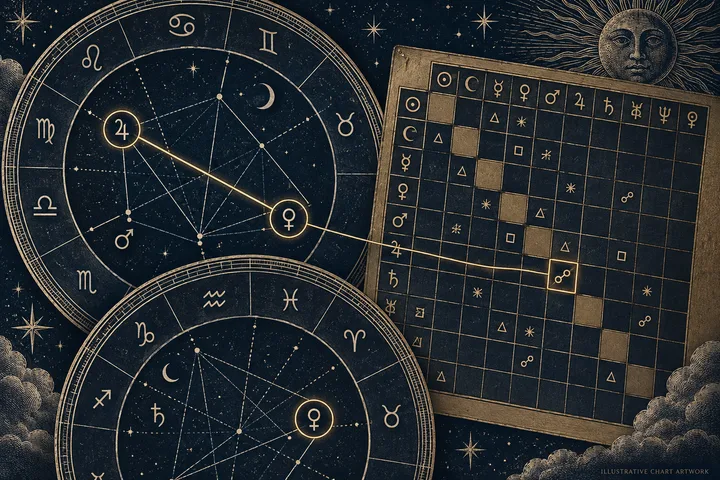
A reported contact is only as precise as the positions behind it. If a report gives Venus as 12 degrees Libra, that may mean exactly 12 degrees for the purpose of the supplied data, or it may be a rounded display of 12 degrees 43 minutes. Those are different inputs. A second planet at 18 degrees Capricorn is 96 degrees from 12 degrees Libra, but 95 degrees 17 minutes from 12 degrees 43 minutes Libra. Both are squares under six degrees, yet the exact orb changes the ranking.
The edge of an orb deserves special care. A pair at 5 degrees 40 minutes from exact is comfortably inside a six-degree rule. A pair at 6 degrees 8 minutes is outside it. If one display rounds both to whole degrees, the wheel may make them look identical. Ask for the unrounded positions or the report's data sheet. When the source only supplies whole signs, do not pretend you can verify a degree aspect.
The Moon adds another layer. It moves quickly enough that an unknown birth time can change its degree, and sometimes its sign, during the date. A Moon-Moon or Moon-Venus contact near the orb limit may therefore be conditional. You can say that the sign-level comparison is available and that the exact aspect depends on the Moon's position. You cannot honestly promote a tentative contact to a confirmed one because a wheel happened to draw a line.
Birth time also controls angles and houses. The Ascendant and Midheaven are time-sensitive. If a report shows a partner's planet conjunct your Ascendant but the birth time is uncertain, that contact needs a separate verification standard from a planet-to-planet aspect. The six-degree rule in this article applies to the major synastry contacts being checked, but missing time can still weaken the position itself.
A clean report should preserve the sign, degree, minutes, zodiac frame, and source setting for every placement. If those details are absent, narrow the claim. 'These signs have a shared theme' is different from 'these planets form a 2-degree trine.' Precision is not pedantry. It tells you what kind of relationship between the symbols you are actually reading.
Date-only comparisons can still serve a placement-only reading when you respect their limits. The Sun and most planets may stay in the same signs throughout a date, but the Moon and chart angles need closer time control. Don't insert a default birth time and forget it. A precise-looking house or angle may belong to no confirmed moment.
The report's strongest sentence should match its strongest input. Full degrees support an exact orb. Sign-only data supports sign affinity. A time range supports a conditional Moon statement. If two sources disagree, investigate the input or settings rather than averaging them, and change the contact's rank when a correction moves it across the six-degree boundary.
Sources: Synastry Aspect Grid Calculator, Augurine; Using your Astro Gold program, AstroSynthesis; Introduction to Relationship Astrology 2: Synastry
What to do when two calculators still disagree
Sometimes you check the labels, recalculate the longitudes, and still get two answers. Don't compare the aspect names first. Compare the inputs. Put the two reports side by side and write down the zodiac type, date format, time zone, daylight-saving treatment, birth location, house system, aspect set, and orb table. Most disputes become smaller once the settings are visible.
The zodiac reference frame comes first. Tropical and sidereal charts place the same planet at different zodiac degrees because they use different reference points. A placement near a sign boundary can move into another sign, and every degree-based contact can shift with it. Two reports using different frames are not measuring the same positions. Choose the frame your reading uses, record it, and do not mix the outputs.
Next inspect time conversion. A birth time typed as local time in one report and universal time in another can move the Moon, angles, and houses. A date entered in day-month-year format may be read as month-day-year elsewhere. The planet positions will then belong to different moments. The wheel can look polished in both reports. That does not make the inputs equivalent.
Then compare the orb policy. One source may call a 6-degree trine active. Another may stop at 4 degrees. One may use wider allowances for the Sun and Moon. Another may use one uniform ceiling. Neither table should be interpreted without its rule. For this publication's comparison scope, use the stated six-degree maximum for major contacts and report the exact orb whenever it is known.
If all settings match but the numbers do not, preserve the disagreement as unresolved data. Re-enter the placements from a reliable record, check the source's detailed position table, and ask which calculation was used. Do not average the two results. An averaged aspect is not an astrological technique. It is a blur.
If the disagreement is only a few minutes of arc, check rounding. If it's several degrees, inspect the zodiac frame, date, time, or location. Keep the original reports and save their settings with the positions. Label the result as a display difference, input difference, or interpretive difference. Only the first two change the reported contact itself; the third belongs to the reading that follows verification.
Sources: Aspect, Astrodienst Astrowiki; Synastry Aspect Grid Calculator, Augurine; Using your Astro Gold program, AstroSynthesis
Maria's final check and the next useful step
Return to Maria and Daniel. Their first wheel seemed to show a Venus-Mars square. The table showed no contact. Maria records the positions instead of arguing with the line. Her Venus is 14 degrees Taurus. Daniel's Mars is 14 degrees Scorpio. The difference is 180 degrees. The table was using a filtered aspect view that had hidden oppositions from the selected panel, while the wheel was showing all major lines. The disagreement was real as a display problem, not as a failure of the chart.
Their verified contact is a Venus-Mars opposition with a 0-degree orb. That is the lead interpretation. It describes strong polarity between attraction and pursuit, a pull that can feel compelling because each person brings a different approach to desire. It does not decide whether they should stay together. It gives them a precise question: when one person wants closeness, pleasure, or movement, how does the other person answer without turning difference into rejection?
The strongest exception would be a faulty or uncertain input. If Daniel's Mars degree came from a rounded sign-only source, the exact opposition cannot be confirmed. If the report used sidereal positions while Maria read tropical signs, the comparison must be rebuilt in one frame. If the Moon or an angle is involved and the birth time is uncertain, mark the contact as conditional. The right answer changes when the data changes.
If you already have the placements, the Synastry Comparison Report can organize supplied Moon, Venus, and Mars signs, optional degrees, and selected major contacts under that stated six-degree scope. It doesn't replace the check. It makes the check easier to follow. Bring the verified data, then compare your placements at [Compare our placements](/compatibility-test). Start with the contact you can prove.
The report's useful output is not a number that declares how compatible two people are. It is a short, ranked map of the supplied relationship planets. A close Moon contact may lead the emotional layer, Venus may describe affection and taste, and Mars may describe pursuit and heat. If the layers disagree, keep that tension visible and ask what each one needs.
If the contact is exact, speak about its presence before speaking about its quality. An exact opposition is not automatically bad. An exact trine is not automatically enough. First name the polarity or flow. Then ask what the planets want. Venus wants to relate, value, and enjoy. Mars wants to act, pursue, and assert. The aspect tells you whether those drives join, pull apart, press, or cooperate. When several contacts repeat one theme, let that pattern outrank an isolated dramatic line. A tight personal-planet contact usually gives the clearest starting point, while Saturn and the outer planets add weight or depth when the data supports it. For a focused example of that ranking, see [how a natal stellium amplifies a partner's planet](/journal/natal-stellium-partners-planet-synastry).
Decide which contacts are confirmed, conditional, or only sign-based. Rank the confirmed contacts by orb and planet pair, then choose one conversation that matches the leading pattern. For Maria and Daniel, the visual question has become a better one: what verified Venus-Mars opposition can they discuss honestly? Fewer guesses. Clearer language. A reading that respects both the symbols and the people carrying them.
Sources: Aspect, Astrodienst Astrowiki; Synastry Aspect Grid Calculator, Augurine; Using your Astro Gold program, AstroSynthesis; Introduction to Relationship Astrology 2: Synastry
A little more clarity
Should the aspect table or the chart wheel lead when they disagree?
Use the aspect table as the first guide when it shows the exact positions and orb, then use the wheel to confirm the planet labels and visual geometry. If the two panels use different filters, compare their settings before choosing either interpretation. The underlying degrees outrank both displays.
Can two planets form an aspect when they are in different signs?
Yes. Degree geometry can create an aspect across a sign boundary. Record the aspect and the signs separately. The aspect describes the angular exchange, while the signs describe the style each planet brings. A six-degree maximum orb keeps the contact within the stated comparison scope.
What if I only know the signs and not the degrees?
You can compare sign affinity and broad planetary themes, but you cannot verify an exact major aspect or its orb. Treat a Moon contact as especially open if the birth time is unknown, because the Moon's degree may change during the date. Ask for the full placement before making a degree-based claim.
Sources & further reading
- Aspect, Astrodienst Astrowiki
Defines major aspects, angular separation, orbs, dissociate aspects, and applying or separating terminology.
- Synastry Aspect Grid Calculator, Augurine
Explains the two-chart grid, exact orb display, tight-first weighting, chart ownership, and missing-time limits.
- Using your Astro Gold program, AstroSynthesis
Documents how a synastry bi-wheel, grid, orb glyph, applying or separating marker, and aspect chart are displayed together.
- Introduction to Relationship Astrology 2: Synastry
Sets out a reproducible synastry grid method using sign degrees, cross-chart planet ownership, and restricted aspect orbs.
Synastry Comparison Report
Enter known placements for two people. Get an input-by-input comparison, selected aspect calculations and a clear record of what remains uncertain.
Compare our placements