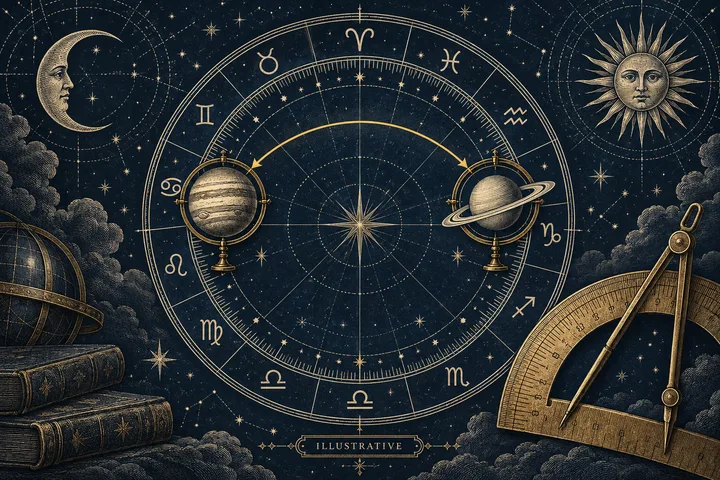
Convert both supplied Western tropical placements to longitudes on one 360-degree circle, find their shortest separation, then compare it with 0°, 60°, 90°, 120°, and 180°. This guide uses a uniform six-degree orb. In the illustrative Venus–Mars example, the separation is 123°45′, or 3°45′ from a trine, so it qualifies under that rule. If minutes were rounded away, mark a near-boundary result approximate.
How can you verify a synastry aspect by hand?
Verify a synastry aspect with two labeled planet positions and a stated orb rule. Confirm that both use the same Western tropical zodiac and include sign, degree, and, when available, minutes. Convert each position to longitude on the circle, then measure the shorter separation. The University of Texas text “Signs of the Zodiac” describes the signs as successive 30-degree ranges of ecliptic longitude, so positions are comparable. Compare the separation with the five major aspect angles: conjunction at 0°, sextile at 60°, square at 90°, trine at 120°, and opposition at 180°. “An Introduction to Aspects and Chart Shaping in Natal Astrology” defines an orb as distance from exactness. This guide uses a uniform six-degree orb, so a separation within six degrees of one of those angles qualifies under its method.
For example, the illustrative Venus at 14°20′ Taurus and Mars at 18°05′ Virgo convert to 44°20′ and 168°05′. Their shorter separation is 123°45′, or 3°45′ from an exact trine. That verifies the geometry under the stated rule; interpretation also considers the planet pair and signs. If the displayed minutes were rounded away, a result near six degrees may need the original precision before you classify it confidently.
Sources: Signs of the Zodiac; An Introduction to Aspects and Chart Shaping in Natal Astrology
Check that both supplied placements are comparable
Before subtracting anything, make sure the two entries describe comparable positions. For each person, write the planet, sign, degree, minutes, zodiac reference, and how the minutes were recorded. A compact record might read: “Person A: Venus, Taurus 14°20′, Western tropical, minutes supplied”; “Person B: Mars, Virgo 18°05′, Western tropical, minutes supplied.” The labels help catch a copied sign, swapped planet, or mismatched reference frame before arithmetic begins. For this hand check, treat each placement as an ecliptic longitude in the Western tropical zodiac. That means both entries must use the same zodiac frame. The University-hosted text “Signs of the Zodiac” describes the signs as successive 30-degree spans of the ecliptic circle: Aries covers 0° to 30°, Taurus 30° to 60°, and the sequence continues around the circle. Retain each sign label for the interpretation after the geometry is checked. Don’t substitute a house cusp or chart angle for a planet’s longitude. Also record the precision, not just the displayed value. Minutes divide a degree into 60 equal parts, so 14°30′ is half a degree beyond 14°. A source may show exact minutes, rounded minutes, whole degrees, or no minutes at all. Mark which one you have. If one placement is rounded to a whole degree and the other is given to the minute, the pair does not support minute-level certainty; carrying both values through long subtraction would make the result look more exact than the inputs allow. Truncated values have a different uncertainty from rounded ones, so don’t silently treat them as exact either. Missing exact birth times do not by themselves prevent this particular check when both planet longitudes have already been supplied. The task here is to compare those entries, not derive them from birth details. Keep the supplied values intact while checking them. But if a degree is missing, or the source’s zodiac reference and precision are unclear, pause before deciding whether the aspect falls inside a narrow orb. Ask for the original placement format or the unrounded longitude. That simple input check separates a genuine arithmetic disagreement from a difference caused by mismatched or imprecise data.
Sources: Signs of the Zodiac
Put both placements on the same 360-degree circle
To compare two supplied placements, first translate each sign-degree position into a longitude measured from 0° around one 360-degree circle. The sign supplies the starting point; the degree and minutes supply the distance traveled within that sign. The circle is a measuring frame, not a replacement for the signs. Keep each planet’s sign written beside its converted number, because that sign remains part of the later astrological reading. The conversion is straightforward. Aries begins at 0°, Taurus at 30°, Gemini at 60°, Cancer at 90°, Leo at 120°, Virgo at 150°, Libra at 180°, Scorpio at 210°, Sagittarius at 240°, Capricorn at 270°, Aquarius at 300°, and Pisces at 330°. Those starting points follow from the zodiac signs occupying successive 30-degree spans of ecliptic longitude, as described in “Signs of the Zodiac.” For a placement given in degrees and minutes, add the sign’s starting longitude to the in-sign degree, then retain the minutes. If you prefer decimal degrees, divide the minutes by 60: 20′ is 20/60°, or one-third of a degree. Choose one notation and use it for both planets; switching formats halfway through invites avoidable mistakes. Consider the article’s illustrative Venus placement at 14°20′ Taurus and Mars placement at 18°05′ Virgo. Taurus starts at 30°, so Venus is at 30° + 14°20′ = 44°20′. Virgo starts at 150°, so Mars is at 150° + 18°05′ = 168°05′. The converted values let you compare the positions directly, while the labels “Venus in Taurus” and “Mars in Virgo” stay attached for interpretation. These are example inputs for showing the arithmetic, not placements calculated from anyone’s birth details. Minutes matter when you later subtract one longitude from the other. In this example, 168°05′ minus 44°20′ requires borrowing one degree, which is 60 minutes: rewrite 168°05′ as 167°65′, then subtract to get 123°45′. That subtraction belongs to the next step of measuring separation; here, the key is to preserve the minutes accurately during conversion. A decimal version reaches the same comparison: 44⅓° and 168⅙°. Avoid rounding those values to whole degrees before checking an orb, especially when the result may sit near a chosen boundary. This shared coordinate also handles placements near the wheel’s ends. A late Pisces position lies near 360°, while an early Aries position lies near 0°; neither number changes the sign name. They can be compared on the same circle in the next step, which accounts for the circle’s wraparound. For now, record both converted longitudes and both original sign-degree labels. That small two-column record preserves the geometry and the astrological context at once. The labels make it easy to retrace each conversion if the inputs are questioned later.
Sources: Signs of the Zodiac
Measure the shorter distance, including across zero
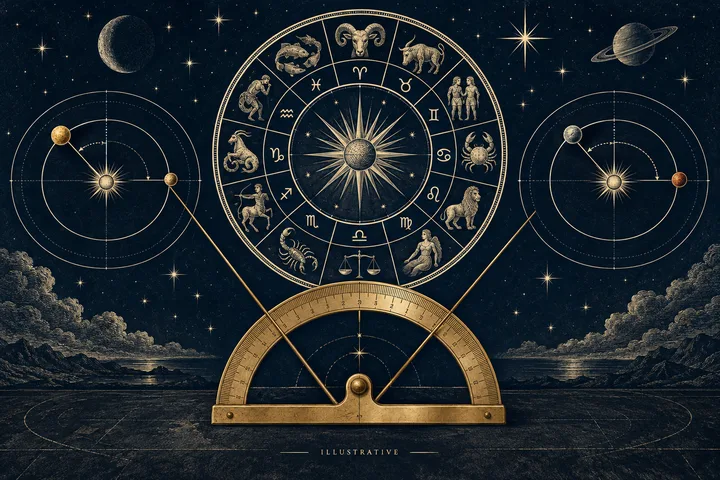
Once both placements share a longitude scale, measure the smaller angular gap around the zodiac. Subtract the lower longitude from the higher. If the result is greater than 180°, subtract that result from 360°; otherwise, keep it. The answer is the shortest separation, always between 0° and 180°. This step matters because zodiacal longitude runs around a circle. The University of Texas text, *The Almagest*, describes the zodiac as successive 30-degree sign intervals along the ecliptic. A circle has no meaningful endpoint at 360°: the point after 359° is 0° again. Treating the scale like a line can therefore make two neighboring placements look far apart when they sit close together across that return point. For a wraparound check, take positions at 350° and 10°. Direct subtraction gives 350° − 10° = 340°. That is the longer route around the circle, so subtract it from a full turn: 360° − 340° = 20°. The placements are 20° apart by the shorter route. This does not yet name an aspect. It gives one measured separation to compare with the major aspect angles in the next step. The distinction is useful near the Aries–Pisces boundary: the sign labels mark neighboring regions on the same circle, not opposite ends of a ruler. When working in degrees and minutes, borrow one degree as 60 minutes if the minutes in the upper value are smaller. In the supplied Venus–Mars illustration, the longitudes are 168°05′ and 44°20′. Since five minutes cannot subtract twenty minutes, rewrite 168°05′ as 167°65′. Then subtract: 167°65′ − 44°20′ = 123°45′. The raw difference is below 180°, so it is already the shorter separation. The arithmetic is exact for those stated inputs; it does not make them a real couple’s chart. The same rule handles every pair. First subtract. Then check whether the result crosses the halfway point of 180°. Only values above that point need the 360° adjustment. For instance, a raw difference of exactly 180° stays 180° because both directions are equal; a difference of 181° becomes 179°. Keeping this rule explicit prevents a common mistake: reporting a large angle simply because the subtraction began at the smaller coordinate. *An Introduction to Aspects and Chart Shaping in Natal Astrology* uses angular distances to define aspect relationships, which is why the shortest separation is the useful quantity to carry forward. Record it before assigning a name or orb. That leaves a clear audit trail and keeps sign-boundary wraparound from distorting the geometry. Keep each original sign-degree label beside the converted value; the longitude measures distance, while the signs remain available for the interpretation.
Sources: Signs of the Zodiac; An Introduction to Aspects and Chart Shaping in Natal Astrology
Find the nearest major angle and calculate its orb
Once you have the shorter separation, compare it with the five major aspect angles: conjunction at 0°, sextile at 60°, square at 90°, trine at 120°, and opposition at 180°. The aspect name belongs to the nearest exact angle. The orb is the amount by which the measured separation misses it. Subtract the exact angle from the separation, then take the absolute value. A contact can fall on either side of exactness and still have the same orb. A separation of 123°45′ is 3°45′ from a 120° trine. For this hand check, use a uniform six-degree orb for each selected major aspect. An orb from 0° through 6° counts under the rule; an orb greater than 6° does not. That gives these working ranges for a shortest separation between 0° and 180°: 0° to 6° for a conjunction, 54° to 66° for a sextile, 84° to 96° for a square, 114° to 126° for a trine, and 174° to 180° for an opposition. The opposition range stops at 180° because the shorter separation cannot exceed it. A result exactly six degrees from its landmark sits on the included edge of this chosen rule. Consider the running illustration: a Venus–Mars separation of 123°45′ is 3°45′ beyond the exact trine angle. Since 3°45′ is less than six degrees, it qualifies as a trine under this method. If the separation instead were 126°10′, its orb would be 6°10′, so this rule would not count it. Record both numbers. “123°45′ separation; trine; 3°45′ orb; six-degree rule” lets another reader retrace the result. A glyph alone hides the measurement and convention behind it. That convention needs a name because astrology does not use one universal orb width. In “An Introduction to Aspects and Chart Shaping in Natal Astrology,” the displayed allowances differ by aspect: the table gives 4° for a sextile and 12° for a trine. The article describes modern practice as setting an orb by aspect, while traditional techniques may give more room according to the planets' prominence. Deborah Houlding’s “The Classical Origin and Traditional Use of Aspects” also traces a shift from planetary orbs toward simpler aspectual orbs and notes that practice changed over time. These references offer alternatives, not a reason to swap rules mid-calculation. Keep three things in your notes: the measured angle, the nearest aspect, and the orb rule used to decide whether it counts. Under this guide’s six-degree rule, 6°10′ falls outside; under a wider published allowance, another astrologer might count it. That is a difference in method, not necessarily in subtraction. “Closer” answers only how near the geometry is to exact. It does not by itself rank a contact’s importance in a relationship, and a square is not automatically worse than a trine. The planets being compared and the question you bring to them shape the interpretation.
Sources: An Introduction to Aspects and Chart Shaping in Natal Astrology; The Classical Origin and Traditional Use of Aspects
Why can two astrologers use different orb rules?
An orb is the distance a planet may sit from an exact aspect and still count within it. Astrologers don't all set that distance the same way. In this guide, count a selected major aspect when its measured orb is six degrees or less. That fixed window makes a hand check consistent. It is a chosen method, not a boundary every astrologer must use. An Introduction to Aspects and Chart Shaping in Natal Astrology presents one alternative: its table assigns different allowances to different aspects. The displayed values are 8° for a conjunction, 4° for a sextile, 8° for a square, 12° for a trine, and 8° for an opposition. The article says modern practice often sets an orb by aspect, while traditional techniques may give greater prominence to the planets involved. Under that table, a contact 7° from exact could count as a trine but fall outside a sextile's allowance. Under this guide's uniform six-degree rule, both fall outside. The subtraction has not changed. The rule has. The Classical Origin and Traditional Use of Aspects describes another approach: orbs belonged to planets, with larger allowances for some planets than others. Traditional Orb Tables makes the method concrete. In its standard Jupiter–Mars example, Mars has a 7° allowance and Jupiter a 9° allowance. Add them, then halve the 16° total: the permitted distance is 8° on either side of exact. Its wider alternative yields 10° on either side. These are examples of a tradition with its own logic, not universal limits or a correction to the arithmetic. For a reader checking a supplied pair, the uniform rule has a practical strength: it is easy to repeat across the selected major aspects. Its cost is that it treats every pair and aspect alike. Other astrologers may choose a narrower sextile orb, a wider trine orb, or allowances shaped by the planets themselves. Those choices make a different method; they don't make the six-degree calculation mistaken. Compare like with like. Before deciding that two reports disagree, ask which orb method each uses, whether both measured the same supplied degrees, and whether either display rounded away minutes. Then apply one rule to both results. If the inputs and rule match but the answers still differ, check the subtraction and shortest separation. A contact just inside six degrees counts under this guide's convention, even if another method excludes it. State the measurement and rule together: “trine, 5°40′ orb, six-degree method.” That lets someone else reproduce the result and understand why another astrologer might label it differently. The aspect's meaning still depends on the planets and signs; the orb decides whether this method includes the geometry, not what the whole synastry says.
Sources: An Introduction to Aspects and Chart Shaping in Natal Astrology; The Classical Origin and Traditional Use of Aspects; Traditional Orb Tables
What if the displayed degrees are rounded or signs differ?
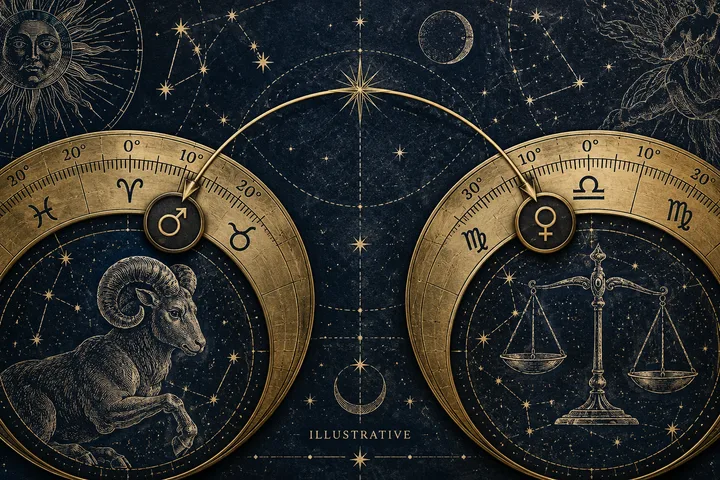
A displayed degree is only as precise as the value behind it. Whole-degree positions can suggest an aspect, but they may not settle a close call at the six-degree boundary. Record what the display gives you and mark the result approximate if missing minutes could change whether it falls inside the chosen orb. Treat a rounded position as a range, not an exact point. Rounded to the nearest whole degree, the underlying position lies within about half a degree of the display. With two rounded positions, their separation can shift by about one degree in either direction in the limiting case. That matters near six degrees. A displayed orb of 5°30′, for example, doesn't prove the exact orb is below six; uncertainty in both inputs could carry it across the cutoff. The same uncertainty could move a displayed 6°30′ inward. These are bounds implied by the rounding convention, not additional chart measurements. Check whether the values were rounded or truncated. Rounding gives a range about half a degree on either side. Truncation drops the fractional part, so the underlying value lies from the displayed degree up to, but not including, the next degree. That's a one-sided range. If the source doesn't say which convention it used, don't treat the display as exact. Ask for degrees and minutes, or keep the verdict conditional: “inside the six-degree orb if the displayed positions are exact; borderline at whole-degree precision.” Signs provide a separate clue, but they don't replace degree arithmetic. The Classical Origin and Traditional Use of Aspects explains that astrologers have differed over sign boundaries and describes degree-based contacts that cross them. For this hand check, measure the supplied longitudes first, then retain both sign labels for interpretation. A contact can be close by degree even when the signs don't form the familiar sign-based aspect pattern. The measured angle describes the geometric contact; the signs describe the styles of the planetary functions. Both layers matter. The reverse case matters too. Two planets can share a sign without forming a major aspect within the selected six-degree orb. A shared sign alone isn't proof of a conjunction; compare the positions with 0° and calculate the orb. The signs may describe a common style, but the geometric label needs its own measurement. An Introduction to Aspects and Chart Shaping in Natal Astrology lays out the major aspect angles; The Classical Origin and Traditional Use of Aspects shows why sign relationships and measured degrees can tell different parts of the story. Preserve input precision in your note. Write the signs and degrees, say whether minutes are available and whether values were rounded or truncated, then mark the separation and orb approximate if needed. Under this guide's uniform six-degree convention, a result near the edge remains conditional until exact minutes settle it. A sign mismatch alone doesn't reject a close degree contact, and a shared sign alone doesn't establish a major aspect. Geometry determines the contact; signs remain part of its interpretation.
Sources: The Classical Origin and Traditional Use of Aspects; An Introduction to Aspects and Chart Shaping in Natal Astrology; Signs of the Zodiac
Audit the Venus–Mars example and its arithmetic
Consider the supplied illustration: Venus is at 14°20′ Taurus, and Mars is at 18°05′ Virgo. The question here is narrow. Do these two positions form a trine within the stated six-degree orb? The arithmetic says yes, and each step can be checked without calculating a birth chart. First, convert each sign-degree position to a longitude on the zodiac circle. Taurus begins at 30°, so 30° + 14°20′ = 44°20′. Virgo begins at 150°, so 150° + 18°05′ = 168°05′. The sign intervals follow the 30-degree sequence described in “The Almagest”: Taurus covers 30° to 60°, while Virgo covers 150° to 180°. These converted values are measuring positions, not replacements for the original signs. Next, subtract the smaller longitude from the larger: 168°05′ − 44°20′. Since five minutes cannot subtract twenty minutes, borrow one degree, which equals 60 minutes. The calculation becomes 167°65′ − 44°20′ = 123°45′. This is already below 180°, so it is the shorter separation. No wraparound adjustment is needed in this example. Now compare 123°45′ with the nearest major aspect angle. “An Introduction to Aspects and Chart Shaping in Natal Astrology” lists the trine at 120° and describes orb as the distance from exactness. Here, 123°45′ − 120° = 3°45′. Under this guide’s uniform six-degree rule, the supplied positions make a trine with a 3°45′ orb. The result is reproducible: another reader with the same inputs and rule should reach the same geometric label. The cutoff matters at its edge. If a measured separation were 125°50′, its distance from a 120° trine would be 5°50′, inside this rule. At 126°10′, the distance would be 6°10′, outside it. The angles differ by only 20 minutes, yet the rule counts one and excludes the other. Those are boundary illustrations, not additional chart positions. When the supplied degrees are rounded or omit minutes, a result that close to six degrees may need to be marked approximate until the original precision is available. Record the raw separation as well as the orb, so a reader can see which subtraction produced the classification rather than relying on a trine symbol alone. Keep three judgments separate. The subtraction establishes the angle. The declared orb convention decides whether this guide counts it. Interpretation begins afterward, with Venus, Mars, their signs, and the synastry context. The worked values and any names attached to them are illustrative only; they do not describe a real couple. The arithmetic supports a trine label under one named method, not a complete account of what the contact means in a relationship.
Sources: Signs of the Zodiac; An Introduction to Aspects and Chart Shaping in Natal Astrology
Restore the planet pair and signs before interpreting
A verified angle gives geometry; interpretation begins with the planets and signs. In synastry, a contact describes an exchange between planetary functions, and the aspect label alone cannot tell you how that exchange feels. Cafe Astrology's “Aspects Between Charts” advises readers to consider the role each person takes through their planet, along with both planets' signs. Start with planet A. Name its function in the relationship question you have. Then name planet B's function. Venus concerns affection, attraction, and what a person values; Mars describes pursuit, assertion, and how desire moves into action. Next, read each planet through its sign. The same planet pair can express itself differently in different signs, as Cafe Astrology notes. Keep the sign descriptions distinct. Now bring back the measured geometry. A trine, square, or conjunction describes the kind of connection between those functions; it does not rank the relationship or settle whether the exchange feels easy. “The Classical Origin and Traditional Use of Aspects” makes a related point : the meaning of an aspect depends on the planets involved and their condition. It notes that a trine's agreeable form does not guarantee a favorable result in every planetary pairing, while a square need not be harmful in every context. Don't let “harmonious” or “hard” replace the actual planet pair. Consider an illustration, not a real couple: one person's Venus forms a close trine to another person's Mars. The geometry suggests a smoother channel between affection and initiative. But the useful question is observable: does practical effort feel affectionate to both people, and does desire meet a welcome response? If the signs describe different styles, ask how those styles meet in daily choices rather than assuming the trine erases their differences. Read the contact in this order: each planet's function, each person's sign style, the verified aspect, then one question about lived interaction. Cafe Astrology also recommends attention to inner-planet contacts and relevant relationship significators, but supplied degrees alone don't establish houses or house rulers. The chart offers a focused lens for conversation; the two people determine what they recognize in it.
Sources: Aspects Between Charts; The Classical Origin and Traditional Use of Aspects
Record the result and choose one next question
Keep the check in one line so you can repeat it: Venus 14°20′ Taurus and Mars 18°05′ Virgo; Western tropical positions; shorter separation 123°45′; trine at 3°45′ orb; uniform six-degree rule; minutes supplied, as stated by the source. If the display rounded or omitted minutes, mark the result approximate, near the cutoff. This record separates the measured geometry from the convention used to count it. If another tool disagrees, compare the two placements first, then their rounding, zodiac reference, and orb settings. The arithmetic may match while the settings differ. Once the contact is clear, choose one question that matters to you: where do affection and initiative meet in ordinary interaction, and what helps each of you feel welcomed? Cafe Astrology's “Aspects Between Charts” advises reading planet roles and signs alongside the contact, which gives the conversation a starting point without turning an aspect into a verdict. If you want a broader comparison, the Synastry Comparison Report organizes supplied Moon, Venus, and Mars placements, optional degrees, and selected major aspects under its stated six-degree orb. It does not calculate natal charts from birth details. Request exact degrees near the boundary.
Sources: Aspects Between Charts
A little more clarity
Can two planets form a synastry aspect if they are in different signs?
Yes. Convert both supplied positions to longitudes and measure their shortest separation. If it falls within the chosen orb of a major aspect angle, the aspect counts by degree under that method. Keep both sign labels for interpretation; they describe the planets’ styles even when the geometry crosses a sign boundary.
Does astrology use one universal orb rule?
No. This guide uses a uniform six-degree orb for its selected major aspects. Published approaches also vary allowances by aspect or by the planets involved. State the rule you use so another reader can reproduce the result and understand why a different method may count it differently.
What if the supplied degrees are rounded?
Treat a rounded position as an estimate, especially near the orb boundary. Two values rounded to the nearest whole degree can shift their separation by about a degree in either direction. Ask for the original degrees and minutes, or mark the classification approximate until you have them.
Sources & further reading
- Signs of the Zodiac
Supports converting sign-degree placements to comparable longitudes using successive 30-degree zodiac intervals.
- An Introduction to Aspects and Chart Shaping in Natal Astrology
Defines the major aspect angles and orb, and illustrates that published orb allowances can vary by aspect.
- The Classical Origin and Traditional Use of Aspects
Describes historical variation in orb and sign-boundary practices, including degree-based contacts across signs.
- Traditional Orb Tables
Explains a traditional planet-based orb method that combines two planets’ allowances to set a contact limit.
- Aspects Between Charts
Supports restoring both planets’ roles and signs when interpreting a verified synastry contact.
Synastry Comparison Report
Enter known placements for two people. Get an input-by-input comparison, selected aspect calculations and a clear record of what remains uncertain.
Compare our placements