Imagine the date that turns into a values argument
Imagine Maria and Daniel planning a long weekend together. Maria wants a small hotel in the old center, a slow dinner, and one beautiful thing they can bring home. Daniel wants a cheaper room outside town, packed days, and money left over for the next trip. Neither is careless. Neither lacks affection. They simply make love visible in different ways.
At first, they call the disagreement a taste problem. Then it returns. Maria reads Daniel's budget as reluctance to invest in the relationship. Daniel reads Maria's preferences as pressure to spend and perform romance. The argument is no longer about a hotel. It has become a question about what care should look like.
In an illustrative Venus-Venus square reading, the irritation comes from two Venus styles meeting through tension. Each person can recognize something appealing in the other while missing the other's signal of affection. What Maria calls thoughtful, Daniel may call excessive. What he calls practical, she may experience as cold. The square names the friction. It doesn't name the cause of every argument.
Keep the scene narrow. Don't ask the chart to explain the whole relationship. For Maria and Daniel, the useful note is not 'Maria spends, Daniel saves.' It is 'A special trip matters to Maria; a protected reserve matters to Daniel.' That wording keeps the symbols close to the event and gives the later chart reading a question it can actually answer.
What Venus-Venus square actually compares
Venus is more than romance. In a birth chart, it speaks to attraction, affection, pleasure, taste, social ease, money, and the values that guide choice. In synastry, one person's Venus meets the other person's Venus, so the comparison asks how two people give and receive appreciation, decide what is worth having, and create a pleasant life together.
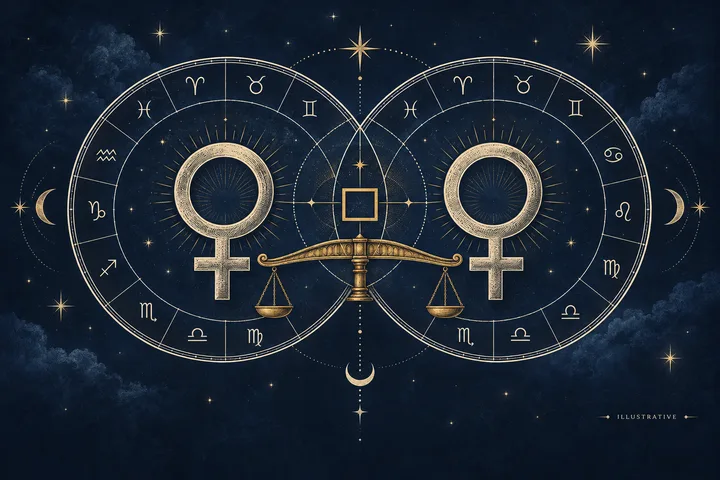
A square is a 90-degree relationship between chart factors. Astrology treats it as a dynamic or hard aspect because the planets press against one another instead of moving with ease. Astrodienst describes the square as a powerful tension aspect and also gives it a constructive role: it can push the people involved to develop a more deliberate expression of the planets. That matters here. Venus-Venus square is not a lack of Venus. It is Venus under pressure to become conscious. [source: Astrodienst's aspect reference](https://www.astro.com/astrowiki/en/Aspect)
Cafe Astrology's Venus-Venus reference gives the practical picture. With the square, opposition, or quincunx, tastes and values differ. Love styles may not match instinctively. Social habits, decorating, clothing, money handling, and couple decisions can take more time. This is exactly why the aspect belongs in a values conversation. It does not only describe whether you like each other. It describes the terms under which liking becomes daily life. [source: Cafe Astrology's Venus-Venus synastry reference](https://cafeastrology.com/synastry/venus_venus_aspects.html)
Both planets still speak Venus. Each person wants affection, pleasure, regard, and a life that feels worth choosing. The difference lies in the route. One may offer gifts. The other may offer time. One may seek regular contact. The other may call loyalty real only when it leaves room to breathe. Start with the behavior, then ask what it protects or provides.
That question keeps the reading from becoming a complaint list. 'You spend too much' may mean 'I need safety.' 'You never plan anything' may mean 'I want to feel chosen.' 'You want too much time together' may mean 'I need continuity.' Write the value as a verb, such as saving, hosting, planning, or making room. The verb gives the comparison something you can observe.
Keep Venus in its proper lane. It can describe attraction, pleasure, values, and the style of exchange. It doesn't by itself describe every emotional need or the whole future of a bond. If the dispute concerns comfort, the Moon deserves attention. If it concerns words and assumptions, bring in Mercury. Begin with Venus because the question is about values, then widen the chart only when the lived event asks you to.
Venus-Venus square synastry doesn't decide that two people are wrong for each other. It shows that you may want love to feel good in different ways. One person may value frequent reassurance while the other values freedom. One may spend to create comfort while the other saves for security. The square turns those differences into a recurring point of contact. Read it as a negotiation about values, not a verdict about the bond. Start with the signs, then check the exact degrees and a six-degree orb. After that, compare the aspect with each person's Moon, Mars, Mercury, and Saturn. The best next step is concrete: choose one live question about money, time, affection, or social life, state what each person means by a good relationship, and agree on one trial change. If the same issue keeps returning, the chart helps you name the pattern. The conversation still tells you what the relationship can carry.
Sources: Synastry: Venus-Venus Aspects Between Two Charts; Aspect - Astrodienst Astrowiki
Read the square through the two Venus signs
The aspect tells you that tension exists. The signs tell you what kind of Venus is involved. Begin there. An Aries Venus may prize directness, initiative, and the spark of pursuit. A Cancer Venus may prize reassurance, memory, and a sense of emotional shelter. If those Venuses form a square, the couple may disagree about what makes affection feel alive. Aries may ask for a clear answer now. Cancer may need proof that the answer will remain kind tomorrow.
A Taurus Venus and an Aquarius Venus can show another version. Taurus may protect continuity, touch, comfort, and material steadiness. Aquarius may protect independence, unusual choices, and a relationship that never becomes a cage. The square doesn't remove desire. It makes the couple negotiate how much sameness and how much freedom their shared life can hold.
A Gemini Venus and a Virgo Venus may both value intelligence, but they can use it differently. Gemini may keep love moving through talk, variety, and play. Virgo may show care by noticing details, improving routines, and being useful. Gemini can experience correction as a failure of warmth. Virgo can experience scattered attention as a failure of care. The underlying values may be closer than the styles suggest.
Don't turn sign meanings into fixed personalities. Venus may be dignified, weakened, retrograde, closely tied to another planet, or part of a larger pattern in each natal chart. Those conditions change how the sign behaves. The strongest reading is specific but modest: describe the likely value tension, then test it against the couple's actual decisions. If the example doesn't fit, keep the aspect and revise the expression.
You can also compare the signs by element and mode before reaching for a stereotype. Fire and water may disagree about how quickly desire should become trust. Earth and air may disagree about whether value is proven through reliability or stimulating exchange. Cardinal signs may fight over who sets the tone, fixed signs may resist changing a settled arrangement, and mutable signs may keep revising the plan. These are starting points, not verdicts. Use the shared mode to choose the question: who leads, what must stay steady, or what needs a written plan?
For a practical comparison, ask what each Venus enjoys, treats as proof of care, and protects when it feels unwanted. Aries may seek a live spark and defend independence when pressured. Cancer may seek emotional shelter and protect privacy when exposed. Those are possibilities, not verdicts. Repeated choices decide which one is alive.
Sources: Synastry: Venus-Venus Aspects Between Two Charts; Aspect - Astrodienst Astrowiki
A worked comparison: pleasure, money, and proof of love
Consider an example with no personal chart claim: one partner has Venus in Libra and the other has Venus in Cancer, with the two Venuses in a close square. Libra Venus may look for balance, shared aesthetics, graceful company, and a fair exchange. Cancer Venus may look for emotional familiarity, privacy, family feeling, and care that protects the bond. Both may want tenderness. They may disagree about where tenderness belongs.
At home, Libra Venus may suggest inviting friends for dinner because shared pleasure keeps the relationship bright. Cancer Venus may want the evening kept private because the home is where safety grows. When Libra says, 'Let's make it special,' Cancer hears a demand for display. When Cancer says, 'Let's keep it just ours,' Libra hears withdrawal. The same Venus wish for connection takes two different forms.
Money makes the difference sharper. Libra may spend on atmosphere, clothes, art, or experiences that make life feel beautiful and mutual. Cancer may spend on the home, food, family needs, or a reserve that keeps tomorrow safe. Neither pattern automatically represents generosity or selfishness. The question is whether each person can recognize the other's spending as a statement of value before asking for a change.
A useful negotiation separates three layers. The preference is the hotel and dinner. The value is celebration or security. The agreement is the rule that protects both. Maria might say, 'I want one evening that says this milestone matters.' Daniel might say, 'I need to know our pleasure won't make us unsafe.' Those sentences give the square something precise to work with.
The test isn't whether they split the difference. Maria and Daniel might choose a modest meal in a meaningful place, set a spending ceiling, and plan a second celebration that costs little but takes thought. Put the plan in three columns: preference, protected value, and agreed behavior. Cutting the dinner may solve the price while missing the need to mark the occasion. Spending freely may honor the occasion while ignoring the need for safety. If one person keeps swallowing the same need, the compromise isn't mutual.
If the same pair brings the square into public life, the scene changes without changing the basic question. Libra Venus may want a full calendar of dinners, invitations, and shared cultural pleasures. Cancer Venus may prefer a few trusted people and a home that stays private. The reading shouldn't call one person social and the other antisocial. Ask who gets to decide what the relationship shares, and how much recovery time follows a busy event.
The signs can also trade places in the visible behavior. Cancer Venus may spend generously on a family celebration while Libra Venus protects a fair budget. Libra Venus may avoid conflict by agreeing beautifully in the moment, while Cancer Venus later feels the plan lacked emotional commitment. Read the placement as a starting hypothesis, then let repeated choices decide who is protecting what. For a wider sign-and-element comparison, see [how to compare Moon, Venus, and Mars elements in synastry](/journal/compare-moon-venus-mars-element-balance-synastry).
How degrees and the six-degree orb change the reading
A sign-based square is not the same as a close degree-based square. In this report's stated method, count Venus-Venus as a selected major aspect when the angular distance is within a six-degree orb of 90 degrees. If you have the degrees, calculate the separation instead of assuming that two signs alone prove the aspect. A Venus at 4 degrees Aries and a Venus at 10 degrees Cancer are 96 degrees apart, so the square falls within six degrees. The same sign pair at a much wider separation may not qualify for this method.
Astrodienst defines an orb as the allowed distance from an exact aspect and notes that an aspect operates within a margin around exactitude. A close square deserves more weight than a wide one. It may describe an issue that appears often and quickly. A square near the edge of the orb can still add background friction, but it shouldn't outrank a tighter contact that speaks to the same relationship question. [source: Astrodienst on aspects and orbs](https://www.astro.com/astrology/in_aspect_e.htm)
The sign relationship matters too. A square usually joins signs with the same mode but different elements, so the two Venuses may share a pace while disagreeing about method. Cardinal Venuses can both initiate and still fight over direction. Fixed Venuses can both want loyalty and refuse to yield on its form. Mutable Venuses can both adapt and keep changing the terms. Treat this as an interpretive lens, not a personality verdict. If the planets sit near sign cusps, keep the expression flexible.
Degree precision ranks the signal. It doesn't tell you how to behave. Use the orb to decide what to study first, not to announce a compatibility score. If degrees are missing, compare the supplied signs only and mark the aspect as unconfirmed unless the sign geometry establishes the square under your chosen system. The report offering on this site uses supplied placements and optional degrees. It doesn't calculate natal positions from birth details.
Suppose one Venus is at 18 degrees Leo and the other at 22 degrees Scorpio. The separation is 94 degrees, so the square is close under a six-degree rule. Suppose instead that the degrees place the planets 8 degrees from the exact 90-degree relationship. That contact belongs in a background note, not at the top of the reading. Precision protects the reader from overreading. Use the degree check as a filter, not a score: note the separation, sign pair, and repeating topic, then rank the contact beside the rest of the chart.
You can check the geometry by hand. Convert each placement to its zodiac position, subtract the smaller number from the larger, and use the shorter distance if the result exceeds 180 degrees. Compare that distance with 90 degrees. For the hypothetical 12-degree Libra Venus and 16-degree Cancer Venus, the positions are 192 and 106 degrees. Their shorter separation is 86 degrees, which is four degrees from a square. The arithmetic confirms the aspect label. It doesn't tell you whether the couple argues about hosting, money, or privacy. That comes from the signs, natal context, and the event you are actually reading.
Missing degrees change the language, not the value of the inquiry. Compare supplied Venus signs and describe a possible style difference. Even when the signs are traditionally square, don't call the degree-based aspect exact, close, or confirmed under the report's six-degree rule. If the data later improves, update the technical claim.
A square near a sign boundary needs especially careful wording. Astrodienst notes that an aspect can connect signs whose usual sign relationship looks different when the planets sit close to cusps; astrologers often call this a dissociate aspect. The degree geometry can be real while the sign symbolism becomes mixed. Describe both layers. Say that the contact is a 90-degree tension by degree, then explain which sign meanings are actually involved. Don't force the pair into a clean modality story when the degrees are doing something more complicated. This is a reason to soften the sentence, not to discard the contact.
Sources: Synastry: Venus-Venus Aspects Between Two Charts; Aspect - Astrodienst Astrowiki; A Brief Introduction to Astrology: The Aspects
Rank the rest of the synastry before you blame Venus
Venus-Venus square is one layer. Read it after you know what each person's Venus is doing in the natal chart, then place it beside the other personal-planet contacts. A synastry reading becomes thin when it treats one aspect as a complete relationship. The Astrology Podcast interview with astrologer John Green makes the same methodological point: understand each individual chart and relationship pattern before bringing the two charts together. Then examine cross-aspects and house overlays. [source: The Astrology Podcast transcript on synastry method](https://theastrologypodcast.com/transcripts/ep-165-transcript-synastry-the-astrology-of-relationships/)
First, check Mercury. Can the couple explain a preference without turning it into a character judgment? A supportive Mercury contact may help them translate, 'You never care about romance' into, 'I need one visible sign that this matters.' A tense Mercury layer can make every Venus difference sound like an accusation. Communication doesn't erase the square, but it determines whether the square becomes a negotiation or a courtroom. Give the translation a form. Each person should say, 'When this happens, I tell myself this story. What I need is this. What I can offer is this.' That sentence separates the event from the meaning attached to it. It gives the other person something real to answer.
Next, check the Moon. Venus describes pleasure and affection. The Moon shows emotional habit, comfort, and the conditions that help a person settle. A Moon-Venus contact may soften the Venus difference by helping one person feel received. A difficult Moon contact can make an ordinary taste dispute feel like rejection. Then check Mars for pursuit, desire, and the way conflict gains heat. Check Saturn for patience, responsibility, limits, and the willingness to keep working on a shared form. This order matters because a Venus disagreement may be the surface of a deeper need. A partner who resists a public dinner may need privacy, not less love. A partner who wants a public gesture may need recognition, not attention for its own sake. Let the Moon and Mercury help you separate those layers before you decide what the square means.
Finally, rank the aspect by repetition and relevance. A close Venus-Venus square that appears in every money decision matters more than a wider square that never enters daily life. A supportive contact elsewhere can help, but it doesn't cancel the square. It gives the couple a tool. The question is not which aspect wins. The question is which pattern is active, what it asks for, and whether the pair has a way to answer it.
This ranking also prevents a common mistake: using a pleasant aspect to excuse a difficult behavior. A soft Moon-Venus contact may explain tenderness, but it doesn't make financial secrecy harmless. A lively Mars-Venus contact may explain attraction, but it doesn't settle how conflict gets repaired. Venus names value and pleasure. Mercury translates. The Moon settles. Mars acts. Saturn makes terms durable. If the fight is really about fear, comfort, or emotional withdrawal, Venus alone won't explain it. If it is about desire or initiative, bring Mars in.
A simple ranking sheet can keep the reading honest. Put the contact, orb, life topic, and observed effect on one page. Then mark whether the pattern repeats, repairs, or escalates. This isn't arithmetic. It stops the most dramatic aspect from taking over simply because it sounds dramatic.
The natal chart gives the baseline that synastry activates. A person with Venus in Cancer may already have a familiar way of protecting privacy, while a person with Venus in Libra may already weigh fairness, beauty, and mutual choice carefully. The cross-aspect describes what happens when those styles meet. It doesn't replace either natal reading. If one person's natal Venus is already under pressure from Saturn or Mars, the same synastry square may land as caution or defensiveness. If natal Venus has strong support, the person may have more practice naming the preference without making it a demand. Read the contact as an encounter between two whole charts, not as a free-floating sentence.
For example, a close Venus square may describe the disagreement over where to spend Saturday. Mercury may show whether the couple can explain it, the Moon why a changed plan feels like abandonment, Mars who pushes or withdraws, and Saturn whether an agreement survives. If several layers point to different needs, [how to read synastry when Moon, Venus, and Mars disagree](/journal/summarize-synastry-when-emotional-affection-desire-layers-disagree) gives you the next comparison.
Sources: Synastry: Venus-Venus Aspects Between Two Charts; Ep. 165 Transcript: Synastry: The Astrology of Relationships
When the square becomes a real dealbreaker
The square is not the dealbreaker. An unworkable agreement can be. Separate preference from principle. Restaurant style is a preference. Whether shared money requires consent is a principle. Different clothes are a preference. Whether one partner mocks the other's body or public presence is a principle. Venus can show where you differ. It can't turn disrespect into a lesson.
Look at repair, not just the original clash. Can both people describe the other's value fairly? Can they make an agreement, keep it, and revisit it without reopening the whole bond? If yes, the difference has room to mature. If every discussion becomes contempt, coercion, punishment, or a test no answer can pass, the lived pattern outranks the aspect.
The strongest exception is a close square inside a wider refusal to communicate, soothe, or share responsibility. In that case, Venus may show where the strain becomes visible, but it isn't the source of the boundary. Write down what each person needs, can offer, and won't accept. If the lists cannot coexist, name the mismatch plainly. Understanding why someone values freedom doesn't require accepting a relationship with no dependable plans.
The practical threshold is simple. If both people can name the value, keep the rule, and repair a breach, the square is describing work. If one person must stay silent, surrender access to money, or accept humiliation to keep the peace, the issue is no longer a style difference. A difference can be painful and still workable, or calm on the surface and still impossible. Read the pattern beneath the volume. Safety isn't the same as silence.
When the lists don't overlap, don't keep searching the chart for a prettier explanation. You can honor a partner's values and still decline the terms those values create. Astrology helps you see the shape of the difference. It doesn't require you to call every shape compatible.
Test the agreement under ordinary pressure. What happens when one person is tired, short on money, visiting family, or invited somewhere alone? Venus is lived through repetition, not one impressive compromise. If the plan works only when both people are rested and generous, it isn't yet a shared form. Add the difficult day to the question. A hard aspect may fit the chart while failing the relationship's real terms, as this [synastry aspect and relationship comparison](/journal/synastry-aspect-fits-chart-not-current-relationship) explains.
Sources: Ep. 165 Transcript: Synastry: The Astrology of Relationships
Three negotiations that give the aspect a better job
Start with money because Venus often reaches daily life through resources. Set a shared amount for pleasure, a shared amount for obligations, and a personal amount each person can spend without defending the choice. The Libra-Cancer example might need both a beautiful evening and a protected reserve. The agreement works when it serves the value behind each preference, not when it splits every bill with mathematical pride. Also decide what requires a joint conversation. A personal purchase may stay personal. A shared debt, gift, move, or holiday may need two yeses. These rules reduce the number of moments when the square has to improvise. They also protect desire from becoming a reward reserved for whoever wins the argument. A couple can keep personal choice and shared responsibility in the same room. That is a small but powerful Venus practice.
Then negotiate affection in observable terms. Don't ask, 'Do you love me enough?' Ask, 'What would make care visible this week?' One person might choose a planned date. The other might choose a quiet morning, a practical errand, or a call before a difficult meeting. Trade vague proof for repeatable behavior. Venus-Venus square improves when each person learns the other's dialect without pretending the dialect is their native one. Make the request small enough to keep and clear enough to notice. A planned call is better than a demand to be more romantic. A budget for dates is better than a complaint about stinginess. A private evening is better than a test of whether the other person will cancel every outside plan.
Third, negotiate the social field. Decide how often you host, how much time you spend with friends, what stays private, and how you handle public affection. A social Venus may need shared culture and movement. A more private Venus may need a protected interior. Build a rhythm with both. One weekend can hold a dinner out and a quiet morning. One month can include a gathering and a night that belongs to nobody else.
Keep each agreement temporary at first. Try it for two or four weeks, and set the review date before the next disagreement. At that date, check three traces: did the couple save automatically while keeping room for delight, ask for affection instead of staging a test, and keep separate friends from becoming a wall? If a clause failed, name the cause. Was the request vague, the cost too high, or the agreement only verbal? Adjust that clause or set a boundary.
Sources: Synastry: Venus-Venus Aspects Between Two Charts; Ep. 165 Transcript: Synastry: The Astrology of Relationships
Use the chart as a mirror, then choose the next step
The reading is complete when it helps you name the event, not when it supplies a grand theory. Record the supplied Venus signs. If degrees are available, check the 90-degree distance and six-degree orb. Translate each Venus into a value, then compare the contact with Mercury, Moon, Mars, and Saturn. Test the interpretation against one disagreement. Keep what explains the pattern. Drop what doesn't. If degrees are unknown, discuss style and values without claiming a precise square. If houses are unknown, stay with the placements you have. Clear inputs make a cleaner reading.
Separate three kinds of missing information. Missing degrees limit the aspect claim. Missing birth times limit houses and angles. Missing planets limit the wider comparison. None of those gaps requires you to invent a conclusion. With Venus signs only, you can discuss contrasting preferences and the sign relationship. With both Venus degrees, you can test the stated orb. With Moon, Venus, and Mars supplied, you can compare the emotional, affectionate, and desire layers the report is built to organize. Say which layer you are reading, and stop there when the data stops.
If you want a placement comparison, the Synastry Comparison Report can work from the Moon, Venus, and Mars signs you supply, with optional degrees for selected major aspects using a six-degree orb. It can help organize the layers and show what remains unknown. It won't calculate a natal chart from birth details, calculate houses, or deliver a relationship verdict. [Compare your placements](/compatibility-test)
Bring one conflict into the open. Ask what each person is protecting. Agree on one change, choose a review date, and write down the sign that would show improvement. It might be a shared spending limit that needs no reminder, one private evening each week, or a plan changed without a personal insult. Judge the result by conduct, not by how persuasive the interpretation sounds.
For a hypothetical chart note, write the inputs in full: 'Hypothetical Venus at 12° Libra square hypothetical Venus at 16° Cancer, 4° from exact; recurring issue is hosting; Libra seeks shared social pleasure, Cancer seeks private safety; next test is one dinner each month with a protected quiet weekend.' The degree separation is 86°, so the contact sits within the stated six-degree orb. Labeling the example hypothetical keeps the technical illustration separate from any reader's chart. The note still leaves room for revision when better data or a clearer pattern arrives.
That is the final order. Input first. Meaning second. Conduct third. Decision last. If the conversation produces curiosity and a workable agreement, keep developing the shared practice. If it produces fear, contempt, or a demand that one person become less visible, take the boundary seriously. The answer may be yes with conditions, not yet, or no.
Sources: Synastry: Venus-Venus Aspects Between Two Charts; Aspect - Astrodienst Astrowiki; Ep. 165 Transcript: Synastry: The Astrology of Relationships
A little more clarity
Is Venus-Venus square synastry a dealbreaker?
No. It describes tension between two styles of affection, pleasure, taste, money, or social life. Read the signs, degree distance, and wider synastry before ranking it. It becomes a practical dealbreaker only when the underlying values cannot share a life or when the negotiation demands disrespect or self-erasure. A square can ask for skill, but it can't ask you to accept contempt. Look for the difference between a partner who learns your style and a partner who uses difference as permission to dismiss it. The first creates a shared language. The second creates a hierarchy.
What does a close Venus-Venus square feel like?
It can feel like attraction mixed with repeated irritation. You may admire what your partner values while feeling unseen by the way they show it. A close square often appears quickly and often in choices about spending, dates, gifts, appearance, privacy, or social time. The work is to translate the behavior into the value beneath it. It may also feel compelling because the other person embodies a style you don't naturally use. That difference can keep the bond lively, provided curiosity stays stronger than contempt. Notice whether the irritation leads to learning or only to scorekeeping. If curiosity survives the first misunderstanding, the square has room to teach both people a richer form of affection.
Can other synastry aspects help Venus-Venus square?
Yes, but they don't erase it. Mercury contacts can help you explain preferences. Moon contacts can help affection feel emotionally safe. Mars contacts can add heat or conflict skill. Saturn contacts can add patience and structure. Read the full pattern, starting with each person's natal relationship style, then rank the contacts by closeness and relevance. A helpful contact is a resource, not a cancellation. Let it show you what the couple can draw on when the Venus difference becomes sharp. The supporting aspect can offer patience, language, or warmth, but both partners still need to use it.
Sources & further reading
- Synastry: Venus-Venus Aspects Between Two Charts
Supports the reading of Venus-Venus hard aspects as differing tastes, values, affection styles, social habits, and money choices.
- Aspect - Astrodienst Astrowiki
Supports the definitions of major aspects, the 90-degree square, and the meaning of an orb around exactitude.
- Ep. 165 Transcript: Synastry: The Astrology of Relationships
Supports reading each individual natal relationship pattern before interpreting cross-aspects and ranking aspects by context.
- A Brief Introduction to Astrology: The Aspects
Supports the technical explanation that aspects operate within a degree margin called an orb.
Synastry Comparison Report
Enter known placements for two people. Get an input-by-input comparison, selected aspect calculations and a clear record of what remains uncertain.
Compare our placements